
Masami Teraoka, From Here to Eternity, Five Decades of Art Making, Catharine Clark Gallery
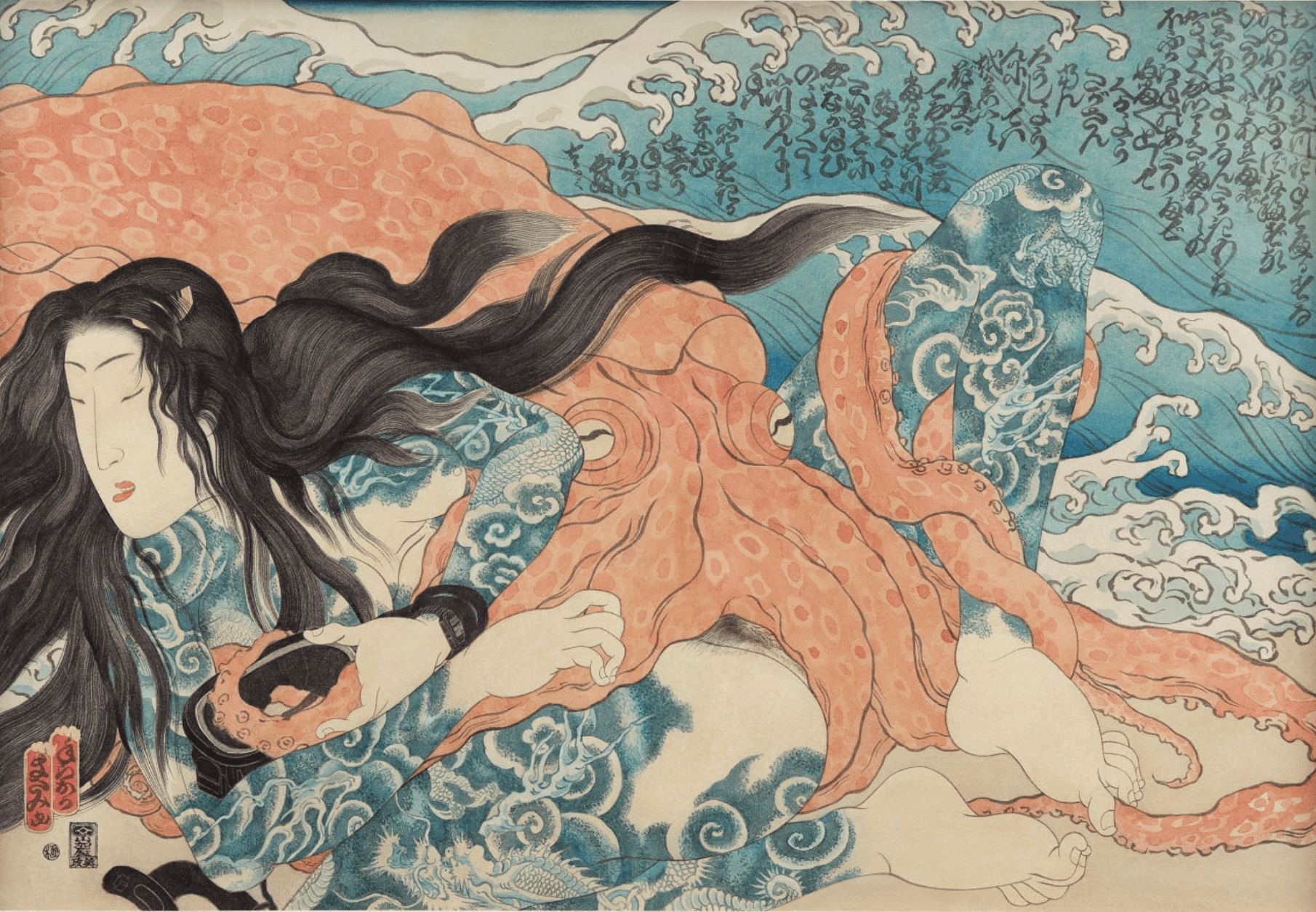
Wave Series/Tattooed Woman at Makapuu Beach, 1984
Watercolor on paper
Sheet: 20 x 29 inches
Colliding Cultures and Common Language
By Jan Wurm
Relocating calls for new orientation in a new town: to the right for shopping, to left for school, turn around for a walk and fresh air. Being transplanted into a new country brings not only culture shock; it brings super powers. There is the adrenalin rush of the new, the excitement of the daring change, and a love for all that is happening: fresh, of the moment, and exhilarating. Without weighty references to a deep past, there is an initial expanse of discovery and possibility in exploration. Then, a yet more potent transformation into outsider opens perspectives and insights that bring a clarity of vision that renders society nearly transparent.
In this extraordinary career survey of the work of Masami Teraoka, the Catharine Clark Gallery has drawn not only on the intimacy of decades representing the artist, but has delved into the artists' archive to expose initial responses to then omni-present pop art including Marilyn Monroe, the polished forms of finish fetish, concise conceptual reduction of thought to paper, and the gritty humor of Los Angeles in the 60s. Here spread out like a banquet table is a feast of development and change, a journey that leads back to beginnings in an ironic rebirth.
A new language brings focus to every word; each opens a world of association, connection, and meaning. Woman. Dressing. Ocean. Wave. Sex. Erotic. Food. Hunger. Each and every character and sound has its pair. Or its not-quite-not-really attempt at equivalence that amplifies its otherness. In the work of Masami Teraoka, bridging these, the visual language makes visible the expression of contrast with complex narratives that employ the vocabulary of traditional Japanese Ukiyo-e woodblock prints.
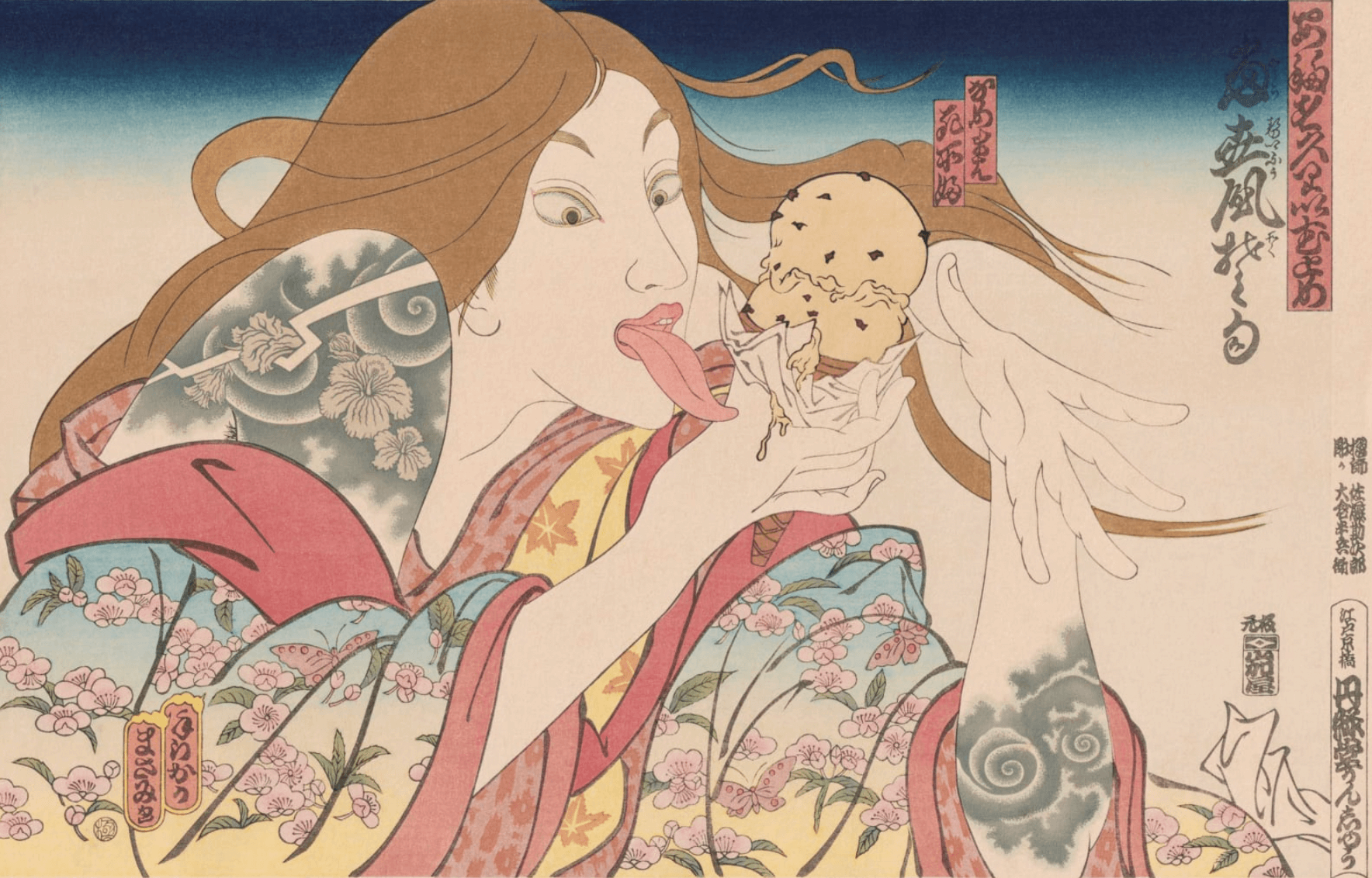
31 Flavors Invading Japan/Spiral Uzumaki Tattoo, 1980–1982 / 2025
In 31 Flavors Invading Japan / Spiral Uzumaki Tattoo (1980--1982), Teraoka has created within a series of woodblock prints an allusion to tradition and beauty just as the woman has taken on the affect of the Geisha. But with the kimono askew, the hair unbound, the woman with elongated tongue ready to devour melting ice cream –all carries an unmeasured grasping. The artist is able to address global expansion of business, cultural appropriation, consumerism, loss of refinement, and sexuality within a singular image.
Employing conventions of rendering fingers and pattern, Kabuki facial expressions and Hokusai-esque graphic waves, the artist also punctuates the pictorial space with writings—texts that label, turn on wordplay and puns, serve as thought bubbles or dramatic exchanges. The direct humor or irony or calligraphic reference may be inaccessible to the non-Japanese reader; however, reading the facial expressions of disgust or revulsion, the postures of seduction or recoil, and the embodied engagement of entanglement opens the intent and attitude with verve.
Inserting ones own image within a scene carries autobiography or fantasy or can deploy the self-portrait as a marker of time and place. Beyond this not-uncommon practice, we find Masami Teraoka with goatee rendered but robed in kimono and elaborately fashioned hairdress in the watercolor 31 Flavors Invading Japan / Rocky Road (1977). Models, symbols, objects of desire, others and self—the fluidity of gender and sexuality weaves a web of folded and extended garments and limbs, digits and tongues and all things phallic in appearance or implication.
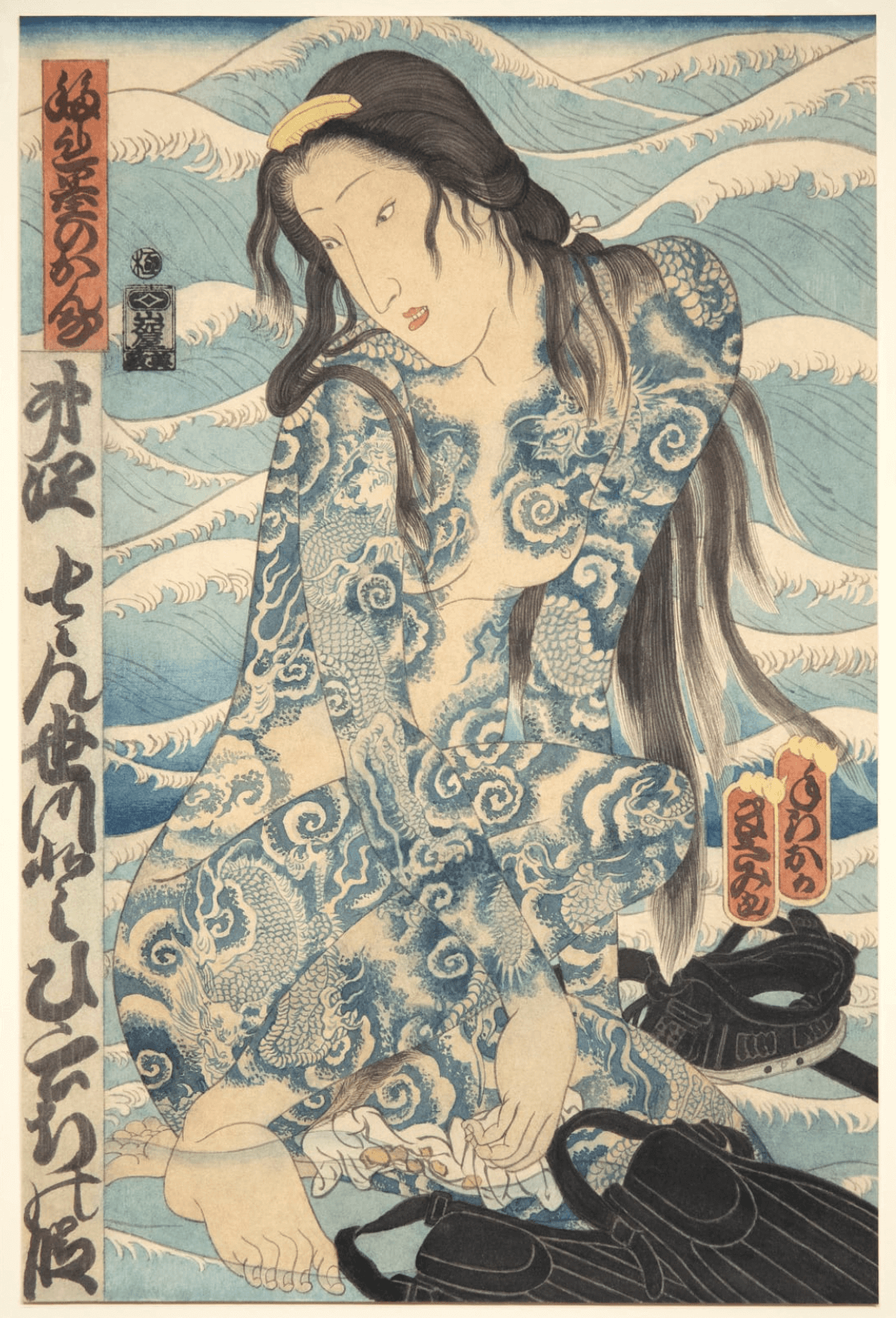
Wave Series/Tattooed Woman at Sunset Beach, 1984
The erotic embrace of the sea holds tight through the decades: from the octopus of 1984's Wave Series/ Tattooed Woman at Makapuu Beach to Sarah and Octopus/ Seventh Heaven of 2001, sea life continues to swirl around the women with tentacles wrapping around body and limb, a binding echoed in the tresses of hair and affirmed with mutual caress. Giving emotional expression to the sea creatures - octopus or whale or dolphin - has a corresponding transmigration as Sarah, in head-thrown-back ecstatic swoon, has been rendered with a phallic fish head contenance.
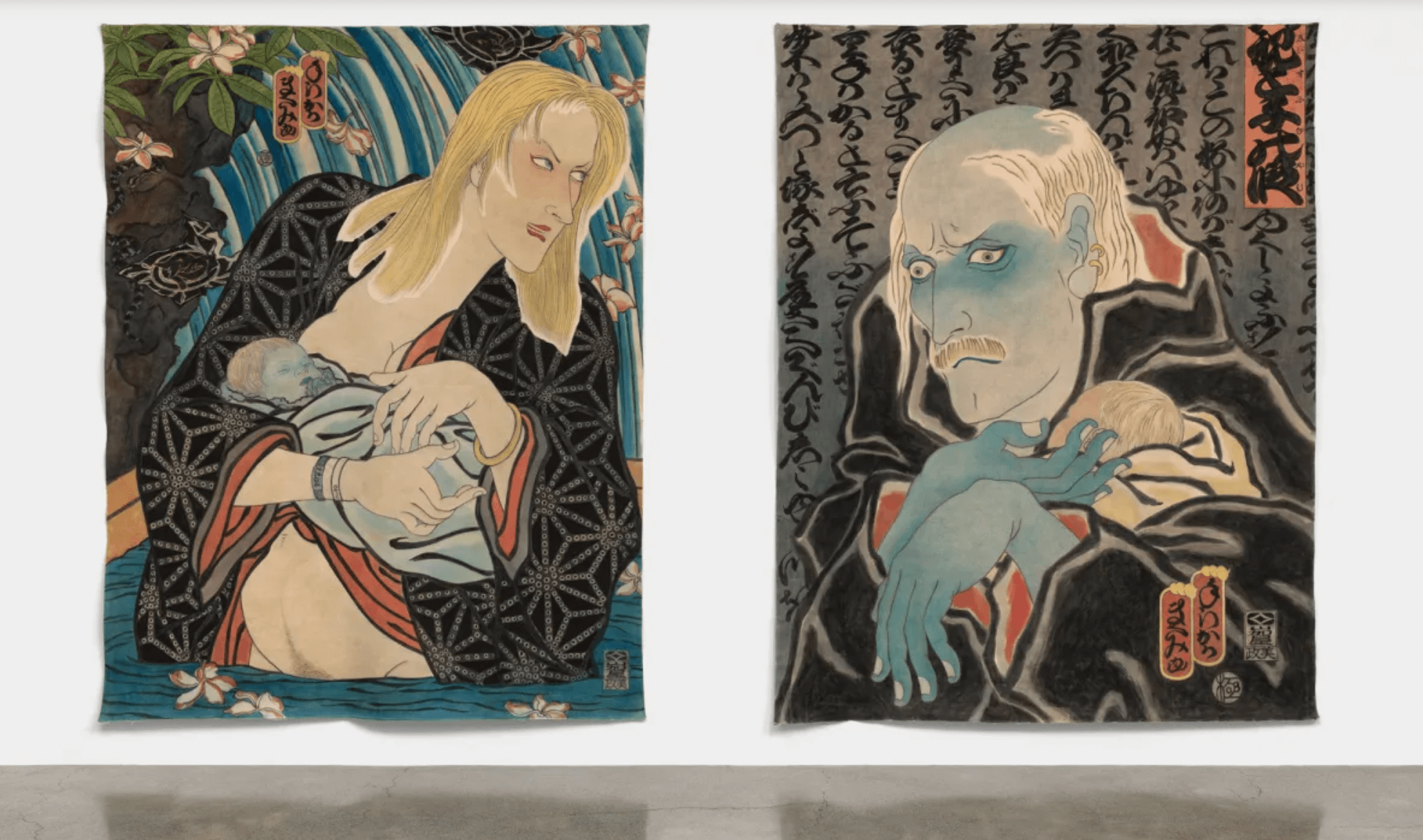
Installation image of Masami Teraoka’s “AIDS Series/Mother and Child” and “AIDS Series/Father and Son” (1990)
The rendering of cherry blossom-patterned Kimono as the song of fragility and passing of beauty —of time, of life itself— the ever-present crumpled napkins and tissue that harken to the Geisha's stash prepared for sex, the interplay of figures top/bottom/side-by-side with arms and legs appearing and disappearing in the erotic dance of scrolling body tattoos and rolling waves and cresting foam: all are later joined by cautionary condoms that give way to the descending darkness of the AIDS epidemic. With a shift in palette, a blue cast across skin, the tragedy of loss shatters the pleasures and lays bare the pain in the AIDS Series/ Father and Son (1990). Watercolor seeps into the weave of unstretched canvas. The isolated parent is powerless in protecting the child. The mother with newborn babe at breast, belly still distended, is half submerged in the sea that meets the sky that engulfs with a ghostly hue that spills into the kimono that envelopes her. AIDS Series / Mother and Child (1990) – the hold circles the child in desperation.

Masami Teraoka, “Hideous Ugliest Orange Toad’s Last Bolero/Viagra Falls” (2019), oil on panel, 120 by 120 inches
With a change in voice, the artist's hand became heavier, firmer, more resolute. No longer lilting, the tone roughened, responding to revelations of the time. A vocabulary to match the outrage of abuse within the Catholic Church expresses stark absolutes in a palette saturated with red and black. Within small oval canvases, such as Virtual Inferno/Behind the Red Curtain (2000), the clerics and their obsessions, their proclivities and their abuses are revealed like a peep show of a confessional. Spread out across a double triptych, Hideous Ugliest Orange Toad's Bolero/Viagra Falls (2019), Masami Teraoka plunges the viewer into a Boschian world of unrelenting indulgence and punishment, littered with masks of a modern plague as death rolls out in an expanse of corpses.
With the horror of the diseased body, there follows the further ironic deployment of conventional form: the religious icon for societal and political corruption and disease of the body politic. The shinier the gold-gilded frame, the more tarnished the players. The church of the Pope, the empire of Putin— the call to account reverberates. And the ship of state burns and goes aground as an Unsinkable Unthinkable Titanic's Last Breath (2022).
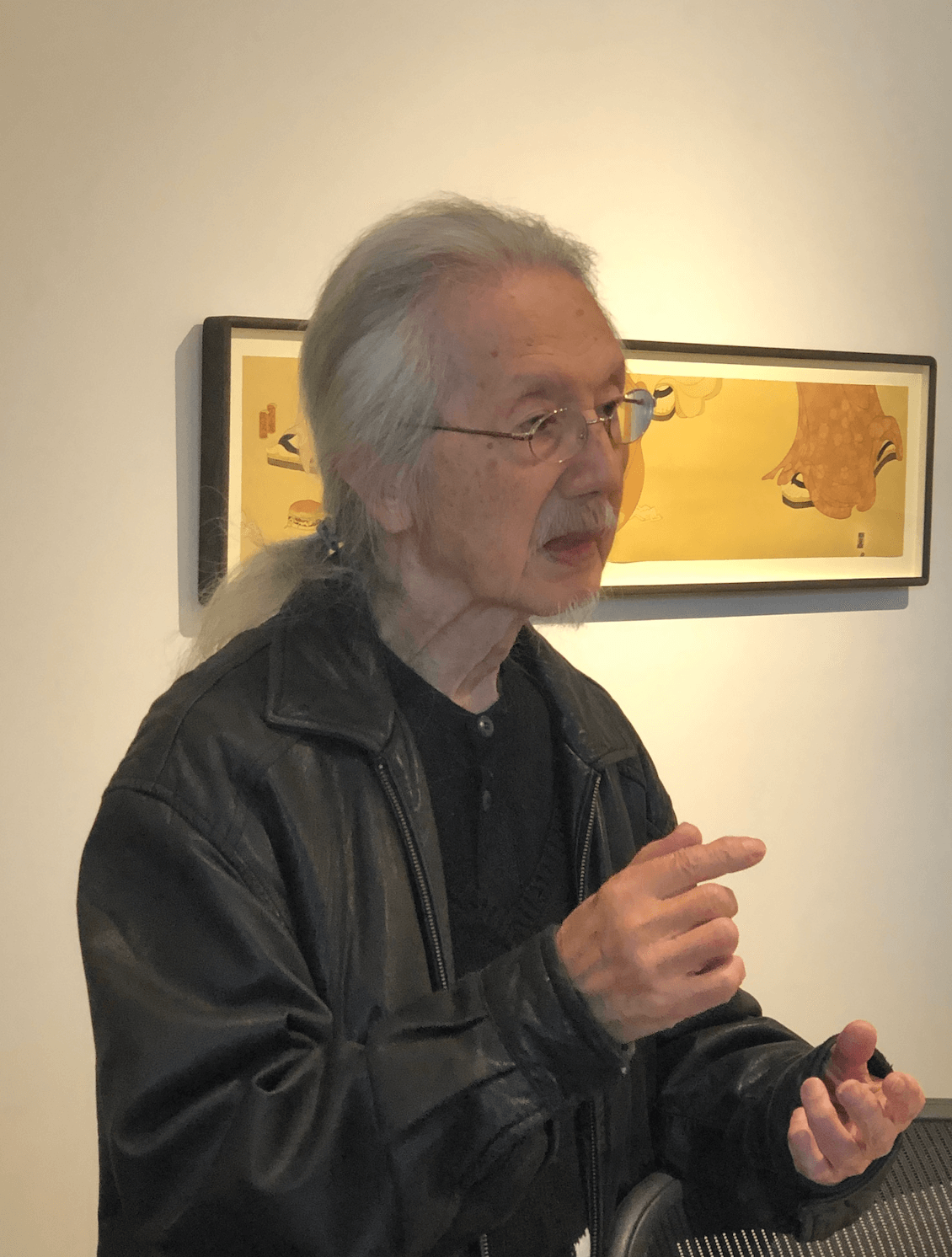
Masami Teraoka, born in 1936 in Onomichi, Hiroshima, Japan
Masami Teraoka has imbued his art with beauty and grace while holding a mirror to society so that we may calibrate to a moral compass. A life of ninety years lived in Japan, California, and Hawaii has given rise to a flowering of art that has explored the depths of life and the passionate forces that fuel the sublime. To swim within these waters is to be buoyed and raised above the crest.
Masami Teraoka: From Here to Eternity, Five Decades of Art Making Catharine Clark Gallery, January 11 – March 7, 2026
