
Xavier Robles de Medina
![Luigi Mangione wears bulletproof vest for court appearance as lawyer complains about actors ‘playing him on TV’, Just Jared, 21 February 2025, 2025, colour pencil on paper, 14 × 21 cm [framed 27 × 34 cm]](https://images.squarespace-cdn.com/content/v1/6849c9198946fd5bd5b82422/1779651944026-NI1JAIZ55SLMBJQRSPMR/luigi.png)
![Bambi. Directed by David Hand (supervising a team of sequence directors), Walt Disney Productions, 1942 , 2019, graphite on paper, 21 × 18 cm [framed 49 × 46 cm]](https://images.squarespace-cdn.com/content/v1/6849c9198946fd5bd5b82422/1779651892389-FVPECSA5AWGJ59F69CI6/1Xavier-Robles-de-Medina_3_1340_c+%281%29.jpg)
Xavier Robles de Medina is a Surinamese artist born in Paramaribo in 1990, living and working between Berlin and Paramaribo. Working at the intersection of visual art and research-based practice, his meticulously crafted works explore post-colonial memory, queer subjectivity, and the constructed nature of historical and political imagery.
Robles de Medina has exhibited at Art Basel Paris and Art Basel Hong Kong through Catinca Tabacaru Gallery, and his work has been included in major international institutional exhibitions at the Stedelijk Museum Amsterdam, Cobra Museum of Modern Art, CCS Bard Hessel Museum, and the 14th Dakar Biennale. In 2025, he was awarded the Krull Arbeitsstipendium and a Mondriaan Fonds Artist Project Grant, and undertook residencies at Fonderia Artistica Battaglia in Milan and the Art Encounters Foundation in Timișoara. His work is held in the permanent collections of the Stedelijk Museum Amsterdam, Pérez Art Museum Miami, Fondation Francès Paris, and the National Gallery of Zimbabwe.
The following are excerpts from Xavier Robles de Medina’s interview conducted by Hugh Leeman.
A Grandfather, a Monument, and a Nation Being Born
Hugh Leeman: Xavier, in 1975, Suriname, where you are from, gains independence from the Netherlands, and shortly thereafter your grandfather is commissioned to make public art that will support the cultural narrative of a new nation. How has your grandfather's art and role in constructing that public narrative impacted how you see your native Suriname?
Xavier Robles de Medina: I have to correct you slightly — my grandfather was making public sculptures before independence, in the 1960s and early 1970s, and continued after independence, but he actually moved to the Netherlands about five years after independence, so that chapter wasn't as long-lived as people might assume.
To answer your question: his legacy — not just in public monuments, but in education, in painting, as a person — had a really big impact on me. I knew him as a family person who really enjoyed cooking Surinamese staples. But he was already living in the Netherlands when I was growing up, so there was always this binary: on one hand he was this warm grandpa figure, and on the other hand I knew he had a reputation, a legacy, as a famous artist. As a kid, you just can't properly process that. It wasn't until only a few years ago that I began to truly contextualize what his legacy has meant in the history of art and in the history of Suriname's independence.
The research I did for my book, Pengel, really gave me a whole other perspective. I knew his contribution was huge and extremely important, but the process of making that book — publishing information around the sculpture he made in 1974 — gave me an entirely new level of understanding.
Hugh Leeman: You say his contribution was huge. What was his reputation, and what specifically were those contributions?
Xavier Robles de Medina: When I was little, he was a professor at the teacher training school, so many of my elementary and high school teachers had been taught by him. They would all ask me whether I was the grandson of the famous artist. But fame has a different meaning in Suriname, which has a population of half a million people. I had no idea what that really meant, and I think it means something quite different in the context of Suriname compared to Europe or the US. He was famous in that context — but he's still basically very obscure internationally, which is part of why I wanted to publish the book.
The sculpture he made in 1974 depicts Johan Adolf Pengel — a towering figure in Surinamese 20th-century history and a major advocate for independence from the Netherlands. The sculpture stands in front of the Presidential Palace, so essentially everyone who visits Suriname has seen it, and everyone who lives there definitely knows it. But I'm not sure many people understand how it was made, or even who made it.
The first thing my grandfather would state about this work is that it was the first and the last bronze monument to be fully produced in Suriname. That sounds like a simple elevator pitch, but what was involved was extraordinarily complex — there was no infrastructure for bronze casting at the time. He had not only to create a 3.5-meter sculpture, which is enormously complex in itself, but also to set up a provisional foundry from scratch.
My grandmother — who is really one of the central figures in the book, and a co-author — was hugely important in the production of this work. Aside from my grandfather being relatively obscure internationally, my grandmother would be even more so, and yet she did so much of the hidden labor: accounting, managing, budgeting. So much of the research I did was around the practicalities of money, because the budget was extremely low. My grandfather had to take a year off from his teaching job and essentially produced this artwork without an income. It was an enormous accomplishment that I think most people don't fully realize.
Post-Colonial Memory and the Education Independence Made Possible
Hugh Leeman: Your grandfather straddles this world — a colonial Suriname under Dutch possession, and then a post-colonial world you were born into not long after. In your own artwork, you've told me you focus on post-colonial memory. What does that mean to you personally?
Xavier Robles de Medina: It's a very complicated idea, because I don't have any subjectivity other than the one I inhabit through being born when and where I was. I only know my own perspective.
What I came to understand — through projects with audience involvement in Suriname, through being close with my parents and grandparents, and especially through writing the book with my grandmother — is the enormous difference in perspective between someone born before independence and someone born after. I entered an educational system that was essentially completely unbound from colonial restrictions. I only realized how significant that was once I spent time in the Netherlands as an adult.
I was raised with an awareness of, and taught about, the history of slavery and colonization — specifically Dutch colonization. These aren't new or strange issues for me. But when I moved to the Netherlands, I found that many of my peers had basically no knowledge of colonial history, and hardly knew anything about Suriname at all. I'm almost proud to say that I wasn't really taught much about the Netherlands growing up. That's diametrically opposed to the education my grandmother and even my father received — a completely Dutch curriculum, in the tropics, learning about the four seasons, singing songs about wintertime without having any idea what winter actually is. Knowing everything about the Dutch royal family, celebrating Queen's Day. I grew up with none of that.
The impact of growing up in an independent Suriname compared to a colonial Suriname is basically impossible to measure. Some of the effects of colonization are so subconscious.
An Introverted, Artsy, Gay Kid Who Resisted Art for Years
Hugh Leeman: I want to go back to your genesis as an artist. In a previous conversation, you described yourself as an introverted, artsy, gay kid, and that art was a kind of refuge for you. How did you begin to find art — or did it find you? And what was the journey toward identifying yourself as an artist?
Xavier Robles de Medina: It's a really long, complicated process that I'm still going through.
As a very young person, I always just wanted to be making things. I was curious about how art was made — especially movies and music, which I was obsessed with as a kid — and I would intuitively always be drawing. I didn't grow up with my grandfather living in Suriname, but we had a lot of his art books that he left behind when he moved. I grew up with his photo album documenting the making of the Pengel sculpture, and also books about his favorite artists — 19th and early 20th-century European painters and sculptors, but also ceramics, West African sculpture, origami. He had so many interests, and I benefited from all the books he left behind.
That was really important, because I had many friends who were creative, but it's very hard to stick with art in a context where it's almost impossible as a profession. I think one of the main reasons I ended up pursuing it is because of all those influences — growing up with my grandfather's art around the house, and with an awareness that he was someone significant in society. That made the barrier just a little bit lower to enter this creative field.
But it's become one of the most important narratives I tell myself: I've spent more than half my life in Europe and the States working in the art world. Observing peers who grew up in London, New York, or Amsterdam — who grew up with museums, who grew up with the idea that art is cool and celebrated — I didn't have that at all. Art was not cool in my context. It was something I resisted for a very large part of my life, until I really just felt I couldn't resist it anymore. And honestly, I'm sometimes still resisting it. I have very complicated feelings about pursuing it, because it requires a lot of privilege — and that's a complicated conversation in and of itself, but especially in the context of Suriname.
Takashi Murakami and the Crash Course in the Art Market
Hugh Leeman: After leaving Suriname, one of the places you end up is New York City, where you work as a studio assistant for Takashi Murakami. You said it was a huge learning experience about the magnitude of the contemporary art market. What was the art market to you before you started there, compared to after?
Xavier Robles de Medina: The art market — I don't know if I even now fully understand what it is or involves. But I definitely gained a much bigger perspective working in New York for several different artists, ranging across stages of career development — some quite young and early, some very established.
Before New York, I'd been living in Savannah, Georgia, studying at SCAD. My sense of what an art career looked like was probably shaped by my grandfather's model, which was almost entirely commission-based. He made commission portraits and public monuments, logos, graphic design, facade ornaments. That was how I probably went into university thinking about art — and then through SCAD, I got a more industrial sense of things: advertising, film, textile — fields where you study and get employed. The contemporary art market, to me, was either very abstract or something I basically knew nothing about.
Then in New York, I attended my first art fair and immediately got this crash course in what the art market looks like in a city like that.
Hugh Leeman: As someone from Suriname, where the idea of contemporary art carries no particular social status or cultural cool factor, you end up working day-to-day in the studio of Takashi Murakami — who for all intents and purposes represents the pinnacle of commercial contemporary art. What were you learning about yourself in that environment?
Xavier Robles de Medina: I realized how much of the work ethic encouraged in the studio resonated with me — specifically how ordinary and regular it actually is. You show up at 9AM on time. The whole painting team does morning exercises together, then everyone collectively cleans the studio, and then you're assigned a task and you try to complete it as efficiently as possible. It's like a corporate job, which I kind of enjoyed.
It's also how I was raised. My dad is a dentist — he wakes up at the same time every day, goes to work, is very responsible in that sense. There's nothing bourgeois about it. I think if you don't have that background, you might imagine being an artist is entirely about freedom and emotion and expression. And that's certainly part of it — but another part is just showing up and doing the work and being professional. Contemporary art, for better or worse, has placed an enormous emphasis on professionalization, especially at the emerging level. That's not always healthy, but if you have those skills, they can help you tremendously.
Luigi Mangione and the Mirror of the Media Landscape
Hugh Leeman: A recurring figure in your recent work is the realistic portrait. One of these figures is Luigi Mangione, the man being tried in the United States for the murder of UnitedHealthcare CEO Brian Thompson on a street in Manhattan. Mangione has become a kind of folk hero, amassing over a million dollars in legal defense donations and enormous public support online. What has so compelled society — and you — about this story? And what does it reveal about the common consciousness of contemporary culture?
Xavier Robles de Medina: It's a very layered question. I can't speak for all of society, but I noticed on the internet — the portion of society active on social media, YouTube, comments sections — this incredible and also very bizarre outpouring of something I wouldn't quite call empathy. Adoration, maybe.
What struck me immediately was that this clearly touches on so many urgent ideas: wealth inequality, corporate greed, corruption. But the only reason it catches people's attention at the scale it did is because the supposed shooter is — hot. Very good-looking. And I think that says something extremely specific about the dynamics of our media landscape, something so obvious it almost doesn't need to be said.
That was my initial interest — and my motivation for making these works. It captures the tension of so much contemporary culture: on one hand, everything that is genuinely urgent and pressing about contemporary experience. On the other hand, something completely absurd. And I wrestle with what Mangione actually is as a public figure. Is he a celebrity? Something else?
The more time I've spent with these images, the stranger they've become. You never hear his voice. He's delivered to us at enormous scale, and there's a market for these images — thousands published over the past year and a half — and yet what do we actually know about him? Apart from four or five words he shouted at the paparazzi, I've never had any deeper insight about him beyond how he looks. That's also why I chose to approach the works the way I did — very matter-of-fact renderings of his face in colored pencil. It's entirely about the surface.
Hugh Leeman: You've written that Mangione appears not as a monumental figure, but as someone suspended between presence and erasure, shaped by the pressures of late capitalism — and that the drawings become meditations on the tension between visibility and disappearance. What is that tension in contemporary culture?
Xavier Robles de Medina: It hints, first of all, at the idea that capital punishment was raised as a solution in this case. But more broadly, it's the tension between someone who is so enormously present in our media landscape and simultaneously almost entirely absent. You can know a public figure's face in intimate detail and know nothing whatsoever about them. That says something wider about what it means to know someone, or to idolize someone. The surface is everything, and the surface is all we're given.
Queen Wilhelmina, Independence Day, and the Show Business of History
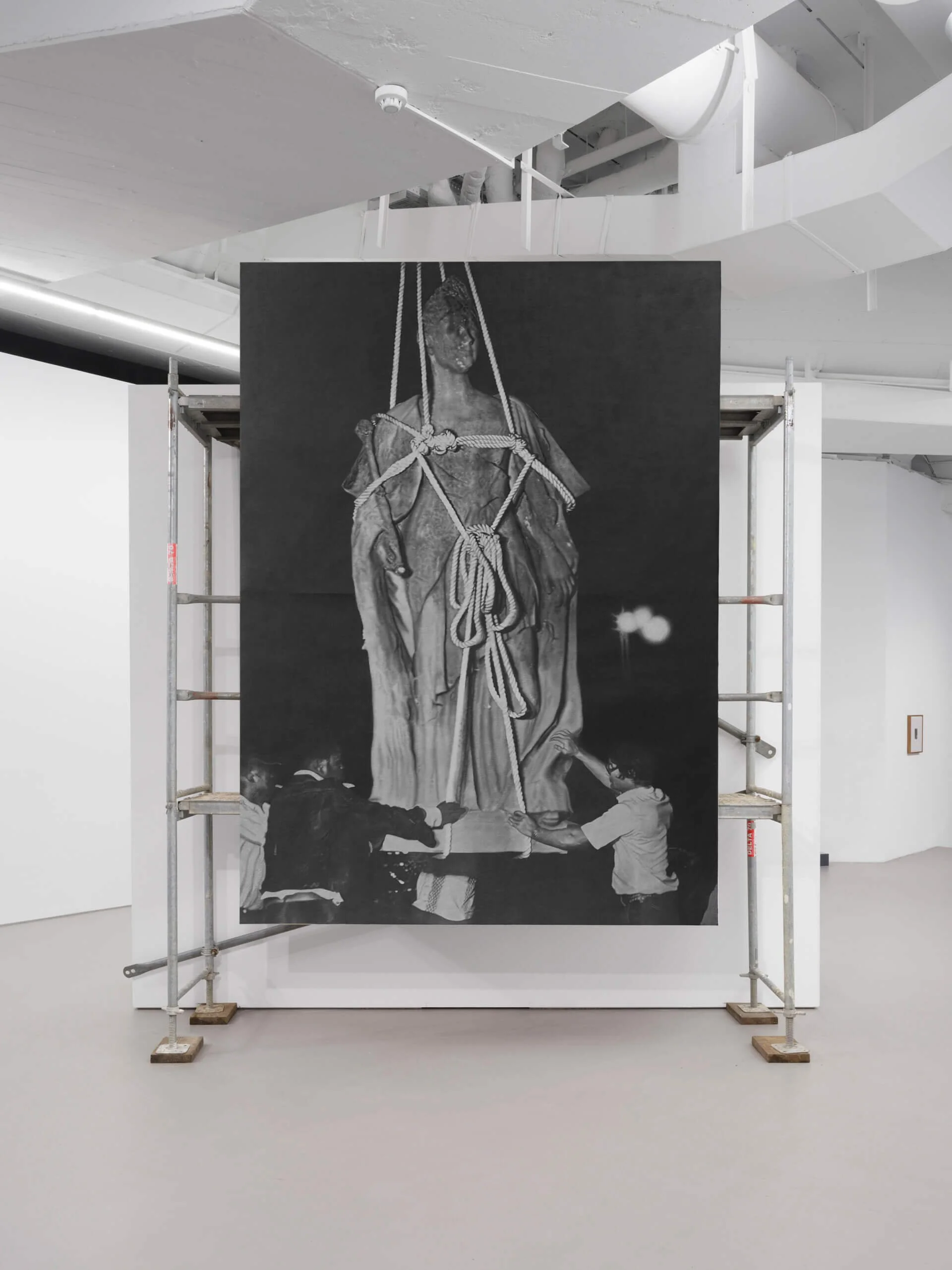
Hugh Leeman: Beyond Mangione, you focus on the constructed nature of images and of the past. In one particular painting you depict the removal of the statue of Queen Wilhelmina from Independence Square in Paramaribo. The viewer sees a realistic painting of construction straps wrapped around a massive sculpture being removed from public view. What is the cultural significance of this image?
Xavier Robles de Medina: It's a continuation of the research I did around my grandfather's involvement in the independence process and in making the image of independence. He was invited to art-direct Independence Square for Independence Day from the Netherlands. He made several significant decisions — one of which was to remove the colonial sculpture of Queen Wilhelmina of the Netherlands, and to replace it with a large flagpole that would raise the first Surinamese flag on Independence Day.
He also decided to place the Queen Wilhelmina sculpture just a few meters further down the road, beside Fort Zeelandia — the oldest colonial structure in Suriname, a fortress overlooking the Suriname River. That was an extremely clever decision. You don't simply erase — you relocate and recontextualize.
There's a constructed element to how that photograph was taken, and there's also this enormous event — independence — which is both history-making and, in a sense, show business. The way you stage it matters enormously. My grandfather's relationship to that idea — the overlap between art and show business, his tendency to engage with politicians and public figures — has a pop art dimension that I don't think people have fully recognized.
Pop art was the art of his time. It was the 1960s and early 1970s when he was making these monuments. And even before the Pengel sculpture, he was commissioned to make a monument to Dr. Martin Luther King Jr. — which ultimately didn't get funded, so he completed the sculpture and the government simply backed out. But learning the background of how he worked — he would gather every possible image of Martin Luther King he could find, cover his entire studio with them, then order the speeches on vinyl and listen to them while he sculpted — that's such a vivid image, and one I completely relate to. When I was painting my work on Aaliyah, I did the same thing: I got obsessed with her interviews and her music.
I don't know that I'm comparing Aaliyah to Martin Luther King. But what I feel strongly about is the element of empathy — the sincerity in how I approach these subjects. A lot of contemporary artists engaging with pop culture are making some kind of ironic statement about a celebrity or about pop itself. I think what my grandfather did, and what I do, comes from something genuinely unironic. Maybe even painfully unironic.
The Last Soldier Out of Afghanistan
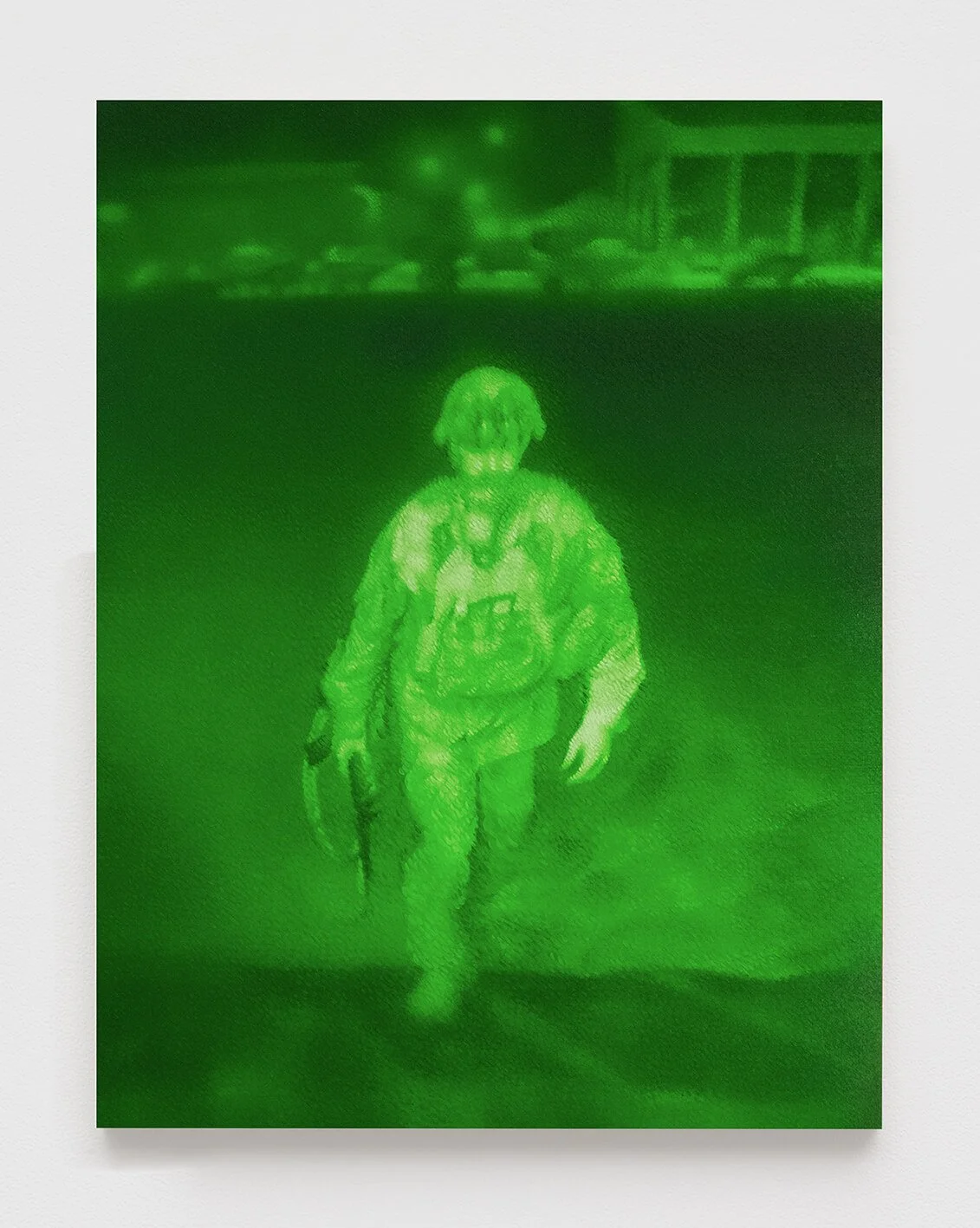
Hugh Leeman: There's another painting you made — U.S. Army Major General Christopher Donahue, Commander of the 82nd Airborne Division — where the viewer, through the grainy lens of night vision goggles, sees him on an airstrip. Like much of your work, it's highly charged with socio-political tension just beneath the surface. What was it about this image that compelled you? And what does it say about the constructed nature of reality that certain images carry?
Xavier Robles de Medina: This image particularly touches on the constructed nature of history — how history can be composed through media. It can't be a coincidence that the last U.S. soldier to leave Afghanistan ended up walking exactly in the center of the frame of that night vision camera. I didn't change anything about the framing — he really just was walking in the middle. Maybe it's pure chance, but there's an element to it that is almost too good to be true. The image has a perfect, monumental quality that made me think about it obsessively.
And then there's the weight of what the image is actually about — this disastrous departure of the United States from Afghanistan, and this being the final gesture of it. The monumentality of that moment, filtered through a grainy green night vision aesthetic. History framed as cinema.
Democracy, Trauma, and the Inescapable Intimacy of Small Nations
Hugh Leeman: Over a three-year period you lived in Zimbabwe during a time of incredible tumultuous change — contested elections, a revolution, the rise of democracy. You drew parallels between Zimbabwe and Suriname. You've also seen the beginning of a democracy firsthand as a child. If you were to make a series of artworks on the state of democracy today, in the places you've lived since leaving Suriname, what might those look like?
Xavier Robles de Medina: I can only speak to it from specific contexts. In Europe, and especially in Germany where I'm based, democracy seems technically still intact — but we've seen the limits of freedom of speech driven to a breaking point, and that will probably continue to haunt the cultural landscape for years.
In Suriname, the context over the course of my life has largely revolved around Dési Bouterse, who led the military occupation in the 1980s and then became president in the 2000s. He's an extremely difficult historical figure. He was eventually accused of being behind political killings on the 8th of December — what are known as the December Murders — the execution of fifteen men who were protesting or speaking out against the military occupation. So much of Suriname's political landscape, while Bouterse was alive, was shaped by that tension, and the case was not resolved until very recently — just before his death, actually.
We're only just coming out of that era. And I think it's a trauma that people — especially older people — may not even realize they carry. There's a kind of self-censorship that happens a lot in Suriname, where people are simply afraid to say certain things around politics. And on top of that, it's a very small society, which makes everything even more complicated.
In a large society, you can find your political tribe and largely stay within it. You can create bubbles for yourself. In Suriname, you're eventually going to have to navigate your political opposites, because the country is just too small to avoid it. You have to engage with the entirety of society if you want to function within it. That forced engagement is both a burden and, I think, something valuable — it's harder to fully demonize someone you inevitably know.
As for Zimbabwe — I had an incredible time during the residency there, and I have opinions based on what I experienced, but I wouldn't want to speak on it with any confidence. I don't feel I know enough to do it justice.
Hugh Leeman: Xavier Robles de Medina, thank you so much for your time.
Xavier Robles de Medina: Thank you!
