

Grey Dey, Reckoning, an MFA thesis exhibition at the Krannert Art Museum

Narrative painting promises to convey a story – or at minimum, a pivotal scene that celebrates a virtue or value worthy of honor. In his practice, painter Grey Dey presents a variation: instead of asserting a universal truth, he invites viewers to assemble a chronicle from the fragments that resonate with their own experience. Because Dey doesn't insist on a single account, he needn't make his paintings overly accessible. He invites the audience to collaborate, offering only an eccentric set of intentions and icons as a point of departure.
Now a PhD student at University of Illinois, Urbana-Champaign, Dey holds the notable distinction of being one of the last students at the San Francisco Art Institute in 2022 who later transferred to complete his undergraduate degree at California College of the Arts, an institution now also transitioning toward closure. He landed on his feet at Urbana-Champaign’s School of Art & Design and recently presented an MFA thesis exhibition at the Krannert Art Museum. His MFA exhibition, which ran from April 11 – 25, presented 12 paintings, ranging in size from 14 x 11 inches to 6 x 10.5 feet, showing enormous achievement and promise.

Grey Dey, The Secret Garden, oil on canvas, 60 x 48 inches, 2023.
In one of the larger paintings, a “Secret Garden,” Grey depicts New York based painter TM Davy standing with his husband Liam, a former elementary school teacher, in their garden on Fire Island. Davy is wearing a magenta jumpsuit and capeline hat with a wide brim, while Liam has a blue shirt and handkerchief around his neck. It's a casual pose, with the viewer being drawn to the aqua colored gloves Liam is wearing and what appears to be certain props in their respective hands. Look closely and you can see that TM pulls Liam close, in a very sure way. Liam isn’t resisting in the slightest and seems quite comfortable resting his arm around TM’s shoulders. The various objects in the painting stir the most ambiguity. TM holds a straight-blade knife he uses for pruning, brandishing it boldly, while Liam clutches an empty bucket or pail. Aside from the obvious metaphor about the roles they may have in their relationship, the presence of the blade would typically suggest something threatening, and yet, here has a prosaic quality, as if Dey simply happened to observe this one afternoon. There is an audacity about it that represents TM’s preparedness to protect what the couple has built. It’s both matter-of-fact and apropos, “Don’t come close if you aren't kind.”
The lighting and staging seem contrived, yet believable. The clouds have parted revealing an intimate moment between two lovers who have weathered many things together. The green foliage in the background, coupled with the almost halo effect of TM’s straw hat, suggests fertility, representing harmony and growth. A single light source offers us the golden hour, when the sun is low in the horizon, making light warm and soft. Only the bottom left of the painting is obscured by a shadow, noticeably not touching either figure. Dey captures the magical quality of Fire Island, specifically the predominantly LGBTQ+ residential community there, known as The Pines, where the pair spend their summers. It’s an instant while they tend to their own garden literally and metaphorically. He wants to convey how very unbreakable this couple's love of one another continues to be.
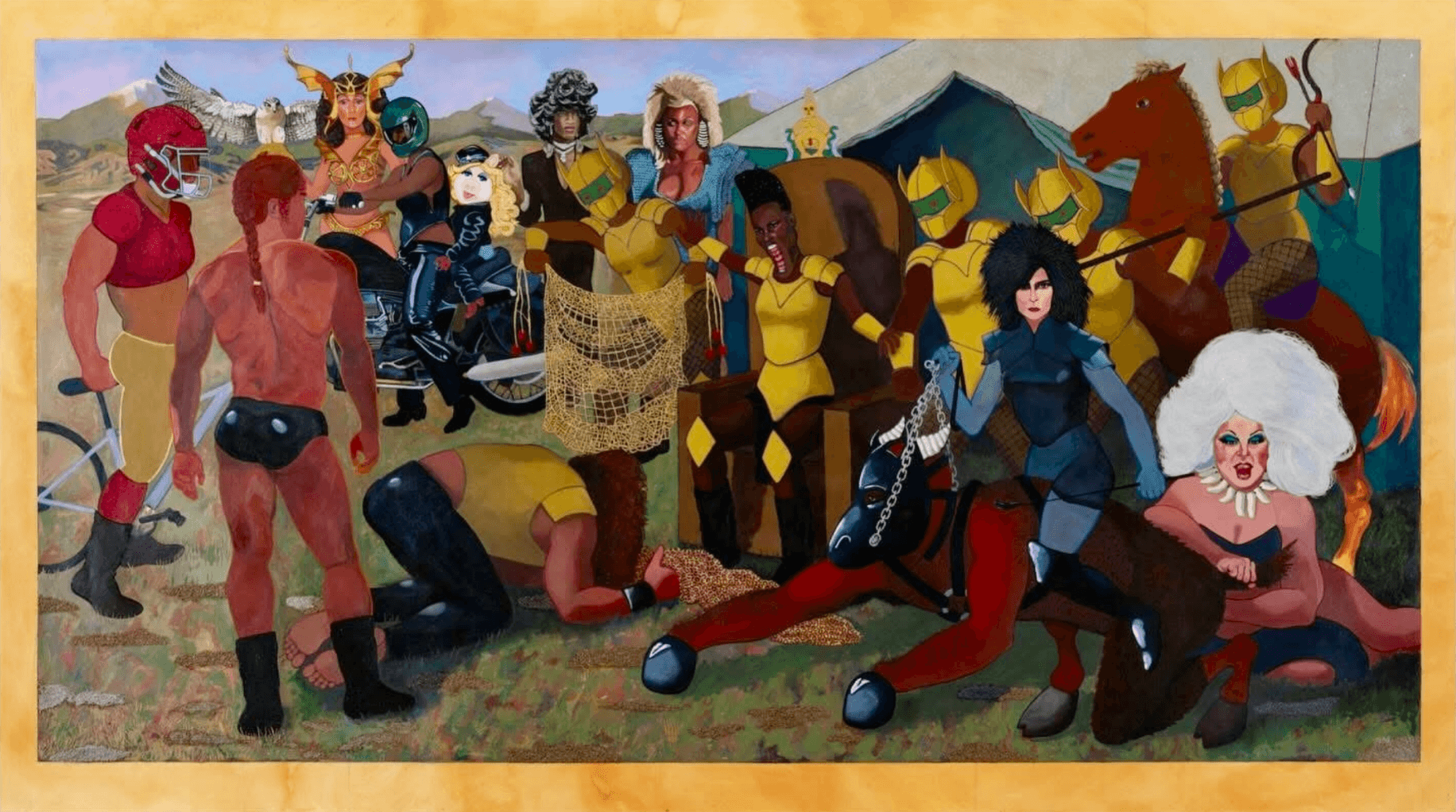
Grey Dey, Paris Petitions Penthesilea, acrylic, glitter, and crushed walnut shell on unstretched canvas, 6 x 10.5 feet, 2026.
Dey’s largest painting in the exhibition is also one that he has been thinking about for the last 15 years; the “Penthesilea” painting was a dream of his to paint. The basic arrangement was first conceived in sketchbooks. At first he believed his proposed rendering was grounded in history. Later he discovered that his favorite story from the Trojan War was largely apocryphal; yet this disappointment turned to opportunity as there were fewer constraints dictating the subject matter. The essential plot is that Paris seeks out the Queen of the Amazons to beseech her to join the Trojans in their effort to repel the Greek invasion; Penthesilea agrees and will later be killed by Achilles in single combat. The story is included in the now lost Aethiopis, an ancient Greek 8th-century B.C.E. epic poem composed in dactylic hexameter, part of the epic cycle recounting the Trojan War. Among the earliest artifacts we have, specifically related to Penthesilea, is the Exekias Amphora (6th century B.C.E.), a black-figure, terracotta vase painting of Achilles slaying the Queen of the Amazons. The story itself has been retold and altered over the centuries, with great liberties taken, which Dey is only too eager to further.
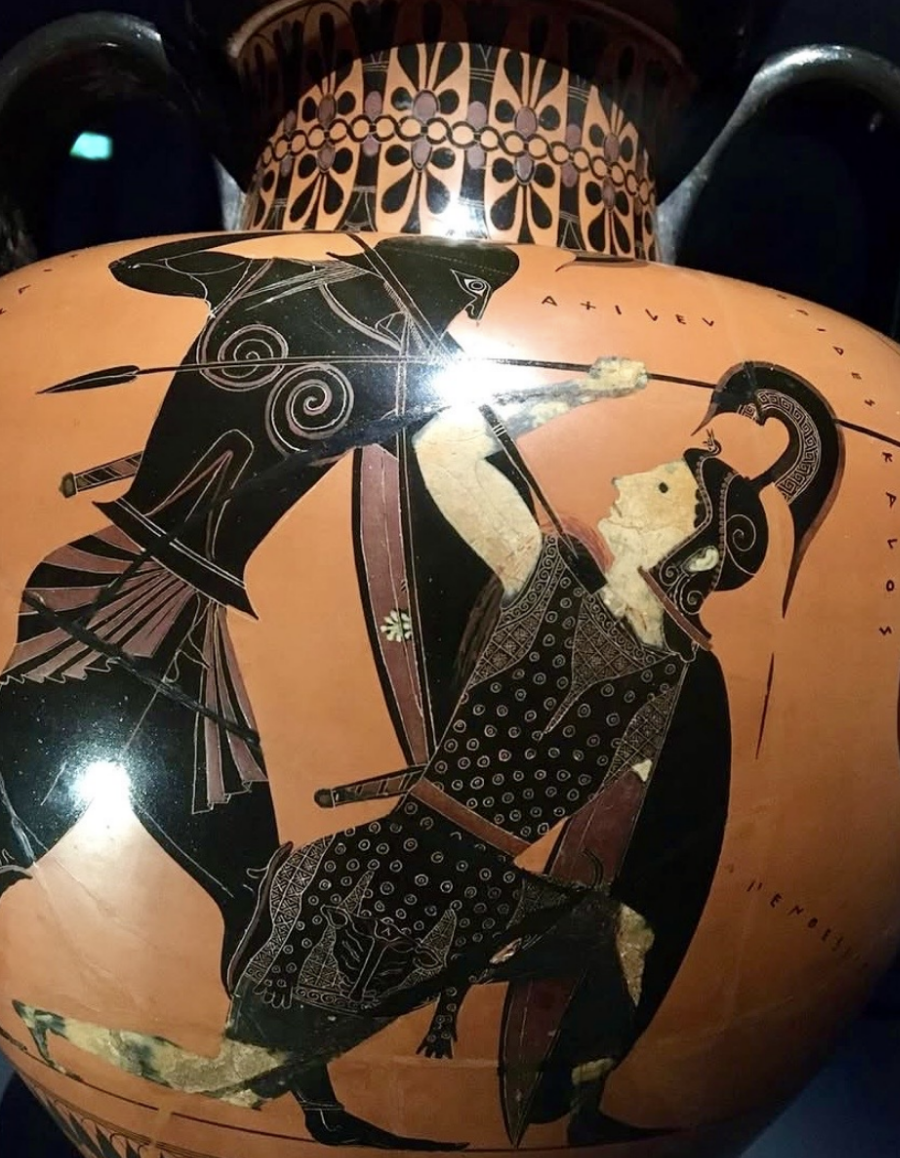
A detail from an amphora (wine-jar) attributed to Exekias (6th century B.C.E.) from Athens, Greece. The two-handled vessel depicts Achilles (on the left) slaying Penthesilea, who is identified by an inscription on the vase. Penthesilea wears a leopard skin (the head and paws are visible in the area of her lower torso). The British Museum collection.
In “Paris Petitions Penthesilea” we see Paris, barefoot, wearing skin-tight pants, on his knees prostrating himself as he asks Penthesilea, the Queen of the Amazons, to oblige the Trojans. Paris is the son of King Priam who, depending on who you believe, either kidnapped Helen or caused her to willingly fall in love with him (the latter a result of Aphrodite’s influence) and abandon her marriage to the king of Sparta, thus sparking the Trojan War. Known for his vanity in classical mythology, Dey depicts Paris without letting the viewer see his face, he is literally covered by his lengthy hair; in effect, depriving us of his beauty. In Dey’s version, the most beautiful man in the world – according to many ancient accounts – holds the leopard-skin cape he wore in a famous scene from Book 3 of Homer’s Iliad at the moment of his proposal; Dey wants us to focus on this object. In the Iliad story, Paris steps out from the Trojan ranks as the two armies face one another, the leopard skin slung over his shoulders. He bravely challenges any Greek warrior to a single duel to settle the dispute once and for all. When Menelaus, Helen’s husband, steps forward to accept the challenge, Paris turns pale and disappears. Homer describes his change of heart, "Just as a man stumbles on a snake in some mountainous ravine.” (Richmond Lattimore translation). In fairness to Paris, his willingness to leave Troy to find other combatants to join their effort does take some bravery. He is also depicted in ancient texts as a skilled archer. Yet, Dey uses this artifice, the offering of the very article of clothing that represents a moment of cowardice and embarrassment as the snapshot from which to view Paris as he beseeches Penthesilea. One can only wonder if deception is being offered, as he freely gives someone else his shame. Symbolism abounds in Dey’s version because later, Penthesilea will wear the leopard skin when she is killed by Achilles, so it augurs her demise.
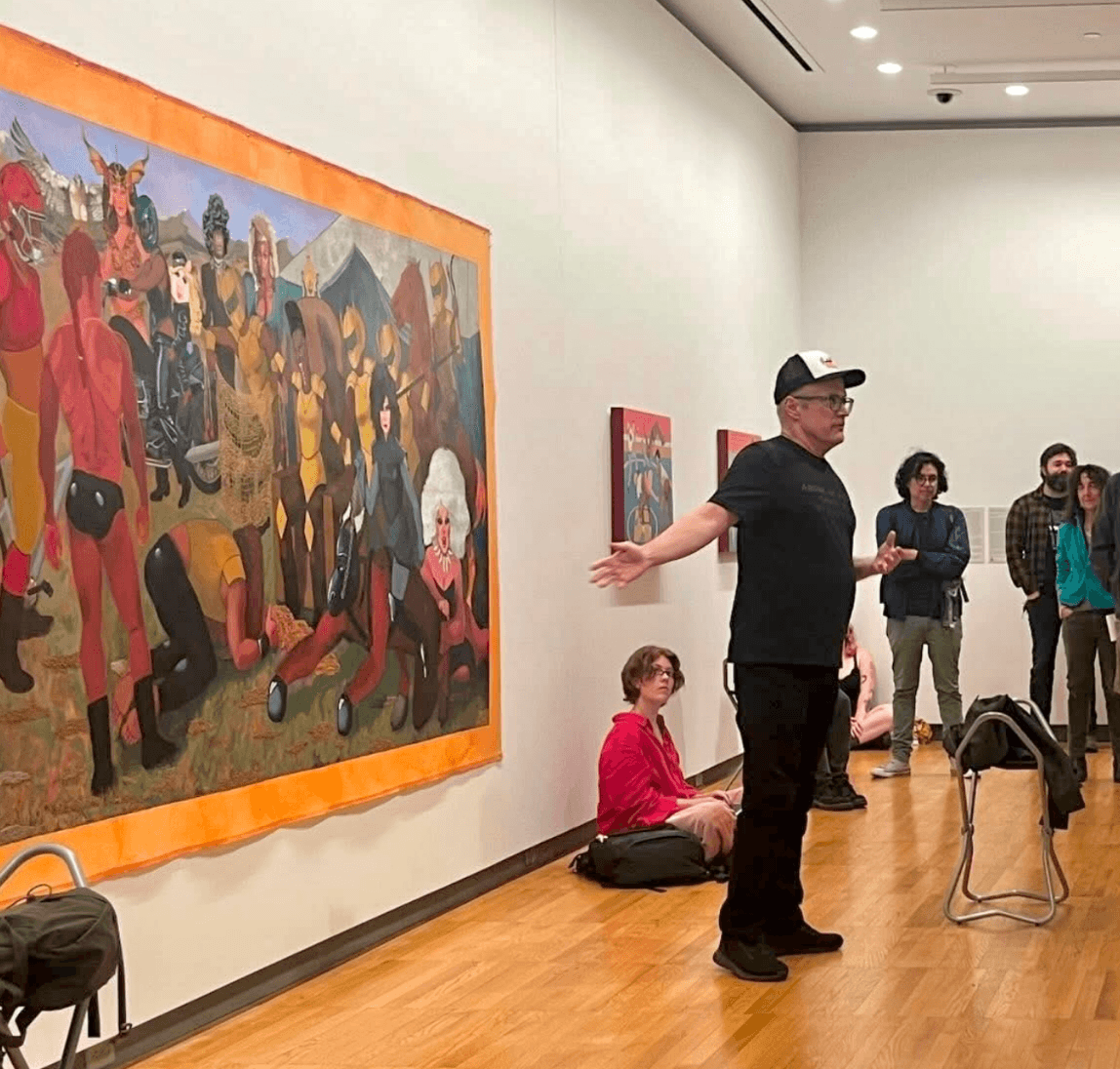
Grey Dey, artist talk
The Penthesilea painting offers a visually colorful ensemble of things to look at. A temporary encampment scene, part circus tent, part trailer park, it suggests an unruly and nomadic existence. We see men on bicycles, a wild assortment of costumes, and a large tent resplendent with glitter. Importantly, Paris and his two escorts are the only men in the painting (with the exception of a satyr). We can’t see their faces, but they appear scantily clad, suggesting they are naked and objectified. Dey presents the Amazon warriors in an imaginative rather than literal way. They are marvelous with glitter accents on their wigs and clothing conveying a magical aura. They embody lesbian separatism and qualities of queer utopia; they are an army of fierce women-only warriors, isolated from patriarchal institutions and mainstream society, who appear to be building an autonomous culture. However, their queer sanctuary does appear either in flux, evident by its improvised condition, or Dey is emphasizing the community’s need to remain vigilant amid changing societal dynamics. One clear message of the chronicle is that men need and want to utilize these women’s strength; the Trojan men have come begging for their help.
Left to right in the painting we see many icons important to the LGBTQ+ community assembled in this queer haven: Cher, who was a 1970s feminist icon, is presented with a peregrine falcon perched on her gloved hand; Miss Piggy, the Muppet diva character, rides pillion on a motorcycle piloted by an anonymous lesbian warrior; Marsha P. Johnson, the transgender activist who played a pivotal role in the Stonewall riots, glances about to see if the Trojans are being followed; Tina Turner, the post-apocalyptic queen in Mad Max Beyond Thunderdome, stands alert with her fellow warriors; Grace Jones, whose visage is taken from the cover of her 1985 album Slave to the Rhythm, which famously features an elongated open-mouth cry, is Queen Penthesilea; Siouxsie Sioux, the “Godmother of Goth” who fronted the post-punk Siouxsie and the Banshees, is astride a satyr holding a riding crop; and finally, well-known for appearing in many John Water’s films, Diva, the underground drag queen with her exaggerated and arched pencil-thin eyebrows, is sexually fisting the woodland creature. This final vignette is important since in Greek mythology a satyr is half-man and half-goat, known as a rowdy and lustful companion to Dionysus, the god of wine and debauchery. Dey depicts the satyr as captured and tame, wearing a BDSM muzzle, while being sexually violated as if to say, “Now the tables are turned.” The other Amazon soldiers are anonymous, with an almost Star Wars–stormtrooper quality about them, donning helmets with pointed “knife” ears.

Cover of Grace Jones’ “Slave to the Rhythm,” 1985, designed by Jean-Paul Goude.
Significantly, in her memoir Grace Jones describes the artwork that Dey bases Penthesilea on as capturing the expression of the final push of childbirth. A polaroid of her face was cut up to stretch her mouth wide and make her hair look extended, conveying motion. The album Slave to the Rhythm was built around eight variations of a single track, thus the cover image is a photomontage which mirrors a deconstructed fragmentation of the musical content that nevertheless represents the whole. It is a complicated reference to separatism and the creation that can result from it.
Classical mythology gives us one reason Penthesilea accepts Paris’ request to aid the Trojans which has nothing to do with the efficacy of his plea. She seeks redemption, which is only attainable through death in battle, for accidentally killing her sister Hippolyta, in a hunting accident. This veiled element of the story adds another complex layer of deception that Dey likely relishes obscuring.
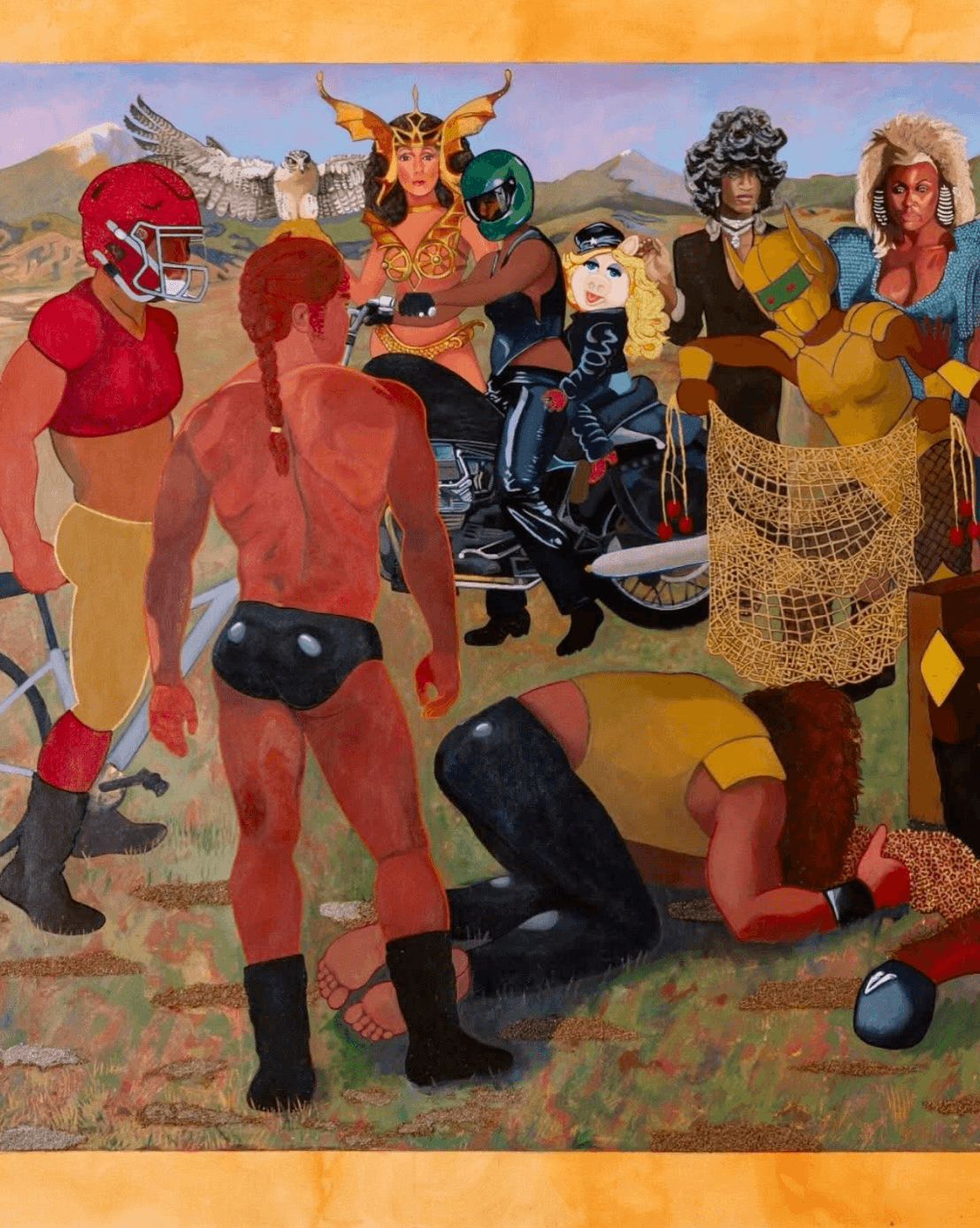
Detail from “Paris Petitions Penthesilea”
The title of the show, Reckoning, suggests a judgement of sorts. We can feel that dynamic throughout the paintings, yet it also speaks to Dey’s interest in assessing what he describes as the contemporary patriarchal, capitalistic, white supremacy which obstructs the utopian ideal, or at least aspirational exemplar, he can imagine. Dey seeks to oppose any agenda of erasure in his community and proudly celebrates what is akin to self-liberation.
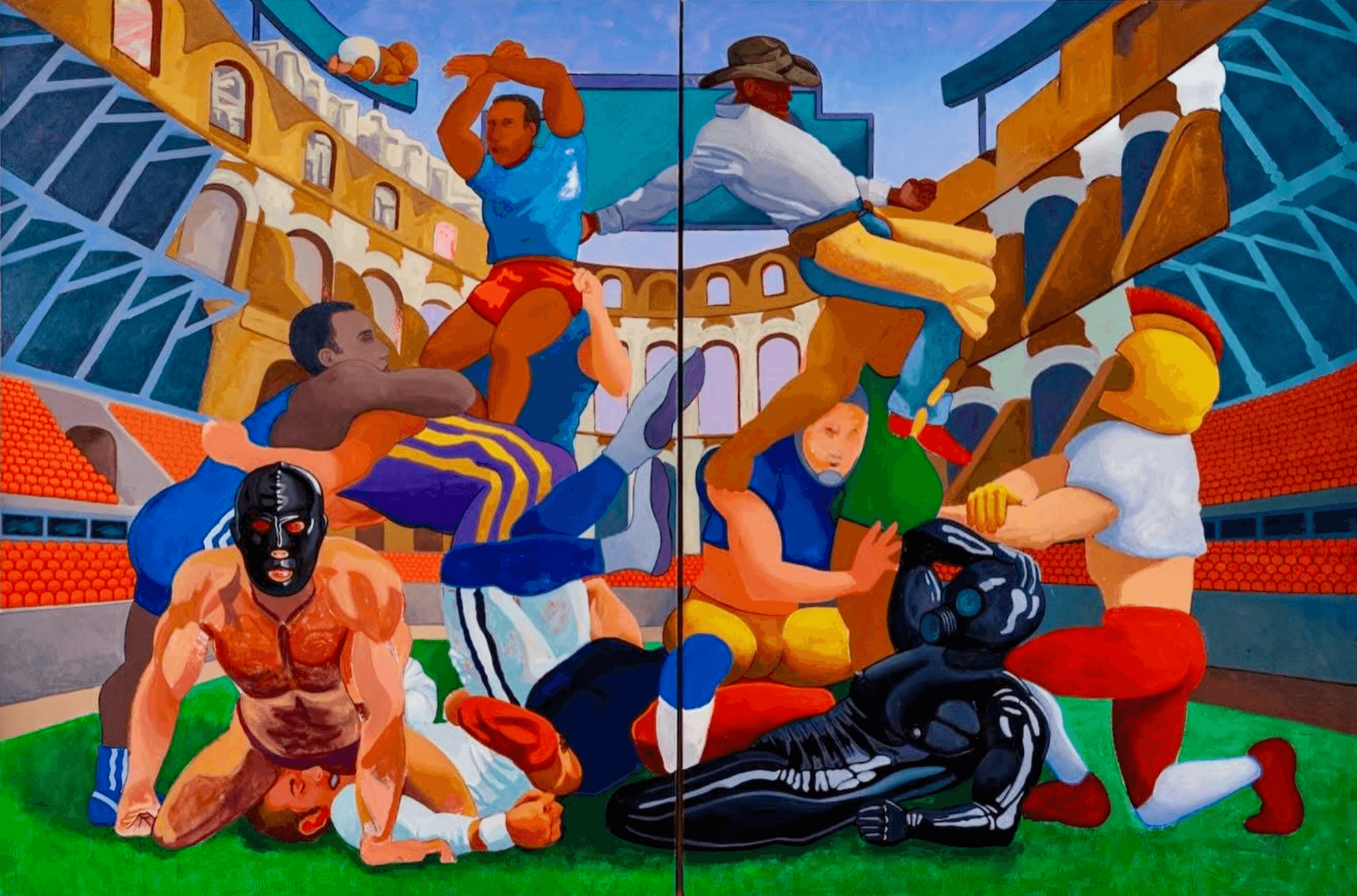
Grey Dey, The Stadium, acrylic on canvas, 48 x 72 inches, 2025.
Other paintings showcase related themes. In “The Stadium,” Dey conflates the modern sports stadium with elements of the Roman coliseum. He uses reference to homoeroticism, which we saw in the Penthesilea painting, to present contact sports as being fundamentally about male bonding and intimacy. In “Daisy Chain,” and “Turkey Day Game,” team sports and military conscription are offered as repressed queer urges or possibilities that Dey manifests as being quite obvious. For him, these activities are the pretense from which to engage in same-sex activity. Eroticism is inherent in contact sports, where violence and sensuality intersect. He isn’t interested in depicting sports to tell a narrative about an exciting ballgame. For Dey, the football player is a modern gladiator who gets to pretend to be hetero-masculine, all the while exploring his true sexual orientation.
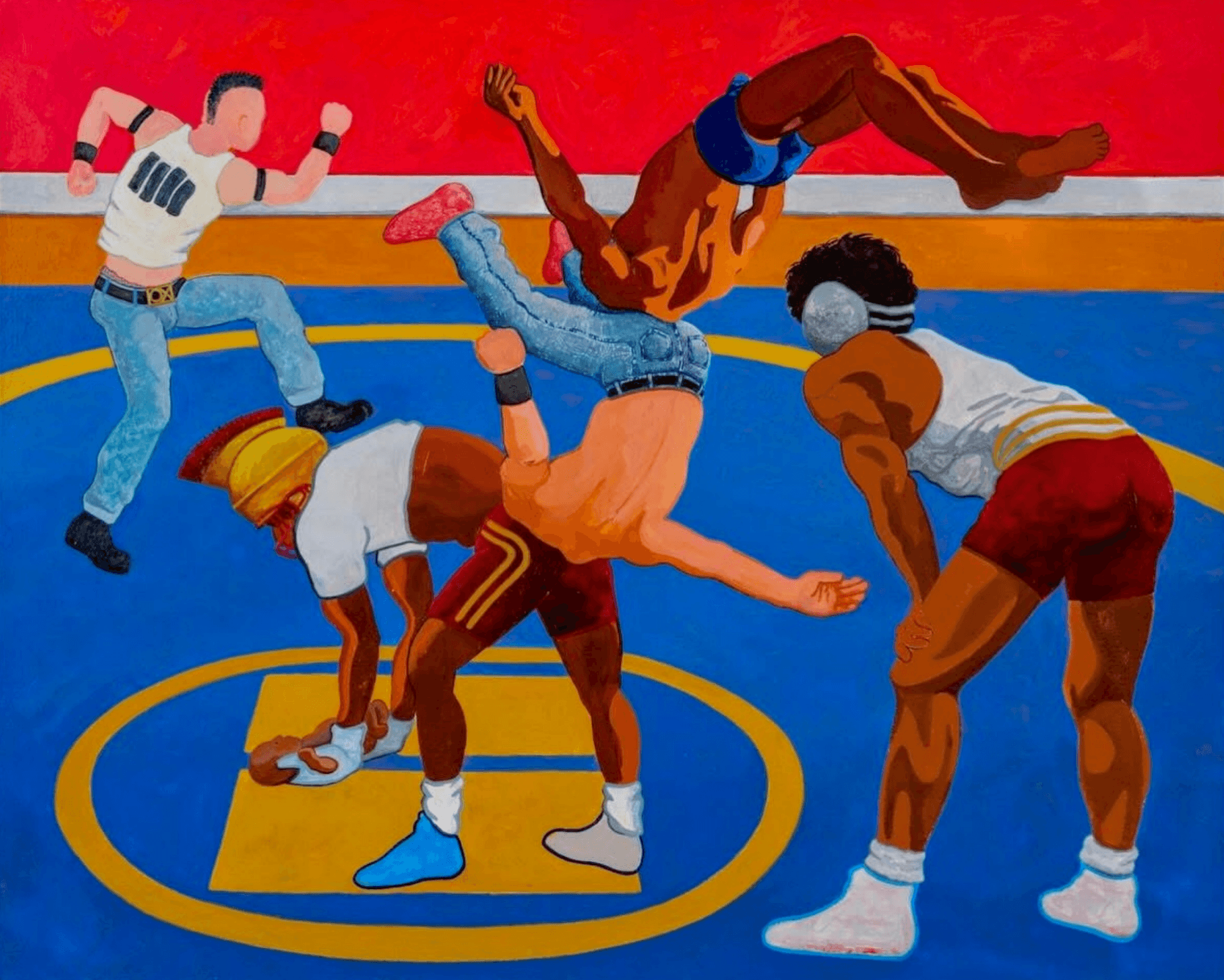
Grey Dey, Daisy Chain, acrylic on canvas, 24 x 36 inches, 2025.
Dey also seems to be commenting on the exploitation of people of color in sports, or at least highlighting their prominence. From a young age, depicted in “Daisy Chain” as a baby being scooped up by a player wearing an ancient helmet with a transverse crest of horse hair, there is a belief in many disadvantaged communities that these activities are the sole route to upward mobility. Dey asks us to consider whether that reflects intergenerational exploitation.
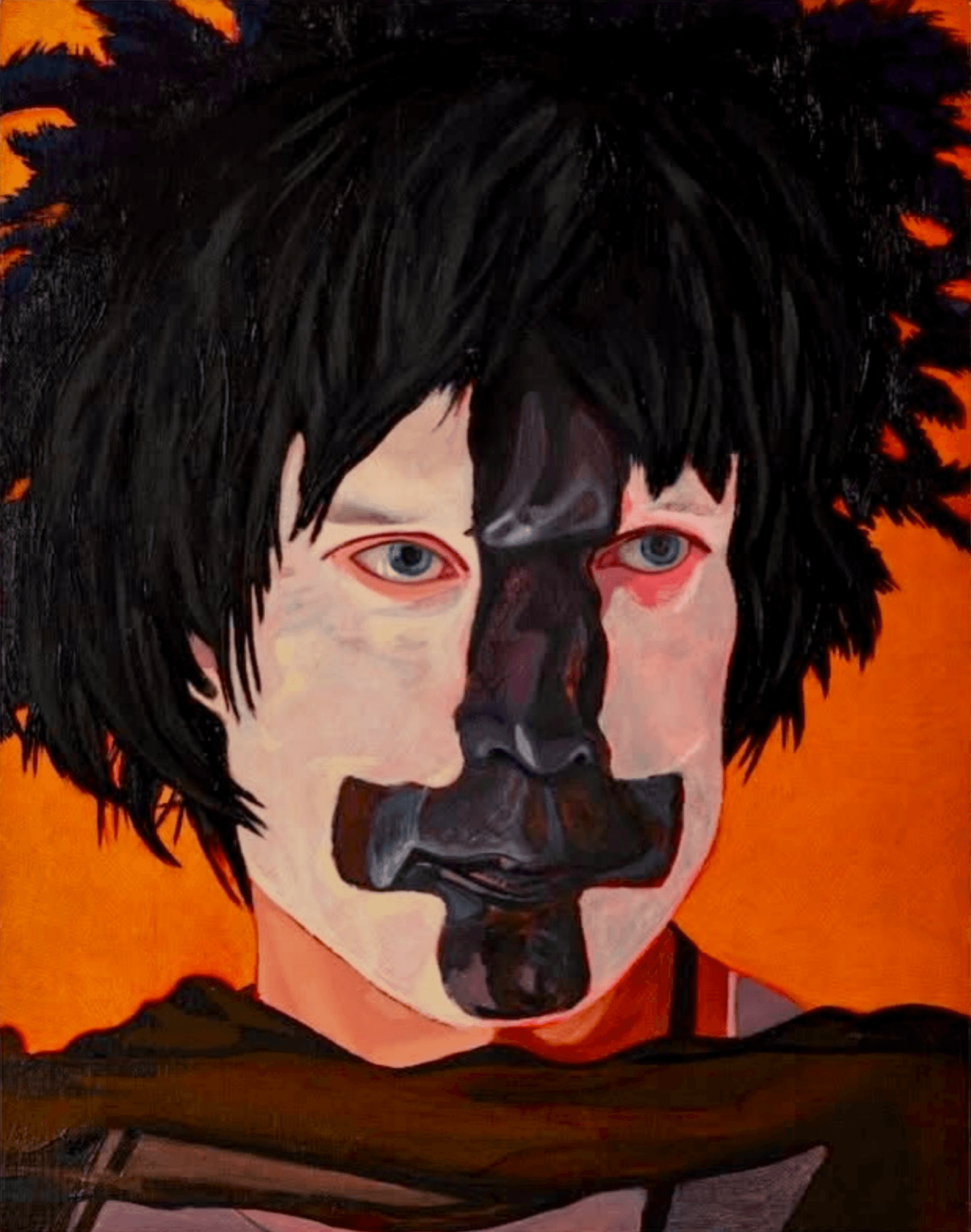
Grey Dey, Cross Addicted (Self Portrait as The Heretic), oil on wood panel, 14 x 11 inches, 2024.
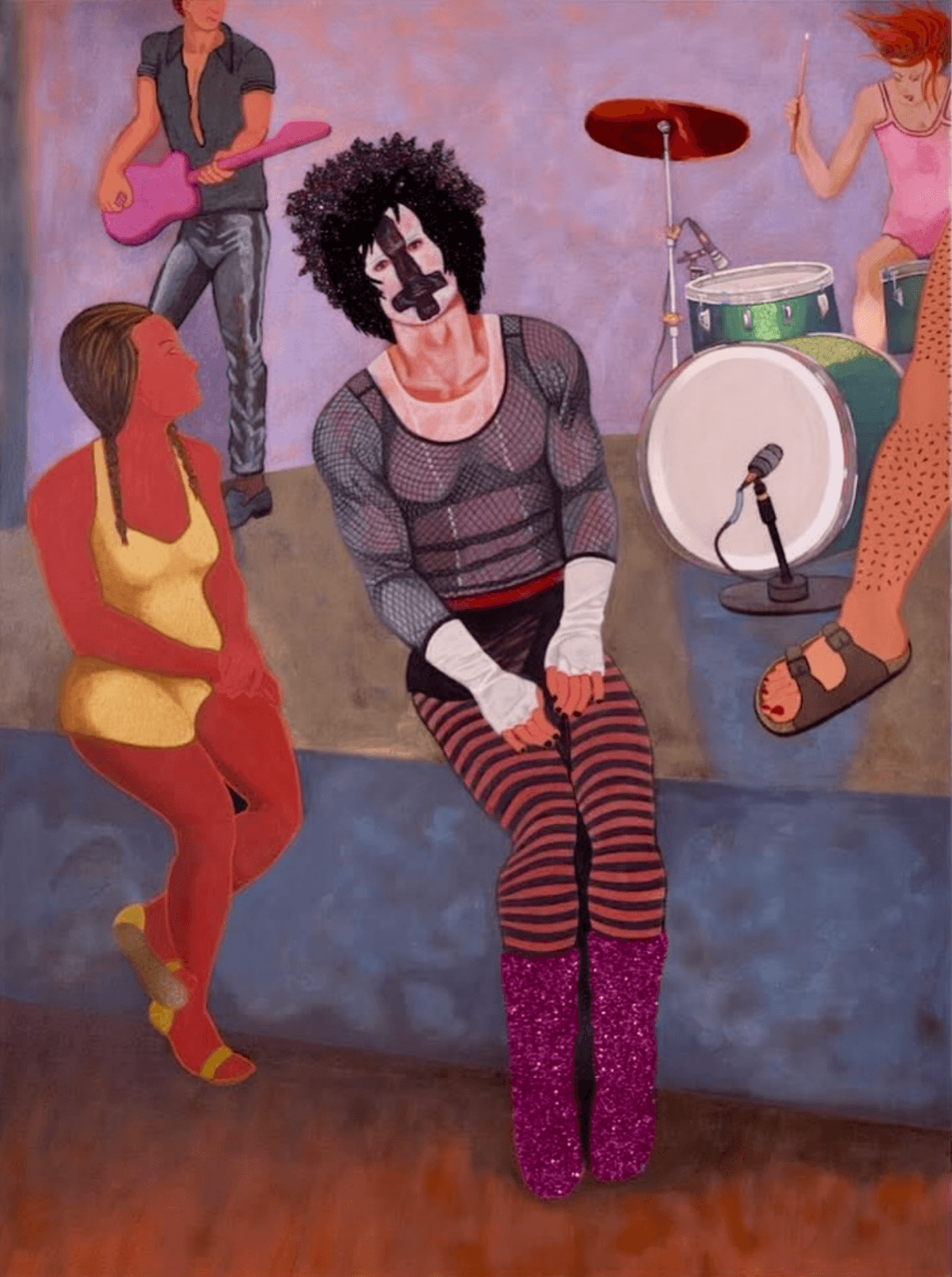
Grey dey, Nana Never Disappoints, acrylic and glitter on canvas, 48 x 36 inches, 2026.
Another group of paintings presents self portraits with crosses and clown faces. Dey recounts going to see bands in the early 1980s Boston hardcore scene and being violently targeted in the mosh pits. He references the heteronormative facade he adopted to blend into the prevalent cisgendered standards. Despite this, he was too outrageous even for this rowdy and aggressive, pushing and slamming crowd. The target paintings, “Cross Addicted” and “Target Face” are about reclaiming the shame of being a victim in these settings. Many figures wear tight-fitting hosiery and make-up that obscures specific facial details while conveying a deep loneliness. These pictures are Dey’s effort to come to terms with those memories.
This exhibition resists didactic certainty. Interpretation remains open as Dey places signifiers before us that lean in distinct directions. His honesty lies in queering the narrative, thus making it his lived experience. Dey asks “Why paint if I’m not going to paint me?” This is the ultimate authenticity he offers the audience. It’s a raw intimacy featuring himself. Yet, he recognizes a viewer will have to engage the paintings with their own ethos. This doesn't diminish the work but rather universalizes it and invites others to wrestle with symbols and themes they may not otherwise encounter.
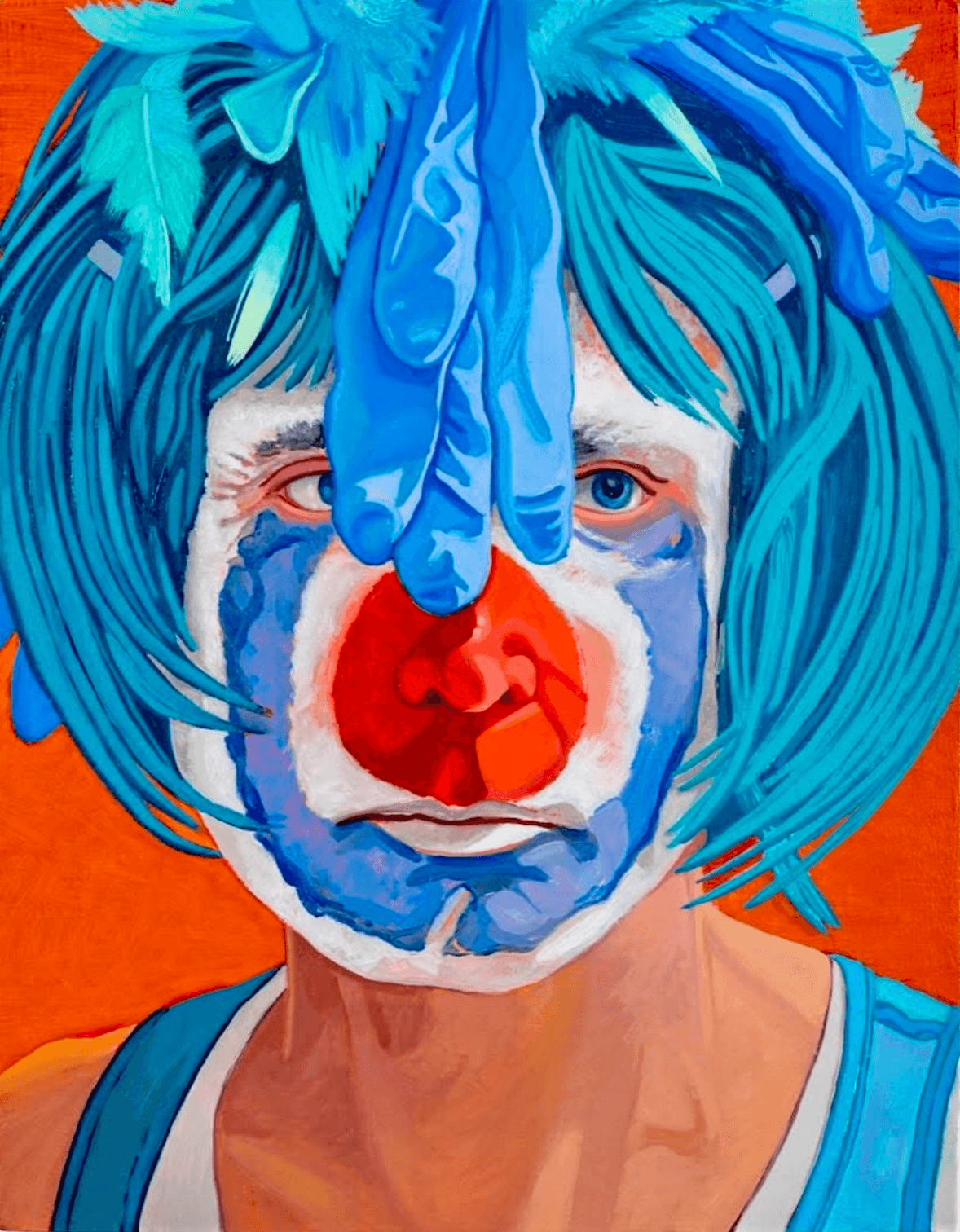
Grey Dey, Target Face (Self Portrait as The Clown), oil on wood panel, 14 x 11 inches, 2024.
There is a wonderful dichotomy between detail and restraint in these paintings. In many compact areas Dey goes further and embellishes particular elements. In other places he relies on discipline to say less. The paint alone, particularly in the sports paintings, gives off a color field experience, where the disbursement or pigment catches the eye and helps the viewer celebrate the inventive quality of the composition. Gay masculine themes abound, but they do so without feeling like these paintings are only for the LGBTQ+ community. These pictures are not restrictive in that sense. At a time the individual is fighting to be noticed, where new things are rarely a departure from the past, these paintings convey the arrival of a painter who has found a way to elevate tangible scenarios with myth-making vignettes and painterly brush work. Dey is crafting important paintings and questioning everything about the expectations placed on a gay man in this particular moment in history. He meets the occasion by reinvigorating the self and amplifying community.
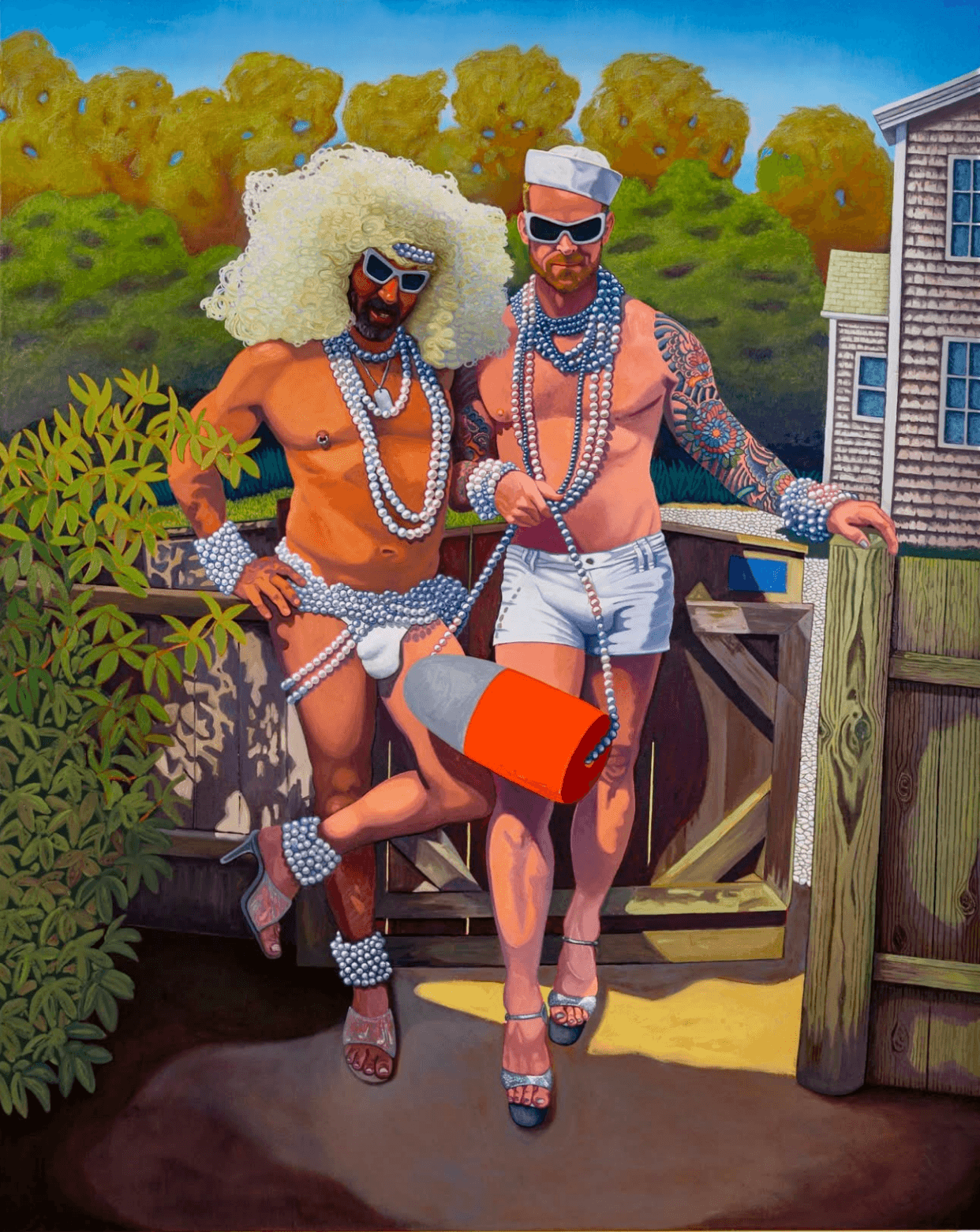
Grey Dey, The Hidden Place, oil on canvas, 60 x 48 inches, 2024.
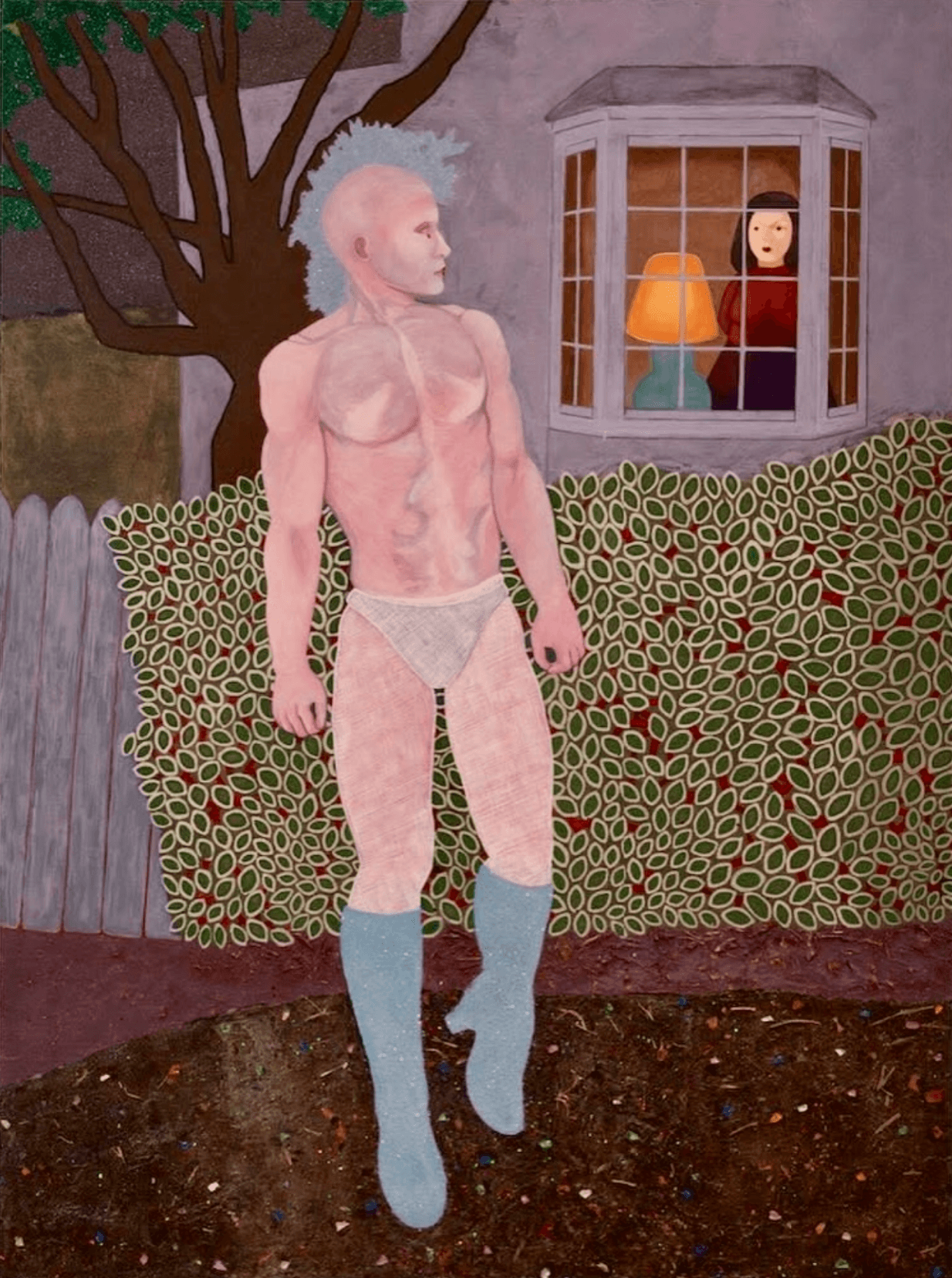
Grey Dey, Serious Moonlight, acrylic, glitter, and debris on canvas, 48 x 36 inches, 2026.
