

Moving San Francisco: Views from the SFMTA Photo Archive 1903 - Now, City Hall, San Francisco
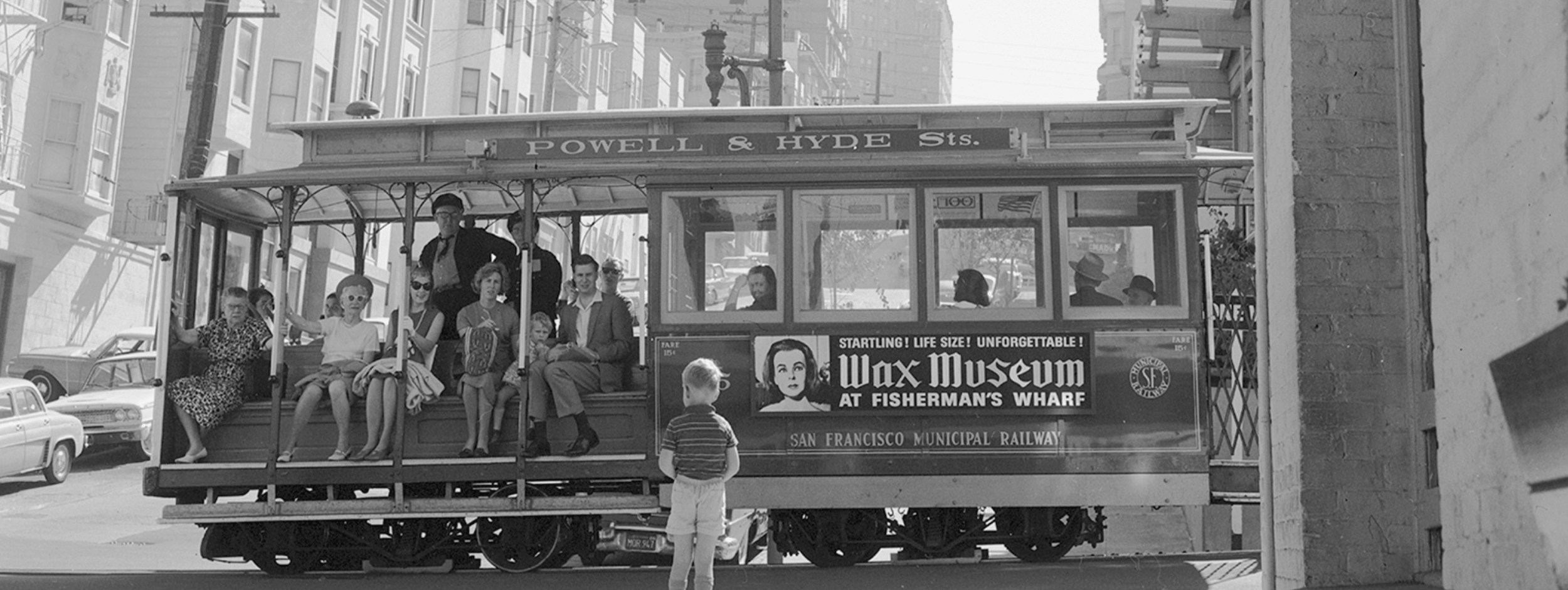
City Hall, San Francisco, Jan 15—Jun 18, 2026
To see Moving San Francisco: Views from the SFMTA Photo Archive 1903 – Now, the exhibition organized by the San Francisco Arts Commission (SFAC) and the San Francisco Municipal Transportation Agency (SFMTA) Photo Department & Archive, you enter City Hall, pass crowds of newlyweds waiting for photos beneath the grand staircase, then descend to the ground floor. In the hushed quiet, a hundred photographs, most of them black-and-white, line the long corridor there, guiding visitors deeper into the building and also the city’s past.
The exhibition’s main concern is the history of San Francisco’s public transportation system, and it approaches this history from a broad perspective that goes beyond passengers or the experience of transit itself. Many of the photos direct attention to the labor, maintenance, and construction that allow the city’s movement to function in the first place. For many San Franciscans today, interaction with the Municipal Railway (MUNI) may consist only of tagging a Clipper card before swaying from point A to point B, but photos of the exhibition take viewers behind the scenes, attending to the workers and infrastructure that sustain those ordinary passages through the city.
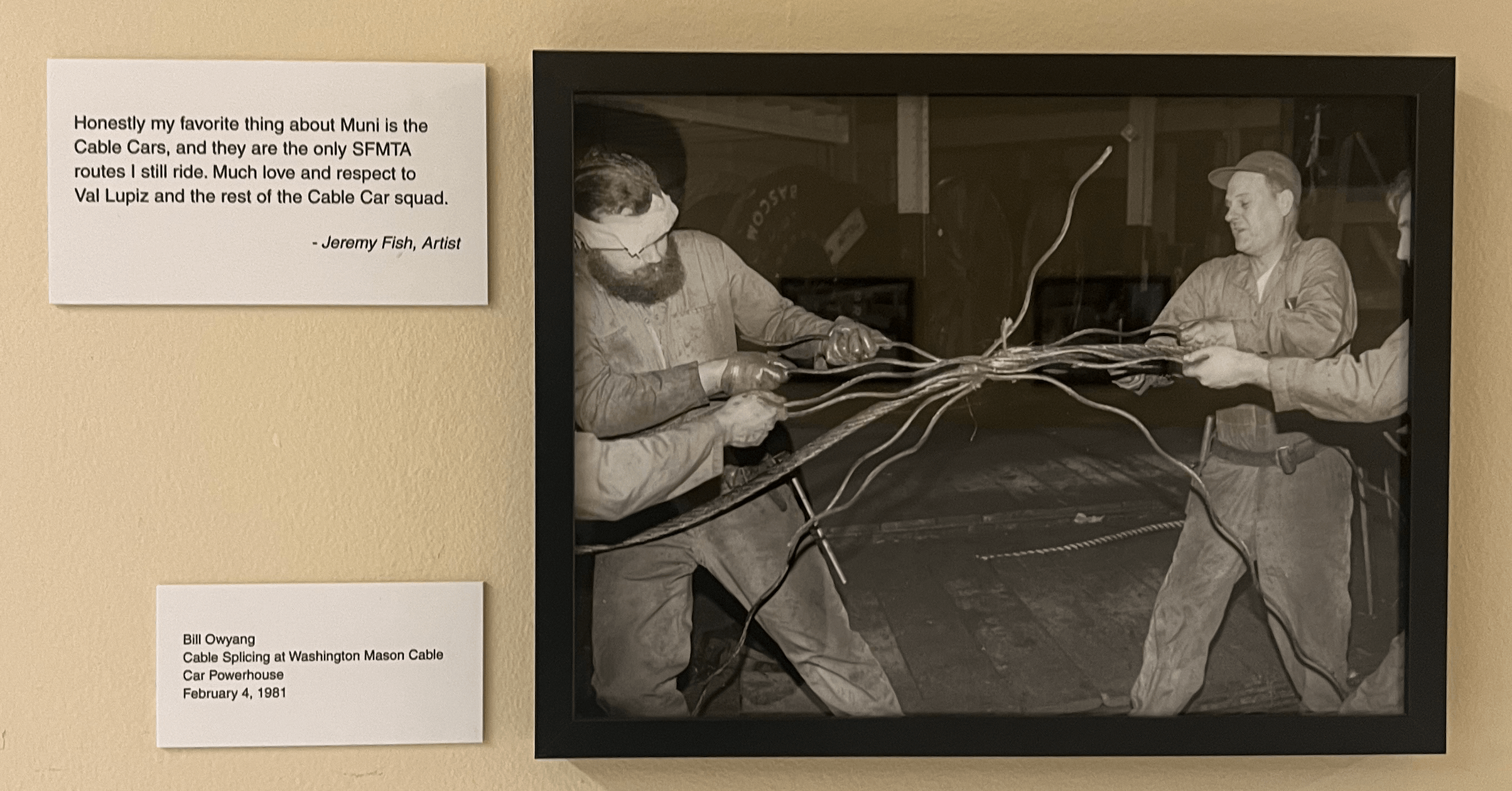
Bill Owyang
Cable Splicing at Washington Mason Cable
Car Powerhouse
February 4, 1981
In Bill Owyang’s Cable Splicing at Washington Mason Cable Car Powerhouse (1981), four workers gather around a thick steel cable, engaging in the specialized process of cable splicing: untwisting strands of steel before reweaving them together into a continuous loop. The men lean backward in unison, using their body weight to counter the cable’s resistance, their formation resembling a tug-of-war. Their uniforms are stained, as are the floorboards beneath them, suggesting the routine nature of the work. The photograph thus captures not only physical exertion but a form of maintenance that remains invisible to passengers riding the cable cars aboveground. What appears seamless at street level depends upon such constant behind-the-scenes labor.
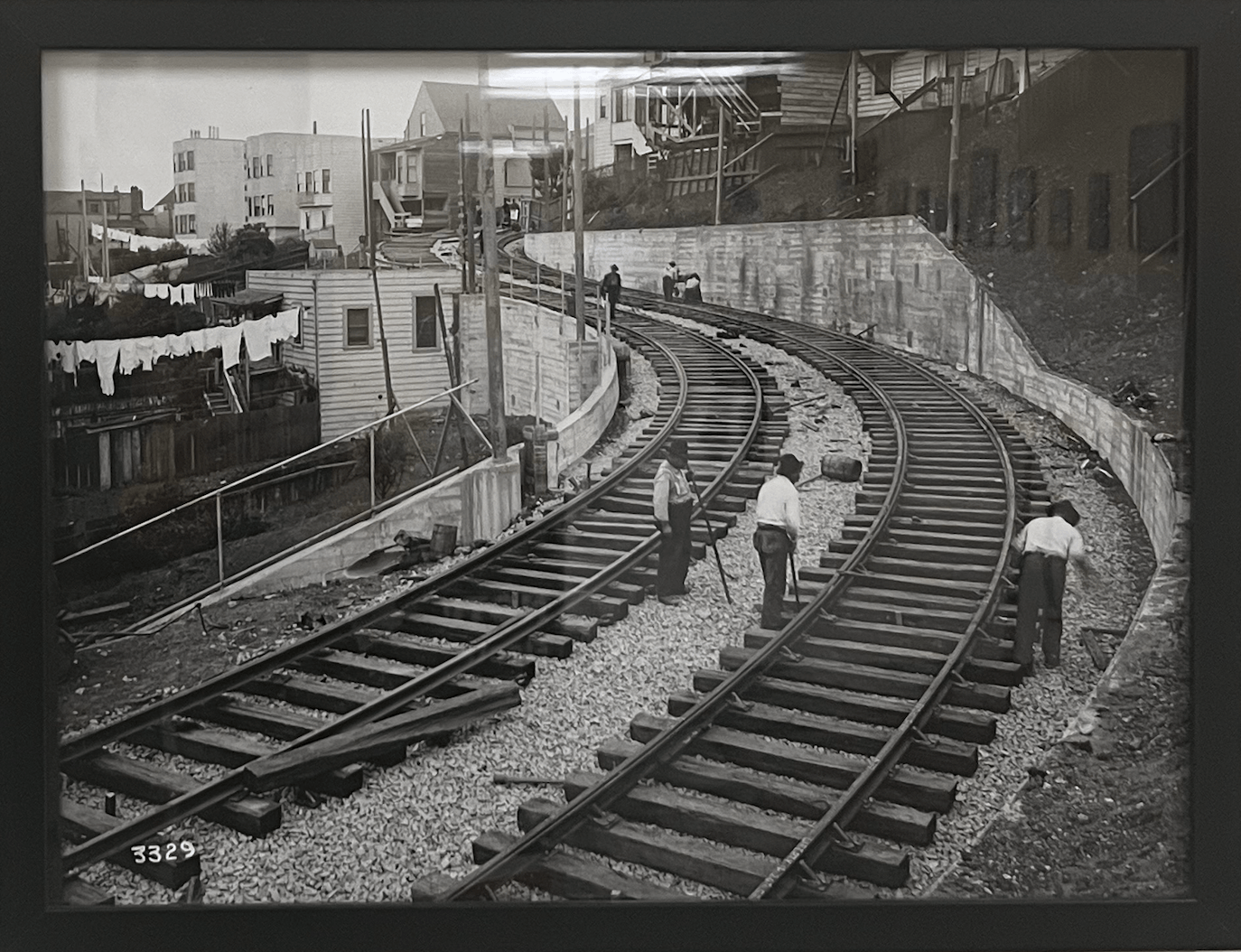
Horace Chaffee
Construction of J Line Streetcar Tracks
Looking East from 22nd Street and Church
Street
June 8, 1916
Construction recurs throughout the exhibition as another form of movement. Streets repeatedly appear torn open and rebuilt: Market Street becomes a construction site for the Embarcadero BART station; Collingwood Street opens again for work on the Twin Peaks Tunnel. In Horace Chaffee’s Construction of J Line Street Tracks Looking East from 22nd Street and Church Street (1916), newly laid tracks curve along the hillside in a loose S-shape, engineered to accommodate the terrain’s slope. Three workers stand with their backs to the viewer, inspecting the tracks as retaining walls rise beside them. The wooden houses in the photo remain recognizably San Franciscan, though smaller details—like clotheslines stretched between buildings—belong to forms of urban everyday life that have largely disappeared.
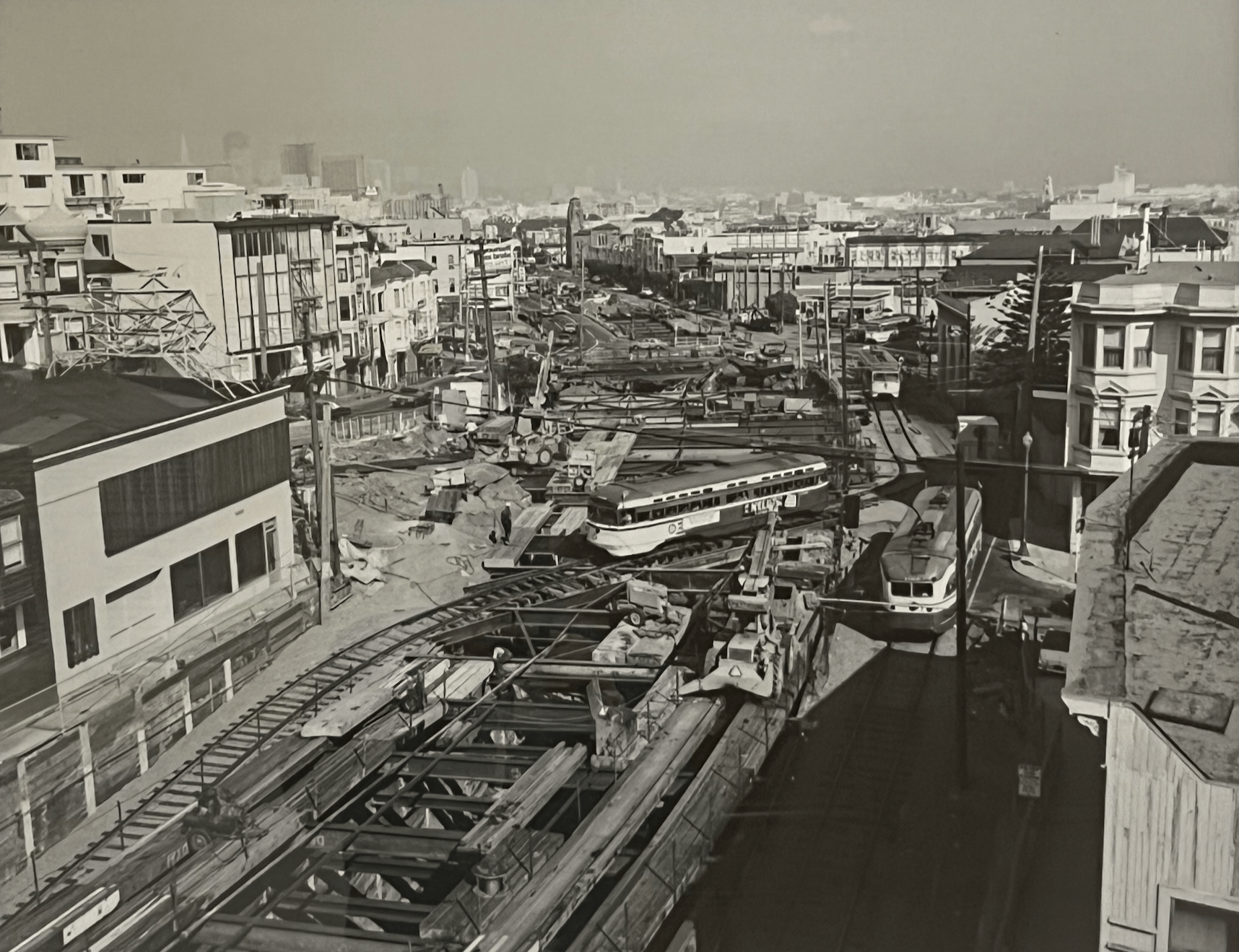
Marshall Moxom
Temporary Structure Bridge Over
Construction of Connection Between Market
Street Subway and Twin Peaks Tunnel Now
Market and Collingwood Streets
October 17, 1974
Other photographs capture the changing forms of MUNI vehicles and equipment over time. In Marshall Moxom’s Muni Overhead Line Department Crew on Tower Truck (1947), an earlier version of the tower truck appears, before the larger fire-engine models more familiar today. A collapsible ladder rests on its flatbed besides coils of cable and electrical equipment. The vehicle’s compact design suggests a different stage in the development of the city’s transit system.
Interspersed among the photographs are small wall plaques displaying comments from San Franciscans reflecting on MUNI. In one, the author Lia Smith shares her fondness for MUNI: “… Muni vehicles lift my spirits, remind me of what’s important, provide rich entertainment, and are opportunities to interact with a diversity of my fellow San Franciscans.” Here, “moving” expands beyond transportation into something emotional: memories of daily commutes, familiar routes, moments of connection. Public transit emerges not merely as infrastructure but as one of the systems through which residents experience belonging to the city itself.
The exhibition at times broadens its understanding of movement even further. A photo of the collapsed City Hall after the 1906 earthquake, its dome ribs still standing but the infill all gone, reminds the viewer that the infrastructure is built for a city that itself was on the move. This broader understanding of movement becomes especially resonant because of the exhibition’s location inside City Hall. When I visited, polling stations had been installed along the corridor where the exhibition was held. The juxtaposition felt unexpectedly apt: the exhibition’s photographs reveal the systems and labor required to keep a city moving, while the polling stations pointed to another system through which the city politically reorganizes itself. Passengers rarely think about cable splicing, and voters rarely think about the logistical machinery surrounding an election, but both become visible only when they fail. This parallel might not be part of the exhibition’s design, but it serves as an apt reminder that the most resonant contexts are sometimes the ones curators don’t plan for.
By the end of Moving San Francisco, “moving” no longer refers simply to transportation. The exhibition expands the term to encompass labor, reconstruction, memory, and civic participation itself. What initially appears to be an archival exhibition about transit thus becomes a broader meditation on the unseen systems that allow a city to keep going. To curate an exhibition, it turns out, you don’t need to arrange everything in advance.
