

Henri Matisse, Femme au chapeau: a Modern Scandal, San Francisco Museum of Modern Art
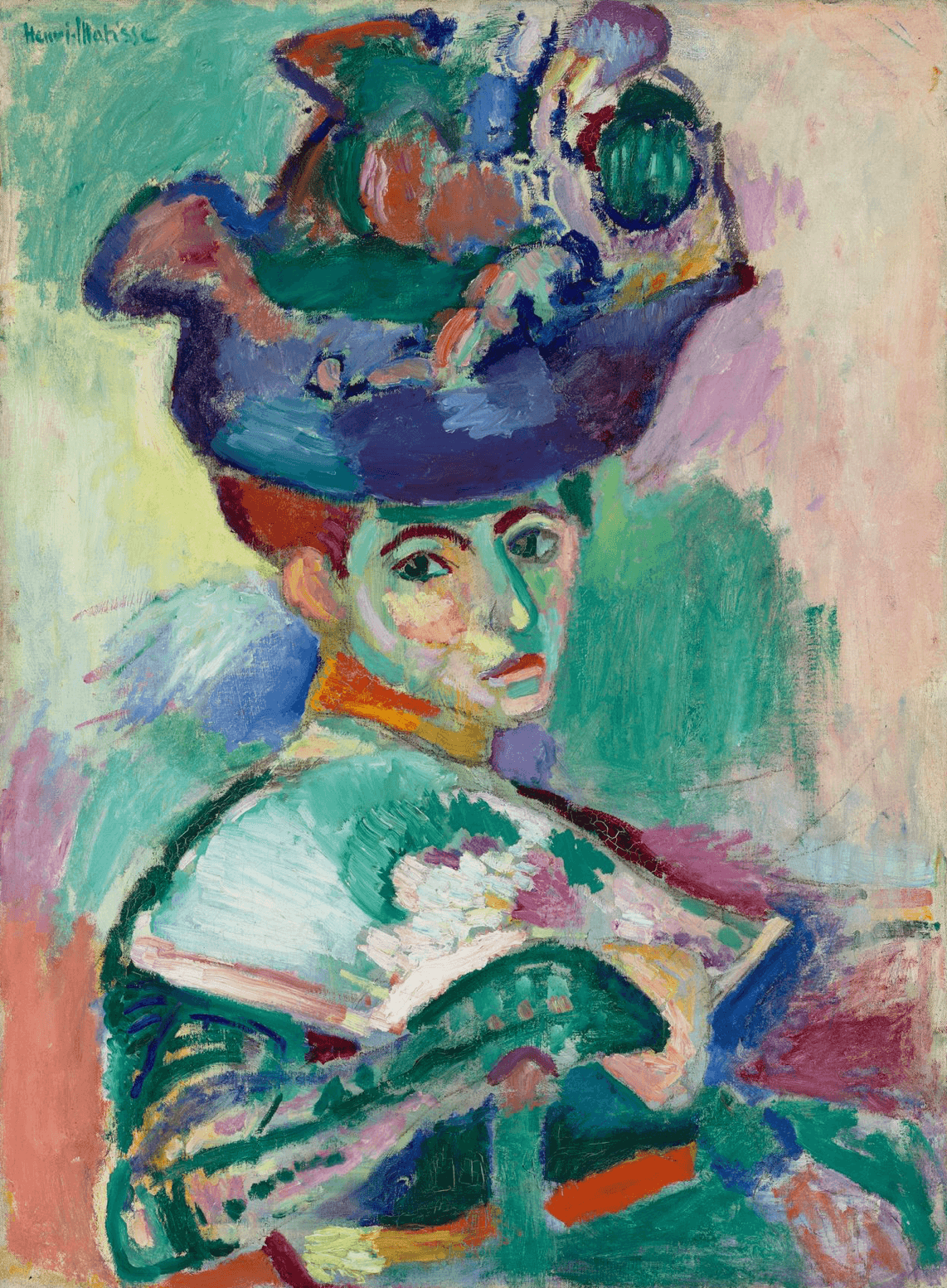
Henri Matisse, Femme au chapeau, 1905, oil on canvas, 313/4”X231/2”
By Robert Brokl
The San Francisco Museum of Modern Art’s tribute to their storied Henri Matisse portrait of his wife, Amélie, signaling the launch of the Fauvist movement, is meaty yet enigmatic, and the show’s appearance at this moment in time is intriguing. Locally, tourism is down, the commercial gallery scene is gloomy after a series of closures, and a telling reminder of the numerous art school disappearances is the San Francisco Art Institute’s elegiac memorial show, also on view at the museum. Perhaps even more pertinent to the museum’s planning is the ballyhooed opening of the new $724 Los Angeles County Museum of Art, designed by Swiss starchitect Peter Zumthor. New York Times critic Holland Cotter notes the street-vaulting, sprawling, all-on-one-level building is “advertised by the museum as a stand-alone work of art itself, a 110,000-square-foot piece of habitable sculpture” with the trendy layout organized not by more traditional, art historical means but by a “view of art as a mingling of art and influences ever on the move.”
So what’s SFMOMA, also lacking the encyclopedic collections of institutions like the Metropolitan Museum of Art and the New York Museum of Modern Art, and with its own 2016 $305 million Snøhetta expansion now a decade old, to do?
Their smart solution is to double down: highlight a crown jewel of its collection, from its debut to contemporary influences, and key to both the birth of modern art and the museum’s own origins. The exhibition was organized at SFMOMA, with the City its only venue, under the direction of Curators Janet Bishop and Maria Castro, the latter formerly with SFMOMA and now at the Met. The helpful catalog includes essays detailing the role of fashion at the time, Gertrude Stein’s poetry, and contemporary artists paying homage to the painting in their own manner.
SFMOMA has lovingly recreated the Paris 1905 Salon d’Automne at the Grand Palais, where the Femme au chapeau shared space in Gallery VII with fellow “Wild Beasts,’ aka Fauves, a critic’s term, not necessarily pejorative, that struck. The numerous Salons were wildly popular, theatrical events, drawing crowds to be entertained and see the latest: the 1905 Salon d’Automne drew twelve thousand viewers the first day, more than five thousand the following day. Press and magazine coverage extended not just to the art but the latest fashion in clothing and hats. And controversy, then and now, is not necessarily a bad thing—it attracts crowds and builds reputations. Recent notable “scandals” include the 1999 Sensation exhibition at the Brooklyn Museum, pilloried by Rudy Giuliani, and the 2011Hide/Seek exhibition at the Smithsonian.
Gallery VII is recreated approximately, with wainscot and wallpaper designed by local artist Ondrea Vicklund, replicating the fabric wall covering shown by archival photographs of the 1904 salon. Potted plastic palms add to the effect. The paintings, by all the Gallery VII artists, if not all the same work included in the Salon, are grouped by artist and are hung in single rows, not “salon style,” with sculptures by Albert Marque in vitrines. Not surprisingly, 121 years on, present-day museum goers may wonder what all the fuss was about. All of the paintings are representational, primarily figures or landscapes, and while many are highly-colored or reflect avante-garde styles of the day like pointillism, only work by Matisse, his friend Andre Derain, and Maurice de Vlaminck exhibit the explosive charge that launched Fauvism and the careers of its proponents. The others— Charles Camoin, Pierre Girieud, Henri Manguin, Albert Marquet, Ramon Pichot, and Jelka Rosen (the only woman in the grouping, and whose works are scattered)—are museum-worthy, if not extraordinary.
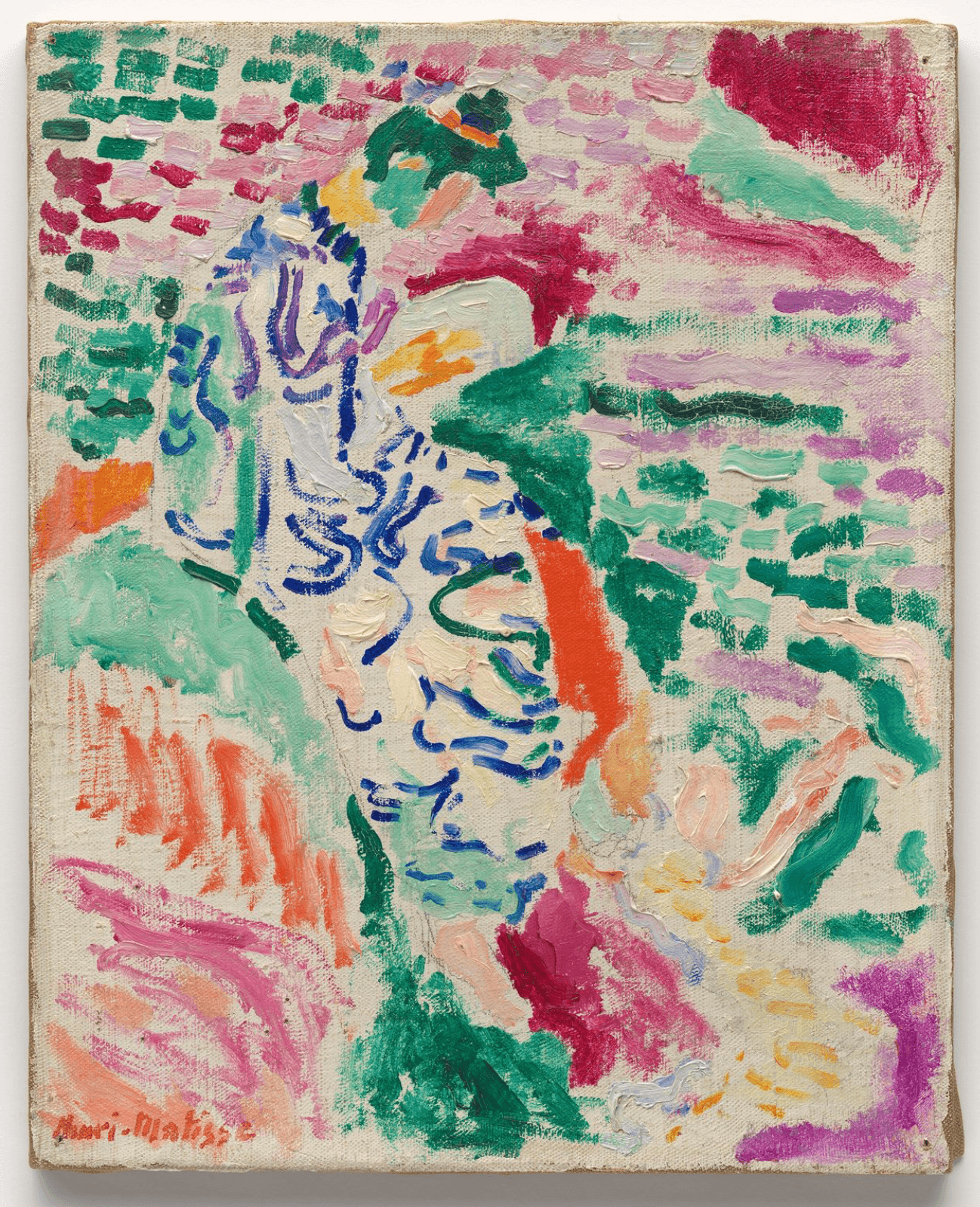
Henri Matisse, La Japanoise:Woman Beside the Water, 1905, oil and graphite133/4”X11”
Femme au chapeau depicts Matisse’s wife Amélie, age 33, wearing an elaborate hat likely of her own making, holding a fan, and gazing unperturbably toward the viewer. She’s no coquette, in the painting or in life. A skilled milliner and hat maker, she had a reputation for being assertive as young girl and had her own millinery shop in a fashionable part of Paris. Matisse and other artists depicted her at work, and wearing kimonos. She was a major contributor to the household income—Matisse had yet to sell paintings, and made scant money doing commercial art. To further complicate their lives, Amélie’s parents had been implicated in a notorious Ponzi-style scandal and while her father was vindicated in court, they were implicated nonetheless. Amélie’s shop and Matisse’s studio were searched, leaving both of them feeling raw and exposed, and not prepared for the controversy generated by the Salon.
But Matisse persevered, rejecting the safety of convention. The jarring greens and yellow on Amélie’s face, along with the simplification and deliberately unfinished look, were startling provocations. The pose, featuring the upper body of the figure, echoes Paul Cézanne’s portraits of his wife—Matisse venerated Cézanne. Matisse ventured into abstraction even more with La Japonaise: Woman Beside the Water, 1905. Amélie wears a kimono, indicated by its deep blue and white pattern, but otherwise indiscernible in a swirl of bright daubs and dashes. Open Window, Collioure, 1905, is also rather pointillist, loose shapes and flat design, a window but no depth, now familiar from so much reproduction, and unabashedly beautiful.
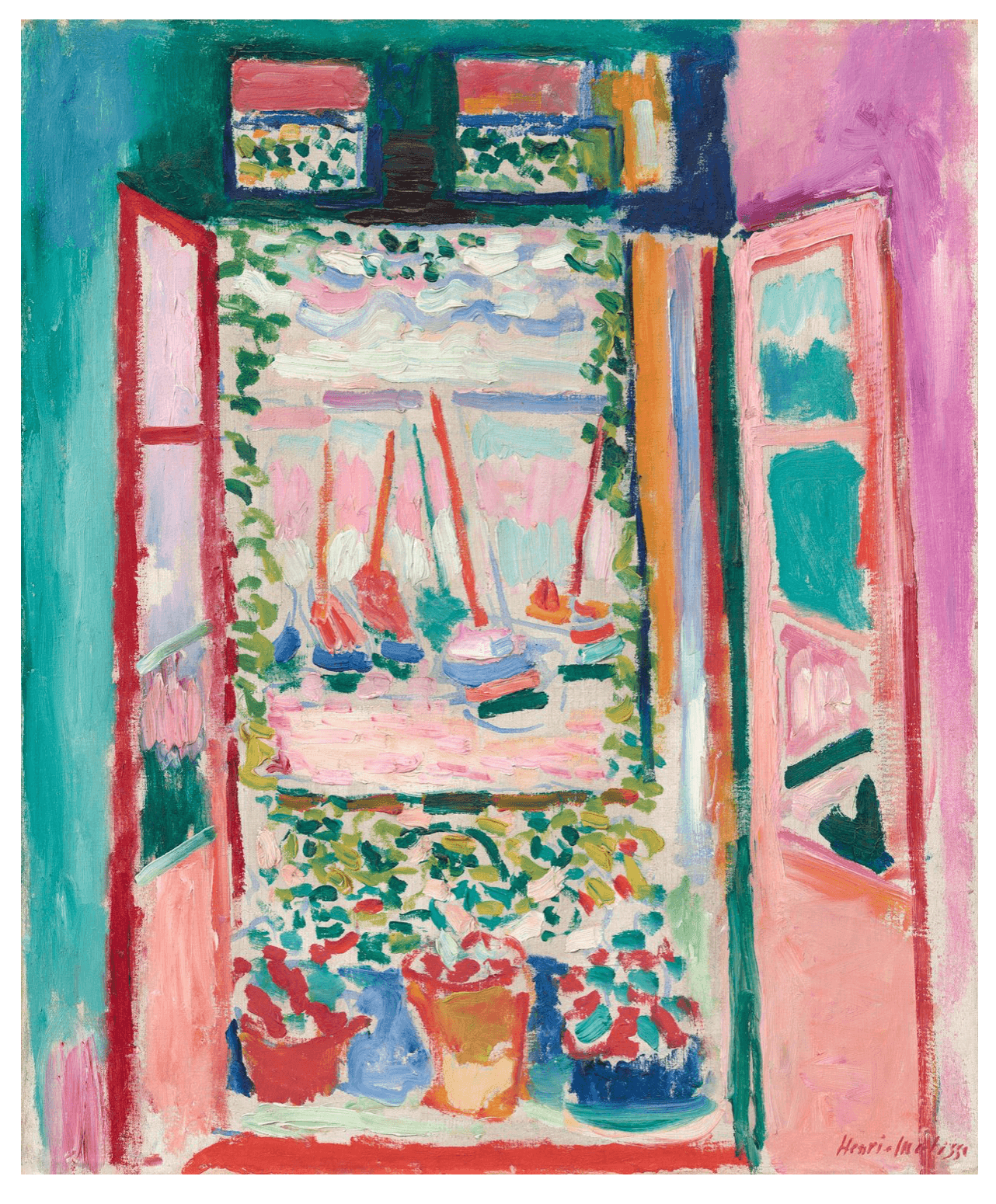
Henri Matisse, Open Window, Collioure, 1905, oil on canvas, 213/4”X181/8”
Derain’s paintings are the most aligned with Matisse, colorful (orange and red predominate) daubs and areas of blank canvas, as in Fishing Boats, 1905. Vlaminck was a self-avowed anarchist, and his paintings, evocative of Van Gogh, are swirling, energetic, and defiantly unconventional.
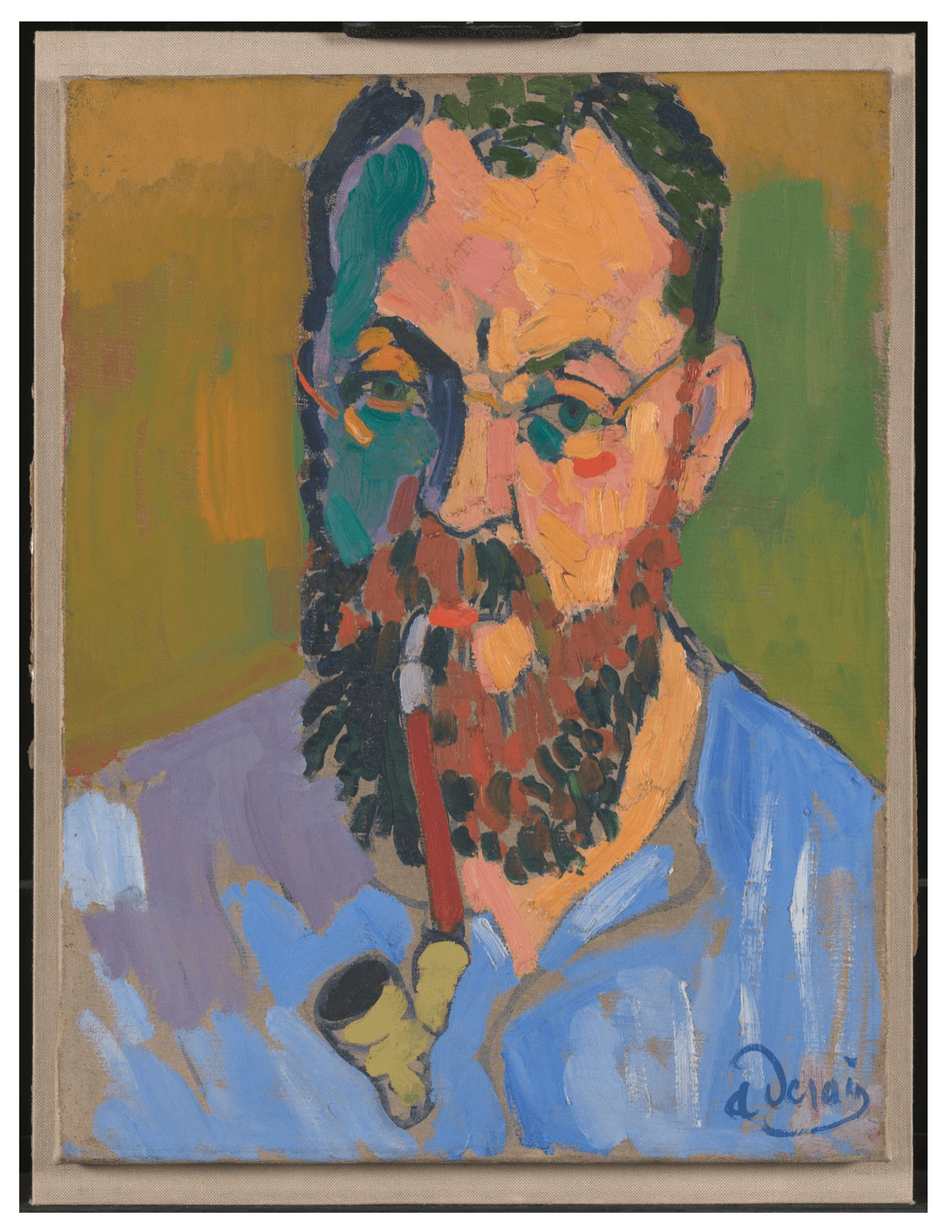
Andre Derain, Henri Matisse, oil on canvas, 181/8”X133/4”
It wasn’t just Matisse’s luck that he was the break-out star of the exhibit, Femme au chapeau generating the most attention, but Leo and Gertrude Stein arrived on the scene and bought the painting. They had moved to Paris from their home in San Francisco. Wealthy and independent, their brother Michael back in San Francisco managed their finances, based upon real estate, investments, and ownership stake, apparently, in the Market Street Cable Railway Co. Leo had developed an interest in art and a taste for collecting, Gertrude had left John Hopkins University, ending her quixotic medical studies, and knew little about art. But they soon filled their apartment with their latest purchases, creating a de facto museum of modern art and drawing curious visitors. The demand was so great for Saturday night viewing, hampered by candlelight illumination, that requests for return visits by daylight proliferated.

Andres Derain, Fishing, Boats, Collioure, 1905, oil on canvas, 1413/16”X1515/16”
To thicken the plot, the Spanish painter Pablo Picasso living in Paris is drawn to the Steins, and their largess, and is intrigued by Matisse’s break-through paintings. The Steins began to acquire Picasso, and soon introduce him to Matisse, thus inaugurating a fruitful if contentious friendship. A companion resource to Femme au chapeau is the Art of Rivalry by art critic Sebastian Smee, who analyzes the Picasso/Matisse dynamic—competitive and beneficial yet toxic, they remained respectful to each other over a lifetime, if at a distance. Picasso wins Gertrude over during the famously slow progress painting her portrait, 90 sittings in all she later claimed. Meanwhile, Michael Stein and his wife Sarah had moved to Paris and also began to collect art. Smee identifies Sarah Stein, a fashionista, as a “penetrating, persuasive woman, (who) was as avid for knowledge about art as Leo, and it wasn’t before long a current of competition began to run between her and her sister-in-law Gertrude…At Sarah’s impassioned urging, Leo bought Woman with a Hat for 500 francs.”
Gertrude dramatized the contest between Matisse and Picasso and egged them on, and when the Steins parted ways and divided their collection, Leo and Gertrude aligned with Picasso and Michael and Sarah took up with Matisse. They bought Femme au chapeau from Leo in 1915, installed the painting in their Le Corbusier-designed modernist house outside of Paris, and took it with them when they returned to the U.S., settling in Palo Alto in 1935.
Picasso became the more public face of modernism, Matisse at a remove from the white hot attention. As Smee writes: “The new movement (Cubism) caught quickly. Matisse, stuck out in front of the classroom, did his best to ignores the rising, insubordinate chatter at the back. He preferred to keep on advancing his own agenda, delving deeper and deeper into the new enchantments of saturated color, expressive decoration, and a new kind of monumental simplicity. In the process, he produced some of the greatest works of his career—and indeed of the entire century. But by around 1913, he could no longer ignore the hubbub. Gushing invention, Picasso and Braque had established themselves with astonishing speed as the new leaders of a pan-European avant-garde.”
Matisse’s sublime, decorative work is newly back in fashion, as Carol Vogel notes in the New York Times: “Call it the Matisse moment. This spring (has) come a global surge of highlighting the master of color and pattern. James Rondeau, director of the Art Institute of Chicago agrees, ‘Matisse once famously said painting is like a good armchair…And in these troubled times, that appears to be exactly what the public is craving.”
The exhibition proceeds with artists exploring the theme of women in hats, including a 1908 Vlaminck portrait with the same title, and the unusual 1934 painting by the underrated Japanese-American artist Yasuo Kuniyoshi, which depicts a still life with a black and white reproduction of Femme au chapeau.
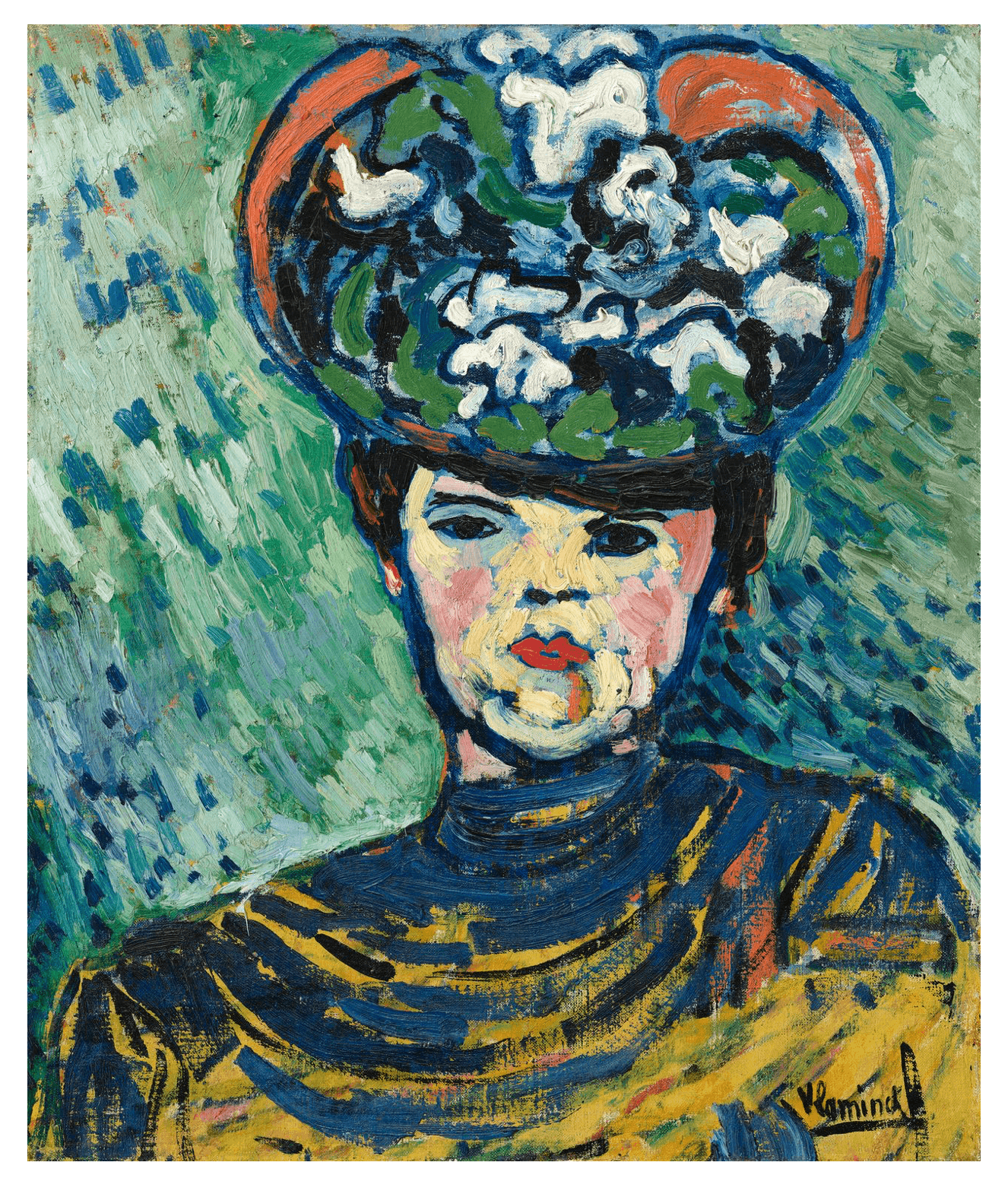
Maurice de Vlaminck, Femme au chapeau, 1906, oil on canvas, 22 1/4”X18 3/4”
Femme au chapeau is also a take on patronage and ownership. Three strong-willed, far-sighted woman are responsible for San Francisco’s own iconic, modernist Mona Lisa. After Michael and Sarah Stein’s move to Palo Alto, the SFMOMA connections to the painting began— Grace Morley, the founding director of the San Francisco Museum of Art (which became SFMOMA) showed work from the Stein collection including Femme au chapeau in 1936, just a year after the museum’s founding. Femme au chapeau remained in their hands until after Michael’s death, when Sarah sold the painting to her friend, Elise Haas, in 1948. Elise was married to Walter Haas, of the Levi Strauss fortune, but an important collector in her own right, and passionate about modern art. She served as SFMOMA trustee, and became the first woman to become board chair. The gallery devoted to her collection, donated to the museum, is a great addition to the show, but unfortunately not included in the catalog. The collection seems personal, not trophies, and includes a sensational Emil Nolde flower watercolor, Henry Moore drawings, small Georgia O’Keefe and Marsden Hartley paintings, and more.
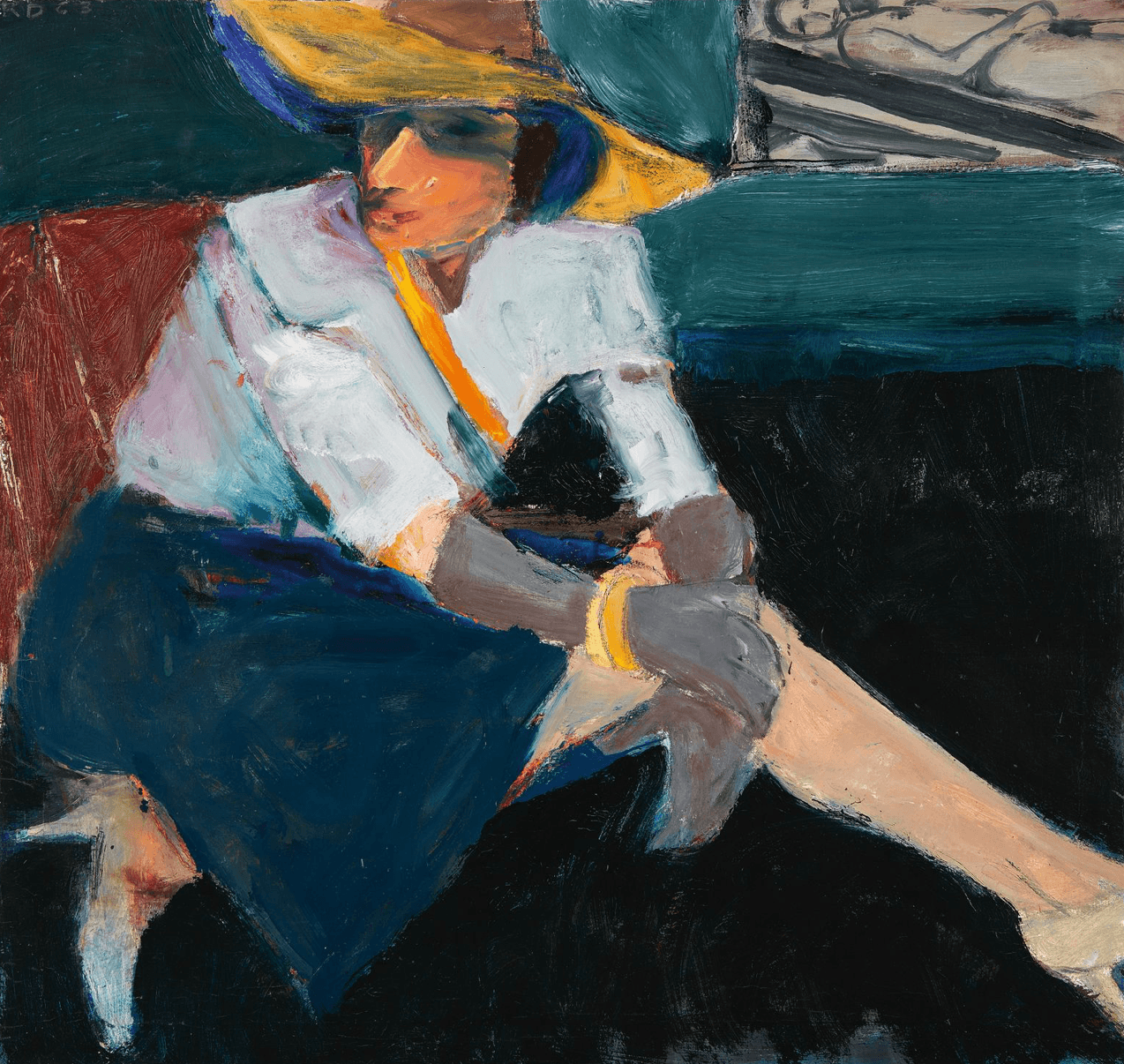
Richard Diebenkorn, Woman in Hat and Gloves, oil on canvas, 333/4”X36”
The exhibit concludes with contemporary responses to Femme au chapeau, and here the selections seem more arbitrary, except for the stunning trio of Bay area Figurative paintings. Bishop writes: “The regular opportunities that local painters had to see Femme au chapeau at the SFMA throughout the 1950s coincided with the emergence of the region’s first distinctive artistic style: Bay Area Figurative art.” Hard to argue with that, but one could make the case that the Society of Six, based in Oakland, have claim to being first, and their paintings were on the office walls of Oakland Museum of California Curator Paul Mills, when he collaborated with David Park, Richard Diebenkorn and Elmer Bischoff on his seminal 1957 Bay Area Figurative show. The grouping includes Diebenkorn’s Woman in Hat and Gloves, from 1963, depicting his wife Phyllis morphing into an abstract Ocean Park painting, the heavily troweled impasto Joan Brown female nude, Girl Sitting, 1963, with wild fauve colors, and the classic David Park Mother-in-Law, 1953-54, from his middle period before the bravura brush work took over. Her face is mostly an ocherish green, topped with amusing daisy hat, bright sunlight above, and shadows beneath the brim. The painting is wry, sarcastic but affectionate, perhaps an oddly subversive take on the Eisenhower 1950s.

David Park, Mother-in-Law, 1954-55, oil on canvas, 26”X191/2”
Here the connections are personal, too. Diebenkorn, a Stanford student, had first seen Femme au chapeau and other Matisses on a visit to Sarah Stein’s Palo Alto house in 1943, and Park, working as a teenage apprentice to sculptor Ralph Stackpole in San Francisco, saw Matisse in 1930 when he visited Stackpole’s studio on a visit to the City in 1930, on his way to Tahiti.
Any quibbles aside, Matisse’s Femme au chapeau: A Modern Scandal accomplishes what a show of this sort needs to do—turn the spotlight on a familiar artwork from its collection that viewers have been looking at for years, and get them to really see it.
