
Redacted, Carlos Ramirez and Emilio Villalba, Ivester Contemporary
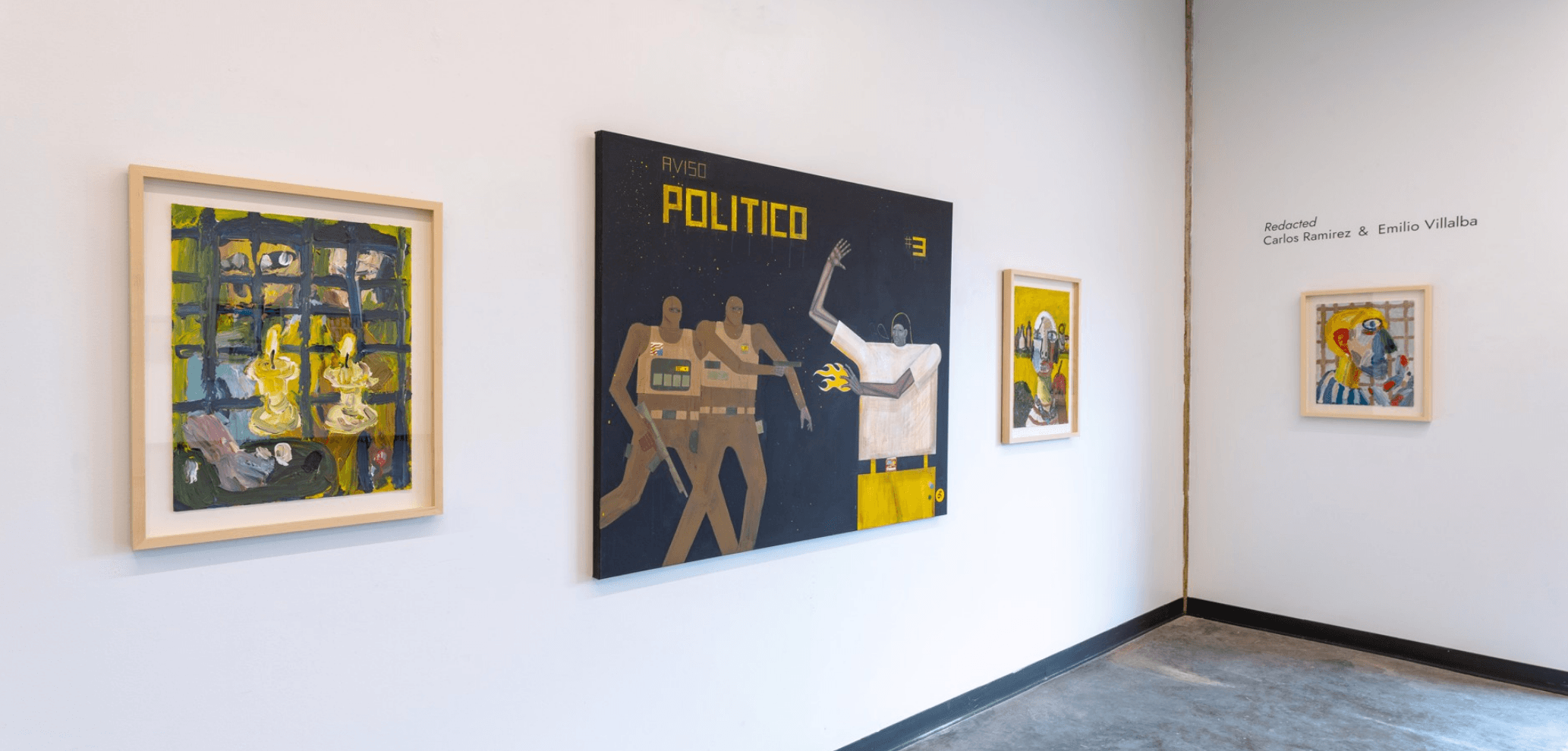
Installation of Redacted, Carlos Ramirez and Emilio Villalba, Ivester Contemporary
Confrontation and Introspection in Redacted, the current exhibition at Ivester Contemporary
Co-curated with Matt Diehl
By Grey Dey
“An artist’s duty, as far as I’m concerned, is to reflect the times.” -Nina Simone
Two profoundly engaging California-based artists, Carlos Ramirez and Emilio Villalba, have been pertinently paired together in the current show, Redacted, on view at Ivester Contemporary in Austin, Texas. Both are first-generation, Mexican-American artists addressing the crises of living under authoritarian surveillance in the United States today. They are staged in an opposite dialogue with each other. Deploying a mixed-media methodology to collaged images and assembled sculpture, Ramirez interrogates the double standards between U.S. democratic ideologies and the brutal systemic inequalities played out daily across our country. Villalba’s current acrylic works maximize painting’s ability to reveal commonly masked, hidden interiorities. They reflect the psycho-spiritual cost of coping with today’s local and global atrocities while still being expected to survive and participate in daily society.
Ramirez’s work is grounded in protest and resistance to the racist subjugation of immigrant laborers and native populations. The current work on view directly confronts the domestic violence unleashed through I.C.E. raids throughout the U.S. Raised by immigrant parents from Mexico, and criss crossing the U.S. as they searched for work, Ramirez is intimately familiar with migrant farm-worker’s experiences. In some of his works in Redacted, the acronym “I.C.E." is plainly written, and in others, it is insinuated through context and signifiers.
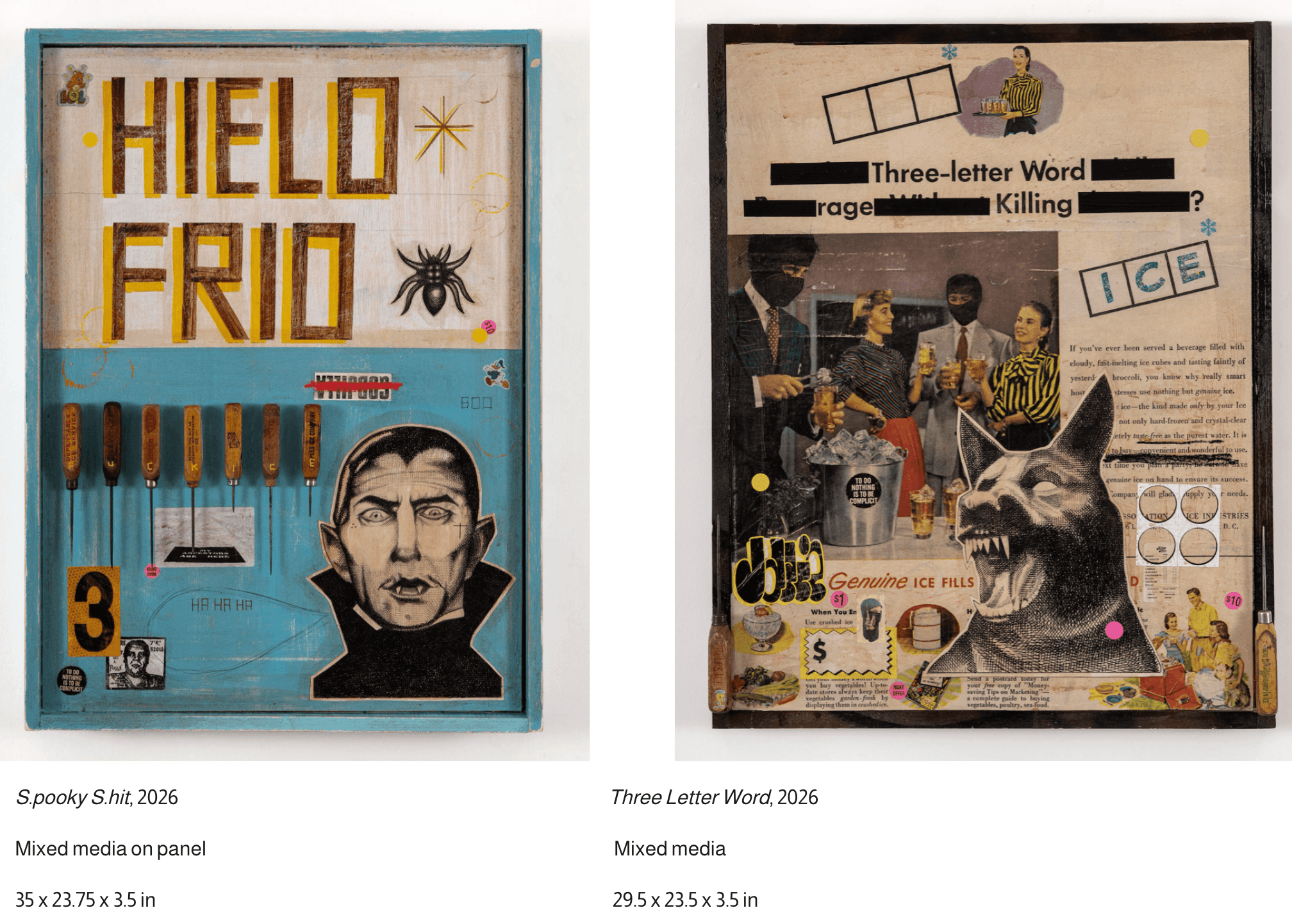
In S.pooky S.hit, we see a white, European monster, Dracula, who, like all colonial empires, sucks the blood from his victims while laughing “ha ha ha.” Significantly, his speech bubble is heard, while other speech bubbles that emanate from BIPOC characters in Ramirez’s works are blank. The voices of the colonized are not heard. Going further, Ramirez uses redaction bars across their eyes and mouths, devaluing their humanity. Low number price stickers dot many of the works, reiterating the low value of the labor of the low valued immigrant workers. But a militant row of old ice picks, that are used to break up ice, stand in defiant unity, spelling out “fuck ice” on their handles. They stand on an illustrated stretch of land that says, “my ancestors are here.”
In Three Letter Word, we see a kind of attack or police dog overlapping a nostalgic mid-twentieth century cocktail party. The terrifying dog is reminiscent of police dogs set on Black Civil Rights protesters, and I.C.E. targets today. The white wives in the party are toasting their masked I.C.E husbands. These black masks are the new cowardly white hoods of anonymity that white supremacist authoritarianism hides behind. There is a second idealized image of a white picnic. Together, the images imply that the only ones benefiting from I.C.E. are white, middle to upper class, capitalists. A sticker on the ice bucket reads, “to do nothing is to be complicit,” declaring that to mingle with the perpetrators, to laugh off or ignore the injustice they inflict, is to participate in their egregious agenda.
There is a sadness in Ramirez's work, but also an empowering warning that this is the last time that our government will be used as a weapon of racism and division. There is increased solidarity in the mobilization of the civil rights movements in the U.S. across demographics since the summer of 2020. And in works such as the recent molotov cocktail series, and the earlier, 2019, Ghetto Kachina From Outer Space, Ramirez speculates on the effectiveness of grass roots organization and resistance futures. The tarantula on Tarantula Azules #2, Jarritos molotov, suggests that a single bite may or may not do much, but seen in the context of his prolific molotov series, multiple bites are a real danger. The U.S. flag being burned to set off the hand held bomb is a declaration that empires come and go, but we were always here, like the native tarantula, and we survive you.
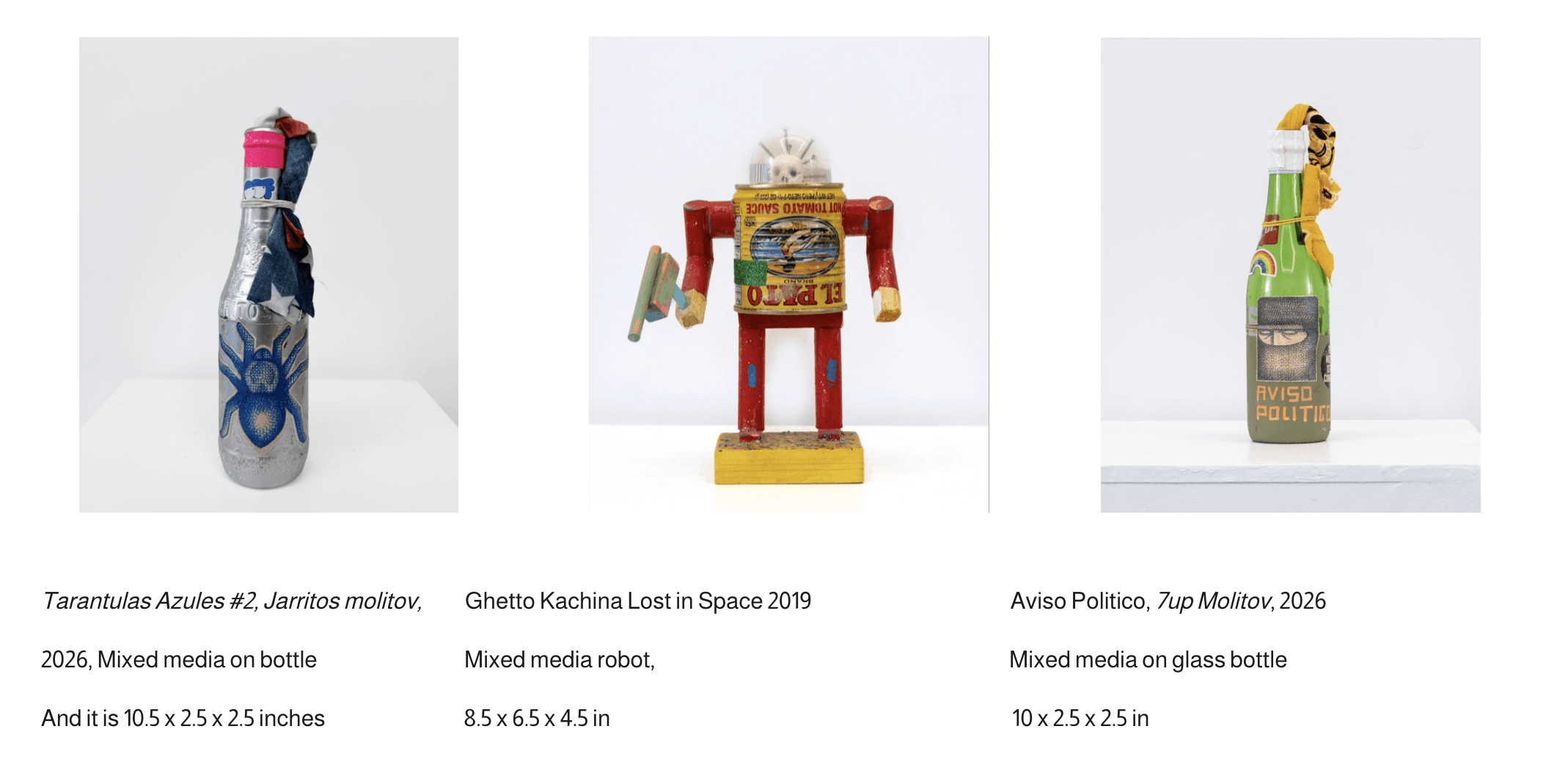
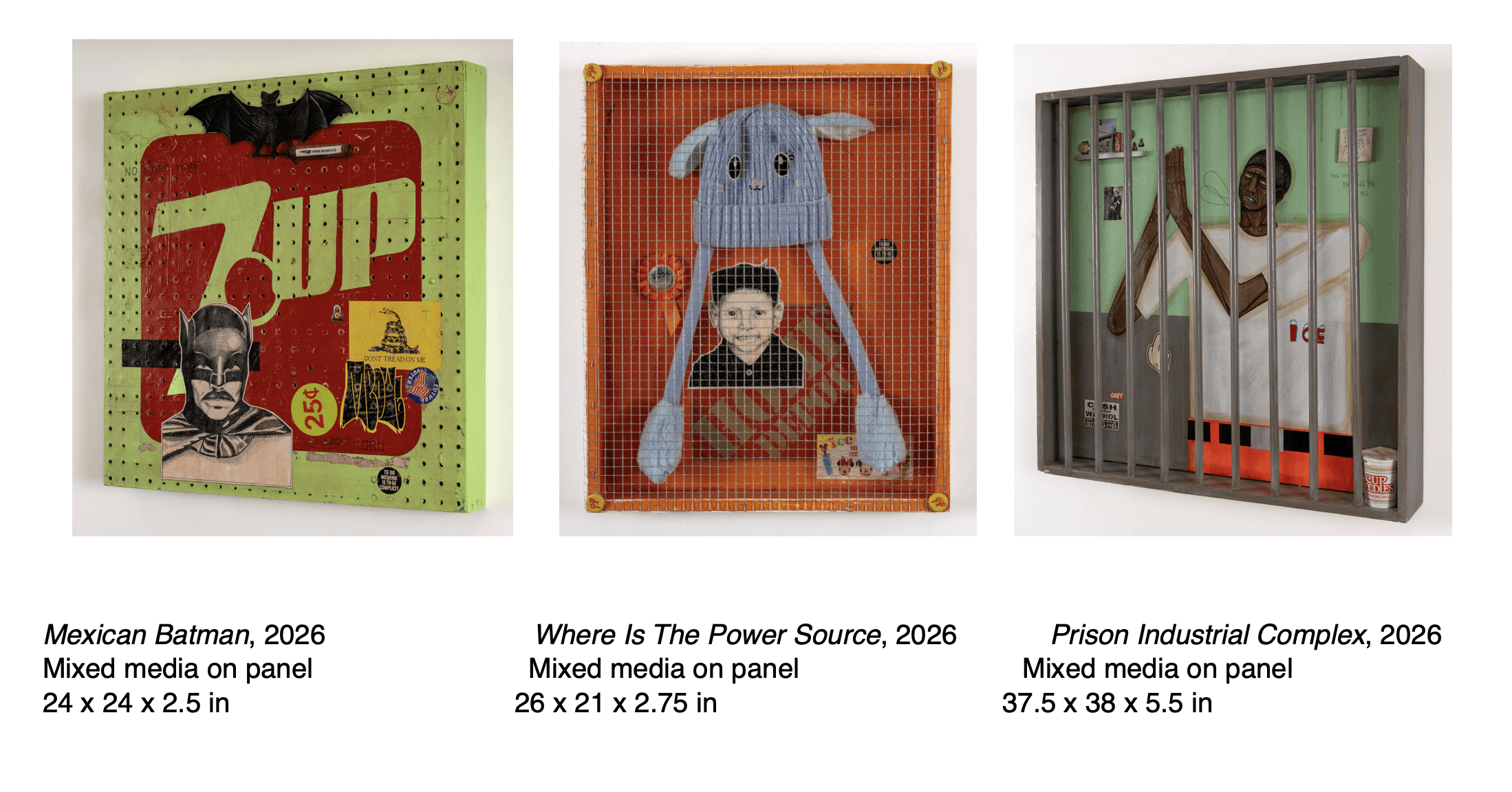
His assemblages can evoke the charm of antique children’s toys or vintage Mexican sign paintings, but a closer look at the components reveals the more sinister readings. The pop aesthetic in Ramirez's work is not the superficial, 1960s, New York brand of pop art, but a more local, rural, and Mexican American tradition deeply rooted in that culture. Ramirez scavenges and collects ephemera and objects that resonate with what he wants to communicate about his experiences with racism and disenfranchisement. His work utilizes scrapped pegboards, dowels, wood, and children's stickers and figurines. All forms of discarded detritus and forgotten clippings are materials for his metaphors and insights. His incorporation of distressed paint and wood, along with beaten up tins and bottle caps signal resilience in spite of abusive treatment over time. In Where Is The Power Source, we see an image of a young, promising child behind a cage of wire mesh. Were his 1st place ribbon, favorite hat, and disney stickers lost during his abduction? Or does he sit, hiding in his home, waiting for his Father who will never return from work at the Home Depot?
In Mexican Batman, there is the American Revolutionary flag that reads “Don’t Tread On Me,” with the coiled and ready-to-strike rattlesnake that is native to the Californian desert Ramirez calls home. But the white settler colonizers who demanded that liberty 250 years ago are now inflicting abhorrent treatment on U.S. BIPOC and immigrant populations. But this time the cartoon hero fighting for justice in a corrupt and cruel system is wearing a traditional Mexican moustache. The “Future Voter” sticker signs that the outcomes will turn politically one vote at a time. In Prison Industrial Complex, the prisoner prays in his cell that contains votive candles, and white European settler-colonial religious icons. There is even a photo of John Lennon, who like Jesus, advocated for peace. An old newspaper ad pitches, “Cash For Your Warhols,” further separating Ramirez’s work from the capitalist art market complicit in the classism of wealth disparity.
Villalba’s works in Redacted take a look at a psychological form or redaction, one that most of us have experienced at some point. This is the redaction of inner turmoil from public view. But today we are not living under any ordinary circumstances. The U.S. we live in today is a rising authoritarian state that subjects entire populations to violence and fear. And for many, the stress of being targeted or having family that might be, or have been, looms daily. How do we carry on with our work, our relationships, our survival, and still maintain any sense of normalcy? So many of us are split in two: the presentable self at home, and in the world, and the hidden self barely holding on.
Villalba’s work in Redacted says much about what that feels like. Whether we are at home or in the office, surrounded by screens in both, as in The Office, we put our best self forward. On the monitor of a zoom meeting, we see the white complected face, maybe one of the bosses, looking like nothing is affecting them and that they are duly performing their responsibilities. But in the office we see workers struggling with their emotional composure. Villalba’s subjects are common workers, artists, and families coping in a mundane, everyday world. But they are represented in compositions that are melting and portray the more emotional needs of human beings. Relationships, social lives, domestic and work surroundings, all struggling to hold together and to maintain themselves so as to be socially integrated.
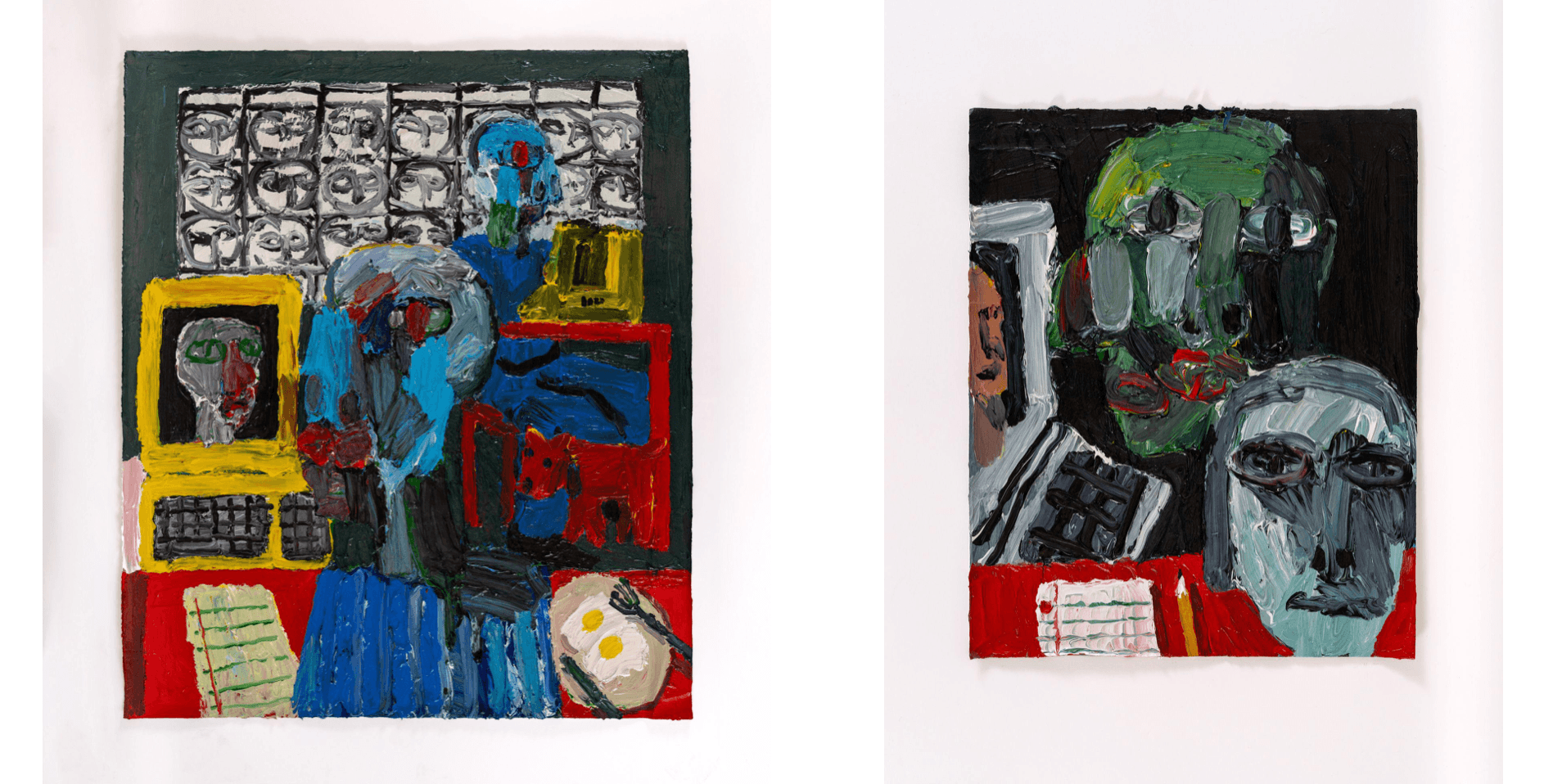
(L) The Office 2, 2026, Acrylic on paper, maple frame 60 × 51.5 in. (R) The Office, 2026 Acrylic on paper, maple frame 20 × 16 in
Villalba has never shied away from taking enormous risks in reinventing his relationship to painting. And in Redacted, we are privileged with possibly his most personal work to date. For this exhibition, Villalba has chosen acrylics on paper, and to productive effect. The application is wet into wet, made all the more challenging by the rapid drying time of the acrylics. This forces the painter to work fast and deeply focused if the painted surface is to remain unified. Villalba has demonstrated time and again that he can paint anything in any technique. But the choice of wet into wet acrylics invites a complication that keeps the work fresh and energized. These canvases are handled with a mastery that comes from long hard-won experience.
The subjects and objects retain their separation while passages outside and within them slip between un-legibility and clarity, not unlike navigating the reality of living with today’s current events. He is not afraid of being at times messy in these works in order to stay honest about his technique. He is never afraid of pushing readability for the animating freedom of his brushwork. The occasional passages of unraveling add a sense of precarity to the gravitas of the work. But Villalba's depth of skill and handling of the paint rescues each ambiguity from allowing the painting to fall apart. We can follow the flows and turns of his gestures in the beyond impasto thickness of the paint. The visual tactility of the heavily applied acrylics maintain a glossy wetness, almost inviting us to reach out with our own hands to squish it.
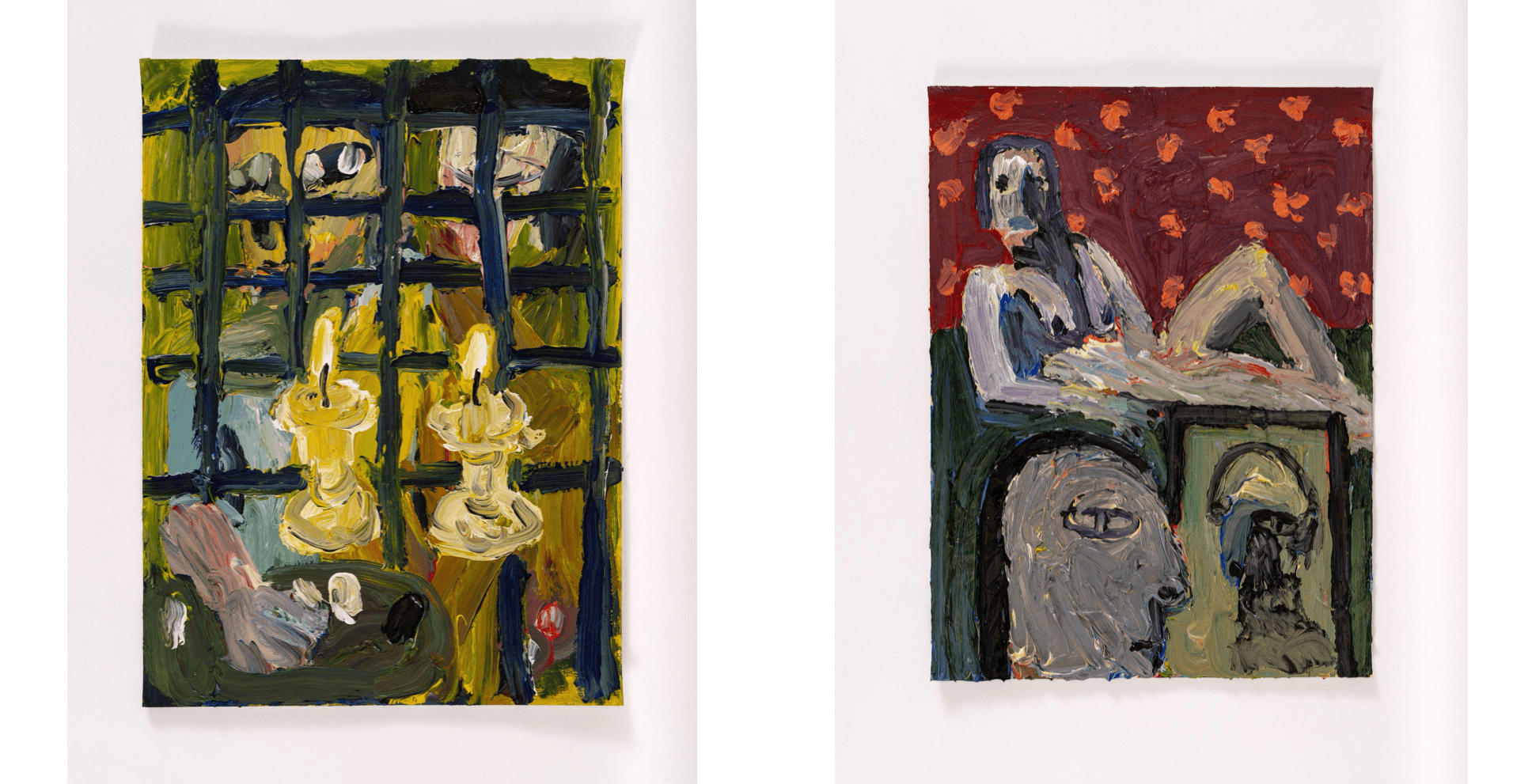
(L) Candles, 2026, Acrylic on paper, maple frame, 24 x 18 in, (R) Painter and Model, 2026, Acrylic on paper, maple frame, 24 x 18 in
Villalba’s ability to simultaneously challenge our perception and convey his humanity is revelatory. The figures and surrounding objects in his compositions are in a frozen flood like the Pompeiian victims of Vesuvius. Only this time the petrifying ash is the psychosis of dissociation. Villaba’s subjects are momentarily stuck in the burning urgency of trying to process ongoing socio-political violence, the day-to-day survival for most of us, and the increasingly convoluted existential crises. We see this most clearly in World On Fire. This is seen in his commitment to painting his immediate surroundings and intimate relationships. We see Human Beings trying to continue cultivating intimacy and meaning in their personal lives. In Painter In Studio, the artist continues to paint while being strangled by an enormous ball and chain. The darkness of this anxious atmosphere is all painted over with a cheerful, sunny yellow. If we let Villalba take us there, we can feel our own vulnerability, and the importance of love in our lives. After all, our loved ones are struggling too.
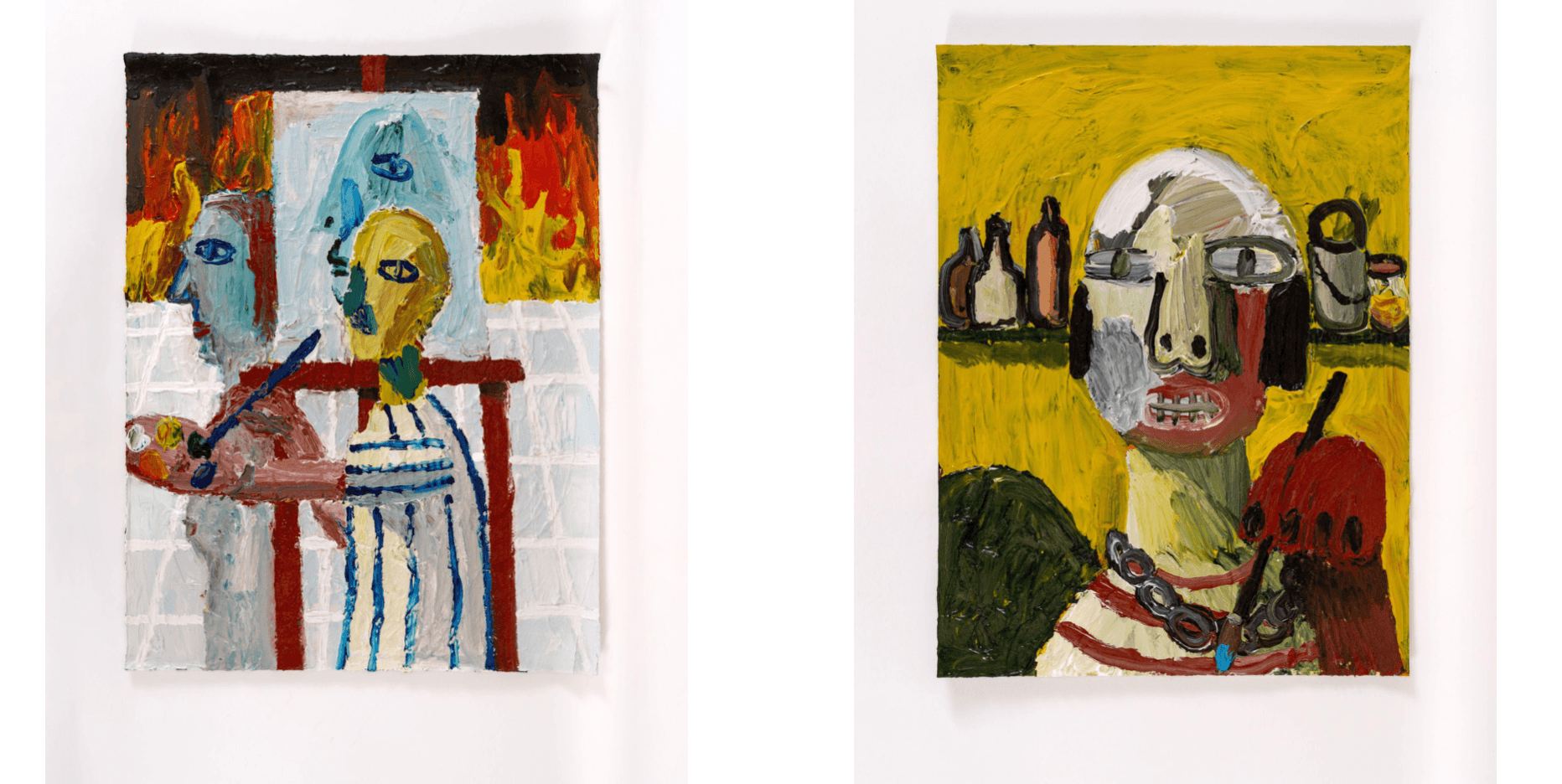
(L) World on Fire, 2026, Acrylic on paper, maple frame 39 × 30 in. (R) Painter in Studio, Acrylic on paper, maple frame, 24 x 18 in
Villalba’s works in Redacted are raw, to say the least, but they are also vibrant and alive. He abandons all notions of the hierarchical, elevated position of the artist in society or the medium of painting in culture. He makes no effort to flatter his subjects, but instead includes them in his deeply felt experience. The neo-expressionist compositions are inherently crude and tender in their existential angst. They question the role of painting in today’s breakneck race towards techno-capitalism and consumer cultural production, and the pressure to keep up with it all in order to survive. Emilio resists the robotic, easily consumable, capitalist cultural production and its reduction to entertainment. His work is confrontationally analog. It is existentially real. It speaks in eons rather than sound bites. Villalba returns painting back to the earliest human recognition of the expressive qualities of materials. The work oozes with the primordial potential of Creation itself.
In these new works, Villalba questions the purpose of painting, both as a profession and as a medium. What are the arts when we live in a time where the arts are co-opted into venture-capitalist philanthropy that signals an empathy with our conflicted zeitgeist, but doesn’t implement or invest in any real and effective change? What does an artist need to do to reflect times and call out for systemic change. Villalba has chosen risk to address these questions. Risk in technique and shifting content. He acknowledges the power of art to redirect perception and critical thinking though subtle nods to art history. We see Picasso’s bald head and signature striped pullover in Painter In Studio, and a Matisse odalisque in Painter And Model. We even see Van Gogh’s empty chair in Self Portrait With Cat. Villaba’s work in Redacted is filled with courage and resolve.
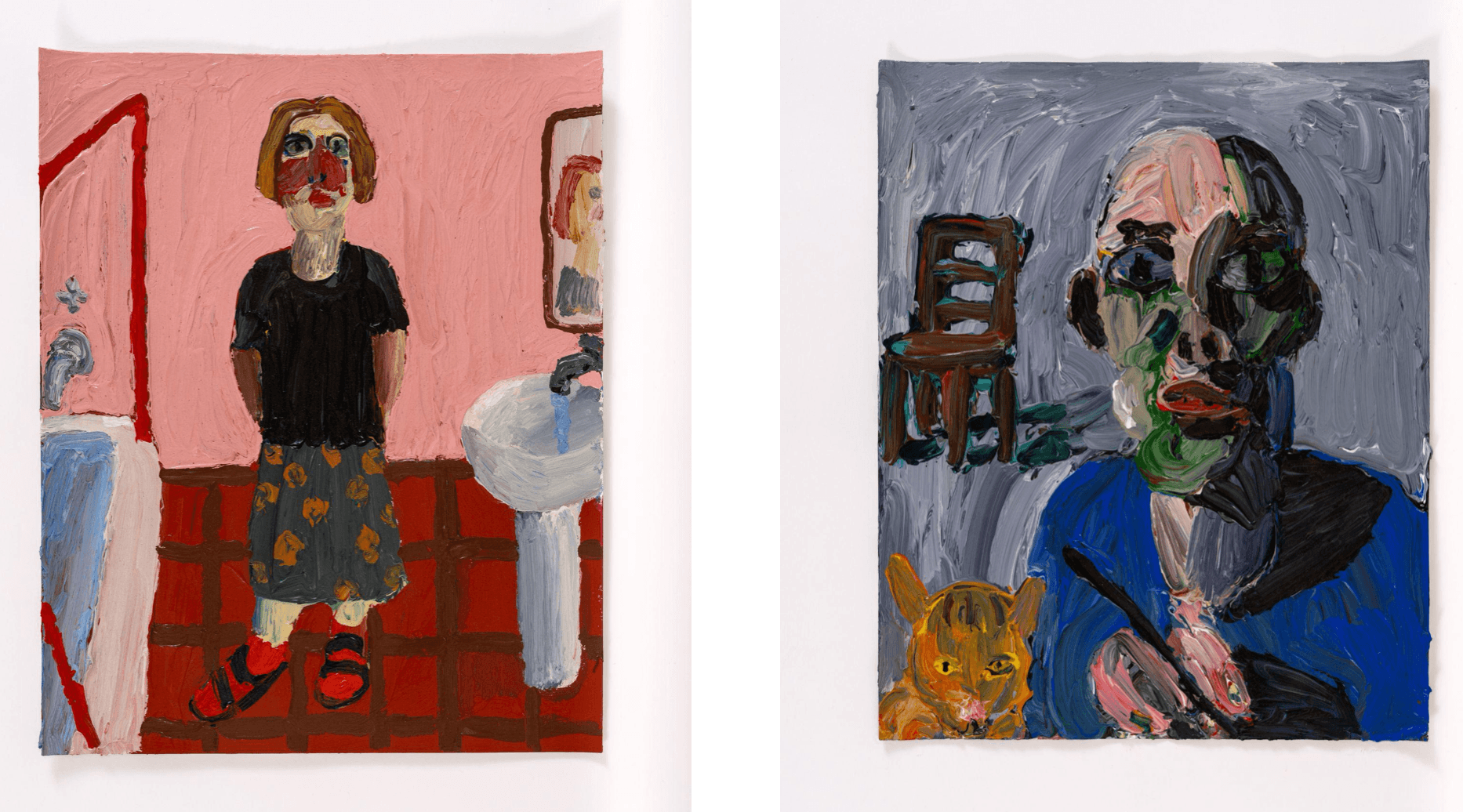
(L) Michelle, 2026, Acrylic on paper, maple frame 20 x 16 in (R) Self Portrait with Cat, 2026, Acrylic on paper, maple frame 20 x 16 in
There is a call and response between Ramirez’s and Villaba’s works. Ramirez’s's cages, especially in Where Is The Power Source, where the grid is a wire mesh cage, and the title points to the power grid and who controls it. In Emilio's Candles, the grid also creates a trap we are all caught in through the inter/net and digital surveillance. The candles represent hope for a way out, but juxtaposed against the grid, also remind us that things were not always as they are now. Ramirez’s work carries the responsibility we have to resist inequity and not be complicit. Villaba exposes the psychological weight of coping while all this plays out in our lives. Ramirez offers strategies and frameworks of resistance, while Villalba brings our shared existential crisis to light. Would that we all have the brave commitment that these artists exhibit and that Ivester Contemporary and Matt Diehl support.
Grey Dey holds an MFA from UIUC’s School of Art and Design, and is currently a PhD in Art History at UIUC
