

Women of Afrofuturism, SFO Airport, Harvey Milk Terminal 1
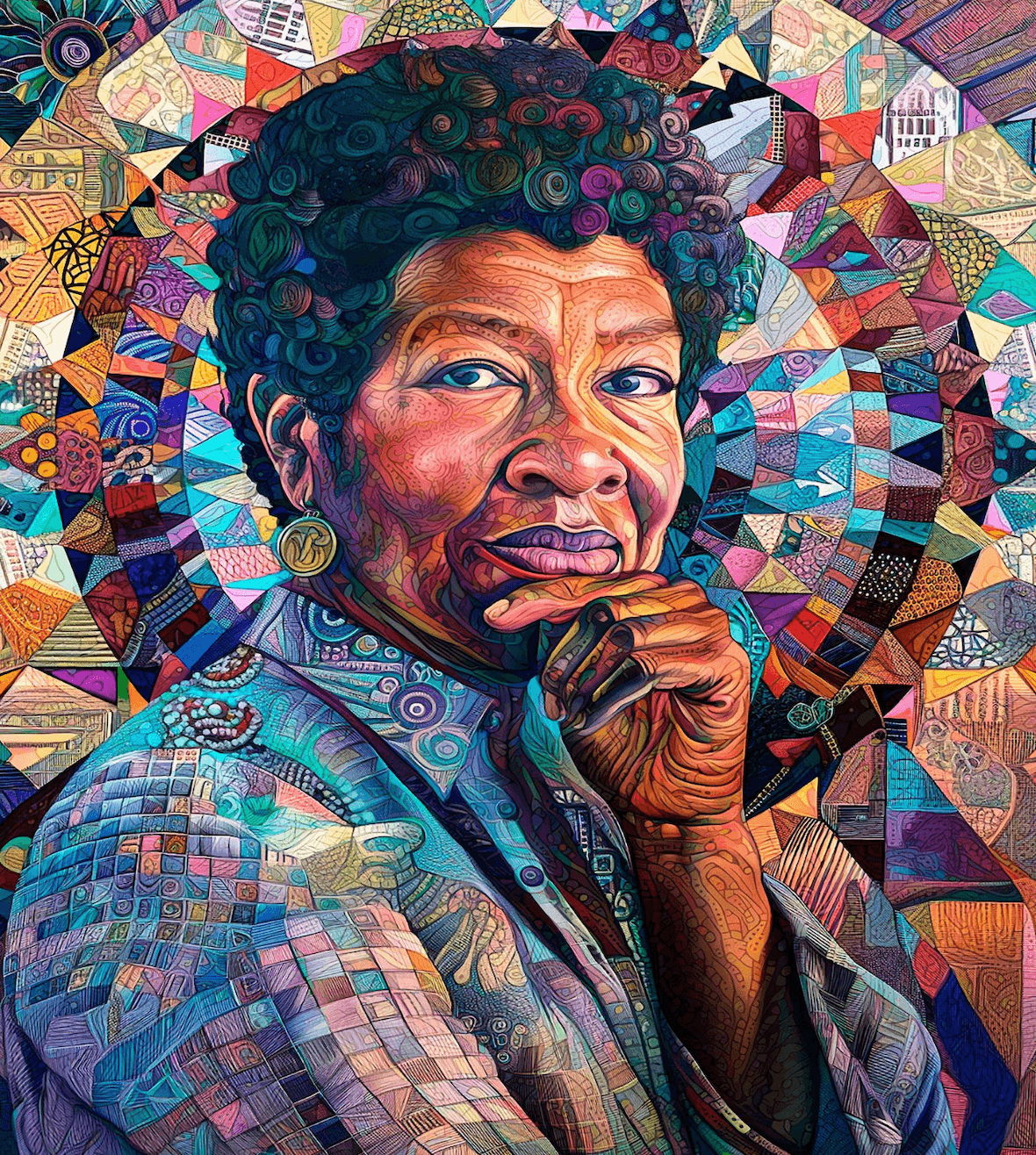
Octavia E. Butler, 2024 | Nettrice Gaskins, Digital art / AI-assisted generative portrait
Courtesy of SFO Museum, San Francisco International Airport
Afrofuturism and the Power of Joy
May 17, 2025 - September 27, 2026 inside the airport at Harvey Milk Terminal 1.
I have been in a continual conversation with myself regarding my body as a vessel of sovereign authorship. I have been tussling with the internal aspects of that authorship. What it means to have absolute power or authority to govern my inner self because of and despite external interference.Interference that includes misogynoir, respectability politics, economic inequities, medical neglect, and bias.The anger, anxiety, and the joy that comes from deconstructing a stifled expression of my sovereignty.Furthermore, unpacking the many retaliatory responses to said expression and still choosing to authentically embody my power in both private as well as public spaces. In comes the exhibition titled Women of Afrofuturism located at San Francisco International Airport.
The exhibition features artists including filmmaker Celia C. Peters, digital artist Nettrice Gaskins, interdisciplinary artist Alisha B. Wormsley, fashion artist Afatasi the Artist, and scholar-artist D. Denenge Duyst-Akpem. Their works form an amalgamation of sovereignty in collective union, while also individually showcasing wearable sculptures, insightful text, film, and stunning designs.What emerges from these works is something imperative to Afrofuturism: Joy.
Joy has always been a ritualistic pillar for afro peoples, a byproduct of sovereign authorship, an emotional resonance that defines and honors Black existence. This is especially evident in Alisha B. Wormsley’s now widely circulated declaration, “There Are Black People in the Future.” In a cultural landscape where Black life is often framed through trauma, absence, or historical containment, Wormsley’s statement functions as a temporal intervention. It insists on a narrative that does not subdue the process of storytelling. Black presence extends (joyfully forward) indefinitely. Future-building is not a space in which Black joy is excluded or will be found missing; we are already there, as Wormsley declared.
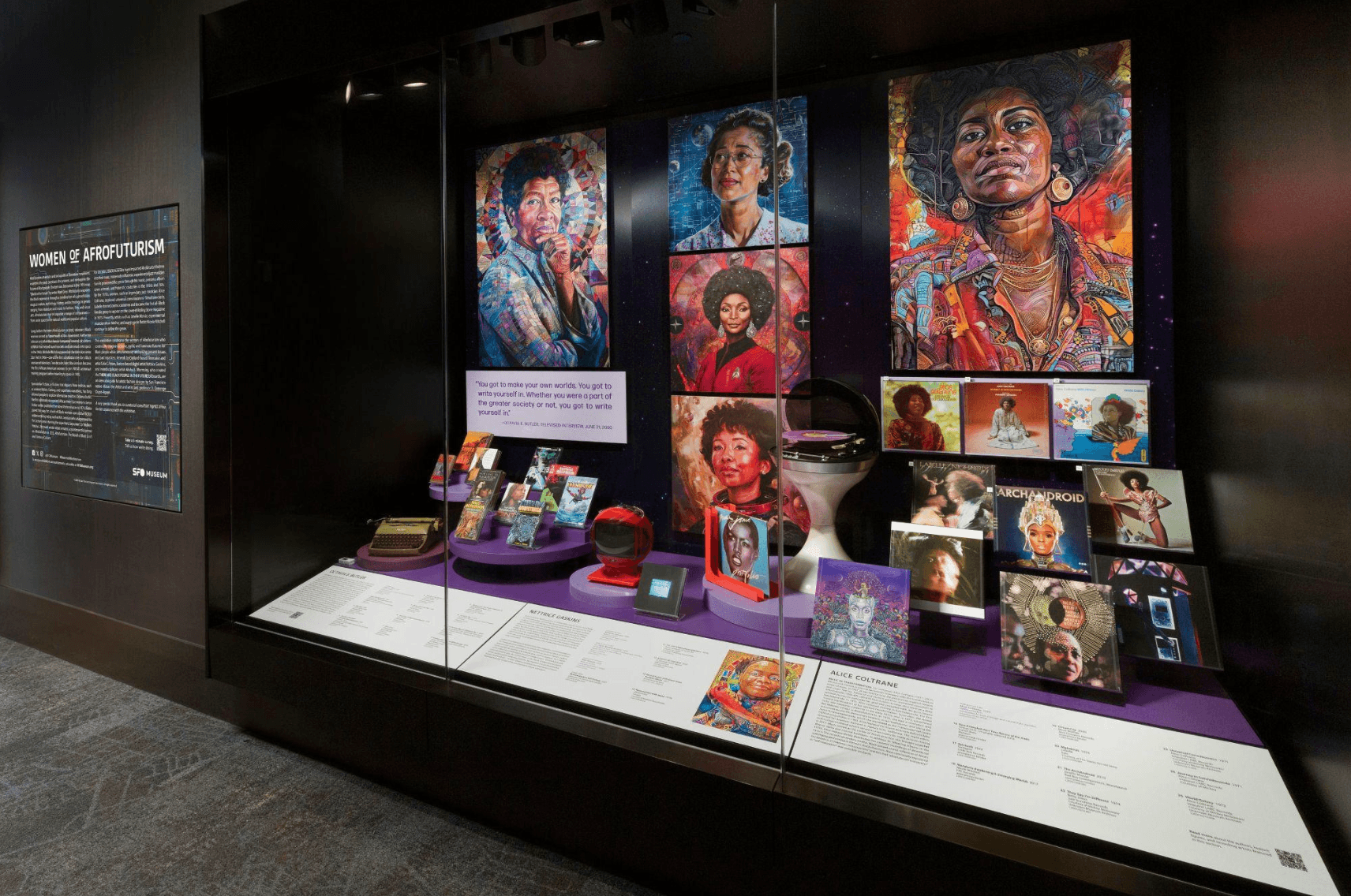
Installation view featuring works by Nettrice Gaskins in Women of Afrofuturism
Courtesy of SFO Museum, San Francisco International Airport
Nettrice Gaskins, known for her explorations of algorithmic and AI-driven art, constructs digital forms that merge cultural memory with technological experimentation. Her practice reveals a crucial aspect of Afrofuturism: the future is not simply invented from scratch but emerges from ancestral knowledge refracted through contemporary tools. Algorithms, data, and digital patterning become vessels through which Black cultural aesthetics travel into speculative worlds. Ibelieve another form of external interference with sovereign authorship is erasure. In exhibitions such as this, especially in works regarding technology, the erasure of Afro/Black identity can occur and remains a continual threat. But what is clear from these works is an amplification of sovereign self-design. Visual language where mathematics, code, and cultural heritage intertwine. The joy embedded here lies in the reclamation of technological space. When Black creativity occupies the domains of artificial intelligence and computational design, the future becomes less an alien frontier and more a familiar terrain. A space where Black women are both in front, in between, and behind the scenes.
The exhibition’s fashion works deepen this conversation through the body itself. Artists like Afatasi the Artist and D. Denenge Duyst-Akpem approach clothing not as mere adornment but as architecture. There is a conversation being had about an outer form of sovereignty that mirrors an internal, innovative regality. Their garments look like armor, traditional regalia, and cosmic attire all at once. The silhouettes are futuristic yet rooted in ancestral symbolism, blending textures, forms, and visual cues that evoke diasporic memory while projecting into the future. In these pieces, the Black body is a site of sovereign self-sculpting through imaginative reconstruction. Fabrics, shapes, and adornments transform the wearer into a figure of possibility—part priestess, part astronaut, part cultural archivist. Afrofuturist fashion interrupts colonial frameworks by proposing alternative aesthetics that originate within Black cosmologies themselves.
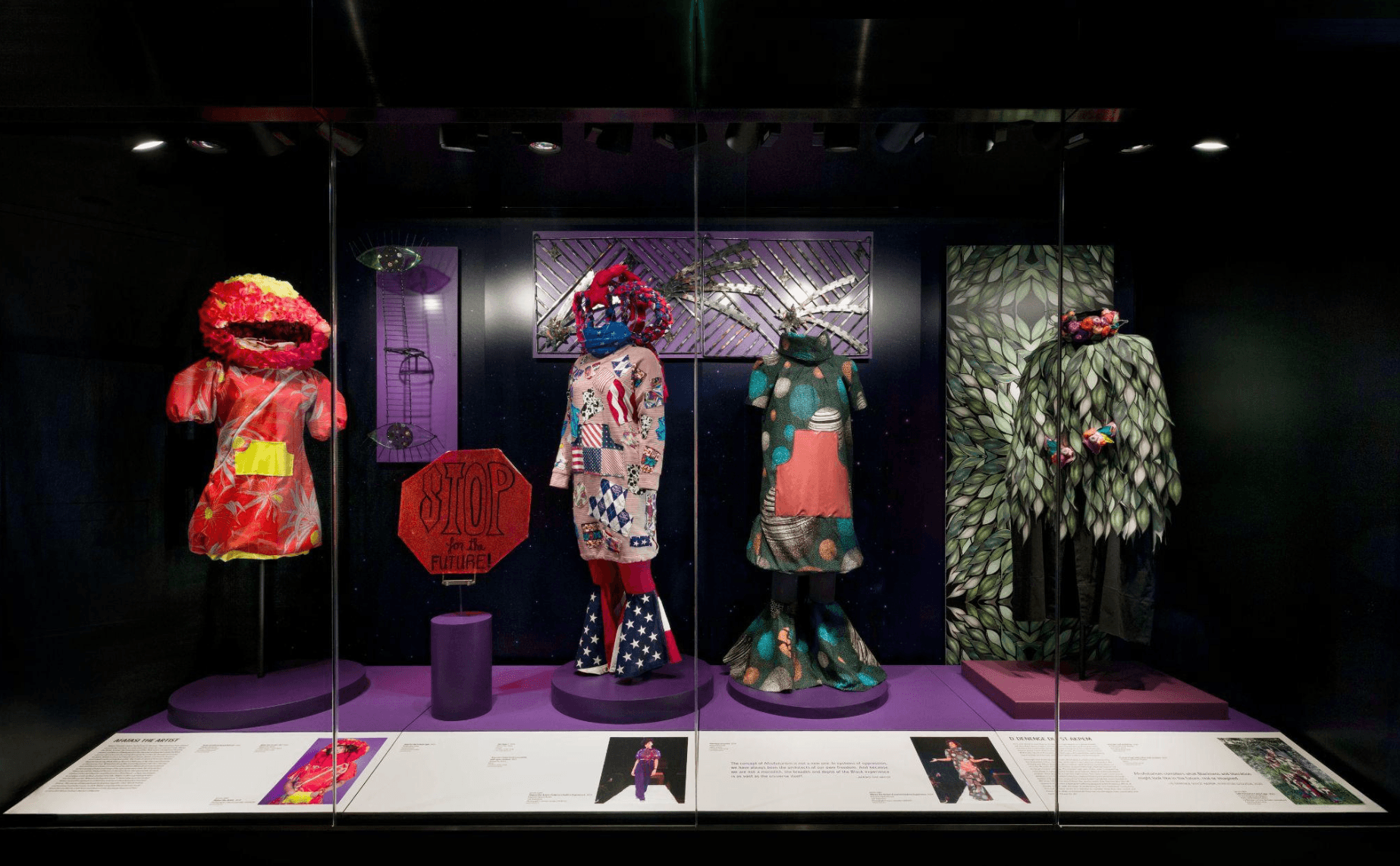
Garments by D. Denenge Duyst-Akpem | Afrofuturist wearable art installation
Featured in Women of Afrofuturism | Courtesy of SFO Museum, San Francisco International Airport
Filmmaker Celia C. Peters contributes to the exhibition’s narrative through moving image, exploring storytelling that situates Black women within complex, futuristic environments. Her work emphasizes that storytelling itself is a form of future-building. There is a clear and joy-filled choice to craft narratives that center Black women as explorers, thinkers, and protagonists of magical worlds. Peters is participating in a broader Afrofuturist project: the expansion of narrative possibility. Across these varied practices—billboard declarations, digital systems, cinematic storytelling, and fashion—the exhibition repeatedly returns to a central principle: the power of self-definition for Black women.
This exhibition positions Afrofuturism as a methodology—a way of thinking that allows Black women to design futures unbound by both colonial and misogynistic narratives. This is where the exhibition’s colorful and intentional balance of portraying joy in different forms shines. The joy is not merely from the beauty of the works themselves but from the processes behind them. Each piece represents an act of creative sovereignty. The artists are not waiting for validation or permission within existing visions of the future; they are constructing entirely new sovereign ones. In doing so, they transform the future from an abstract concept into a space of agency.
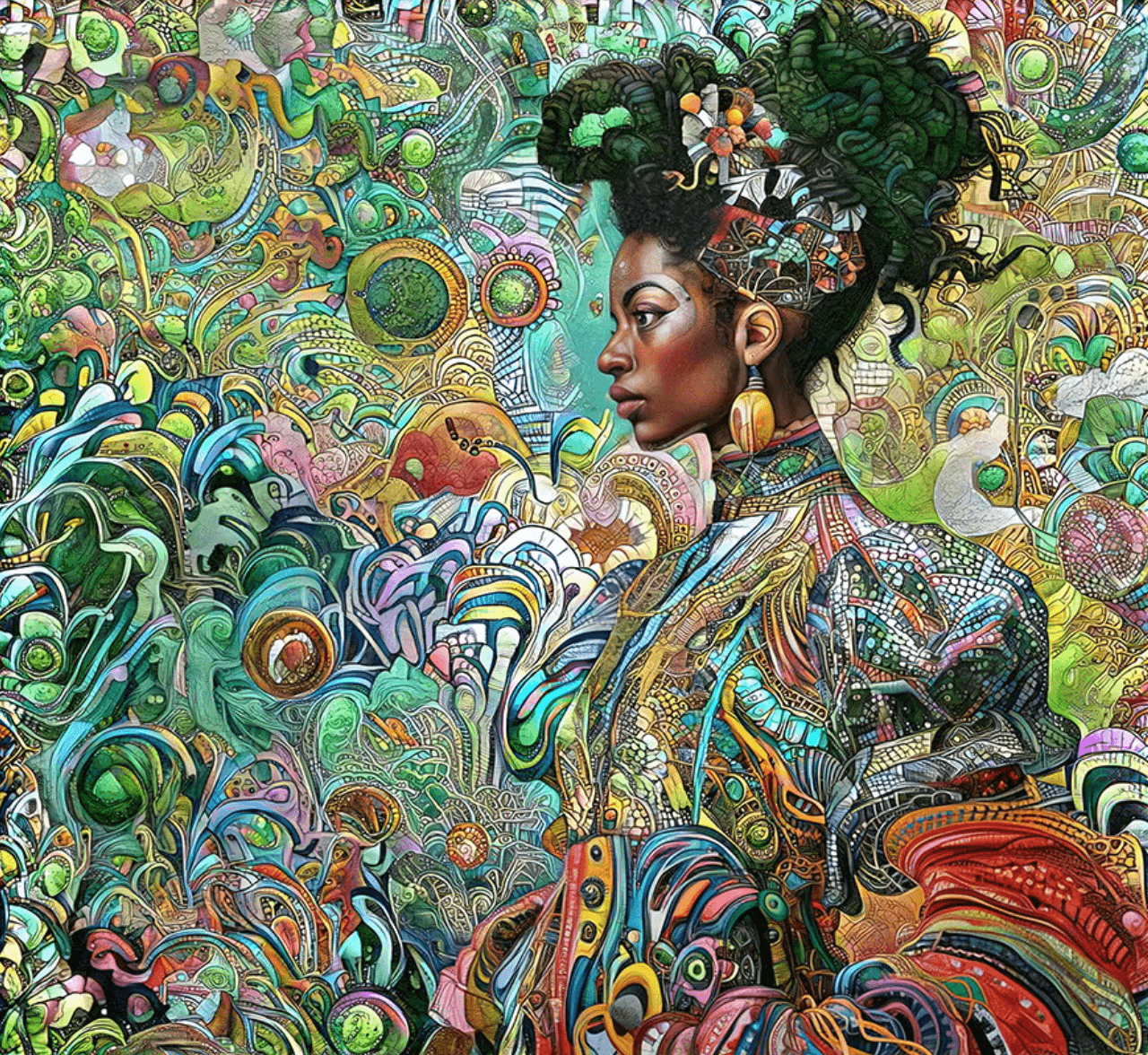
Afro-Surrealist Carnival (series) 2023
Artwork by Nettrice Gaskins (b. 1970)
Tools applied: Generative AI (text-2-image and neural style transfer) and
Adobe Photoshop
I also love that this exhibition is in an airport—an environment defined by movement between places—so the exhibition takes on an additional layer of meaning. Airports symbolize departure, arrival, and transition. Positioned within this space, Women of Afrofuturism suggests that the journey toward liberated futures is already underway and will always transcend time and space. Travelers moving past the exhibition may only glimpse the works briefly. Yet even in passing, the message is clear. My hope is that this review will encourage visitors to make a purposeful trip to view the exhibition. I am grateful to these artists for reminding me that the future, with Black women in it as sovereign authors, is a joyful site to behold. Afrofuturism is about active self-designing and reimagining through art, technology, and storytelling. And because of Black women, whose creative visions stretch far beyond the limits historically and currently imposed upon them, I will sovereignly exist forever. And in that act of sovereign self-design, joy appears not as decorative or as mere musings but as evidence. Evidence that the future has already begun.
I reiterate my first thought in this review. I have been in a continual conversation about embodying and imbuing self-sovereignty.The broader conversation being explored through this exhibition therefore mirrors my own. Black joy embodiment and creative autonomy are intertwined with my wellbeing as a Black woman. I have often seen my body as a vessel, a conduit, an archive, and a portal. A space where I can unzip my skin, examine, reconfigure, and reclaim—a space where hidden or untouched layers of memory, identity, and imaginings—magic—exist. Afrofuturism then, becomes an act of revealing what has always been there. The artists in this exhibition impress upon the audience a poignant truth. Joy for Black women, is accessing that interior space and designing outward from it thereby emerging as sovereign Beings. Every obstacle that has occurred in Black women’s lives has directly attacked that sovereignty and exhibitions such as this showcase how that that Power can never be fully thwarted.
