
Making Moves: A Collection of Feminisms at the Crocker Art Museum
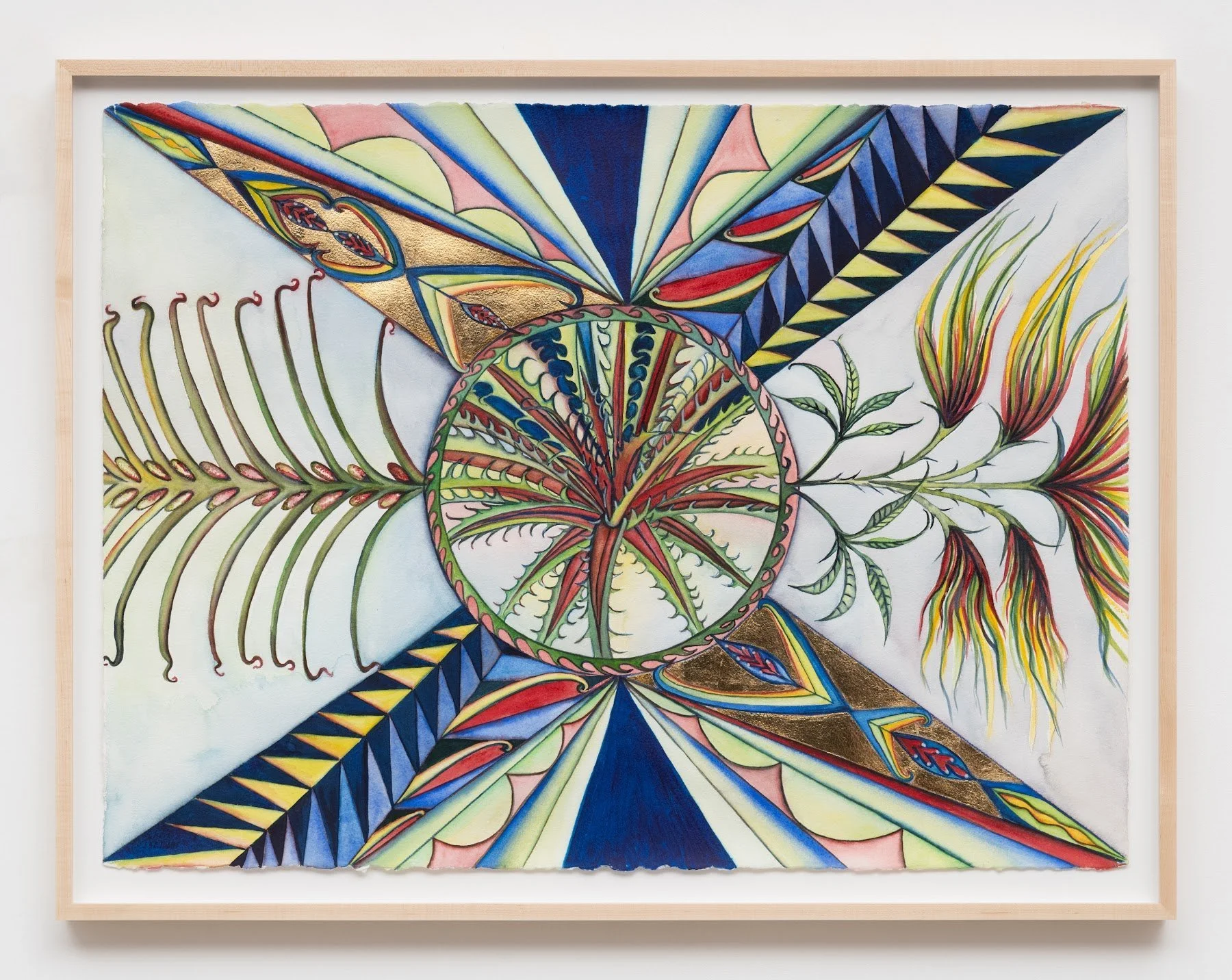
Faith Wilding, Firebrush Cactus, 2020, watercolor, pencil, and gold leaf on paper, 25.25 x 32.75 in
Making Moves: A Collection of Feminisms at the Crocker Art Museum - Until May 3, 2026
Inspired by the writings of feminist scholar bell hooks, the Crocker Art Museum’s exhibition “Making Moves: A Collection of Feminisms,” announces itself as a collaboration of curators across departments and their conscious effort to address the many social benefits that are the ultimate goals of the movement. With walls swathed in regal purple, the exhibition space feels feminine, powerful, and hypnotic - inviting viewers into another, better world where women’s voices are amplified, and never quieted. True to its exhibition title, the curators of this impressive group show compiled a selection of work by over 60 artists from across the world, representing several, discrete modes of feminism. Although the exhibition is divided by walls into specific sections, there is a distinct lack of stagnation. The curators avoid a descent into relying on trite categorizations. The delineations feel informative, without limiting the potency of individual works to speak to multiple ideas. These explorations of broad topics encourage visitors to consider the intersectionality of the artists’ identities and how an inclusive personal framework can further feminist discourse. The thematic organization seen throughout the sections of the galleries is neither geographic nor temporal, but in creating narratives around broad themes, the exhibition offers snippets of the many avenues that feminist artists take to create and share their visions, and resultantly the significant sociological sub-groups of feminism as well.
Devoid of discourse on the classic historical waves of feminism, the curators neatly avoid the pigeonholing that can come with these descriptors. Although wall didactics do not dive deeply into the many different branches or definitions, mentions within specific texts, such as for Faith Wilding’s Firebrush Cactus, do highlight the artist’s own definition of her favored branch - ecofeminism. With its vibrant stained-glass coloration and use of gold leaf, the large work on paper inspires religious connotations, even as it blends elegant vegetal and genital forms and typifies the “Reclaiming Erotic” theme. A complex composition with a mandala-like effect, involving extensive geometric patterning, it invites continual contemplation.
The oldest work in the exhibition is a sensitive portrait, “likely intended for an intimate audience,” of singer Sarah Bates by 18th-century painter Angelica Kauffman. It juxtaposes a nearby ceramic sculpture Okla Homma Ohoyo (the Choctaw words for Oklahoma and woman) by one of the youngest artists represented in the exhibition, Raven Halfmoon (b. 1991). This visual, temporal dialogue highlights the routes that women take to depict other women, but it also captures a more indirect theme - the continued pursuits of women striving to gain rightful entry into the art historical canon. This exhibition purposefully opens a wider dialogue, particularly through the inclusion of works by young artists such as Halfmoon and others like Jojo Abot (b. 1988) and Maya Fuji (b. 1988). These younger artists also provide the bridge to the future, and this inclusion lends hope to the continuity of urgent conversations that are only too relevant in today’s cultural landscape.
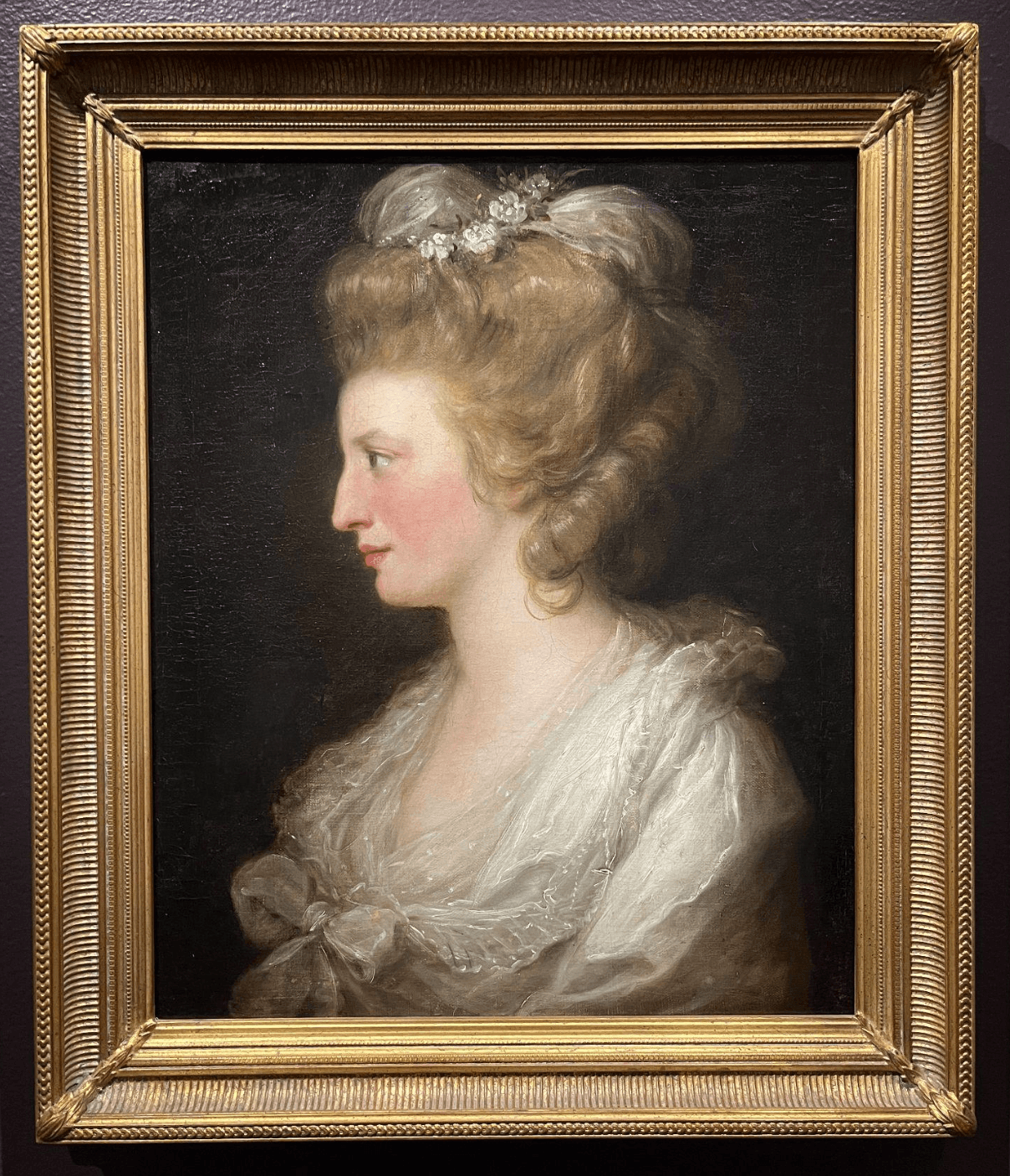
Angelica Kauffman, Portrait of the Singer Sarah Bates, c, 1780, oil on canvas, 23.25 x 19 in
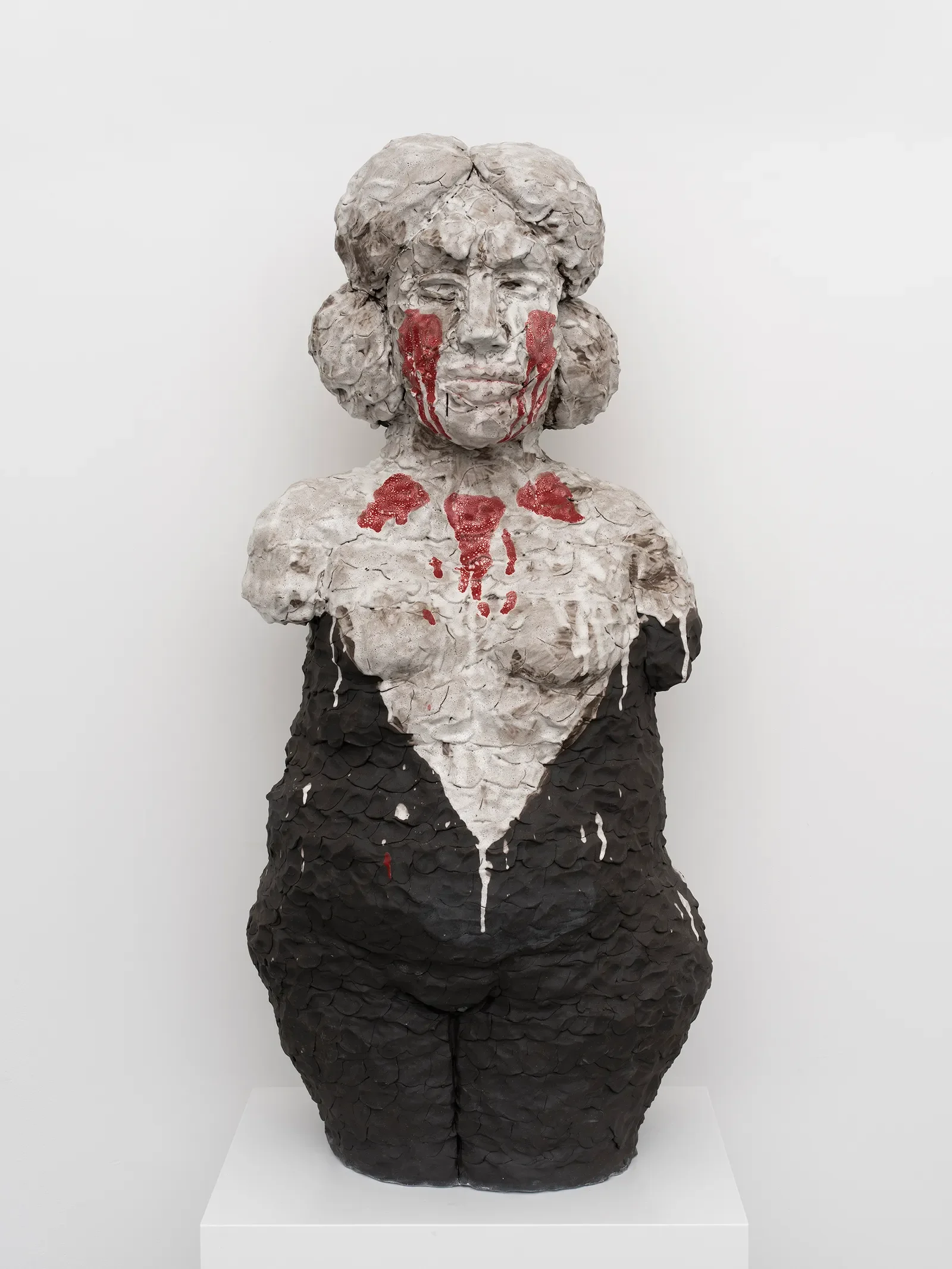
Raven Halfmoon, Okla Homma Ohoyo, 2020, stoneware and glaze, 36 x 16 x 14 in
The exhibition triumphs in presenting an incredible range of media, including powerful examples such as Roz Ritter’s Self Portrait. Her unabashedly candid work offers a glimpse at a personal and private rebellion against gender norms, made public. Ritter transforms a symbol of rigid misogyny, using her own wedding dress in the work. She metamorphosizes it into the story of her independence, with colorful, unembroidered threads that pool to the ground, leaving the story of her hopeful future open and endless. The general artistic diversity serves to emphasize the many modes that women have not only adopted, but adapted (and dare say, perfected), to explore the themes that permeate feminist art. The reclamation of mediums often disparagingly ascribed to women is on view in every section of the exhibition - further emphasizing the validity of the experiences of women.
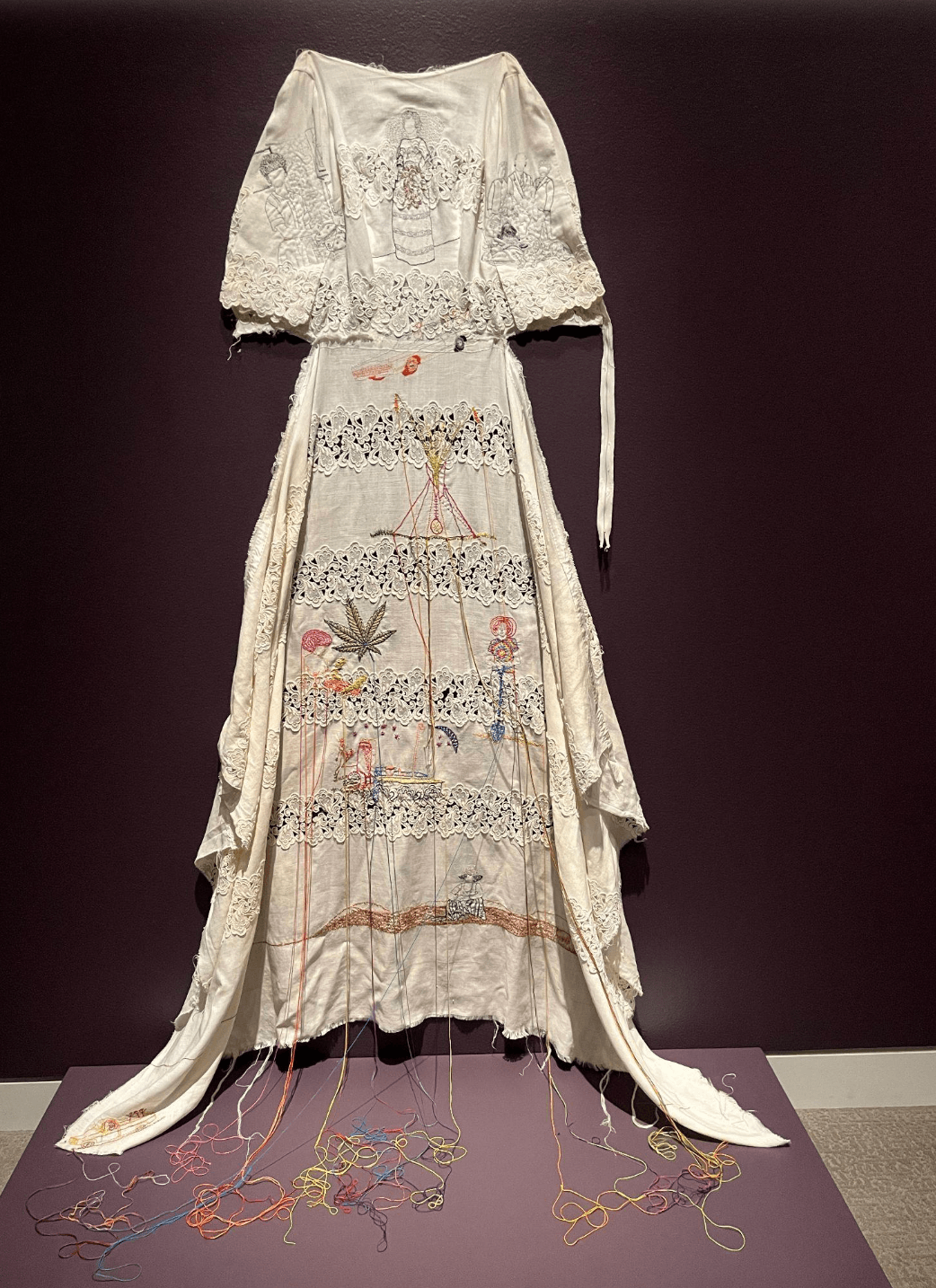
Roz Ritter, Self Portrait, 1962 - 1977, deconstructed linen wedding dress (belonging to the artist), hand embroidery, photo transfer, 61 x 26 x 2 in
However, any visitor would be remiss to not spend time in contemplation of the crown jewel of the exhibition - Frida Kahlo’s Self-Portrait with Loose Hair. This laudable inclusion (one of the only major loans in the show) represents the first time a work by this artist has ever been on view at the Crocker. This significant milestone bodes well for the art-lovers of the Sacramento region and certainly serves as a sign of the good things to come under the leadership of the Crocker’s new Mort and Marcy Friedman Director and CEO, Agustin Argeaga. This striking work is one of Kahlo’s most raw, as she paints herself without the typical animals or elegant clothes and hair accessories that are so common in her self-portraits. This pared back painting includes fine details like a small succulent and an embroidered blouse, but as the painting’s cartellino at the bottom of the work describes, this work was not an exercise in Surrealist pursuits. She painted what she saw in the mirror, on a day in July in 1947. The rest of the section dedicated to this portrait is filled with photographs of Kahlo by fellow artists Emmy Lou Packard and Lola Alvarez Bravo. It invites viewers to consider the contrasts of portraits in different media and what each image purposefully reveals or obfuscates about the subject - Frida Kahlo.
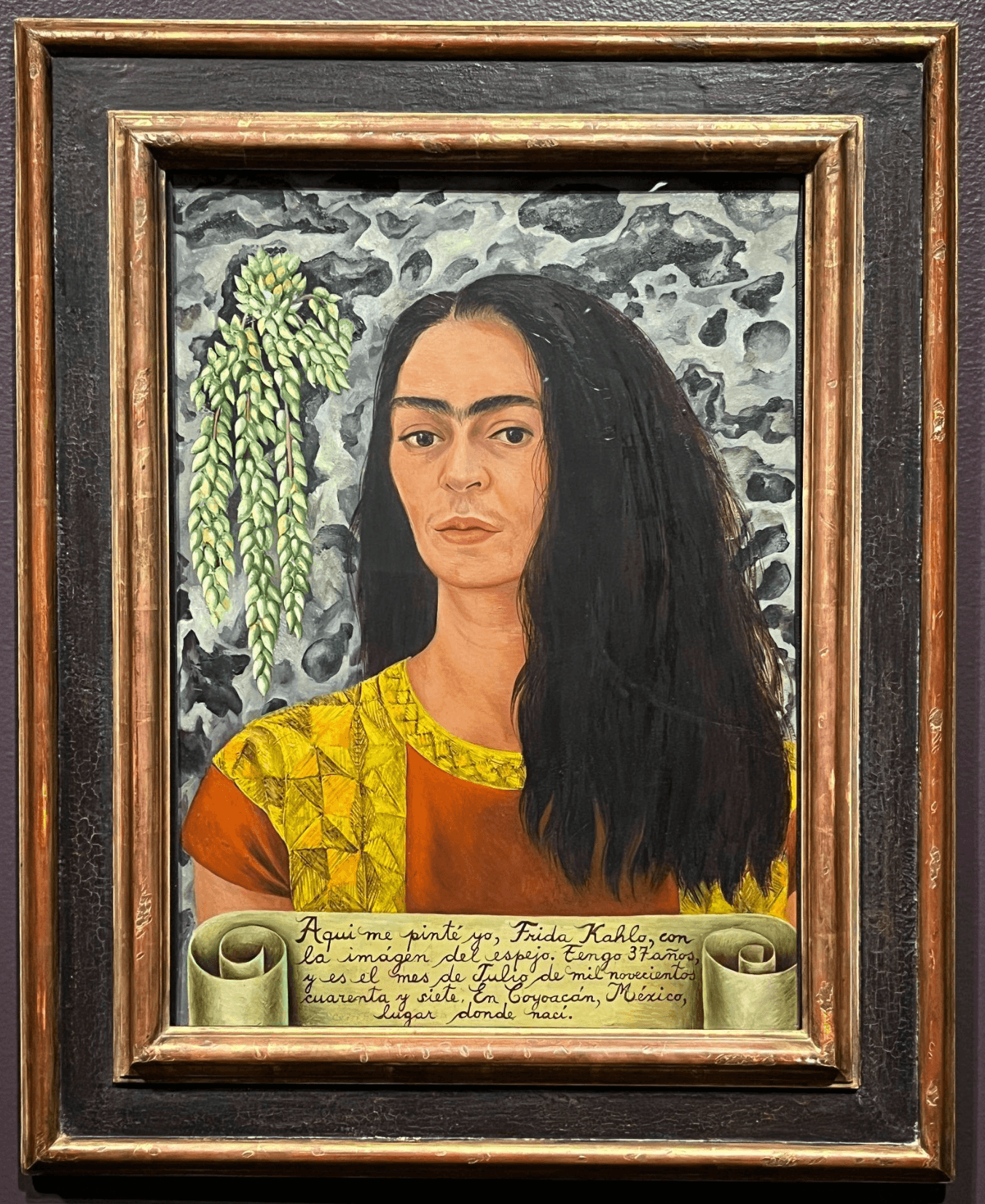
Frida Kahlo, Self-Portrait with Loose Hair, 1947, oil on masonite, 24 x 17.75 in
One of the stand-out components of the exhibition is the artwork credit lines on the wall labels - a vast number bear a Crocker accession number. The fact that the exhibition is mostly derived from the museum’s own collection is encouraging in a day of blockbuster shows driven by inter-institutional loans. The celebration of the Crocker’s own collection is commendable; the curators have demonstrated an incredible aptitude for elevating their own holdings by bringing them together in this manner of storytelling. The accession numbers also reveal the Crocker’s continuous interest over many decades in collecting works by women artists — preceding the more equitable collecting practices that have only earnestly emerged in the wider art world in recent years. The additional section titled “Californians Making Moves,” further positions Crocker as a leader of including women as central to the history of Californian art. The exhibition becomes a soft yet potent space for all people, but especially local women - as artists and visitors - to seek equality and to feel heard.
