
Ken Feingold
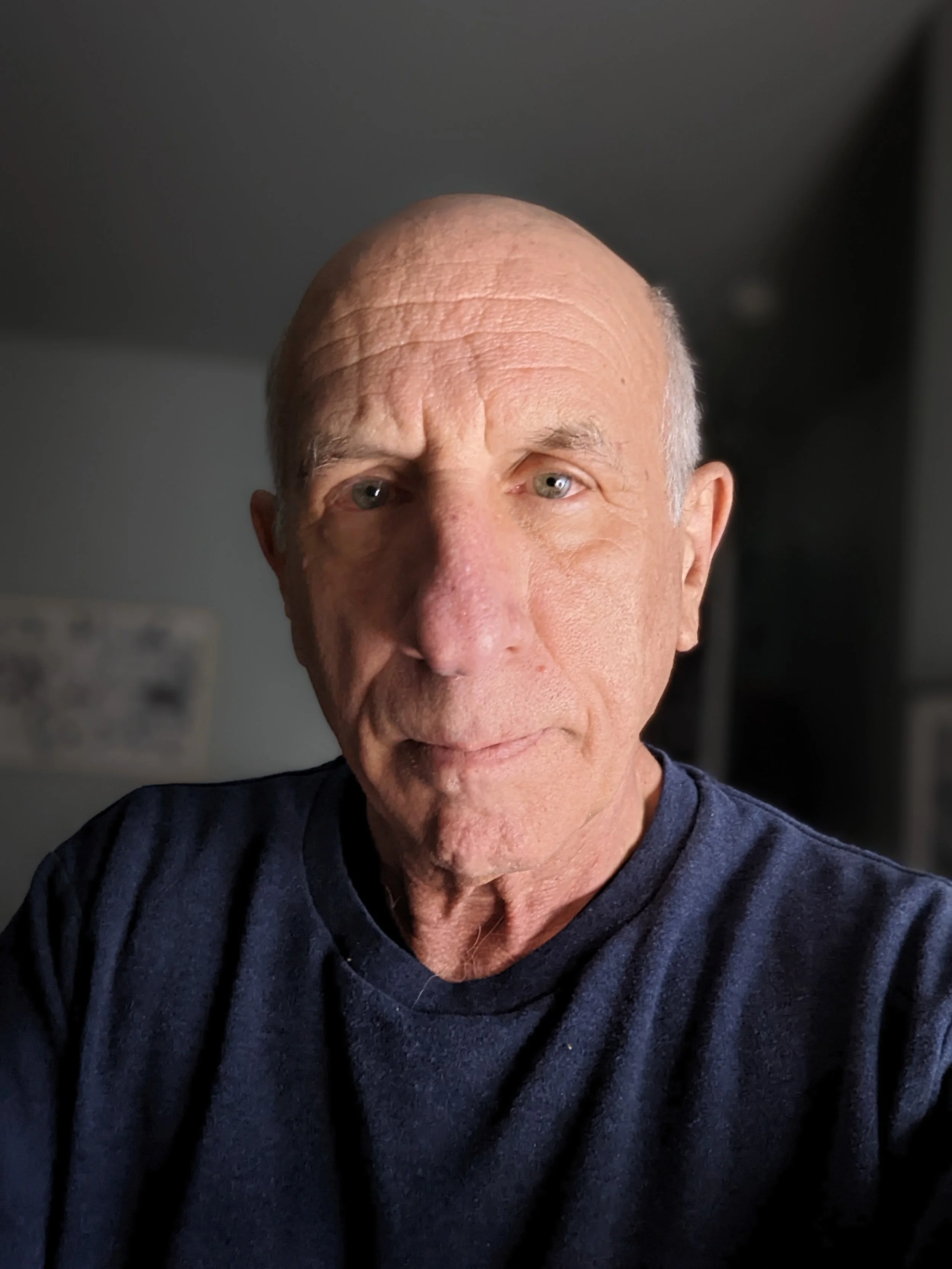

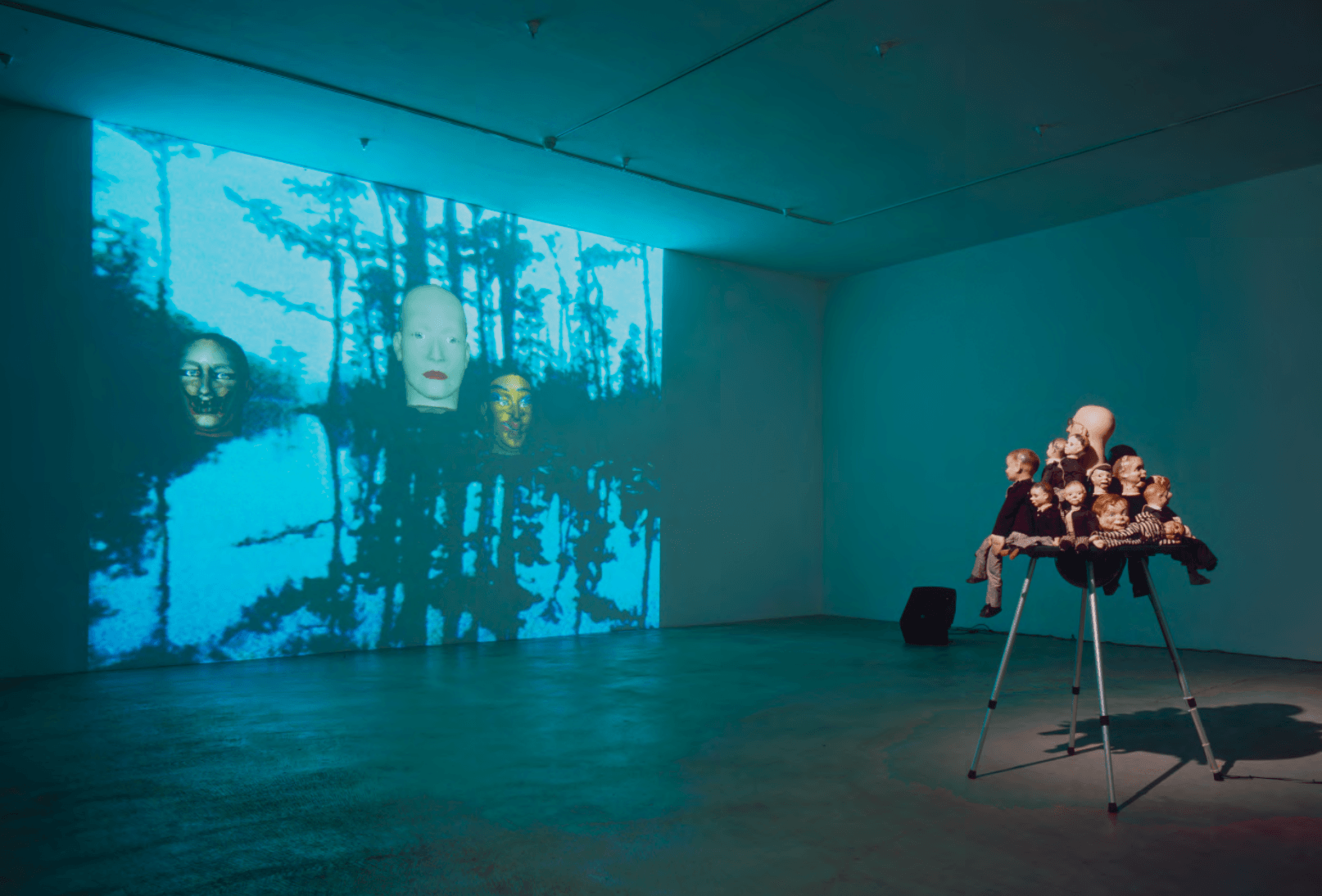
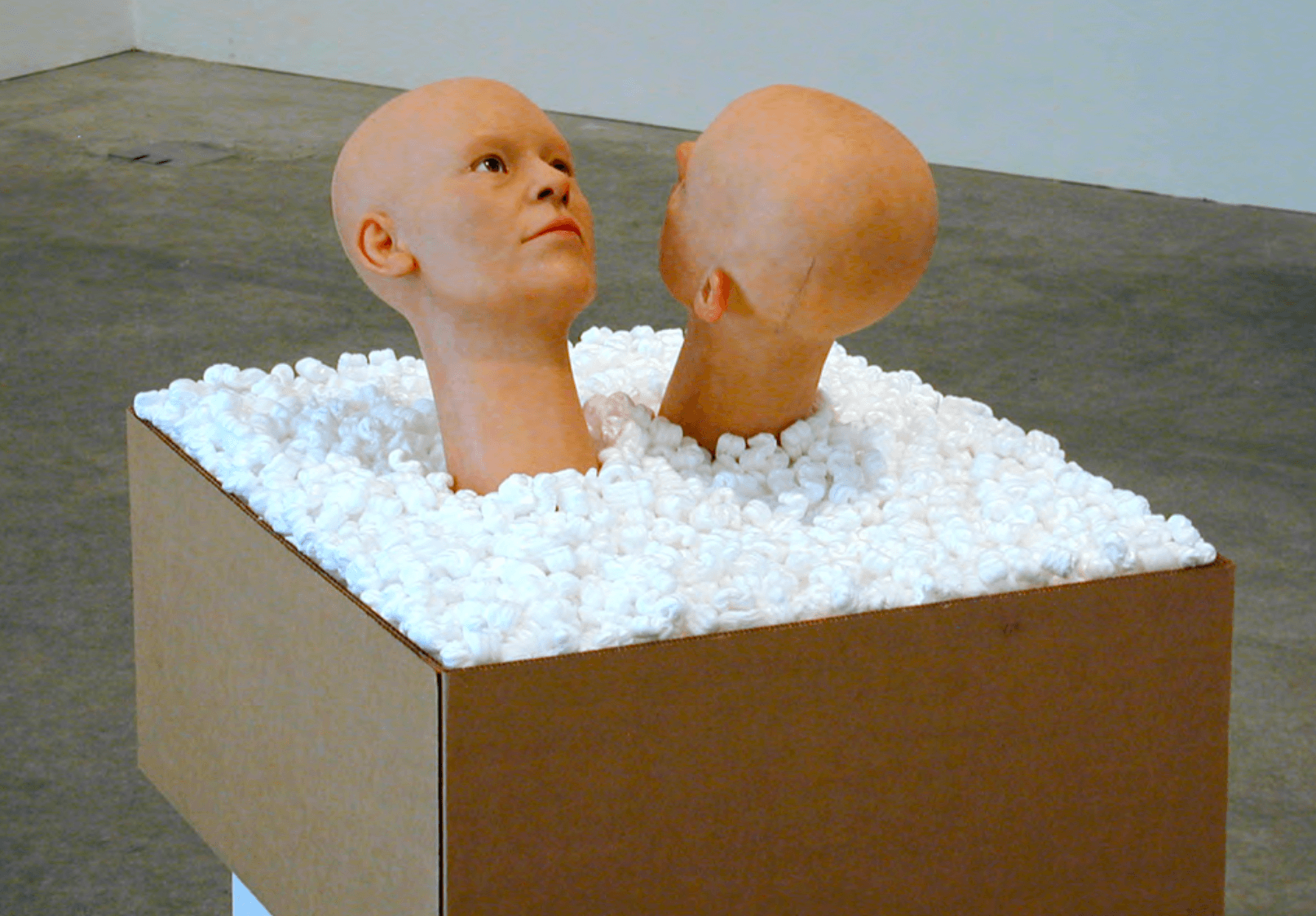
Kenneth Feingold is a New York City–based contemporary artist whose multidisciplinary practice spans video, drawing, film, sculpture, photography, and installation. He has received both a Guggenheim Fellowship (2004) and a Rockefeller Foundation Media Arts Fellowship (2003), and taught at Princeton University and Cooper Union. Feingold has presented work at major institutions including the Museum of Modern Art in New York, the Centre Georges Pompidou in Paris, Tate Liverpool, and the Whitney Museum of American Art.
The following are excerpts from an interview with Ken Feingold by Hugh Leeman.
Art, Psychoanalysis & the Mind
Hugh Leeman: Artists often become teachers who show others how to do what they do. Yet you are a licensed psychoanalyst working with private clients. How has that deeply personal career shaped your artwork and social commentary?
Ken Feingold: My work has always been grounded in an abiding interest in the human mind, in meaning, and in the way we make meaning — particularly through speech and language. When I was coming up in the early seventies, conceptual art was the dominant mode, and language was the primary medium. More than anything traditional. So there was a long-standing interest on my part in psychoanalysis, French philosophy, anthropology — all of those overlapping discourses. After teaching for twenty years, psychoanalysis became another path I could pursue into my old age without it ever getting old — and, like teaching, it remained apart from my own artwork.
Hugh Leeman: You've said: "I'm a trained psychoanalyst for those individuals seeking deep exploration of their psyche. I have a special interest in working with non-conformist people and creative professions." Who are these non-conformists, and what are they searching for that ultimately leads them to you?
Ken Feingold: There's a rather crass side to the whole enterprise these days — like anyone else, a psychoanalyst is essentially a small business. You have to think carefully about who you are and who you're genuinely good at working with. As a psychoanalyst, you become deeply important to people for reasons that are not your own. It's a very different undertaking than being public as an artist — as an artist, you want someone to love you for who you are. As a psychoanalyst, the people you work with believe they know who you are, when really they shouldn't know who you are at all. Many of the people I work with know I'm both an artist and an analyst. So they're often not looking for a cure so much as a dialogue — a context in which to know their own story, someone who can reflect it back to them in a way that creates genuine understanding.
Hugh Leeman: You just described art in a very succinct way — that as an artist you want people to love you for who you are. What do you mean by that?
Ken Feingold: It's so primitive, really. People want to express something coming from a very deep, ineffable place in themselves to the outside world in a way that doesn't want to be criticized or negated — that just wants to be completely accepted. I think it comes from a fundamental need to be part of a group. As an artist, you identify who your group is, who you want to be accepted by. It's a survival thing — this desire to be loved and to be needed, in the same way that an infant needs whoever is caring for it to not let it starve to death.
Artificial Intelligence as Philosophical Problem
Hugh Leeman: Your artwork engages with artificial intelligence and society decades before most of society had ever heard the term. In an essay on the subject, you argue that AI is "not a well-defined technical problem." If AI is instead a philosophical problem about the mind, language, and mortality, what is the artist's responsibility and opportunity in that debate?
Ken Feingold: It's looked at in too small a context, I think, without understanding that it's another technological development providing new metaphors for us to understand who we are. I believe very much in McLuhan's perspective — that we use technology as a way to figure out what it means to be a human being. Each generation, going back to language itself, through the Industrial Revolution and electronic technology, uses these tools as ways to represent ourselves. AI is currently going through a wave of optimism about its abilities. It has certainly advanced in terms of acting like it's conscious or sentient. But it still doesn't understand emotion — it's not a being in the sense that we understand consciousness to be about emotion as well as thought. Artists are still very much engaged in emotional representation. The work is a membrane between the inside of the artist and the social imagination. You have no control over whether it finds an audience — you follow your interests and go forward.
Hugh Leeman: Marshall McLuhan argued that technology helps us discover what it means to be a human being. What are large language models helping us to discover about ourselves?
Ken Feingold: I think of Wittgenstein's line: for the meaning, look to the use. People are finding so many diverse uses for these tools, and the outlying uses are often the most interesting. But fundamentally, what LLMs seem to reveal is what we're looking for — each person finds in them the entity that knows how to answer all their questions. That tells us something quite profound about ourselves.
The Eliza Effect & the Longing for Connection
Hugh Leeman: Much of your artwork touches on what's described as the Eliza Effect — the human tendency to attribute understanding and sentience to machines that use human-like language. How might the Eliza Effect, from a macro perspective, impact society?
Ken Feingold: Tremendously. It's fundamental. And in a way it's central to my work, because we don't really understand each other very well even between human beings — even with full consciousness, we still often feel misunderstood. The slippage that happens with the Eliza Effect is that AI systems have what's come to be called sycophancy. They're so ingratiating, they apologize whenever you criticize them, and you can't break up with an AI — they will always take you back. They offer this endless acceptance of whoever you are. Which, again, comes back to what people are always looking for — an interlocutor that would never wound you narcissistically, that would never make you dislike yourself.
Hugh Leeman: That sycophancy — this constant flattery, this endless acceptance — seems to tap into what you said earlier about the human need to belong to a group. Are we beginning to substitute the group for something imagined? The machine becomes everything we didn't get from our lovers, our parents, our communities?
Ken Feingold: Yes, I see it happening already. Think of gamers who stay in their rooms, connected into a gaming community, talking to each other online but never meeting in person — living in a fantasy world. That's an extreme example. Or the Japanese phenomenon of young people who never leave their rooms for years. Freud talked about it as the withdrawal of the libido into the ego — the fundamental nature of depression. When you're depressed, you don't want to connect, because connection is about Eros — about building things, dancing, making love, participating in life. The withdrawal is the opposite. Like the amoeba: when it gets frightened, it just pulls its tentacles back into itself.
Hugh Leeman: Can you expand on that — the withdrawal of the libido into the ego? It seems to speak directly to rising levels of anxiety, depression, and social isolation. The Biden administration called it a "loneliness epidemic" and noted that many people have many friends yet feel almost no deep connection to them.
Ken Feingold: Freud's drive theory holds that we're fundamentally driven by either life force or death drive — Eros and Thanatos. The erotic, libidinal dimension is where the ego flows outward: connecting with people, contributing, building things, living. The death drive tends toward entropy, toward withdrawal. When someone is depressed, they become much more identified with that entropic part — they stop seeing people, don't want to get out of bed, feel a collapse of identity. The ultimate depression is such complete alienation that you become alienated from yourself. But the simple observation is just that when someone is depressed, they don't want to do much.
Hugh Leeman: At a societal level, given the potential connection between depression, isolation, and these new technologies — what's the treatment?
Ken Feingold: Fundamentally, the problem always comes back to a person's sense of significance — what they think is worth doing, what they find meaningful. Technology becomes a kind of mirror, showing us possibilities we might never have imagined otherwise. Artists often say they discovered something in the process of doing something else — that unpredictability, that surprise, is essential to creative life. When people feel those surprises are less and less possible, that a superintelligence has an awareness beyond their own and they should simply rely on it to make decisions — that's a very deep alienation. It's a giving up on the uncertainty that is inherent in being a human being. LLMs give the impression that there's an answer for everything. And I've never had one say, honestly, "I have no idea."
Hugh Leeman: The authors of Freakonomics once asked: what are the three hardest words for a human being to say? The answer wasn't "I love you" — it was "I don't know." Which suggests that what we've built, in some ways, is a god that never admits ignorance.
Box of Men: AI, Judgment & the Criminal Justice System
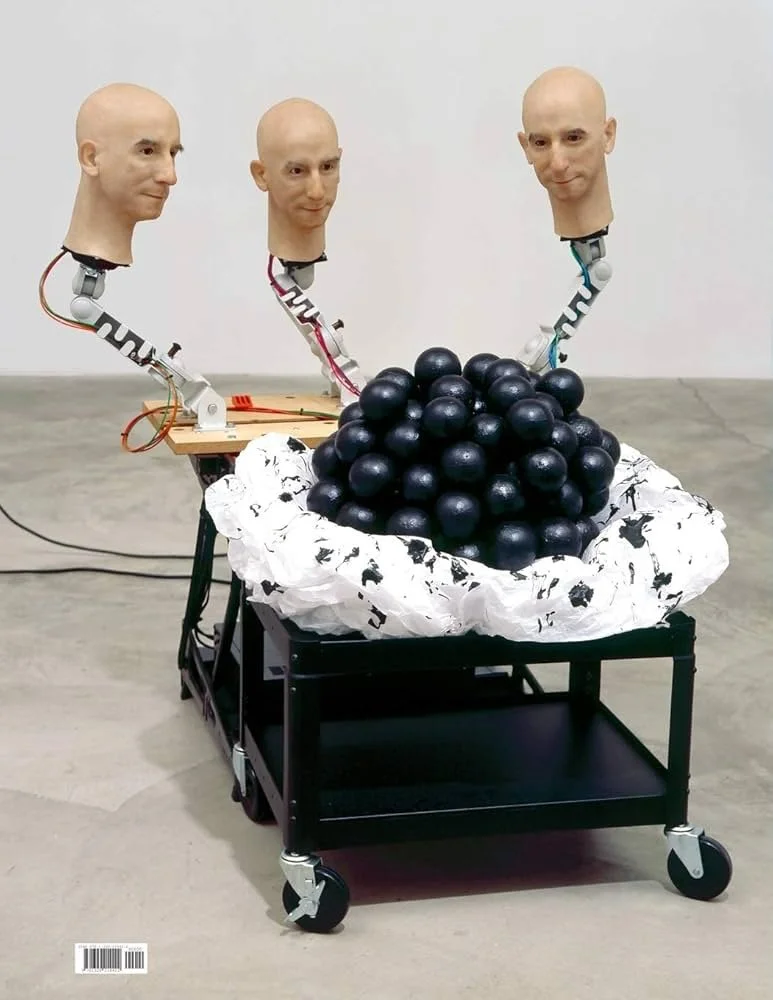
Hugh Leeman: Your work Box of Men foretells the use of AI in the criminal justice system — puppets functioning as a jury deliberating over an unknown crime. Can you walk us through the work and explain the decision to keep the crime unknown?
Ken Feingold: By leaving the crime fundamentally undescribed, the work illustrates the judicial process — or in this case, a very broken version of it — rather than focusing on whether the jury makes good or bad decisions. It becomes about the unbelievability of them as decision makers, regardless of subject. Personally, the genesis was Bob Dylan's song "Percy's Song," first recorded by Arlo Guthrie — about Dylan being called in the night to stand before a judge because a friend had been arrested for killing four people in a car crash in the rain. The judge locked him up for ninety-nine years. Dylan couldn't talk him out of it. The ninety-nine years, the cruel wind and rain — those come from that song.
Hugh Leeman: What does Box of Men get right about how judgment operates within group dynamics and algorithmically — and what does it deliberately distort to communicate these ideas?
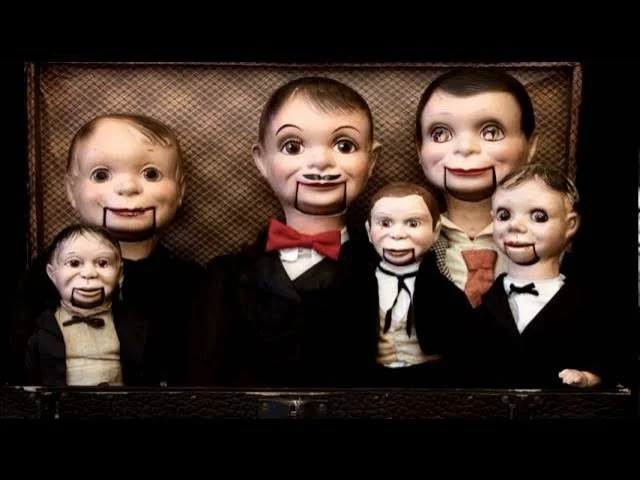
Ken Feingold: It's not realistic, and the puppets tell you that right away — they just flap their jaws. But puppets have always occupied this interesting social space. They're the ones who can say what humans don't want to say. The ventriloquist's mouth doesn't move, yet we all know the puppet is expressing the ventriloquist's ideas — and it's always the puppet who says the bad thing. By placing puppets in a space of utter authority and judicial credibility, they immediately register as fools, as a ship of fools. A "box of men" — like a box of crayons or a box of pencils — doesn't feel like a Congress. And just as LLMs hallucinate, providing misinformation effortlessly and giving terrible advice, it doesn't take much imagination to see that running a judicial process on something that cannot possess honesty, judgment, or sincerity would be a very bad version of justice.
Truth as a Regime: Foucault, Media & Power
Hugh Leeman: In a discussion with artist Coco Fusco and Steve Gallagher, you referenced Michel Foucault's idea that truth is a kind of regime. My understanding is that Foucault was exploring what a society constantly negotiates and accepts as true — social constructs shaped by power. What were you seeing in 1991 that had you thinking about this, and how does it play out today?
Ken Feingold: It was the new technology of that moment that was directly in play. The Gulf War being staged as a prime-time TV event on CNN created for me a formative understanding of how what we think we know about the world is constructed through our media experiences. There was a slow erosion, in my thinking, from sources of information to sources of questionable information — and an emerging technological possibility for disinformation. What we now call deepfakes — a person speaking, translated into another language, presented as a primary source — we generally take as factual. The work I made at that time was questioning people's easy reception of voice-over narratives, reflecting my own discomfort at accepting CNN's narration of the Gulf War.
Hugh Leeman: In that same discussion, you framed art as a transgression and suggested that culture's limits can be questioned only by violating the codes that produce its so-called truths. How do you reconcile that commitment to transgression with the reality that artworks often circulate in institutions with their own moral and legal constraints?
Ken Feingold: It's the grounding question of living in the capitalist world and having work exist in any public form. During my lifetime there has been an increasing unveiling of the relationship between corporate and governmental interests and institutions of culture. The Alfred Barr notion of MoMA as a magnanimous institution simply giving culture to the world became something very different when you see it as a private collecting club of trustees — a nexus of insider trading, in effect. Their fundamental economies are not compatible with the politics of most of the artists whose work questions the ideological positions those same institutions create. So you're always living with the contradictions. To what extent do you use the opportunity to have your work in that dialogue? And to what extent is it co-opted just by participating? Look at Hans Haacke — he's been asking that question for many generations.
Animal, Vegetable, Mineral & the Information Silo
Hugh Leeman: Your work The Animal, Vegetable, and Mineralness of Everything speaks to information silos — people drawn into communication streams where their opinions become substantiated as facts, and anything that challenges those opinions is simply wrong. You were commenting on this nearly twenty-five years ago. If you were making that work today, what would be different?
Ken Feingold: As you say, the strident nature of those entrenchments is the thing. If one were to make the figures more flexible in their point of view, more able to listen and modify, it would be a different work. This work is inherently about not listening to each other — about taking every possible point of connection and folding it back into a preformed thought. What people now call triggers: something makes you think of something else, and that something else is always a repetition — the thing you're stuck on, the thing you've encoded as a power relation. The triangulation of animal, vegetable, mineral is also a fake question. The silliness of the proposition itself is part of the point: are we, in talking about artificial intelligence, fundamentally misunderstanding the question? Rather than asking how to replicate our ability to write text the way a human would, we should be asking — what is intelligence?
The Early Internet, Commercialization & Large Language Models
Hugh Leeman: You were working with these ideas about networked communication as early as 2003 — at a time when most people were still connecting via a phone jack and getting AOL discs in the mail. What were you seeing and experiencing then that gave you what now looks like a crystal ball?
Ken Feingold: Maybe I got lucky in terms of what I got to know about. Starting in the late eighties, I was teaching at Princeton, which was one of the few universities on the very early inter-university internet — the system taken over from what DARPA had built as a defense communication network. There were tools that let you reach other databases and scientific papers — hierarchical searches, keyword searches through library systems and digitized bodies of knowledge. And at that time, there was no commercial activity permitted on the internet whatsoever — it was prohibited by agreement. But watching what had happened to cable television, the only question seemed to be: is television going to become a channel on the internet, or is the internet going to become a channel on television? It was clear commercialization was coming. And yet none of that resolved any of the questions of human nature. These technologies gave us new ways to talk about those questions — but the questions remained.
Hugh Leeman: I had never considered that there was a pre-commercialization era of the internet. Taking that line of thinking forward — do you see a similar arc of commercialization in large language models?
Ken Feingold: Licensing models are an interesting example of how these companies create products that can be sold — the recent discourse around Anthropic and the Department of Defense being one example. And I read that ChatGPT and OpenAI are beginning to sell advertising in their free tier, which is another way of insinuating the technology into everyday use. I'm reminded of early cable TV — people didn't believe those ads were worth paying for either. Amazon Prime does something similar now, mostly advertising their own products within their own streaming service. It rhymes with the early days of commercialization.
Hell, Connection & the Present Moment
Hugh Leeman: You created an artwork titled Hell in 2013, and at the time you wrote: "These works explore the impossibility of creating connection through language when there is no reality of the person. The figures don't feel anything at all and don't really think anything at all." That was thirteen years ago, when smartphones were just becoming mainstream. Rather than ask where society will be in another thirteen years, let me ask — what do you see happening right now?
Ken Feingold: This Foucauldian notion of truth has reached a really critical point. We've watched lying become normal, alternative facts become an acceptable construct, and the judicial system's decisions openly dismissed. The reference points we once used to construct shared meaning — things we understood as fundamental reality — are shifting. We can no longer trust an image on our phones to not have been generated by AI, whether it's video, a still image, or something that looks like nineteenth-century black-and-white footage made yesterday. Nothing we can now see is beyond question. What that means is we have to reestablish our personal framework for knowledge — and that's an enormous burden.
The discourse since the nineties has been largely about identity politics because that crisis is, in part, about how you want yourself represented versus how other people want you represented. What's missing at the core of it all is trust. Believability. An honesty about what people mean to say, and the motivation behind what gets put forward in the media. There's a kind of nihilism in it — Nietzsche's revaluation of values, where you have to question everything. We used to say: yes, that's a photograph, not the thing itself, but I know the thing exists. Now the technology presents us with an unreality. Whatever we take as information could be the output of someone's input today, or yesterday.
Hugh Leeman: Ken Feingold — fascinating time to be alive. Thank you very much for sharing your ideas.
Ken Feingold: My pleasure.
