
Seeing Silence: The Paintings of Helene Schjerfbeck, The Metropolitan Museum of Art
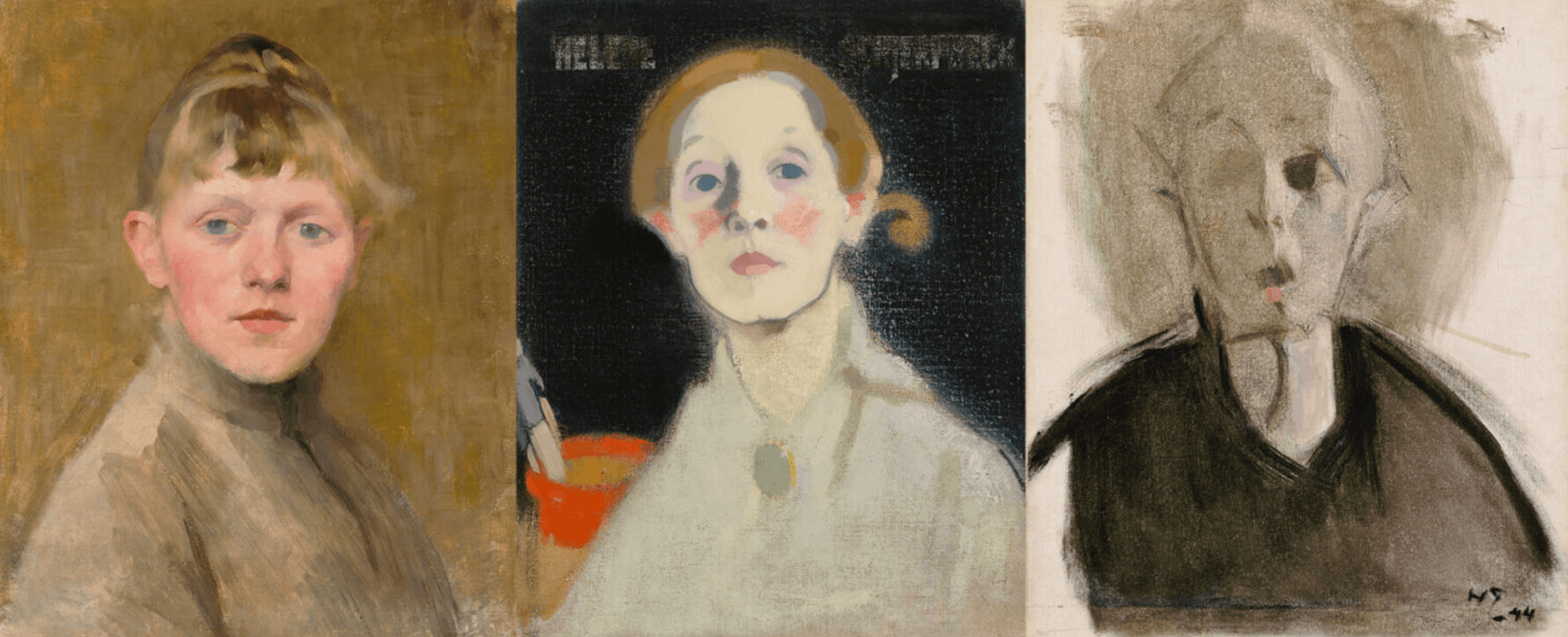
From left: Self-portrait (1884–1885), Self-portrait, Black Background (1919) and Self-portrait with Red Spot (1944).Photos: Jenni Nurminen, Hannu Aaltonen, Hannu Aaltonen/Finnish National Gallery/Ateneum Art Museum
By Wei Huang
How does one see silence? And how could one be convinced that this aural characteristic is conveyed through purely visual form? At The Met’s Seeing Silence: The Paintings of Helene Schjerfbeck, the first exhibition of the great yet underrated Finnish painter Helene Schjerfbeck (1862–1946) at a major US institution, the silence overarching her works appears self-explanatory. “Eloquent Silence,” titled art historian Annabelle Görgen Lammers’ catalogue essay for the exhibition “Helene Schjerfbeck” at Hamburger Kunsthalle, Hamburg, in 2007, which was the first show the outside the Nordic countries to feature the artist. It has been agreed that Schjerfbeck is an artist of silence, and her silence has much to say, but what exactly makes this silence timely for a broader audience beyond Finland during this very moment?
To see Schjerfbeck’s silence, one might turn to her work Silence (1907). The sitter in the painting wears a compact updo and a blue turtleneck dress. Her gaze directs downward, or perhaps her eyes are even closed. From outside the picture plane on the proper left, a source of light casts a layer of aura around her that illuminates against the pitch-dark backdrop. Her silence is indeed loud, but what accounts for it? For one, she appears almost static. There is a sense of contemplation, if not piousness, in her, and the luminosity further obscures her silhouette and therefore insulates her from us. From a formalist standpoint, her spirituality and silence are achieved through the palette Schjerfbeck applied to the picture: cold, reduced, and flat—reminiscent of the typical “Nordic aesthetic.” The quiet and simple visual quality with minimized visual noises translates the aural silence to visual silence.
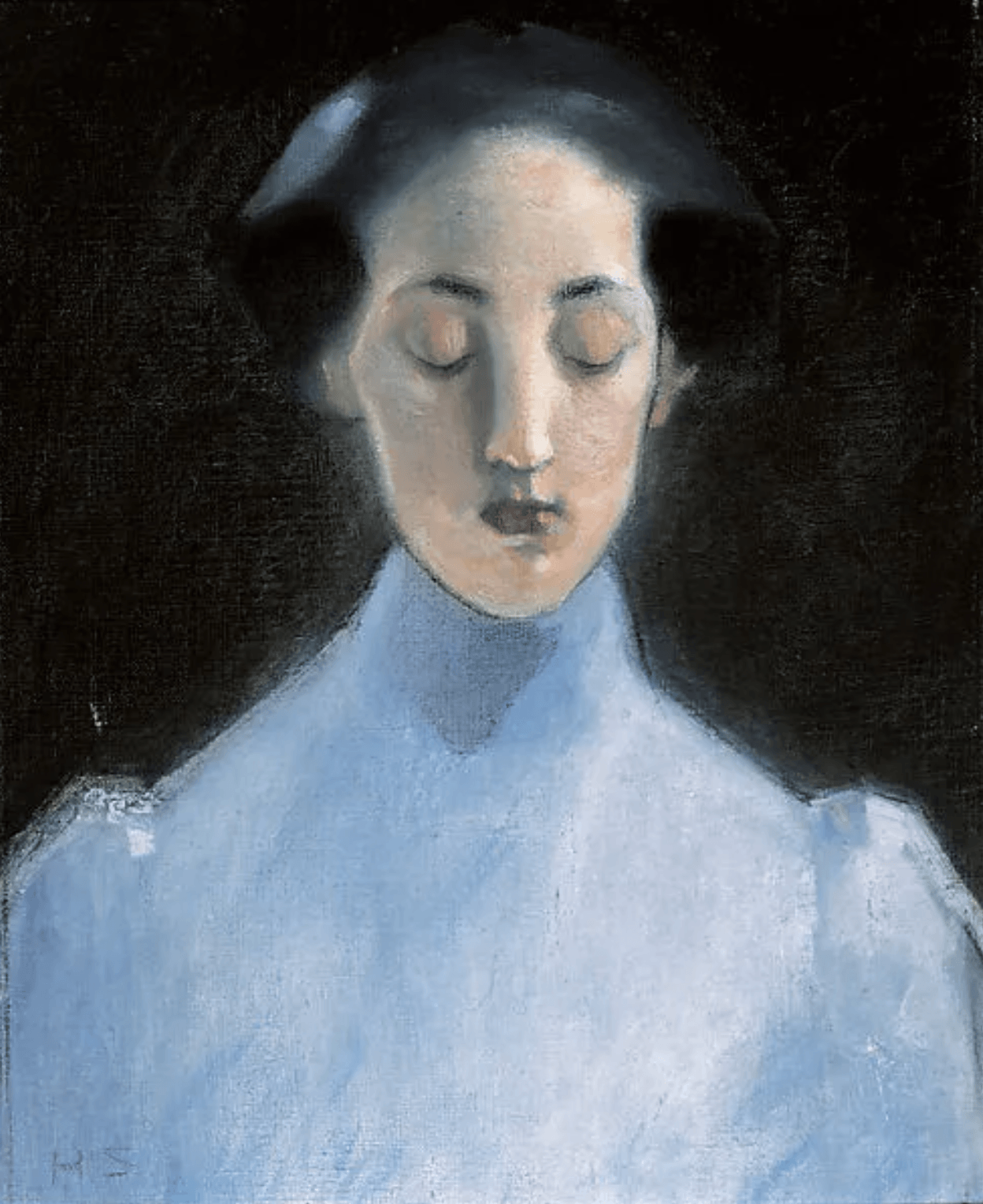
Helene Schjerfbeck (Finnish, 1862–1946), Silence, tempera and oil on canvas, 67.2 × 59.2 × 6.5 cm (26 7/16 × 23 5/16 × 2 9/16 cm), 1907, Nordea Art Foundation Finland.
In most of her portraits, Schjerfbeck captured her family members or friends in the middle of their own activities, oblivious to the artist’s presence. This naturalistic approach had always been in her artistic genes, but she started from a vastly different place before she arrived at the modernist destination, as seen in Silence.
Born in 1862 and after early artistic formation in Finland, she secured a grant to study in Paris in 1880. Much like some of her most trailblazing peers such as Akseli Gallen-Kallela (1865–1931), Schjerfbeck adopted French academia-infused realism earlier in her artistic journey before developing her own visual lexicon.
In The Convalescent (1888), arguably one of the most famous works of hers if not of any Finnish artists, the influence from contemporaneous French realists and naturalists like Jules Breton (1827–1906) and Jules Bastien-Lepage (1848–1884) is evident. The painting was featured in the Finnish pavilion (then still under Russia’s rule) at the 1889 Exposition Universelle in Paris and won Schjerfbeck a bronze medal. Here Schjerfbeck adopted the “sick girl” motif common in nineteenth-century Nordic art, which could have been a reaction to the distress looming over fin-de-siècle Europe catalyzed by urbanism and the rampage of tuberculosis. The Convalescent has long been considered autobiographical, mirroring Schjerfbeck’s childhood injury which led to lifelong disability. Nonetheless, despite the rosy cheeks and dazed blue eyes possibly resulting from fever, the disheveled and swaddled child clearly shows signs of recovery. Visually much busier than her later works, the picture retains peace and serenity brought by a sense of hope.
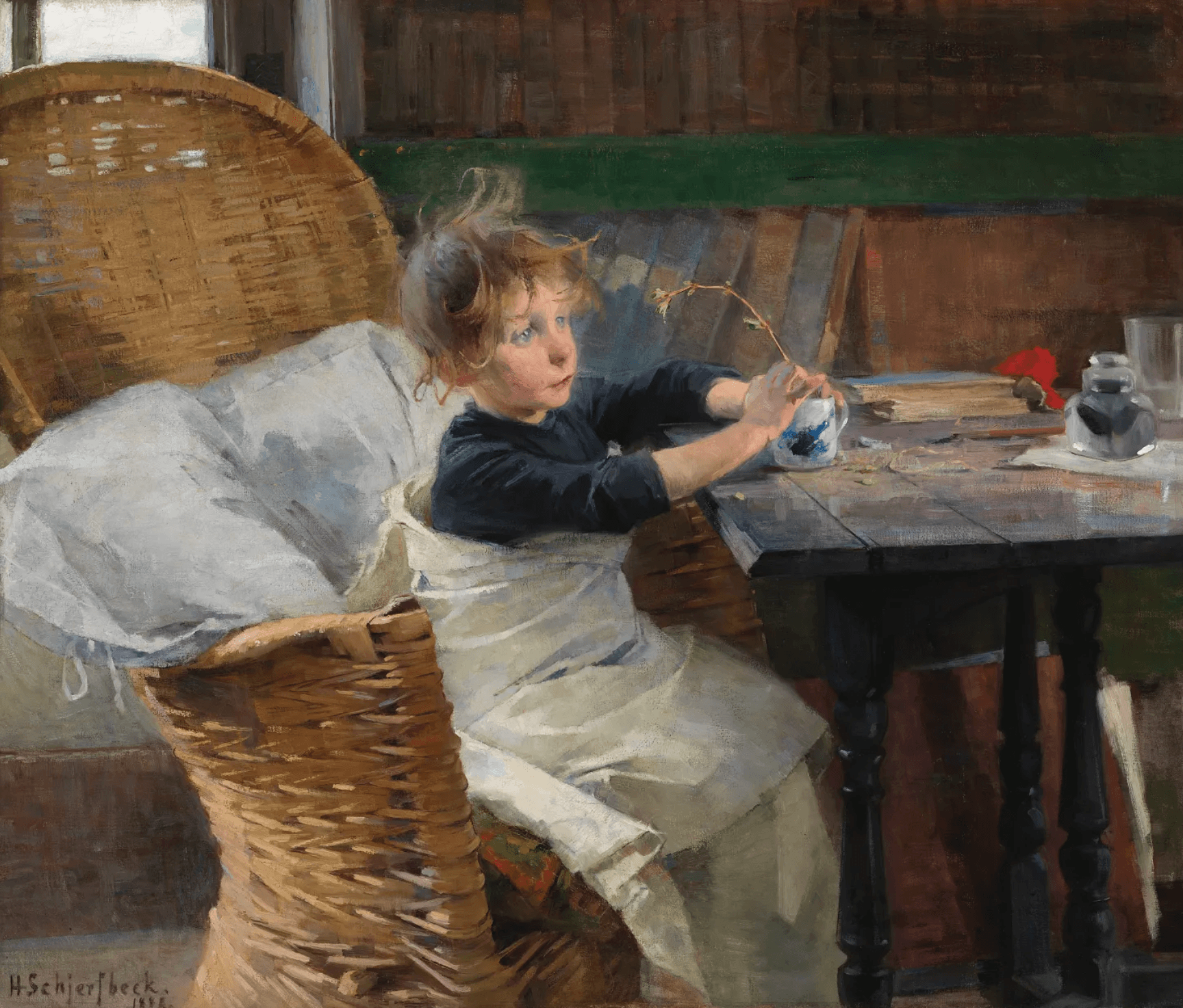
Helene Schjerfbeck (Finnish, 1862–1946), The Convalescent, oil on canvas, 92 × 107 cm (36 1/4 × 42 1/8 in.), 1888, Ateneum Art Museum, Helsinki.
The Convalescent was an early testimony of Schjerbeck’s consideration for her models and her dynamic with them. Prolific in portraits, the exhibition charts them with care. By the 20th century, one can easily see when the modernist influence crept in and eventually took over her artistry: Her palette grew much more muted, largely scaled down to earth tones, black, and blue. She is frequently compared to James Whistler, especially regarding the portraits of her mother, but Schjerfbeck expresses the similar aloofness with even more idiosyncratic use of flat geometric color fields. In the 20s and 30s, a group of portraits displays even more stylized visages with reference to both modernists and Old Masters from Amedeo Modigliani (1884–1920) to El Greco (1541–1614). This includes her first work to have been acquired by a US museum The Lace Shawl (1920), a highly stylized portrait of her friend-cum-landlord from the coastal Finnish town of Tammisaari, which was also her grandfather’s hometown and her place of residence until the outbreak of the Winter War (1939–40), an invasion of Finland conducted by the Soviet Union.
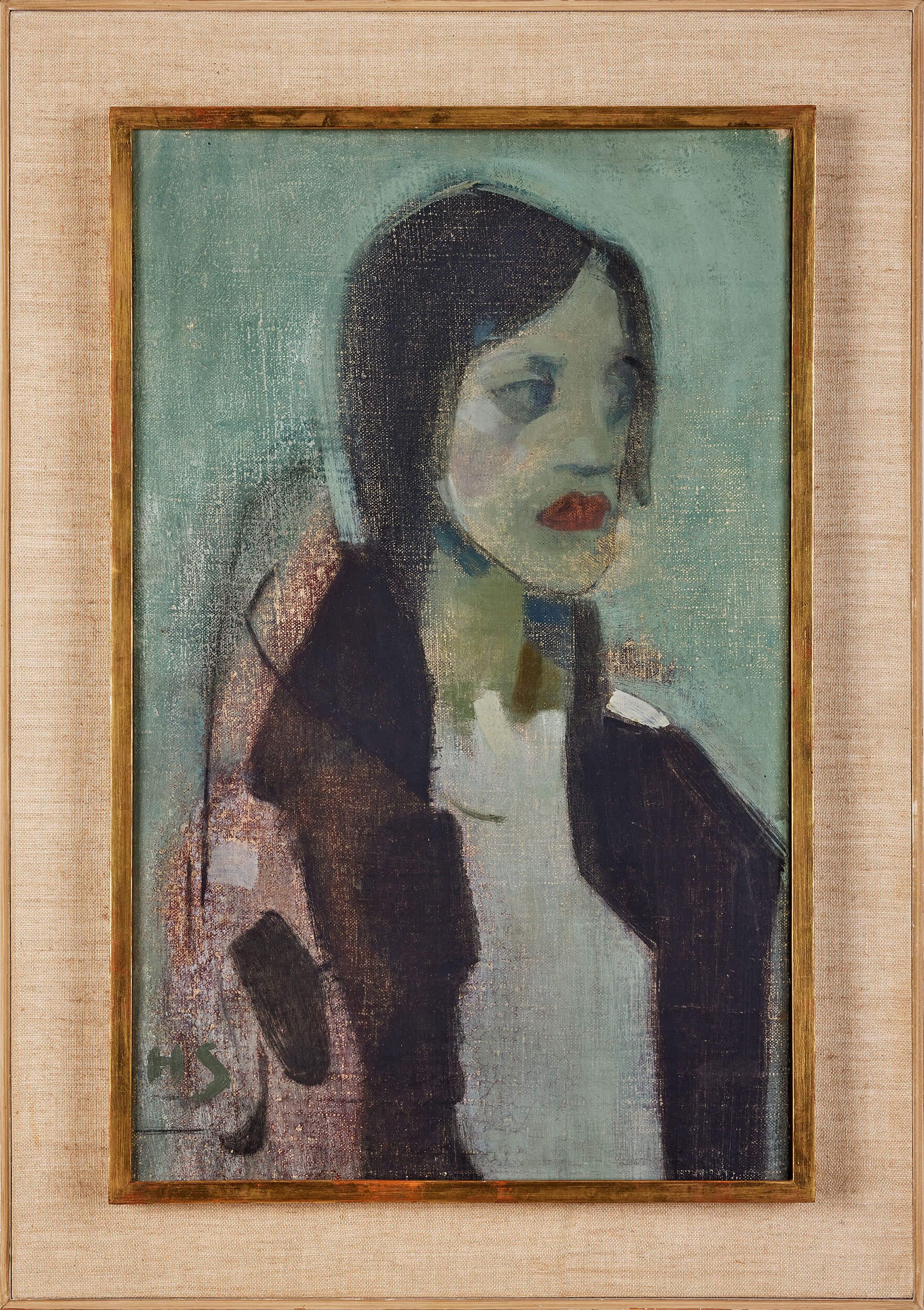
Helene Schjerfbeck (Finnish, 1862–1946), The Lace Shawl, oil on canvas, 58 × 36.5 cm (22 13/16 x 14 3/8 in.), 1920, the Met.
This is, however, where the exhibition comes up short. To introduce Schjerfbeck to a broader audience, the Met diligently follows chronology and the artist’s biography. A warranted curatorial direction, it nonetheless comes at the expense of examining the interaction between the artist and the broader social, cultural, or political context. In the early 20th century when Art Nouveau was making waves in continental Europe, the Nordic countries also witnessed their own aesthetic movement, one that would later define the contemporary Nordic aesthetic. Schjerfbeck’s modernist style not only contributed to the clean and simple aesthetic but to the Arts and Crafts aspect of the movement. She designed home decor goods such as tapestries and cushions and was under the influence of Japonisme as well.
Still, we are able to posit these influences from the exhibited works. Could be qualified as one of her best works is her tapestry design from around 1915, showing two persons at a waterfront. Compared to Silence, the silhouettes of the two are even more reduced, geometric, angular, flat, and nebulous in appearance. The teal water body nearby is vast but calm with no sign of waves or currents, only punctuated by one shoal and its bristling trees. The lone shoal speaks in a voiceless dialogue with the pair on land; their mutual company is a hush, it is silent.
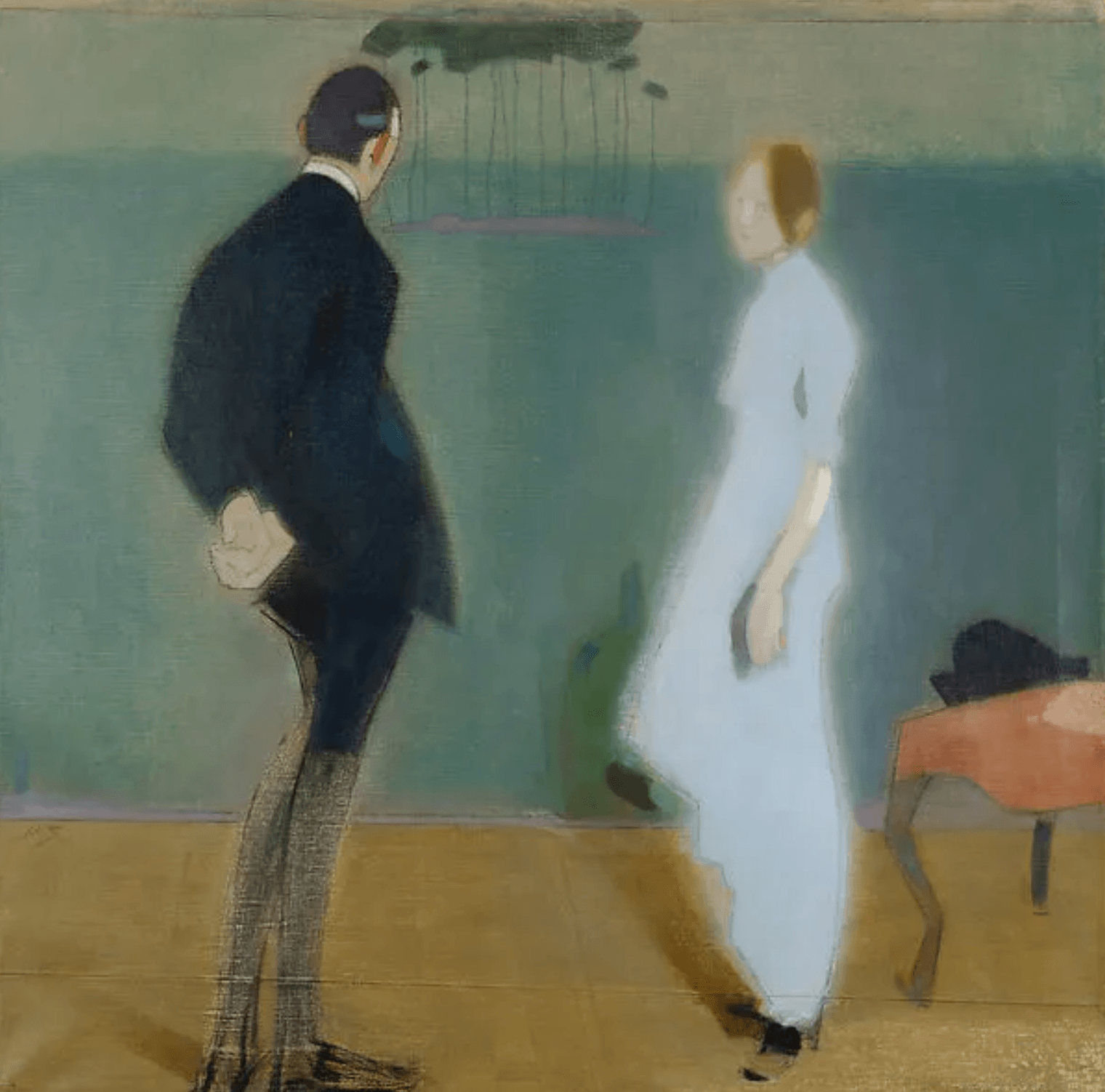
Helene Schjerfbeck (Finnish, 1862–1946), The Tapestry, oil on canvas, 89.5 × 92 × 2.5 cm (35 1/4 × 36 1/4 × 1 in.), 1914-1916, private collection
The outside world’s most palpable influence on Schjerfbeck’s works manifests in the last two sections of the exhibition, where her still-life paintings and self-portraits are displayed. The still lifes, more chromatic than her portraits, feature typical subjects of the genre but with an idiosyncratic twist. Juxtaposing her depiction of apples from the 1910s to the 40s, the style starts from the timely ethereal symbolism, still rife with Impressionistic touch, to a much more unsettling use of harsh contours, flat colors, and jarring palettes. In Still Life with Blackening Apples (1944) what’s not to be ignored is her consistent modernist approach to the colors, especially with the use of complementary colors. Already visible in The Convalescent exemplified by the red clutter on the table and the green bookshelf, this pairing grew into her signature as seen in the backdrop and the lips of the sitter in The Lace Shawl, until it mutated into an almost jarring sight in Still Life with Blackening Apples, in which the sections of the sliced red apples radiate an ominous chunk of fluorescent green.
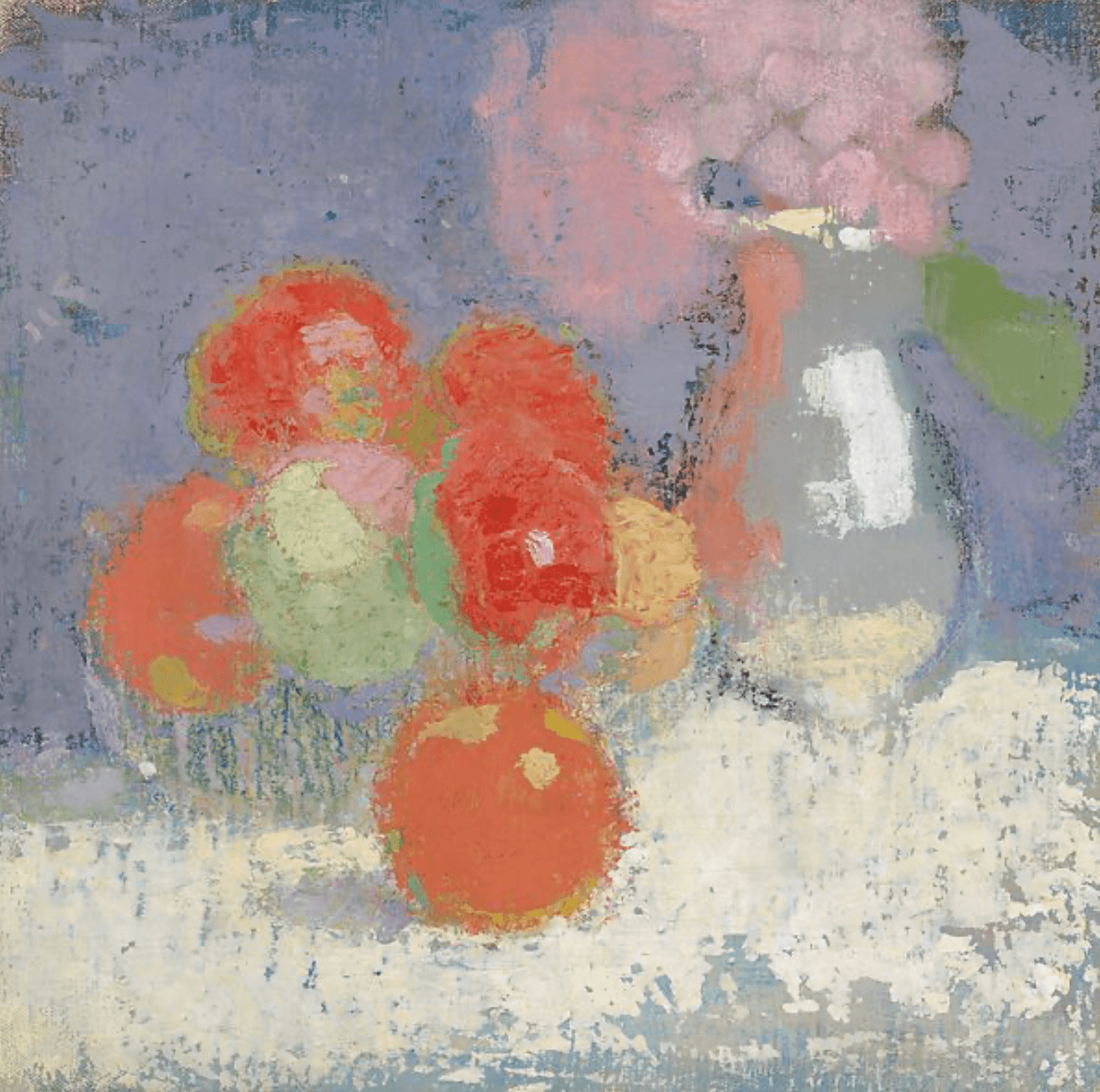
Helene Schjerfbeck (Finnish, 1862–1946), Red Apples, oil on canvas, 40.5 × 40.5 cm (15 15/16 × 15 15/16 in.), 1915, Ateneum Art Museum, Helsinki.
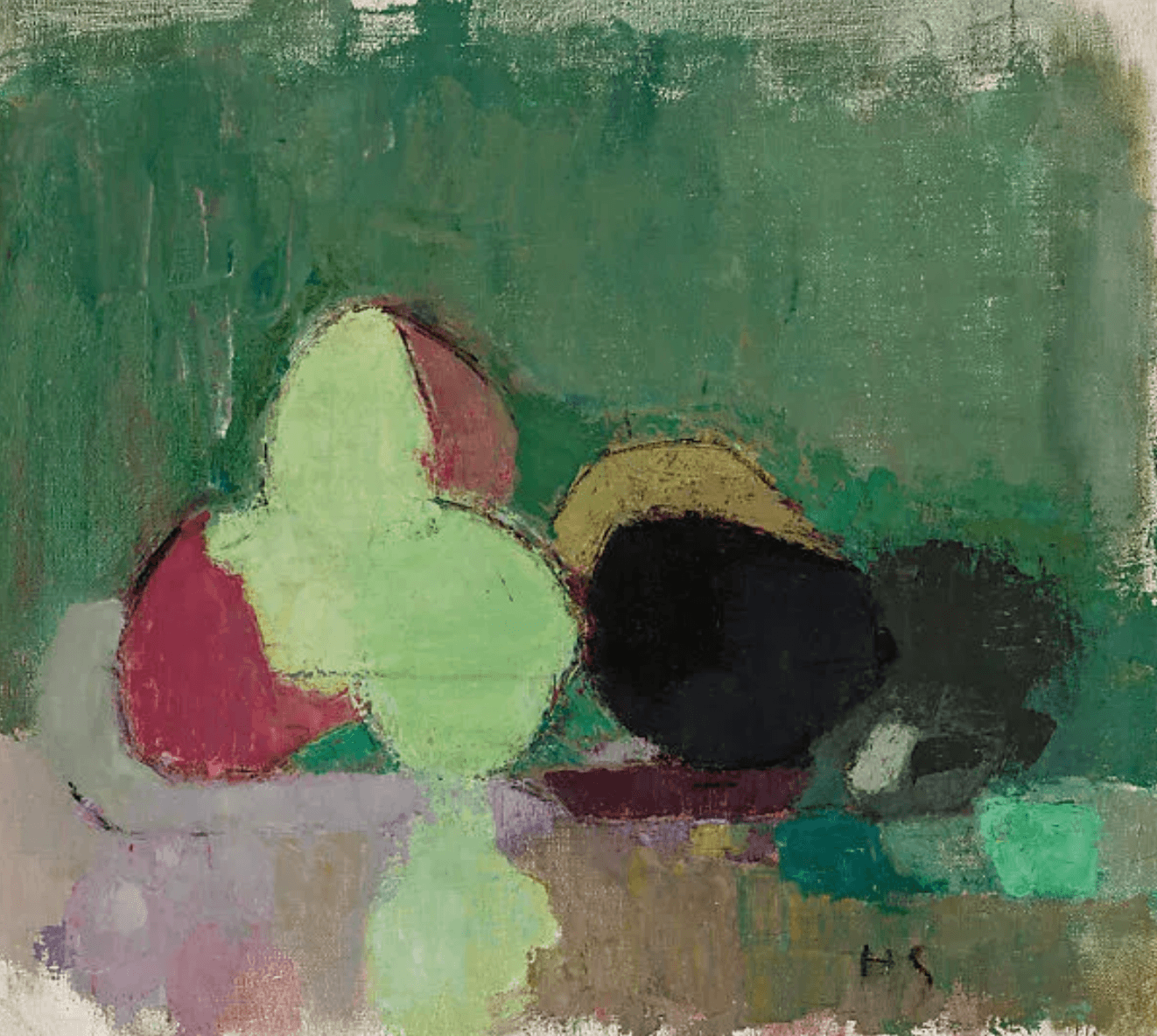
Helene Schjerfbeck (Finnish, 1862–1946), Still Life with Blackening Apples, oil on canvas, 36 × 50 cm (14 3/16 × 19 11/16 in.), 1944, Didrichsen Art Museum, Helsinki.
The upfront depiction of the rotting and the unsettling use of colors have been theorized to be a reflection of Schjerbeck’s psyche in the face of the devastation amidst World War II. Paralleling her still lifes, the last section of the exhibition, dedicated to her self-portraits, maps the way Schjerfbeck interrogates herself throughout the years. Schjerfbeck viewed herself as poised and detached as she was confident and unphased in the earliest years. As one of the few women artists at the time, Schjerfbeck presented herself in what would have been a “masculine” fashion: a solemn if not isolated individual typically seen in the self-portraits of Gradually, her visage grew angularized, frequently bearing a slanted gaze with the expression of indifference, if not disdain, until her last years during which she rendered herself almost unrecognizable in repeated goblin-like forms. Schjerfbeck saw herself and the war through the lens of mortality with brutal honesty that bordered on unforgiveness, but such was the mortality that she and the whole world all inevitably faced. Her mouth stays half-open in her last portraits, as if aghast yet frozen in silence, like a screamless cry.
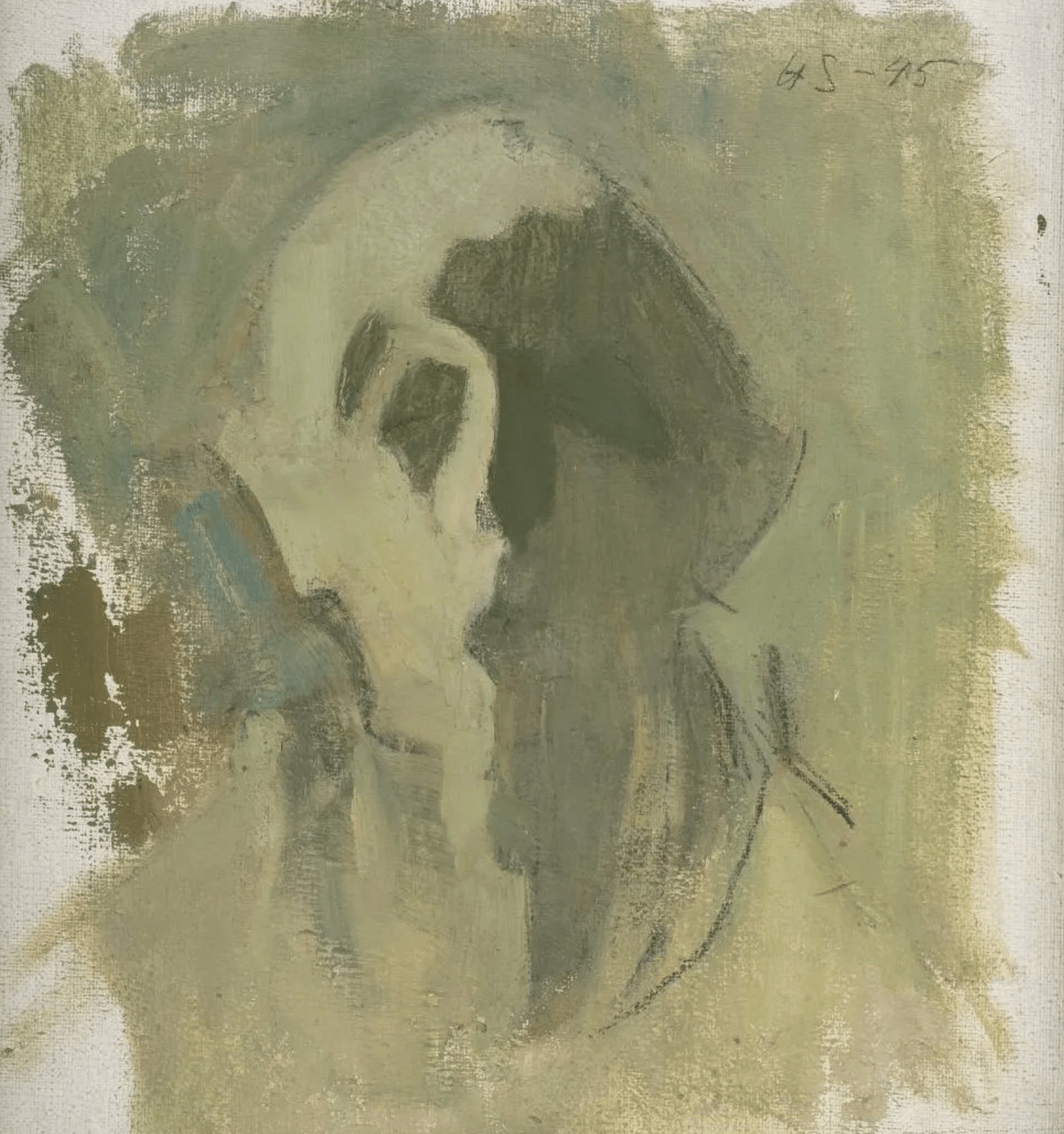
Helene Schjerfbeck (Finnish, 1862–1946), Self-Portrait, Light and Shadow, oil on canvas, 34 × 36 cm (13 3/8 × 14 3/16 in.), Villa Gyllenberg, Helsinki.
What does it mean to show Helene Schjerfbeck’s works to a global audience at this moment? Certainly, it’s always opportune to reintroduce an underrated artist, especially a woman artist, to the world. In a broader context, she heralds a potential newfound enthusiasm for Finnish and Nordic art. For a long time, Nordic art was dismissed as provincial due to Nordic countries’ marginal position in the geographical and cultural landscape, but Schjerfbeck serves as a compelling case to not limit the capacity of modernism and art history at large.
Seeing Silence: The Paintings of Helene Schjerfbeck, however, can provide more than a rediscovery. In her twilight years, Schjerfbeck lived through turmoil and wars: Finland’s independence in 1917, the Winter War and Continuation War between 1939 and 1946, and World War II. Less than a century later, the world remains in chaos, and this time the Nordic countries have come under the spotlight. Schjerfbeck’s art is a presentation of the utmost honesty and raw introspection of herself, and it serves as a reminder to constantly look inward, to not ignore our sense of human in moments of crisis like the one we are living in, and hopefully through, right now.
