
Video Craft, The Museum of Craft and Design
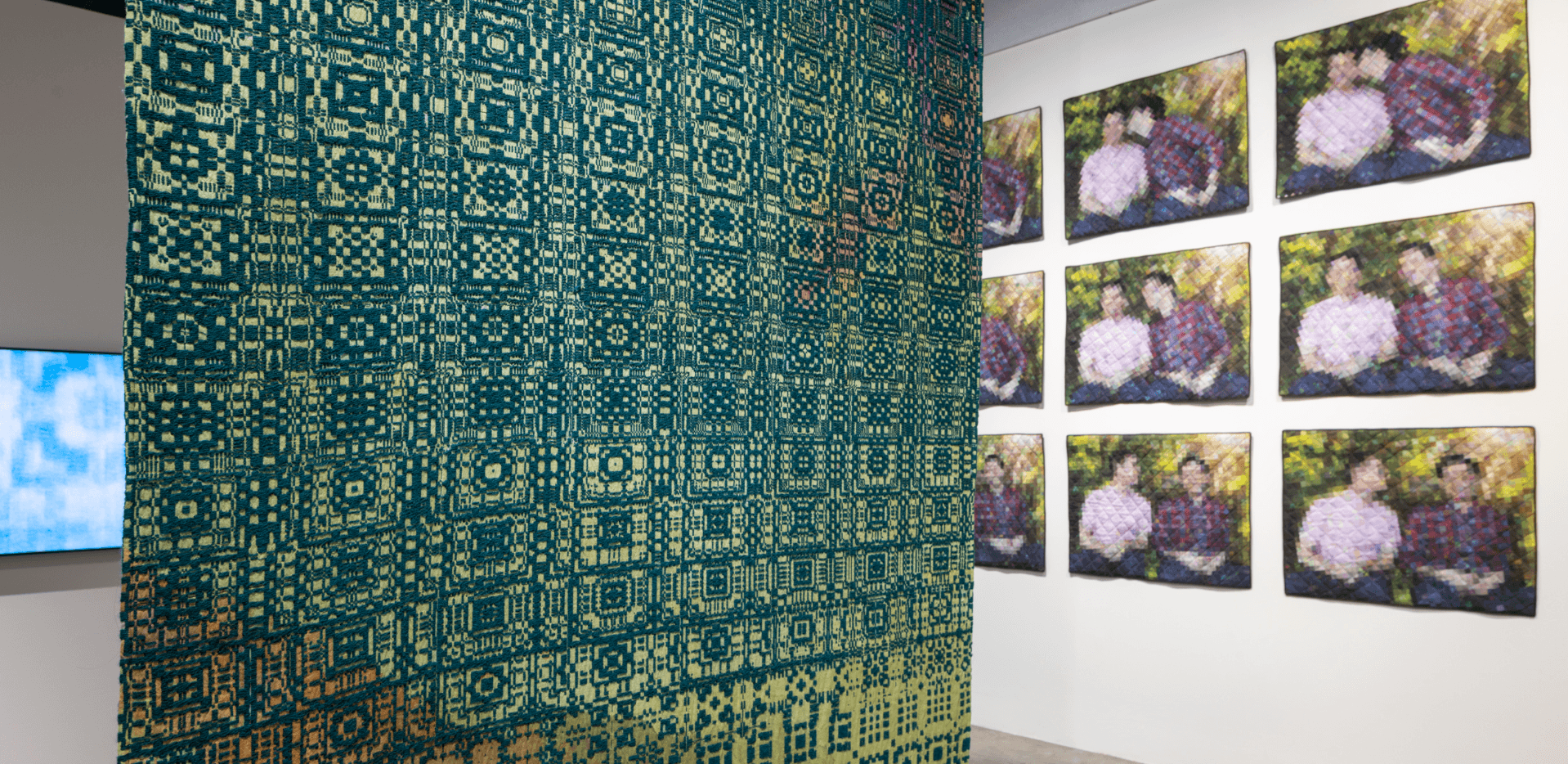
Video Craft Installation
There are two ways to read the title of the exhibition currently on view at the Museum of Craft and Design, San Francisco: an exhibition about the craft of making moving images, or one about what craft has made of the moving image. The first reading is not a stretch, as editing, color timing, and the physical labor of slicing and splicing footage are all forms of embodied, specialized knowledge; a show called Video Craft could easily have been about them. Video Craft turns out to be an exhibition of the second kind. Across its galleries, moving-image media keep getting pulled into craft’s orbit: a sixteen-millimeter documentary turns into a quilt, home movies get cut up and rewoven as patchwork. For a culture that lives increasingly on TikTok and Instagram, an exhibition like this reminds us that craftsmanship still has a claim. To the extent that video gets included, it is for demonstrating ways it gets reconfigured through craft.
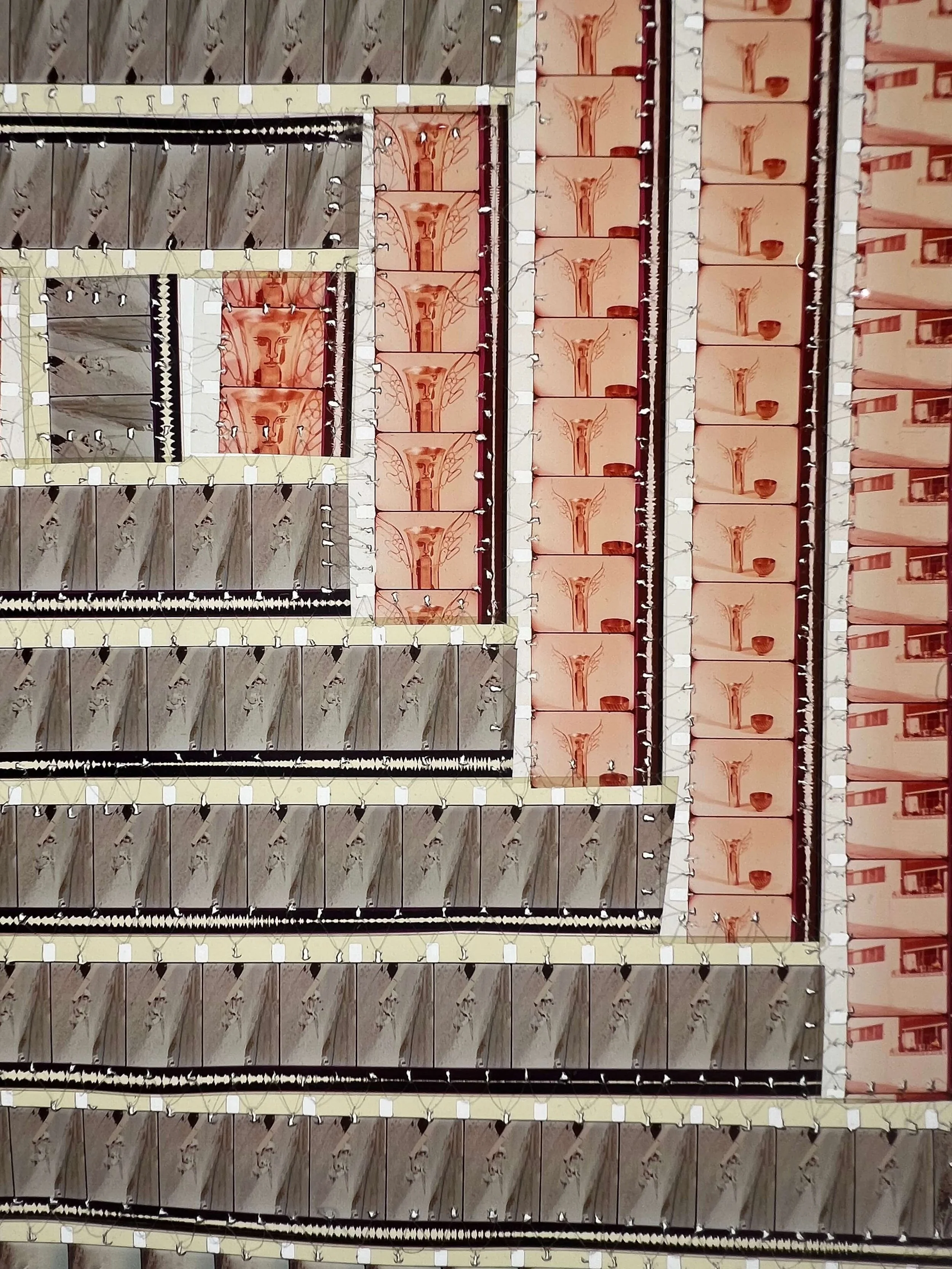
Sabrina Gschwandtner, Arts and Crafts in American and Peruvian Weaving, (2016/2025)
Among the works that literally feed video into craft, Sabrina Gschwandtner’s Arts and Crafts in American and Peruvian Weaving (2016/2025) exemplifies this one-way flow by weaving strips of 16mm polyester film into a square quilt. The films are two documentaries from the 1980s, one about arts and crafts in America, the other on Peruvian weaving, both thematically apt for their new use. The artist cut the film into segments of different lengths and then threaded them together using translucent polyester thread in a courthouse-step pattern, a quilt pattern of blocks of symmetrical stripes on alternate sides of the center square. As one film was brown-tinted and the other blue, the artist placed the film segments in a symmetrical pattern, mimicking the color alternations of a real wool quilt. When the film quilt is backlit, the images on the film become visible, and the work resembles finer needlework: each frame is almost identical to its neighbor except for small alterations, together creating an intricate, tessellating pattern. In making use of the film’s color and image this way, the moving image disappears into the craft object.
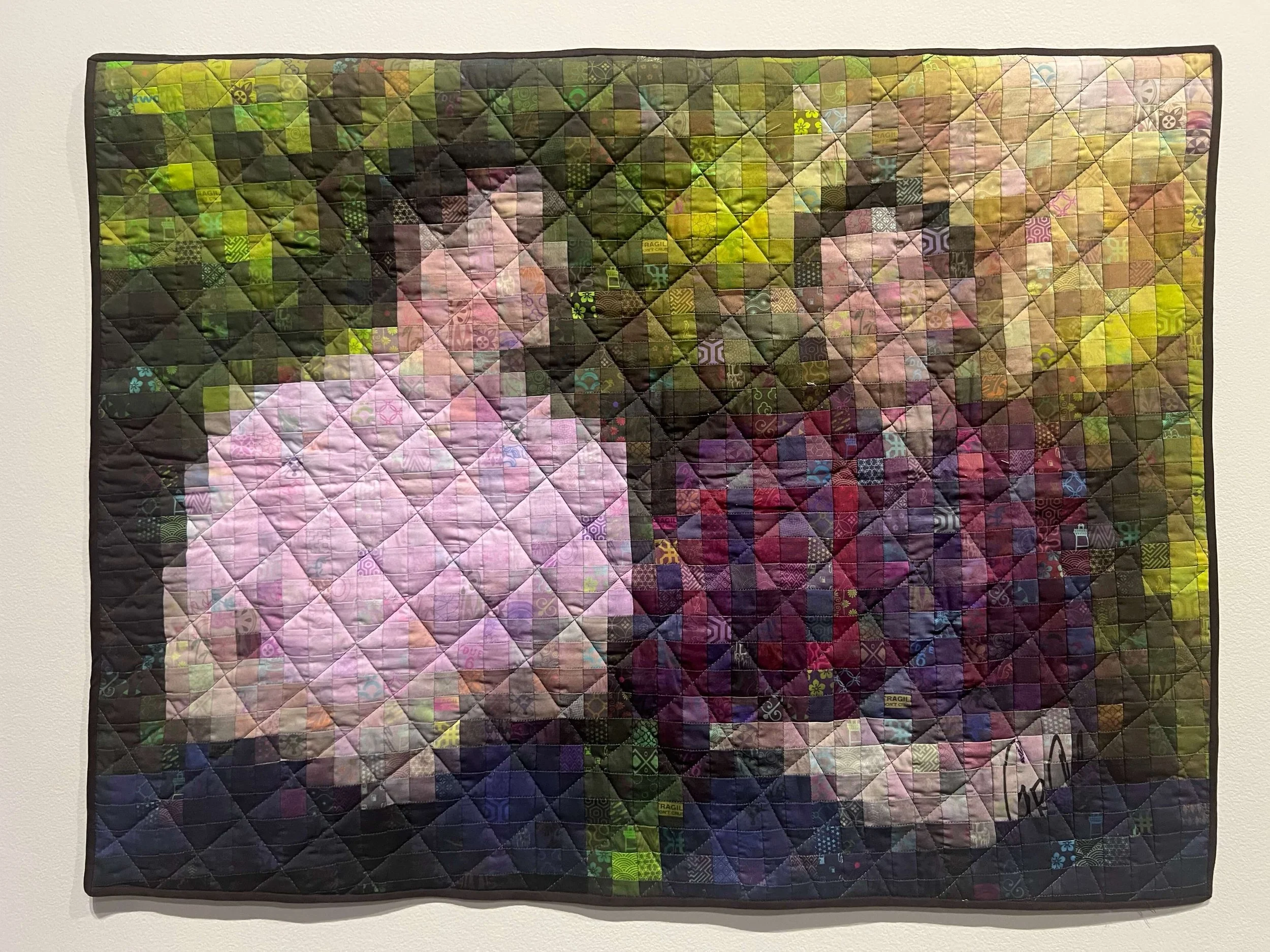
Greg Climer, The Animated Quilt of Nathan and Bryan, 2022. Courtesy of the artist.
A few other artworks play on similar ideas. In RGB (2021), Sarah Rosalena weaves red, green, and blue yarn into a rectangular piece of fabric, mimicking the fundamental building blocks of digital color and display. Greg Climer’s Animated Quilt Film (2016–2022) extends this logic to motion, assembling thirty-six cotton quilts, eighteen of which are on view at the show, to animate five seconds of animation showing two men kissing in a park. The contours of the figures arise not from drawn lines but from patches of color, and the imprecision is part of the point: the embrace registers first as shape and hue, only secondarily as the two men it depicts. The theme of the movie resonates with the history that the medium carries: quilting has long served as a vehicle for queer memorial, most visibly in the AIDS Memorial Quilt. Climer’s work inherits this association even as it puts quilting to a new use.
This pattern of rendering the digital, or the moving, in craft’s terms gives the exhibition its coherence. While first appearing as a counter example because it is not a craftwork but a video, Ahree Lee’s Bojagi (Memories to Light) (2015) actually shows what this logic would look like when taken to its limit. The artwork is a fifteen-minute video. In it, the artist assembles archival Asian American home movies into a digital bojagi, the traditional Korean patchwork wrapping cloth used as gift wrapping in weddings and in Buddhist rites, often gifted from mothers to daughters before marriage. The footage is cut and recombined, borrowing its editing logic from Korean textile piecing. The result no longer reads as film in the usual sense: the screen is divided into four quadrants, each further divided into four, simultaneously showing the same imagery distorted and flipped left to right and top to bottom. The final work is an abstract, kaleidoscopic dynamic that refuses any coherent narrative. What is lost here is legibility itself: the imagery is no longer recognizable as imagery, not merely unplotted but unseeable as the footage it once was. The artwork is thus not a counterexample to the exhibition’s dominant logic but a case of the logic’s complete realization. Here, craft’s reorganization of video does not just borrow the moving image’s material; it dissolves the image’s claim to being an image at all.
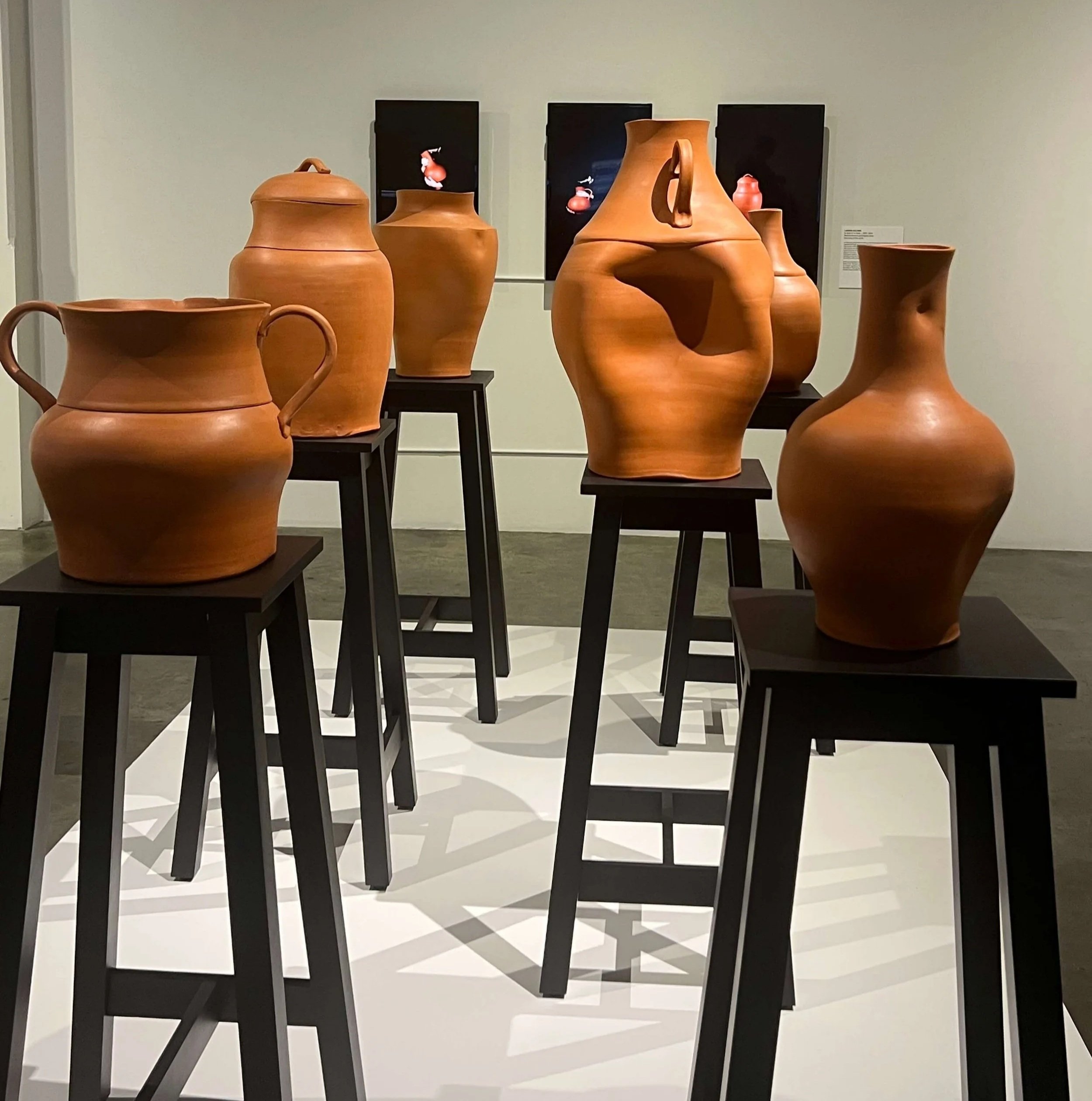
Lauren Kalman, to have or to hold, 2021–2024
Lauren Kalman’s to have or to hold … (2021–2024) would also look like a counterexample at first glance, as both craft and video are constituents of the artwork. A group of six large ceramic vessels sits on black pedestals at chair height, each bearing strange distortions on its surface. An accompanying three-channel video reveals their origin: the artist presses her body against the unfired clay, distorting its form before firing. The finished vessel also gets rotated in the video, allowing the viewer to trace the contact points between body and clay. The video here is thus mostly documentary, with no formal ambition of its own; it is not, any more than the others, an instance of video’s craft coming into view. Without the recording, the objects appear enigmatic; with it, they become traces of a specific encounter between body and material. The ceramic needs the video to disclose its process, and the video needs the ceramic as its subject. In forming one pillar of the mutual dependence, Kalman’s video deviates from the one-way-flow logic not by reversing it, but by entering into dialogue with craft.
On this point, Kalman’s work recalls a passage in Walter Benjamin’s 1936 essay, “The Work of Art in the Age of Mechanical Reproduction,” in which the cultural critic describes the imprint left by a hand in clay as emblematic of artisanal production, the trace bearing an unmistakably individual mark that lends the craftwork its aura. Benjamin contrasts this with mechanically reproduced media such as photography and film, whose images can be endlessly replicated and thus detached from their original context. Yet Benjamin was equally fascinated by the camera’s ability to disclose aspects of reality inaccessible to ordinary perception. What Kalman’s work achieves is to hold both observations and retain the best of the two media: vessels preserve the aura of bodily contact, while the video reveals what that contact looked like. The vessels retain the physical trace of the encounter with the body, and the video captures and keeps its temporality.
Here, the show’s prevailing one-way logic turns out to be not an oversight but an expression of where it is being staged. A craft museum is built to notice craft. Kalman’s vessels suggest what a fuller dialogue between video and craft might look like, but even there, the dialogue tilts toward craft’s terms: it is the ceramic, not the video, that remains the true subject. Given that video and the image have become so pervasive these days, the show’s one-way logic starts to look like craft’s insistence that touch, slowness, and the trace of the hand still have a claim. Benjamin watched cinema unsettle the conditions of artistic production; Video Craft suggests that craft, a century later, still finds ways old and new to hold its ground.
