
Valerie Huhn, The Wound Is The Place Where The Light Enters You, Hunterdon Art Museum
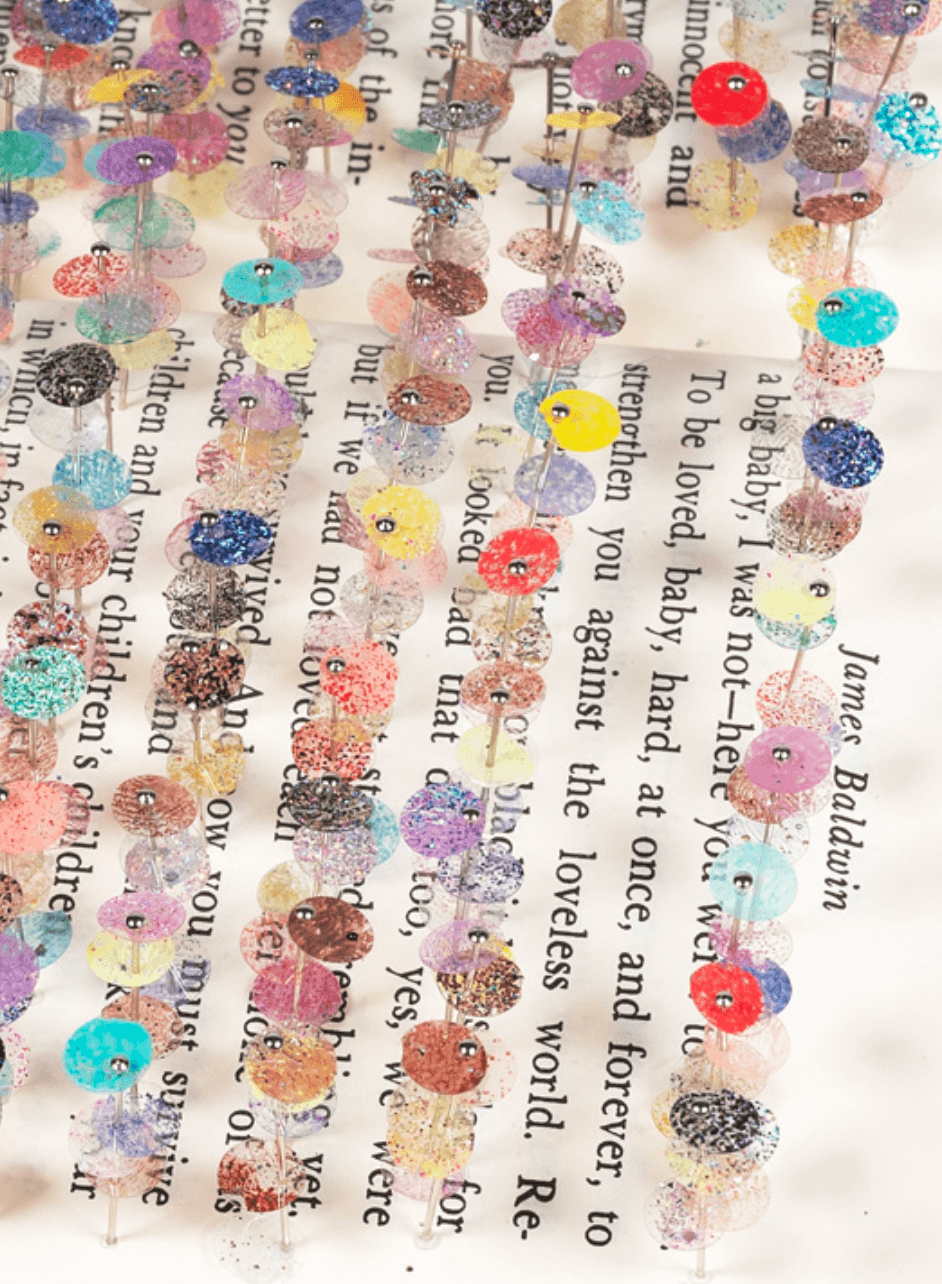
The Fire Next Time (detail), 2026, ink, acetate, pins, repurposed copy of James Baldwin's
The Fire Next Time, 3” H x 8.5” W x 12” L. (photo credit Valerie Huhn)
July 8–September 6, 2026
Valerie Huhn's sculpture and painting exhibition at the Hunterdon Art Museum, The Wound Is The Place Where The Light Enters You, joins two important topics: being educated about the empowerment of marginalized people during her formative years in San Francisco, and reconciling her own troubled history with a grateful and creative present. In her teens, Huhn suffered a traumatic brain injury in a car accident. For years, she was intermittently institutionalized until she was properly diagnosed and started medication. After achieving independence and becoming an artist, she took a wrong turn––literally––that led her back to a former hospital parking lot. "I started to search myself for the large unhealed wound that needed care,” she says. “That was when I realized I was talking about myself in my art."
Mixing ritual, magic, science, and literature, Huhn represents the DNA nucleotide bases (A, T, C, G) by fastening four acetate holepunch circles painted with the print of her right forefinger to hundreds of pins. She inserts the colorful fingerprint pins into books and personal objects, creating auras or personality clouds that both attract and repel, are beautiful and dangerous. Counterbalancing the aggression of voodoo dolls and pain with the healing of acupuncture, metal pins pierce tiny, delicately embossed acetate discs, expressing an intensely focused intellect at work. Her work reminds me of making an insect collection: the year-long process of trapping and pinning, where the seasonal timing of insect emergence determines the project's overall pattern and meaning. Huhn's creative system becomes a time-sensitive taxonomy of thought and feeling about shared human identity.
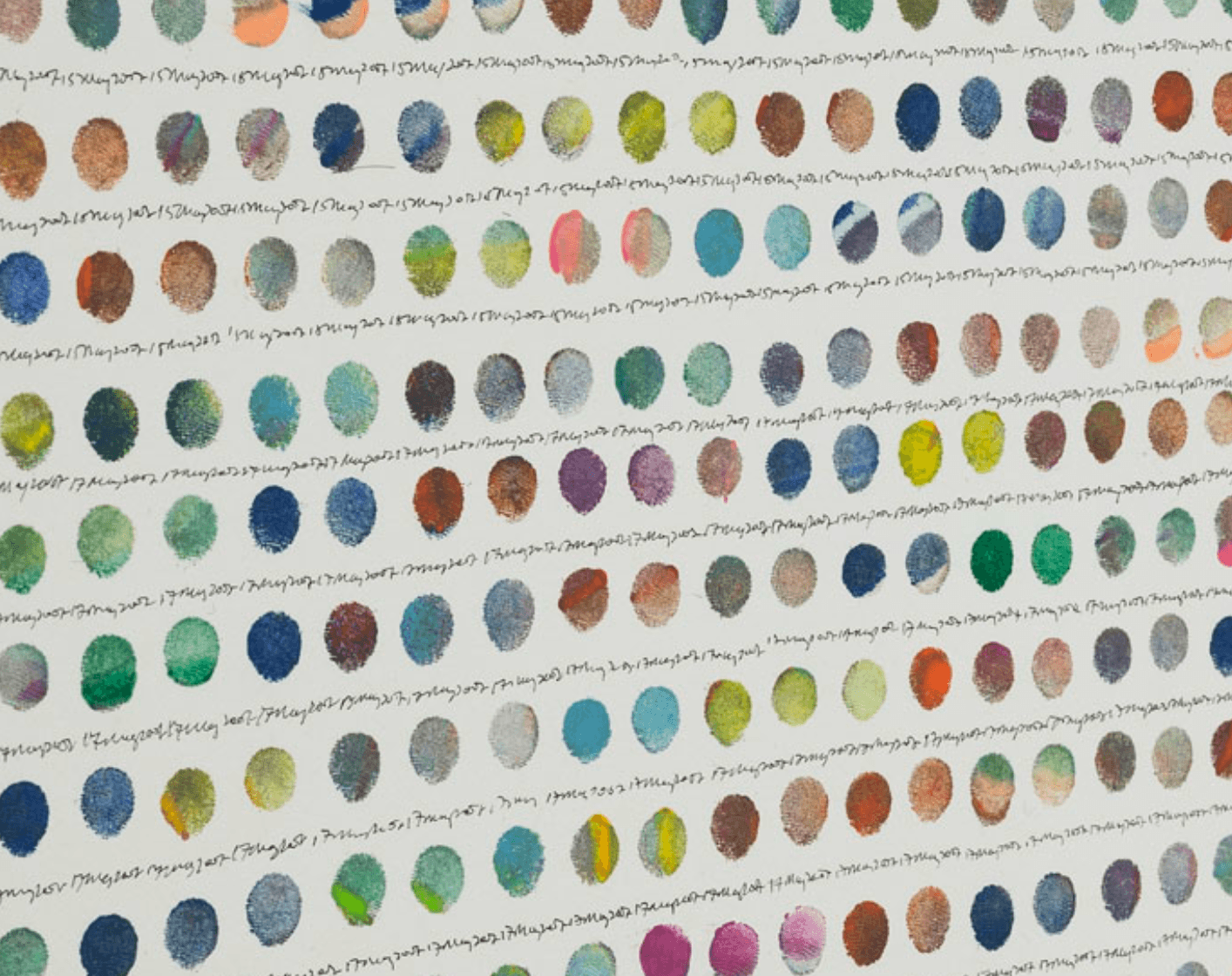
Fingerprint Mural, 2007, ink on paper,
120” H x 55” L. (photo credit Valerie Huhn.)
Fingerprint Mural (2007) is a diary of Huhn painting her fingertip with multiple ink colors and pressing once or more on a giant scroll à la Agnes Martin. Each tiny print is different, and when she gets multiple printings from a single finger-load of ink, the sequence stutters cinematically. As I draw closer at the piece, I realize that what looked like a scumbled charcoal line between pointillistic rows of fingerprints is a monologue written in immaculate miniscule longhand, an unbroken date stamp recordingthe days she worked. I admire how the large mural seems to float and flow from the wall, gently asserting monk-like serenity. Fingerprint Mural reminds me of Howardena Pindell's multimedia pieces of pinned numbers and circles that bucked the use of small red dots separating Black people's glasses and dishes during Jim Crow, though Huhn says she was first inspired by Andy Warhol's Ben Day dots.
In books by some of the best contemporary writers, who turn vulnerability into strength, Huhn chooses quotes by leaving space around them. The quotes stand out in contrast to continuous pinning below or between the two facing pages. To honor all the words, she is careful to not pierce them. She takes a sleight-of-hand approach to structure. She carves out space underneath the featured pages and then inserts foam to make pinning easier. "I chose to leave quotes bare that I felt carried a kernel of meaning representative of the work,” she told me, “and of meaning that reverberated with me long after I set the book down. Each quote also carried a shared interaction within the book's contents.” The line in bell hooks's All About Love––"There can be no love without justice"––inspired Huhn's All About Love (2026). Huhn said, "I read this part of her book and just couldn't let it go. I read and then reread each book as well as listened to the ones I can get access to via the Libby app. I spend hours and days poring over the book's contents and its language in search of a sentence or two that convey a truth and beauty that wraps itself around my heart and mind and echoes within me."
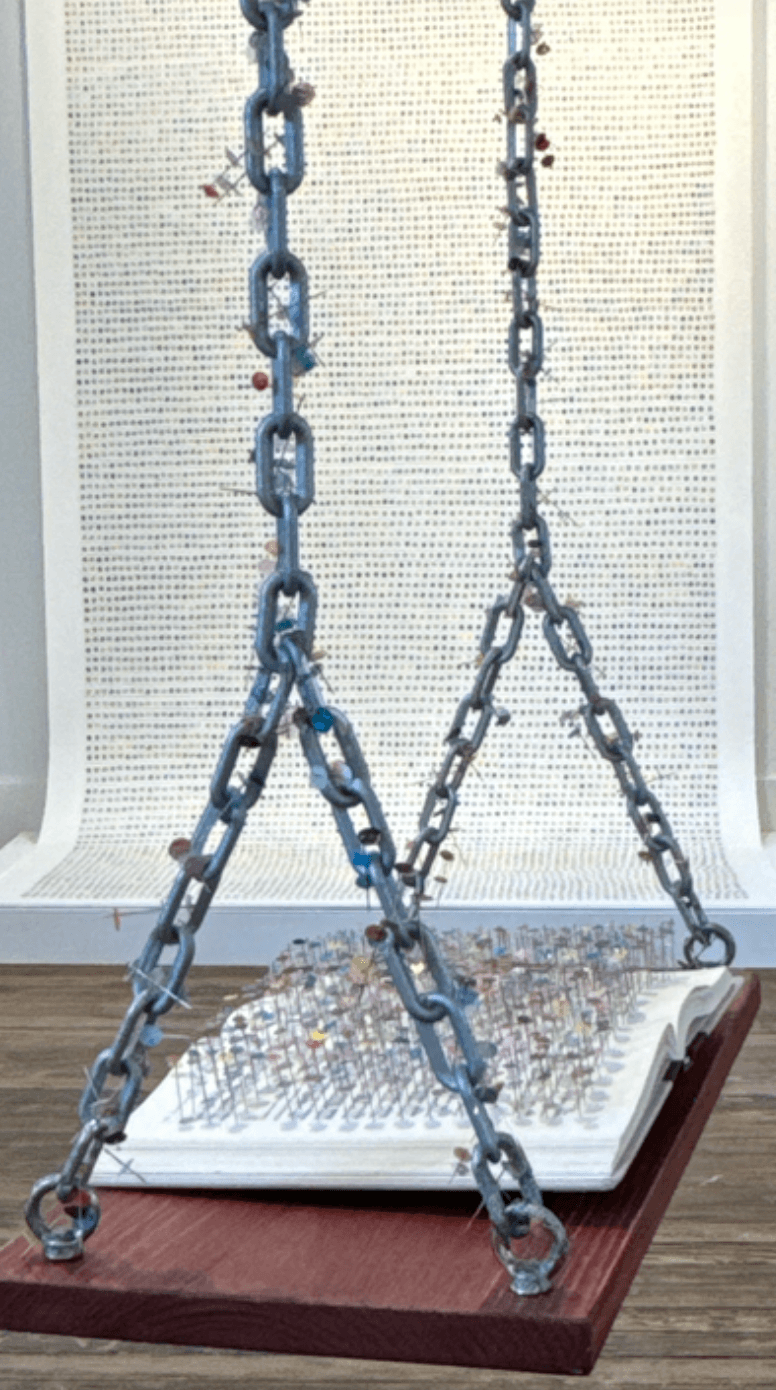
(back) Fingerprint Mural, 2007, ink on paper, 120” H x 55” L. (front) On Earth We’re Briefly Gorgeous, 2025, repurposed copy of OceanVuong's On Earth We’re Briefly Gorgeous, ink, acetate, pins, 2.5” H x 9.25” W x 12.25” L. with Wood Swing, 2026, sedona stain, hardware, glitter, paint, ink, acetate, pins, monofilament .75” H x 8.5” W 18”L. (photo credit Valerie Huhn)
Several books in the exhibit are presented on suspended wooden plank and plastic chain swings, the chains wrapped to mimic DNA double helixes with fingerprint pins that have been individually tied and twirled together with quilting thread or monofilament. Huhn's On Earth We're Briefly Gorgeous (2025) transforms a copy of Ocean Vuong's On Earth We're Briefly Gorgeous by pinning around "There were colors, Ma. Yes, there were colors I felt when I was with him. Not words––but shades, penumbras." Huhn says Vuong's "sentences are instantly accessible, ripe with intensity and feeling. Vuong's writing is so lyrical. Almost anyone who has ever loved knows what this feels like. The words are so rich."Her The Fire Next Time (2026) fingerprint pins around a quote in James Baldwin’s eponymous novel: "To be loved, baby, hard, at once, and forever, to strengthen you against the loveless world." She says, "I held my breath when I reread this sentence, its honesty adroitly carried the weight of history and its meaning."
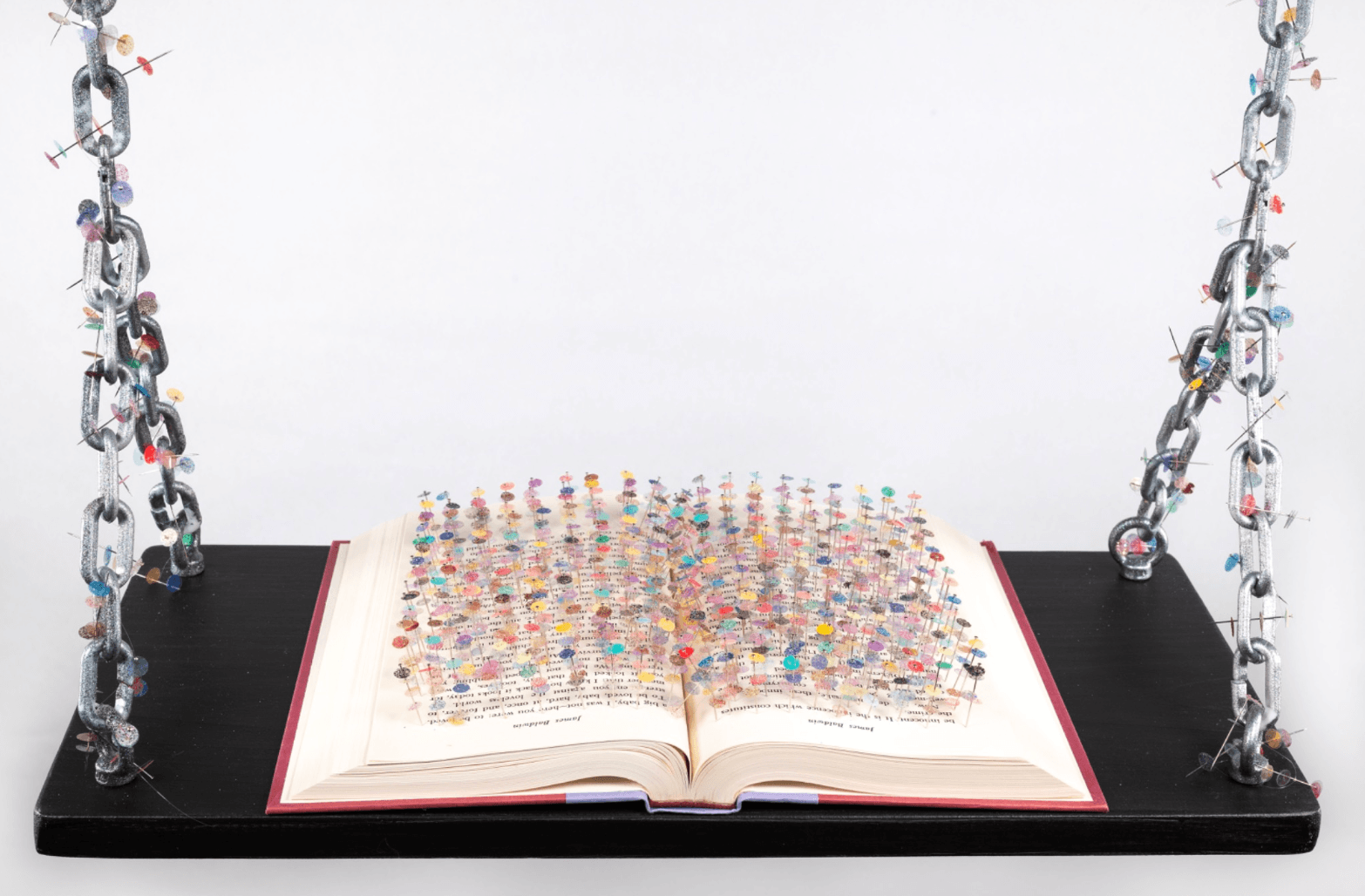
The Fire Next Time, 2026, repurposed copy of James Baldwin's The Fire Next Time, ink, acetate, pins, ebony wood swing, monofilament, pins, chain, paint, 65" H x 8" W x 18” L. (photo credit Paul Takeuchi)
Against the Loveless World (2025) alters Susan Abulhawa's novel Against the Loveless World, which also celebrates Baldwin's phrase, by pinning Abulhawa's text continuously without piercing the words. This piece and Huhn's treatment of Anne Frank's Diary of a Young Girl are displayed inside mirror boxes made of one-way glass, which Huhn encountered when she was hospitalized. The boxes create ephemeral reflections of natural and artificial light throughout the day and night. These pieces read as miniature, hermetically sealed weather systems, the surveillance glass opaque from the captive or internal side and clear from the perspective of freedom: the authority and the viewer.
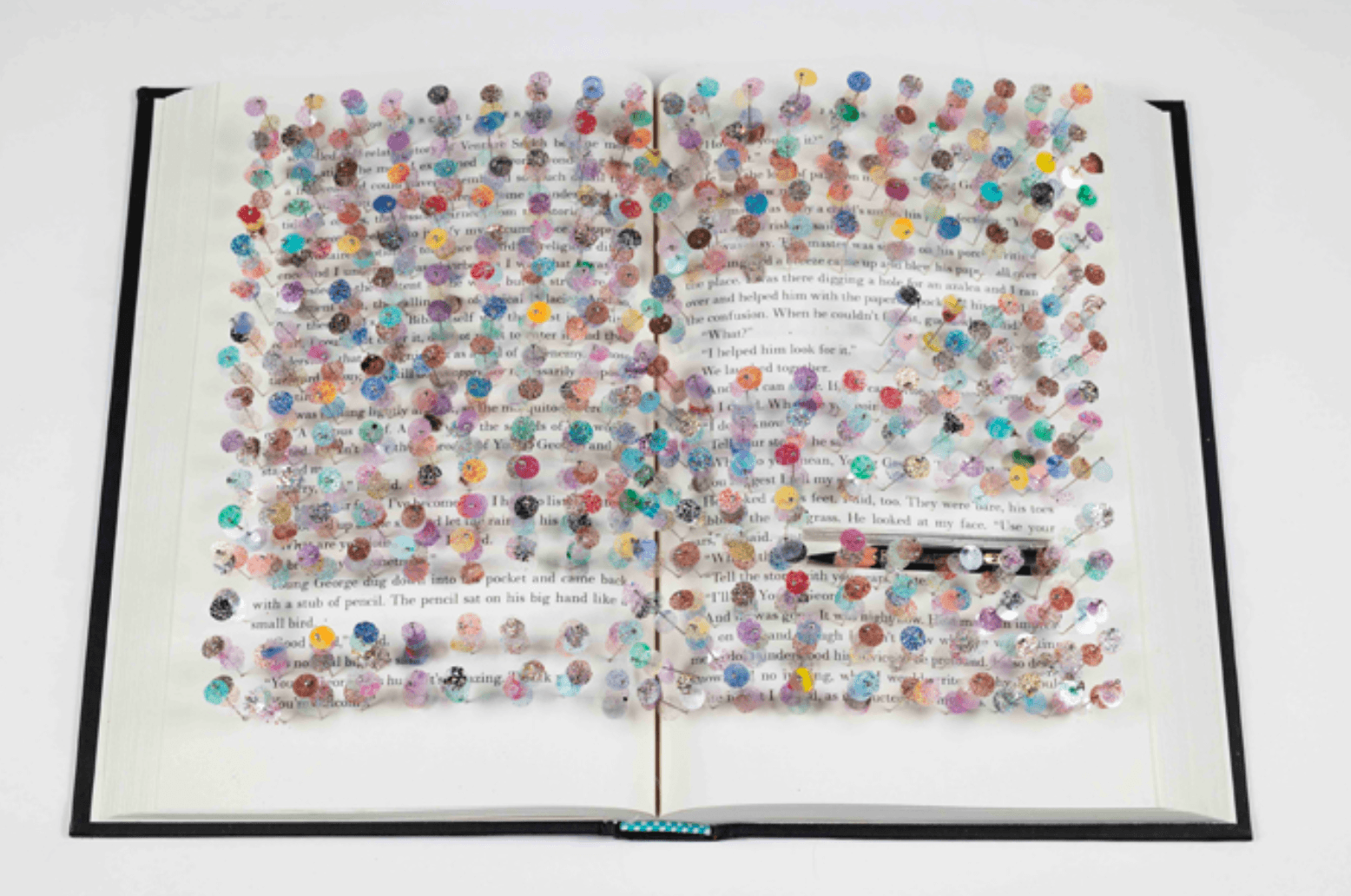
James, 2025, repurposed copy of Percival Everett's James, ink, acetate, pins, pencil, 2.5” H x 9.” W x 12” L. (photo credit Valerie Huhn)
In Percival Everett’s novel James, based on Huckleberry Finn, the enslaved character Jim privately calls himself James and is taught to read and given a stolen pencil. By cleverly carving out white space in a line break as a compartment for an actual pencil, Huhn's James (2025) expands this symbol of literacy into an equal sign between author and reader.
Fingerprint Pin Ladder (2025) offers a Baroque memorial to the day that Huhn donned running shoes and escaped from a Philadelphia mental hospital. A ladder composed of custom-made, unbreakable safety sporks and spoons floats off the wall, wafting plant-like threads of hot glue, evidence of its assembly. The ladder seems to dissolve under the weight of helix spirals of magnetic fingerprint pins and a pair of trainers titled Fingerprint Pin Shoes (2025). Huhn recalls, "Running away from hospital was the only time I truly knew I made the right decision."
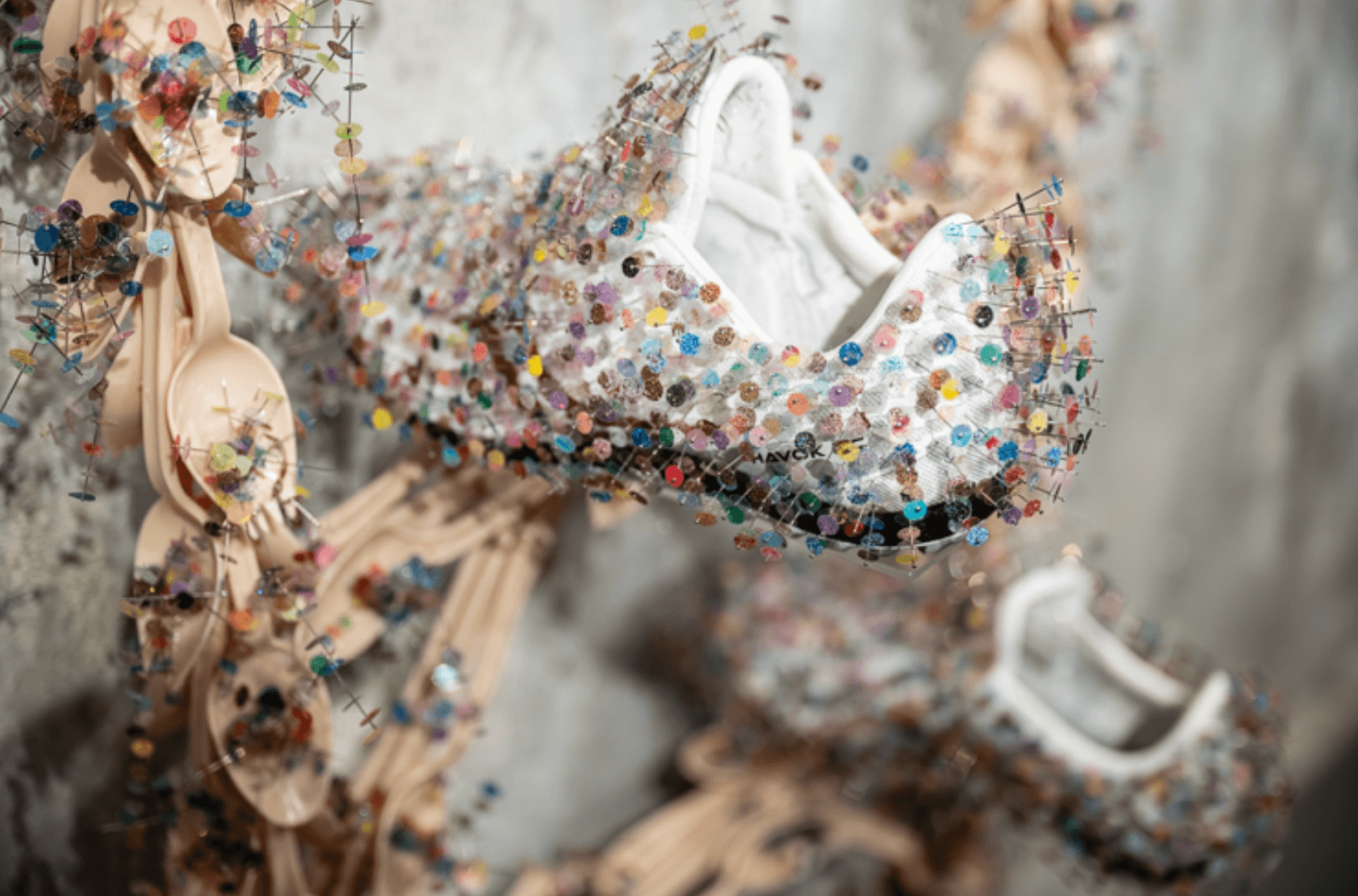
Fingerprint Pin Ladder, 2025, ink, acetate, pins, magnets, prison industrial flatware, glue
96” H x 24” W x 18” D. With Fingerprint Pin Shoes, 2025, ink, acetate, pins, Saucony racing spikes, 6” H x 14” W x 14” L. (Photo credit Paul Takeuchi).
Supplying the opportunity to feel the terror of what Huhn calls "a brain injury where a person never comes back" and "the shock of being able to focus, remember, and read again," The Wound Is The Place Where The Light Enters presents hands-on collaborations with specific ideas of some of our best contemporary writers. Happiest in fluid intimacy with authors about the life truths of vulnerability, self-regard, and love, she says, "I'm half German and a quarter Asian with a smattering of Romanian, Austrian, and Celtic ancestry. One of my grandparents hails from Mongolia. Now more than ever, I'm a part of the art I make."
