
Emmy Lou Packard in Mendocino
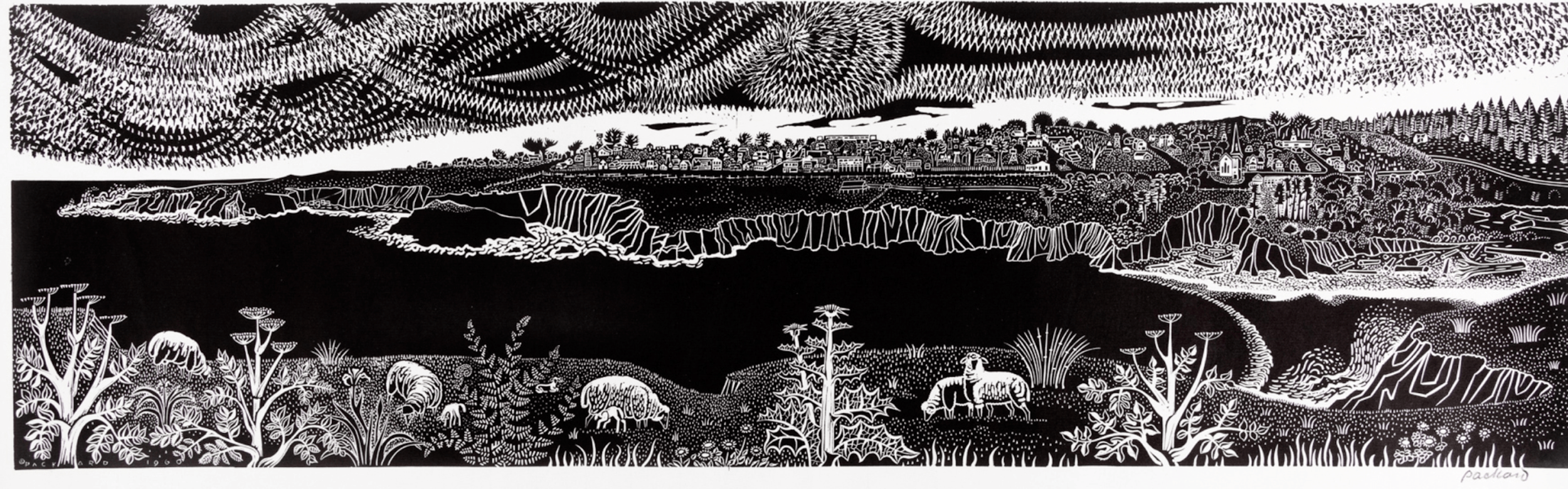
Emmy Lou Packard, View of Mendocino from Highway 1, 1960, linocut, 11”X38”
By Robert Brokl
San Francisco artist Emmy Lou Packard, along with her artist husband Byron Randall, packed up and moved to the charming but somewhat down-at-the-heels North Coast California lumbertown of Mendocino in 1960. She and the town were both in transition, and each subsequently impacted the other. Packard was moved to lead the efforts to save the town from commercial development, while making a life for herself and Randall there for nine years, depicting the architecture and landscape.
In 1960, she was 46, middle-aged, and mid-career. Her first husband, Burton Cairns, an architect she had met at UC-Berkeley, had died in a tragic car accident in 1939, and their son, Donald Cairns, was mid-twenties. Packard was an established, well-integrated artist, along with Randall, of the artistic, progressive community centered around the legendary Montgomery Block Building. She also was longtime close friends with Diego Rivera and Frida Kahlo, whom she’d known from childhood in Mexico, where her leftist father worked as an agronomist. Later Packard worked as their studio assistant in Mexico and with Rivera on murals in San Francisco, and she shared their socialist political views—the ones she’d inherited. Rivera inserted a portrait of her at work, wearing baggy blue jeans and sandals, easel in hand, in his 1940 Pan American Unity Mural, lent by City College of San Francisco to the San Francisco Museum of Modern Art for their 2022 Rivera Retrospective.
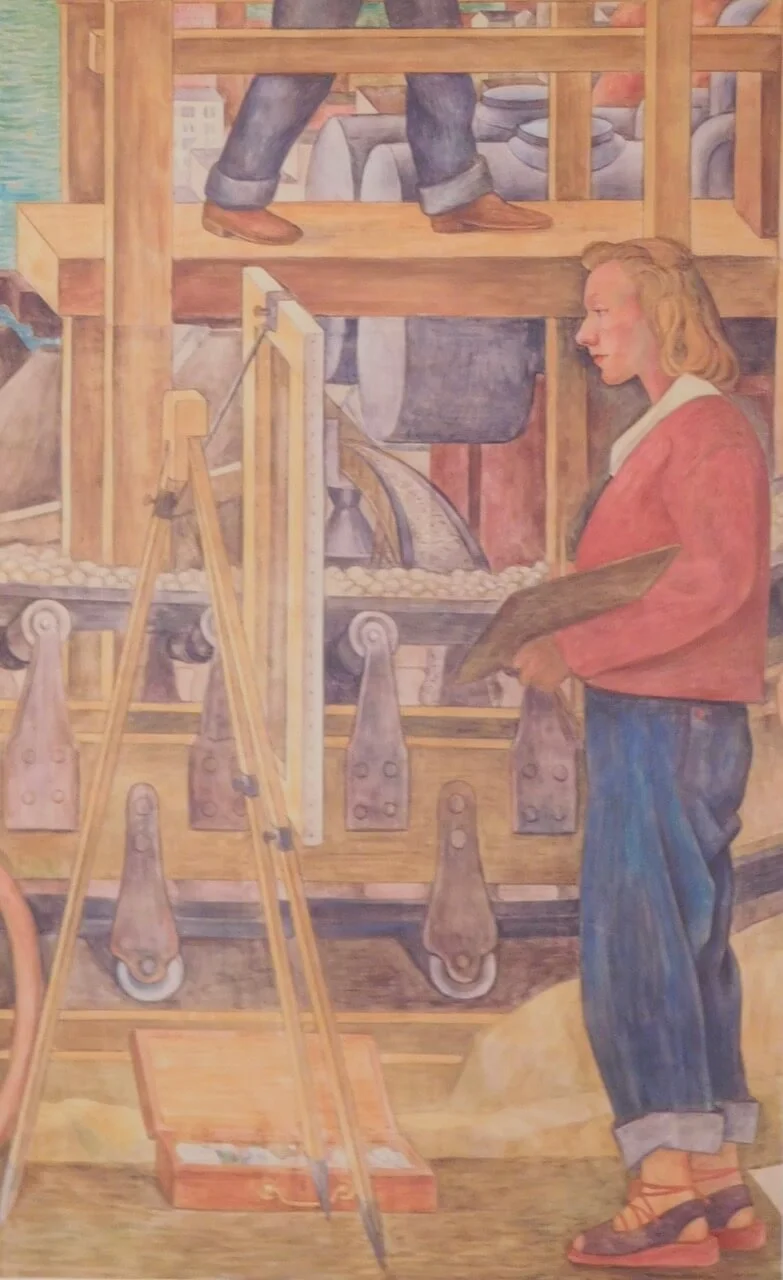
Diego Rivera, Portrait of Emmy Lou Packard (detail) Pan American Unity Mural, 1940, fresco
She and most likely Randall were both members the Communist Party USA, and at the height of the Red Scare era in the McCarthy post-war period, she had been ordered to appear before the House Un-American Activities Committee, although she publicly challenged the summons and was never forced to appear. But Packard and Randall assumed commissions would dry up after the summons, and leaving San Francisco, her home since 1941, seemed wise, according to the definitive (to date) monograph on Packard by Gallerist John Natsoulas. The monograph was updated in 2022 in connection with the long overdue retrospective of her work at the Richmond Art Center the same year, scheduled to coincide with the Rivera show.
They bought the 1882 Victorian on 44860 Main St., establishing a gallery, B & B inn, and their studios. (The house more recently, before reverting to private use, was Didjeridoo Dreamtime Inn.) The English Gothic 1868 Presbyterian Church is directly across the street, and was often depicted by Randall in his rough-hewn, expressionist style.The church’s Preston Hall contains a Packard painting of children, Peace and Brotherhood to all Nations, used for promotion by UNICEF. Located behind their house is the Luna Restaurant, built by her as a studio to create an installation piece of large paintings for the Fresno Convention Center.
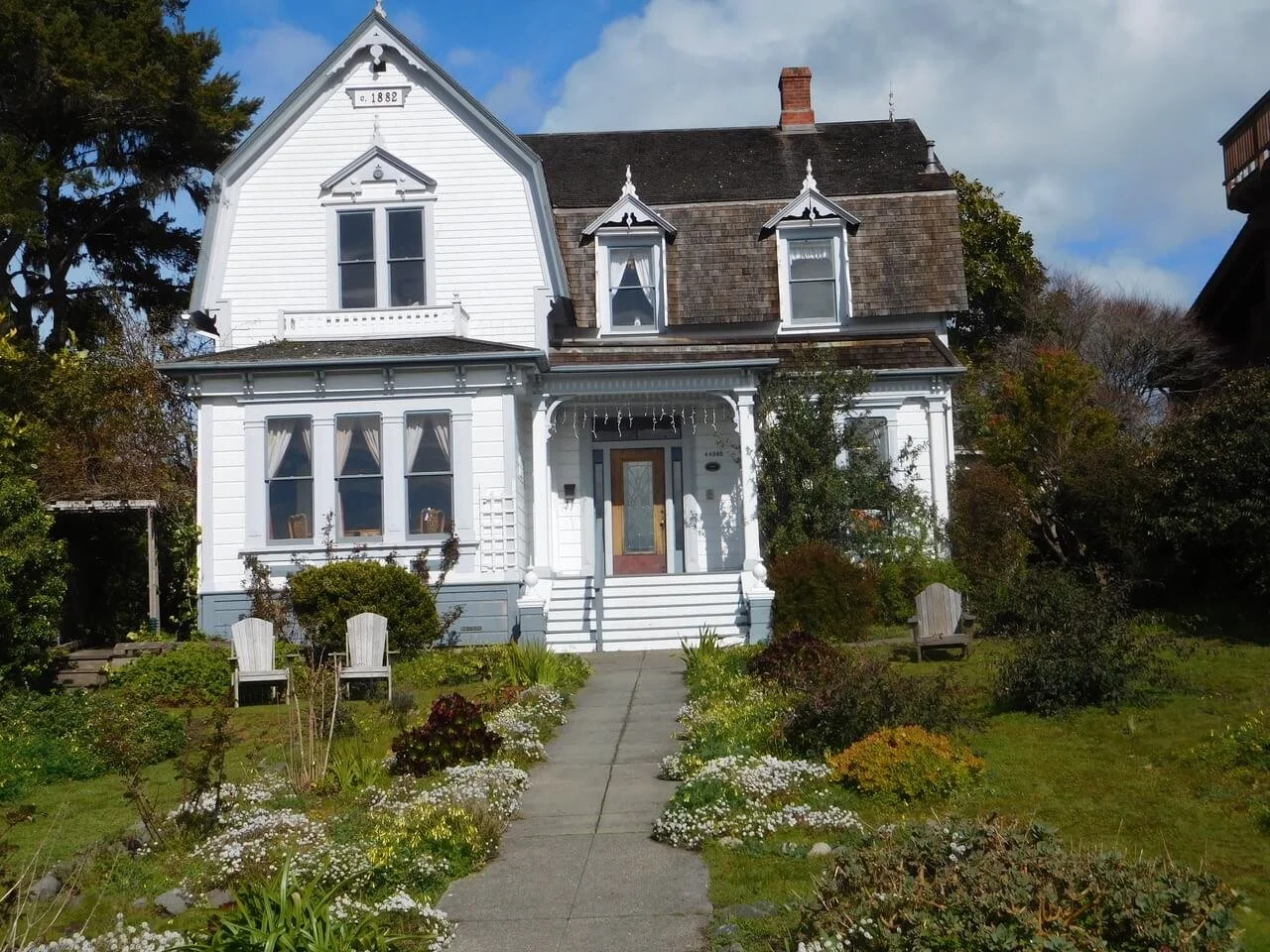
4480 Main St., Mendocino, Packard/Randall residence/studio/inn,1960-69, photo Didjeridoo period ca. 2018
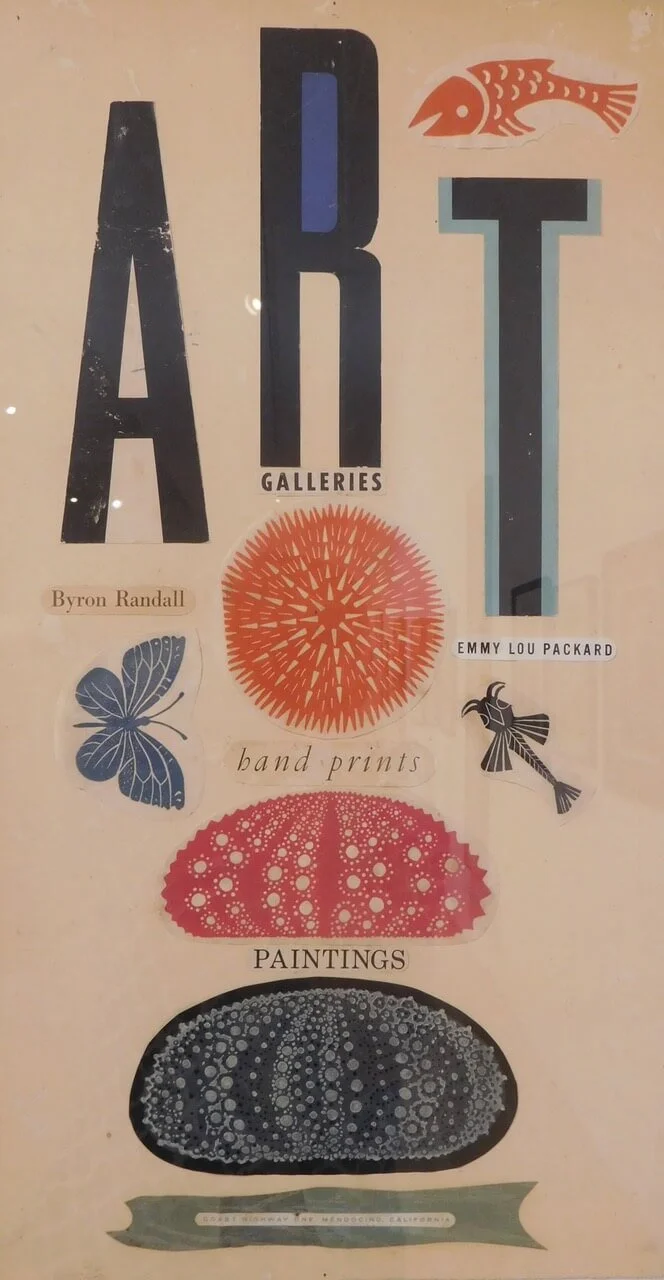
Emmy Lou Packard/Byron Randall, poster, ca.1960s
Watertower aka tankhouse depicted by Packard occupies the lot next door. The town was built on the headlands, a bluff, and while the sea is literally at your feet, the water supply is dependent upon shallow wells, hence tankhouses that store water pumped to the tanks at the top, gravity fed for plumbing and irrigation. She also portrayed the nearby Masonic Temple, now a bank, with the sculpture Time and the Maiden above the cupola.
Mendocino ca. 1960 was no longer a bustling lumbertown with a prominent lumber mill on the bluff. Other than the demolition of the mill, in anticipation of the sale of the property by the local Union Lumber Company to Boise Cascade, the town itself was an intact Victorian-era village, with austere structures mostly either clad in weathered shingles or painted stark white with black trim, almost Shaker in their simplicity. Mendocino had thrived on the fur, lumber, and whaling industries, the inconvenient Pomo Indians had either been killed or uprooted to reservations in what is described as one of the worst genocides against native Indian tribes in the entire country.
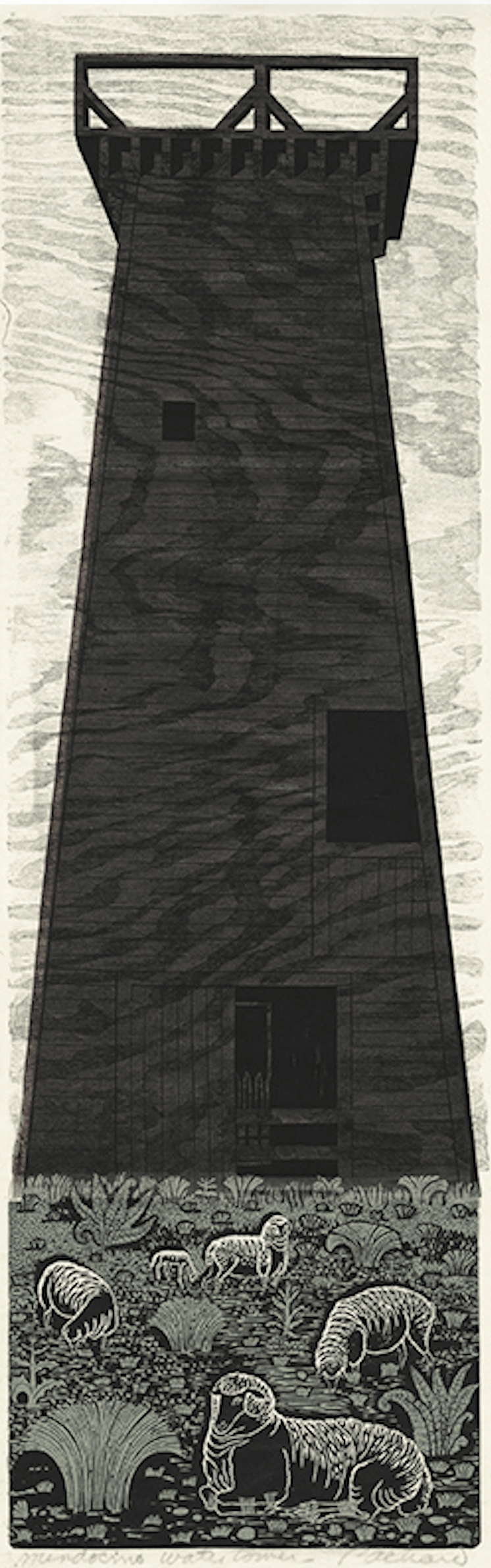
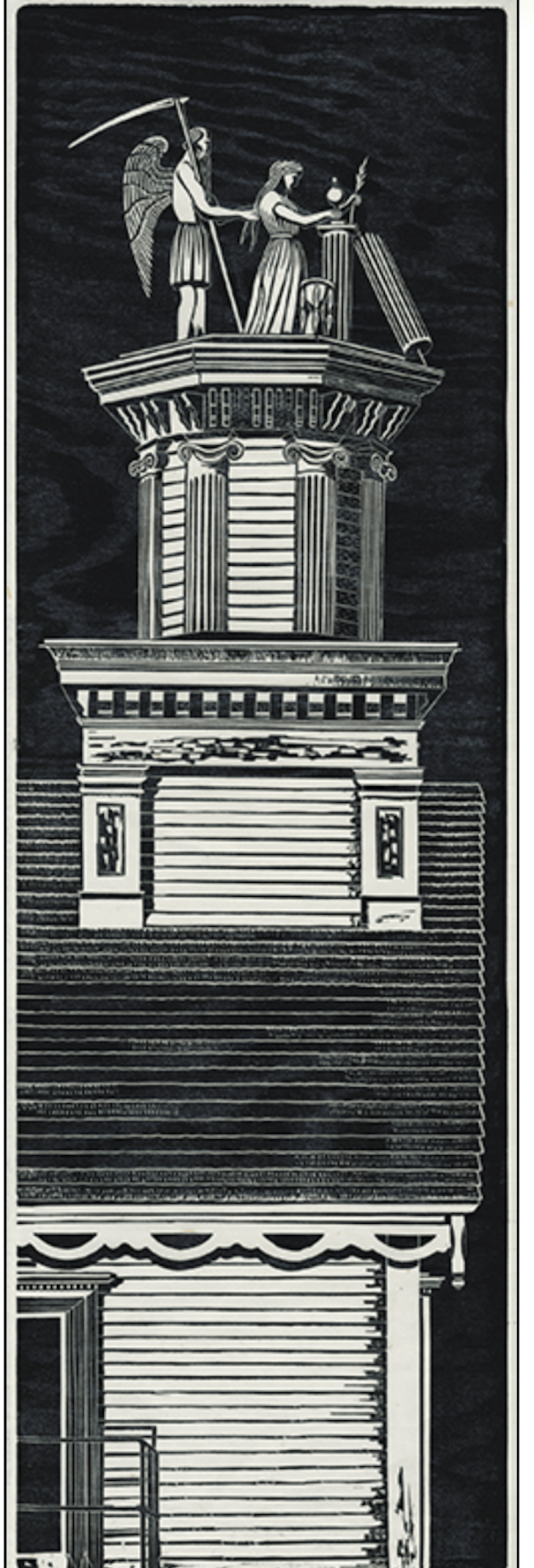
Viewers of the 1955 East of Eden movie, with its anachronistic James Dean lead, may not be aware the town is a substitute for the Salinas of the Steinbeck novel, providing glimpses of the buildings on Main St. later demolished on the bluff. The elaborate Victorian Preston Mansion, home of the Dean character’s patriarchal father, subsequently burned down in 1956, and is now the site of the Mendocino Art Center and the repository of Packard artwork gifted by her son. The founding director of the Center, Bill Zacha, is said to have convinced artist friends such as Packard and Randall to relocate.
By branding the town, lovingly depicting every building in her View of Mendocino from Highway 1, she is in the company of American artists making icons of their surroundings—Georgia O’Keefe with New Mexico, Edward Hopper with Truro, Cape Cod, and Marsden Hartley with Maine. View’s potency perhaps derives partly from Packard’s fidelity to detail but also the view from afar, as if discovered by someone coming upon it for the first time. In 1960, inspired by the new visual material, Packard was on a roll, and many of her most notable prints date from then.
Packard’s concentration on linoleum or wood cut prints was part of her democratizing aesthetic and orientation. She said she’d sold, at affordable prices, over 4,000 prints in her lifetime. She never produced numbered editions—the staple of the fine art press production business, which prioritizes scarcity. She was a skilled painter and draftsperson, but the print medium allowed her to produce multiples from the same fixed matrix, and she employed young artists like Rick Tejada-Flores, who helped organize the Richmond show (along with Robbin Henderson and Art Hazelwood), to help her print. She experimented with colors and other effects during the printing process, so the prints are varied.
Packard was quite the colorist, as in Surf Fishing, Mendocino Coast, with vivid turquoise sea, salmon shore, and red sun, or the almost lurid shades of pink in the commissioned prints of tide pools and coral. She had detailed instructions about colors for her prints in a notebook since lost. Her use of black and white is also formidable. No available sources explain her unusual, exaggeratedly vertical or horizontal formats, but early panoramic photographs have that horizontal format, and several are on view at the nearby Guest House Museum in Fort Bragg. (The Guest House Museum is a 1892 Victorian built by a lumber magnate, its redwood interior created with locally harvested lumber. A large, vertical linoleum Packard print of oxen teams hauling logs hangs in the grand stairwell, and the museum features the lumber industry.)
You have to look afield to someone like Kathe Kollwitz to find a woman artist who made her mark specializing in printmaking. Notable, too, is Packard’s lifelong Type 1 diabetes. One reason her mother, a nurse, encouraged her choice to pursue art was her belief her daughter didn’t have long to live. Indeed, insulin derived from pig pancreases was new, ground-breaking treatment, and Packard was one of the first to benefit. Tejada-Flores said she carried supplies of fruit juice in her car, in case her blood sugar plummeted. According to Natsoulas, “Throughout her life, she was plagued by health problems stemming from this disease, including vision problems that led to eye surgery. She noted later in life that, ‘I’ve often wished I had a limp, or more ‘visible’ physical handicap. Diabetes doesn’t show. When insulin lowers your blood sugar too much you simply begin to sound like you’re only half-witted, and people begin to wonder what in hell is wrong with you.’“
Unfortunately, description regarding Packard’s artwork is woefully inadequate, and more scholarship in general would be welcome. She often combined wood and linoleum blocks in prints, but descriptions often omit this fact, despite the obvious contrast between the fine buttery lines possible with linoleum and the abraded textures of plywood, which co-exist in Watertower, Masonic Temple, etc.
Before she left Mendocino in 1969 to return to San Francisco, her marriage to Randall ending, she led the ultimately successful effort to prevent development on the Headlands bluff, resulting in the creation of the state park and the entire town placed on the National Register of Historic Places, preserved in time like Siena, Italy or Ouro Preto, Brazil. Today, Packard is revered in Mendocino, almost as a secular patron saint. With her preservation activism and her affiliation with the Peace and Freedom Party, Packard embraced a form of practical, pragmatic, and not explicitly political “sewer socialism,” now championed by Zohran Mamdani and others.
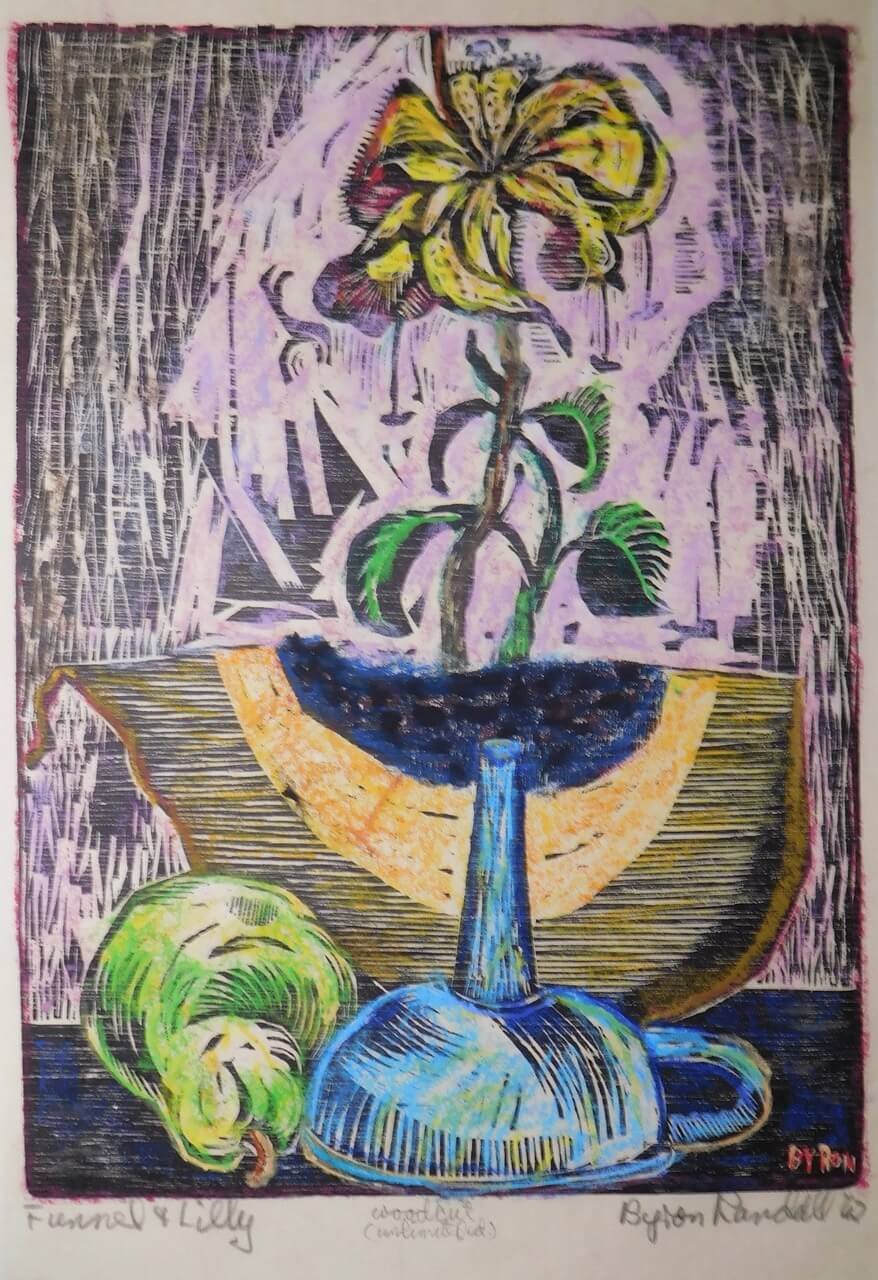
SFMOMA lacks even one Packard in their permanent collection, and the Oakland Museum of California has her large Mirabeau Restaurant Kaiser Center concrete sculpture Peaceable Kingdom, The Garden Before the Fall of Man, from 1967, in storage needing restoration. But other venues to see Packard artwork include auction houses, speciality print galleries, the internet, and, by appointment, her pieces in the collection of the Achenbach Foundation for the Graphic Arts, Fine Arts Museums of San Francisco.
The 2022 retrospective was a recent highwater mark for Packard, but she’s yet to receive the belated acknowledgment and distinction of other formerly marginalized Bay Area artists like Ruth Asawa and Bernice Bing.
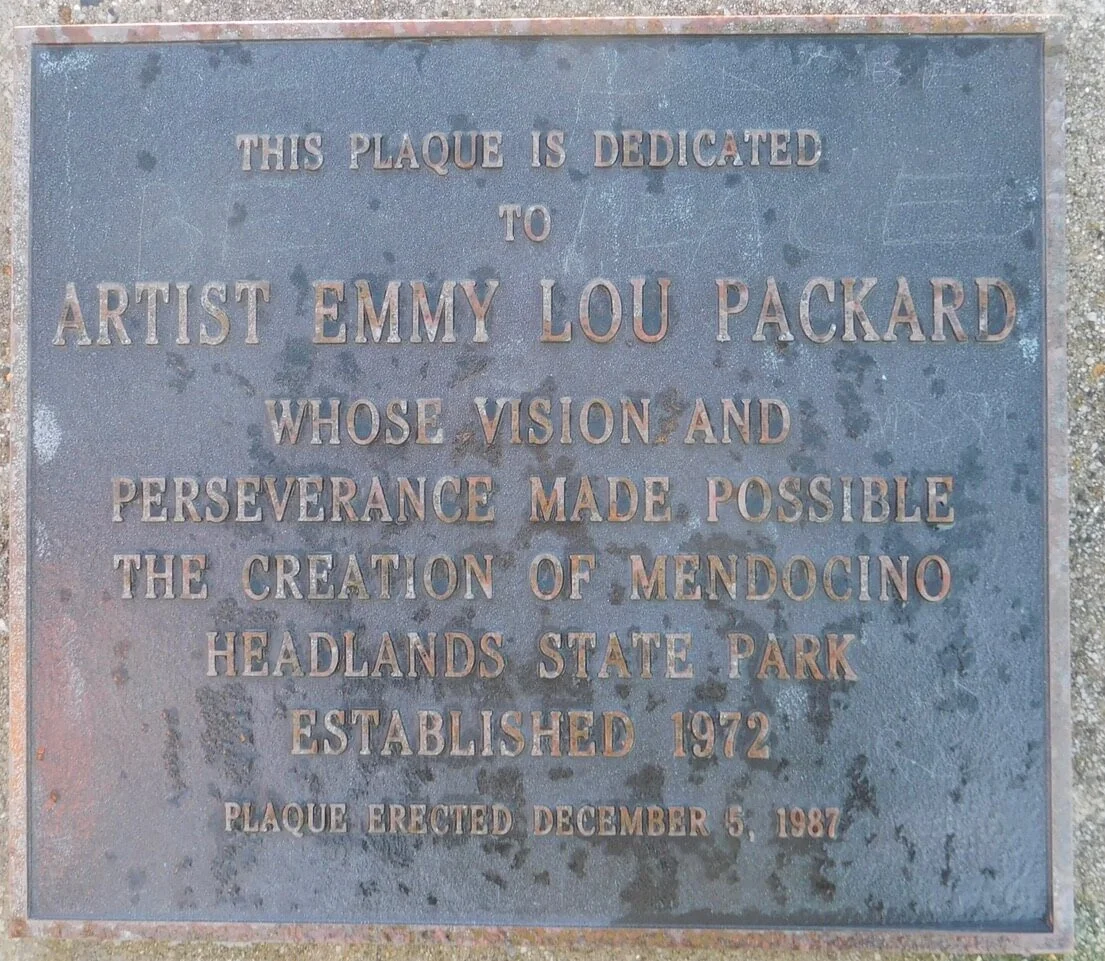
Plaque, Mendocino Headlands,1987
