
To Be Continued: Notes on Legacy Land
The issue facing many artists today: What will become of their work, or their friends’ work, after their deaths? Even artists of limited means or access to “power players” in the Artworld can still work to preserve conserve, document, promote, and place their own artwork, and that of friends, collaborators, and mentors, during their lifetimes and then after they’ve died…
Preventing artwork from becoming mere flotsam, tossed to the curb or dumpsters, is an uphill battle in general. Natural disasters and wars; the fragility of paper, canvas, panel; obtuse or even unsympathetic family/heirs, or blind fate—all mean a Van Gogh-like posthumous superstardom is the exception, most posthumous careers must begin, if at all, during the artist’s lifetime. New obstacles…include the decluttering, anti-hoarding mania, a lack of appreciation for the relics of the past (“brown furniture”), instagram and texts replacing letter-writing, etc.
I wrote this in 2019 for my website, but nothing has changed, likely only gotten worse, given the implosion of the commercial gallery world, and art school closures, as described by Enrique Chagoya in his recent insider perspective interview in Roborant. Mid-tier galleries are disappearing, leaving international blue chip galleries with bankable stables and estates, or, at the other end, small galleries and pop-ups.
I had a foreshadowing at the beginning of my career. Phil Linhares, chief art curator at the Oakland Museum of California, groused that artists’ families were constantly trying to get the museum to take their late relatives’ artwork. Therese Heyman, the photography and print curator at OMCA, remarked that “it takes three generations (for artwork to establish value).” However, Heyman persuaded Dorothea Lange’s husband, after her death, to donate her archive of negatives and prints to OMCA, a coup, and Heyman’s name in silver letters is on the gallery wall at OMCA dedicated to Lange’s work.
The Vincent Van Gogh phenomenon was engineered by the brilliant widow of Theo Van Gogh, the art dealer and Vincent’s brother, who died shortly after Vincent’s suicide (or murder as some have claimed.) Jo Van Gogh-Bonger is unknown to all but art historians, but she carefully marketed and placed the work, even relocating to France for more contact with influential critics and writers. She shrewdly determined the significance of the sunflower series of paintings and placed them carefully to ensure their enduring status.
No one will likely ever top her success, but Stephen Koch, the executor of photographer Peter Hujar’s estate who died this year at 84, deserves runner-up status. As described in the March 18, 2026 New York Times obituary, Koch discovered his calling orchestrating the Hujar apotheosis. Koch had been a professor in the writing program at Columbia and elsewhere, was a longtime reviewer, novelist, and a study of Andy Warhol’s films. He’d written a review of Susan Sontag’s work, who then befriended him, and introduced him to Hujar. Hujar was impoverished in his lifetime, his only published work Portraits in Life and Death, featuring friends like Sontag, John Waters, and Fran Liebowitz, and photographs of the mummified remains in the Palermo, Sicily catacombs. (My Oct. 8, 2024 review in the Bay Area Reporter, Peter Hujar’s Portraits in Life and Death Photo Book Reissued Nearly 50 Years On, lauds it. )
Hujar, dying of AIDS at 53, invited Koch to his Lower East Side loft, and asked him to be his executor: “…he turned to Mr. Koch and said, ‘I have decided that you should have the pictures. You’re no good, the acerbic Mr. Hujar added. But you’re the best I have’.” Becoming the executor of the photographers’s artistic estate changed Mr. Koch’s life. Following Mr. Hujar’s death that fall, he began a long mission to ‘usher his art into posthumous fame…He relentlessly badgered galleries, dealers, and museums, at first to little avail’.” I can attest personally to his reputation— at the Leslie Lohman Museum of Gay and Lesbian Art in New York City, on a mission on behalf of Richard Caldwell Brewer, the Collections Manager mentioned him with a mixture of awe and annoyance.
Eventually, galleries and museums came around, sales followed, and now the burst of Hujar-mania: the reissuance of the Portrait book, with introductory essay by Benjamin Moser (author of a recent Sontag bio), two shows at the Morgan Library, including a show of contact sheets and Speed of Light in 2017, books including Andrew Durbin’s The Wonderful World that Almost Was, the story of Hujar’s relationship with artist Paul Thek, and the upcoming biography by John Douglas Millar, Nude Opera: A Life of Peter Hujar, due 2029. Not to mention the masterful movie Peter Hujar’s Day (2023), by director Ira Sachs, based upon a conversation between Hujar and writer Linda Rosenkrantz, who asked Hujar to narate Dec. 18, 1974. Both were 40 at the time. Ben Wishaw plays Hujar and Rebecca Hall Rosenkrantz. Westbeth, the famous artist coop on the Hudson River, stands in for her East 94th Street apartment.The tape is long gone, but a transcript was found, printed, and discovered by Sachs. Wishaw talks and talks, describing his relentless pursuit of money and difficulties with an Allen Ginsberg shoot, chain smokes, snacks and drinks, and Hall listens and questions sympathetically, the perfect friend.
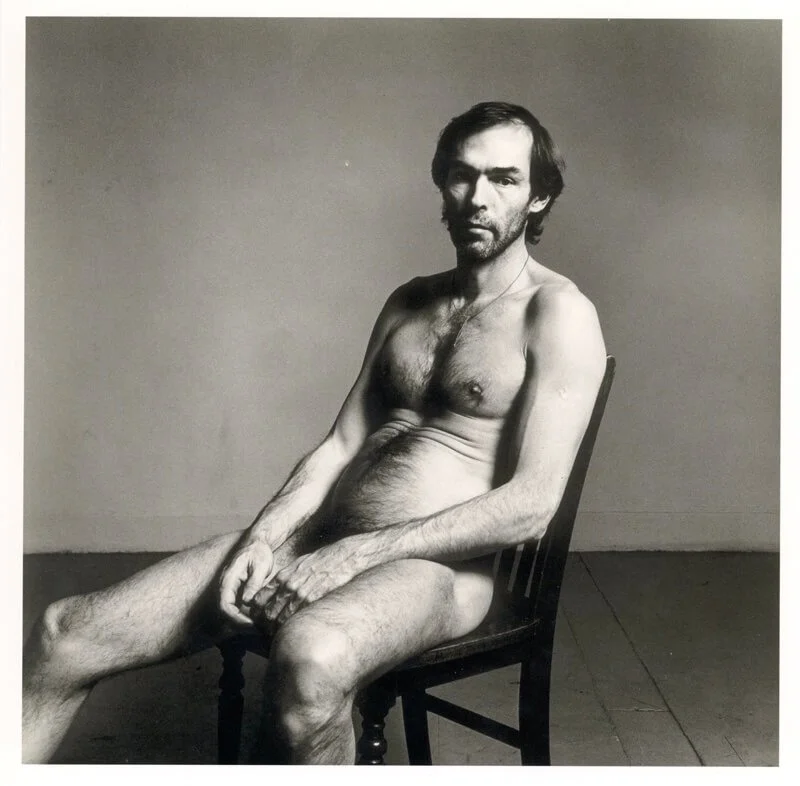
Peter Hujar, Seated Self-Portrait Depressed , photograph, 14 3/4”X14 3/4,” 1980, printed 2013
This image is owned by Ben Wishaw, who plays Hujar in the movie.
Amanda Fortini profiles the 91 year old Rosenkranz in her May 13, 2025 T: The New York Times Style Magazine profile: “…their friendship was essential to her work, too. Indeed, as the both the book and film make clear, the shared dialogue that bound them together in life has continued, through their art, into the present, nearly four decades after Hujar’s death. What speaking with Rosenkranz over several months revealed to me is that for every well-known artist who dies, especially those who die tragically young, there is a friend, a writer, a keeper of the flame, maybe an executor, who has kept the memory of that artist alive. ‘No matter who you are, whether Peter Hujar or Robert Rauschenberg, if no one is there to mind the story, you are going to be forgotten,’ says the writer Stephen Koch, 84, the executor of the Hujar estate. And the role of the minder, is, in its unassuming way, as important as—and perhaps more noble than—that of the star whose name is in lights.”
Another notable example of posthumous legend-making is the elevation of Francesca Woodman 1958-1981) to the canon. She graduated from the Rhode Island School of Design, and photographed herself and others, often nude, in mysterious and blurred settings, but jumped from a loft window in New York City, over rejections and disappointments in her personal life and work. Her mother, the well-known ceramic artist Betty Woodman, set about to promote her work, and was wildly successful. Francesca, now represented by Gagosian Gallery, is in museum collections all over the world, even paired with Julia Margaret Cameron at the National Portrait Galley in London in 2024. Woodman and her painter/photographer husband George Woodman were featured at Charleston, Bloomsbury’s legendary home of Duncan Grant and Vanessa Bell, now a museum. The surviving son and heir, Oakland resident Charles Woodman initiated the Woodman Family Foundation to manage holdings and exhibitions of his parents and sister.
Locally, there are some notable, even improbable, successes. San Franciscan Roy Ragle (1944-2014) was largely unknown outside printmaking circles, but Robert Flynn Johnson, curator of the Achenbach Foundation for the Graphic Arts, Fine Arts Museums of San Francisco, gave him a two person exhibition at the Legion of Honor in 1988, and Ragle’s visibility increased at galleries and print shows. He was virtually confined during the last years of his life to his apartment on Fulton St., opposite Golden Gate Park, suffering with Crohn’s disease, which lead to his death. He documented his physical changes and the effects of medical treatments in his work. His dark subject matter, and preference for black and white, meant an audience and collectors more likely to be connoisseurs and institutions than decorators. His friends helped him print his woodcuts, and he accomplished his immense masterwork, Self-Examination Series, Part II (1987-90), the woodcut triptych portrait of his wife Carol, his therapist, also with Crohn’s, and himself. The subjects were inked and then pressed onto plywood, leaving impressions which he meticulously carved at home. The entire piece, composed of three individual sheets, spans 48”X108.”
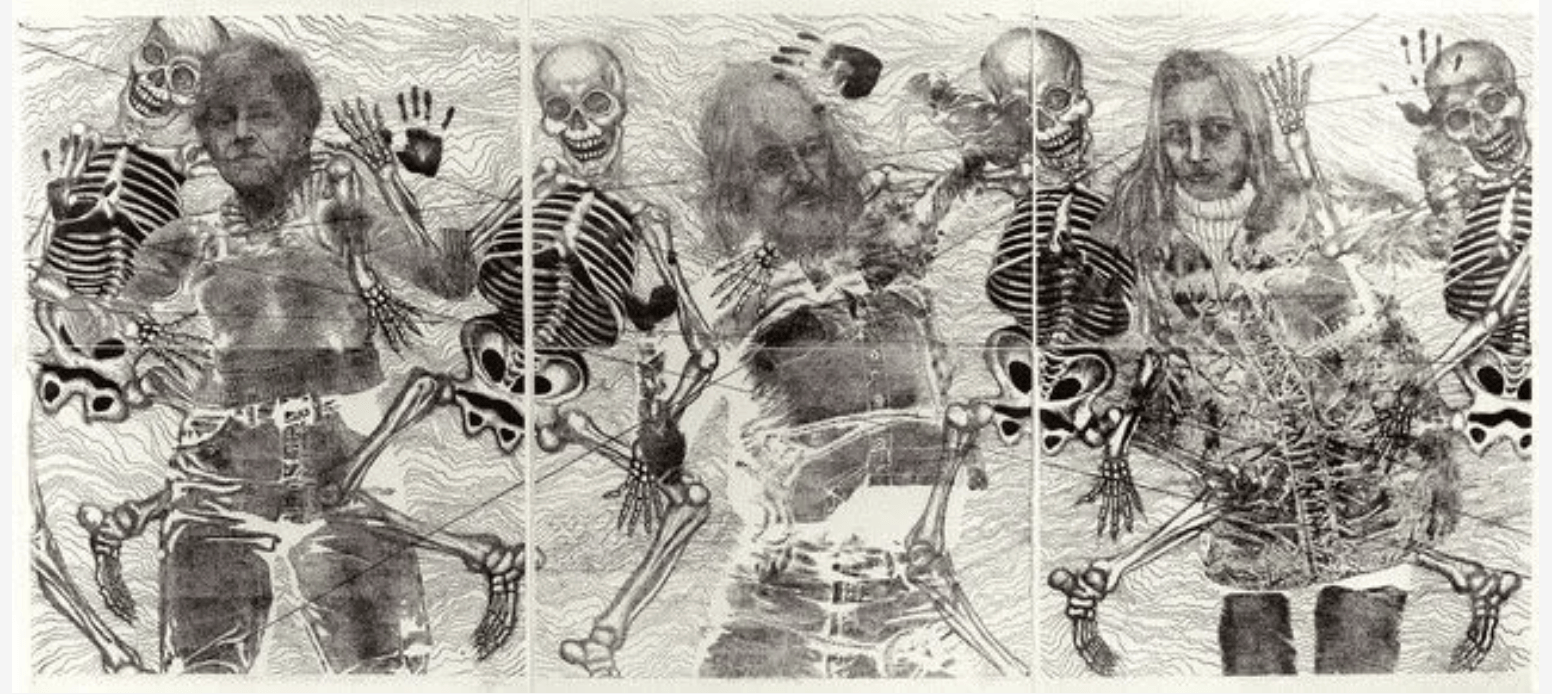
Roy Ragle, Self-Examination Series, Part II, woodcut, 48”X108,” 1987-90
Artist Herlinde Spahr (recent solo show, After the Storm, of drawings on formica at the Museum of Northern California Art in Chico) and artist Art Hazelwood have spent years promoting Ragle’s work, and Spahr accomplished acquisition of the triptych by the Los Angeles County Museum of Art, which included it in their BEFORE YOU NOW: The Self in Portraiture, traveling to several museums in 2024-25, while LACMA’s building was under construction. Ragle’s work stole the show, even overshadowing Diane Arbus and Cindy Sherman.
A contemporary of Ragle is artist/professor/editor Sylvia Solochek Walters. A longtime professor of printmaking at San Francisco State University, co-editor of California Society of Printmakers, One Hundred Years, 1913-2013, with Maryly Snow, her work is housed in many museum collections such as the Achenbach, and with her alma mater, the University of Wisconsin, Madison, Chazen Museum of Art.
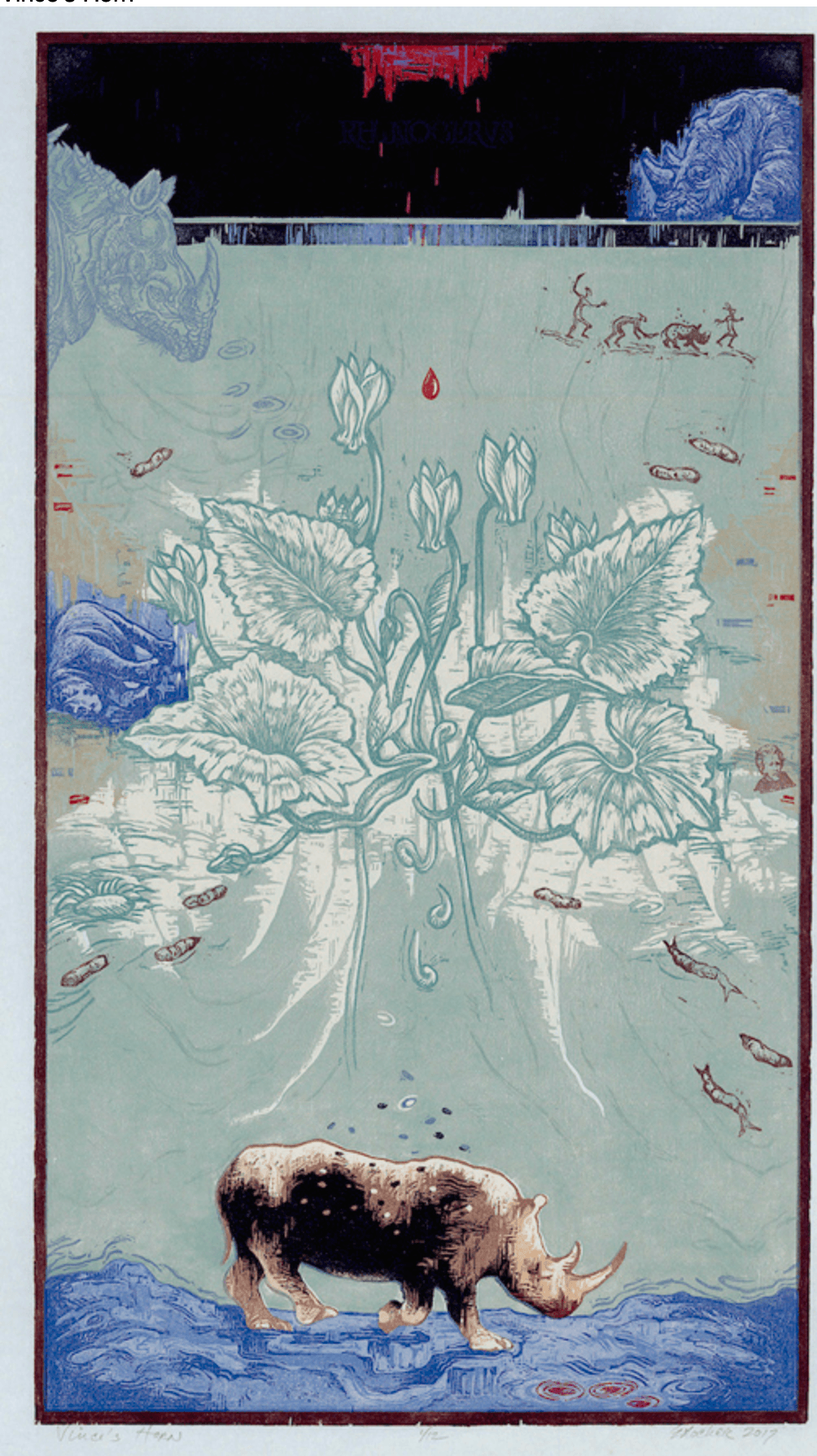
Sylvia Solochek Walters, Vince’s Horn, reduction woodcut, 23 3/4”X 13 1/5,” 2019
Walters’ description: “Vince’s Horn draws attention to the dramatic disappearance of African rhinoceros populations due to the illegal ivory trade and habitat loss. All its formal elements including the melancholy colors, low-growing toxic flowers, curling roots and crawling insects, and the deep red accents, are designed to highlight the story of another wild animal losing its war with human venality. The print is named after a white rhinoceros who was shot and killed for his horn in a private animal reserve.”
CHURN and TRANSITIONS:
Traditionally, many galleries survived by “selling out of the back room,” the resale or secondary market. Dana Reich Gallery in San Francisco, during the 1970s and 80s, was notable for showing fresh MFAs, and a few more established artists like June Felter, in the main showroom, at out of-the-gate prices, but his rent was likely covered by selling Diebenkorns and others from the back room. Claire Carlevaro tried her hand at the resale market by opening Art Exchange in Berkeley, and then San Francisco, taking pieces on consignment and splitting sales proceeds. She took over, briefly, the eponymous Charles Campbell Gallery in one of its many iterations post-Campbell, and featured Walter Snelgrove, relatively unknown now but included in the seminal 1957 OMCA Bay Area Figurative show. Auction houses have long been a venue for art from private collections and deacquisitions. Free viewing, too. Butterfields was a venerable mainstay in the SOMA Design District, before sale in 1999 to eBay, and then purchase by London-based Bonhams in 2022, becoming part of their global operation. Clar’s Auction gallery in Oakland partly fills the void, with gems amidst the dross. Clar’s is also de facto the Emmy Lou Packard (1914-1998) gallery, her work appearing in almost every monthly sale, five pieces in April and also May.
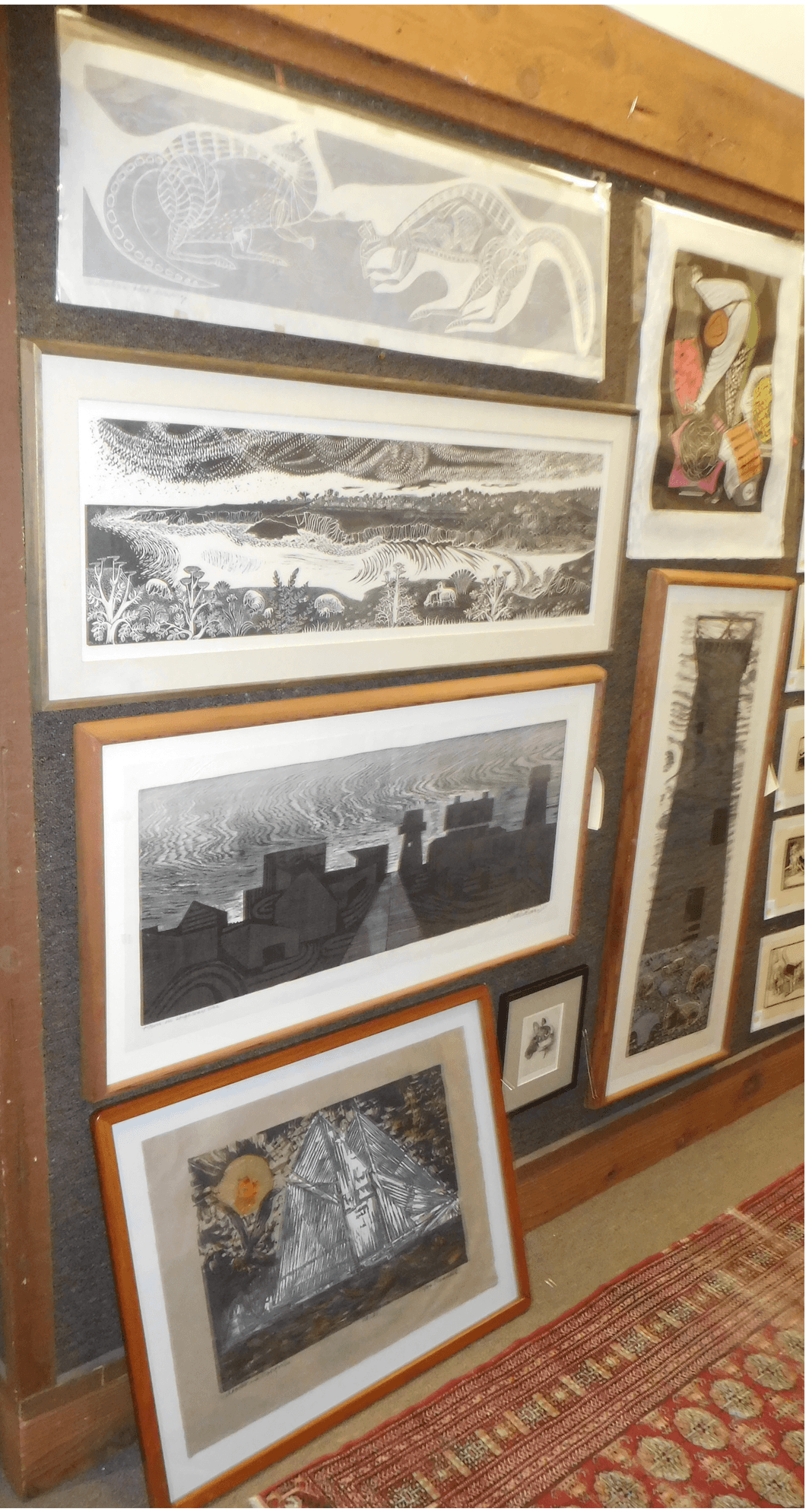
Clar’s Auction Gallery, showroom, April, 2026. Top to bottom, left: Packard’s Australian Bark Drawings, View of Mendocino, Town on Highway One. Right: Front Street, 5AM, Watertower, Mendocino. Bottom left: Byron Randall’s Schooner and Doryman.
More important than the dust-up by heirs over leftovers from the Feinstein estate at Clar’s in May making national news was the appearance in the same sale by Chiura Obata (1885-1975) with his immense (82”X151”) four panel screen—entitled Monterey Cypress in the auction catalog, the proper title is Beauty (or Glory) of Struggle. The imagery suggests a roiling figure.The screen was commissioned by the UC-Berkeley Chancellor Clark Kerr and his wife Kay, and, noted in the catalog, the screen hung in the Kerr dining room where Kay Kerr and her friends Sylvia McLaughlin and Esther Gluck, founders of the Save the Bay movement, strategized.
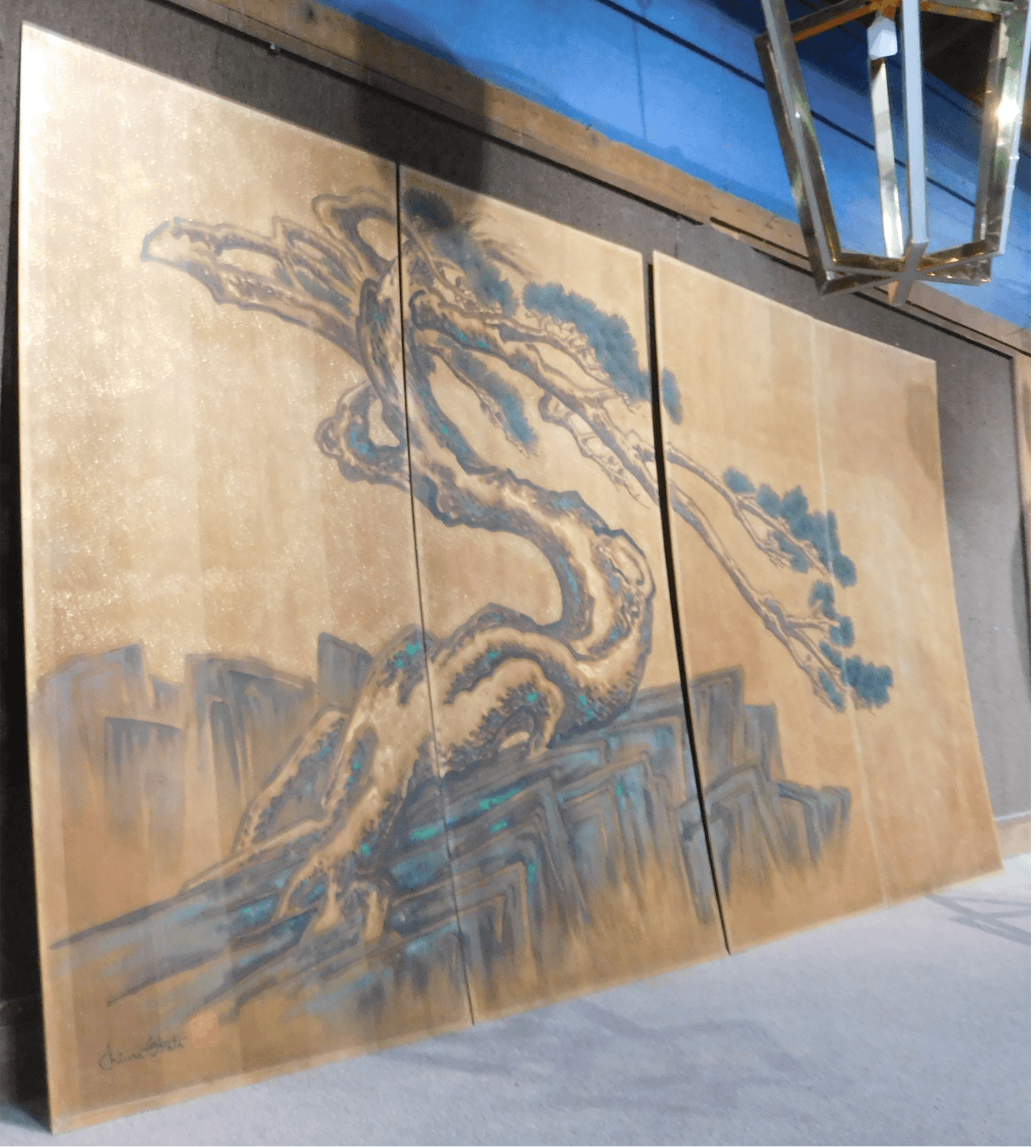
Clar’s Auction Gallery showroom, May, 2026. Chiura Obata, Glory of Struggle, screen, ink, watercolor?, 82”X151,” ca. 1960s
Timothy Anglin Burgard, Curator of American Art at the FAMSF, organized the Great Nature: The Transcendent Landscape of Chiura Obota in 2000, the final show at the de Young Museum before demolition. Burgard describes Obata as “the Bay Area’s most prominent practitioner of the modern nihonga (Japanese Painting) movement, which sought to reconcile traditional Japanese and contemporary European schools of art.” Obata was an art professor at UC-Berkeley, before he and his family were placed in Japanese internment camps during WWII. He was released early after suffering a severe beating in the camp, and returned to teaching after the war. Fortuitously, the surviving children of Obata’s youngest daughter, Lillian Yuri, have taken up the mantle. Kimi Kodani Hill gives illustrated lectures promoting Obata and other previously overlooked Asian American artists, leads Obata-related tours of UC-Berkeley, makes trips to Yosemite to promote his well-known depictions of the landscape to young people, and the family has placed significant artwork in their possession with prominent museums, often resulting in shows.
Richard Caldwell Brewer (1923-2014) is my personal legacy project, which began after we met at his Top Floor Gallery show in 1979, and when he was in his mid 50’s. My husband and I promoted and documented his work, which continues. After his death in 2014, with myself as his executor, we placed his papers (including his My History diary) and many works on paper at the UC-Berkeley Bancroft Library, paintings and works on paper of his and by his model/muse/fellow artist Steven Krstich at the GLBT Historical Society in San Francisco, and paintings at the One Archives at USC Libraries in Los Angeles. We await developments, inquiries—Legacy Land has its own timeframe. (I wrote Rediscovering Richard Caldwell Brewer: Bay Area Gay Painter may finally get his due, Bay Area Reporter, June 2, 2024.) Lost Art Salon in San Francisco gave Brewer a solo show in 2019. Their business model is to buy in quantity from artists’ estates, and sell retail, and they’ve done a brisk business with Brewer, including internet sales.
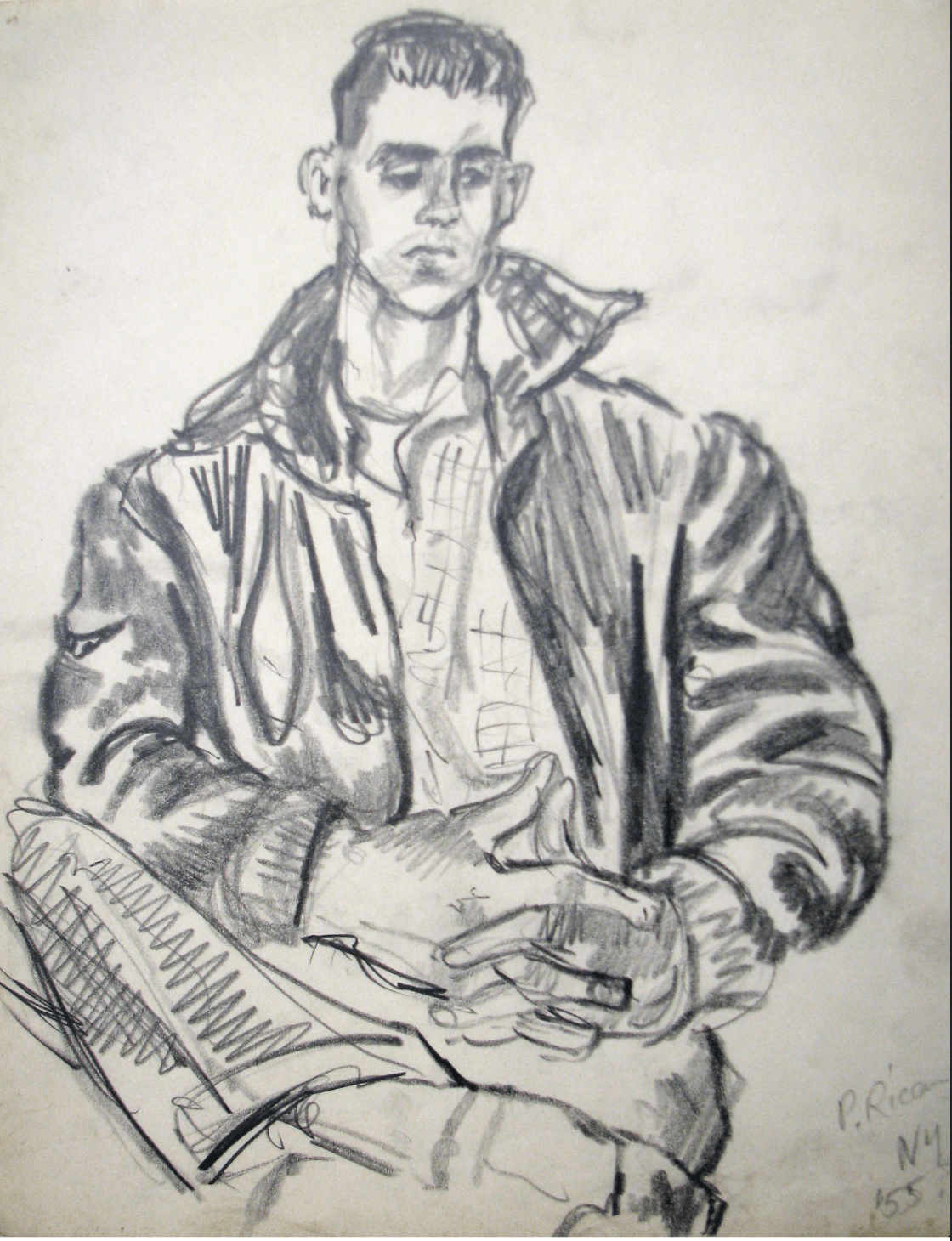
Richard Caldwell Brewer, P. Rican, ’55, pencil/paper, 11”X8.5”
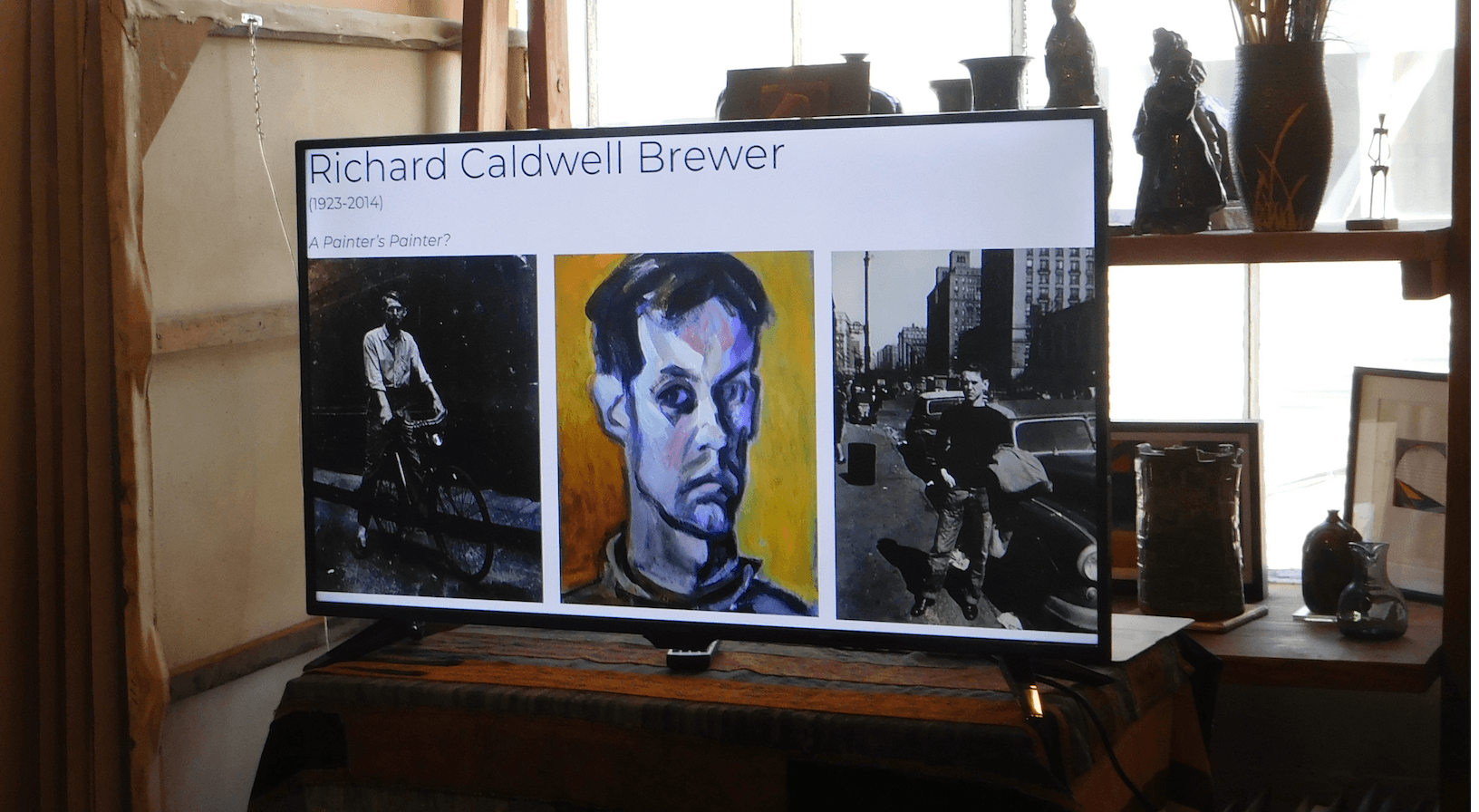
Richard Caldwell Brewer solo show installation view, Lost Art Salon, San Francisco, 2019
Hanging by a Thread
Some artists and writers come within a hair’s breadth of oblivion, erasure. Perusing the contents and advertising in an old art magazine shows how fleeting reputations can be.
The outsider artist Harry Dodger (1892-1973) was unknown before moving into a nursing home shortly before his death. His landlord and an artist helper, clearing out his apartment, were amazed by what they found. The Chicago nanny/photographer, Vivian Maier (1926-2009) is now acclaimed, the results of efforts of John Maloof and others who discovered her work after her storage locker contents were auctioned off for non-payment. Augusta Rathbone (1897-1990) had a late surge when the Annex Gallery print dealers found an etching of hers in an Arizona antique shop, and started selling and showing her work. I met Rathbone in her 80s while she was living in a Tenderloin studio apartment and wrote about her in the 2025 Volume 49:4 Journal of the Print World.
The intriguing Samuel Steward (1909-1983) would likely have disappeared without a trace were it not for the detective efforts of writer Justin Spring, who published Samuel Steward: Secret Historian in 2010. Steward was fired from his professor job in Chicago, had a lifelong friendship with Gertrude Stein and Alice B. Toklas who called him “Sammy,” was a tattoo artist favored by the Hell’s Angels in Downtown Oakland (with “poverty, crime, police brutality, racial tension, and conflict”), lived in the “slums of Berkeley” at 2019 9th St., was a pornographer (the Phil Andros series, with covers by Tom of Finland), a friend and subject of Alfred Kinsey, the sexologist, who filmed him being assaulted by a sadist, and suggested he compile his Stud File, a 50 year record with some bold face names like Rock Hudson, Rudolph Valentino, Lord Alfred Douglas, and Thornton Wilder, and snippets of pubic hair. His small cottage was a “stinking, densely packed mess.” Luckily, his back-up executor (the first died of AIDS), was a librarian and carefully packed up and organized cartons of his papers, but then ran out of steam, storing them above his Castro St. garage. Some of his papers were at prestigious institutions like the Beinecke Library at Yale, but no one before Spring had asked to see them. Because of their content, bureaucratic procedures, and rules regarding the privacy of living people, even the Kinsey Institute made accessing his records difficult.
Ragle and Steward might object to the comparison, but both are sui generis, and hard to imagine many followers, or a school.
Novelist Dawn Powell (1896-1965), chronicler in her sophisticated, satirical way, of mid-century Manhattan, friends with types like Edmund Wilson, and then out of fashion, was buried in an unmarked potter’s grave in the Bronx. But an essay in the New York Review of Books, Nov. 5, 1987, by her friend Gore Vidal revived her career, creating a “cult-like following,” reissuance of her books, and a biography by Tim Page. The Golden Spur, her last and best book, is set in the art world of a fictionalized Cedar Tavern, hangout of the Abstract Expressionist crowd.
In summation: Make hay while the sun shines, don’t count on a Van Gogh-Bonger, Koch, or Spring to accomplish posthumous recognition. Have a narrative of your life and work. Don’t be ashamed if you have a lot of inventory to deal with—it means you’ve worked. I’ve had friends who only produce for an upcoming show, maybe why they’re silent these days. Catalogue your work, make a will or set up a trust, commit money for practical uses like conservation, storage, cataloging, placement, after your passing. Find someone to agree to be your estate or art executor, and have back-ups. Place as much of the work as you can, while you’re alive and kicking, in places where it will be cherished and not just languish in cold storage or—horrors!—deacquisitioned.