
Thomas Murray, This is Our Garden, Noyes Museum of Art
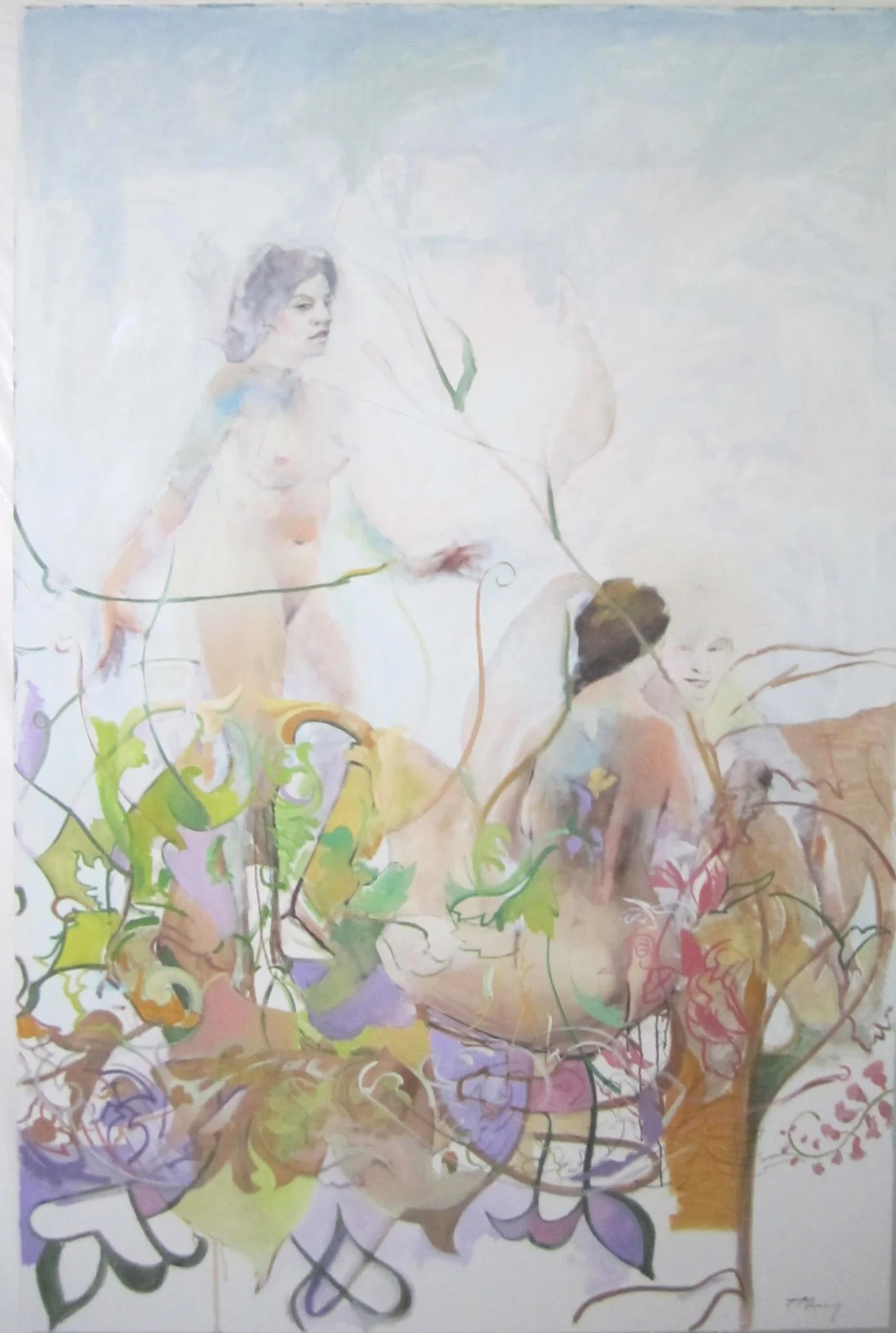
Sentinel,
72 x 48", oil on canvas
From a materialist standpoint, gardens are places where life begins, ends and begins again. From a philosophical and symbolic perspective, gardens are spaces of transformation, conversion, rejuvenation, abundance, temptation, free will, metamorphosis, beauty, death, mystery, and paradox. In gardens, life, in its overflowing abundance and incomprehensibility, is on display.
Medieval and pre-Renaissance Christian paintings, as one observes in artistic representations of humans looking upward and terrified at an omnipotent deity, had a simple message. Humans are plagued by a cosmos that exceeds comprehension. The cycle of birth and death can only be overcome by an orientation to eternity that requires denouncing the world, disciplining the body, and preparing oneself for life after death. Earthly gardens only promised momentary nourishment and reprieve. To the idyllic Garden of Eden, there is no return. As a theme in Western art, gardens flag something we have lost but also aristocratic power, royal hegemony, and leisure: an attempt to overcome alienation.
Thomas Murray’s exhibit “This is Our Garden” consists of twenty-one oil paintings. His work touches on many classical themes in the history of Western art. There is a peculiar gravitas to Murray’s paintings. The title of the exhibit is an invitation to the viewer and visitor to enter the realm of fantasy, one unmediated by techno gadgets that promise freedom but entrap us in endless cycles of passwords, confirmation codes, and dual authentication. Via art, take a moment to breathe and enter paradise, Murray seems to be saying. Lush life and bodies are on display. The facial expressions on the human figures are pensive and serene. The faces are seductive, sensual and welcoming. But also uncanny, haunting, and mysterious.
In aggregate, Murray’s work positions itself in relation to narratives of birth, beginnings, flux, death and innocence. Themes prominent in Christian and Renaissance art. Shame and guilt do not haunt Murray’s work, though. In many of the paintings, human bodies (female, male, non-binary) are unclothed, exposed, and naked. The images, but also the titles of his works, illustrate the connection to a broader classical tradition of fine art: “Adam”; “Prince”; “Eve”; “Thinker”; “Trinity”; “Sentinel”; and “Witness.”
In terms of the influences of other artists streaming through his work, one can detect the subtle presence of Albrecht Dürer (“Adam and Eve”), Titian (“Venus of Urbino”), and Henri Rousseau(“The Dream”). Murray extends the powerful theatricality of their paintings into the contemporary moment.
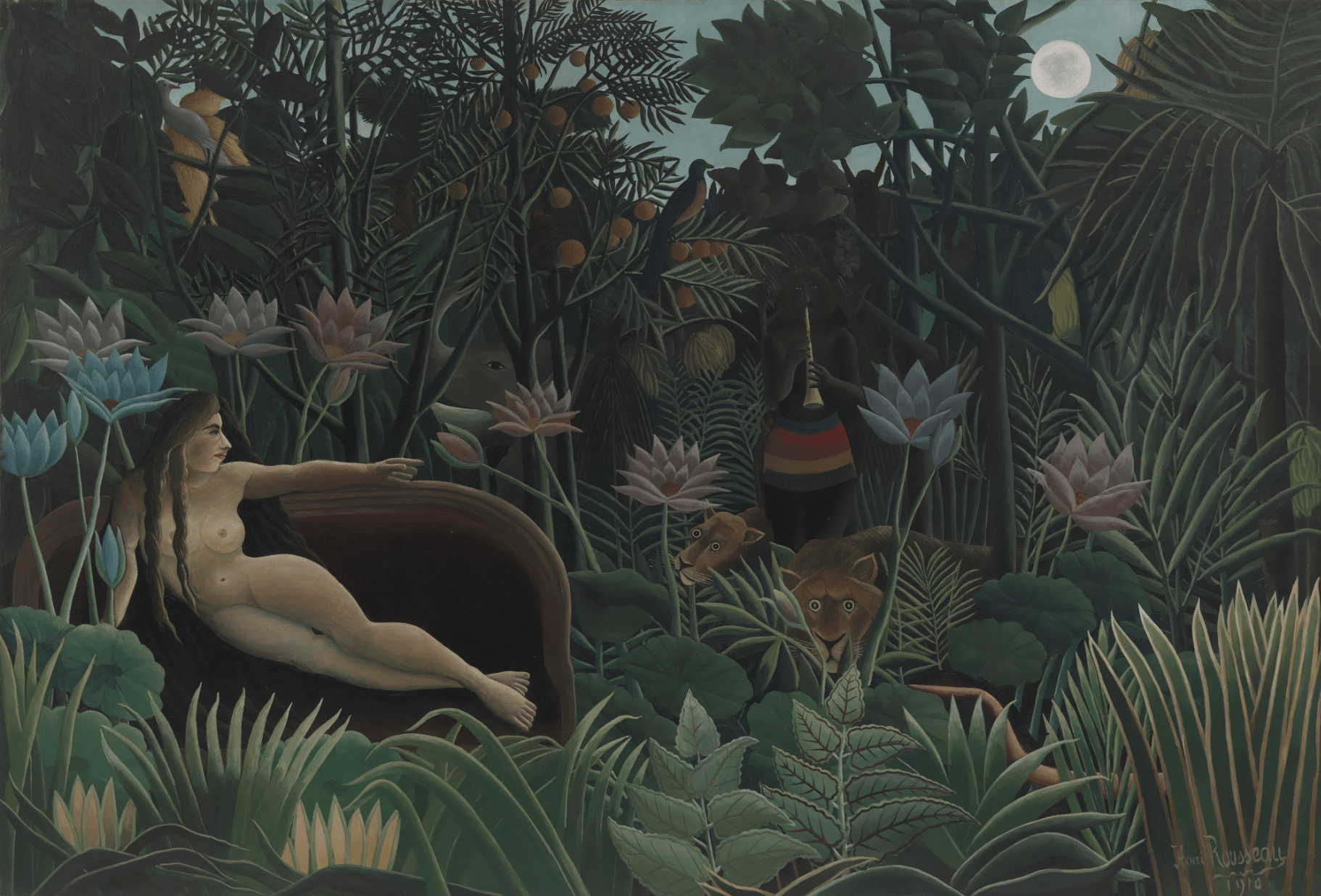
Henri Rousseau,The Dream, 6' 8 1/2" x 9' 9 1/2", 1910
Tibetan, Florentine and Persian design thematics are evident in many of Murray’s pieces. There is an ambience, a peculiar atmosphere and weightlessness in his paintings, magically surreal.Murray’s technical mastery is evident in all the paintings on display, but thematic content takes precedence over observable brush strokes. The edges of some of the art pieces nonetheless bare the trace of the human hand and fingers holding a paint brush.
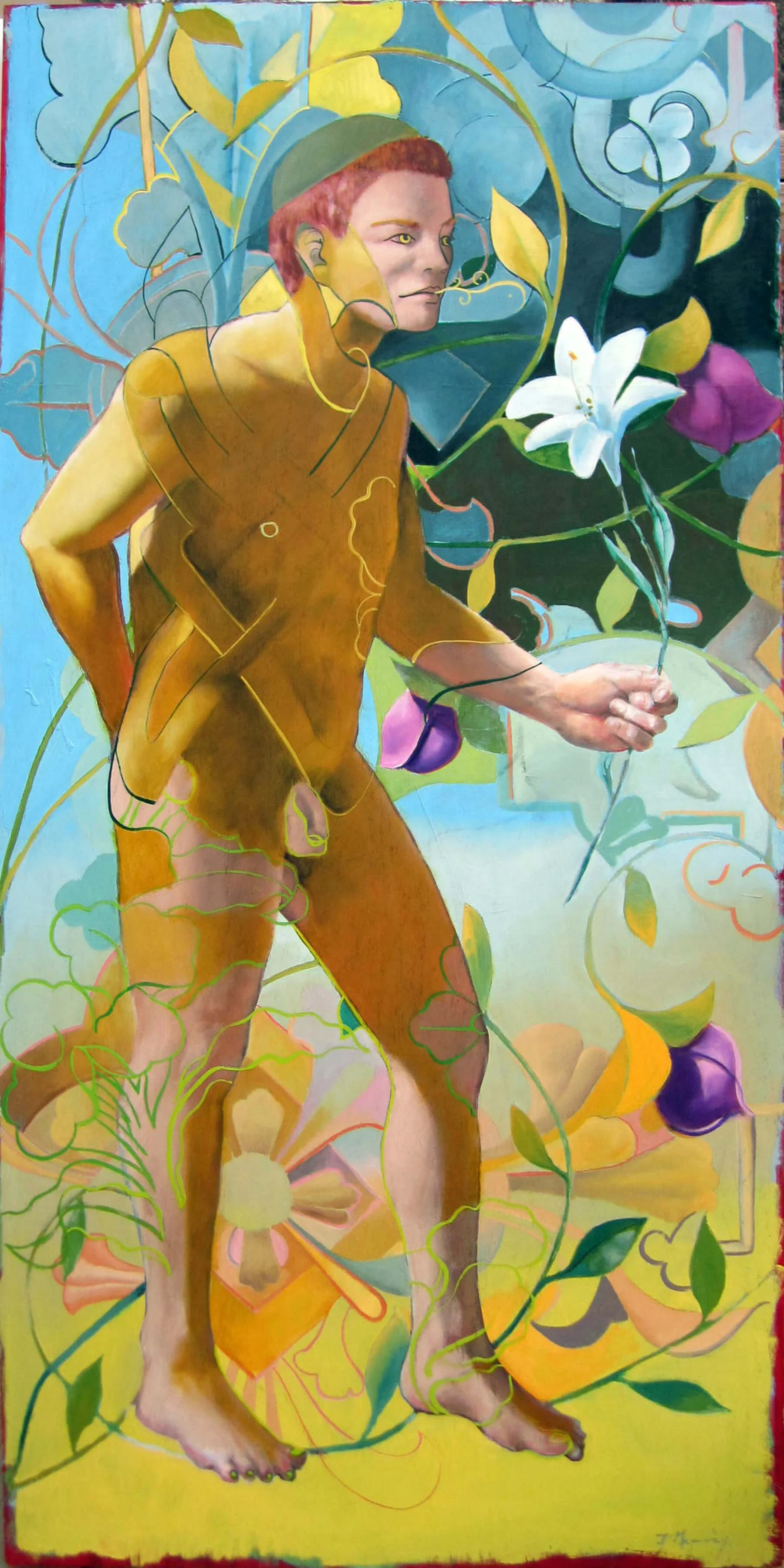
Adam, 48 x 24’’, oil on wood panel
The exhibit consists of twenty-one paintings. Fifteen of them are oil paintings on wood panels. Most of them are 48 x 24”. Six are oil on canvas. The piece “Adam,” oil on wood panel, depicts a nude male figure. One arm is behind Adam’s back. The other is outstretched and holds the stem of a white flower. Adam’s eyes are tiger-like. His lips are touched by a stem. His feet are simultaneously grounded yet ungrounded. Triangular toenails imply a connection to animality. Genitals are pronounced via outline. Adam’s facial expression is serene yet focused. He wears anun-brimmed green hat. Yellow paint is dominant and yields brightness, especially to the bodily flesh. Adam looks to his left.
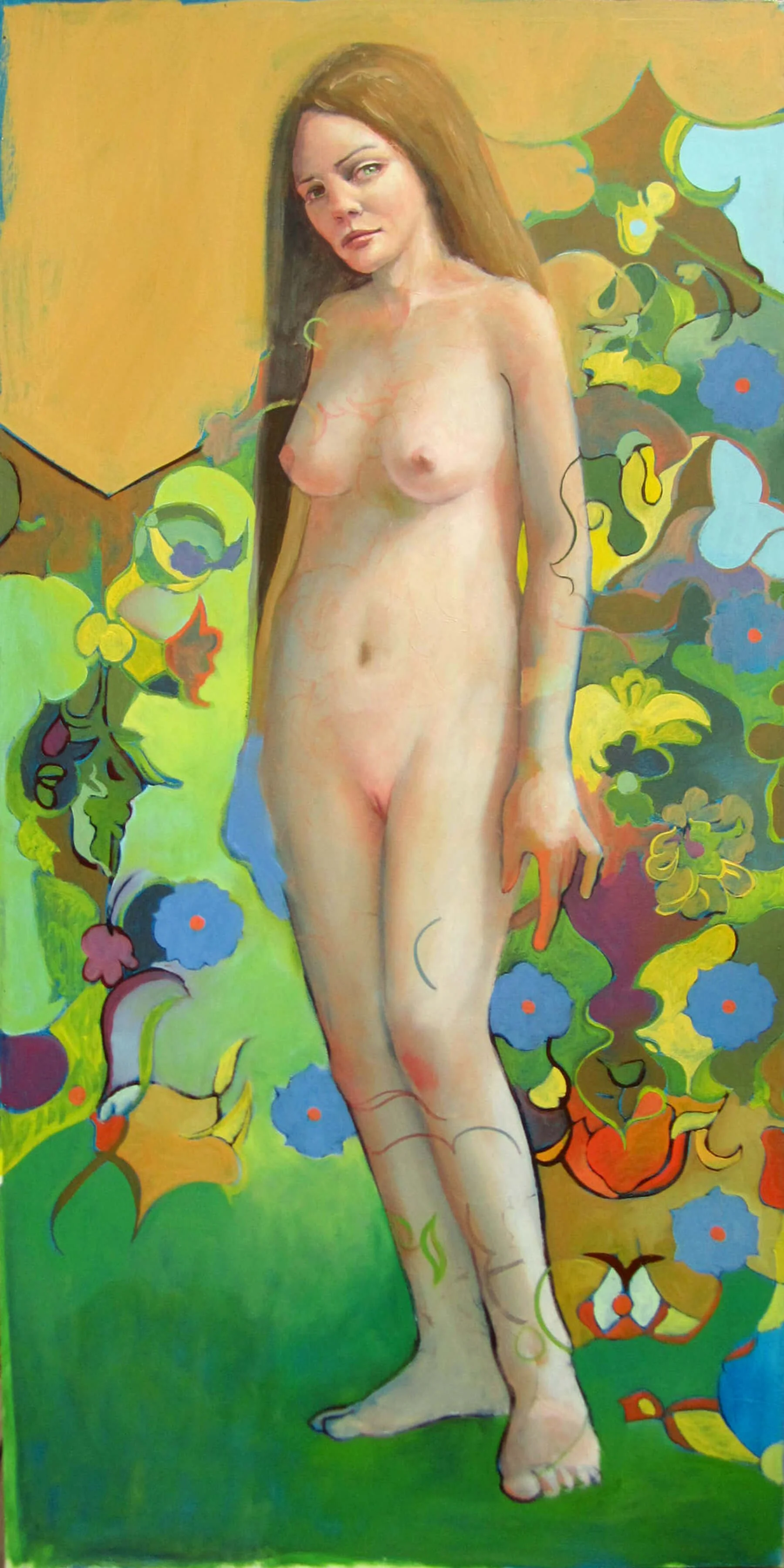
Eve, 48 x 24’’, oil on wood panel
The piece “Eve” is also 48 x 24’’, oil on wood panel. Eve does not look to her right but directly at the viewer. She is naked but unaware of it. Her left hand has a bent pinky finger. Index finger is long. Another finger even longer. Was this the outstretched hand that handed Adam fruit? She stands on green. Her brown hair is long and lush. Eve is lovely but also powerful and slightly menacing. Bright blue flowers contrast powerfully with green and yellow background. There is something beautifully haunting and peculiar about Murray’s aesthetic representation of Eve.
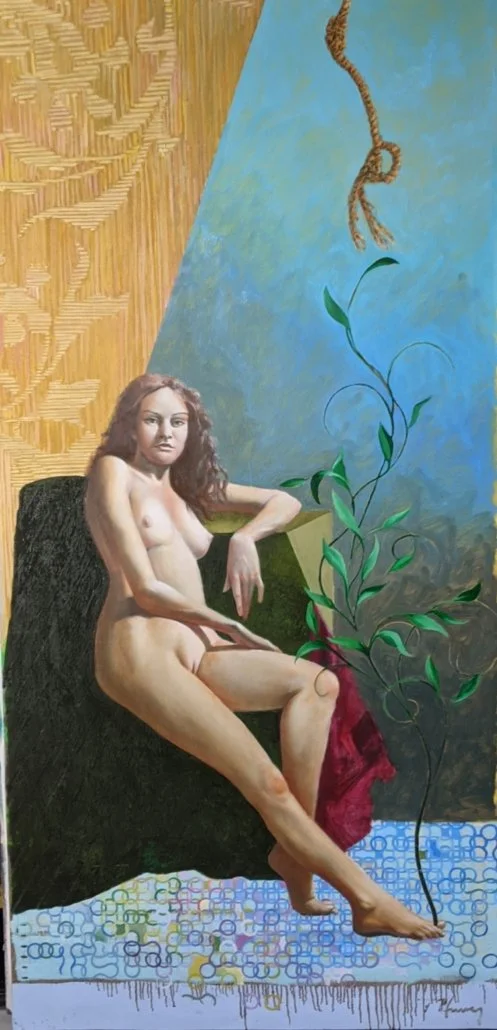
Sola, oil on panel, 72” x 34”
In the piece “Sola,” oil on panel, 72” x 34’’, a nude female reclines on a chair. Like Eve, the female stares directly at the viewer. Her left elbow rests on the chair, and the hand floats downward. Her right arm crosses her torso and rests on her left leg. Her legs are magnificent. Her face is otherworldly. One can detect traces of Henri Rousseau’s painting “The Dream.” As in Murray’s painting “Eve,” there is something inexplicable and uncanny about the face of the female figure.
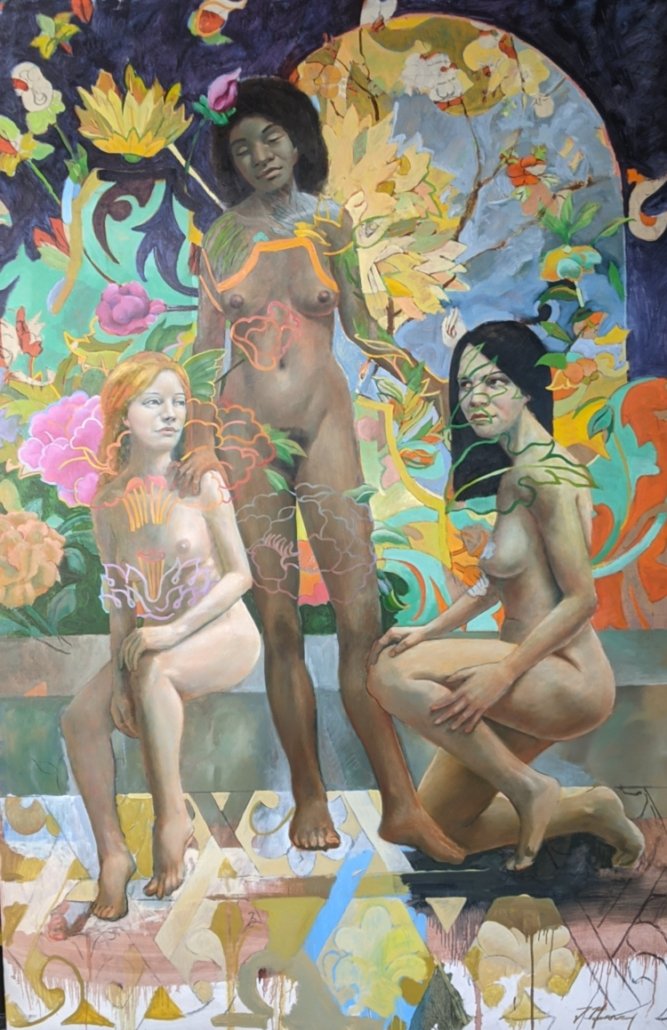
Trinity, oil on wood panel, 72” x 48”
In the piece “Trinity,” oil on wood panel, 72” x 48’’, the Father, Son, and holy ghost are displaced by three nude females (triple goddesses?) in states of contemplative rest. In Murray’s reinterpretation of a classical theme, floral design explodes outward, mirroring the state of outward expansion of the universe. The female on the right has cubist hair with sharp and crisp angles, rests on one knee, hand on her calf. The female on the left is in a sitting pose and stares into the horizon. The woman of color in the center, seemingly lost in thought and looking downward, rests her hand on the shoulder of the female on her right. What was previously a marginal figure, now becomes centered with focal intensity.
Murray’s paintings are influenced by Christian themes. But he is an artist beyond good and evil via the transformation of Christian iconography. His invitation to reclaim “our” garden indicates as much. Our garden is one without Christ, guilt, shame, piety, discipline, and self-denial. Murray depicts “our” garden that welcomes everybody and flags shared humanity, not my garden surrounded by a gate, cameras and attack dogs. Gardens and earthly life are eternal, Murray seems to be saying. In a strange but obvious way, humans are also gardens.
Murray is not an academic artist. He is not in search of disciples and followers who will imitate the master. Traces of authority in his pieces are undermined. Aesthetically, Murray dwells in a world that is open and inviting to everybody. A world that calls into question the aesthetic impoverishment of commodity culture, Christian asceticism and rigid definitions of art in institutions of higher learning. Murray’s “This is Our Garden” is an aesthetic representation of redemption and sharing in the age of popular interest in sasquatch, backyard cage fighting, Joey Chestnut hot dog gluttony events, monster truck rallies and wrestling matches. In this sense, Atlantic City is somehow an ideal location for this exhibit.
Sometimes Murray takes his aesthetic message and artistic prowess to inmates at South Woods State Prison in Millville, New Jersey, where he frequently teaches. South Woods is not a garden but a 1.3 million square foot correctional complex. Murray’s work with inmates implies that they are invited into our garden. Murray also teaches art at Rowan University. Through art, Murray asks what is our relationship to nature and ourselves? “This is Our Garden” is also a way of asking “what and where is our garden”?
Thomas Murray lives in Glassboro, New Jersey, with his partner, Donna Sweigart, professor of art and design, and their son, Truxton Donnally Murray.
