

Degas in New Orleans
By Bob Dunlap
In July 1870 the Franco-Prussian War began, a conflict that would redraw the map of Europe, end the French Second Empire, create and then crush the Paris Commune, and unify Germany into the Second Reich. Beyond the vast military and political implications, the war reverberated throughout French society, shifting cultural norms across economic, philosophical and artistic realms. Many artists (Monet, Pissarro and Cezanne) fled Paris, taking refuge in London or remote parts of France to evade the war (and its draft). Others joined the army (Renoir, Rodin and Redon), and still others fought in the National Guard. Enter Edgar Degas.
Born in Paris on July 19, 1834, Edgar was the eldest of five children born to the union of Auguste De Gas, a banker of French-Italian descent, and Marie Celestine Musson, a French Creole born in New Orleans in 1815. The unexpected death of Marie’s mother in 1819 prompted her grief-stricken father, Germain Musson, who had fled the aftermath of the Haitian Revolution in 1805 and relocated to New Orleans, to relocate again to Paris. It was there Marie, 17, wed Degas’s father in 1832.
Edgar enjoyed a privileged background (though at a young age changed the spelling of his last name to its less pretentious form), earning a baccalaureate in literature in 1853 while continuing to pursue his passion for painting. In 1856 he went to Italy, spending three years copying masters such as Michelangelo, Titian and Raphael. Returning to Paris in 1859, he began copying paintings at the Louvre. In 1865 his “Scene of War in the Middle Ages” was exhibited at the Salon, where he continued to exhibit annually until 1870, when the Franco-Prussian War broke out, prompting Degas to enlist in the National Guard. During rifle training, it became apparent Degas’s eyesight was impaired, which he attributed to the rigors of the war, especially the hardships imposed by the Siege of Paris.
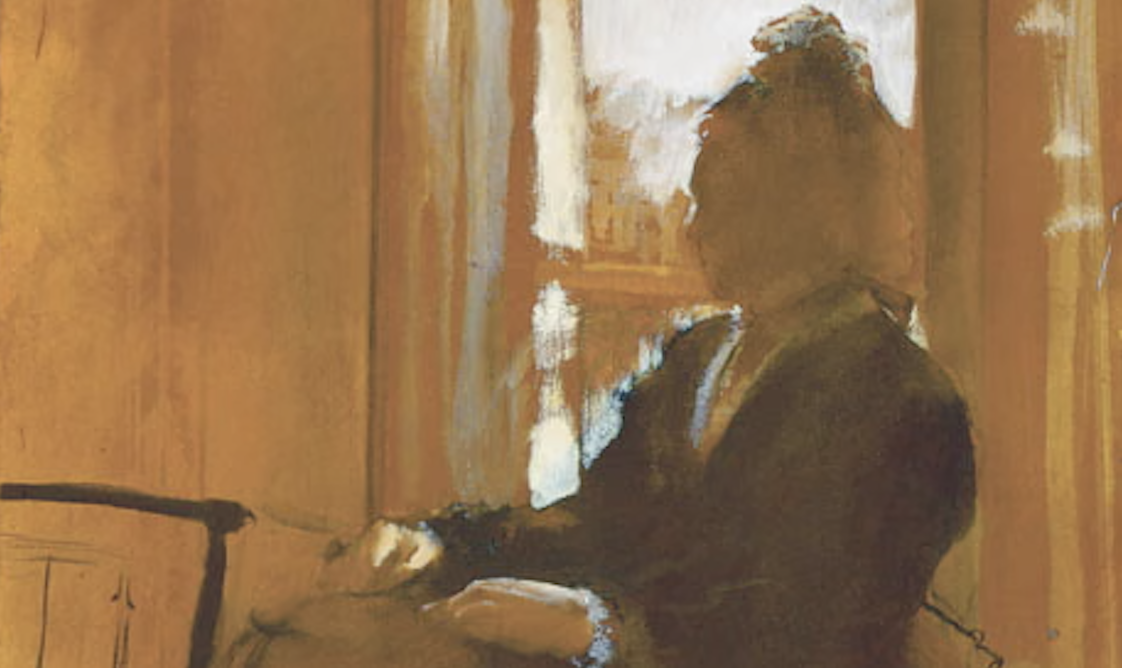
The Woman at Window, 1871–1872,
Oil on paper mounted on cardboard,
24.1 x 18.1 inches
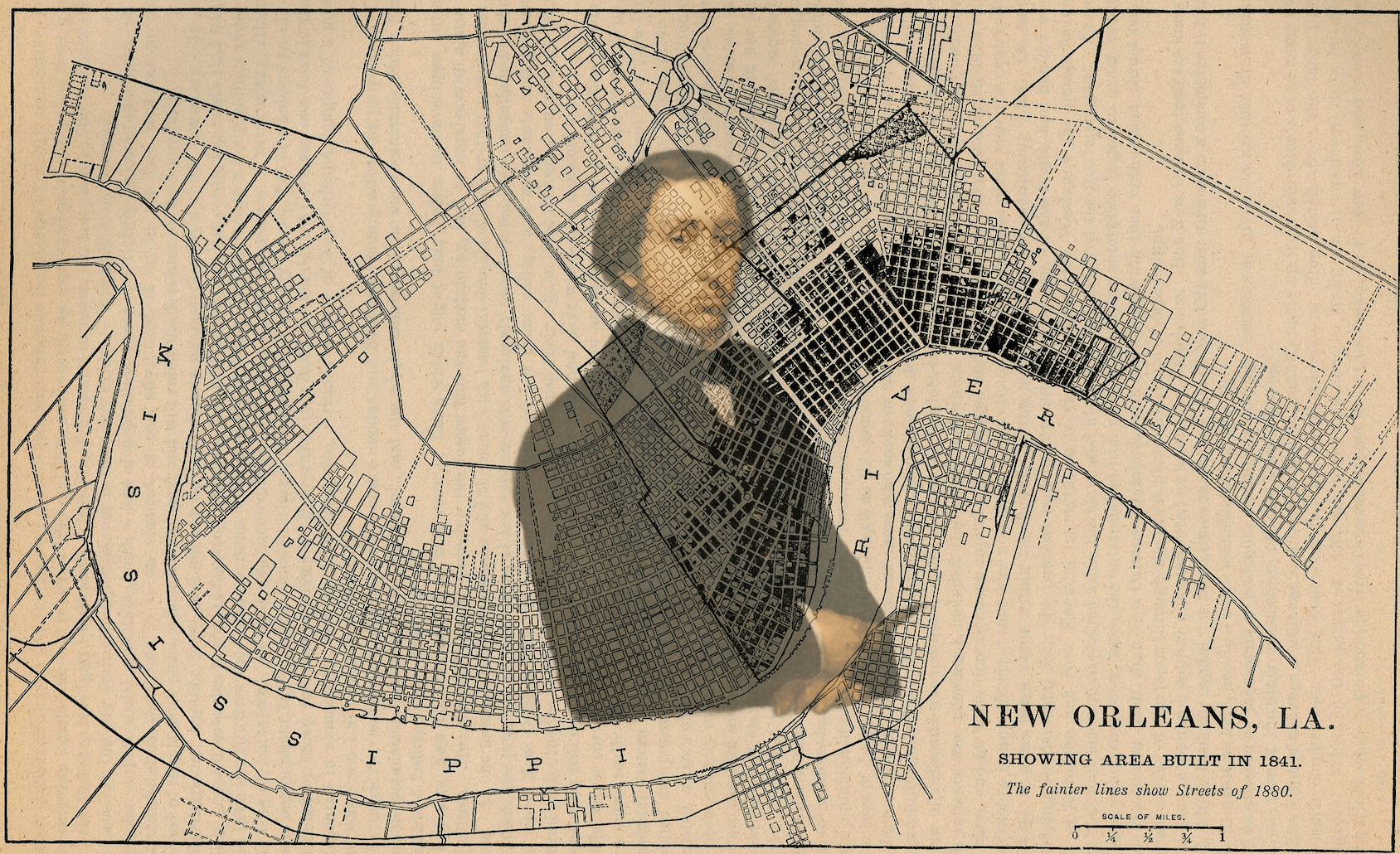
In 1872, the war over and France defeated, Degas’s brother, René De Gas, came to visit him in Paris. He persuaded Edgar to accompany him back to New Orleans for a family visit. Degas agreed, and in October 1872 arrived in the city where many of his relatives still lived, including his maternal uncle, Michel Musson, who invited him to stay in his luxurious home. Much like Paris, New Orleans was reeling from huge wartime losses and social divisions, with widening fault lines between Northerners and Southerners, Blacks and whites, English speakers and French-speaking Creoles.
Degas, no stranger to adversity, thrived there. He was at an artistic crossroads, both substantively and stylistically. Venturing away from his classical roots, he shifted from historical paintings to depictions of modern life. Even his paintings in the aftermath of a monumental war were focused not on battlefields but on the starvation and deprivations the Siege inflicted on the citizenry, such as the haunting “Woman at the Window” (1871–1872).
Degas remained in New Orleans for five months, producing eighteen oils and other pastel drawings. Family life both rejuvenated him and became the focus of his art. His famous “A Cotton Office in New Orleans” (1873) depicts the office where the men in his family worked and became his only painting acquired by a museum in his lifetime.
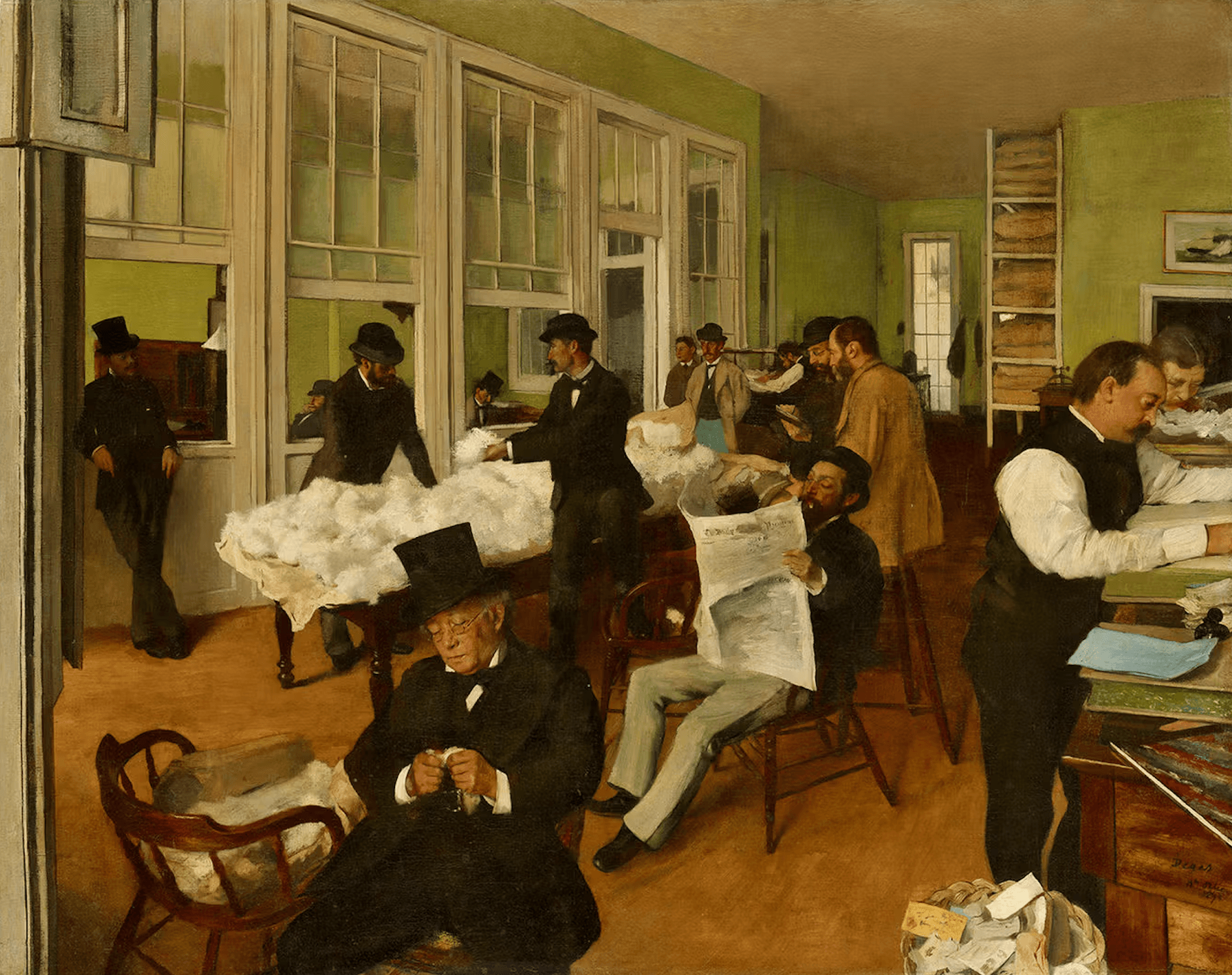
Edgar Degas (French, 1834–1917). A Cotton Office in New Orleans, 1873. Oil on canvas, 28 3/4 x 36 1/4 in.
Degas also reconnected with his cousin, Estelle Musson, whom he had first met ten years earlier in Paris when she and her mother fled New Orleans during the American Civil War to escape the chaos of Union occupation. Estelle was pregnant at the time and recently widowed, her husband, Joseph Davis Balfour (the nephew of Confederate President Jefferson Davis), having been killed in the Battle of Corinth. By the time of Degas’s visit to New Orleans, Estelle was married again, to her cousin/Degas’s brother, René, and pregnant again. She was also nearly blind from a hereditary eye disease, likely a form of macular dystrophy, the first indication that Degas’s visual impairment may have been genetic.
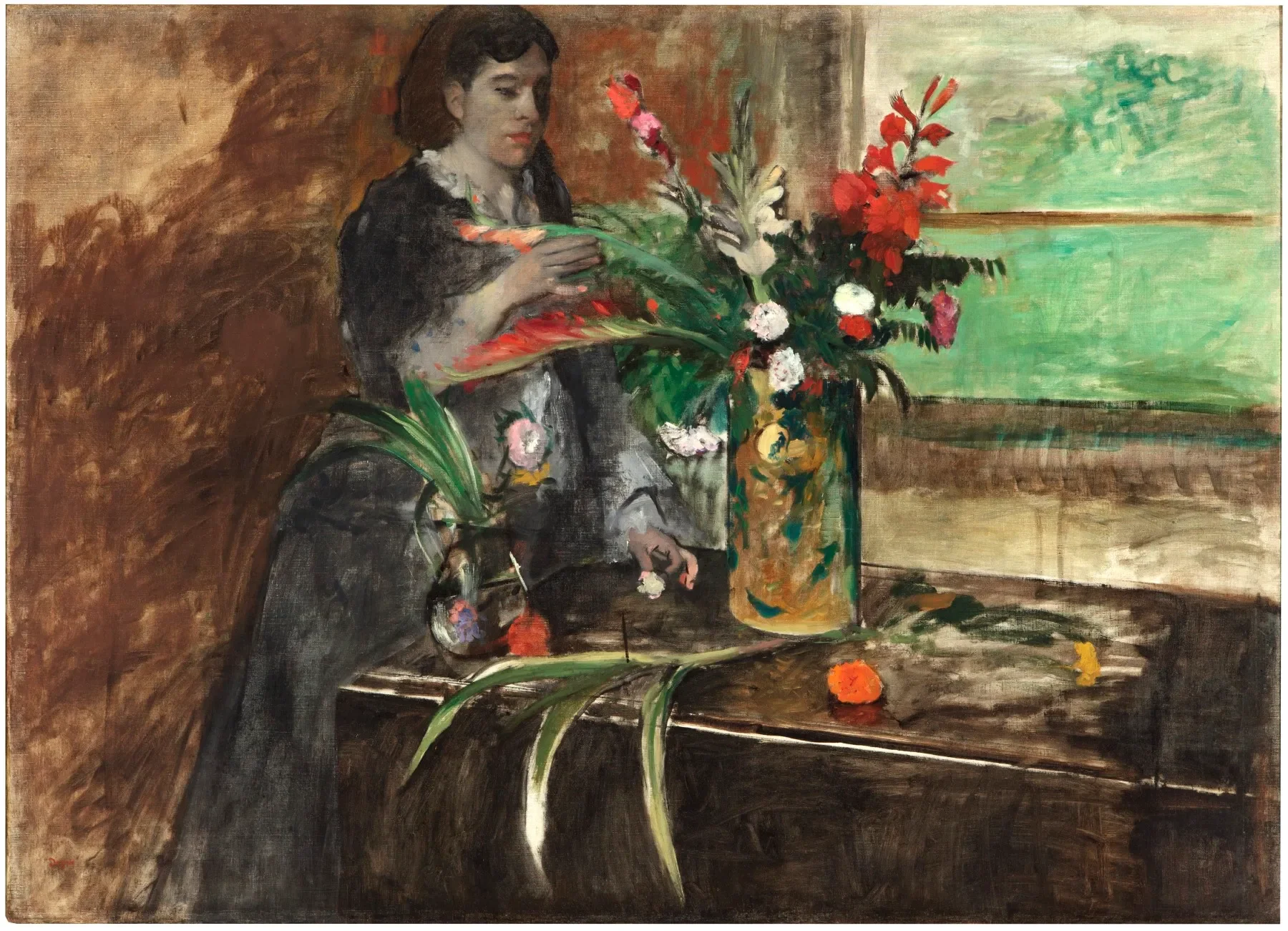
Portrait of Estelle Musson Degas, 1872, Oil on canvas
Estelle and Degas’s reconnection culminated in “Portrait of Estelle Musson Degas” (1872), weaving together many strands of Degas’s life at the time. It depicts Estelle, nearly sightless, arranging a vase of colorful flowers by feel. Clearly pregnant, a pink chrysanthemum suggests a protruding navel framed by her swollen belly. The background wall is drab brown, with a hasty, unfinished quality, the canvas visible in areas. So too the brown table Estelle is working at and her black dress – a dark palette reminiscent of the “Dutch Dark” of Degas’s earlier, classic-copying phase. By contrast, vibrant green foliage (mirrored in a light green wash outside the window) and resplendent red, orange and pink flowers brighten the center of the scene, seemingly pulling Estelle out of the darkness, or at least partially so, with half of her face (and one eye) lit, the other half in shadow.
In March 1873 Degas returned to Paris, bringing his new style with him. His loose brushwork, use of natural light, and efforts to capture modern life in fleeting moments were major tributaries in the river of Impressionism that swept over the art world. Degas was a driving force behind the movement, participating in seven of the eight Impressionist exhibits between 1874 and 1886.
Degas was the only notable French Impressionist to visit the United States. His time in New Orleans transformed him personally and professionally, allowing him to heal from the war and explore a new artistic path, a path he remained on until his death in 1917, with France once again at war with Germany in WWI. His eyesight continued to worsen in his later years, contributing to an ongoing debate among art historians whether failing eyesight among Impressionists such as Degas, Monet, and Cassatt contributed to their looser style. Perhaps Degas put it best: "Art is not what you see, but what you make others see."
As for Degas’s portrait of Estelle, the painting passed through his family for decades. In 1965 the Delgado Museum in New Orleans sought to purchase the work, but the cash-strapped organization was hard-pressed to meet the $190,000 price tag. A groundswell of local support – a telethon, fundraising by schoolchildren, poboy luncheons – helped finance the purchase. The civic pride generated by the effort, as well as the cachet the piece lent to the museum, helped it survive and evolve, becoming the New Orleans Museum of Art in 1971, a hundred years after the Franco-Prussian War. New Orleans had changed Degas and Degas had changed New Orleans.
