

Juana Alicia, Not Erasure, But Context, Murals, Memory, and Who Gets to Be a Hero
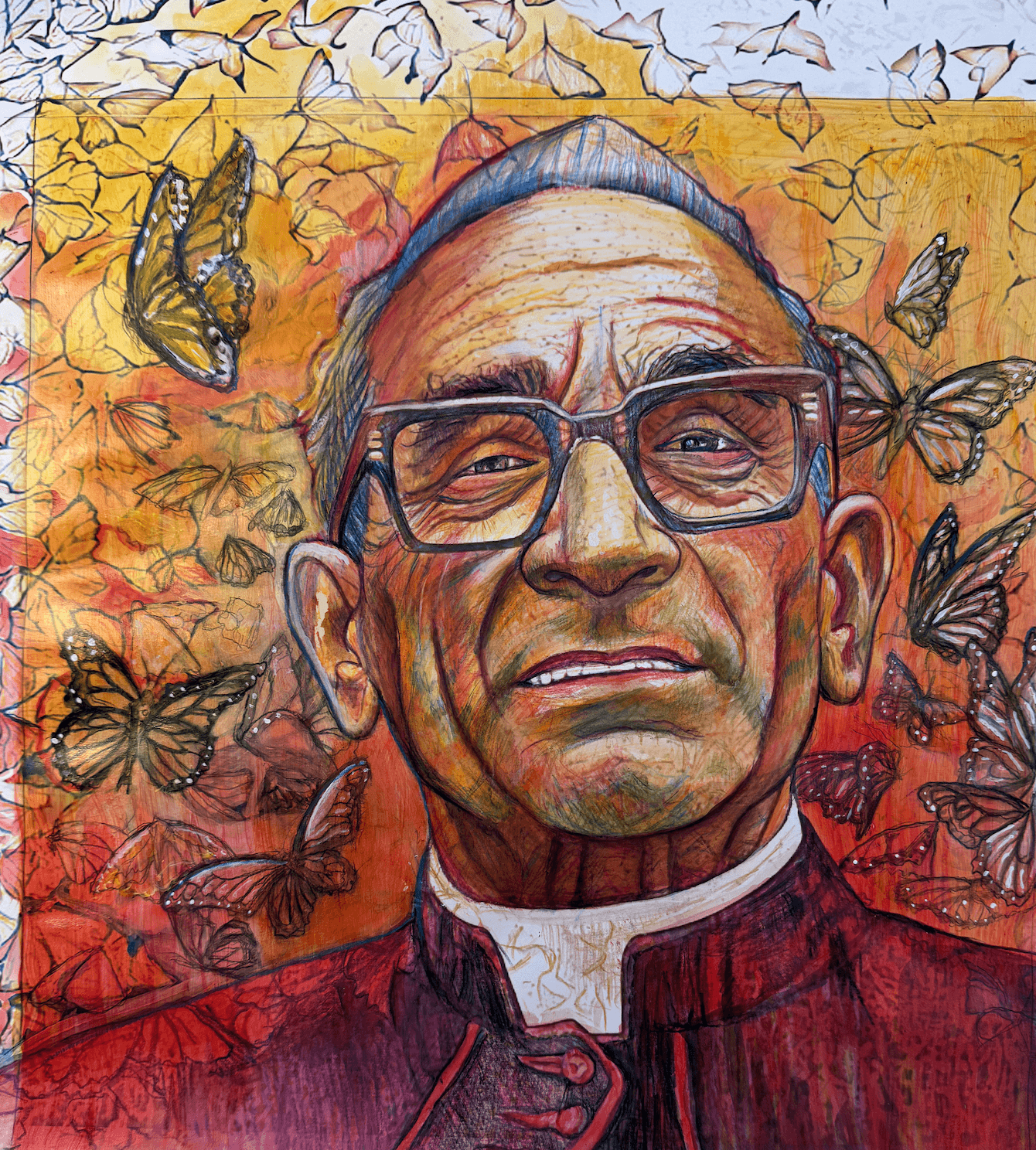
Juana Alicia is a muralist, printmaker, sculptor, illustrator, painter, and educator whose career spans more than four decades. Working in a style rooted in magical and social realism, she addresses social justice, gender equality, environmental crisis, cultural memory, and resistance. Her honors include a Fulbright Fellowship, a Windcall Residency, Precita Eyes’ Master Muralist Award, and a California Arts Council Legacy Artist Award.
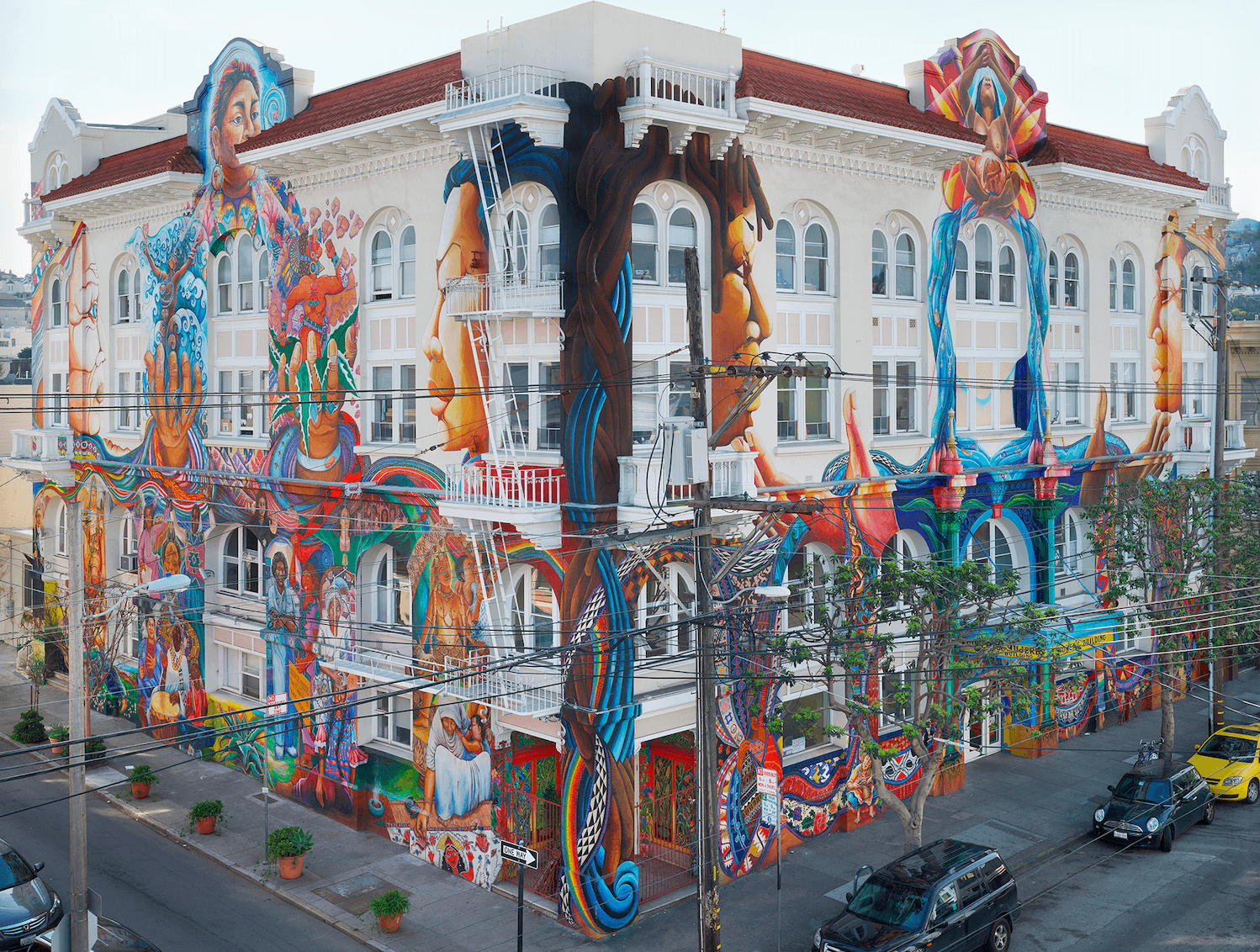
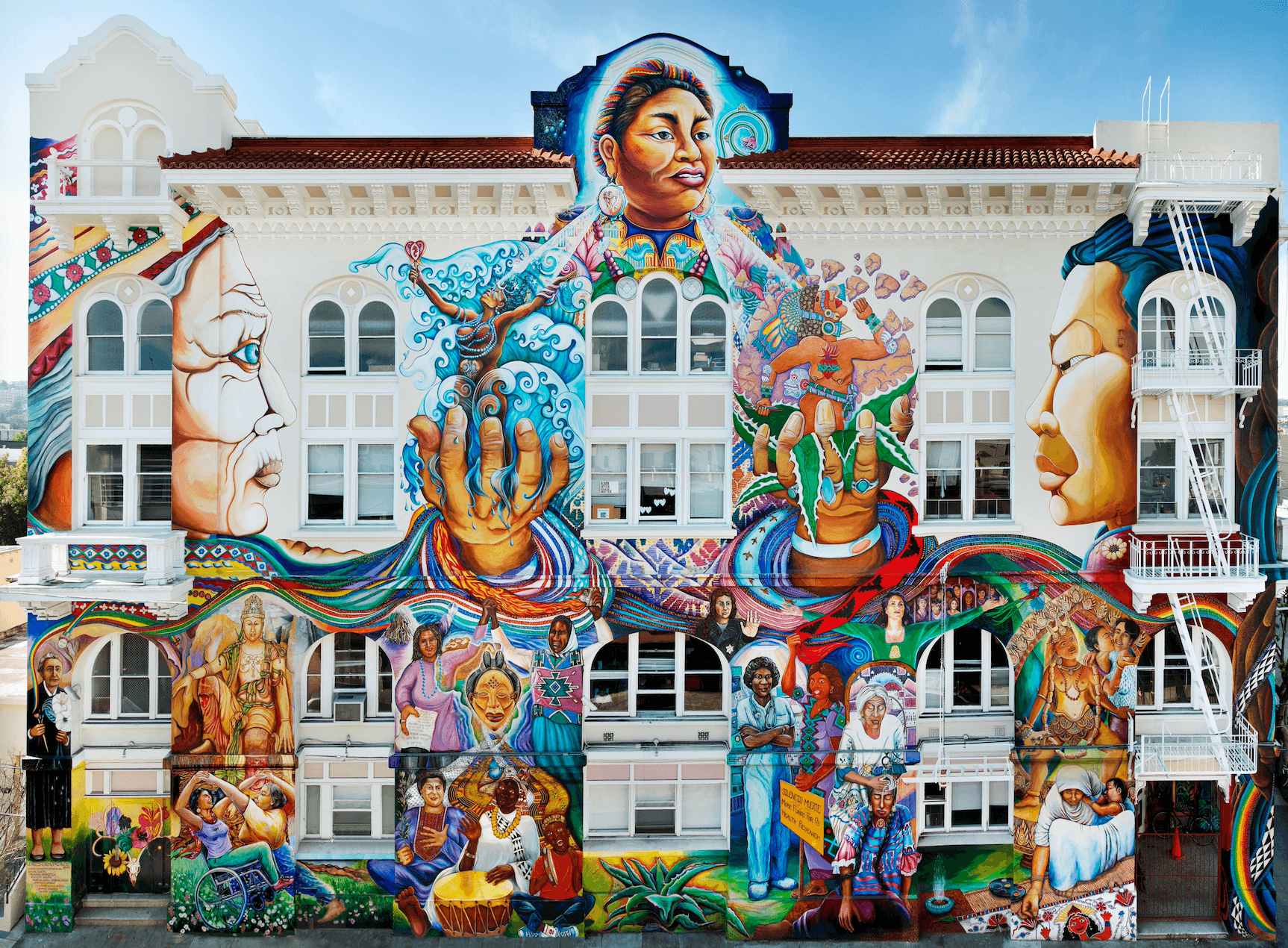
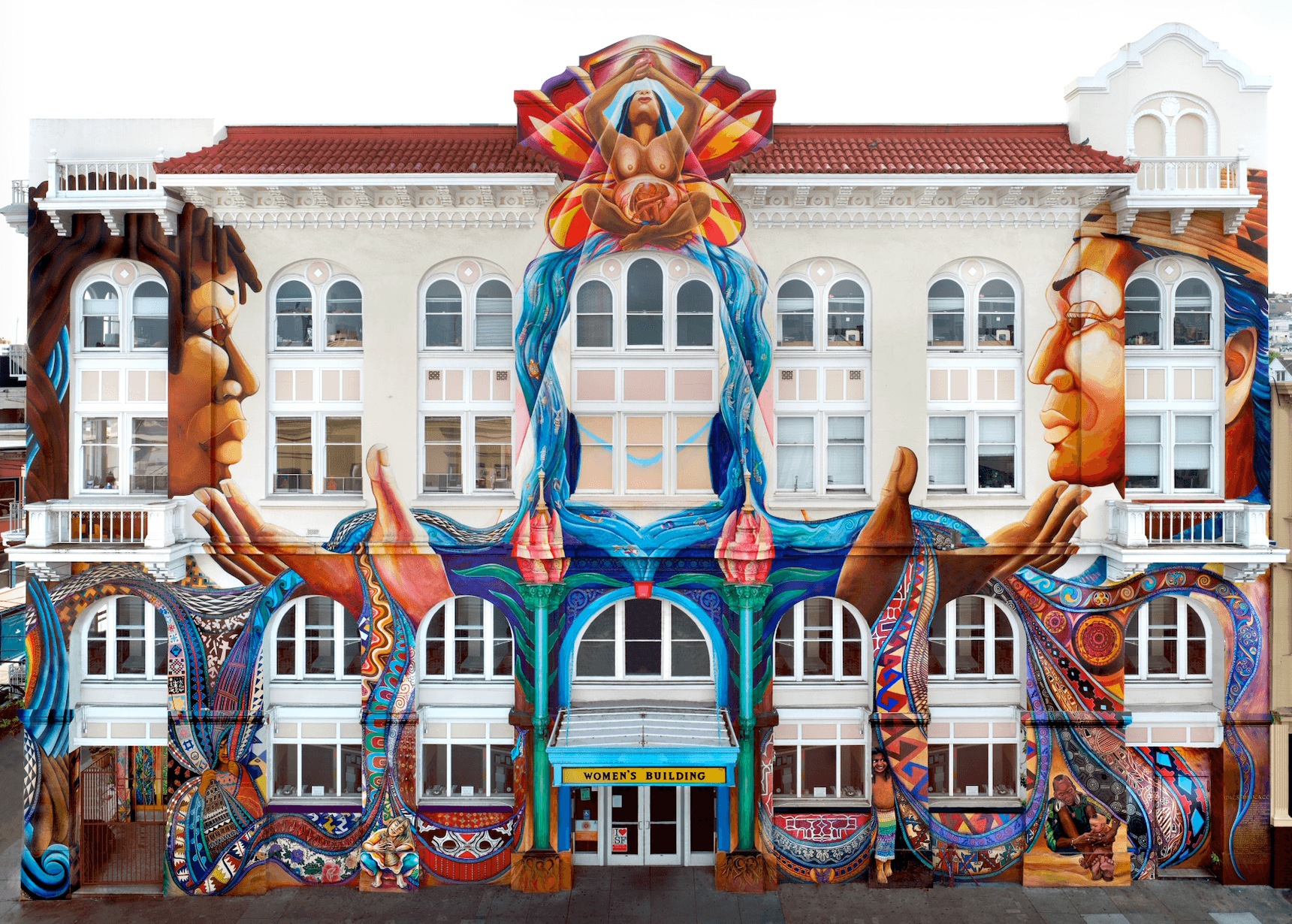
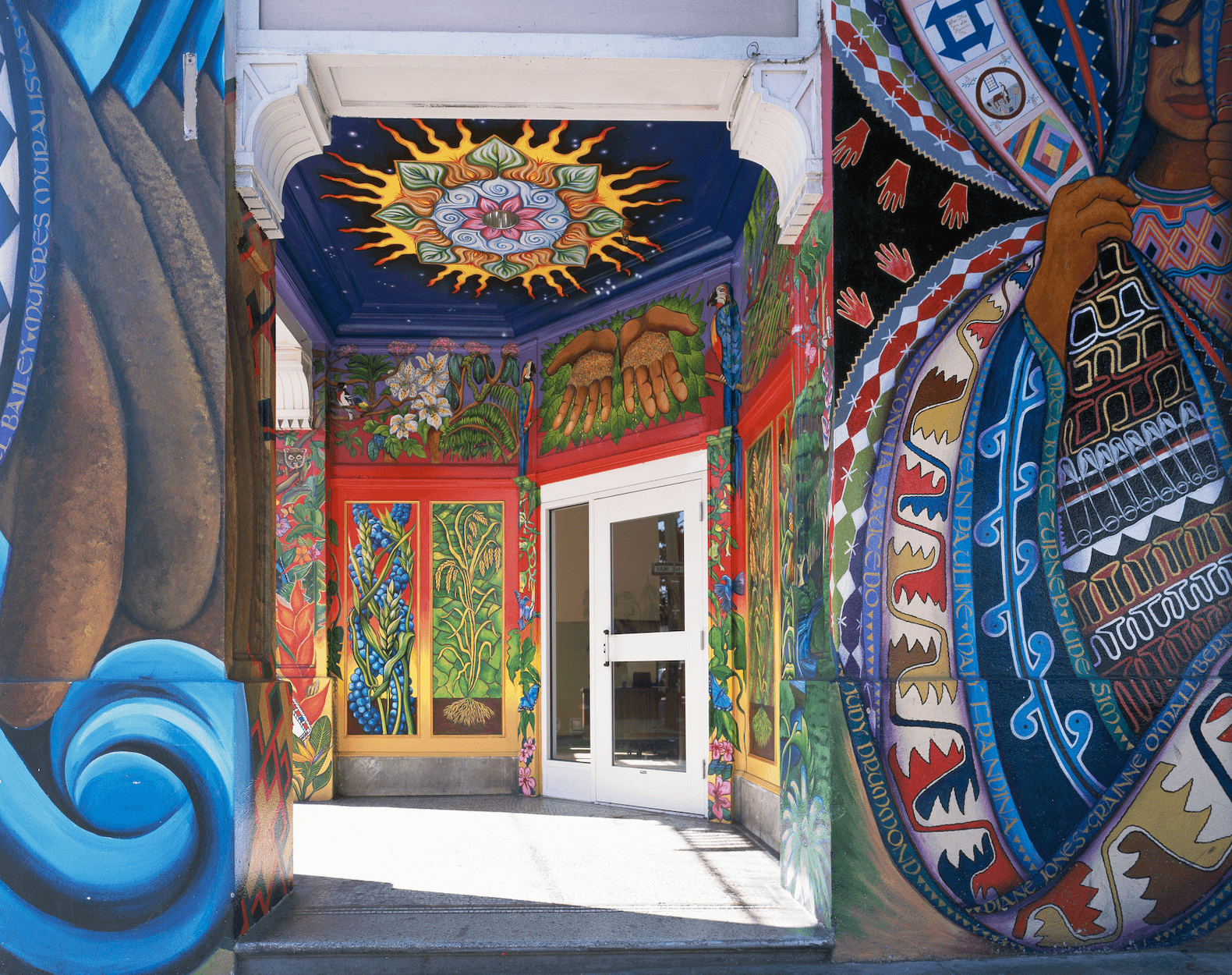
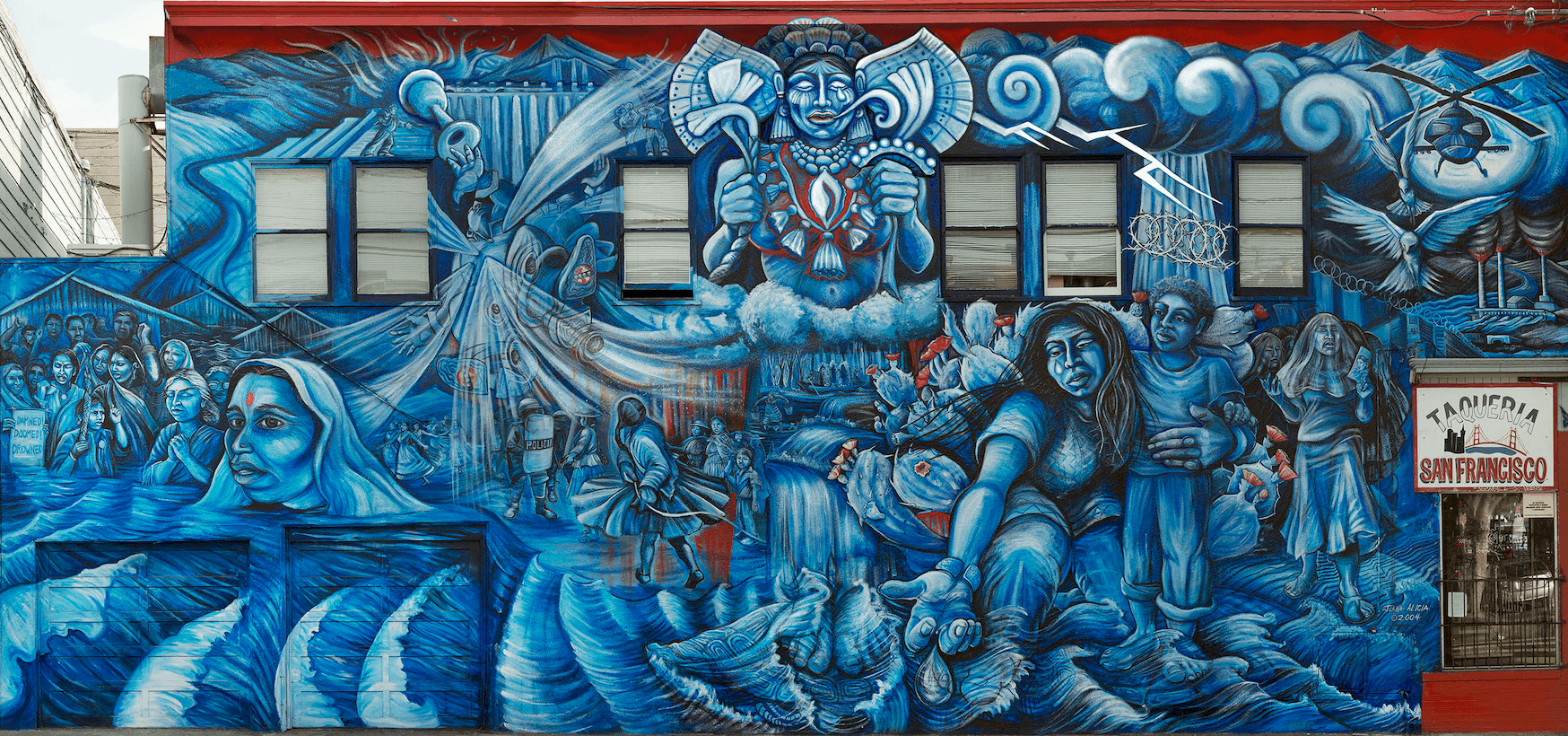
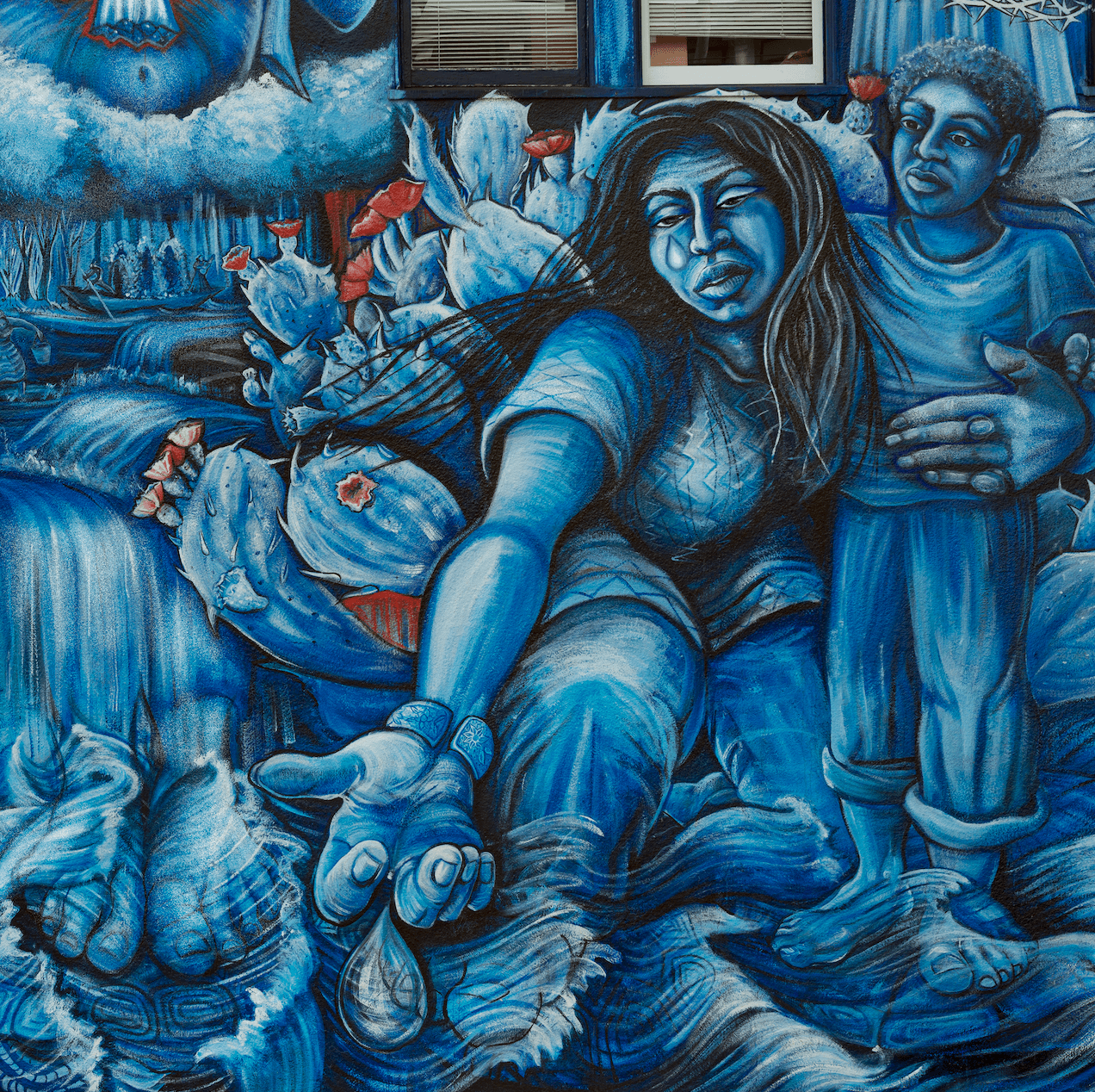
Her public artworks appear throughout California and in Mexico, Nicaragua, and Pennsylvania. Major projects include SANARTE at UCSF Medical Center, SANTUARIO at San Francisco International Airport, LA LLORONA’S SACRED WATERS in San Francisco’s Mission District, MAESTRAPEACE at the Women’s Building, and GEMELOS in Mérida.
A longtime professor, she founded Berkeley City College’s True Colors Public Murals program. San Francisco State University recently awarded her an honorary doctorate in Fine Arts. She divides her time between the Bay Area and Mérida, Yucatán, and continues developing community-based public art projects.
Portrait Photo of Juana Alicia by Alexa Treviño
Muralist, Educator, Activist | Interview by Hugh Leeman
Paper Dolls on the Kitchen Floor
Hugh Leeman: Juana, you've described your first memories of art making as cutting out paper dolls with your mother, and sitting on butcher paper on the kitchen floor drawing figures with your mom and sister. How did that early domestic, collaborative form of art making shape the way you approached murals, public art, and collective image making?
Juana Alicia: What you learn in the home as a young child is very important, and my mother always really encouraged my creativity. It's good to be embedded in family when you do that. I do that with my grandchildren now — a lot of projects with them.
Learning to work not just with family but with community, to create something in a group, is really important. I struggle against this ivory tower artist image all the time. Even though I work on my own a lot in my studio, I'm always standing on the shoulders of my ancestors and my mentors, and held by my communities — large circles that inform my work.
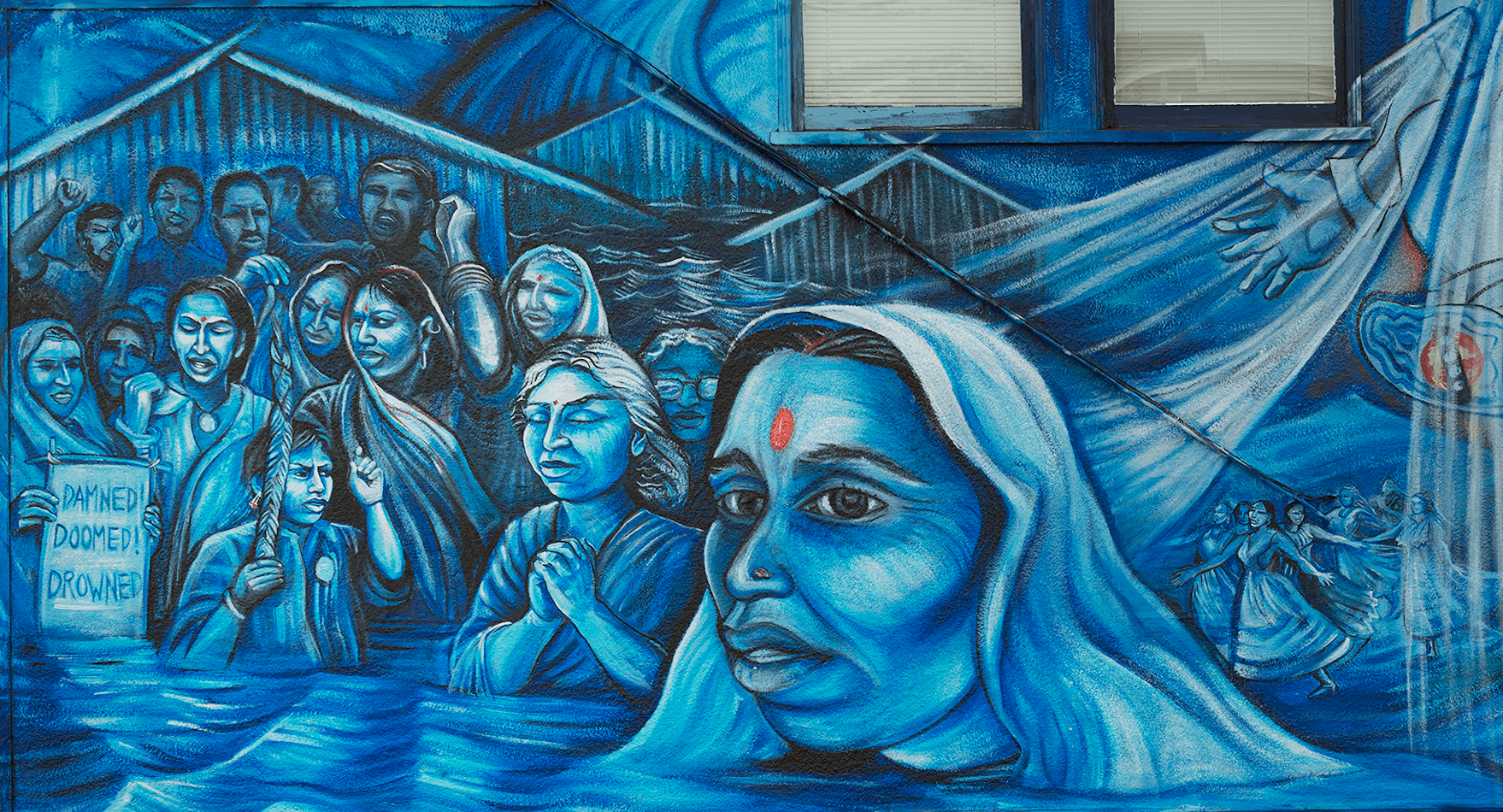
My mother also took me to the Detroit Institute of Arts, where I saw the Rivera murals on the Detroit automobile industry from a young age, and that made a very strong impression. My grandmother took me to the public library, where there was a Rodin sculpture out front and a mural inside by LeRoy Foster, Black Muralist, Detroit Public Library Damned, Doomed and Drowned (film title). At the Art Institute I was exposed to artists like Romare Bearden, the Black Arts Movement.
And from my high school days, I was very impacted by my art history teacher, who became my godmother and guided me throughout my life. She died a week after her hundredth birthday this year, on March 8th. She was a sculptor and an art historian — Dr. Cledie Collins Taylor. She ran the longest-living Black arts gallery in the Midwest for over fifty years, called Arts Extended, and she had a plethora of students and godchildren she taught and mentored and supported throughout our lives.
Tomorrow at the Museum of Modern Art, I'm going to be talking about her, because I did a couple of portraits of her for an organization called As We Grow Older, sponsored by the nMetta Foundation. I'll be in dialogue with Fabiana Rodriguez, a wonderful public artist here in the East Bay, and she'll be interviewing me about that portrait. So during my childhood I had those wonderful influences — mother, godmother.
Hugh Leeman: It's beautiful to think about how someone can enter your life that way and influence the direction your career has taken. You've also mentioned Käthe Kollwitz and Rivera.
Juana Alicia: Absolutely. And during the seventies and eighties, I was blessed to make friends with several Mexican artists from a little after Rivera's generation — maybe the era of La Ruptura in Mexican painting, but they were actually very active before that, in the 1930s, in the graphic arts workshop, El Taller de Gráfica Popular. That was Alfredo Zalce and Alberto Beltrán. They became friends and mentors, in the sense that their friendship was an example of how you can work as an activist and contribute to your community, and work internationally — because the TGP worked in solidarity with the Spanish resistance against Franco, they did a lot of international work. It was a beautiful thing to have those Mexican mentors as well.
Struggling Against the Ivory Tower
Hugh Leeman: You mentioned that you struggle against the ivory towers of the art world. What is that struggle?
Juana Alicia: It's a very colonial imposition of a role upon the rest of the world, in terms of what the model for creativity is. In so many cultures across the globe, and in Indigenous cultures, people work together to make art — they collaborated and cooperated. And then there's this whole notion that it's one individual genius.
People like the Guerrilla Girls have been really great and instrumental in dispelling that, too, with the idea of feminism — that a more horizontal, transparent, democratic social structure fosters a different kind of culture. And artists are part of making that.
The Farm Workers Union and an Education on the Ground
Hugh Leeman: You have a backstory that sets your career in motion. In your twenties and thirties, you were a farm worker with the United Farm Workers Union, and you were part of picket lines. How did those experiences impact you?
Juana Alicia: That was the most foundational education I could have received. Wonderful training by working-class intellectuals from Mexico who were participating in the United Farm Workers Union — from everyday workers, people who had immigrated mostly from central Mexico, Michoacán, Jalisco, during those years.
Such an amazing learning experience in terms of how to organize, how to create victories with the union model. There were many flaws in the approaches of all of the movements born in the 1960s and 70s. The Black Power movement was a model for all of us. It was the Black Panthers, which I was familiar with growing up as a teenager in Detroit — I attended meetings, and I was also part of the anti-Vietnam War movement. But the farm workers was really a total immersion, on-the-ground training for how to gain rights for workers. And artists are workers as well.
Reclaiming La Llorona
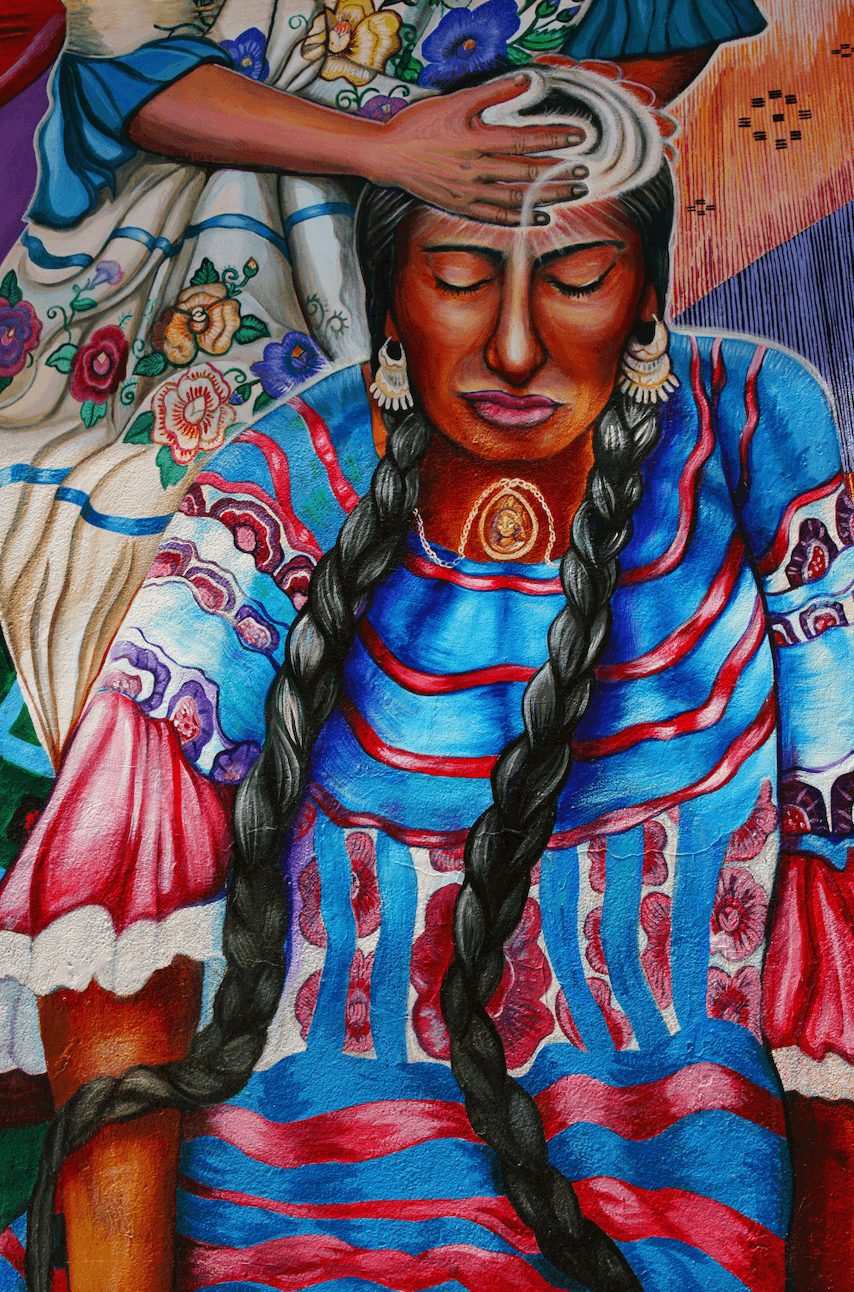
Hugh Leeman: There's a scholarly article I came across about your mural La Llorona's Sacred Waters, describing your reworking of that tragic folk legend from victim or scapegoat into a Mother Earth figure — a heroic actor. How do you approach transforming culturally inherited myths that have been used to discipline or blame women into images of agency and resistance?
Juana Alicia: I was fortunate to be influenced by the writings of someone like Gloria Anzaldúa. I participated in her first book, This Bridge Called My Back, feminist writings from Latinas — writings and artwork. There was a very important seminal, or ovarian, article by two Chicana feminists about this particular theme: reworking and reclaiming La Llorona, La Chingada, La Malinche — those myths that were formed by a patriarchal mentality — and reclaiming them as Chicana feminist myths. I didn't do this on my own. I came to this through other writings by Chicana feminist writers.
Another way I came to reworking the Llorona story was through my teaching at UC Davis. I had a marvelous class on the border economies of the Southwest, with some fabulous students. I'm a Freirean-based educator, so I believe in students and professors being equal partners in research. All of us did a lot of research, and one of the big issues this class helped me research was water — water issues in the Southwest and how that affects economies.
One of the readings I required was Vandana Shiva's Water Wars. These struggles are international. Also the film that Arundhati Roy played a big role in, Drowned Out, about the struggles around the Narmada River Valley and the dam first proposed by the World Bank, then abandoned after great international criticism — but the project went forward under other auspices. There were a lot of resources I tapped in creating that image for La Llorona's Sacred Waters.
Hugh Leeman: You mentioned you're a Freirean-based teacher. Is this referential to Pedagogy of the Oppressed?
Juana Alicia: Absolutely. Paulo Freire. Pedagogy of the Oppressed, and many other books. And not just him — he worked with Augusto Boal in theater, and there were other arts movements influenced by Freirean thinking. Freire's daughter continued the legacy as well. The idea is that everyone comes to the learning situation with a source of knowledge and information, that everyone's experience is welcomed into a group of people who come to share those experiences and enrich whatever we're learning.
Maestrapeace: Seven Women and a Five-Story Wall
Hugh Leeman: You talk about the power of collaboration and collectivity. There's a very large mural in San Francisco you worked on — the Women's Building mural, Maestrapeace. The collaboration among seven women artists was described as being as important as the image on the wall itself. How did that project change your understanding of authorship, ego, trust, and collective power?
Juana Alicia: There were two murals most transformative for me on that question.
The first was in Nicaragua in 1985, when the artists from Balmy Alley were invited by Ernesto Cardenal, the great Nicaraguan poet. He had visited Balmy Alley, and he invited us to go to Nicaragua to paint a mural in solidarity with the Nicaraguan revolution. Four of us went — myself, Miranda Bergman, Arch Williams, and Ariella Seidenberg — to Managua during the Contra War, to paint this mural in collaboration with ANDEN, the National Teachers Union, whose headquarters is located in El Parque de las Madres in Managua. We were one of a series of invited international solidarity murals in that park. Across the way there's a mural by LA artists Yreina Cervántez and Barbara Carrasco.
That collective empowerment — working with the teachers' union, working with people who were sent into a war zone to do literacy education — was a very, very scary time, and a very productive time, and a time of flowering in terms of the Nicaraguan revolution. We know it wasn't entirely successful, but it was an amazing example of collaboration. We interviewed the teachers, we worked with the teachers, and we created that mural along with the teachers and the whole community.
On the heels of that, a few years later, two of us from that project — myself and Miranda Bergman — applied for the commission on the Women's Building, which became Maestrapeace. We applied to a call for artists, and five other sisters in paint were selected. We were in an arranged marriage. Not all of us had worked together, or even knew each other. I had done a couple of murals with Susan Cervantes, so we were already work wives. I knew Irene Pérez from Mujeres Muralistas. Yvonne Littleton was a new friend. Edythe Boone I knew as a friend but had never worked with. And Meera Desai I was meeting for the first time.
The seven of us got together and did a drawing in a few months, and it was extremely harmonious. A beautiful experience. We each did our own concept drawing — and we decided right from the outset that although the Women's Building had told us we had a certain section of the wall on 18th Street, when the seven of us got together, even at that point in our careers we had over a hundred years of mural painting experience among us. And we said: we're going to do the whole building. And surprise them. There wasn't the budget for it or anything, but we did it. We designed the whole building. Each of us took a wall and did the drawings, then we came together and negotiated the imagery to all of our liking, and presented it at a huge meeting. Everything was analog at that time — surveys sent out to the community on paper. People came to this big community meeting to see our drawings, and we shocked and surprised the Women's Building with the design for the whole building. They embraced it, but then we had to do a lot of fundraising after that.
That experience of working with those women was so beautiful. We had a hundred women volunteers who came and worked with us, whom we supervised. Some were already really accomplished, like Jane Norling and Xochitl Nevel Guerrero. It was an incredible group effort. We all ate lunch together, sat on the sidewalk together. The building is five stories high — we had to haul our water up five stories. A few of us worked at the top; people were a little afraid of that.
There were parts of the drawing I made that other people painted. Miranda Bergman did the sketch of Rigoberta Menchú; I painted her; Susan painted her huipil. We mixed it up so all of our styles combined and it wouldn't look like anybody's style was dominating.
It was an amazing lesson. We also had to fight the city, because they paused our project. They said they couldn't go forward because it was on a historical building, and there were mutterings about us destroying a historical landmark. There was a lot of racism and sexism behind that. We tried to win it through local politicians — Art Agnos and others — and when that didn't work, we had to take it to the press. We won our struggle in the press, and the city released the funds. They had been withholding funds for all mural projects in the city because of our project.
So there were a lot of struggles we had to confront together, and we really had each other's backs, and we've had a lifelong relationship since. We did a book together — the Maestrapeace book, produced by Heyday Books. It's out of print now, but you can still get it online. It has a foreword by Angela Davis, and poetry by Genny Lim, Alice Walker, Naomi Quiñonez, devorah major. We're talking about poet laureates here. It documents our process and our relationship — because we've maintained this sisterhood for several decades now. Each woman has a section in the book of her own work.
Hugh Leeman: It's inspiring that you were able to work together against a bureaucratic system using the free press to get those funds released.
Juana Alicia: The press is not so free anymore either. But we're on different platforms.
Dolores Huerta, Corbis, and a Precedent-Setting Lawsuit
Hugh Leeman: There's another name you haven't mentioned yet who has been a hero to so many people — Dolores Huerta. Who is Dolores Huerta to you personally?
Juana Alicia: Dolores Huerta is a friend. She's a role model for sure. I hope I can be dancing the way she is in my nineties. Her recent revelations sort of shook the earth, but were not so surprising in many ways. I have tremendous admiration for her.
I worked with her from afar when I was a farm worker. I didn't know her personally, but I saw her a lot, because she would come to meetings and rallies, and I went on marches. I saw her as a young organizer and mother, and I was a young mother too — well, at the end of my stint as a farm worker. I had to quit after my son was born.
Dolores was part of a claim that the Maestrapeace collective and Susan Cervantes and I — as authors of the murals on César Chávez Elementary School, where Dolores's portrait is huge — brought against Corbis Corporation, which was then the world's second-largest photo stock corporation, owned by Bill Gates. We asserted claims against Corbis for violating our copyright on both the Women's Building and César Chávez Elementary School, and the portraits of Dolores, without her permission — using photos of the murals without crediting the mural artists. We had some intense meetings with Corbis’ CEO up in La Paz, near Keene, California and now a National Historic Site. Dolores and UFW leaders ourselves, and we succeeded. With our incredible lawyer, Brooke Oliver, we set industry precedent: credit for artists is now mandatory for a photographer when they're photographing artwork online. You can't just credit the artwork to the photographer. At a minimum, photo stock shops now typically provide a warning when they license a photograph that third party (artists) consents may be required before use. And we got a settlement that allowed us to pay off our credit cards.
I've seen Dolores on many occasions. She's very accessible. She's been supportive of many struggles around LGBTQ+ issues, around lots of issues in the Bay Area. She's not a one-issue person. She's an international and national emissary for so many human rights causes.
Modifying the César Chávez Murals
Hugh Leeman: In a recent conversation, you told me you're in the process of modifying murals that had previously been commissioned to celebrate César Chávez. What has that process been like, amidst this recently revealed history brought forward by Dolores Huerta and other women?
Juana Alicia: We're just beginning the process. Susan Cervantes met with the school district in my absence, and now we're having a conversation with the community about what they want in terms of the images on César Chávez Elementary School. The school district is going to rename the school as well.
There's this issue about erasing such a powerful figure from history. I don't think they should be erased. But I do think they should not be celebrated in the way they've been celebrated. Like Jefferson, like so many others whose statues need to be removed and put in a special place where we talk critically about history. I don't think erasure is good for the history — or herstory — of humanity. But I do think telling the truth about sexual violence, about what's been done to women, matters. We cannot allow a mask of progressive politics to deny women's rights.
I think the Latino and Latinx community has stepped forward in a way that very few other communities have. Women have almost unanimously had Dolores's back, and these other women's backs. Since I was approached by the press as soon as it erupted, I needed to read all of the articles — from the LA Times, the New York Times — to inform myself about what had been done, how valid the research was, how valid the interviews were. So as not to just jump on a bandwagon of erasure, but to understand what actually happened, so I could take a position that was ethical.
Hugh Leeman: What are some of those early conversations about what the community wants — not just what it should be named, but how this should be treated?
Juana Alicia: We haven't had that meeting yet. I will say that here in Berkeley, for the César Chávez Park out at the Marina, my friends Santiago Casal and Beatriz Leyva-Cutler did a whole community survey among the Latino community — very in-depth data gathering about what people wanted in terms of renaming the park. Then they brought it to the Planning Commission. And someone on the Planning Commission, whose wife had another idea, was allowed to step forward and basically negate the research those two community leaders had done with a massive amount of people. I don't know where that's going. But I do know it's important to do research in the community — and then have that research respected.
Get Out: On Statues, Erasure, and Context
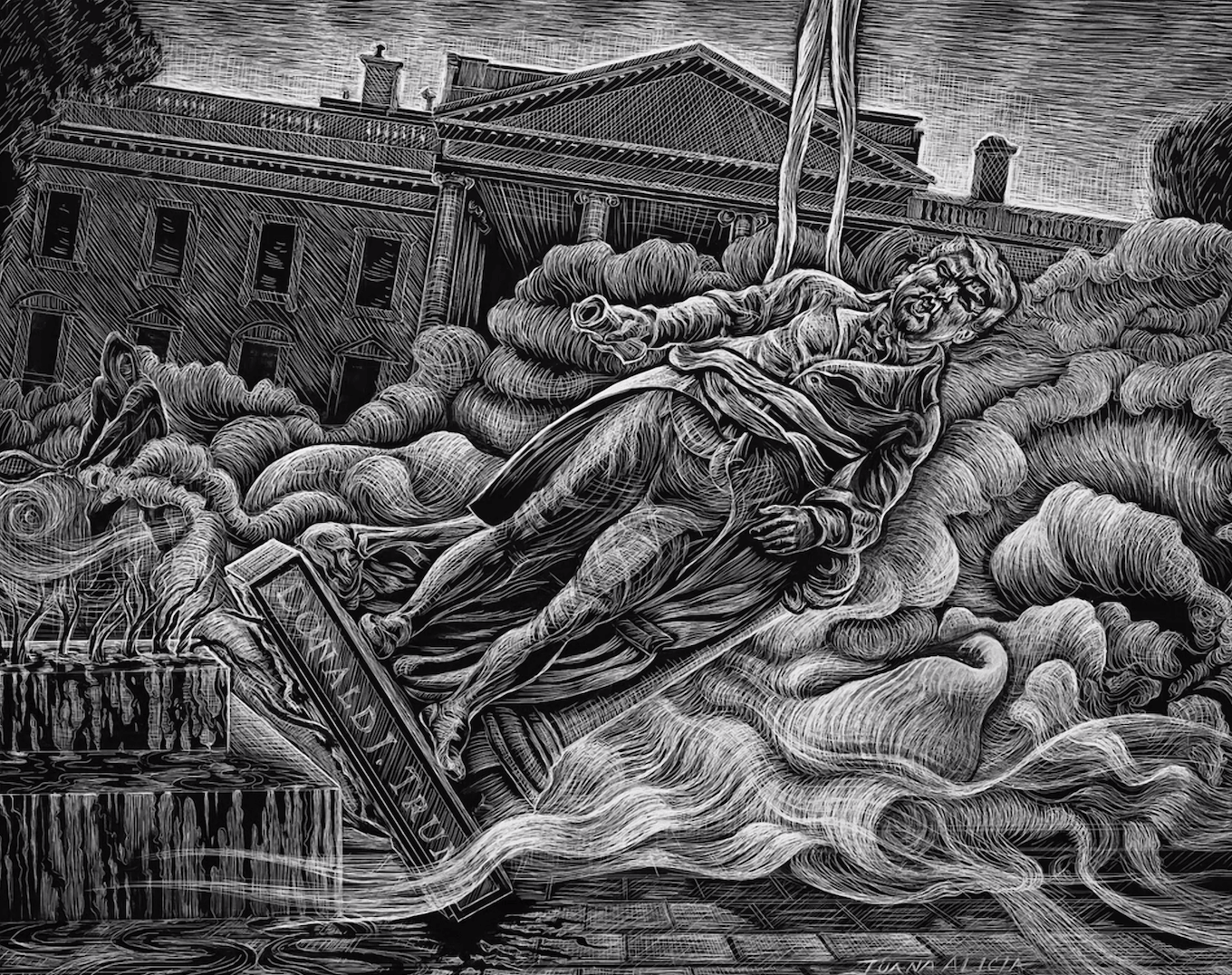
“GET OUT! / ¡FUERA!”, drawing on scratch board, 16” x 20”, Juana Alicia © 2020
Hugh Leeman: This idea of erasure — we saw it as a society, particularly with art and murals in early COVID: well, we'll just get rid of them, paint over them, take down the statue. That form of erasure becomes a pretty dark act in and of itself.
Juana Alicia: Let me show you an image. During that time I did a piece called Get Out.
Hugh Leeman: So we have Donald Trump as a statue being torn down. Can you describe it?
Juana Alicia: The background is a dark-windowed White House. In the middle ground is one of the street protesters with a tennis or badminton racket, hitting a smoke bomb toward the viewer — toward the statue, actually — which is in the foreground. It's a statue of Donald Trump in colonial clothing, with the Constitution in his hand, or some document. And he's being dragged off the pedestal. There's a big rope around his torso that one can imagine is attached to some kind of hoist, and the rebar connecting the statue to the platform is torn apart. There are clouds of tear gas all around him.
It's an allusion to the George Floyd protests, to all of the street protests going on, and an homage to the removal of colonial images, enslaver images, that need to come down — because those are terrorizing images for Black children in the South, for children of any color who understand their impact on their life, their history, their family history.
So I'm not against taking those statues down. Like I said, the question is: where do they go, and how are they contextualized? Because in the middle of Dixie, where we have all of these statues still remaining — with the gerrymandering, the voter control, the destruction of the Voting Rights Act — all of those statues are like visual enforcers of this retrograde return to the Jim Crow South.
Who Replaces a Portrait Thirty Feet Tall?
Hugh Leeman: How have you creatively thought about a mural where Chávez needs to be taken out, but he's still part of history?
Juana Alicia: What has come up in conversation is talking about the movement instead of an individual protagonist. But in the case of something that's clearly a portrait — and there's a huge thirty-foot-tall figure in the mural at César Chávez Elementary — we have to think about who that figure is going to be. It's not a movement symbol. It's going to be a human person.
I don't know who that will be. It could be Philip Vera Cruz, one of the Filipino farm worker organizers. Selecting a man can be very dicey as well if we're not properly vetting their history. Not that women are totally innocent, but the likelihood they're going to have that same kind of history is much smaller.
This is a point for historical research. There was a woman who helped co-found the UFW, and then she was sort of disappeared from history. Lori Coyle, a local filmmaker who's quite recognized, made a film about her — Adiós Amor: The Search for Maria Moreno, broadcast on PBS VOCES, and it won an Imagen Award. Maria Moreno was red-baited by the union, because there was red-baiting going on in the union as well.
The union had some dubitable associations, and some tragic defenses of the AFL-CIO's position on undocumented workers — of not having their backs, of going along with the AFL-CIO line when César Chávez and the union made agreements with Jerry Brown about farm worker rights in California in the 1970s. There were problematic positions taken on the rights of undocumented workers. There were political issues that arose in the union, and one of the people excluded was Maria Moreno.
She might be a person we would consider celebrating — especially in this era where the Democratic Party has shown to be extremely ineffectual and in many ways corrupt, and there's a rising movement of working families and democratic socialism, and the idea that socialist ideas are part of a democracy and can be part of a democracy. To restore the image of someone who was red-baited could be a nice thing to do.
Hugh Leeman: Educate me — she was red-baited. What does that mean?
Juana Alicia: That means you're called a communist and you're disqualified from participation in so many organizations. We're talking about the UFW being formed in the late 1950s and early 1960s, on the heels of McCarthyism in the United States, where so many Hollywood people, so many intellectuals, so many workers were either imprisoned or had to escape to Mexico or go other places because they were accused by the Committee on Un-American Activities of being communists. And that is not a crime. That is not a crime.
Murals as Memory When the Community Is Displaced
Hugh Leeman: In writing about Mission murals and displacement, the writer Mauricio Ramírez asked how murals can remain if the communities that made and protected them are displaced. How do you think about murals as cultural memory when the people represented on the walls are being pushed out of the neighborhoods?
Juana Alicia: Big ups to Mauricio. I really appreciate his writing. He was actually my student at César Chávez Elementary School when we did the murals there — he participated as a fifth grader on the murals inside the school. And now he has his PhD from UC Santa Cruz and is an eloquent writer, particularly on the history of Central Americans in the Mission.
My daughter's mural Mission Makeover on Balmy Alley is a direct critique of gentrification in the Mission. She was assisted by my husband, and a little bit by me, but by a lot of people — it's her authorship, Lucía Ippolito González. That mural speaks directly to that issue.
It is difficult, because we can't erase or invisibilize the people who still remain in the Mission — we still have a strong Latino presence there. In fact, Lucía produces an event once a year called Lover's Lane on Balmy Alley, a huge community celebration, very much Latinx-based, with artists and massage therapists and activities for children, low riders — it really brings out the community. We have the Paseo Artístico, led by Paul Flores and Acción Latina. We have important cultural organizations in the Mission that we're working in coalition with on this Balmy Alley project — Calle 24, Acción Latina, El Tecolote, and Brava for Women in the Arts is our fiscal agent. We came out en masse to support the Mission Cultural Center when the city was about to shut it down. And we're about to inaugurate the restored Mission Library in October, where I'm doing a fused glass mural window. So we have to continue to celebrate our existence in those places.
But the truth is, yes, we've had a mass exodus. There's been the biggest transference of wealth in the history of the world with Donald Trump's administrations — and it didn't start there. The whole financial bailout of 2008, the propping up of the auto industry and the banks in particular. Neoliberalism created the fertile ground for this transference of wealth, as well as the security state and the empowering of the NSA.
We have been forced out of our neighborhoods. Even here in Berkeley, where I live, there's been huge gentrification in my West Berkeley neighborhood. I had to leave the Mission because I couldn't afford to live there anymore. We were able to buy a home here in the early nineties, which I couldn't afford to buy today. And really, I can't afford to live in the Bay Area — we live in Mexico for at least half the year, a little more. We're both retired seniors living on a fixed income, and the Bay Area does not accommodate our budget.
The Spiral Word: A Mural Inside the Ivory Tower
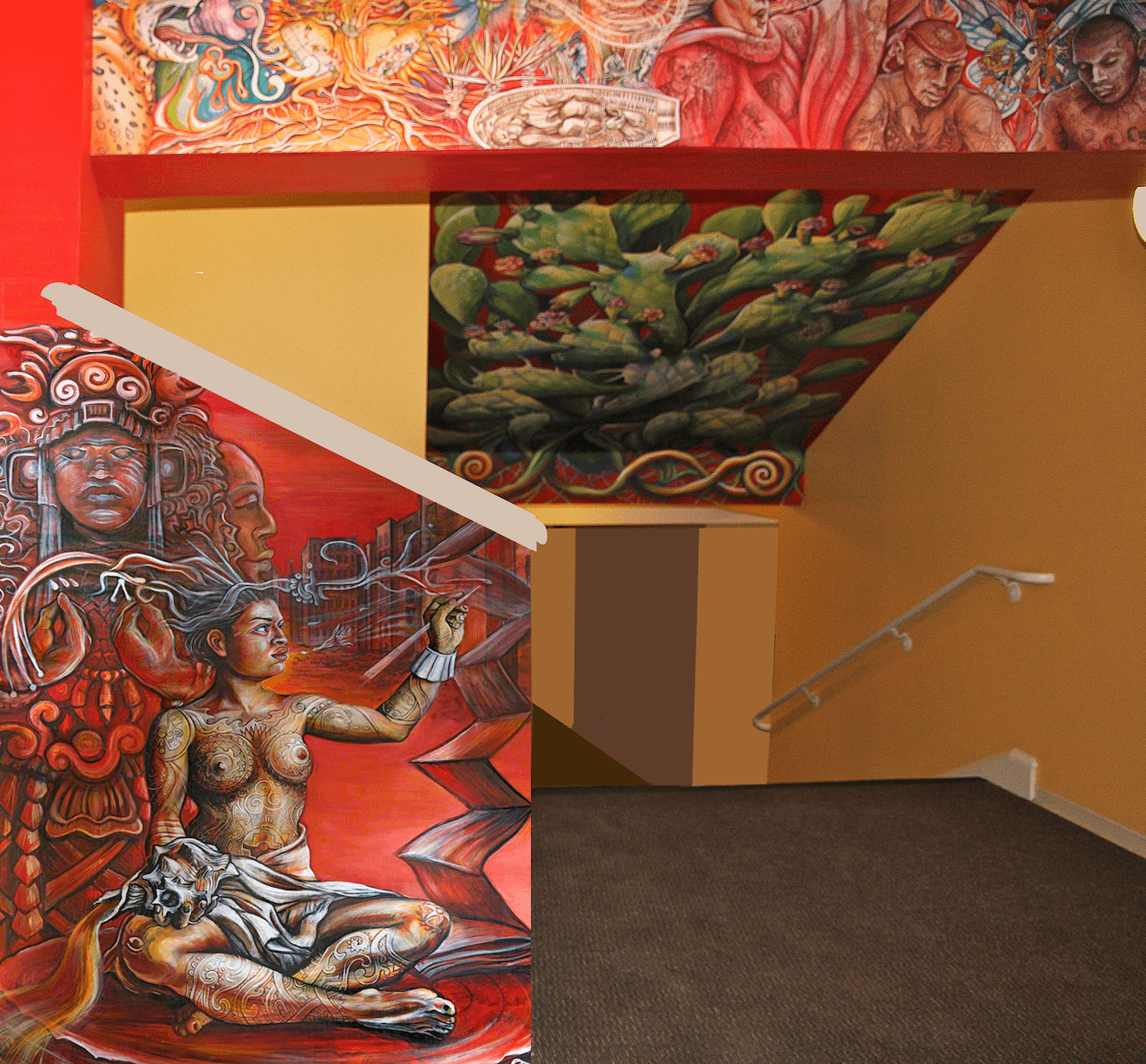
Hugh Leeman: I'm thinking of The Spiral Word, which differs from many of your street murals because it exists inside Stanford's El Centro Chicano y Latino — yet it still functions as critical pedagogy. How does the meaning of a mural change when it moves from the street into an elite educational institution?
Juana Alicia: I've taught at Stanford on many occasions, so I'm very familiar with how Latinos and other BIPOC people are challenged to survive in that kind of institution.
When I conceived the mural, I worked with the janitors, the students, the professors, and the graduate students at El Centro Chicano to come up with a narrative. Same thing at UC Santa Cruz, where I did the mural La Promesa de Loma Prieta: Que no se repita la historia — the promise of Loma Prieta, that history not repeat itself — in 1992. I had the same kind of community process with the workers, the students, and the professors.
So the research doesn't change. And the critical perspective of the students was key to maintaining the edge, the critical thinking — to not becoming like a Mexican restaurant that has to adapt its mole to the flavors of the gentrified neighborhood. We don't do that, even if it moves into the elite institution.
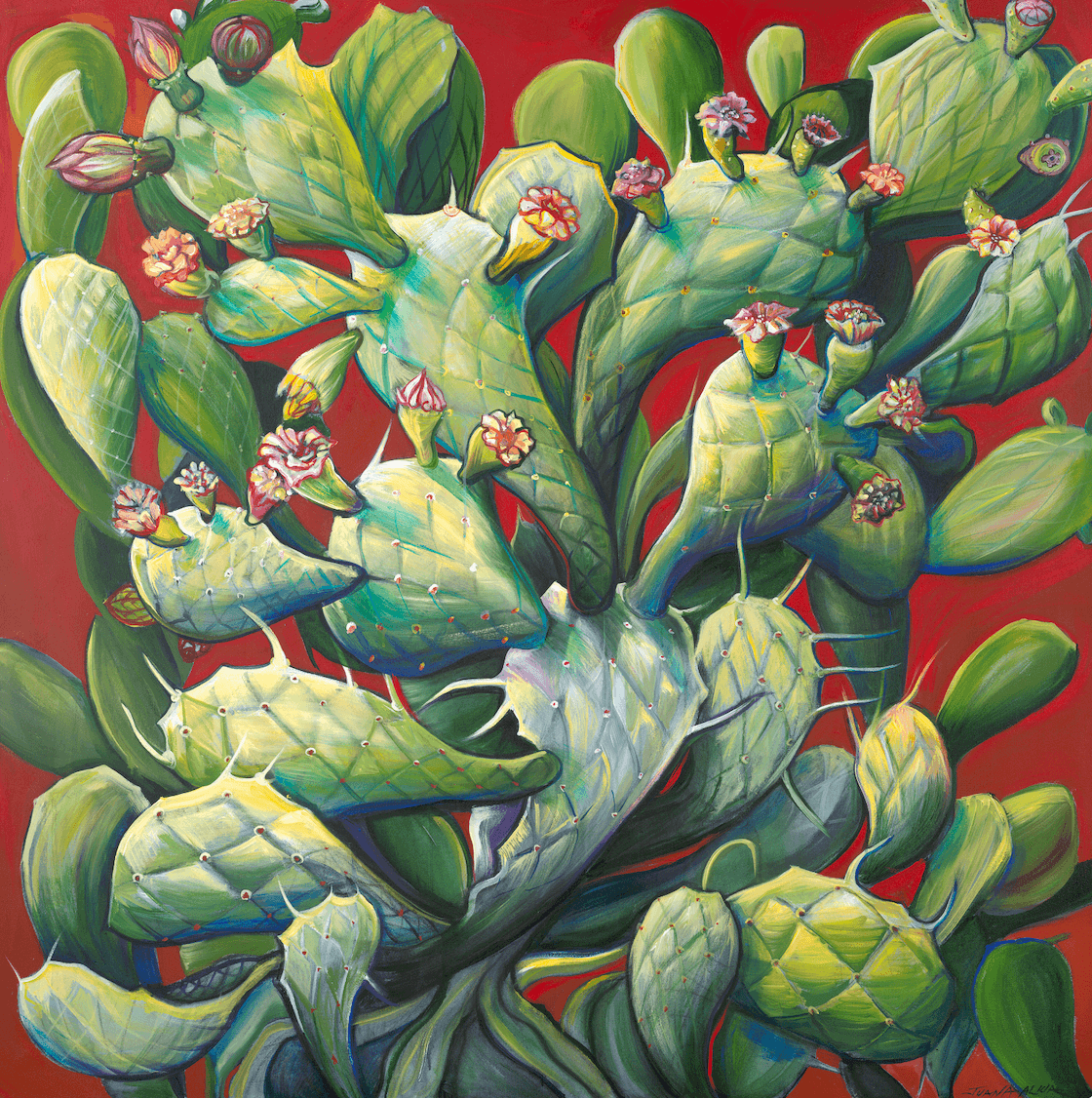
I had a bit of a tussle with Stanford over that, because I wanted to do a mural on the exterior of El Centro Chicano, in ceramic. They wouldn't go for it. They would not approve public art on their plaza by a Chicana with our themes. What I was proposing was a big nopal cactus — an idea birthed in collaboration with my husband, Tirso González Araiza — putting the names and images of Latino authors from all over the world on the pencas, the paddles, of the nopal. It would have been a big bas-relief cactus covering the facade of El Centro Chicano. I'd already done the big murals at UCSF Medical Center on Parnassus — I made a thousand ceramic tiles for that — and Tirso and I had done a bas-relief mural weighing several tons for the Universidad Tecnológica Metropolitana in Mérida, Yucatán. So I had plenty of experience doing exterior bas-relief murals. But Stanford would not go for it. So we had to work on the interior.
In terms of compromising content, that didn't change. The mural is called The Spiral Word, named by a poet laureate — there's a poem about it, and the title is by Juan Felipe Herrera. It's about passing the voice on through history: the oral tradition, the literary tradition. The students and the other people I consulted said they wanted me to tell the story of the past, present, and future of Latino lives. And I thought — that's a small calling.
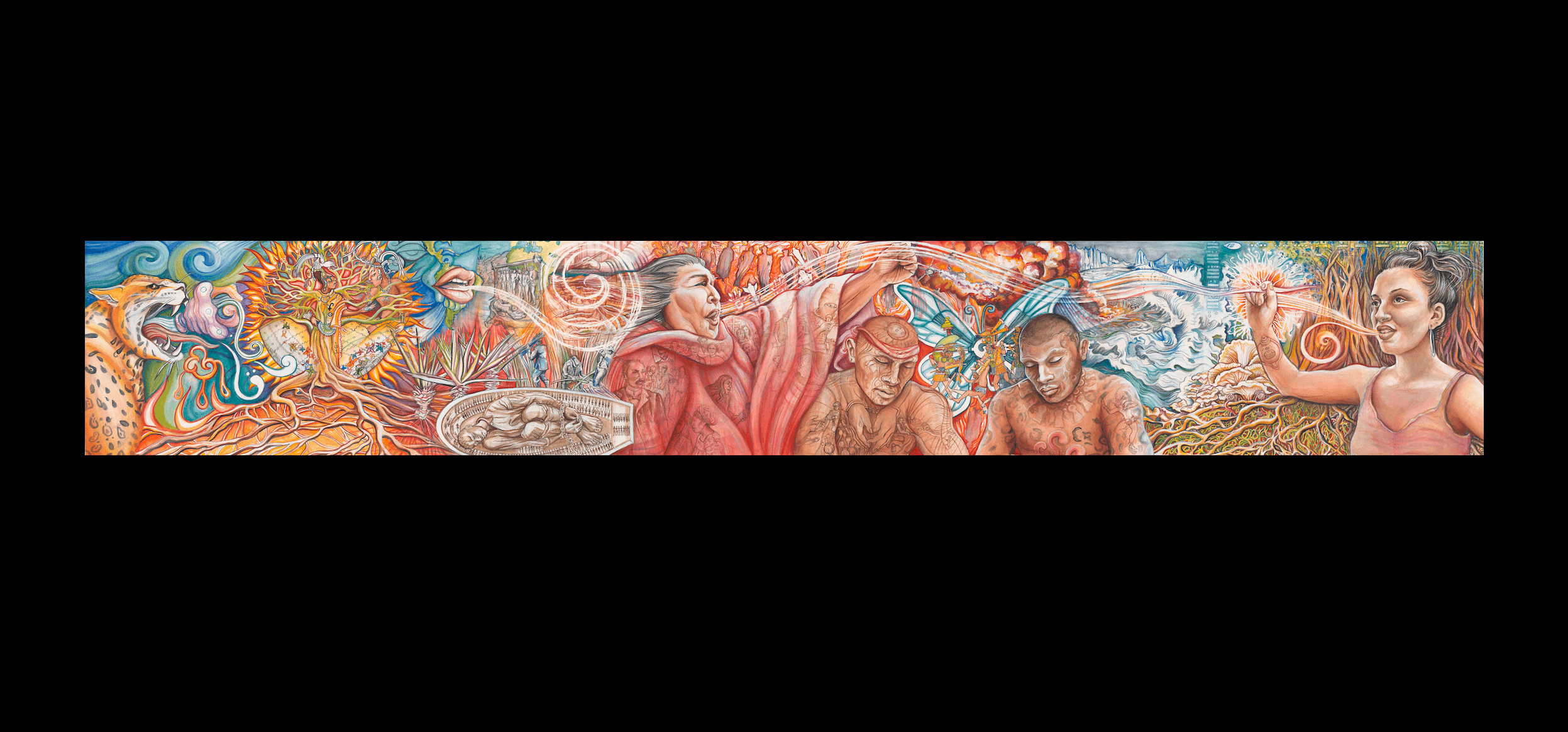
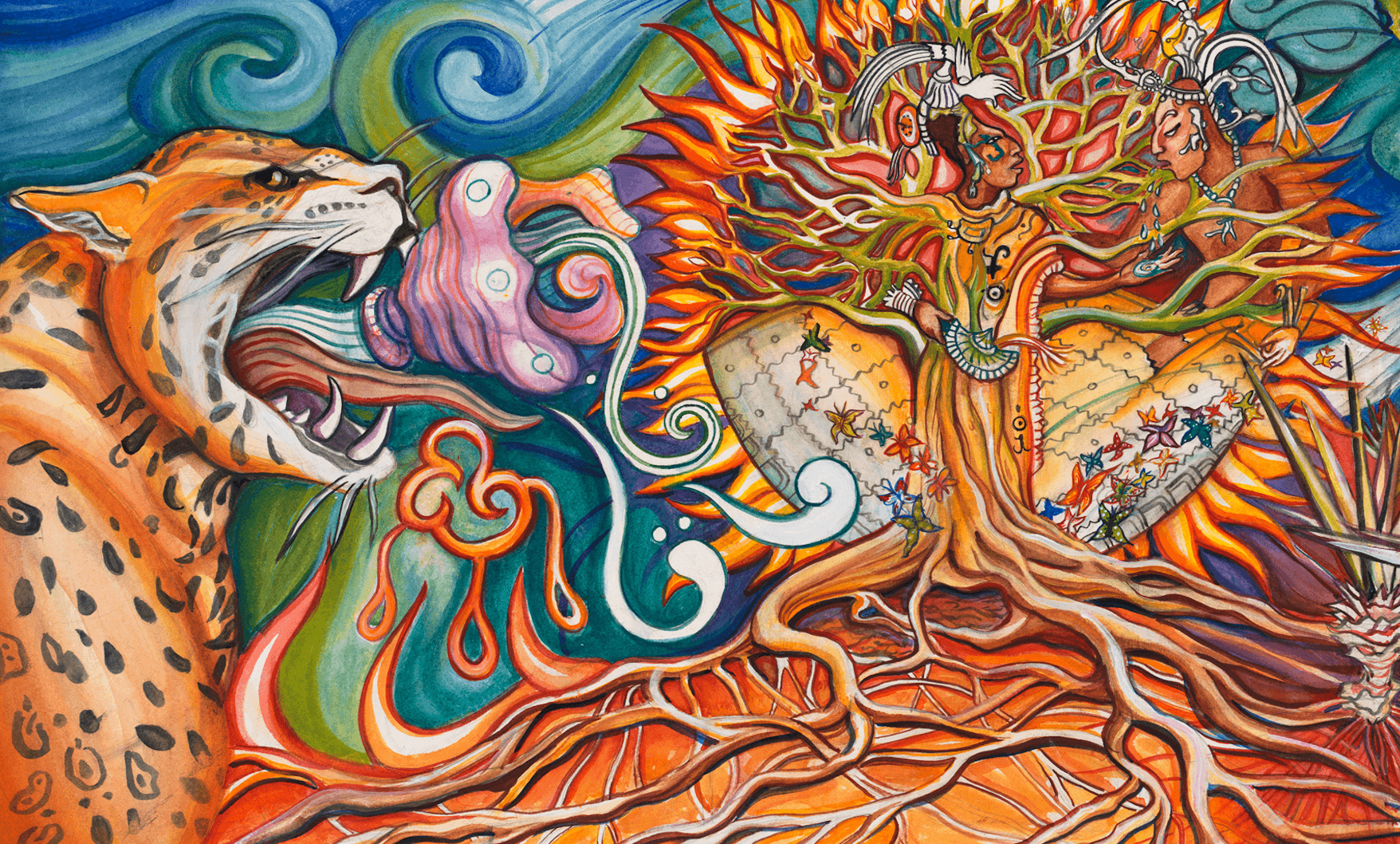
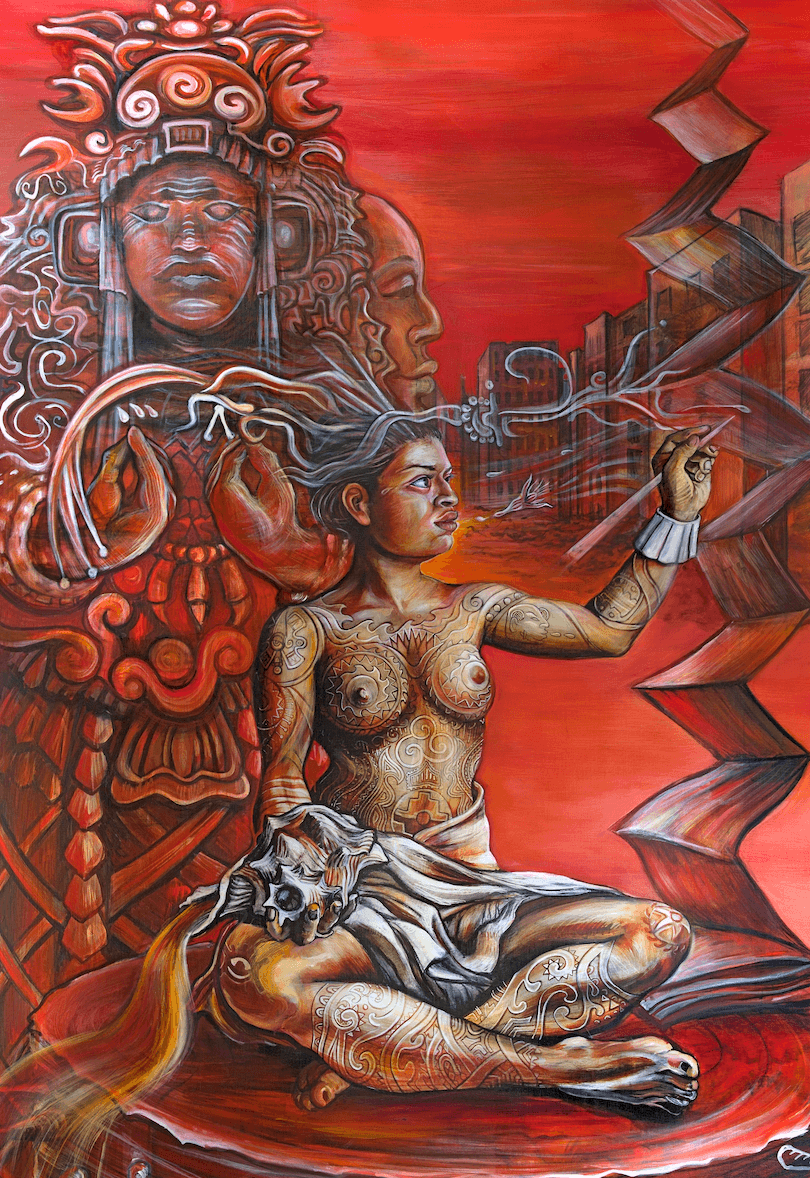
What I created was in part inspired by my dear friend Dr. Francisco Vásquez, because he'd been asking me for years: can you do a mural that's a timeline of our histories? So that's what this became, particularly the codex mounted on the frieze. On the main large panel there's a Mayan scribe, a young woman, writing on a codex, sitting among urban ruins — maybe the Bronx — with a recovered Mayan stele in the background. She's telling the story, and the story evolves onto the codex as a timeline in five panels: Genesis, colonization and slavery, resistance and revolution, the twins, and the future.
Hugh Leeman: The twins — you're referencing the Maya origin myth, the ones who navigate the underworld?
Juana Alicia: Correct. The story begins with Genesis from the Popol Vuh, where the jaguar's breath is breathing the story, and the princess Ixquic is reaching her hand toward her slain lover's face — his head is hanging from a tree, and he impregnates her by his saliva dropping into her hand. She becomes pregnant with twins. Her lover is a twin as well — Hun Hunahpú and Hun Ixbalanqué are the original twins. Then she has another set of twins who are the protagonists who bring corn to humanity from the underworld. To shorten the story extremely.
That's the first panel of the codex. And then the fourth panel is where the twins appear again — I have an actual reproduction in the background of the twins from the murals of Bonampak in Chiapas, Mexico, and in the foreground, the Gangbanger and the Dreamer, who are the twins, with tattoos referring to their stories on their bodies.
La Xtabay: An Erotic Horror Story of Ecofeminism
Hugh Leeman: Juana, I want to open up the field a bit here. What are you working on now, around these ideas of mythology?
Juana Alicia: Thank you for asking. My most recent work, which I'm just completing now, is a collaboration with my husband, Tirso González Araiza, who is a tremendous muralist, graphic artist, and sculptor — a visual artist principally.
He's been telling me this story, which I've heard many times living in the Yucatán, where I have lived for the last twenty years. Everybody in the Yucatán knows about this female entity. She could be a deity. She's a mythical spirit who represents and embodies — and sometimes transforms into — the sacred ceiba tree of the Mayan peninsula. There are ceiba trees all over Central America and the Caribbean, and it's a very sacred tree to Indigenous peoples. In Cuba, Zenaida del Río has beautiful paintings about the ceiba. So it's not just in the Yucatán, but this story is of the Yucatán.
There are similar stories, like La Ciguanaba from El Salvador, where the woman actually has a horse's head. But in this story, La Xtabay is a beautiful Mayan woman with long black hair to her waist, dressed all in white, who appears to men in the rainforest — basically to philanderers and drunks who are losing their way home in the low jungle. And she seduces them. When she gets them in her embrace, her thorns — which are part of the ceiba tree, in its masculine form only; the female version doesn't have thorns — her thorns come out. And she spines them to death. She pierces them and leaves them to die at the foot of the tree, on the roots of the tree.
She's got a pretty big bad-girl reputation, as you can imagine. The story's a little longer — she's one of two twins, the bad girl and the good girl. But everybody's got an Xtabay story, even in our colonia where we live in urban Mérida. People have seen her. And it's very difficult to escape her, and you should never look her in the eye — because it's over for you, brother, if you do.
A ninety-year-old tía of ours who lives on our street in Mérida tells the story of her brother seeing La Xtabay on the railroad tracks in our neighborhood, running home and escaping — and when he gets home, his mother says to him, why didn't you just throw your shoe at her? That'll get rid of her. There are all these urban legends. And rural legends. Tirso and I did a lot of research, going to villages and interviewing people, and everybody has a story.
Tirso had been telling me the story of La Xtabay for several years, and I finally said to him: write that shit down. So he did — and he's an amazing literary voice. He wrote this incredible story, and it's more of a contemporary erotic horror story, which to me has ecofeminist overtones. He doesn't like that term, but I think it's there.
He and I were going to illustrate it together, but I started illustrating it, and when he saw my illustrations he said, you know what? You do it. He liked what I was doing and how I had interpreted his story.
So there are over fifty illustrations. If you go to my website under illustration and go to La Xtabay, you can hear the audio of the story in segments, interspersed with music by John Santos, in English, Spanish, and Maya. And you can see most of the images from the book. The book is for sale, but at a price only collectors and museums can afford — it's a hand-printed, handmade book.
It's had three museum shows. It was exhibited at the Sonoma Valley Museum of Art, and for almost nine months at the Museum of Anthropology in Mérida, Mexico. The book is a beautiful art object. When we did that mock-up — the art book — nobody knew it would become what it did. It's segments, but it's fifty-two feet long. It's a huge codex with a lot of illustrations, and it's the story. It's good enough.
But I kept adding more and more illustrations, because I couldn't keep up with the story as he had it. So now we're ready to look for a commercial publisher, where we can make the book accessible across borders to Mayan and non-Mayan communities — because the book is in English, Spanish, and Yucatec Maya.
It is the recapturing of this feminine spirit, this female icon, and giving her a more heroic presentation. Or at least it's a depiction of the conflict between modern civilization and Indigenous tradition, male and female, masculine and feminine, and issues about the environment. But it is not didactic. It is not pamphletic. It is an erotic horror story.
Lighting Others, Not Passing the Torch
Hugh Leeman: As a final question — you recently received an honorary PhD, you're in your seventies, and you're still getting up on scaffolding, still making murals. What keeps you inspired amidst the social challenges of our times?
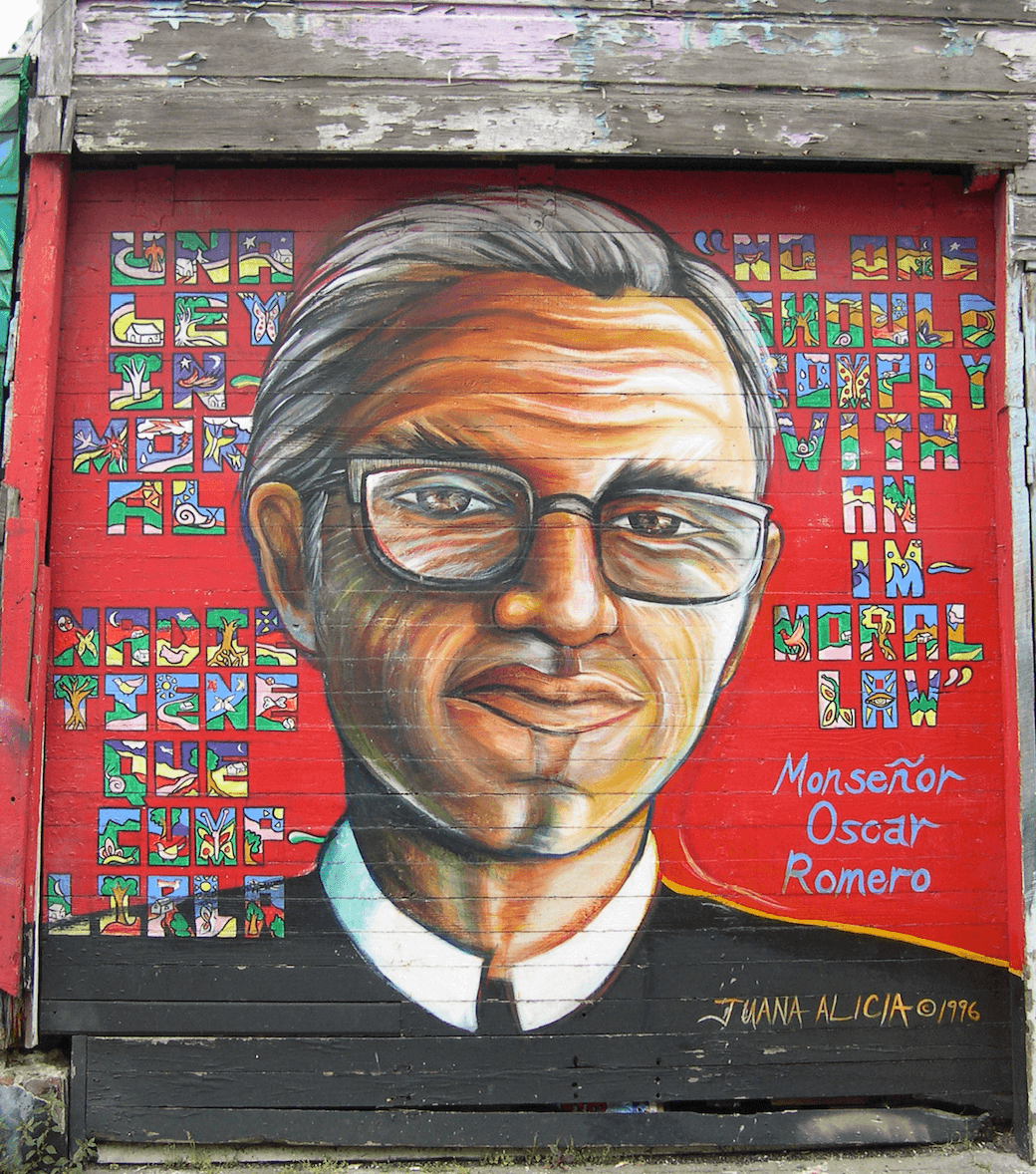
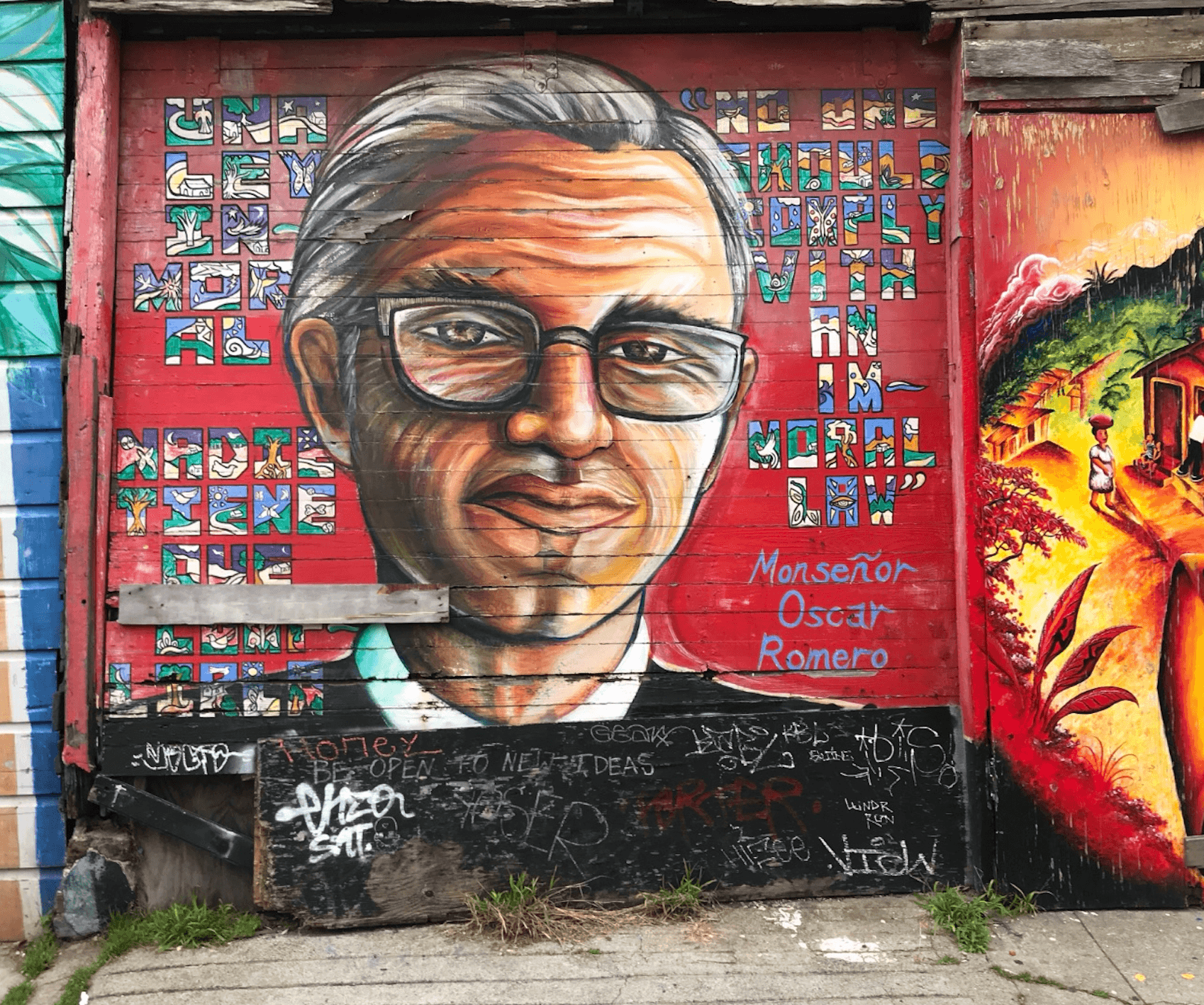
Juana Alicia: Well, my scaffolding climbing is sort of reduced. I'm still doing it, but not very high — not because I can't, but because I just don't want to anymore. But I love being on the street. I love being with people. I'll be painting the Romero panels here in my studio, then taking them to the street to finish them up.
I need my nap every day. I work out every day. I keep very physically active. I have an amazing partner who does the same. We have an incredible family, very talented children, and five grandchildren. Those are all inspiring people. And then we have this amazing community — a lot of my ex-students who are now my colleagues are great inspirations.
I feel so happy and relieved that I'm not passing the torch — I'm just lighting others, as Gloria Steinem says. I'm so glad there are so many young muralists out there just kicking ass. Cece Carpio, Josué Rojas, Keena Romano, the Few and Far women's collective, Trust Your Struggle Collective — of which I'm a participating partner. My ex-students and I did the murals together on the West Oakland Youth Center a few years ago. So I feel a little bit like Carlos Santana, doing collaborations and duets with our daughter and the generations of students we've had the pleasure of working with.
And the social movements around the world. We're very involved in social activism, both here in the Bay Area and in Mérida, Yucatán, where we're part of a consortium of community organizations — from the Frente Campesino to a group organizing around water control, to something called Café Ciudad, an urban-planning-based group that meets once a month to talk about local issues around water, earth, Indigenous rights, city planning, accessibility.
Right now, because so many governments of the world have swung so hard to the right and are so repressive, our real hope is in community collaborations — as it always has been, in grassroots movements. It was the grassroots movements building before the George Floyd assassination that came together and created the Black Lives Matter movement, which was created by several Black women leaders previous to that assassination. People at the grassroots need to work in coalitions together. Nobody can build a movement on their own. We're way beyond the days of the single charismatic leader.
The principles of feminism — horizontal structures, transparency, collaboration and not competition — all of those are going to lead us forward to deal with our climate crisis, which is the most pressing of all issues, because if we don't resolve that, we won't be here.
What's most inspiring is to see all these grassroots movements. The Concilio Maya in the Yucatán, where a collective of different Mayan groups across the peninsula are working together to resist the contamination of the cenotes, the pig farms, the cancer alleys these pig farms are creating. The grassroots movements working in coalition are the future. And that's very inspiring, because there's a lot of that all over the world.
Hugh Leeman: Juana Alicia, thank you so much for what you do, and thank you for sharing about it today.
Juana Alicia: My pleasure, Hugh.
Footnotes courtesy of Juana Alicia
The earliest Chicana feminist writing on La Malinche emerged during the 1970s and early 1980s. Key feminist scholars and poets dismantled traditional patriarchal views of her as a "traitor". They reclaimed her as a survivor, a victim of colonialism, and the foundational mother of La Raza. [1, 2, 3, 4, 5]
The foundational writings include the following pivotal essays and poems:
"Malintzin Tenepal: A Preliminary Look into a New Perspective" (1974)
Published by Adelaida R. Del Castillo in the journal Encuentro Femenil, this is widely considered the first major academic essay by a Chicana dedicated to reinterpreting La Malinche. Del Castillo argues Malinche was an intelligent, strategic actor navigating a brutal colonial reality, rather than a willing betrayer of her people. [1, 2]"Como Duele" (1973)
This poem by Adalijza Sosa-Riddell is celebrated as one of the first literary texts to address the Chicana experience by reclaiming the "Malinche" label as a badge of surviving marginalization. [1, 2, 3]"La Malinche" (1978)
Published by Carmen Tafolla, this widely read poem directly challenges the 1967 Chicano Movement poem "Yo Soy Joaquín" by writing from Malinche's own perspective. Tafolla frames her as an invincible survivor and a clever linguistic bridge rather than a screwer of her people. [1, 2, 3, 4]"Loving in the War Years: lo que nunca pasó por sus labios" (1983)
In this groundbreaking book, Cherríe Moraga critically examines how the myth of La Malinche was used to enforce silence and suppress the sexuality and independence of Chicanas. [1, 2, 3, 4, 5]
