
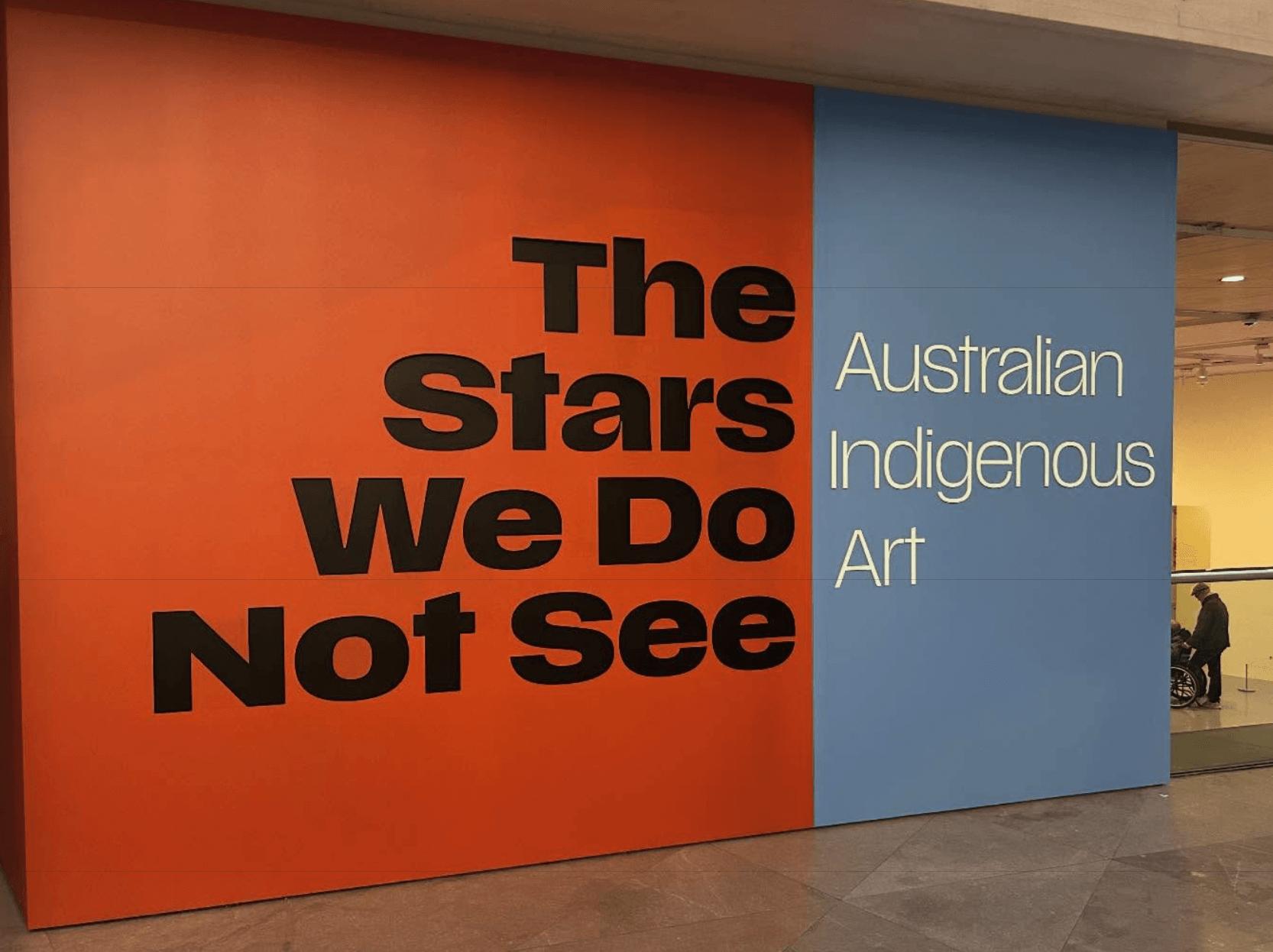
The Stars We Do Not See: Australian Indigenous Art, National Gallery of Art, Washington, D.C
By Liz Goldner
When I visited the exhibition, “The Stars We Do Not See: Australian Indigenous Art,” at the National Gallery of Art in Washington, D.C., with 200 pieces by more than 130 artists, I anticipated the work to be resonant of American Indigenous art. Yet the Australian art is different from the American version in several respects. One major feature of the Aboriginal and Torres Strait Islander art is the artists’ reverence for their 65,000 years of history — which they share through stories, spiritual practices and recently through inspired artmaking.
Another major aspect is that many pieces appear as non-figurative, contrasting with the representational images I often see in Native American art. Australian abstraction is composed of fluid forms and dense patterns, often representing coded ancestral knowledge. These abstract-appearing works are referred to as “Dreamings,” which are belief systems connecting the past, present and future. They are artistic depictions of thousands of years of ancestral stories that bond Indigenous people to their landscape and to their “country.” In these paintings, country encompasses symbolic illustrations of land, waterways, skies, plant life, living beings and spirituality. Looking at these large “Dreamings” creations, the viewer will likely become immersed in their deep colors and vibrant rhythms, leading to a profound sense of spirituality.
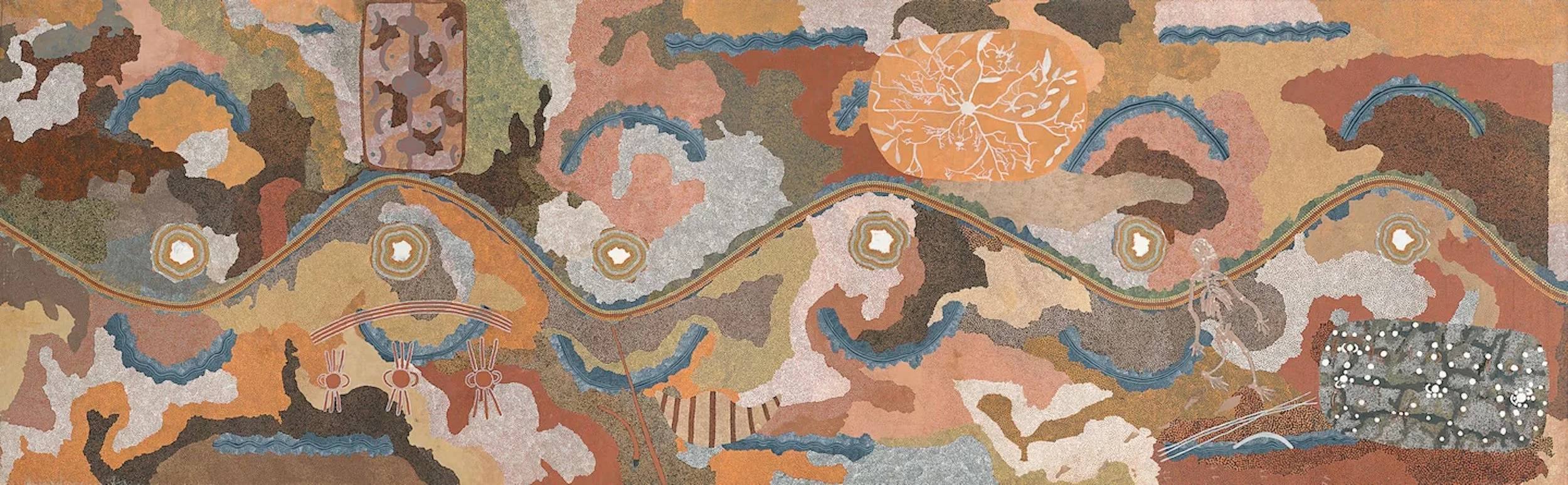
Tim Leura Tjapaltjarri, Clifford Possum Tjapaltjarri, Spirit Dreaming through Napperby Country, 1980, synthetic polymer paint on canvas, 207.7 x 670.8 cm (81 3/4 x 264 1/8 in.)
Tim Leura Tjapaltjarri and Clifford Possum Tjapaltjarri’s “Spirit Dreaming Through Napperby Country,” 1980, of synthetic polymer paint on canvas, is a fluid abstract depiction of the “catastrophic dispossession” (from the exhibition catalog) of Anmatyerre people whose ancestral lands were seized by the British to establish a cattle station. A small skeletal figure on the right of the canvas represents an old death spirit or the anticipation by Leura of his life coming to an end, according to the catalog.
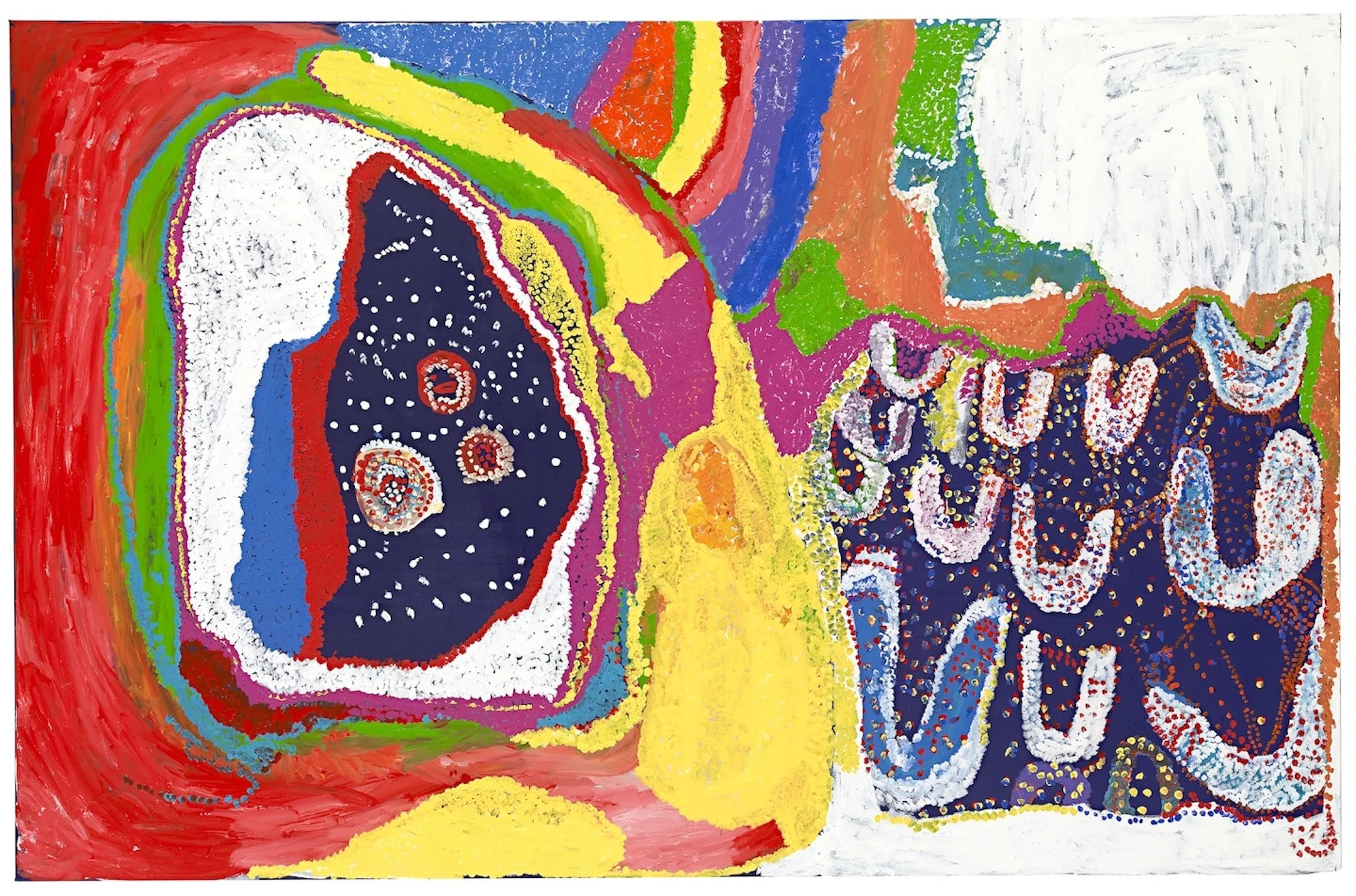
Kuruwarriyingathi Bijarrb Paula Paul, My Country, 2009, synthetic polymer paint on canvas, 198.1 x 305.2 cm (78 x 120 3/16 in.)
Kuruwarriyingathi Bijarrb Paula Paul, who created “My Country,” 2009, (also of synthetic polymer paint), is from Mornington Island, Queensland. She has lived a traditional life, growing up with the customs, laws and familial knowledge of the Kaiadilt people. Her passionate, colorful painting, containing ancestral references, flows from her joy of life, vast cultural memories, learned and experienced, and from her respect for the surrounding land and sea.
“The Stars We Do Not See” also contains “Bark Paintings,” works created throughout northeastern Australia. Exhibition didactics explain that at the beginning of the 20th century, British Australian biologist Baldwin Spencer commissioned artists from the wilderness area of Arnhem Land to create these drawings on single sheets of eucalyptus bark. Their designs had previously been painted onto cave walls, bark shelters, the human body and ceremonial objects. These figurative, story-telling drawings, often including cross-hatching, geometric and clan designs, blend in with the bark texture.
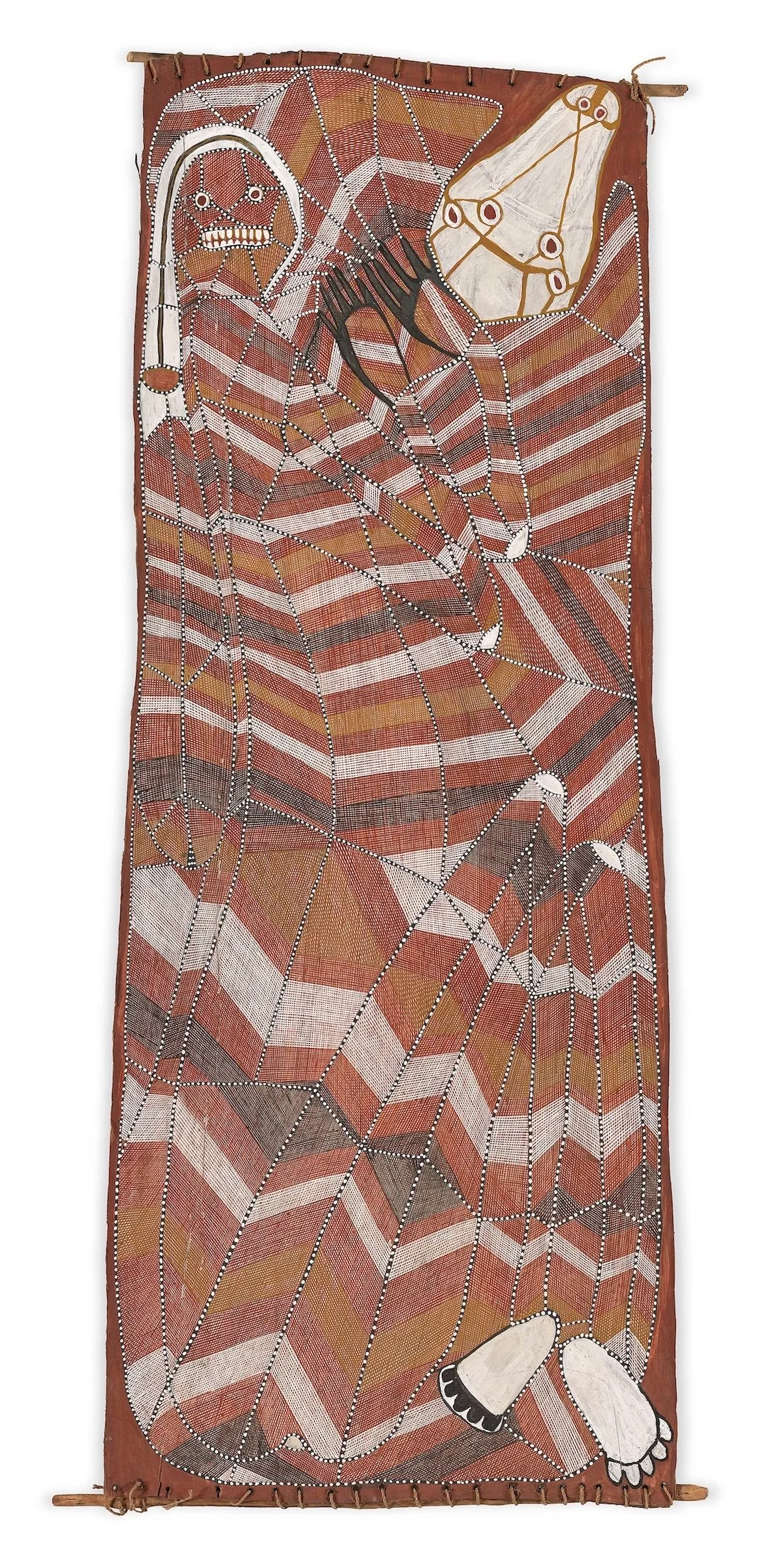
Jimmy Njiminjuma Ngalyod, the Rainbow Serpent, 1993, earth pigments on stringybark (Eucalyptus sp.), 166.5 x 66.2 cm (65 9/16 x 26 1/16 in.)
Jimmy Njiminjuma’s “Ngalyod, the Rainbow Serpent,” 1993, is a semi-abstract bark rendition of “The Rainbow Serpent,” a creature that is part of “Kuninjku culture.” The serpent is said to be intertwined with aquatic realms, including creeks, rivers, waterfalls and waterholes, all of which spur the growth of algae, palms, sinuous vines and water lilies. The artwork is composed of white earth pigment, often used for bark paintings and bodily adornments, an element that some traditions associate with the Rainbow Serpent. The mesmerizing painting expresses spiritual energy and synergy.
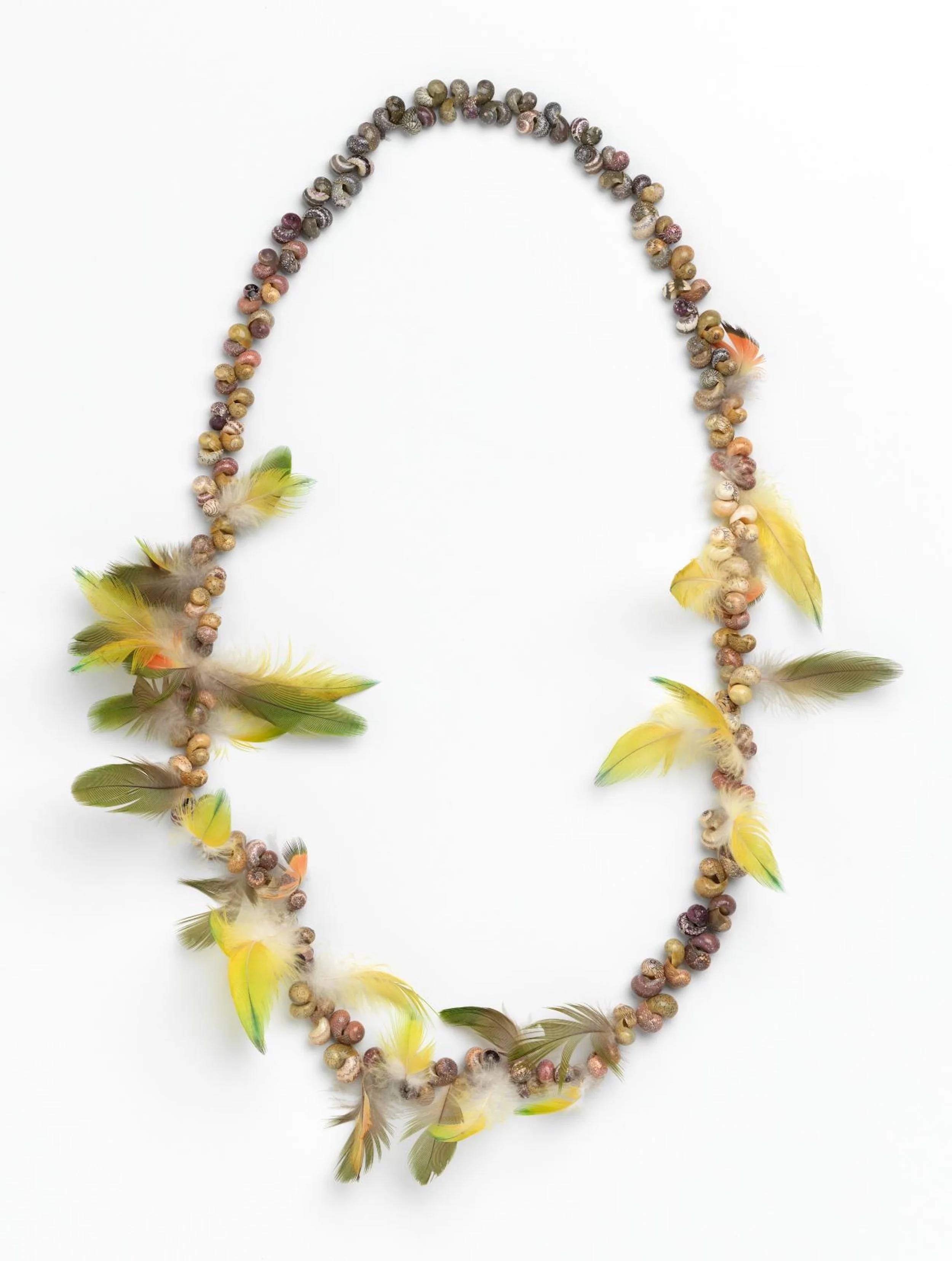
Rose Mamuniny Gurruwiwi, Mani Mani (Necklace), 1993, welirr (shells), butju (feathers), nylon thread, 30.5 x 21 x 5 cm (12 x 8 1/4 x 1 15/16 in.)
Jewelry displayed in the exhibition combines decorative aspects with millennia-long spirituality. Yulyurlu Lorna Napurrurl Fencer mines her early abuse of being forcibly removed from her traditional home to become a respected artist and teacher and to create painted body designs and vibrant acrylic canvases. She fashions headdresses and necklaces for the art market and for ceremonies, including her “Untitled Necklaces,” 1977-99. She uses for the work earth pigment, synthetic polymer paint, gumnuts, seeds, seed pods, wood and wool. Jewelry designer Rose Mamuniny Gurruwiwi’s “Mani Mani (Necklace),” 1993, is composed of welirr (shells), butju (feathers) and nylon thread.
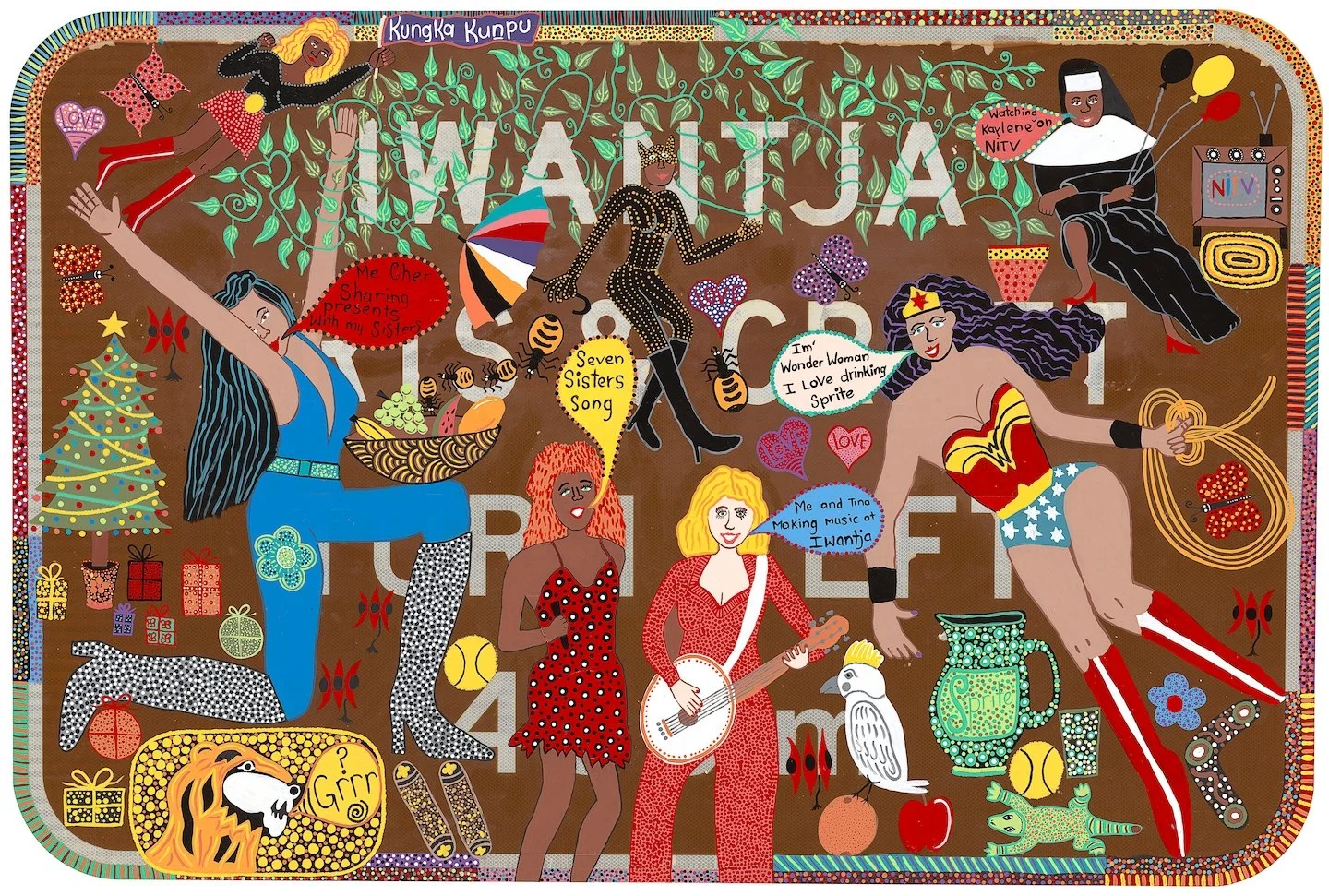
Kaylene Whiskey, Seven Sisters Song, 2021, enamel paint on road sign, 120 x 180 cm (47 1/4 x 70 7/8 in.)
Kaylene Whiskey’s “Seven Sisters Song,” 2021, of enamel paint on a discarded road sign, is among the most contemporary works in this exhibition. By synthesizing her ancestral knowledge with popular culture and daily life in her town of Indulkana, she reimagines the Australian Indigenous “Seven Sisters” story, about seven bold, audacious women. By turning the sisters in her painting into a joyous Dolly Parton, Cher, Wonder Woman, rock stars and a flirtatious nun, and adding native wildlife, Whiskey brings her artwork into our pop-obsessed world. The catalog explains, “A producer of paintings and video works, and recently, a collaborator on projects within the fashion and retail industries, Whiskey brings people together with her art, giving permission for viewers to exhale, laugh and just feel happy.”
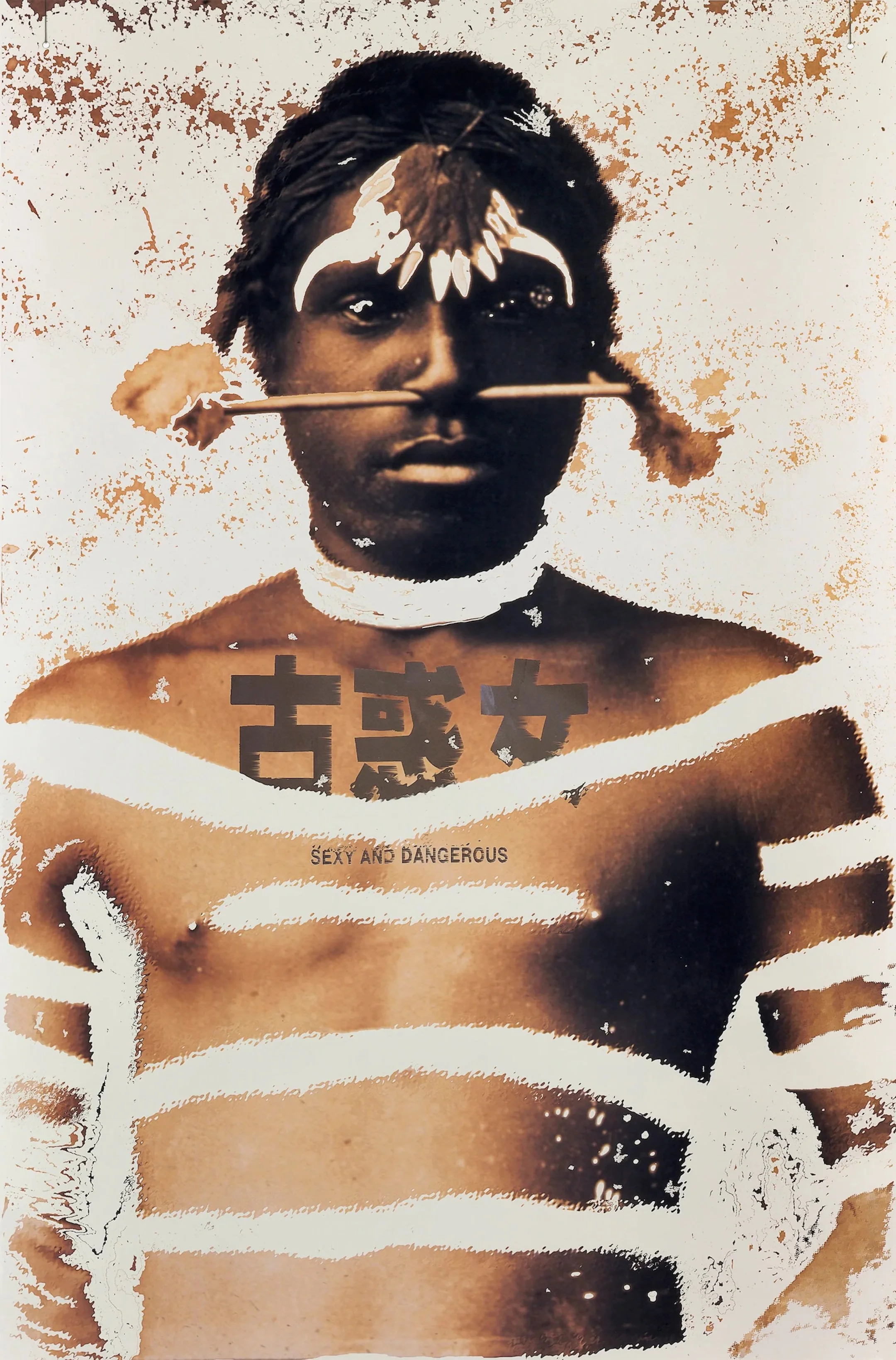
Brook Andrew, Sexy and Dangerous, 1996, printed 2005, computer-generated color transparency on transparent synthetic polymer resin, 145.9 x 96 cm (57 7/16 x 37 13/16 in.)
Brook Andrew’s “Sexy and Dangerous,” 1996, is a manipulated photo from the early 20th century of an Aboriginal man. The original picture, taken to reveal Australia’s exotic inhabitants to the world, was part of a sideshow of colonization, or the “settlers’ exploitation” of the people they subjugated. The catalog explains that Andrew reaffirms the subject’s real identity and turns the man’s powerful gaze back to the viewer. Andrew says, “We are sexy and dangerous.”
“The Stars We Do Not See: Australian Indigenous Art” is a celebration of groundbreaking work by the Indigenous art community. The artwork combines contemporary perspectives with the preservation and illustration of several millennia of culture, all interwoven through their artmaking. The show is the largest exhibition of Australian Indigenous art to be displayed in North America.
The exhibition is a cultural partnership of The National Gallery of Art, Washington, and the National Gallery of Victoria, Melbourne, Australia. It is curated by Myles Russell-Cook, Artistic Director and CEO, the Australian Centre for Contemporary Art, and former Senior Curator of Australian and First Nations art at the National Gallery of Victoria (NGV). The show will close on March 1, 2026, and will travel to the Denver Art Museum, the Portland Art Museum, and the Peabody Essex Museum in Massachusetts.
