

Tara Donovan: Stratagems and Lily Kwong: Earthseed Dome
Institute of Contemporary Art, San Francisco, January 17—July 31, 2026
The Institute of Contemporary Art San Francisco is, according to its website, “nomadic by design and non-collecting by choice,” meaning that rather than maintaining a permanent collection, it presents and commissions public art, then moves on. Both terms imply a certain relationship to impermanence: nothing owned, nothing held, nothing meant to last. This spring and summer, Tara Donovan’s Stratagems and Lily Kwong’s Earthseed Dome take that relationship into the works themselves. Installed in the glass annex gallery of the Transamerica Pyramid Center and the adjacent Redwood Park, the two works share not only a neighborhood but a material logic: both are made, in different ways, of impermanence itself. Yet despite their materials and temporary installation, both arrive with the visual and social force of monuments. They are also neighbors in purpose, each finding a different way to embed itself in the public.
Stratagems
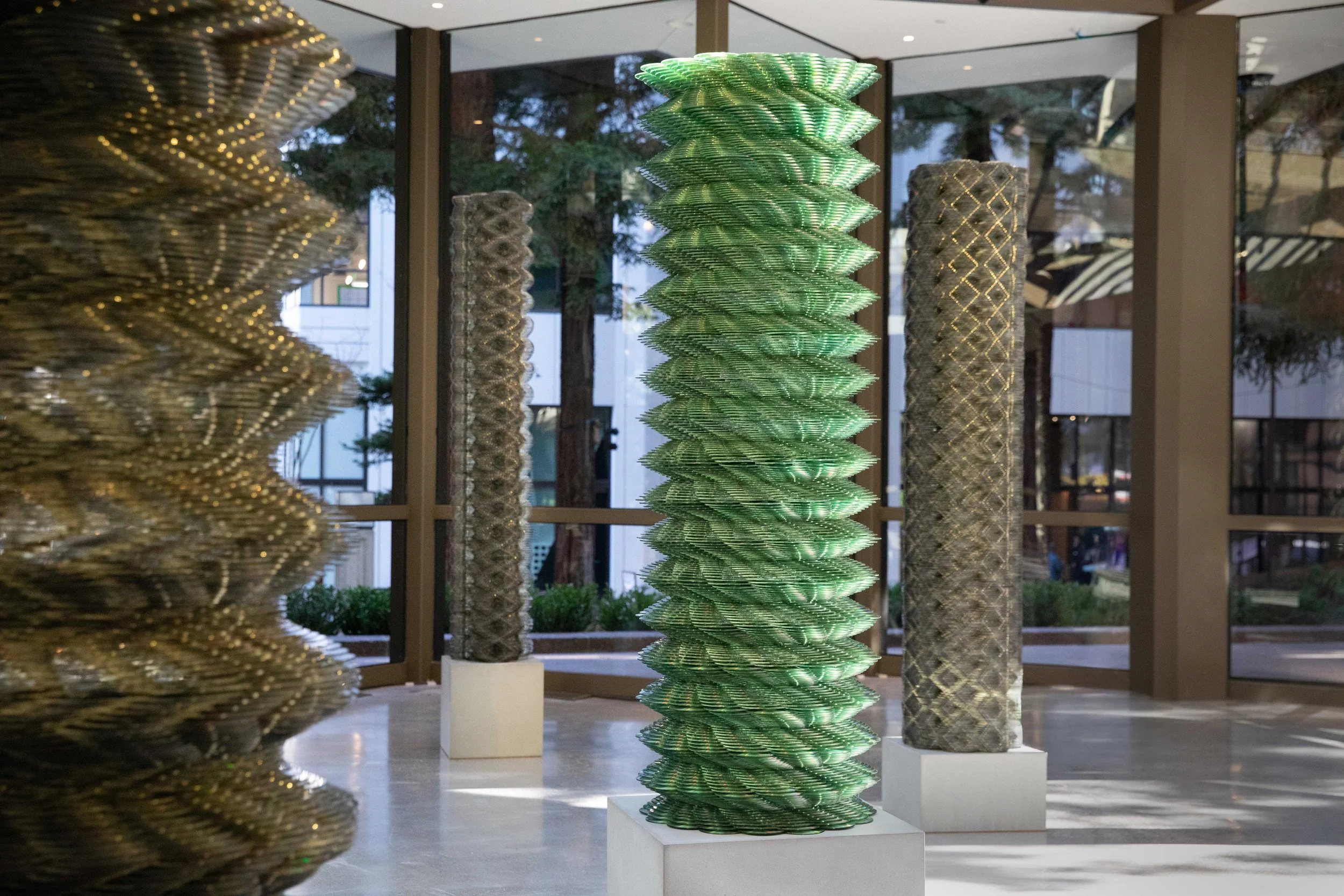
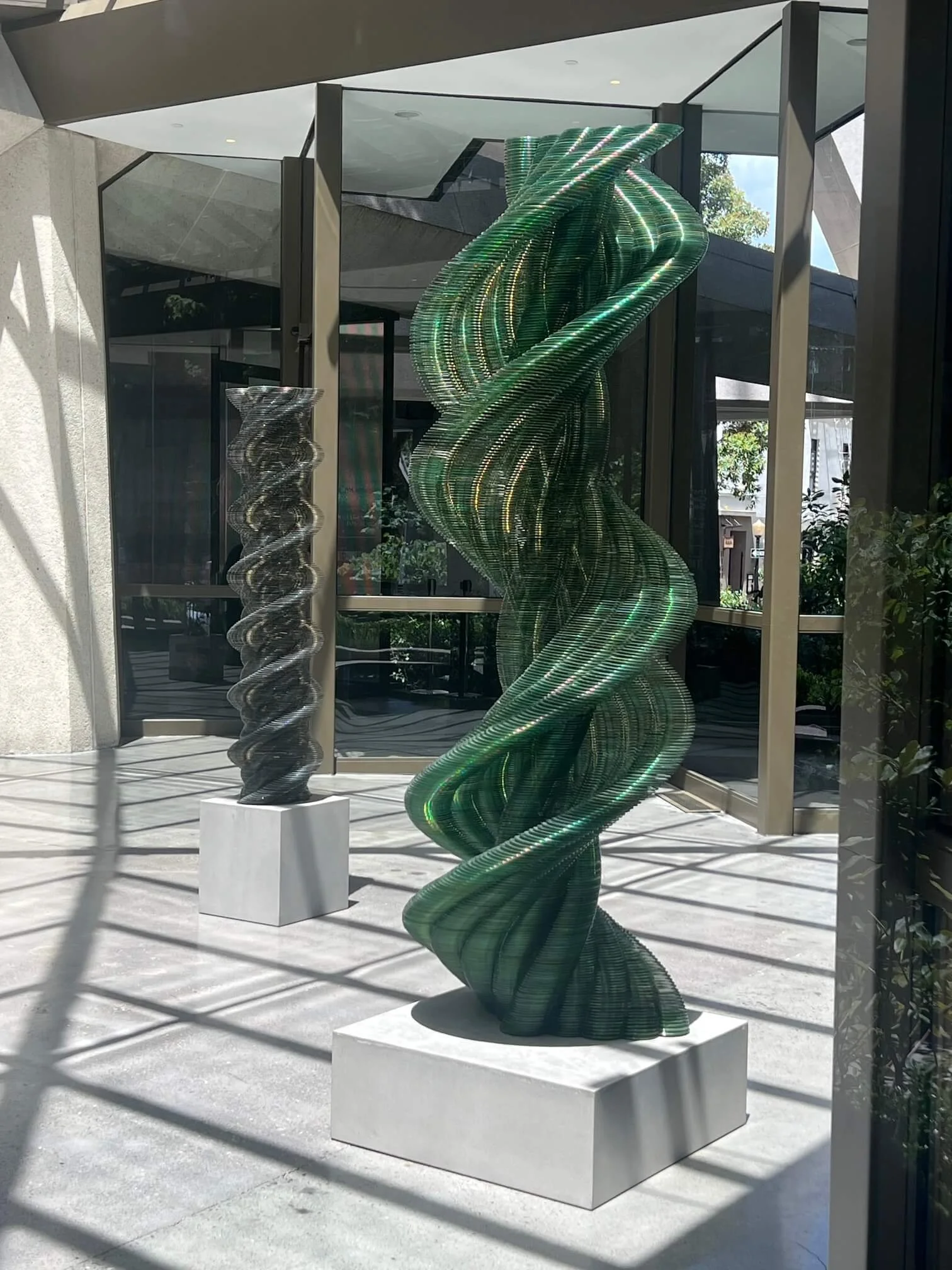
Continuing her signature of accumulating daily objects, particularly disposables like tar paper, Scotch tape, and drinking straws, Donovan erects fourteen columns built from CD discs, a medium so collectively obsolete it has already passed into the register of the throwaway. The columns vary in height, though all exceed a person, and they pick up different tints: green and silver from the original dyes, brown from oxidation and age. Their patterns of accumulation vary, too. Some layer in regular rhythmic protrusions and recesses, like the bracketed eaves of Chinese pagodas. Others present a flat gridwork surface, their accumulations so regular that the columns resemble industrial mesh or woven screens. Still others twist and curve to varying degrees along their height, producing the visual effect of flowing or torqued material. In the glass annex gallery, sunlight enters from different angles throughout the day, and the iridescence changes accordingly. Squinting, you might mistake them for columns of cut glass covered in arabesque intricacies. The twisting ones in particular seem alive under direct light, the surface catching and releasing reflections as you move past. That the sculptures achieve this sense of vitality through a medium now largely regarded as obsolete makes the effect all the more uncanny.
Earthseed Dome
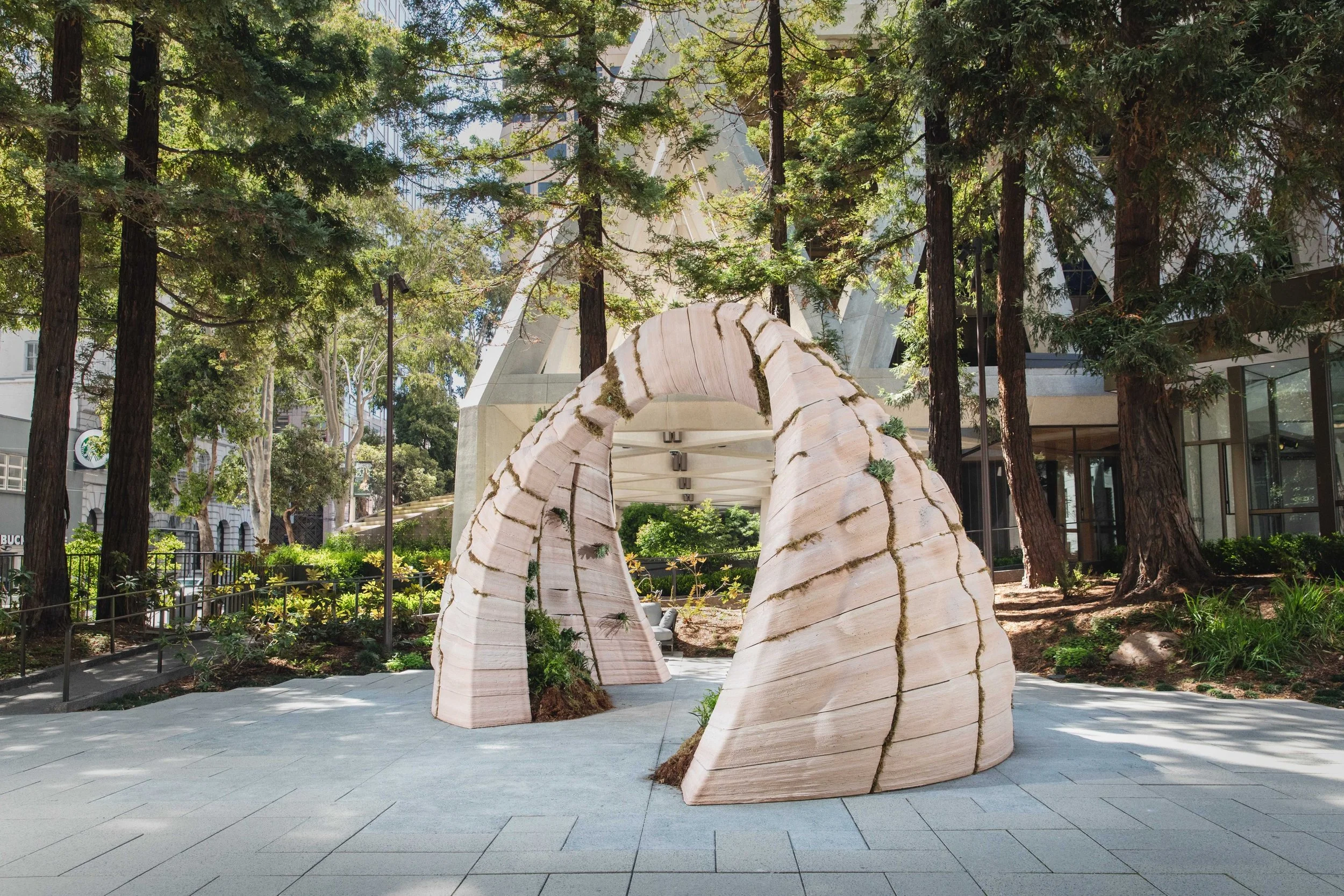
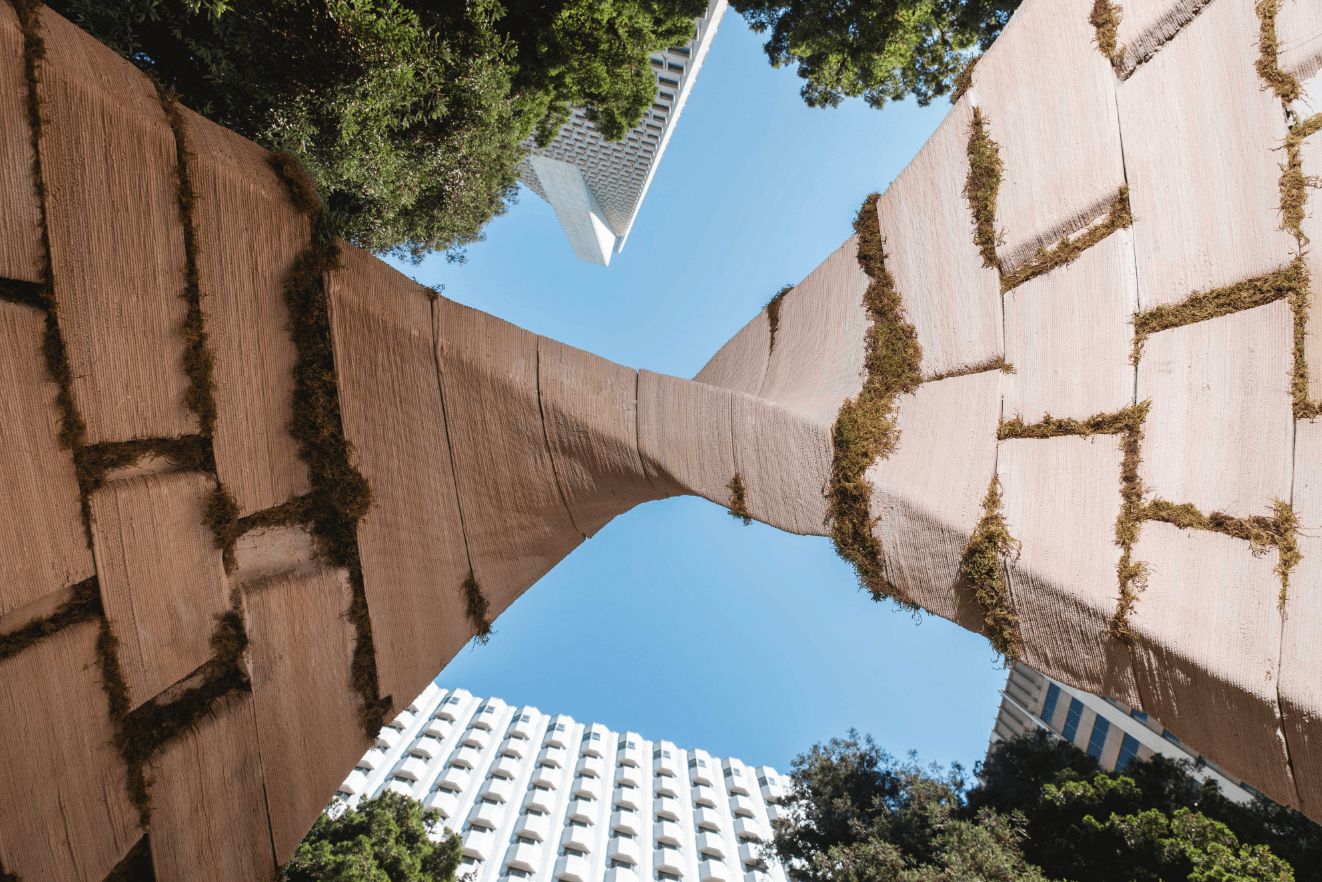
Seen from the glass annex hosting Stratagems, Earthseed Dome reads at first as a hollowed dome arching over the path through the redwood parklet, wide enough to walk through. It takes a moment to notice that the surface twists at the capstone into a Möbius configuration, intrados of one half flipping into extrados of the other. This structure was built onsite, using a 3D printing machine that printed the building blocks of a seed-impregnated soil mix. The blocks are then piled up to create the whole structure, their seams filled with moss. The printed units retain the horizontal ridges of their manufacture. Like the stacked CDs in Donovan’s columns, these repeated layers transform accumulation into texture, making the process of construction visible on the work’s surface. Seen up close, the Möbius twist and layered printed ridges make the structure feel simultaneously engineered and grown, inviting a moment of inspection before one passes through. At the base inside, a mulched planting bed supports ferns and succulents. Though modest in scale, it helps anchor the structure within its surroundings. The reddish mulch echoes the bark of the neighboring redwoods, while the ferns echo the grove’s undergrowth, softening the transition between the printed dome and the landscape around it.
In close proximity, the pair invites a reconsideration of monumentality itself. A slab of stone, a cast of bronze: monuments are traditionally built to outlast their moment, but this premise is shared by neither Donovan nor Kwong. One builds from a medium already relegated to obsolescence, and the other incorporates living matter that will continue to grow, change, and eventually die. And yet, standing among them, it is not impermanence that first comes to mind. Their height, public placement, and glass- or stone-like appearance invoke associations with monuments: structures addressed to the public and built to be stood before.
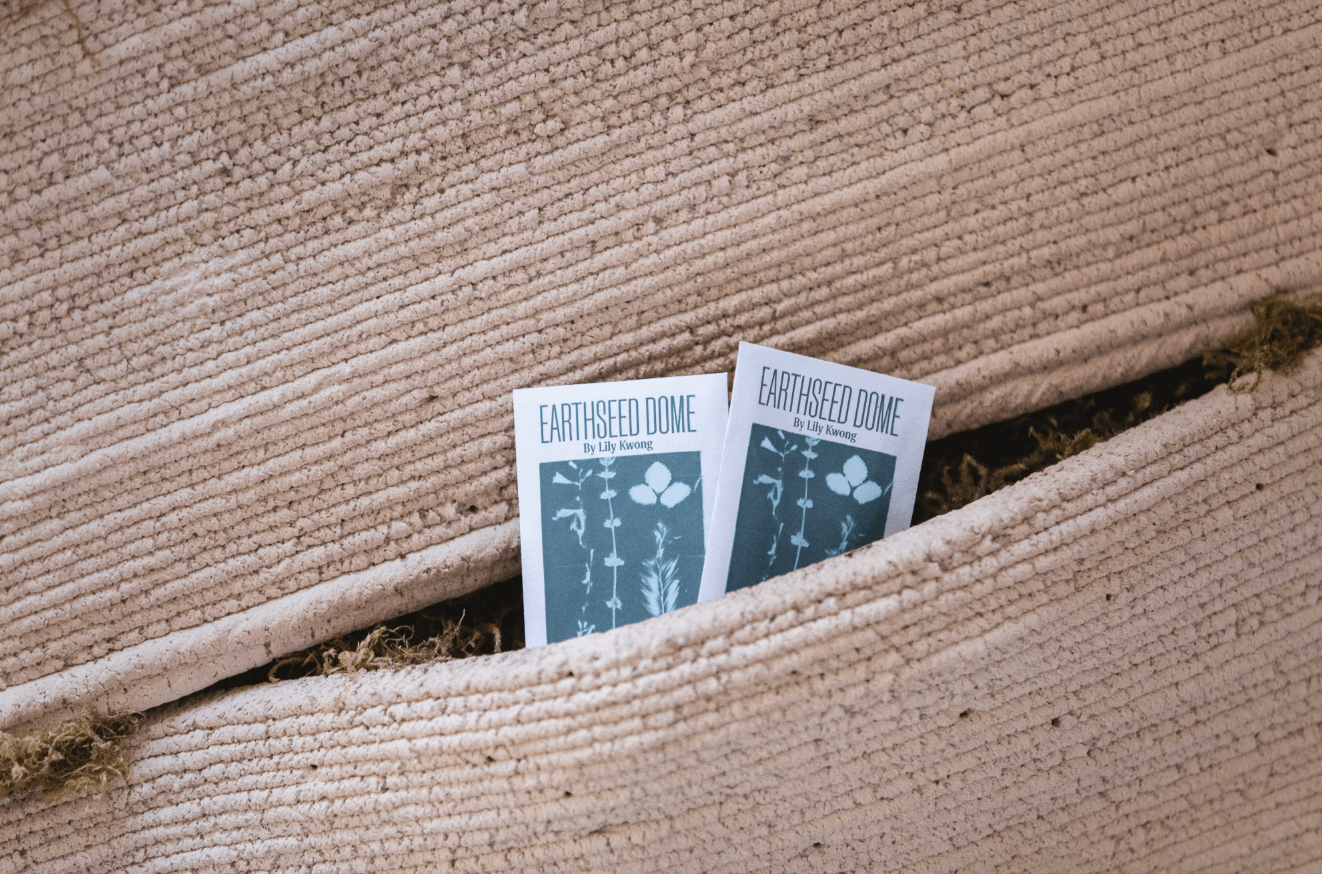
Earthseed Dome seed packets
On this point, Donovan’s work specifically reminds me of totem poles, which are monuments of a specific kind, marking not a person or an event but a group’s presence to itself. Their verticality is part of the resemblance, but so is the density of surface detail that makes the columns looking less assembled than carved. Durkheim, in The Elementary Forms of Religious Life (1912), described the totem as “the flag of the clan, the sign by which each clan is distinguished from the others.” The sacred object works not by transcending the social but by concentrating it, giving a group something to cohere around. Watching people gather around the two works, some admiring the reflections, some inspecting the plants, I found myself thinking less about what the sculptures represent than about what they allow. The clan doesn’t need a totem that outlasts it. The columns catch light, the dome holds its ground, and these are sufficient reasons for people to pause and congregate.
Earthseed Dome goes even further: it invites visitors to take seed packets stacked in its seams home, acting as “human pollinators.” The work thus disperses beyond its site, carried off in pockets. Stratagems will eventually come down too, packed in crates and removed as the exhibition closes. But while both works stand, they do what Durkheim thought totems always did: give a community something to gather around and recognize itself in. The seed packets help. So does the iridescence.
