
Shiva Ahmadi, Crown of Flames, Haines Gallery
SHIVA AHMADI
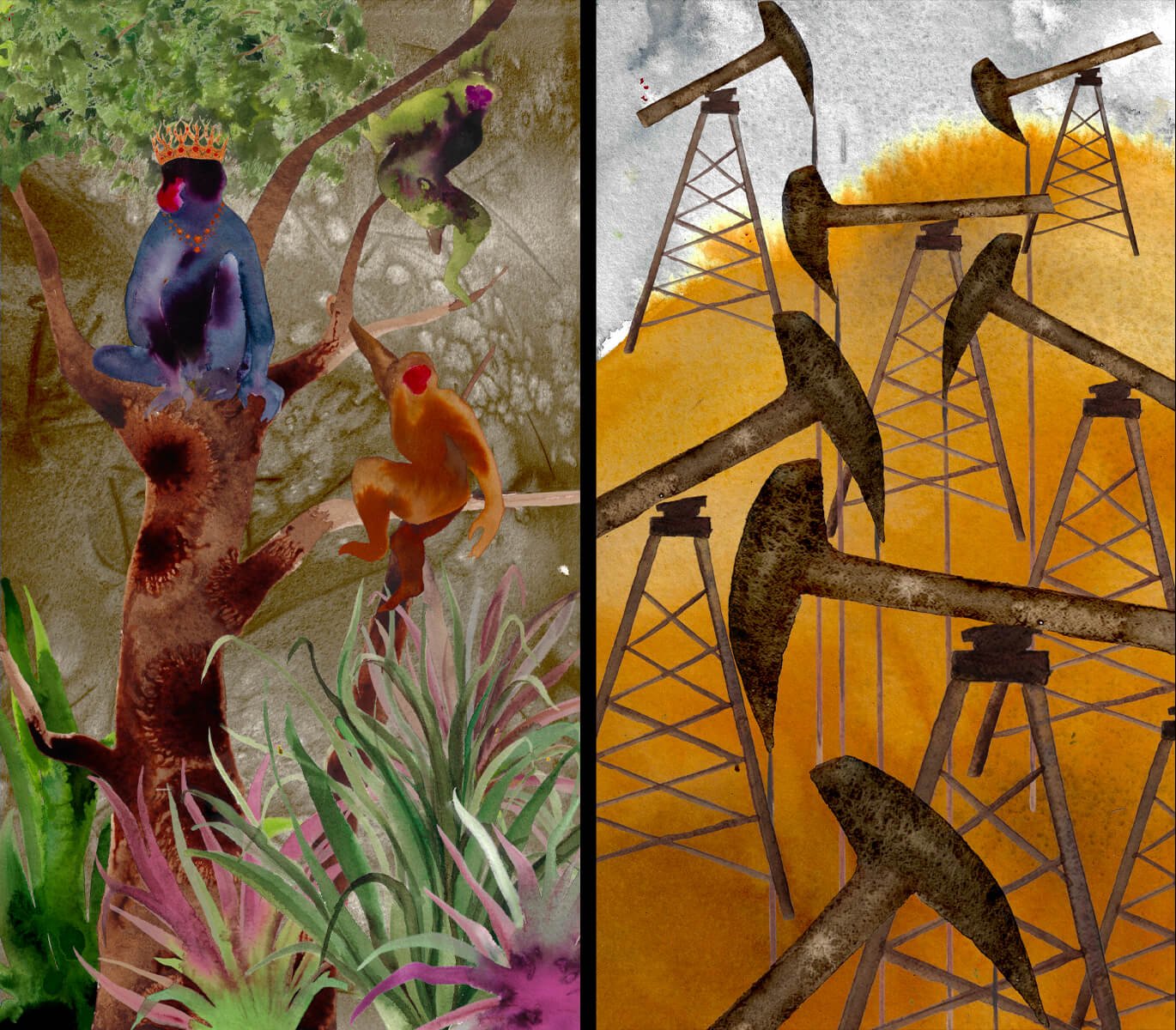
Crown of Flames, 2026
Two-channel animation (color, sound)
5:51 minutes
Edition of 3 + 2 AP
Credit: Courtesy the artist and Haines Gallery
Shiva Ahmadi happens to be from Tehran. She happens to speak with a noticeable Iranian accent. And she happens to have strong feelings about the war against Iran that started on February 28, 2026. But Ahmadi's new art exhibit at Haines Gallery, Crown of Flames, which runs through April 25th, doesn't have a specific Iranian focus, nor was it timed to current events in Iran — even if two of her exhibit's central motifs are oil's pernicious impact on the world and the incalculable cost of human suffering. Instead, what Ahmadi has done is something altogether universal: She created timeless artistic commentary that could be applied to man-made atrocities anywhere in the world — past, present, or future.
An irony: No men are really pictured in Crown of Flames. None. Instead, Ahmadi has centered female figures throughout the exhibit's stunning artwork, freeze-framing them into contorted positions of free-fall or having them float amid objects and creatures that spiral with them. And yet: On the exhibit's opening night, it was a lineup of men — the United States' current male president, and Iran's entire clerical regime of men — who were on the minds of many attendees, prompting them to pepper Ahmadi with news-oriented comments about "how timely your exhibit is!" The interlude temporarily overshadowed what for Ahmadi is an exhibit whose truths extend far beyond a single war and a single country.
"Like everyone else, I didn't know there'd be a war," Ahmadi tells me days after the March 13 opening. "And I didn't want the work to be seen as, 'Oh, look: There's a war and this is an Iranian artist talking about all this.' The war didn't happen in one night. It was years in the making. A lot of people were asking me in the opening, 'Oh my God. This is so timely!' But it wasn't planned like that. First of all, I didn't make the animation two nights ago. And the paintings and (other work) aren't about specific attention to this subject."
SHIVA AHMADI
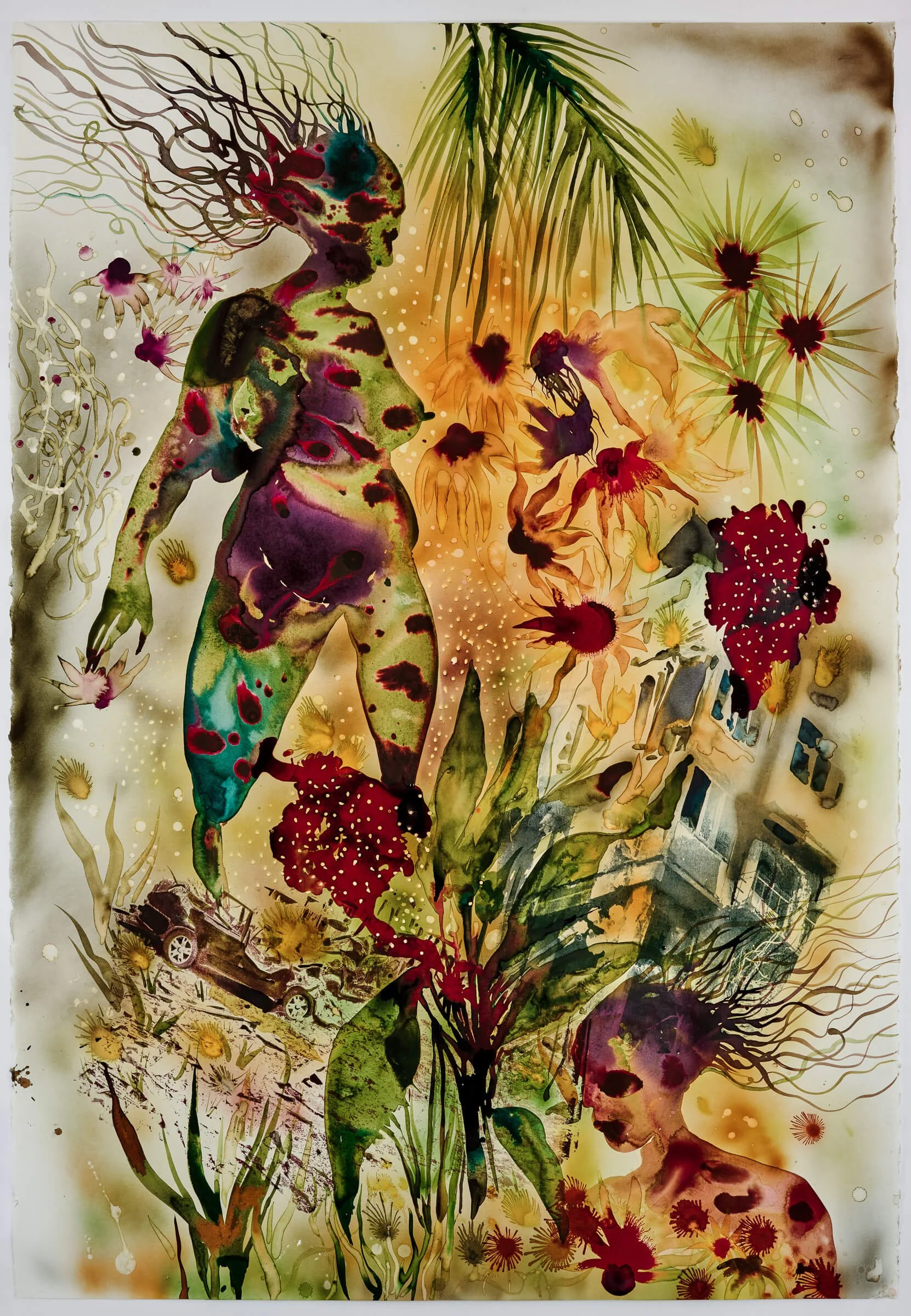
Unbound, 2024
Watercolor and silkscreen on paper
60.25 x 42 inches
Credit: Courtesy the artist and Haines Gallery
Art doesn't exist in a cultural vacuum, of course, so every public exhibit is subject to scrutiny that dissects the artwork through news events. The same holds true for all artistic mediums, including movies, novels, and music — which is why, as one example, there was so much debate about The Kite Runner, Khaled Hosseini's 2003 novel that, critics said, overly simplified Afghanistan's ethnic and cultural landscape at a time when the U.S. war in Afghanistan was in full force. In the United States, war creates more interest in a country that's subject to American weaponry, but the danger is that onlookers will only see that country through a sensationalized parsing of "black or white."
Crown of Flames asks complicated questions. A longtime professor of art at UC Davis, Ahmadi is a multidisciplinary artist who — besides making paintings and sculptured objects — has become an undeniably powerful filmmaker. Her short animation at Haines is a diptych that shows parallel worlds: on the left side, monkeys reside in a Garden of Eden-like environment where they thrive amid nature's colorful pastiche; on the right side, kids play leapfrog on brown terrain where black drilling rigs appear. Over the next five minutes, the two sides intersect in profoundly gruesome ways, with the monkeys fleeing their once-idealistic domain, which burns to the ground, for the kids' territory, where the oil wells have decimated the environment and the monkeys now swing from the rigs and paralyze the kids' movements. The characters speak no words. The most prominent sound: The soulful, stringed music of composer and instrumentalist Shahab Paranj, who gives the animation an external sorrow that brings out the story's intense animation (done with Sharad Patel, who has collaborated on Ahmadi's previous animated works).
SHIVA AHMADI
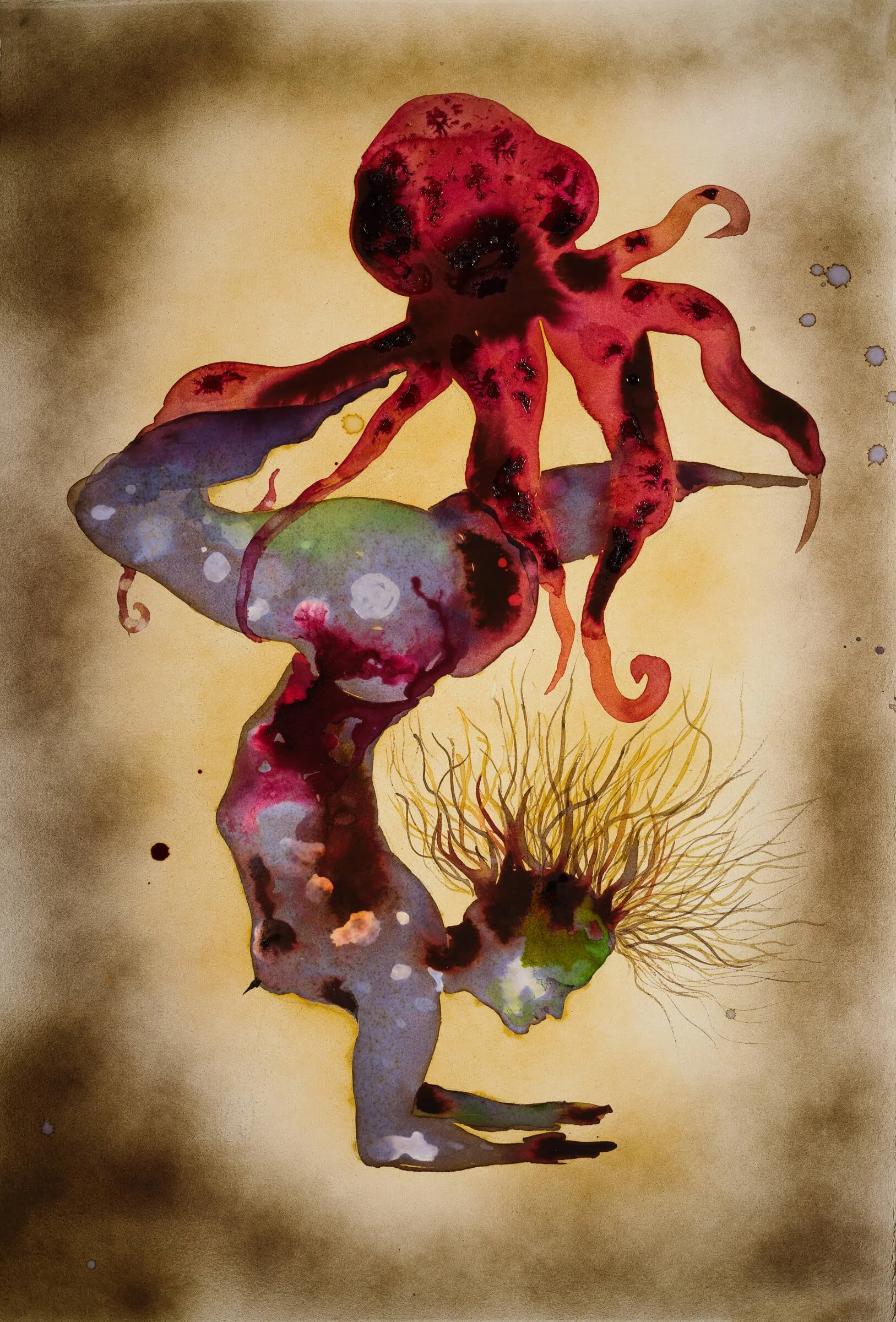
Octopus, 2024
Watercolor on paper
22.5 x 15 inches
Credit: Courtesy the artist and Haines Gallery
I watched the animation six straight times, each time picking up on small details that Ahmadi has worked into the video, as in the rustling flowers that swoon with the monkeys' swinging, and the swarms of what appear to be small fireflies that evolve into small missiles. The animation was painstaking for Ahmadi, involving painting, re-painting, image-mixing, more image-mixing, and editing over and over. In the end, "Crown of Flames" is similar to her watercolor works at Haines: suffused with a "hide-and-seek" style that is reminiscent of the Persian miniature paintings that Ahmadi loved as a child in Iran.
"When I was a kid," she tells me, "we had a lot of Persian miniatures in the house — a lot of Iranians have them — and one thing that I notice is that every day I was passing them by, I would find something new in it. There are all these hidden layers that are there. And I'd say, 'Oh, there is this one.' And, 'Oh, my God: Did you see this one?' I guess I'm also trying to do that in my own paintings. There are layers and layers of hidden stuff in it. In that sense, it's less a single image and more of a process of hide and seek, and of trying to bring in more engagement with the viewer."
Art-goers familiar with Ahmadi's work may wonder why she uses monkeys as a motif. She explains it this way to me: "When I grew up in Iran, there was always this big question that I had since I was a kid: When you're looking at the establishment and the government, there's always this guy who is sitting out there and ruling. In my case, the Iranian government was always cruel and had this mentality of constantly going to war with the whole world instead of trying to find a diplomatic solution to work with the world. My whole childhood was spent hearing, 'Down with the U.S.A.' And 'Down with Israel.' And 'Israel must disappear from the map.' That was the mentality and the rhetoric. But when you talk to people, 90 percent don't believe it because it was stupid. Everybody knew that. But then there was about 10 percent who truly believed in it. They were brainwashed. They really thought that's how it should be, without analyzing it or questioning it. And many of these people are educated. And to me, they always represented monkeys. My mother used to say: 'Look at them. The leader says one thing, and the monkeys jump up and down and do what he wants.' That has stayed with me."
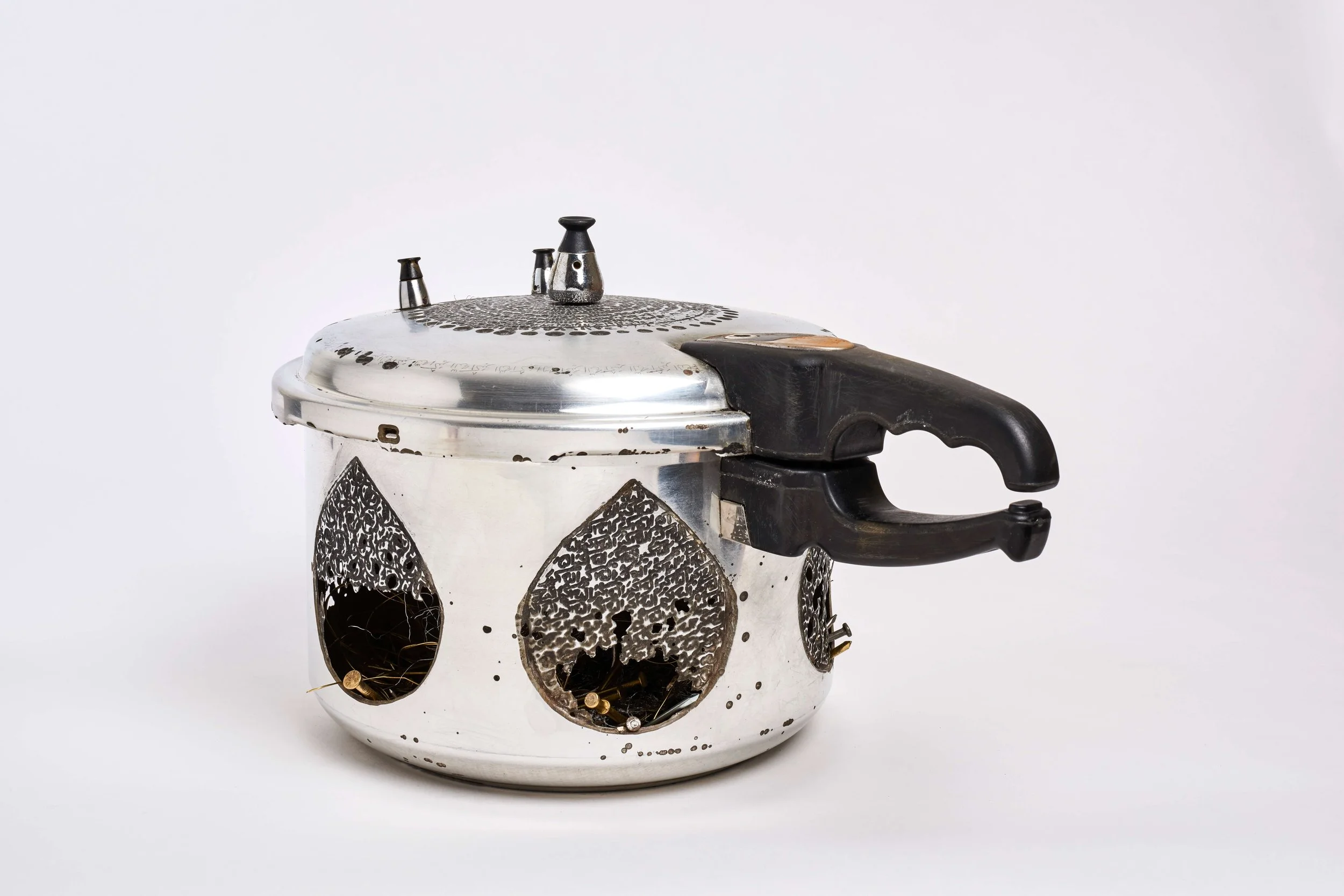
SHIVA AHMADI
Pressure Cooker #2, 2016
Intaglio hand-etching on Aluminum
pressure cooker
10 x 19.5 x 12 inches
Credit: Courtesy the artist and Haines Gallery
When I interviewed Ahmadi, events in Iran were unfolding in dramatic ways. They still are. As I write this, Trump's White House may initiate a ground invasion of Iran. Israel and the United States may continue bombing buildings across Tehran and other Iranian cities, deeming their war a "success" while killing hundreds of more civilians — men, women, and children — who just happen to be in the wrong place at the wrong time. Block by block, tragedy by tragedy, Tehran is beginning to resemble Gaza, which years of bombing have turned into a hellish, rubble-strewn landscape that feels abandoned by the world.
Getting caught up in day-to-day news events around the world — Iran or otherwise — means being waylaid by shifting feelings of anger, sadness, and resolve that catapult emotions from one extreme to another. Those feelings can be entirely ephemeral. An art exhibit like Crown of Flames centers those feelings into something that's focused. Haines Gallery has referenced Ahmadi's new animation as a "parable" and "storytelling" — and that's what it is. Like Aesop's Fables from ancient Greece or something more contemporary like the songs of Bob Marley or Nick Drake, Ahmadi's new animation will be watched and enjoyed generations from now, with people relating to Crown of Flames in whatever way that makes sense to them.
SHIVA AHMADI
Fiery Descent, 2024
Watercolor and silkscreen on paper
59.5 x 42 inches
Credit: Courtesy the artist and Haines Gallery
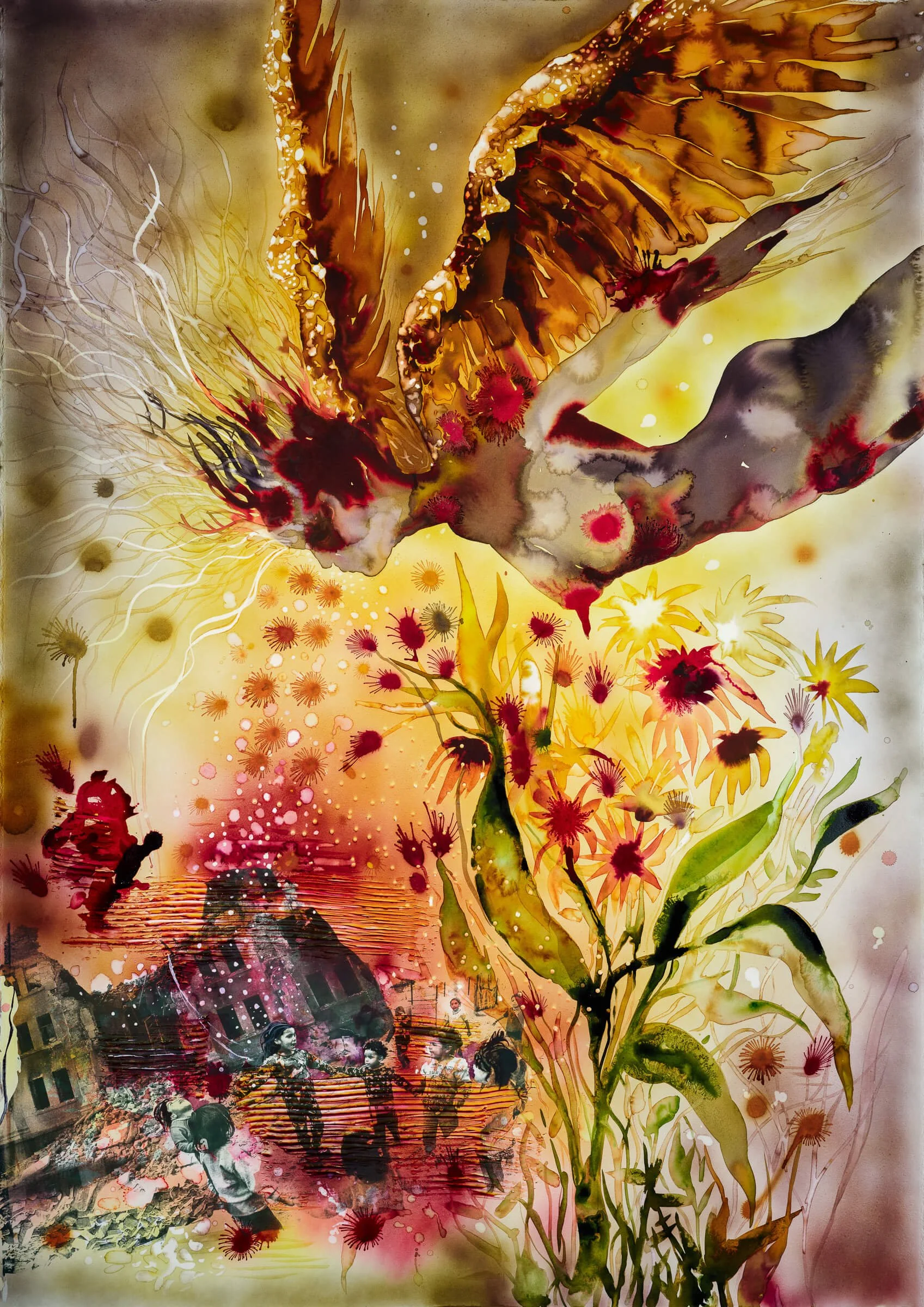
If Ahmadi's animation is the exhibit's centerpiece (Haines has cordoned off a gallery space just for its viewing), then the five-foot-tall watercolor painting called "Fiery Descent" is the exhibit's labyrinthian masterwork. One way to think of it: As a giant jigsaw puzzle with individual scenes or "pieces" that come together to form a bigger narrative of beauty, resilience, and tragedy. The top section features a winged female whose outstretched feathers are saturated with colors that resemble a leopard fur coat — which complements the background's gold and yellow, Klimt-like colors that bathe the figure's seemingly-bloodstained body with a giant patina of celestial sunlight. Flowers bloom from the painting's lower-right scene, but "Fiery Descent" is anchored by the lower-left scene that has children playing amid bombed-out structures. But even this scene requires three or four looks since Ahmadi has painted different grids across the children and the bombed-out structures. The wavy panels of yellows, reds, and charcoals give this section another dimension — prettier than the scene would be otherwise, and creating a labyrinth within a labyrinth, as if the children are in a dream space within the rubble, where they can be free of worries as they play their momentary game of hand-holding.
I asked Ahmadi where she got the kids' touching image, and her answer speaks to the deluge of images and news stories that we all face when trying to stay updated about global events. It also speaks to Ahmadi's upbringing: she grew up during the Iran-Iraq War that killed a million people from 1980 to 1988. "Honestly, I don't know where the image is from," says Ahmadi, who still has family and friends in Iran. "Every day I catch the news, and it's either Ukraine or Gaza or Iran or Syria or a refugee crisis in some part of the world. Pain is pain all over the world. It's the same language… When I see an image that stays with me, I usually save it. When I was making that painting, I wanted to start with an image of children playing on the ruins of destruction. It was also personal to me, because I grew up like that."
SHIVA AHMADI
Oil Barrel #32, 2026
Oil and Swarovski crystal on steel barrel
29 x 21 x 21 inches
Credit: Courtesy the artist and Haines Gallery
I also asked Ahmadi how she felt about events in Iran, and she has mixed feelings about the current war. "Just like any other Iranian you might talk to, it's such a complicated situation with a lot of complicated feelings," she says. "On the one side, I'm happy that Khamenei is dead, and the regime is getting weaker. And that there is a chance the regime is going to change. But on the other hand, there are 92 million innocent people in the middle of it who are getting bombed every single day. And their homes and their families — everything is being destroyed. And for (an Iranian) government whose rhetoric and mentality is, 'War, war, war until we win!' — it's been mortifying to me that they haven't made one shelter or one siren for people. That breaks my heart. And it breaks my heart that a lot of historic sites are getting damaged."
Of course, I was curious about Ahmadi's opinions about the current war, but I was essentially falling into the same trap as many of the exhibit's guests on opening night. While my questions didn't focus just on the war, I was in a privileged position: I could ask Ahmadi a whole series of questions, including inquiries about her art, which I've known since 2018, when Ahmadi had her first solo exhibit at Haines.
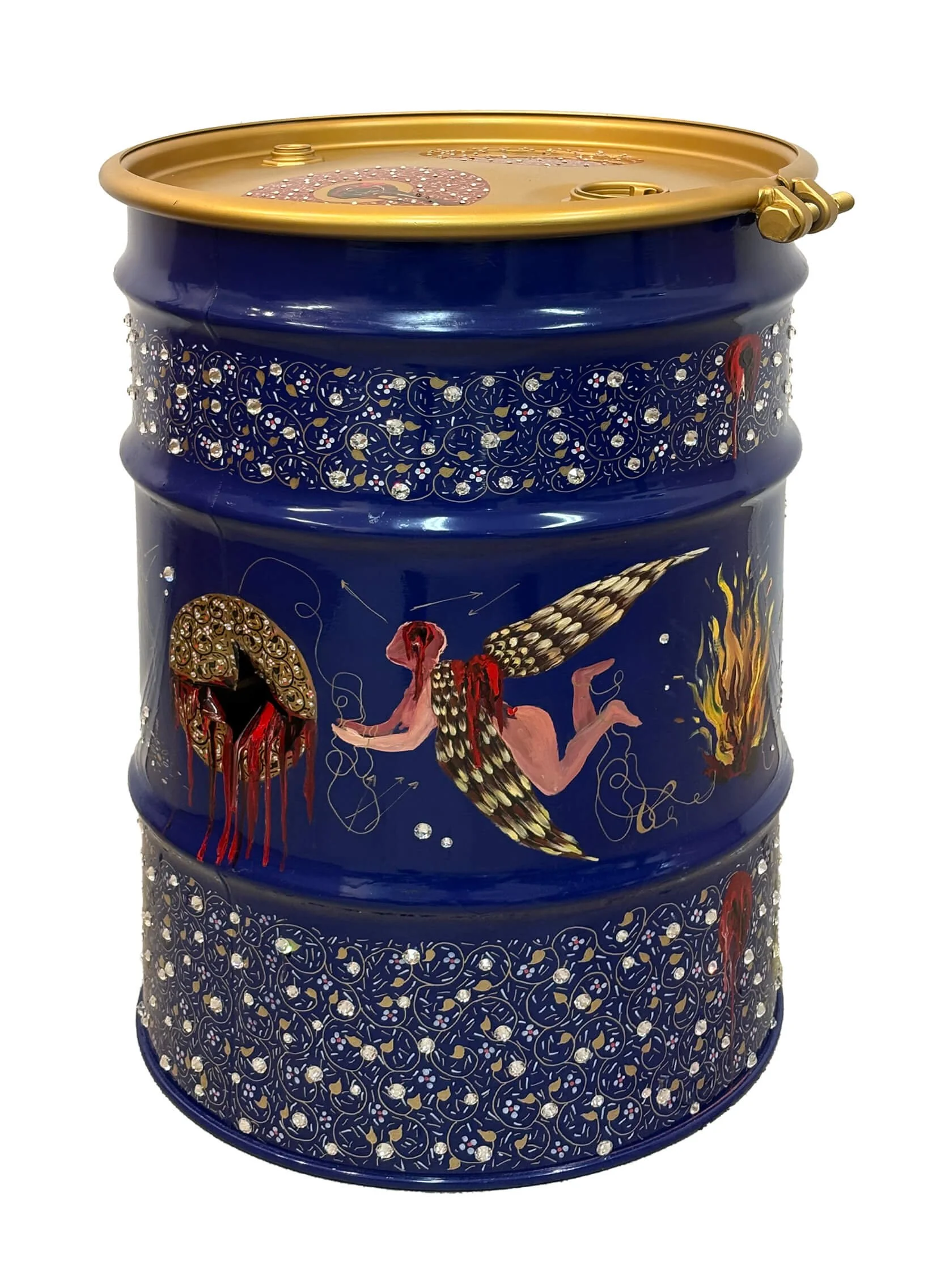
Like that one, Crown of Flames features large, everyday objects that she has sculpted into symbols of greed and terror, like her new work called "Oil Barrel #32." Oil's role in people's lives has been a central theme in Ahmadi's art for 30 years, and "Oil Barrel #32" is a real barrel that Ahmadi festooned with glittering crystals, a gold top, figures of women, and holes that look like they emerged from violent means. Painted pools of blood pour out onto the barrel's Persian blue surface. What is at first strikingly alluring becomes, on closer inspection, an entry point into a perception of depth and death. This thin line between beauty and betrayal is one that Crown of Flames highlights in every artwork. Visitors to Haines Gallery don't need to ask Ahmadi questions about that. Through her art, Ahmadi addresses that topic for everyone to see.
