
Renee Billingslea, Ten Japanese-American Concentration Camps, Art Object Gallery
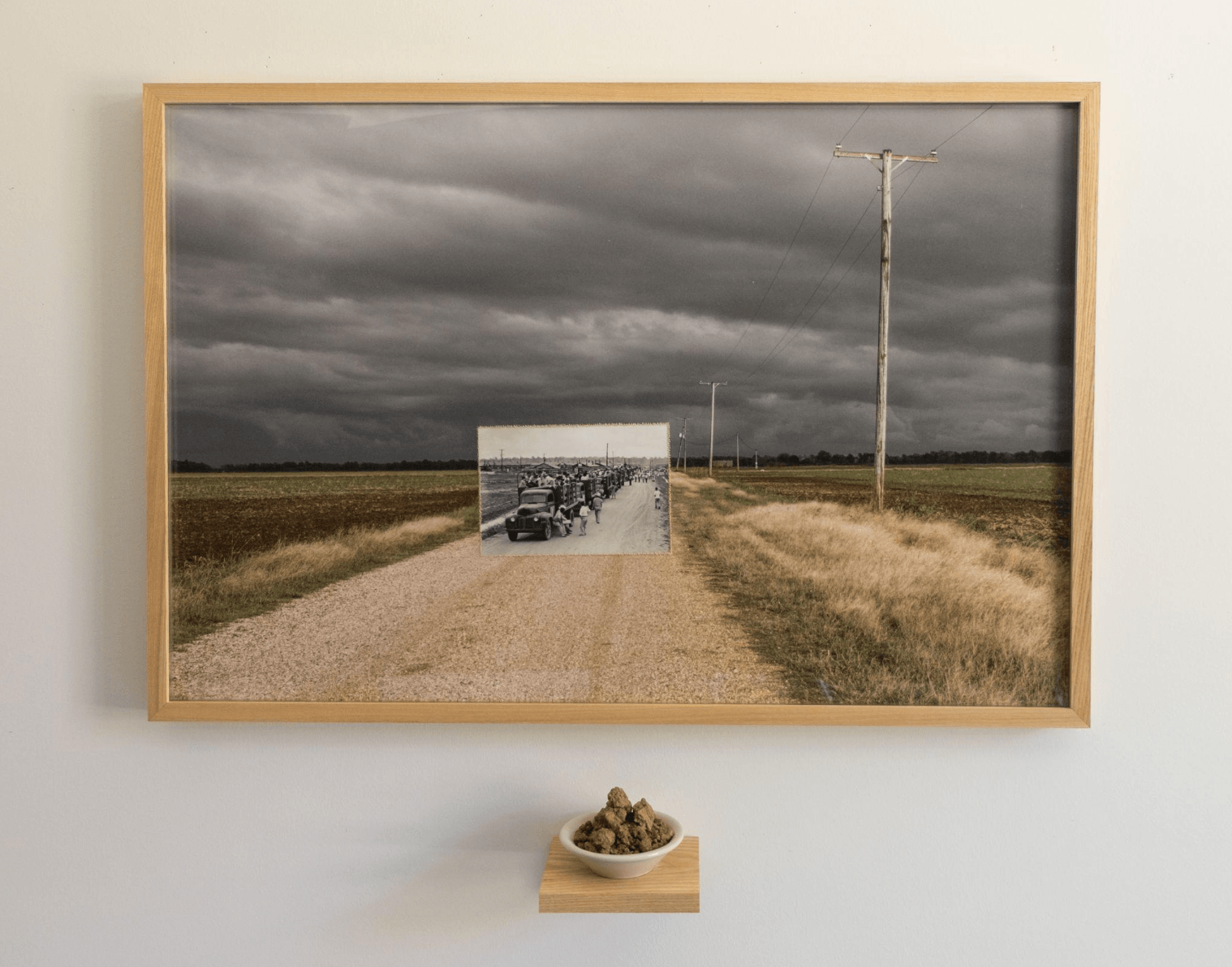
Renee Billingslea, Untitled, Jermone, Arkansas, 2018, digital print
In the historic Japantown neighborhood of San Jose, forgotten history is brought to life. Art Object Gallery, owned by Ken Matsumoto, is the latest location for South Bay artist Renee Billingslea’s exhibition, Ten Japanese-American Concentration Camps. One of the three Japantowns remaining in the nation, Renee’s exhibition documents and connects isolated, wild contemporary landscapes with a harsh national history, to a neighborhood and community that has quietly endured the weight of its memory.
Renee Billingslea is an artist who combines photography and stitching to illuminate historical and social topics in American history. She is committed to challenging accepted norms in our culture and, through her photographs, provokes a conversation about social issues and historical topics.
Her photographic series, which culminated in the exhibition Ten Japanese-American Concentration Camps, came to be during a research trip at the Library of Congress. There, she stumbled upon the photographer Russell Lee’s image of two Japanese women eating hot dogs with chopsticks at an assembly “holding” center in San Juan Bautista, California. Recognizing the site was just 50 miles from her home in Silicon Valley, Renee became engrossed with learning about Japanese-American internment during World War II.
Many Americans, including Renee, have had little to no education about Executive Order 9066. On February 19, 1942, President Roosevelt signed into law the authorization of military exclusion zones, which later led to the displacement and imprisonment of approximately 120,000 men, women, and children of Japanese ancestry living in the United States. Each location is in a remote part of the country, demonstrating that even today, its location connotes an invisibility, hiding from our collective and individual consciousness of our country’s inexcusable history. Renee made it her mission to visit and document all ten internment camp locations, culminating in this exhibition.
For all but one location, Renee traveled independently to experience the land each internment camp was built upon. Witnessing the vastness, isolation, and intensity of each site’s natural landscape allowed Renee to fathom in real time the harsh realities Japanese-Americans faced during their imprisonment.
Depicting the land of each camp is just one aspect of Renee’s artwork. Also imperative is the curation and integration of the War Relocation Authority (WRA) photographs of Japanese-Americans interned. For Renee, the propaganda element of this government project intrigued her: photographers from across the country were hired and given orders to capture specific aspects of life within each camp. Even with strict orders from the government, some WRA photographers, such as Ansel Adams and Dorothea Lange, produced images that challenged the approved narrative being broadcast from Washington. Using these WRA historical photographs as evidence, Renee retraced the steps these same photographers took to capture the landscape as it was then and now–bridging the gap between the invisible string that ties history and the present.
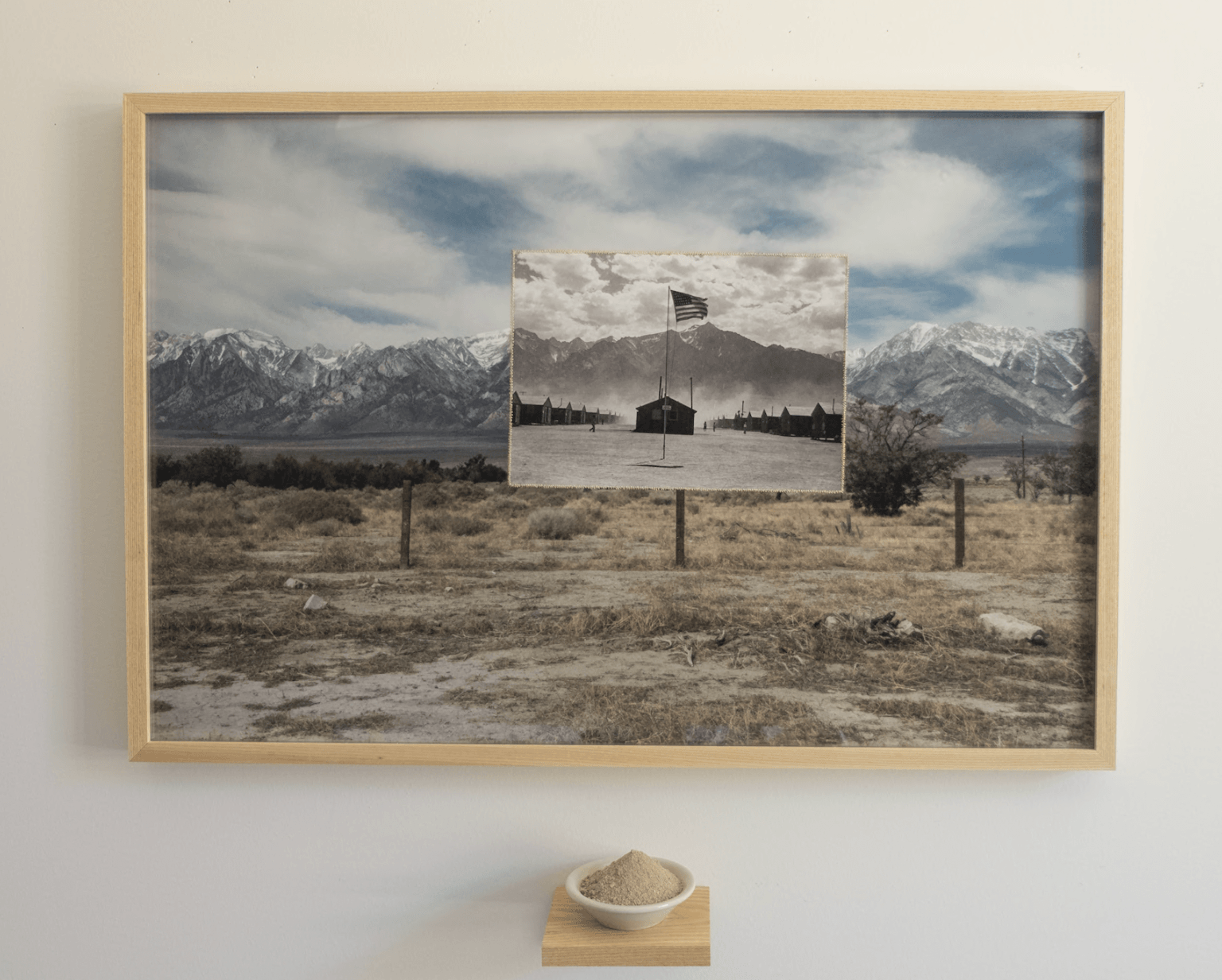
Renee Billingslea, Manzanar, California, 2018, digital print
Renee incorporates her photograph of the landscape with Dorothea Lange’s WRA image of the Manzanar camp, titled Manzanar, California, 2018. Past and present are intertwined with the artist sewing in gold string, honoring the Japanese art of Kintsugi, where gold is used to repair what has been broken. This physical act bridges the past and present, sewing together what is a broken aspect of American history. By stitching the historical artifact into the contemporary image, the two become bonded, and the landscape is forever impacted by the camp's existence. What is now a severe remote landscape is embedded with historical significance.
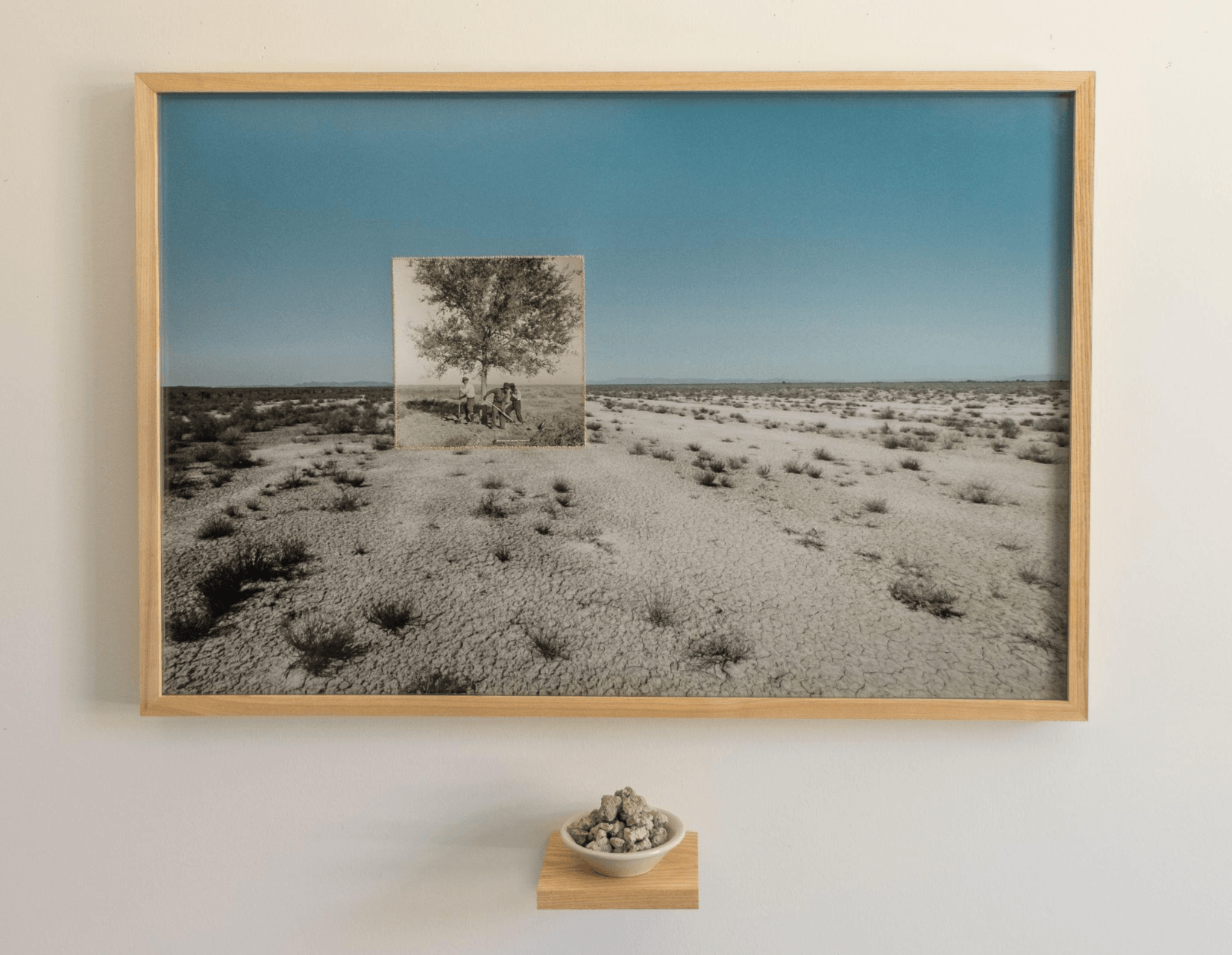
Renee Billingslea, Topaz, Utah, 2019, digital print
Soil from each landscape is included with every installation of the exhibition. For Renee, the physicality of the soil ties the land to the contemporary and historical photographs, making the location real and tangible. Up close, the soil from Topaz, Utah, 2019, shines with a slight blue tint, mimicking the reflection showcased in the photograph on view. The soil adds a material culture to the photographs, bringing a personal connection to each site. In this exhibition, each of the ten soil types is on display in two rows, showcasing the vast and diverse landscape of the camps. Two bowls remain empty to honor the native land that two of the ten camps occupied, stolen by the federal government and returned to its rightful owners after the war.
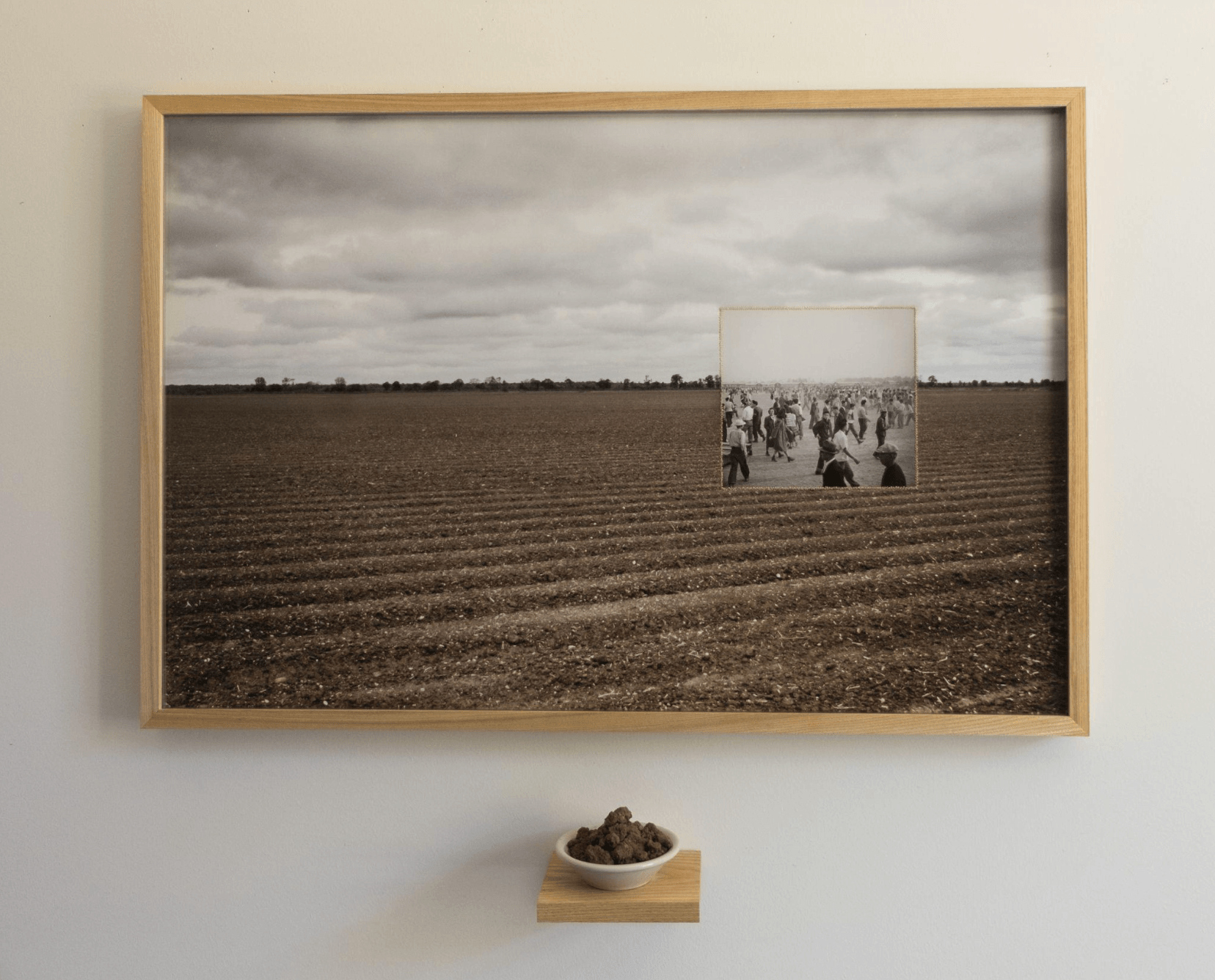
Renee Billingslea, Rohwer Arkansas, 2019, digital print
By bringing together contemporary imagery of each landscape with a historical photograph, Renee captures the individuality and grace exhibited by Japanese-Americans, even though their rights as citizens have been stripped away. In Rohwer Arkansas, 2019, Renee captures a barren contemporary rural agriculture field embedded within a historic photograph of camp prisoners leaving a high school football game. The scene looks as if it could be taken anywhere in America: stylish women and men socializing with their peers after an all-American sporting event. Our mind sees these prisoners as any and every citizen leaving a football game, and yet, Renee’s brilliant connection of weaving in their reality burns the image of imprisoned Americans firmly in the minds of the viewer. They look like any of us, and the chilling reminder that the American government took the liberty to imprison its own citizens while trying to maintain the image of normalcy.
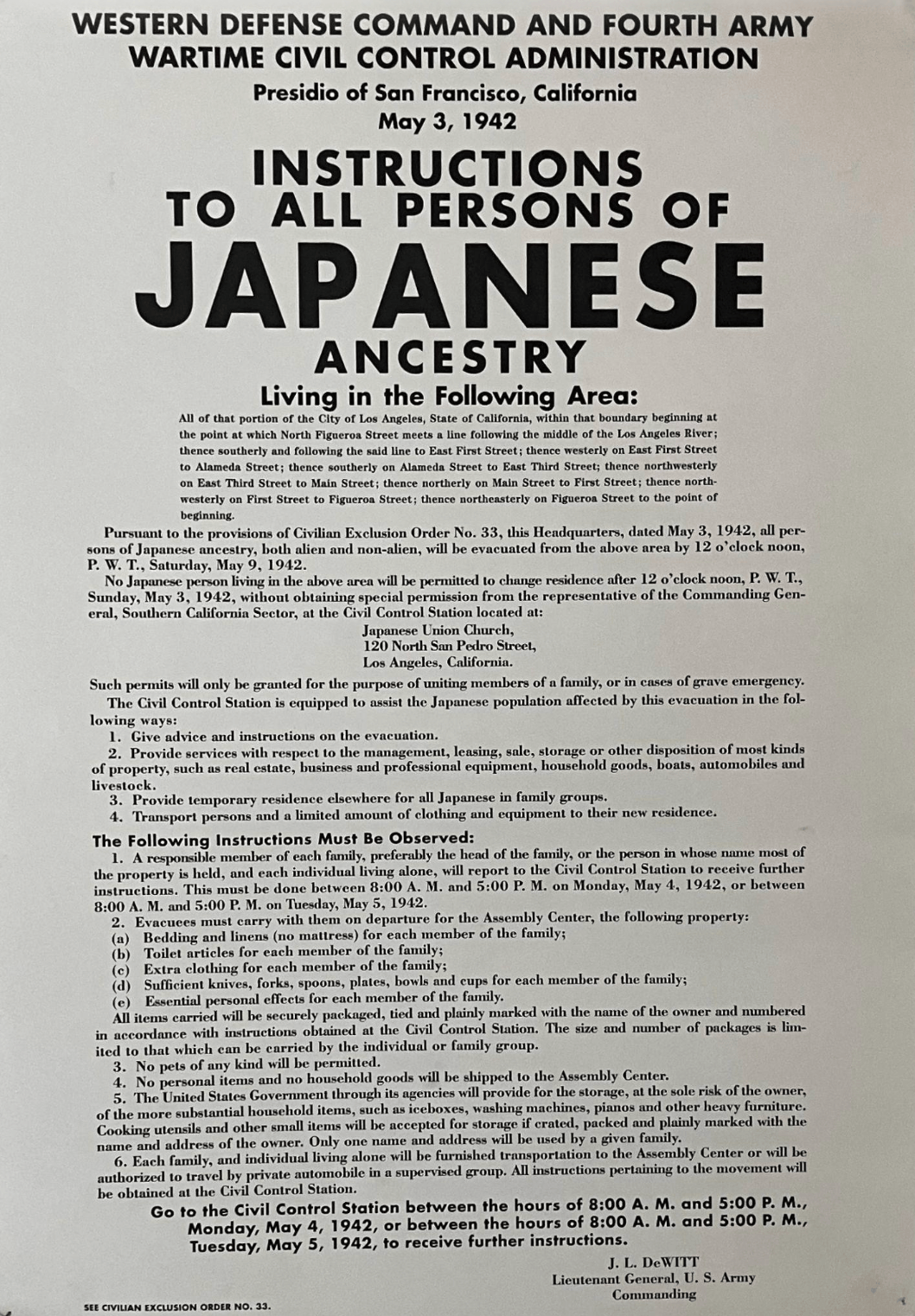
Image of the Western Defense Command and Fourth Army Civil Control Administration’s instructions to all persons of Japanese ancestry
An integral part of the exhibition is a printout of the Western Defense Command and Fourth Army Civil Control Administration’s instructions to all persons of Japanese ancestry. Reading this document is like reading any government memo—your mind at first wants to follow its orders, until you keep reading, each sentence stripping away the rights of the people one line at a time. The realization that the government simply and effectively created “lawful” documentation to imprison its own people is chilling. The success of Ten Japanese-American Concentration Camps lies in its wherewithal to capture the viewer’s slow and yet deliberate understanding of the silent horrors our government inflicted upon its own people.
For Renee, discovering and researching the history and treatment of Japanese-Americans runs parallel to what immigrants and citizens of Central American descent face in our country today. Renee’s photographs visually demonstrate the similarities between the internment camps of World War II and immigration holding facilities that currently occupy landscapes across our country. Ten Japanese-American Concentration Camps is her artistic appeal to reckon with the horrors of America’s past, in hopes that we wake up to it repeating itself in our contemporary lives. History is not linear; it runs parallel to the present and deeply affects our future. Renee Billingslea’s exhibition, Ten Japanese-American Concentration Camps, shows us the importance of seeing the truth and therefore forbidding the horrors from happening again.
Ten Japanese-American Concentration Camps is on view at Art Object Gallery through August 25, 2026, by appointment. Free admission.
Art Object Gallery, 592 N. 5th Street, San Jose, CA 95112
