

Rebecca Manson, Time You Must Be Laughing, Jessica Silverman Gallery
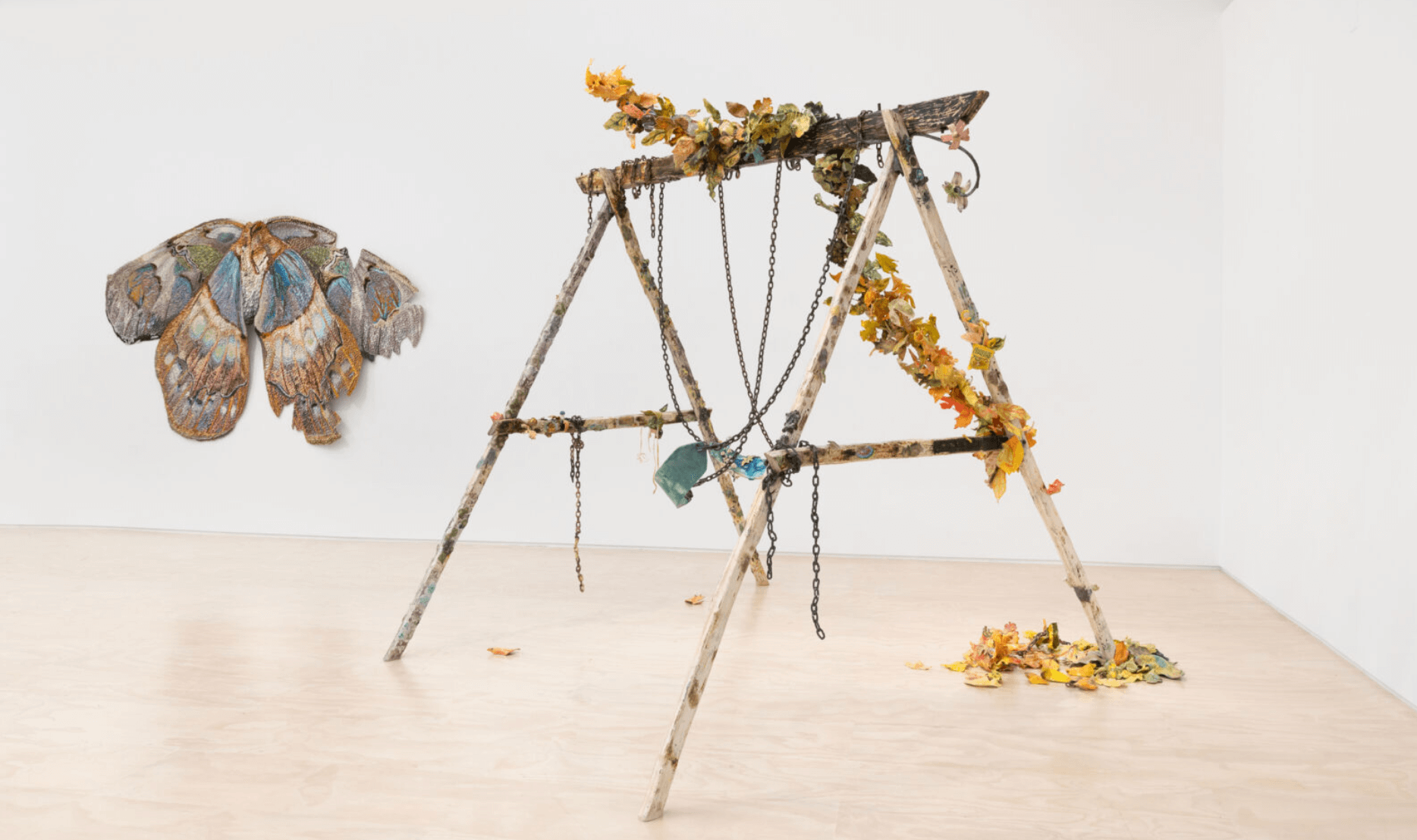
Installation view. Rebecca Manson at Jessica Silverman, 2026.
The most conspicuous element of Rebecca Manson’s exhibition “Time, You Must Be Laughing,” which runs through February 28 at Jessica Silverman, is a series of human-sized butterfly or moth wings mounted on the walls or on floor pedestals. Almost immediately, one notices that the elaborately patterned wing surfaces have been assembled as mosaics, built up from bits of porcelain that the artist calls smooshes.
A smoosh often resembles an elongated, shelled sunflower seed in size and shape, but the wing elements lack the regularity of your typical tesserae. There are smooshes shaped like bits of torn tape, pieces that look like curled ribbons, and larger disks with concentric circles painted on them. Many smooshes have different colors on each side, or a molted appearance that is the result of a complicated process involving multiple glazings and firings. Some smooshes have a pattern of ridges that resembles the veins of the complete wings, but on a smaller scale.
Just as the smooshes lack uniformity, they have been applied to the canvas backing in an inconsistent manner. Sometimes they are placed with their broadest face downwards, other times they rest on their narrowest edge. The smooshes are most often attached so that the end closest to where the wing would have been connected to the insect’s body is below the opposite end, but all sorts of angles, including completely flat, are found. Nor are the various colored smooshes applied in regular patterns: in a series of eyespots, the lightly colored center of the spot is placed slightly differently in each instance.
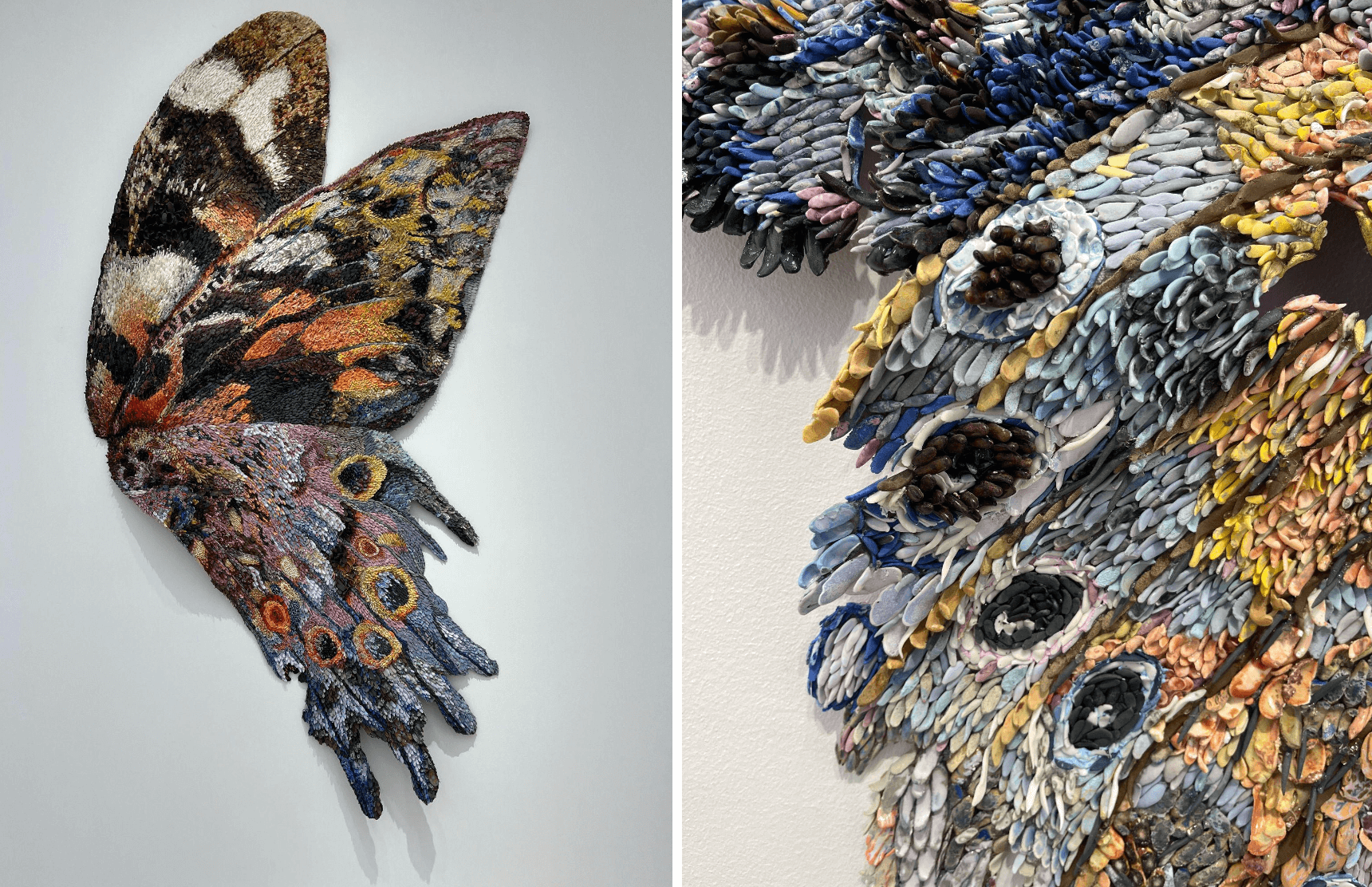
Left: Rebecca Manson. Black Swallowtail, 2025. Porcelain, glaze, adhesives, canvas, and hardware. 108 x 80 x 3 inches.
Right: detail, Rebecca Manson, Opal, 2025. Porcelain, glaze, adhesives, canvas, and hardware.
In many of the works based on Lepidoptera, a single wing is depicted. In some cases, it’s only a fragment of a wing. When multiple wings are included, between-wing symmetry, both in shape and in coloration, is lacking. There are often holes or tears in the wings, and they never lay flat, instead rippling like waves, curling at their edges, or both.
Non-insect-wing pieces include sculptures depicting a life-size swing-set and oversized, bedraggled flowers. The swing-set has been decorated with swooshes of dried leaves and a bikini, but its most interesting feature is that the swings are depicted in twisted motion, as if being blown by the wind or, perhaps, as suggested by the scholar Jenni Sorkin at the artist’s talk, ridden by ghost children.
Assembly from smooshes is unique to the Lepidoptera wing works. The wing pieces also stand out from the other works in the show due to their greater ambiguity. As the wings are depicted isolated from the remainder of the insects’ bodies, the works do not function as portraits of living beings. The diversity of the wings and the differences in their arrangement (such that some displayed on the floor are barely recognizable as wings) mean that, although they represent variants of a form, the pieces do not come across as specimens from a catalog.

Rebecca Manson. Oilslick, 2025. Porcelain, glaze, adhesives, canvas, and hardware. 38 x 64 x 3 inches.
What are they then? The wings are built up from bits like mosaics, but the smooshes have a non-traditional irregularity that makes them look, in aggregate, like brushwork, making the finished works appear to be paintings. As the wings exist in three dimensions and are sometimes free-standing, they also seem to be a sculpture. Due to their medium, the works fit in the craft tradition – yet they have no practical function.
A notable aspect of the wing works is the foregrounding of the handmade and the studio tedium that comes with it. The works question a world where ideas are key, and production is mechanical. Instead, the pieces, which are assembled from sketches, hark back to workshop traditions, including large-scale mural making.
The wing works’ messiness as well as their refusal to pursue a clear purpose—they are neither portraits nor catalog entries—saves them from being kitsch. Their antecedent, at least in spirit, appears to be fragmentary notebook drawings from an art school course involving examination of biological specimens through the microscope. If the Lepidoptera-inspired works do not descend into kitsch, they also do not attempt transcendence. Rather, the works remain rooted in the real: this, right here, is all there is, they suggest.
