
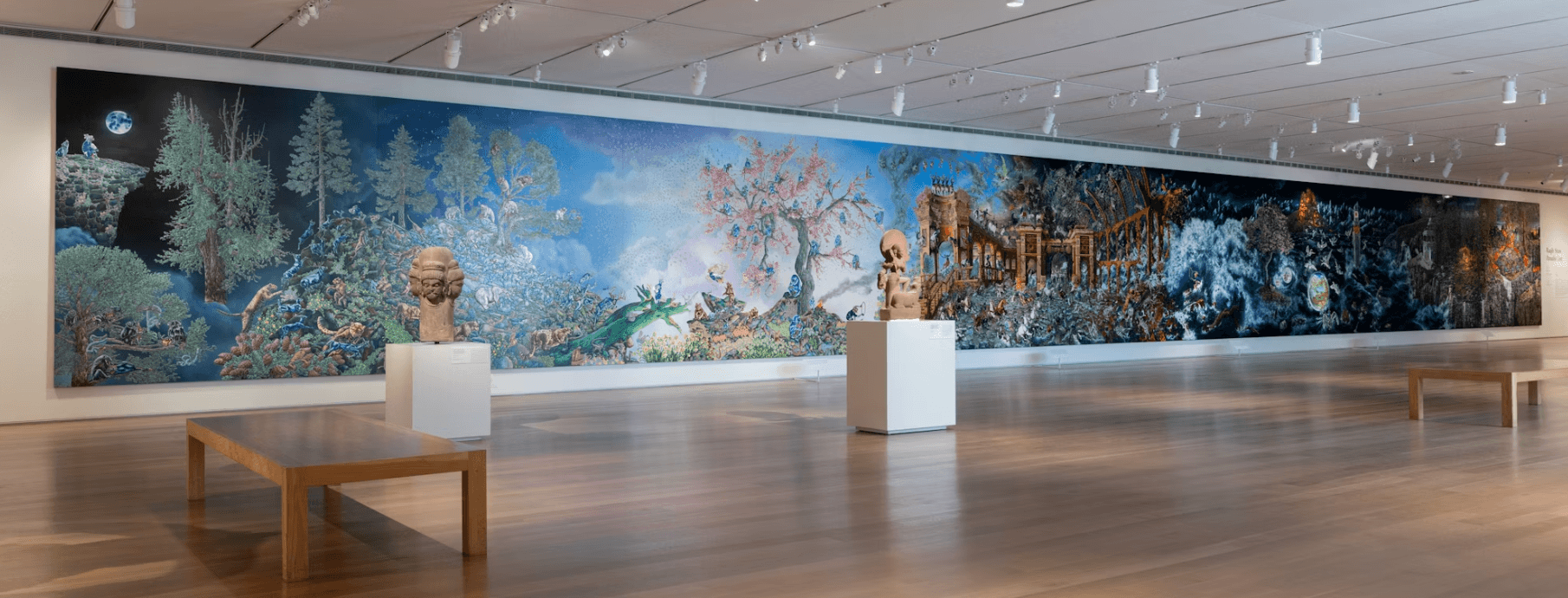
Raqib Shaw, Paradise Lost, The Art Institute of Chicago
By N Stern
You've walked this path a thousand times, off the zen reverie and cradle rock of the El, down the rusted honeycomb steps, over rain-specked sidewalk, past the patinated bronze lions, gatekeepers of the dreaming. You once shot b-roll on these steps - permitless - because that's the Chicago way - the cinematographer grinning, the actor in shades, lest he tempt the lenses of the Japanese tour group obsessed with his early, funny dance/dance revolution.
In your past, the Arts of Asia gallery is a transitional artery, five millennia never touched by contemporary art - you're either ascending toward Chagall's stained glass harlequin - or descending from O'Keeffe's Sky Above Clouds IV.
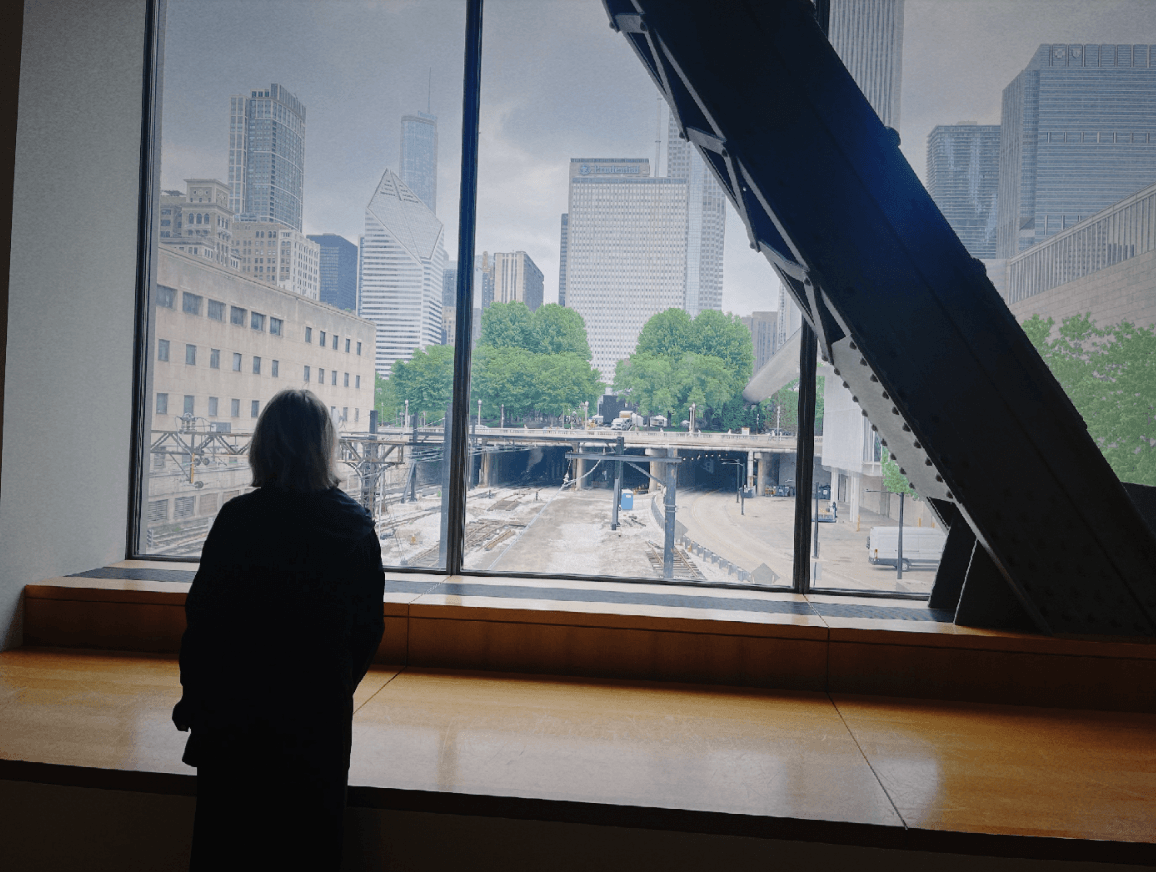
Honey blonde wood, a rail yard glimpse of the Millenium Park skyline, a diorama of a city within a city. A university classmate used to save on train fare by hopping the freight line and riding the rails to the switchyard below. The ghost of Woody Guthrie taps your shoulder and you stop in your tracks.
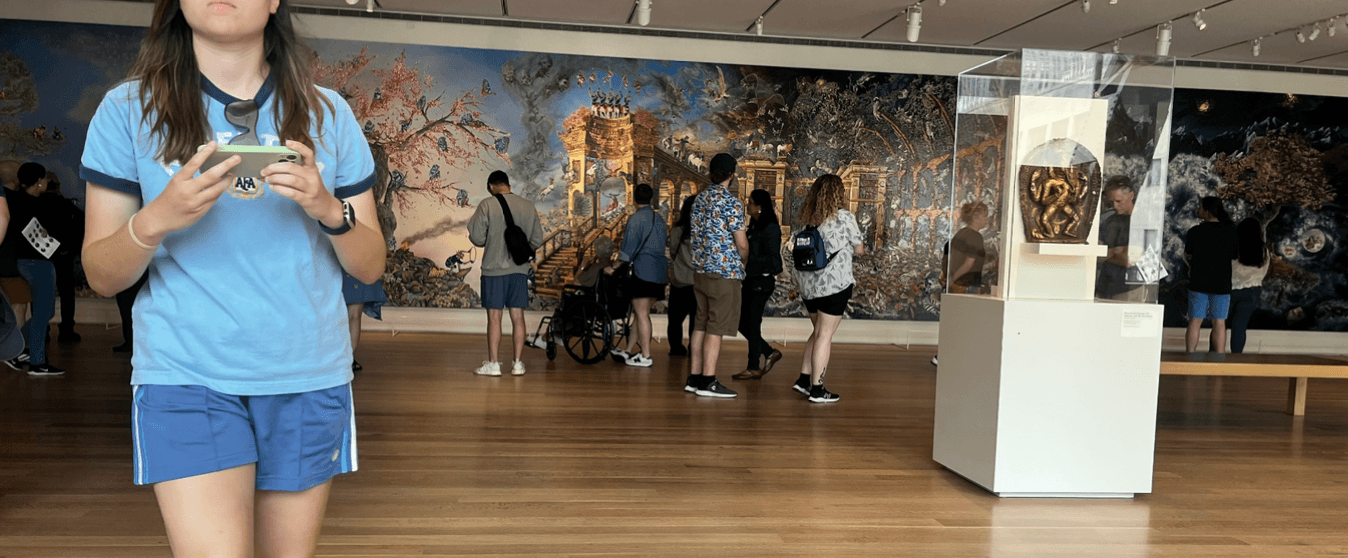
It's not supposed to be there, Starbursts of color, shimmering hoards of gold and silken green and deep-dyed cerulean. You sense movement in the corner of your eye - or is it trompe l’oiel. A landscape, no a dreamscape, in 70mm Cinemascope, where birds alight, trees sway in slow disco, verdurous, serpentine, as invasive as Jeff VanderMeer’s terroir.
100ft+ wide, 21 panels of automobile enamel firework glimmering over acrylic liner on gemstone-imbued gesso. Raqib Shaw's PARADISE LOST (2009-25). Framed by Buddha(s) and the Goddess(es) Durga, Kali, and Hariti. Your spider sense tingles, your hand reaches for your camera, but iPhone algorithmic color cannot touch Shaw's palette. You are shoulder to shoulder with the instagram masses who drop the veil of selfie stick Narcissus and just..
Breathe.
Wisdom of the crowds.
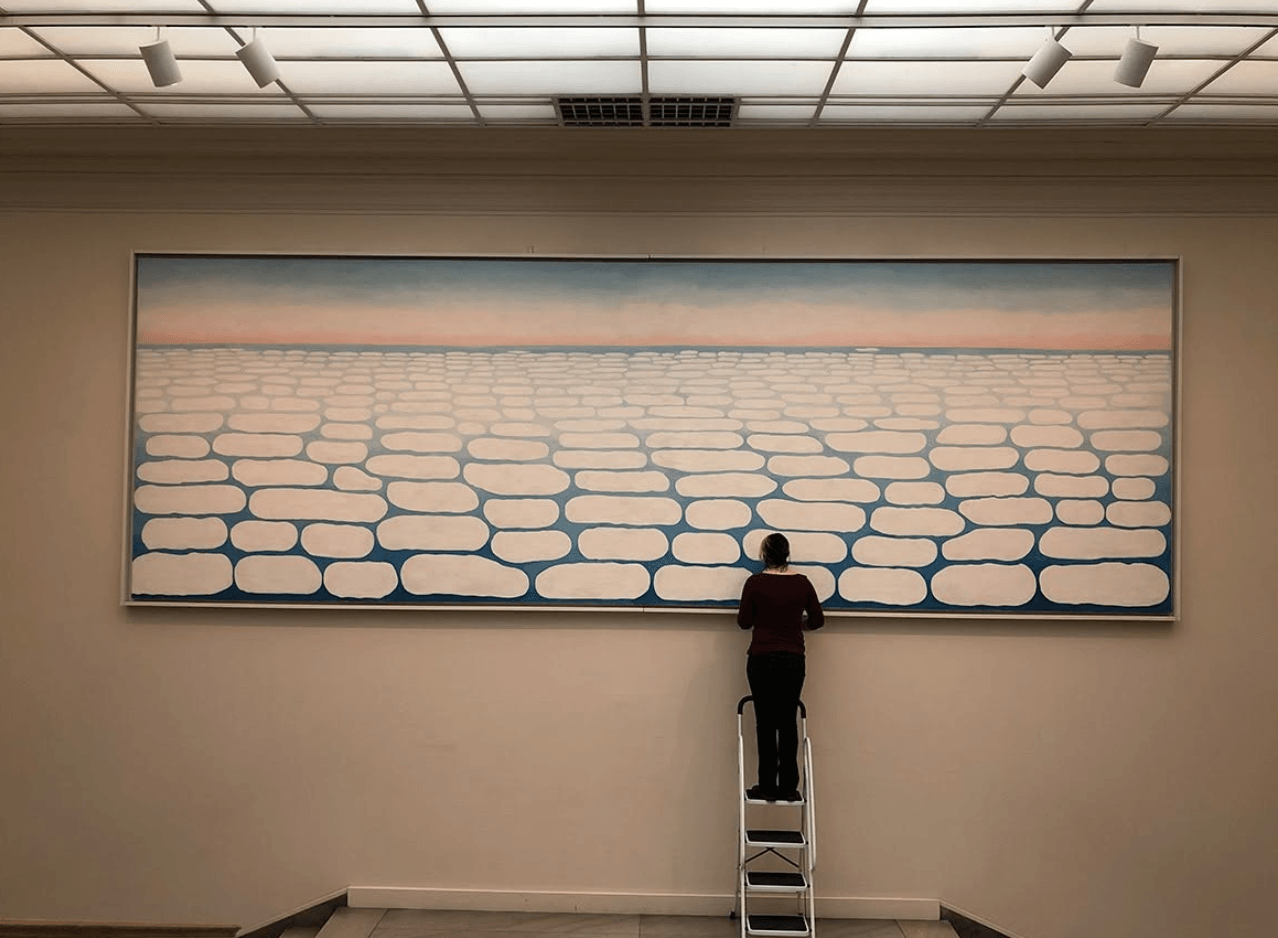
There are no accidents - Shaw's work in conversation with O'keefe's. On Sky Above Clouds IV she writes:
“I painted a painting eight feet high and twenty-four feet wide—it kept me working every minute from six a.m. till eight or nine at night as I had to be finished before it was cold—I worked in the garage and it had no heat—Such a size is of course ridiculous but I had it in my head as something I wanted to do for a couple of years.”
21 years in creation, for Shaw it was an art school dare then a single panel, then a saga:
"It was just a flight of fancy, but then as they say words do have their own spirits"
PARADISE LOST whispers in conversation with O'keefe (and Hockney, and Bosch and Edo screens.)
It screams over the formal tomb-silence of limestone and bronze, yet never monopolizes the conversation - you are beckoned into the hospitality of Abraham's tent, opened on four sides, anointed by the scent of mint tea, and candied delights - stuffed dates and Nankhatai, Nutty atta laddoo that stains gold leaf across your tongue.
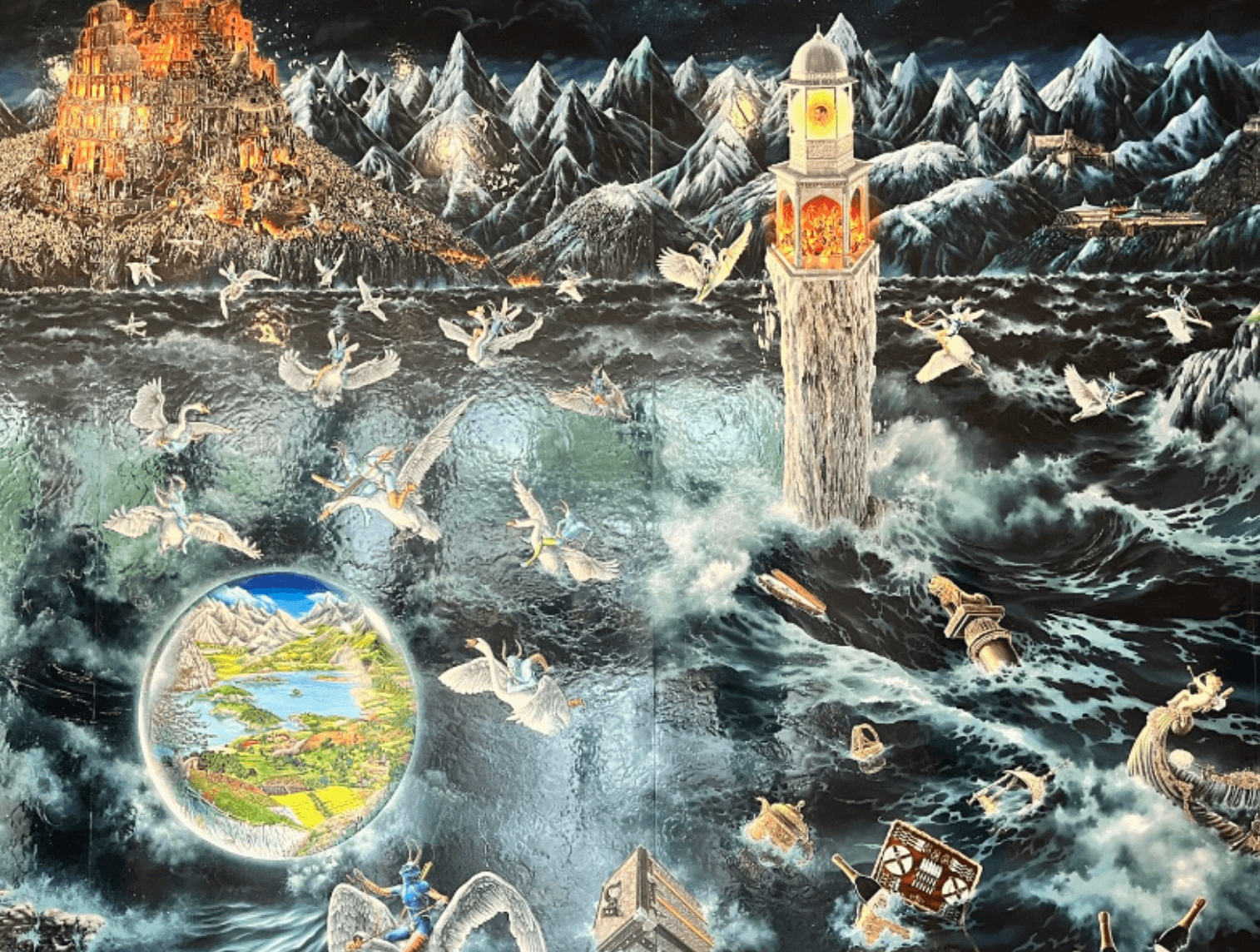
Milton’s Paradise Lost never (quite) fades, never leaves the party early or for long. Not in psychology, nor socio-political predicaments of state. Orlando Reade's "What in Me is Dark" (Astra House, 2024) shouts out Milton's influence upon Jefferson and Eliot and Heidegger and Arendt.
It's the atheist's favorite codex.
Never out of style, Reade notes how "Satan contemplates his minions’ prospects in hell “like a tech chief executive contemplating child labourers in a mineral mine”.
It's no wonder Roger Avary has announced an AI film adaptation.
Shaw's panels are both sequential and oblique - you flashback to a screening where filmmaker Michael Haneke (Cache, The White Ribbon) dismissed the linear tale, the geometric directness of a Newton's cradle strike - praising instead the elegance of the "banked" billiards shot. The clack of wood and chalk on resin echoes through Shaw’s mise-en-scene, offering eras past and present, kaleidoscopic and pixel keen.
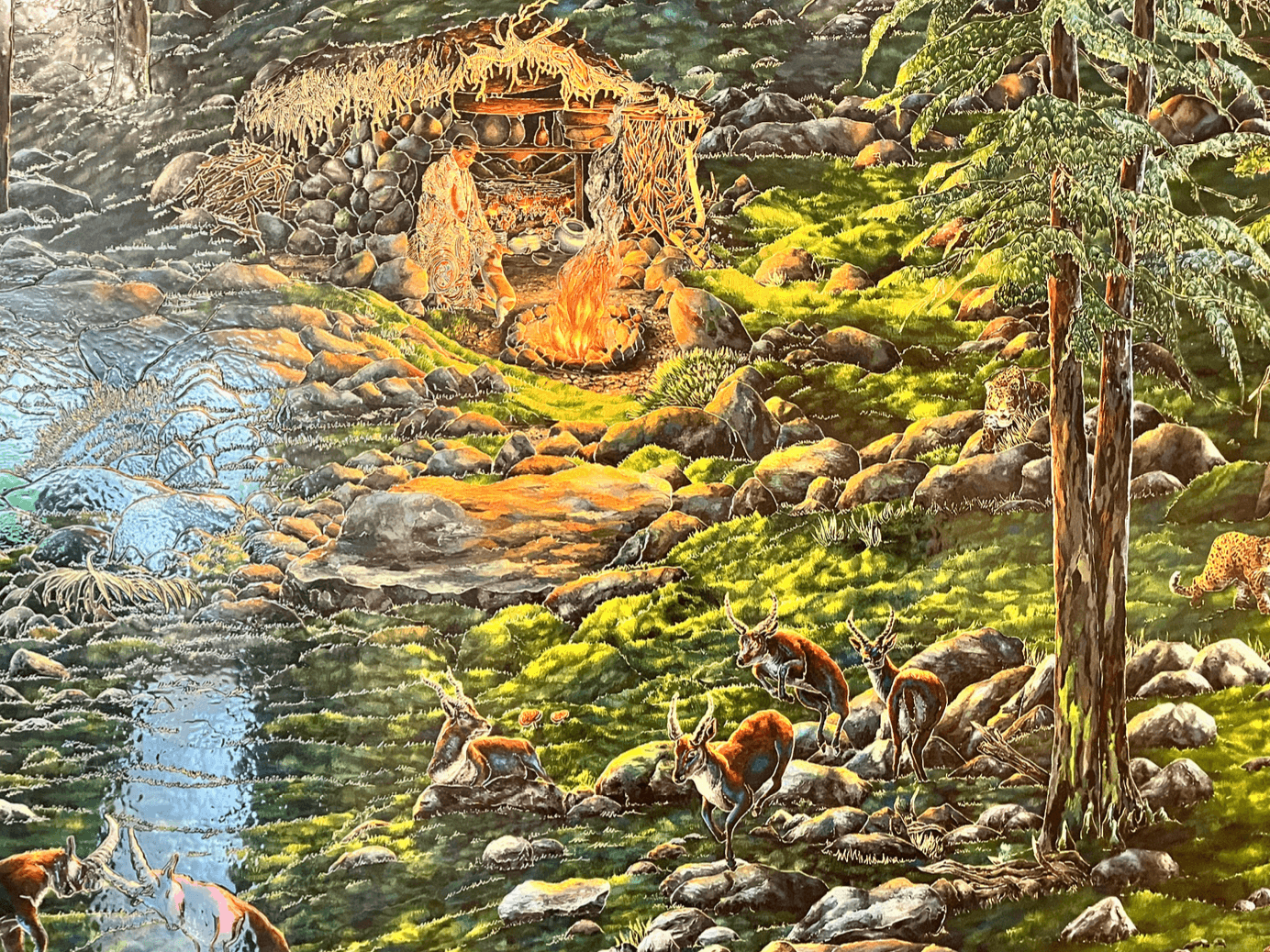
Shaw's tales a paean to the lives never lived and the lives best lived. A middle-aged yearning to understand and a punk youth fever to belong. “This is not just my story,” Shaw explained. “It is the story of each of us, and the story of our times.”
His enemy is complacency and puny thought.
His enemy is your old boss at a comic book company who thought graphic novels and movies were identical in form and perception.
(No - film unspools in axis of time and defined space - the graphic novel grants permission to linger.)
Shaw invites you to linger. To sit on carved wood or the window beam. Traverse 20 years and dynastic Mahabharata tales. Peter Brook's version runs 9 hours on stage, 3 on screen.
Shaw entreats you to take your time.
You (and he) instantiate the Main character energy painted into every frame. You are the monkey king you are the trickster you are the deceived. You are then and now and never (and forever.)
You are the train at every station (and the one that never stops.)
For every paradise lost /another found.
In Mark Helprin's "Winter's Tale," urban scions seek to construct a bridge to the future - Shaw has succeeded where your dog-eared paperback failed.
Exit, pursued by a Kashmiri Himalayan black, Ursa mosaiced into this epic.
Your eyes narrow in the peak Midwestern sun, skyscrapers as high as an elephant's eye.
Keep passing the open windows.
And don't awaken the lions.
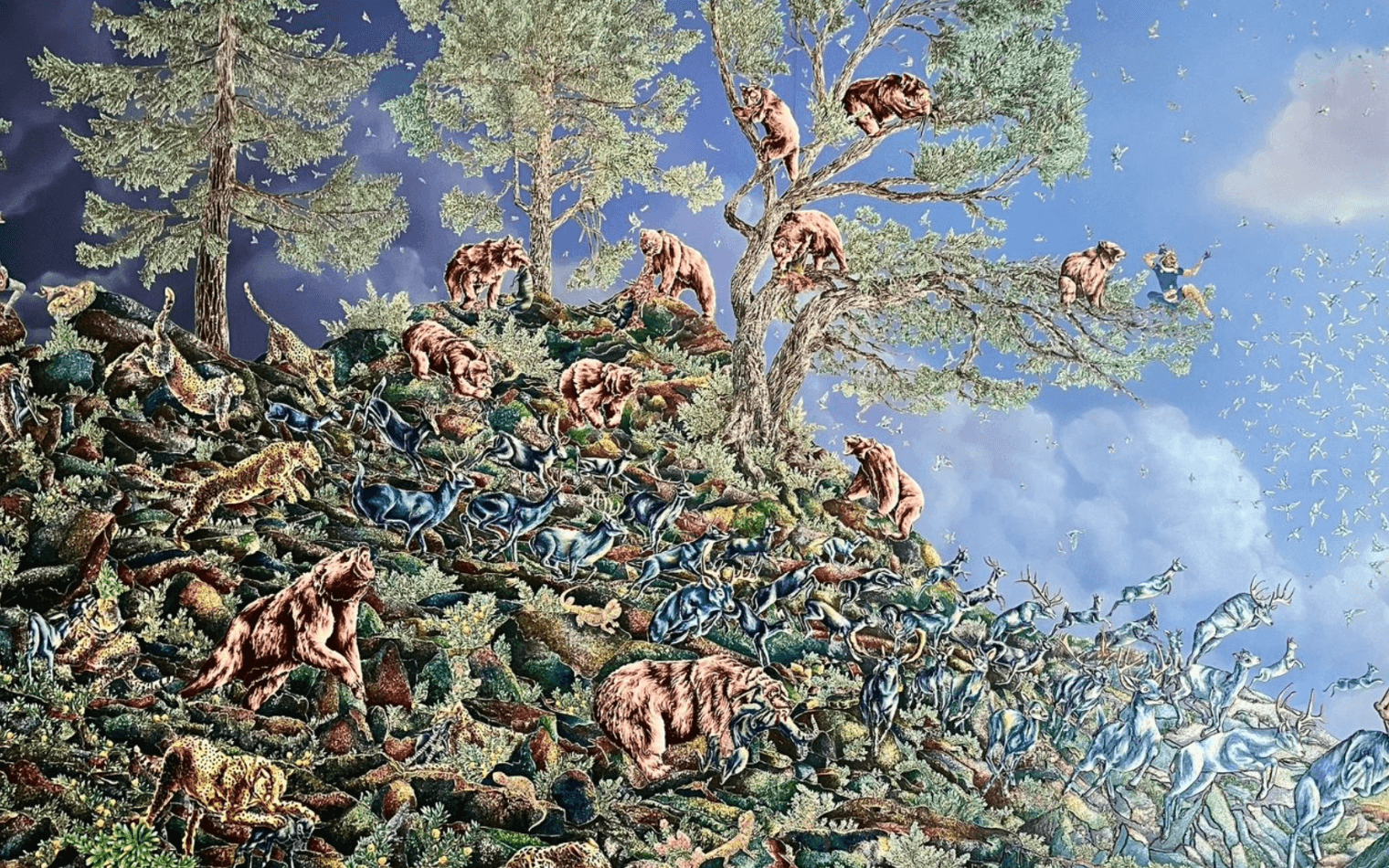
Raqib Shaw, Paradise Lost, 2009–25, automobile enamel, acrylic liner, and gesso on panel, 21 panels, more than 100 feet wide. Curated by Madhuvanti Ghose, Alsdorf Associate Curator of Indian, Southeast Asian, and Himalayan Art, Arts of Asia. Alsdorf Galleries (141–142), Art Institute of Chicago. Generous support provided by Usha and Lakshmi Mittal. On view through Nov. 15, 2026.