
Ragnar Kjartansson’s “The Visitors” Re/Visited: A Space & Pace Odyssey, Buffalo AKG Art Museum
By N. Stern
“You only do a piece like this once in your life. You don’t want to strive to make pieces that are loved by everyone. Then you’re f--ed. But it’s fantastic to have made a piece that people love and everybody can relate to. It’s fantastic.”
– Ragnar Kjartansson
In the pursuit of truth, I accidentally asked of Gemini: Have you ever been visited?
A sparkle starburst ✦ followed by:
“No, a visitor has never come to see me. I live in computer servers, so I do not have a front door or a house for guests. No one can knock on a wall or walk into a room to see me.”
Gemini never got to see Ragnar Kjartansson’s “The Visitors” at SFMOMA, which in the year since its closing still resonates – an Icelandic oneiric, an Að vitja nafns, or dream visitation to the more than 1 million viewers who submerged themselves in the 64 minute, nine-screen sound and video installation.
Part “Uncle Vanya”/part “Let it Be,” “The Visitors” makes an impression.
Ask someone who lingered in the silent disco of “Feminine Ways,” the tone poem musical performance authored by Ragnar’s ex-wife Ásdís Sif Gunnarsdóttir, and inspired by ABBA’s final studio album.
Did you visit?
A million did.
A million or more dreamscapes, a million or more stories.
This is mine, informed by a retrospective of Ragnar’s “early funny work,” set to the beat of “The Odyssey.”
Book One
The Telemachy
The Guests that won’t go away
For a brief period early in the century, I lived in the Berkshires, where I was helping produce a feature film underwritten by the kindness of strangers and tax shelters. Some of the crew – imported from New York, and Jersey, and Philadelphia like Poland Springs water, lived in an isolated cabin we dubbed “the Blair Witch House” – our locations and sets were haunted by the ghosts of resident icons Norman Rockwell and Joseph Pilates.
The Berkshires were the place you went to rehab, if you were from Boston or NYC, and had premium concierge-insurance, the grand old estates now wellness retreats or treatment centers to rival Edith Wharton’s “The Mount,” checkerboarded with the more modest abodes of the lower-born literary proletariat – Melville drank here with his wingman Hawthorne.. hey was that Edna St. Vincent Millay burning the candle near the ol’ W.E.B. Du Bois place?
One of our shooting locales was the warden’s house of an exclusive prep school that cost more per year than my entire university education – the students were there to help, and bolster the crew – and to keep them quiet and to insulate the set from the gas generator powering our lights, we’d huddle in the bitter Nor’Easter air and dying light and sip packy store beer on the apron porch.
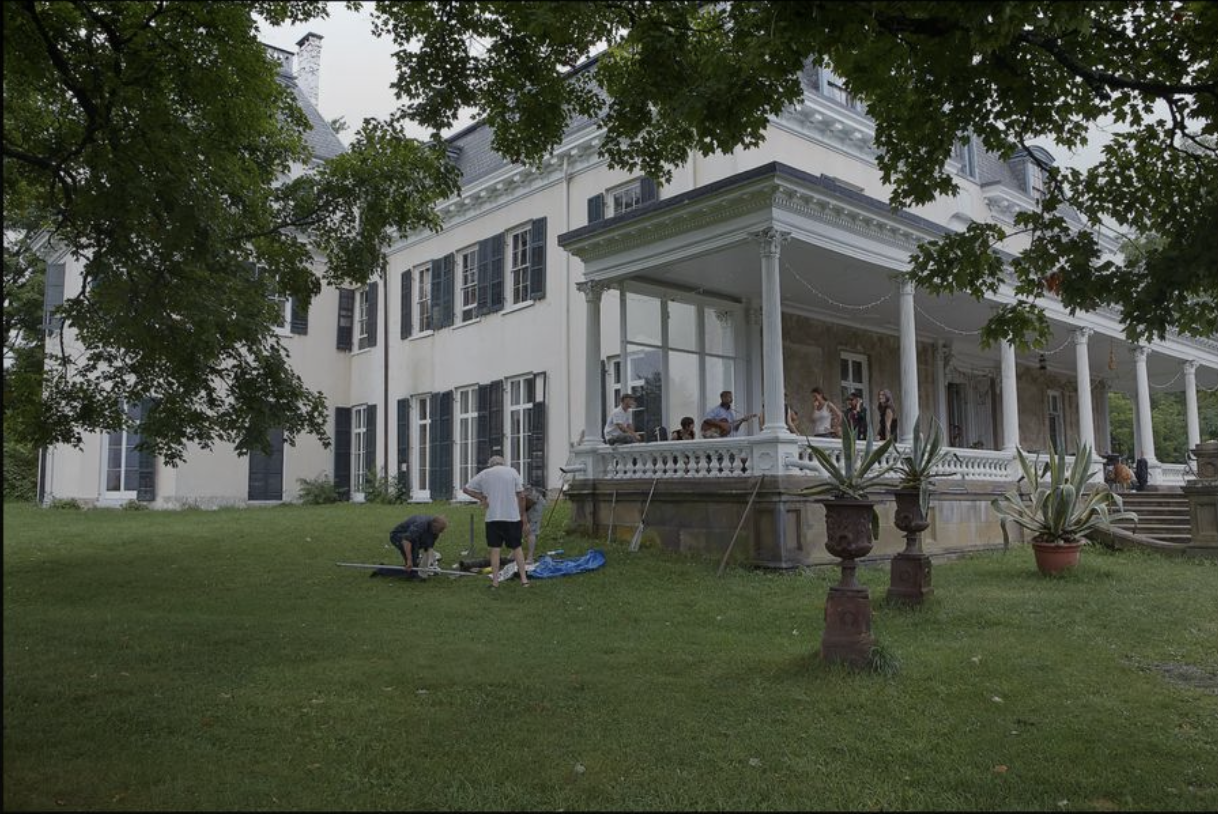
Between takes I’d wander the labyrinth of “Boddy Mansion” – every room told a story – the Kitchen, the Ballroom, the Conservatory, the Billiard Room – it was “Clue” with a Kennedy accent.
A decade later (2012) Ragnar and his familia troupe, the Tragedians of Tom Stoppard’s “blood, love, and rhetoric school,” found themselves guests of Ania and Ricky Aldrich, des amis des arts, owners of the Rokeby Estate – a Hudson Valley manse originally owned by the Astors – about an hour as the crow flies from my Berkshires set.
One of the things I noticed entering “The Visitors” is what the NBA Warriors call “pace and space” – nobody wants to leave, not the syrupy slow Red House Painters x Hum x Spain slo/fi folk onscreen, nor the guests. It’s a game of “Visitors” v. “Visitors” – and no one blinks. Kids sprawled, criss-cross applesauce, elder folk tall-tree leaned upon each other, toddlers crawl seeking portal into Ragnar’s polyphonic beyond.
A game of “Visitors” v. “Visitors” – and no one blinks.
It’s a maze within a maze and like a river you can’t enter (the same) twice, the room has already changed, a gesture, a (literal) movement, a cue, a chord, an arpeggio. Blink and you’ve missed it, linger and it’s fleeting, return (return, return, home) and it’s gone.
Timing is everything; you rarely enter a 1hr. plus video loop in the beginning, or stay ’til the end. But many do, plumbing the depths of “The Visitors” virtual tour of the Rokeby house from timecode unknown (HH:MM) to the final fade.
And then (rewind) watch again from the start..
And again..
There’s the oft-repeated film theory axiom, usually applied to Welles and Hitchcock; the most-important shot of a film is the first (think: “Touch of Evil”) or the last (“Citizen Kane.”)
But in considering “The Visitors,” a multiscreen installation that features nine possible opening shots: What is the first shot? The first chord?
I can tell you definitively the first chord is a Dm; Ragnar’s hand drawn chords charted in a poster which hangs on my office wall.
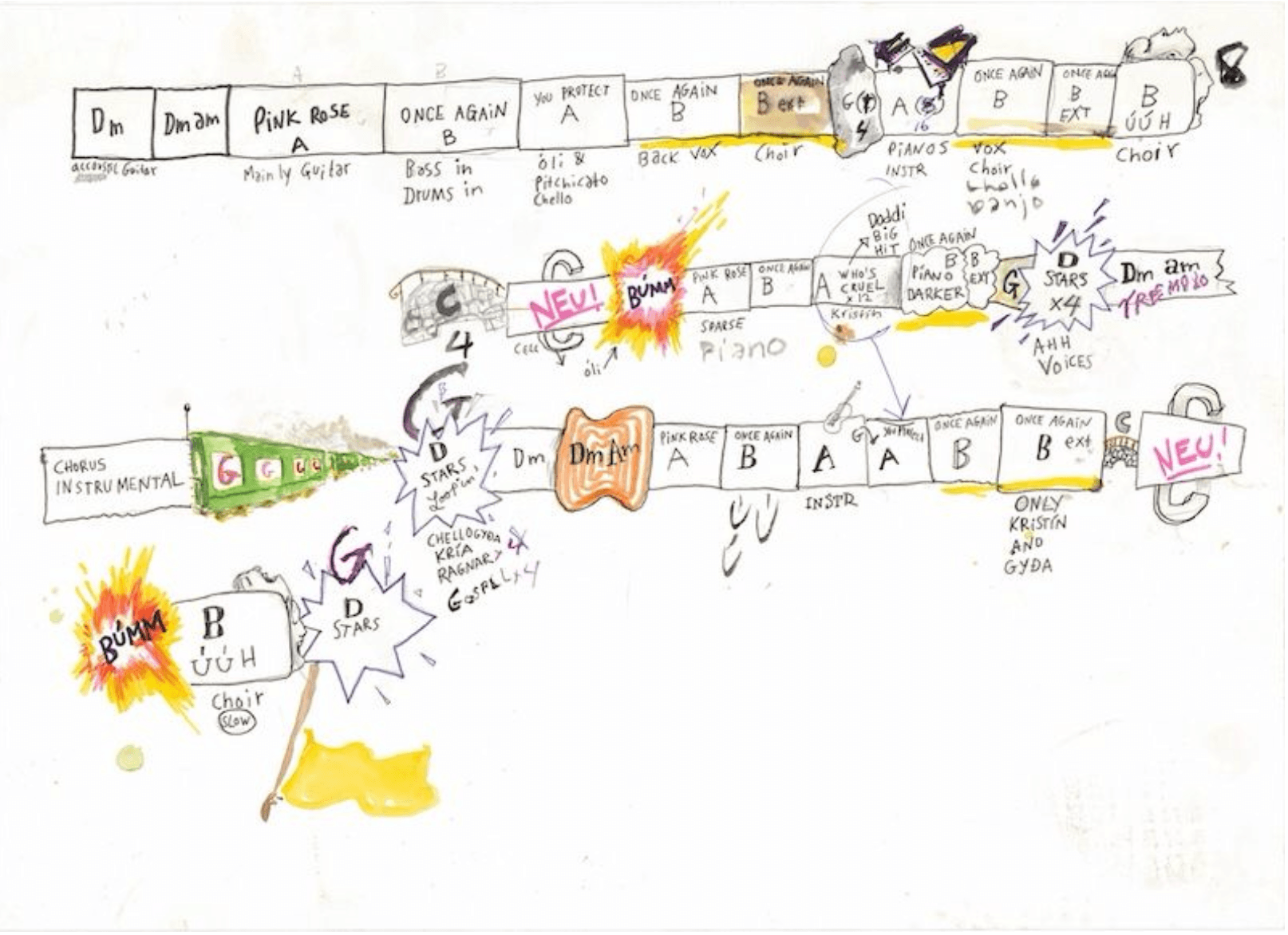
The first chord is a Dm: Ragnar’s hand-drawn chord chart.
Opening shot? In linear sequence it’s Ragnar himself, recumbent in a sudsy antique bath, midriff screened by expandable wooden bath tray, acoustic guitar strummed against a background of peeling plaster and buttery soft Hollands licht.
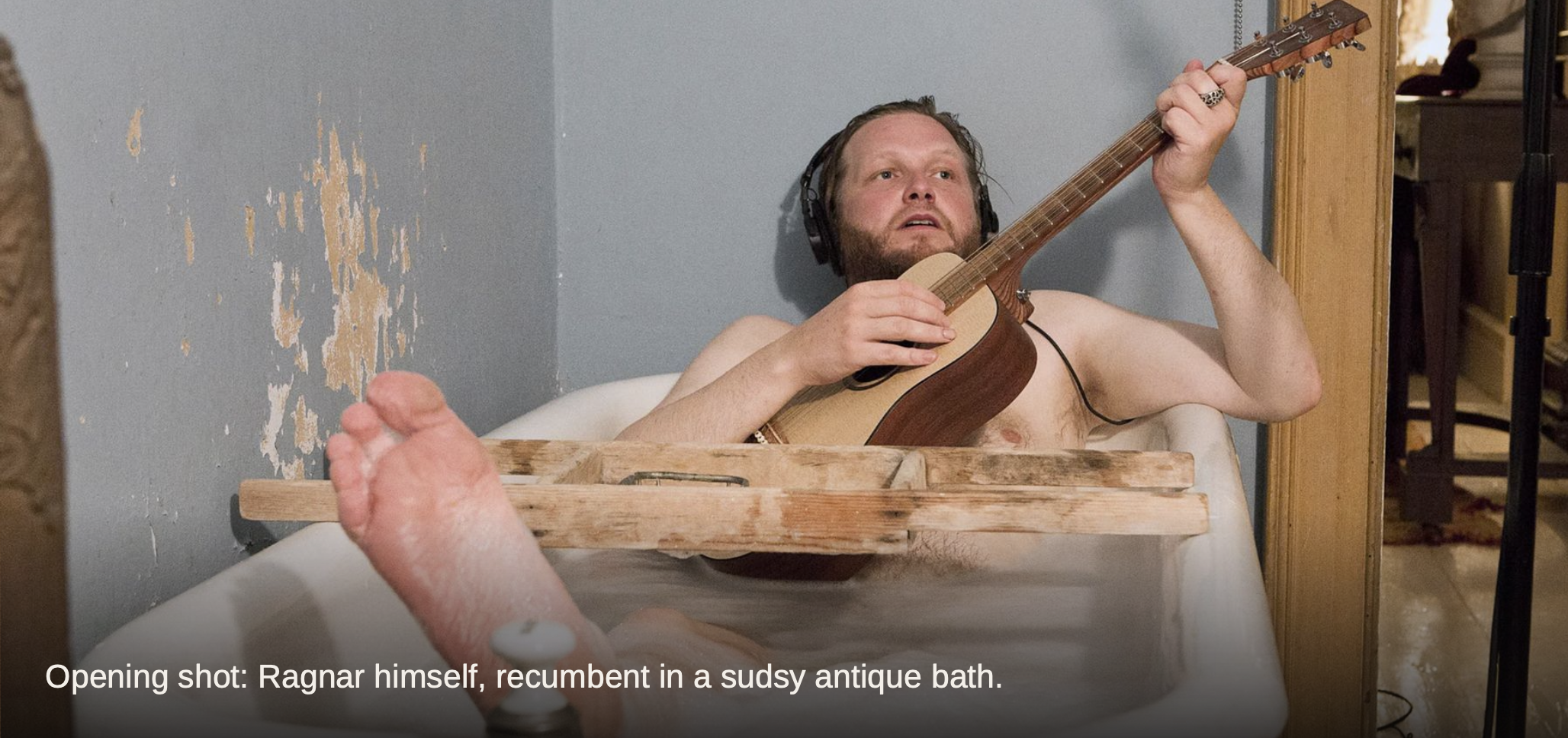
A portrait of the artist in repose as louche as a mid-century G-plan swiveled John Lennon, strumming “You’ve Got to Hide Your Love Away” in “Help,” while Ringo plays somnambulant tambourine in a sunken lounge pit at his Beatle-booted feet.
The image matches the beat – the same vinyl villain chair used by Blofeld in “You Only Live Twice.”
It’s the family band, or family as band – like the young Beatles in 1965 or Dylan and the Band, recording their “Basement Tapes” in their Woodstock houses – Ragnar’s “Last Waltz” (or “Neverending Tour.”) is a family affair – members of Icelandic bands múm, Sigur Rós.
“You can concentrate on the solo performance,” said Ragnar “Or you can concentrate on the whole thing.”
It’s my second time thru the looking glass – I first viewed “The Visitors” at the Hirshhorn in Washington, D.C. in 2012. Then I was drawn to Ragnar’s doppelgänger, the co-composer and cigar-chomping pianist Davíð Þór Jónsson.
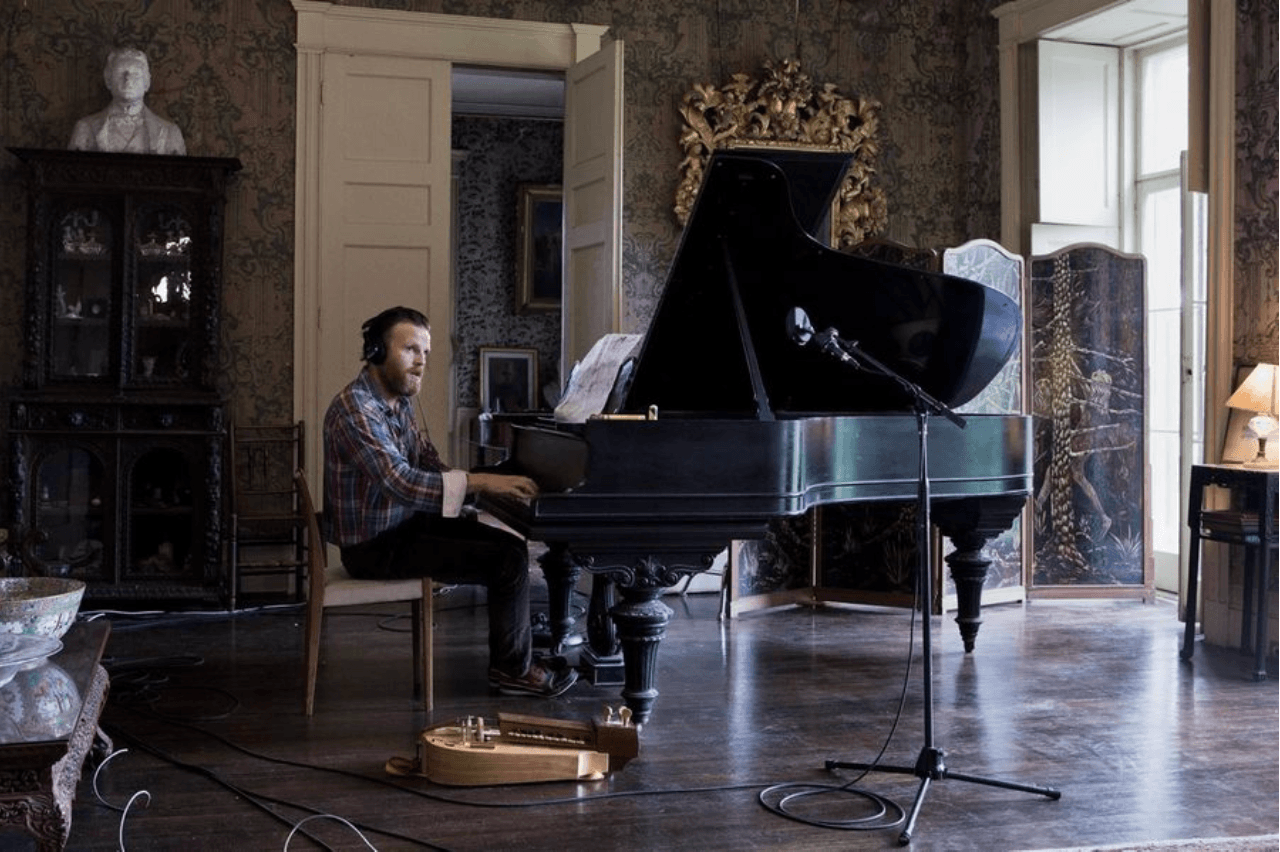
Now it’s the pale phantasmagoric Gyða and Kristín Anna Valtýsdóttir, gauzy, barefoot, Turn of the Screw haunted, cello and accordion, identical twins not separated by birth, but by drawing room walls and staircases.
Each room has a voice, each voice a motif, each motif a movement in the symphony of sight and sound.
“The Visitors” isn’t limited by a finite number of performers or rooms, rather (infinitely) expansive dependent on the route you choose, the labyrinth defined not by Ragnar as Minotaur, but how the individual visitor waits (as the musicians wait) submerge (as their music washes over you.)
I recall a CalArts/REDCAT production of “King Lear;” (2002) we intrepid few who wandered the site-specific complex of the old Pabst Brewery in downtown LA as the all female cast performed in deserted industrial caverns; there was no raging against “another part of the heath.”
Instead the King and Fool remained in place – it was the audience, in Christo-covered mobile bleachers – who rolled and roiled amidst epileptic phosphor flashes – a camera obscura on wheels.
In the dark aperture of “The Visitors” Ragnar is Lear, and the Fool – all of us his offspring vying for affection.
Literary allusions abound:
Mark Z. Danielewski’s “House of Leaves” (2000). Rooms within rooms within rooms.
Arthur Miller’s original stage concept for “Death of a Salesman” (1949) – “Inside of His Head” – a giant skull as set, with characters wandering amongst the nooks and crevices.
Jeff VanderMeer’s “Southern Reach” (2014) and its permeable, transformative, and endless encroaching borders.
Punchdrunk’s “Sleep No More” (2011) – a haunted, audience-immersive “Macbeth”.
“The Backrooms” (2019) – 4chan post morphs into horror franchise.
Book Two
Descent into the Underworld
Dead Can Dance
If you’ve ever listened to a Philip Glass opera, or immersed yourself in the HD liquid of HBO’s “100 Foot Wave” then you’ve already visited the land of the dead.
The sound of “The Visitors” is not the jasmine-scented New Orleans brass and blues of “Hadestown.” Ragnar’s soundtrack is funereal, a dirge. It’s Schoenberg 12-tone, boiled down to Glass’s metric modulation and repetition. It’s John Grant electronica whispered by Björk.
Call it “Icelandic Primitive.”
Formally titled, “Feminine Ways,” he labels it a “feminine nihilistic gospel.”
I waking/dreamed of Welles’ “The Lady from Shanghai,” or the frozen fractals of “The Shining” –
What is staring into the infinite abyss of a hall of mirrors if not a glimpse into the inner maze of creation?
“Once again, I fall into my feminine ways /
There are stars exploding around you /
And there’s nothing, nothing you can do /”
(Ritornello, Ostinato, Refrain, Reprise)
The mistress of time is concomitantly the dictator of space.
As I’ve discovered in the late stages of my daughter’s flag football games, she who controls the clock – often an opponent’s parent – is the mistress of time, and the mistress of time is concomitantly the dictator of space.
Roughly at the 32:00 mark of “The Visitors’” Tardis loop, the music crescendos in a jam band high. I realize I haven’t moved from the spot. Grandaddy’s “At My Post” weaves into the instrumental fill.
Out here at my post, I’ve learned a few things/
Like the sun ain’t afraid to bleach out a dream/
And the way that you were ain’t the way that you will always be/
Ragnar’s frozen time and with it my heart.
He’s performed this legerdemain before:
The precedent is an early black and white funny work, “Death and the Children” (2002.)
Part Edward Gorey/part SCTV “Count Floyd,” “Death” finds Ragnar cosplaying as the Grim Reaper, ambushing summer campers on their tour of Reykjavik’s main cemetery.
His tale from the crypt masquerades as a “Los Espookys” outtake – high existentialism tamed with low-brow hijinks; the happy campers ain’t impressed with Death, or his cardboard prop scythe. Much like Matt Damon’s EA tech-bro Odysseus, they laugh at Death (and taxes) blissfully unaware that it comes for us all after the IPO.
Returning now to the land of the living, I can still smell the sulfur of the underworld, museum-industrial rug shampoo, and the rising scent of Illy espresso brewing a floor below.
The dead have spoken. I’m ready to return to the land of the living.
Book Three
The Sirens
Silent Disco
What do the sirens sound like?
You could ask Odysseus (but he’s taking the fifth.)
You could listen yourself, but in our noise cancelling headphones era you’d sacrifice your sanity for the sake of science.
In truth, and reconciliation, it’s not that different than a BART ride; you’re sharing the space, but the dude next to you may be decibel surfing on Turnstile? Lerado Khalil? Fantastic Negrito w/SFS Strings?
We’re never going to know – it’s binaural bingo, digital “Name That Tune,” and the closest we get is Homer’s musical manna description, from the text:
The Sirens sing what the listener longs to hear, psychically adapted to the individual listener’s identity, vulnerabilities, and desires. According to Odysseus “All the things you wanted to be and then all the things you wished you never wished for.”
Specifically their voices are “honeysweet,” “melodious,” and “delicious.”
“It told you what you most want is what you can’t have, and what you can’t have is what you already possessed and lost.”
Put your hands together for the Valtýsdóttir sisters, Gyða and Anna, featured on cello and accordion (accordingly). Seraphic, ethereal, barefoot and empyreal in sound and countenance, the twins and founding members of múm hover just above the melody, a hybrid helix of Moaning Myrtle and the waltzing holograms of Disneyland’s “Haunted Mansion.”
Painted in chiaroscuro, you can’t look away; blink and they’ve moved from the corner of your eye to a soloist’s spotlight, Weeping Angels, selkie tangled in spectral light and wavelength and vibrato oscillation.
Feint with their lullaby. Look back/don’t look back.
For the first time you understand what Odysseus had to hear.
Why John, Paul and Ringo followed George to the Maharishi – and stayed for 6 weeks.
And at long last, can you forgive Orpheus for turning back – did he ever truly have a choice?
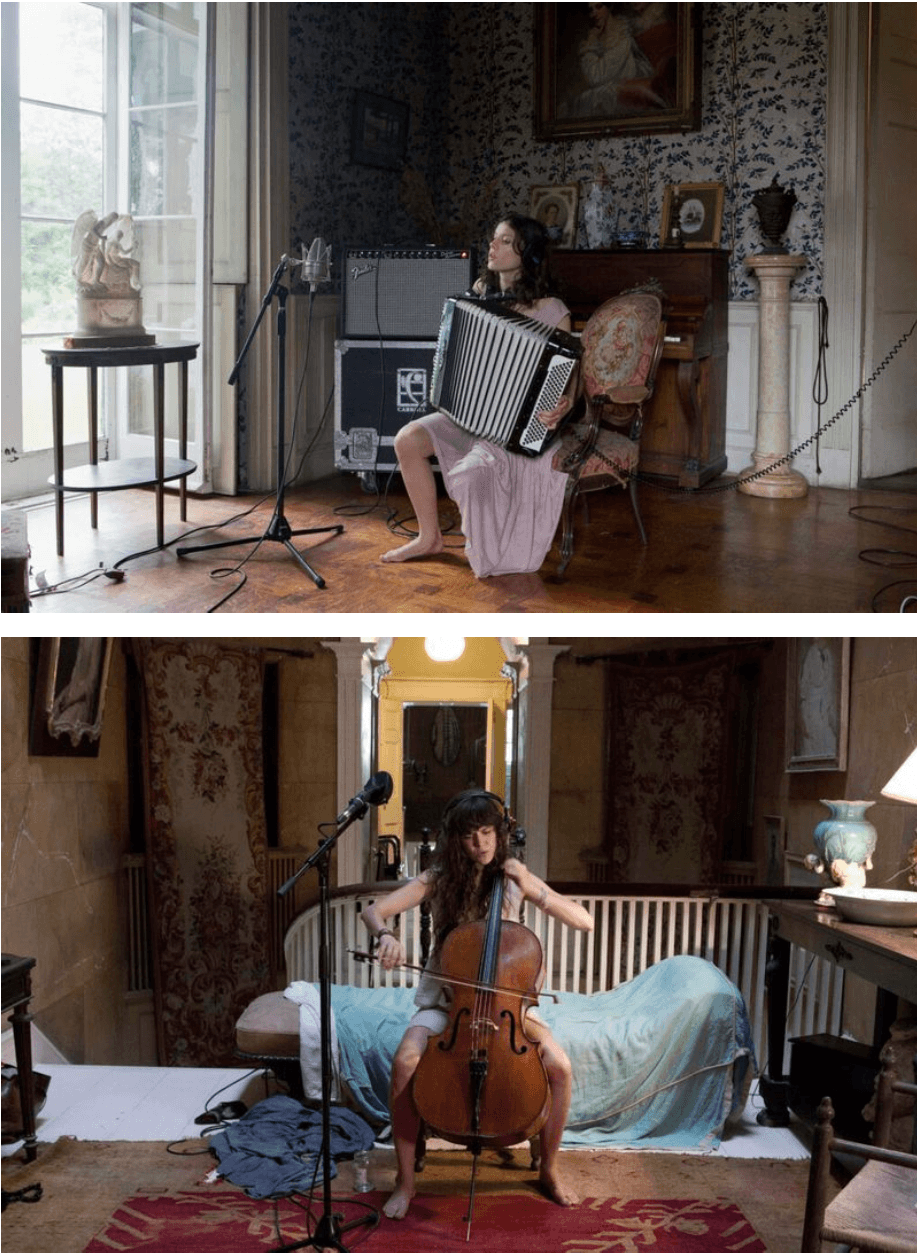
Kristín Anna and Gyða Valtýsdóttir, on accordion and cello.
Book Four
The Bending of the Bow
The Seventh Seal
A core excavation of Ragnar’s work unearths not so much an aversion to endings, but a polarity magnetically attracted to exclamation marks. Suspended somewhere between Eliot’s “And the end of all our exploring/will be to arrive where we started” and The Doors’ “my only friend,” Ragnar isn’t long on goodbyes.
Despite labeling a 2009 video piece “The End,” Ragnar’s terminal points are more precisely graphed as circular closures; he shakes the Etch A Sketch and begins anew.
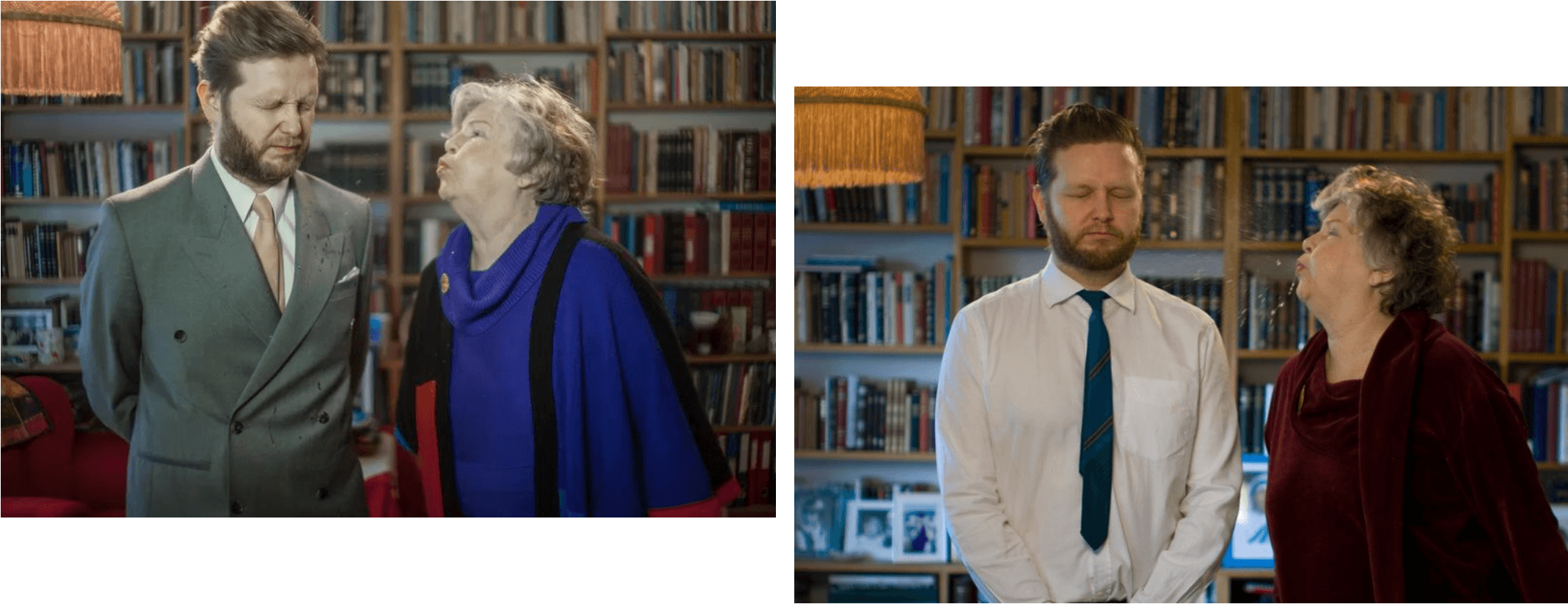
Stills from “Me and My Mother” (2000), repeated cyclically every five years.
His 2000 piece – “Me and My Mother” – repeated cyclically every five years – chronicles his mum, Guðrún Ásmundsdóttir, a noted Icelandic actress and Björk’s great-aunt (it’s a long story) spitting in his face with Oedipal scorn (and glee). Perhaps he never calls?
What is the future of work at the dawn of AGI? It’s “Woman in E” (2016) – fourteen female rockers working two hour shifts, pedestal worshipped in gold lamé and tinsel, carousel spinning a single (minor) chord – a gilded caryatid of Neil Young’s cinnamon girl muse.
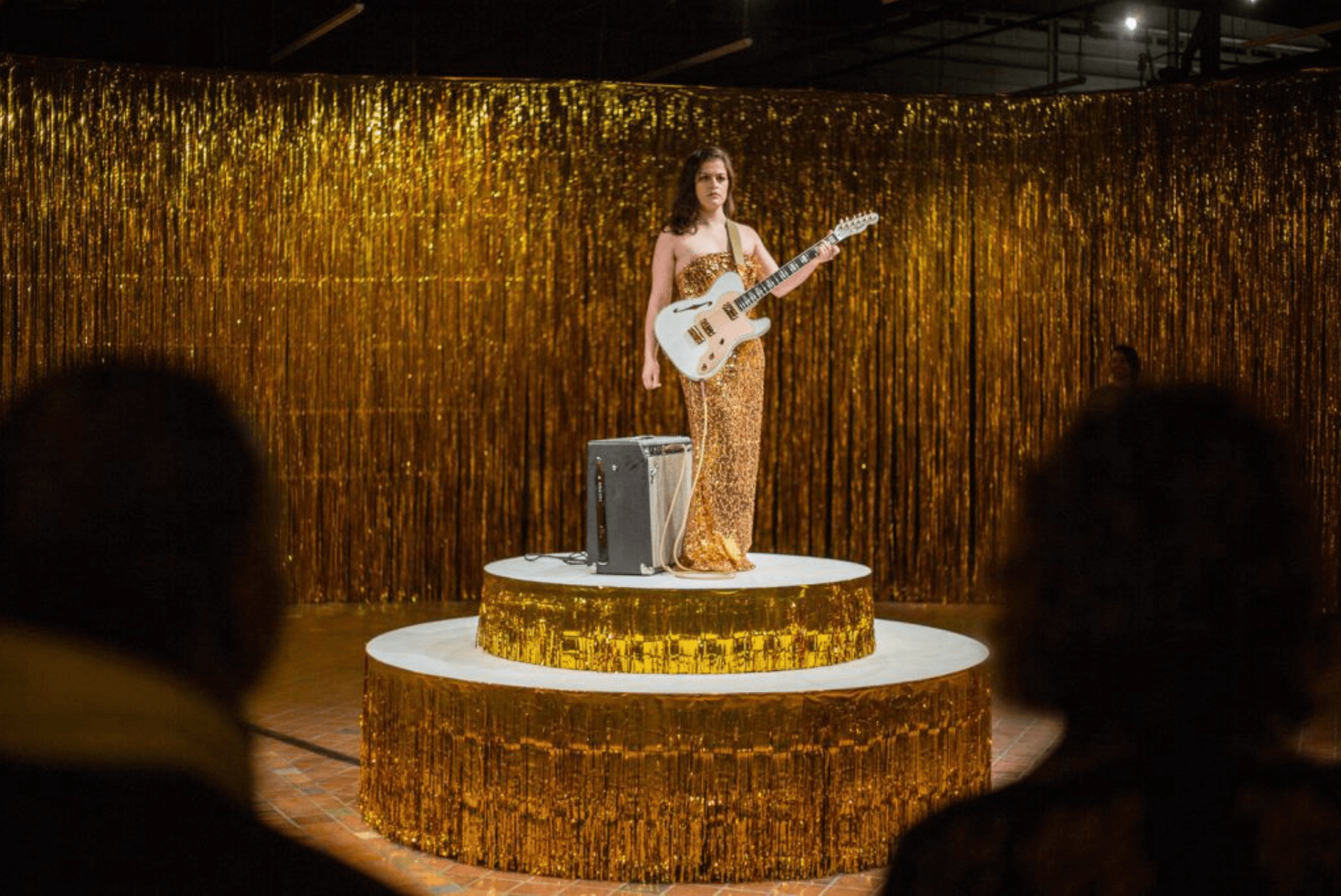
“Woman in E” (2016): a gilded caryatid, spinning a single minor chord.
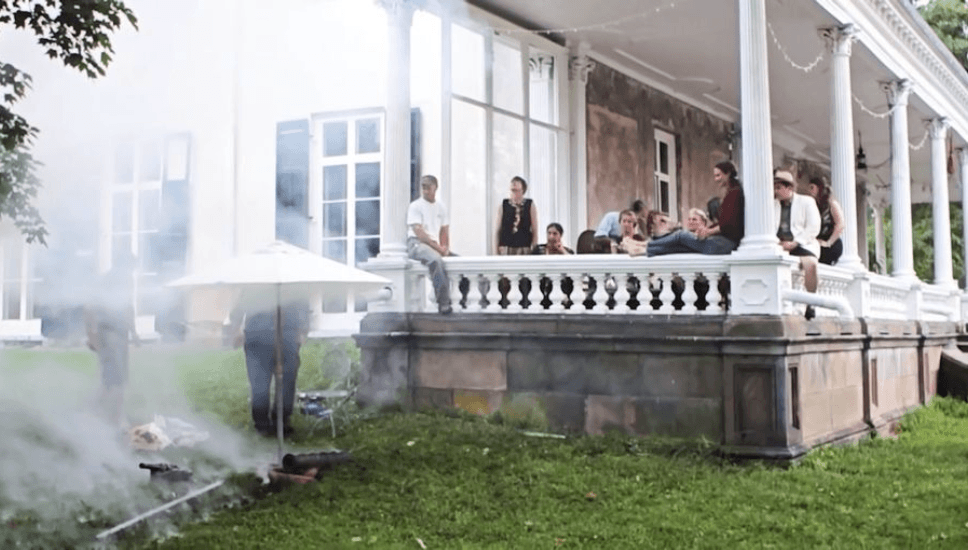
“The Visitors” takes rare exception; a single screen reveals an antique cavalry cannon abutting the porch, prepped and primed by Rokeby patron Ricky Aldrich. It’s Chekhov’s gun. It’s the dueling pistols bequeathed to Hedda Gabler. It’s an “1812 Overture” rock show at the Hollywood Bowl (pre-9/11.)
You get not one BÚMM, but two bangs for your buck. Fin. Saga Búin. Thank you for coming and please make sure you have all your belongings.
You didn’t think he was going to bring a cannon to the party and “not” fire it?
The cannon fire and curl of post-coital smoke isn’t the exclamation point – it’s the em dash.
It’s a feint, a diversion. In magician’s parlance, Ragnar’s pledge/to his turn. Consider the very nature of video installation – at some point it loops. The prestige. The cannon fire and curl of post-coital smoke isn’t the exclamation point – it’s the em dash.
Troubadours gather beneath the portico. Celebratory champagne flows. Ragnar still soapy slick from the bath, a red towel and guitar pageant draped across his pale form.
There he is/Mr. America.
Ragnar’s parade isn’t over, it’s migrating – a moveable feast.
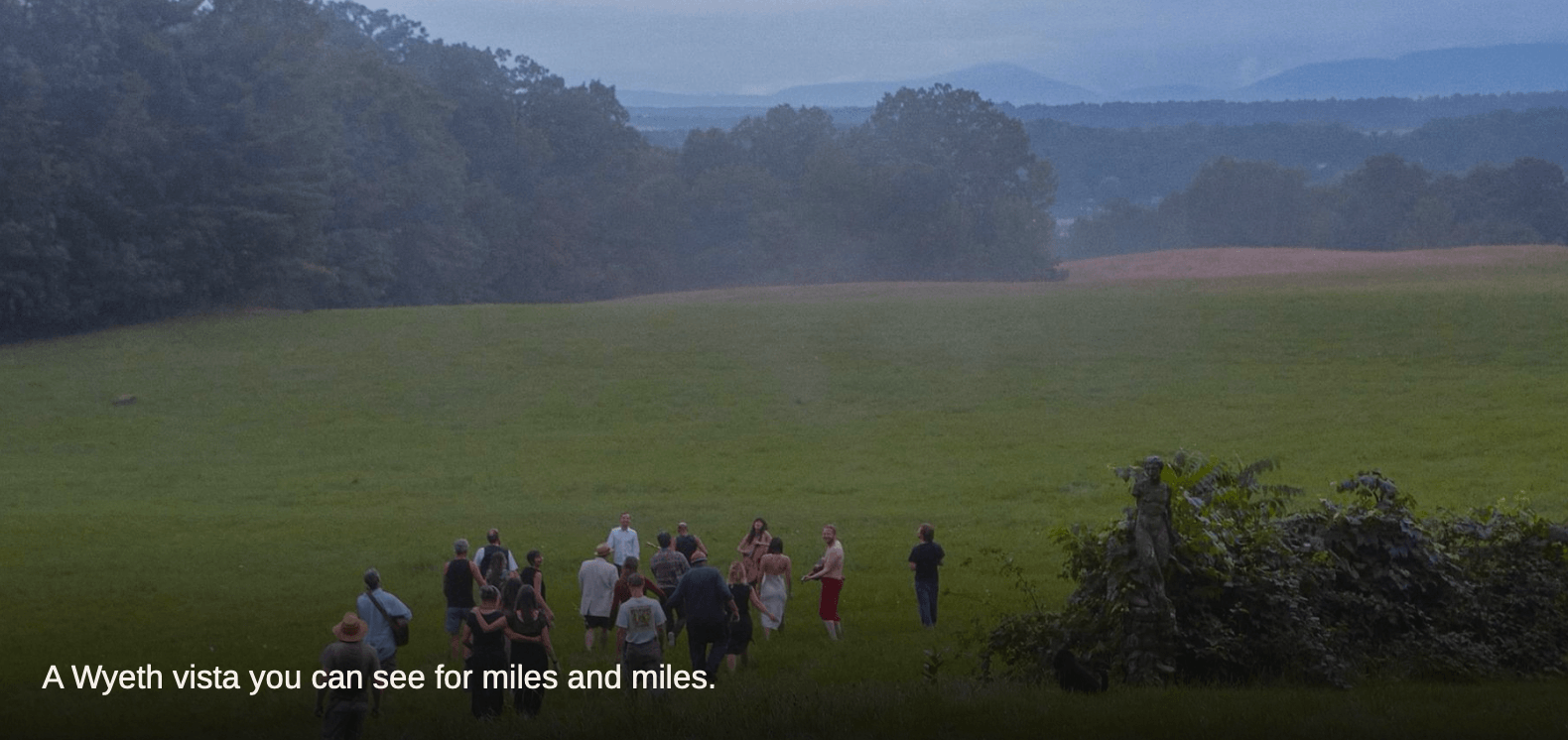
The haunted mansion clears its lungs, or like his mother, expectorates the band of musicians, the troupe spilling out in Sgt. Pepper’s formation, a lyrical river flowing into the purple haze of the Hudson Valley – a Wyeth vista you can see for miles and miles.
I flashback to the first time I saw Bergman’s “The Seventh Seal,” Det sjunde inseglet. A subterranean library screening room buried stories beneath the Midwest soil because of experimental AGI plots the university deemed more worthy of sunlight than its students.
Two thoughts dueled in the dark:
Wow.. is this all there is? Even Bill & Ted bested Death at “Battleship” and Electric Football, and lived to die another day.
And..
This is how every film should end.
We live, we cry, we sing, we celebrate, we die, we mourn.
We dance.
You don’t need the lights to rise to know that Ragnar has left the building.
Ragnar Kjartansson’s video installation The Visitors (2012) is currently on view at the Buffalo AKG Art Museum in Buffalo, New York, as part of the solo exhibition Ragnar Kjartansson: Politics of the Obvious running through January 31, 2027.