
Interview with Artist Chad Abbley
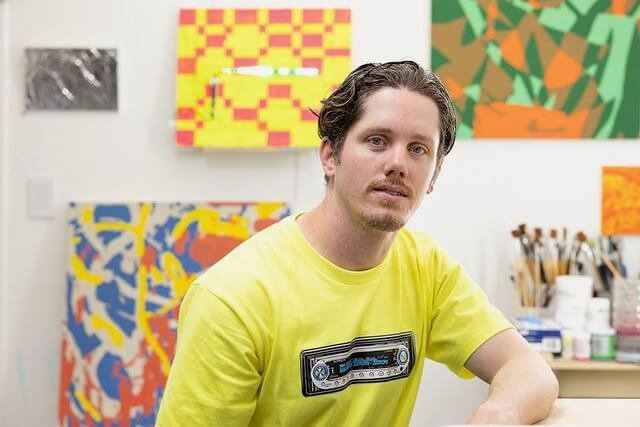
Chad Abbley is a San Francisco-based artist whose vibrant abstract paintings draw from graffiti, nature, and technology. Originally from San Bernardino, Abbley now lives and works in San Francisco, where he is also active as a curator.
Thanks for agreeing to this interview. We’re delighted to learn more about your practice. Can you start by describing your work and specifically what you’re working on now? Do you have a preferred medium? Subject matter?
Currently I’m working on some paintings that revisit a technique I was using several years ago. Over the last few years I’ve been pretty focused on more graphic work with a lot of control and hard edges. More recently I’ve been trying to relinquish some of that control and let the work get a little more blobby, fluid, and flowy.
My studio setup has also changed the way I work. I don’t really have the wall space to paint vertically the way I did in my previous studio so now I’ll open up a folding table, lay the paintings flat, and work around them almost the way you would with a drawing. It takes some of the formality out of the act of painting.
The overall process that gets me to the finished piece is still similar to what I’ve been doing for the past several years but the last part of the process has changed. I’m trying to integrate the material into the work more and step away from needing to be so in control.
I think as artists we understand that some of the best work comes from a place where you can set the table and arrange things but you’re not telling your guests what to eat? Letting things happen in the process that I couldn’t have pre-planned makes the work more interesting for me. But, I am definitely not an improvisational artist. Relinquishing control in my work for me might seem like OCD to others.
The best work I’ve made has usually come from not being obsessive about the outcome. I’m trying to get rid of some of the editing and mechanical feeling and maybe cleanse some of the sterility out of the work.
Where can people see your work? Are you in any exhibitions right now or have anything scheduled? Do you welcome studio visits?
I’m planning to be included in an exhibition at Root Division in November called New Works. I’ll be showing some of the pieces I’ve been working on over the past year.
I’m open to studio visits. My studio is in Union Square and people can reach out by DM or email if they want to come by and chat.
Can you share how you became an artist? Did you have an epiphany that compelled you in this direction? Did you have formal training? Did you grow up in a family that valued art and left the door open for you to become an artist?
One thing that I think about is in third grade when we were coloring pumpkins with crayons as a class project and my orange ran out halfway through. Recess was about to start so I grabbed another orange and scribbled fast. It was a different shade and I thought I ruined it but my teacher said it looked great and asked if my parents were artists. I had accidentally added some light and depth to a flat drawing. I still think about that because it’s what I’m after in the work now. I can only take a piece so far on purpose and then something else has to come through the process.
I drew all through middle school and high school but didn’t get into paint until my friends and I started doing graffiti. That’s when paint became a material for me. Part of it was teenage angst and part of it was composition and location, and seeing how far you could push an idea.
My family didn’t like the graffiti. My sister was always artistic and my mom was very creative. Neither of them an artist exactly but I got a lot of that from them.
I don’t have any formal training. I learned about contemporary art from friends and going to galleries and looking at work and using the internet. The barrier to entry is as low or high as you want it to be. If you take the work seriously you take it seriously and if you don’t, you don’t.
What is the most challenging thing about being an artist in San Francisco [OR ANYWHERE]? There’s a lot being said now about the changing landscape of the art scene here. On the one hand there is criticism that City Hall isn’t doing enough to support the arts and some are pointing to the changing landscape of the gallery scene. That perhaps the old model of a brick and mortar gallery that represents artists, with exclusivity agreements, is dying off. Any thoughts?
I think it’s rough for artists in San Francisco right now. You have institutions and arts organizations taking a hit. CCA is closing, SFAI closed several years ago, and those arts education institutions used to be magnets for talent from around the world. We may not feel all of the ramifications immediately but over time I think that loss is going to be significant unless there’s some kind of shift.
That’s especially disappointing to me because I’ve been in the Bay Area since 2012. I came here because of the creativity and the ethos and I stay here for the same reason.
The city does a lot of PR around arts and culture but I think there’s a difference between decorative support and the kind of support that actually helps sustain artists financially. Rent is high and income disparity is huge and now there’s another influx of high-income tech and AI jobs. San Francisco seems to go through these waves and there’s always a question of what gets pulled out of the city in the process.
At the same time, I’ve been here long enough to understand the underpinnings of the community and I really value the anti-commercial side of the art that gets made here. A lot of people are perfectly willing to make work outside of the commercial art world and I think there’s something honest about that.
As far as the old brick-and-mortar gallery model, having any brick-and-mortar business in San Francisco is hard right now. An art gallery has the added challenge of selling expensive objects to a relatively small group of collectors. There have also always been far more artists than galleries so representation was never an evenly distributed path in the first place.
I don’t think gallery representation is something I would tell a younger artist to make the center of their plan. What I’ve learned is that it’s more realistic to find a way to sustain the practice alongside other sources of income. When I left my full-time W-2 job I think the dream was to sustain myself on art alone but over time I realized I haven’t figured that out. Most artists I know haven’t either. The real goal is to build a life where the art can continue. You can be an artist and also be something else at the same time.
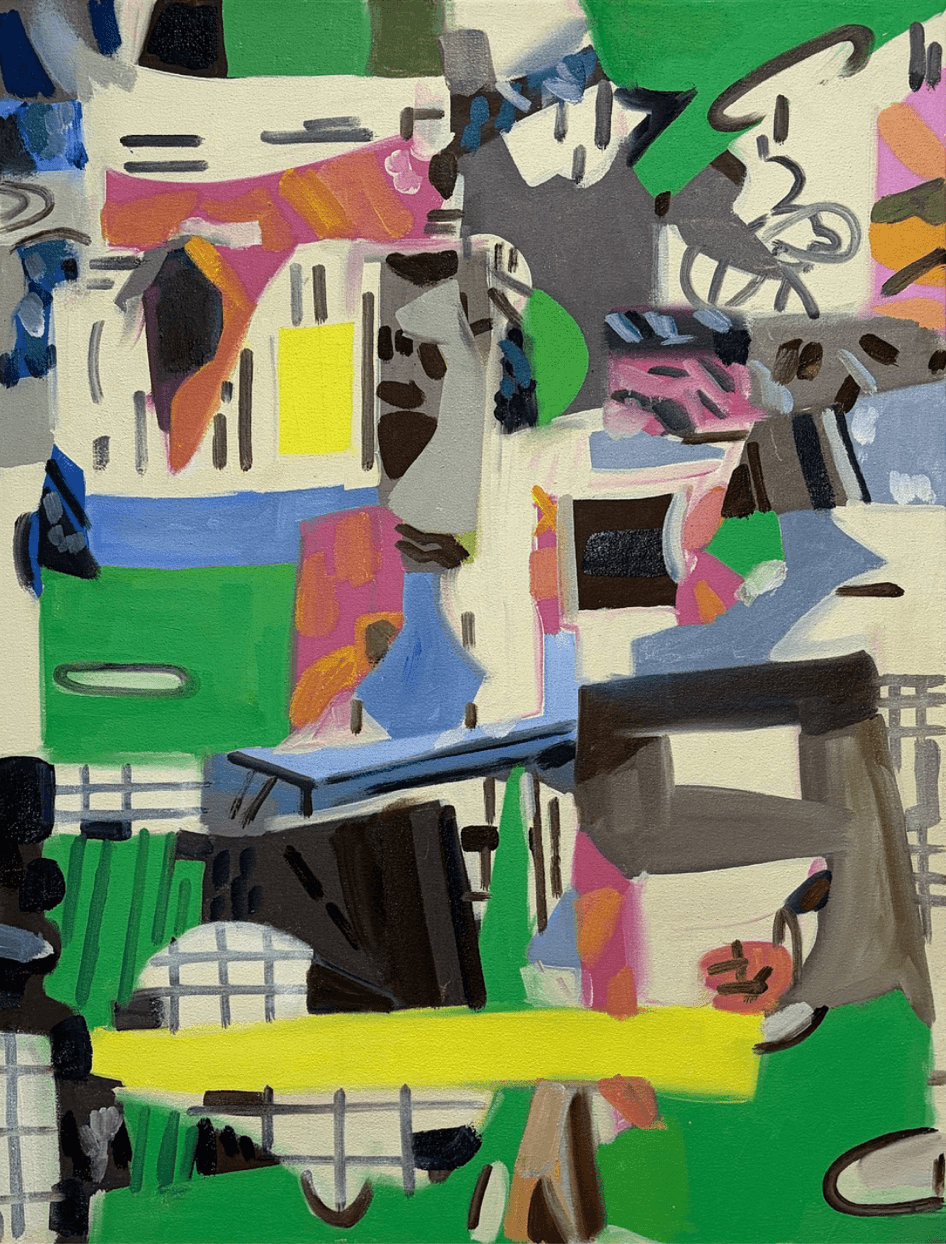
Chad Abbley, Human Error, 2026, oil on canvas, 21 x 28 inches.
Have you ever put on exhibitions yourself as a curator or organizer? If you were to put on an exhibition in the future do you have any curatorial ideas you’d like to share? Is there a show you’d really like to see put on?
I’ve organized a couple of shows in the Bay Area with my friend Shrey Purohit including a show on Treasure Island a couple of years ago. We’ve also done a couple of exhibitions in New York which were a lot of fun.
For something in the future, I’d be interested in working in a less traditional gallery setting. Maybe a basement, storage room, or another kind of space that’s interesting to physically be inside. I like the idea of a visual art show where the space itself supports the theme.
One idea I’ve been thinking about is giving artists an outlet to respond visually to the direction the Bay Area is going in especially around AI and this next wave of tech descending on the city.
Do you think art should make political or social commentary? Does your art do that? Is there a role for the artist to play in challenging political climates?
I think art can absolutely make political and social commentary. It’s a strong tool for doing that. You go to any protest and there are signs everywhere. At the end of the day art is a form of communication.
I do think we can sometimes get caught up in the idea that the art itself is enough. If you’re making work that’s explicitly social or political I don’t think the work should necessarily be the end of it. There has to be some kind of action beyond the art too.
Do you believe art reflects an artist’s diversity such as gender identity, sexual orientation, ethnicity, or race? Are these (or any other diversity consideration) present in the art you make? Why or why not?
Yeah definitely. Any time work is made it reflects something about the person making it.
For my own work, especially more recently, it has been less about representing one fixed identity category and more about moments in my life. The work can come out of an event that happened, something that brings me joy, something I’m thinking about, or just where I’m at in my life at that moment.
My work is abstract, and I like to keep it open rather than nailing a piece down to one singular theme. More recently I’ve been building multiple pieces around a shared reference or idea, almost as a way to help me understand my own life.
What do you think artists should be talking about right now?
I think artists should be talking about whatever they actually feel like talking about.
There can be pressure to talk about whatever is trending at the moment especially because social media gives everyone the same little nuggets and references at the same time. It makes sense that people start riffing on the same themes but some of the most interesting work goes against the grain a little bit.
I’m interested in work where somebody takes an idea that might seem random, and makes a connection from an angle that feels genuinely unexpected rather than trying to be forcefully unique. That’s also pretty close to how I’d ideally like to approach my own work although I only have so much control over how it comes out.
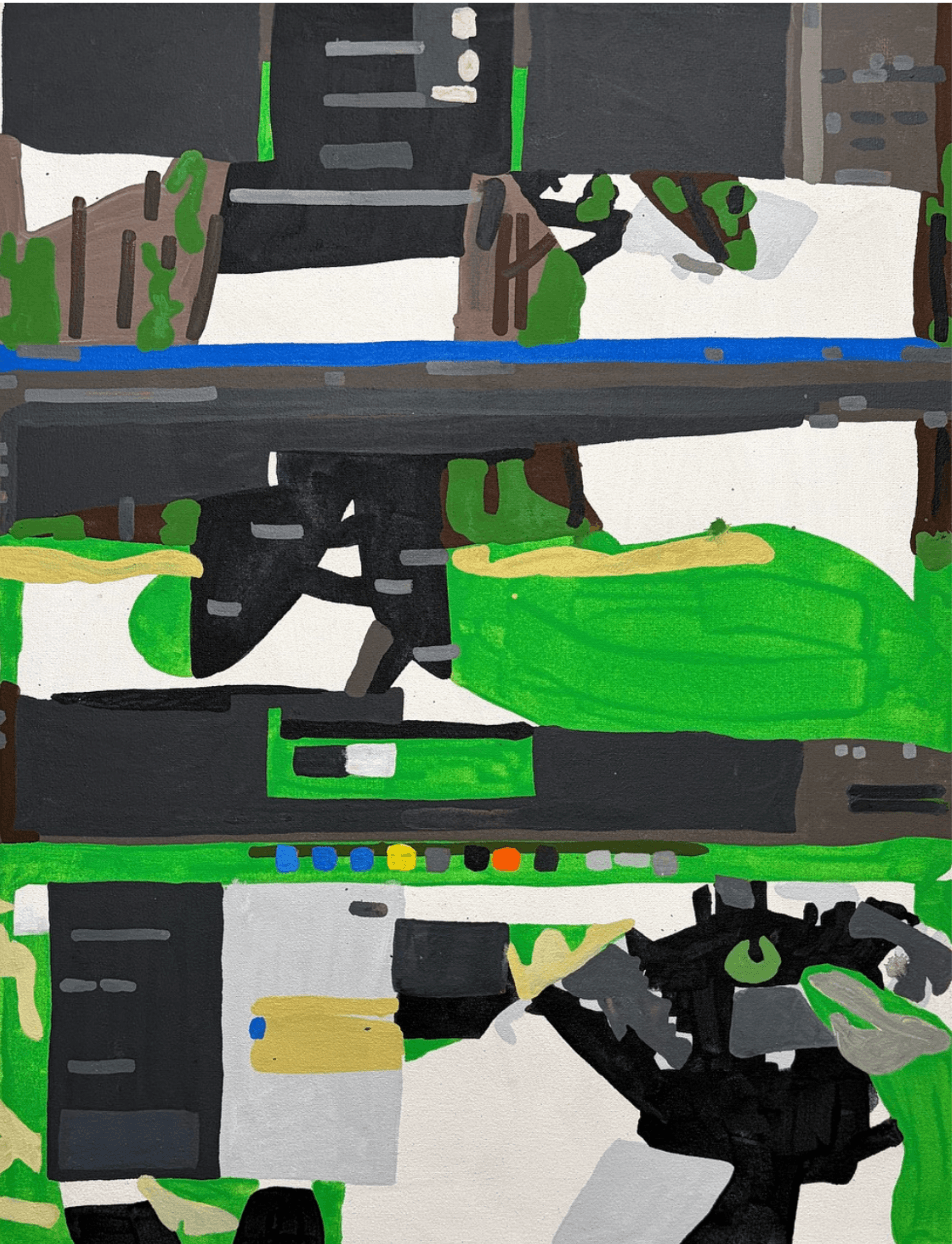
Chad Abbley, Simulated Landscape, 2026, acrylic on canvas, 28 x 21 inches.
Outside of artmaking are there any cultural projects you’re interested in or currently engaged with? Any art adjacent hobbies you enjoy?
I’ve recently gotten into 3D printing. It’s a brand new hobby for me and right now I’ve mostly been using it to make functional things for the studio. But ideas are already percolating about how it could eventually find its way into my creative practice too.
Are there any contemporary artists you draw inspiration from? Can you name the artists and say how or why they inspire you? Same thing for historical artists. Are there any who speak to you despite their living in a different era?
Katherine Bernhardt is one contemporary artist who comes to mind. I don’t know if the influence is one-to-one but I really like her work and where she is in her career and trajectory. Every time I see the work I respond to it.
Misaki Kawai is another artist who always comes up as one of my favorites, and Keltie Ferris makes great work too. I found out about all these artists either through Instagram or the Art21 series on PBS.
For historical artists, I’d probably leave that part open for now rather than forcing a list of the usual names just because they’re expected. The little I know about art history is awesome though.
Do you have a favorite public art piece? What is it and why?
Domestic Seating in Bronze by Primitivo Suarez-Wolfe
Can you say something about the art you live with? Whether you bought, found, were gifted, or traded for the piece, what artworks do you live with? How has the experience of having these pieces influenced your own art making?
The art that I have collected over the years feels the same as the art that I am surrounded by in my own studio. There is so much that happens when you are going about your day and subconsciously interacting with this stuff. It really is like some kind of magic.
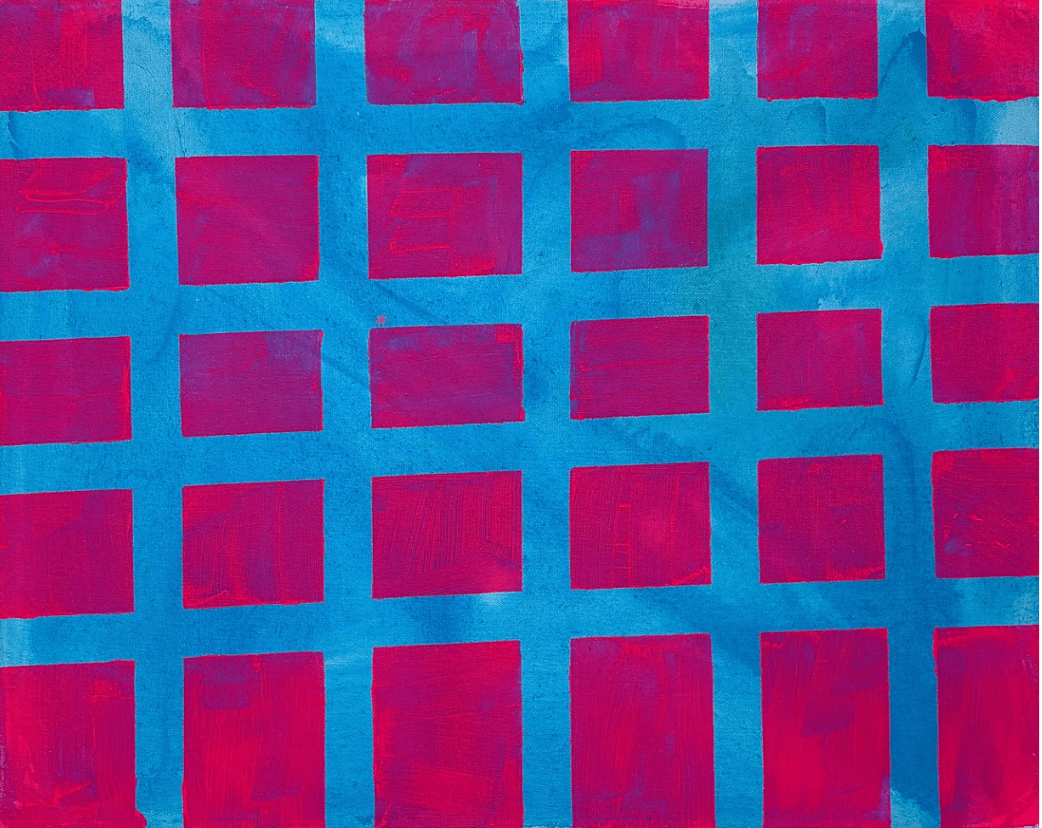
Chad Abbley, Liquid Retina, 2025, acrylic on canvas, 16 x 20 inches.
Artists are increasingly expected to have an online presence and, in some cases, become their own publicist. How do you feel about social media? Has it helped your career, or does it sometimes feel like another job entirely? Any social media rules or tricks you abide by?
Social media is something I was resistant to for a while but I’m trying to adapt to it. Whether it’s art, your personal brand, or a business, everybody is online now. We’re all content creators and our own publicists yes.
It definitely can become another job. It can even become an income stream in itself and for an artist who is clever about it, it can create a kind of sustainability outside of simply marketing and selling the art.
Has it helped my career? I guess to some degree but I also think we sometimes give social media more credit than it deserves. If I got one art sale over a number of years because of Instagram does that mean Instagram created my career? If we weren’t pushed toward social media we would probably find other outlets to promote ourselves and generate revenue. Social media needs us more than we need it. So I don’t necessarily give social media all the credit. It’s one of the ways to market yourself now no matter what industry you’re in.
It’s difficult to talk about being an artist without talking about money. What does making a sustainable life as an artist look like to you? Do you think the art world is honest enough about the financial realities of being an artist?
A sustainable life as an artist is finding a way to generate an income and still have the time and energy to make work. That’s what it has grown into for me.
I don’t think the art world is very honest about much at all and money is definitely part of that.
My current studio practice is supported by contract jobs and I’ve also been doing a lot of screen printing as a service out of my studio (generalprintingservice.com) to help subsidize the rent. That has been helpful and I think a smart way to use the space.
Having a studio is a luxury that most people don’t have but in a city it can also become a necessity if you’re trying to make work and don’t have enough room at home. It becomes this double edged sword. Either you have a small apartment and a small studio or you have a living situation that’s large enough to make work in. For me part of making it sustainable is trying to maximize the resources of the studio and make the space work in more than one way.
What are you unwilling to compromise on in your work, even if doing so might make the work easier to sell?
I’m open to the work selling. I’m not overly precious about it and over the years I’ve become less possessive of the work once it leaves me. I’m even comfortable with the idea that an artwork can become a product to some degree even if that sounds like a dirty word.
What I don’t want to do is make creative decisions based on guessing what will sell. I think the work I’m making now is as good as it has ever been because I’m trying to make honest work. That’s really the bottom line for me. The work has to come from an honest place.
Whose opinion of your work matters most to you?
My friends and community.
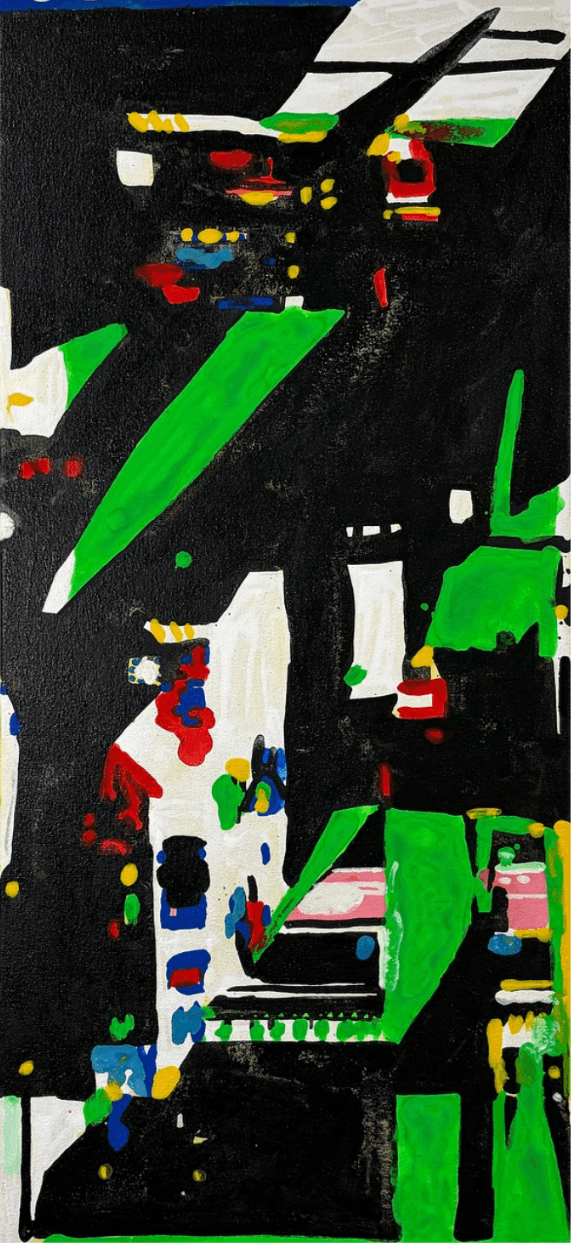
Chad Abbley, Lurking My Feed, 2026, acrylic on canvas, 12.5 x 28 inches.
If you suddenly had unlimited money, space, and time to make one work or project, what would you make?
I’d probably make really similar work to what I’m already making just at a larger scale.
What current art trend have you noticed and do you support it? Are there any fads or trends in the art world you believe will be fleeting?
Airbrush feels pretty hot right now. But maybe even that is fading. I’m not sure what the kids are doing right now to be honest. In art, design, and fashion there are always techniques that bubble up again. Sometimes they last and sometimes they fade.
Y2K aesthetics also feel very present right now in design and art, including that weird tribal kind of graphic language. I think maximalism is supposed to be making a comeback?
What do you make of celebrities who turn to visual art outside of the careers they’re known for? Do you enjoy seeing what they make, or does it bother you that their work can receive immediate attention simply because they already have an audience and a platform? Is that just the nature of the art world, or does it make it harder for working artists to be seen?
It doesn’t really bother me. If you have a platform you should be able to take it into other industries. Celebrities move from entertainment into fashion or from music into art. That isn’t really a new thing.
I have no problem with it but just because I like your music doesn’t mean I’m going to like your paintings.
If a fancy collector wanted to take you out to dinner anywhere, where would it be? Do you have a suggestion for a great inexpensive meal in San Francisco [OR ANYWHERE] for the proverbial “starving artist”?
For the fancy dinner I’d probably go to House of Prime Rib.
For the inexpensive meal I’d probably go to Golden Boy Pizza in North Beach.
LAST QUESTION: Any question you wished we asked you? What is it and what is the answer to it?
I think this was good.