
Future Geographies: Art in the Century of Climate Change, Vancouver Art Gallery
By Terri Cohn
At first, it is not entirely clear where—or how—we are meant to enter Future Geographies: Art in the Century of Climate Change. The entryway floor of the Vancouver Art Gallery, covered in brightly colored strips of vinyl tape that ripple across the space and up the stairs, seems to be a pulsing, almost psychedelic field of color. I hesitate before stepping onto it. Is this floor meant to be walked on? There seems to be no other way, so I venture forward.
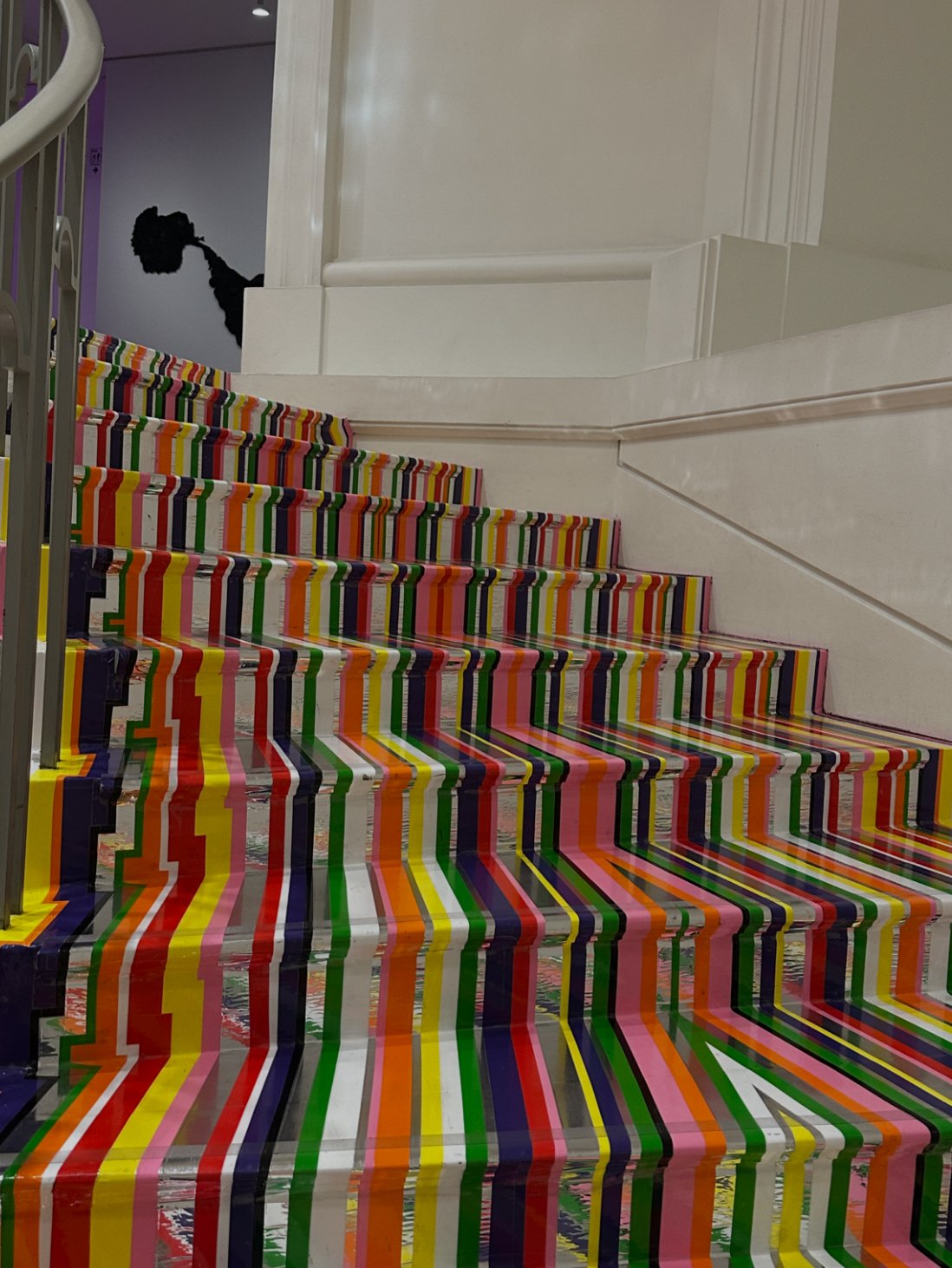
Jim Lambie, Zobop (Colour-Chrome), 2026, floor installation, tape. Photo by TC
Jim Lambie’s Zobop (Colour-Chrome) transforms our experience of the gallery. Its effect is playful and disorienting: the familiar space of the museum has been subtly altered, and with it, our sense of how to move through it. Lambie has observed that “a simple addition of color and pattern can radically shift how we experience space.” Here, that shift becomes the prelude to the exhibition. Before we encounter a single work about climate, geography, or the future, we are asked to experience transformation ourselves.
At the top of the stairs, the world seems to open before us—and then to come apart. Teresita Fernández’s monumental Island Universe 2 (2023), a dramatically reconfigured, thirty-foot-long map of the world, stretches across the gallery. Drawn and sculpted in charcoal, it is at once recognizable and strange. The continents we know have been pulled together into a single, borderless landmass, recalling Pangaea: a configuration from the distant past that also suggests a world yet to come.
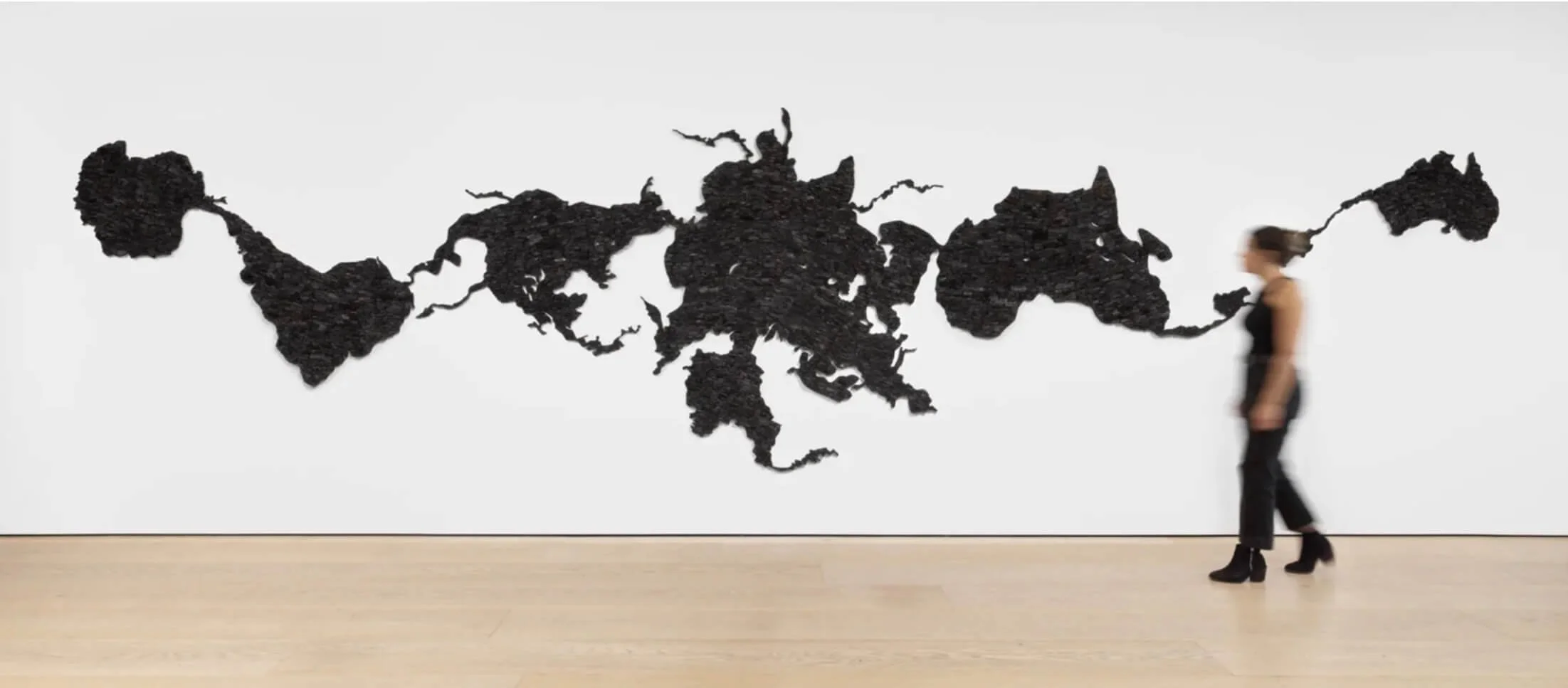
Teresita Fernández, Island Universe 2, 2023, charcoal, Collection of the Vancouver Art Gallery, Acquisition Fund. Photo: Dan Bradica, Courtesy Lehmann Maupin, New York, Seoul, and London.
It is deeply meaningful that Fernández named the piece Island Universe 2. The title points to the limits of our myopic worldview: we mistake our single planet for an entire universe, remaining preoccupied with arbitrary human boundaries while orbiting in a vast galaxy.
Fernández’s map was inspired by R. Buckminster Fuller’s 1954 Dymaxion Map, which challenged the presumed neutrality of conventional geographic projections and the biases embedded in their systems of orientation and scale. But Island Universe 2 pushes that disruption further. The familiar divisions of North and South, East and West, are no longer fixed coordinates. Geography becomes provisional—a world among worlds, capable of being rearranged.
This is the first of many shifts that animate Future Geographies. The exhibition does not simply ask us to imagine what the future might look like. It asks us to actively consider how the future is already being shaped by the maps, histories, systems, and ways of seeing we have inherited. Its artists look backward as they look forward, revealing a future that is less a blank horizon than a terrain already marked by the past.
Standing before Island Universe 2, I found myself thinking about how the present is always informed by the past, while our understanding of the past is itself shaped by the present. Both inevitably become part of how we imagine what might come next. Fernández makes this instability visible, asking us to think of geography not as a static backdrop against which history occurs, but as something shaped by it—and in turn, shapes how history is understood.
This is one of the great strengths of Future Geographies: its premise places contemporary art within the moment we are living through. We do not yet know what this “century of climate change” will ultimately mean. We are inside the history rather than looking back at it. The exhibition asks us to consider the ideas, materials, and systems we are carrying into the future.
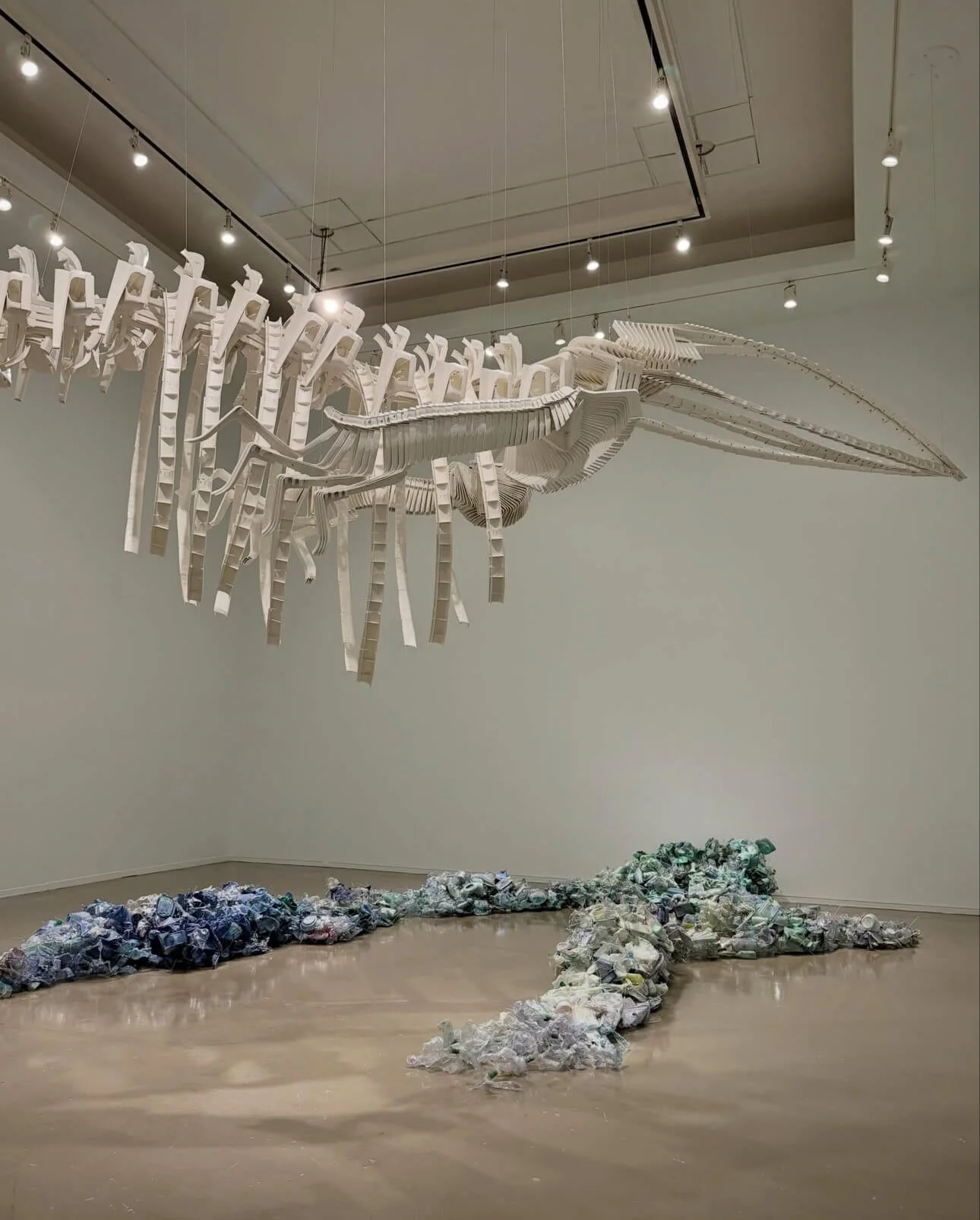
Brian Jungen, Cetology (2002), plastic chairs, Collection of the Vancouver Art Gallery; Liz Larner, Meerschaum Drift (Blue) (2020–21), plastic, Courtesy the artist and Regen Projects, Los Angeles.
What happens when geography itself becomes a way of imagining the future?
The more than 30 participating artists do not offer a single vision of what lies ahead. Rather, each responds to this question in markedly different ways. While Fernández looks back to an earlier geological time to destabilize the geography of the present, Brian Jungen transforms objects of contemporary consumer culture into the skeletal remains of an ancient creature.
Jungen’s monumental whale, constructed from white plastic chairs, is both immediately recognizable and strangely otherworldly. The chairs—objects of everyday use—have been stripped of their ordinary function and reassembled as the bones of a great marine animal. They become evidence of a culture whose material remains might one day be read archaeologically. We are looking at a whale, but also at the remnants of a particular kind of human consumption.
Installed in the same gallery, Liz Larner’s Meerschaum Drift (Blue) creates a compelling encounter between materiality and transformation. Like Jungen, Larner asks us to look differently at the material world we have produced, making plastic waste and its environmental consequences unexpectedly beautiful. The gallery itself is one of the exhibition’s most memorable spaces for me. Neither artist relies on simple admonition. Instead, they alter our perception of the objects and materials that surround us.
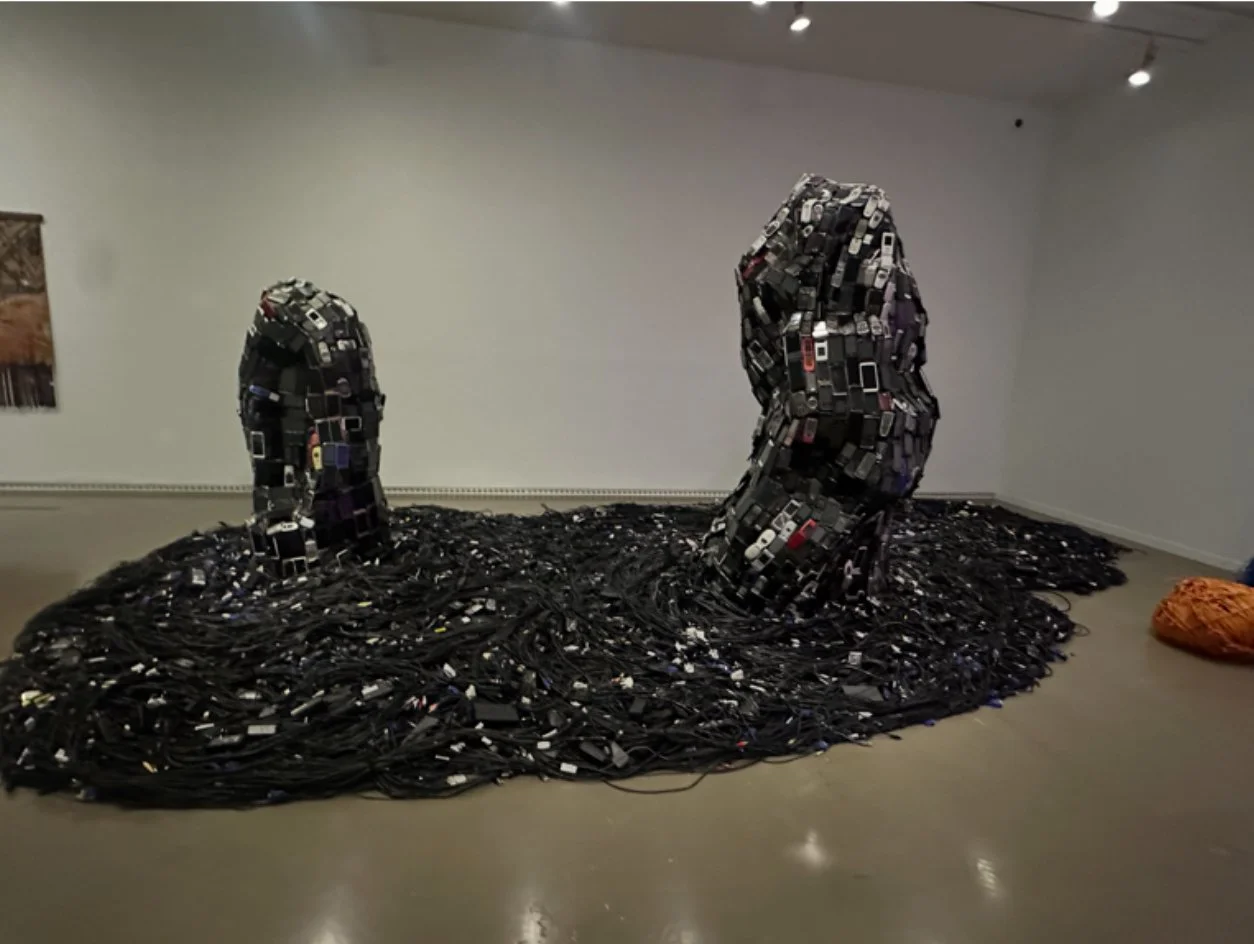
Jean Shin, Huddled Masses (2020), mobile phones, electrical cords and cables.
Jean Shin extends this investigation into the material systems underlying our increasingly digital world. In Huddled Masses (2020) she transforms obsolete mobile phones into scholars’ rocks, traditionally valued in Chinese art, while electrical cords evoke the raked lines of a Zen garden. Around them are spherical “e-bundles” made from laptops, computer towers, and hard drives wrapped in cable. The bundles almost function as reliquaries, entombing the personal histories of the devices along with the material consequences of technological consumption.
A related transformation occurs in Cannupa Hanska Luger’s Mideegaadi: Fire Bison (2022). Constructed from materials sourced from salvage yards and recycling centers, the work transforms the remnants of industrial and consumer surplus into a human-animal hybrid that evokes kinship, adaptation, and survival. Part of Luger’s ongoing Future Ancestral Technologies series, the work draws on Indigenous customary knowledge while imagining speculative futures.
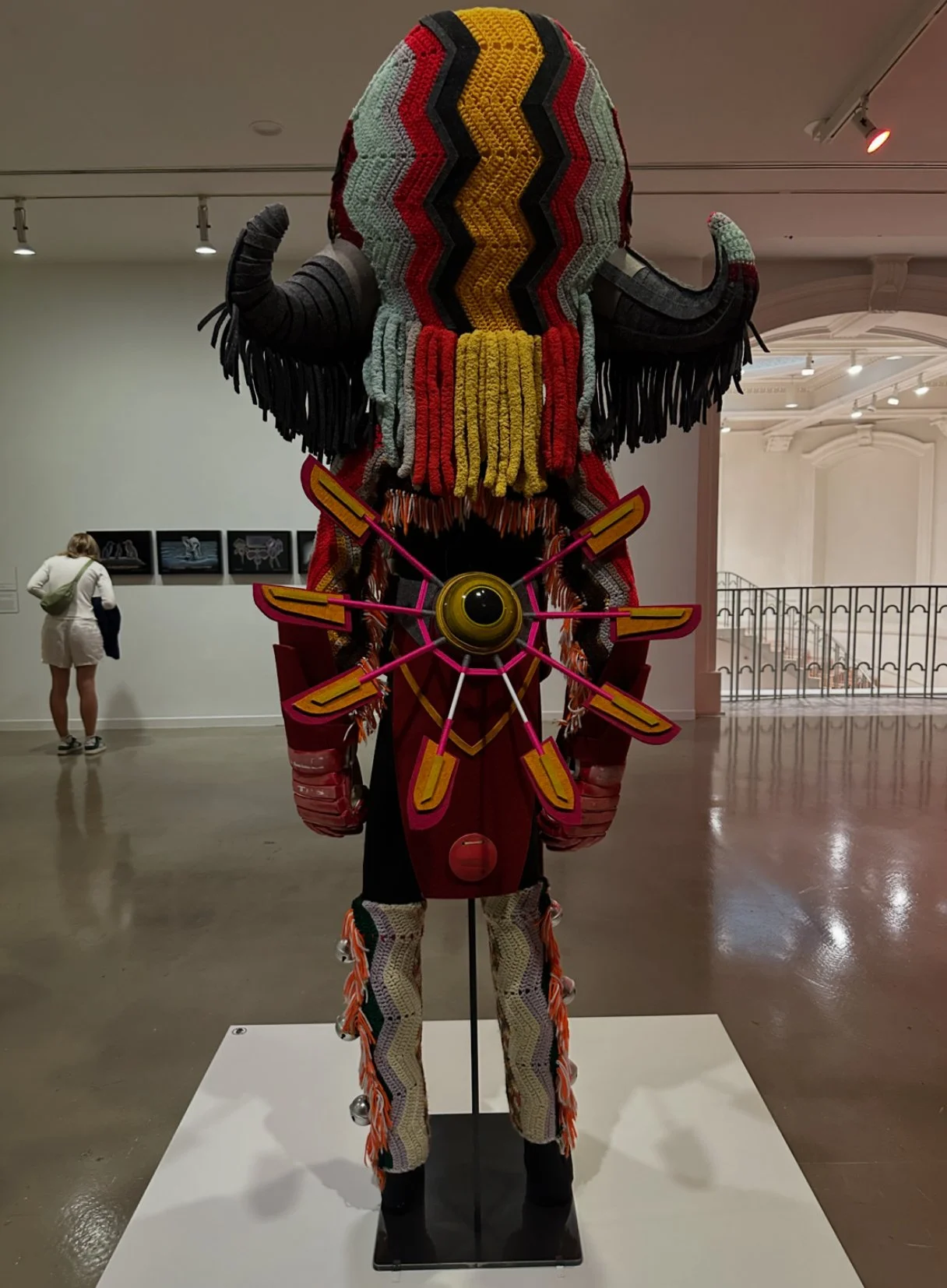
Cannupa Hanska Luger, Mideegaadi: Fire Bison (2022), repurposed materials, Gochman Family Collection.
If Shin and Luger ask us to reconsider the material remains of contemporary life, Carolina Caycedo turns our attention to the histories embedded in landscape and water. Her To Drive Away Whiteness/Para alejar la blancura (2017) is composed in part from handmade fishing nets collected by the artist in river communities in Latin America affected by the privatization of waterways. Caycedo considers these sculptures talismanic, embodiments of local resistance to corporate and governmental attempts to control the flow of water. Her work brings questions of extraction, capitalism, cultural survival, and environmental biodiversity into the geography of the present.
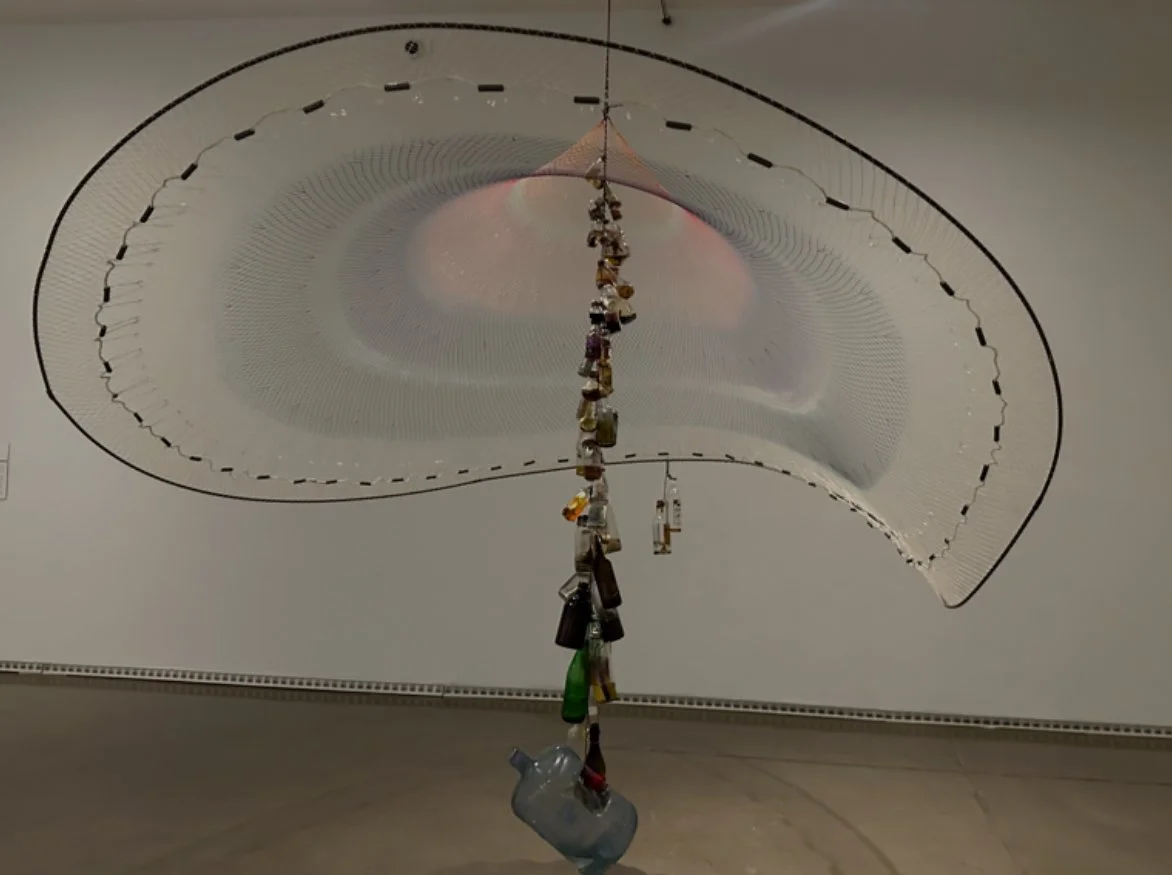
Carolina Caycedo, To Drive Away Whiteness/Para alejar la blancura (2017), mixed media, Collection Hammer Museum, Los Angeles; Purchased through the Board of Advisors Acquisition.
With Vertigo Sea (2015) John Akomfrah also considers the ocean through history, but on an expansive temporal and geographic scale. The three-channel video installation draws on literature, music, and the histories of enslaved people and freed sailors, collapsing centuries of migration, colonialism, slavery, and climate into a meditation on our relationship to the sea. Rather than treating the ocean simply as an environmental resource or threatened ecosystem, Akomfrah reveals it as a site in which histories of human movement, exploitation, and survival continue to reverberate.
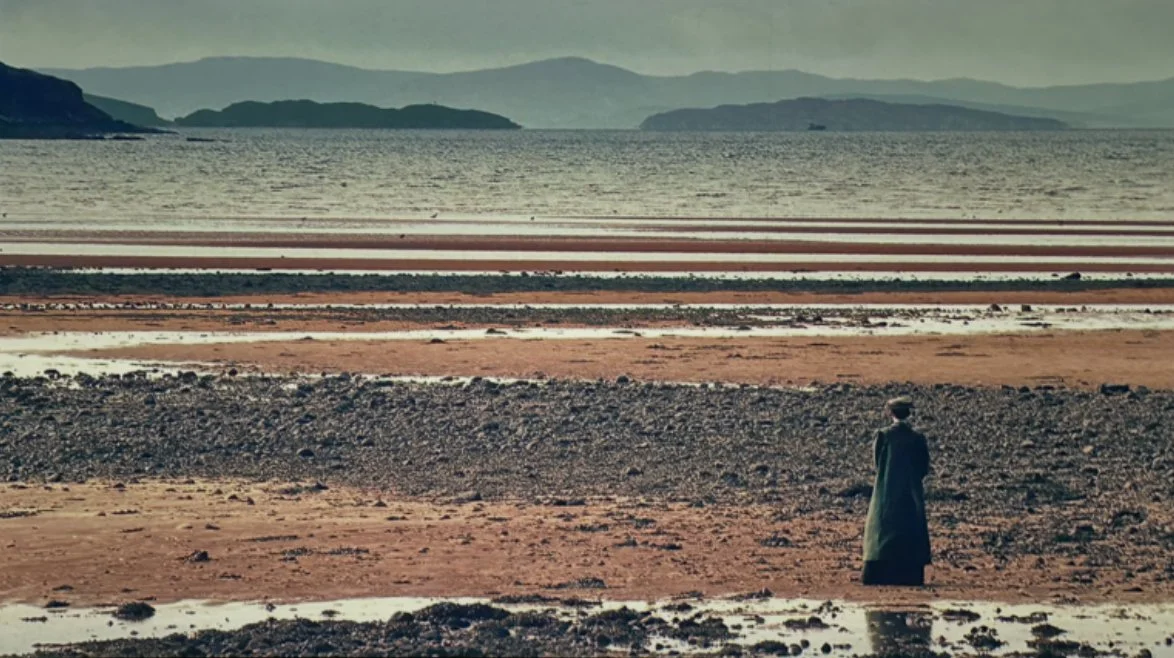
John Akomfrah, Vertigo Sea (2015), three-channel high-definition video with sound, Collection of the National Gallery of Canada. Photo by T. Cohn.
One of the most surprisingly poignant works is Clarissa Tossin’s Future Geography: Cosmic Cliffs (2023), created from discarded Amazon boxes. As Tossin explains it, the boxes symbolize excessive global consumption and the conceptual displacement between Amazon (the rainforest), and Amazon, the e-retail company. At the same time, she was thinking about spaceships and rockets crossing the sky and journeys to other planets, “maps of journeys that are yet to be made.”
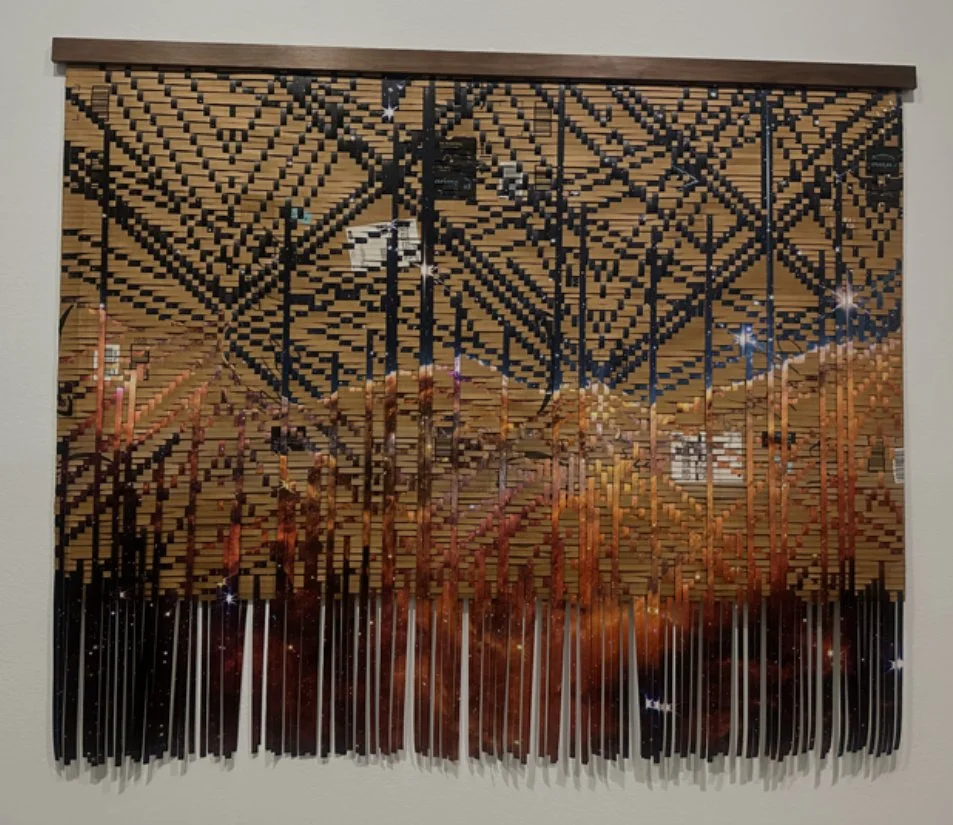
Clarissa Tossin, Future Geography: Cosmic Cliffs (2023), Amazon boxes, archival inkjet print on photo paper with lamination, wood, Collection of Sarah Miller Mengs.
These are not merely different subjects. They are different ways of making time visible. Fernández brings deep geological time into the present. Jungen and Larner expose the material consequences of consumption. Shin reveals the infrastructure of our digital world. Caycedo brings colonialism and extraction into the geography of the present. Akomfrah brings the ocean into a vast historical field of migration, colonialism, slavery, and climate. Tossin connects consumer culture with cosmic speculation. Luger brings ancestry, community, and future generations into the conversation.
What connects them is not a single vision of the future, but an understanding that the future is already being assembled from the remnants of the past and the conditions of the present:
Charcoal.
Plastic chairs.
Discarded objects.
Cell phones and cables.
Amazon boxes.
Historical images.
Indigenous knowledge.
Recorded voices.
The ocean.
The body.
The future, in this exhibition, is not made from nothing. It is assembled from what we have inherited.
The questions raised by Future Geographies are also part of a larger cultural moment. Across contemporary art, artists are increasingly turning to hypothetical futures as a way of reconsidering histories of colonialism, displacement, environmental destruction, and technological change. Afrofuturism, Indigenous futurisms, and other forms of speculative practice have challenged the idea that the future is a neutral or universal space, asking instead: Whose future? Whose history? Whose geography?
The Tate Modern’s A Year in Art: 2050, for example, considers how artists might imagine a future shaped by climate change, while its Alterfuturisms project examines alternative ways of envisioning the future beyond a predominantly Western, technology-driven model. These approaches reflect a broader shift in contemporary art: the future is increasingly imagined not simply as a destination ahead of us, but as a contested space shaped by the histories and power structures, we carry with us.
By contrast, what distinguishes Future Geographies is the way it makes geography itself the site of this inquiry. Its artists move between geological time, colonial history, consumer culture, Indigenous knowledge, migration, and cosmic speculation, asking us to reconsider not only what the future might hold, but the very maps and systems through which we imagine it.
Rather than presenting the future as an empty space waiting to be filled with new possibilities, the exhibition asks us to recognize how thoroughly that future has already been shaped by what came before—and by what we continue to do now.
Future Geographies does not offer a singular image of what is to come. Instead, it asks us to look closely at the materials, memories, histories, and systems from which our possible futures are being constructed.
Exhibition runs May 14, 2026 - January 10, 2027.