
Susan Cervantes: The Precita Eyes Way

Artist Susan Cervantes | Interview by Hugh Leeman
Leaving Dallas at Sixteen
Hugh Leeman: Susan, you graduated from high school at sixteen and moved from Dallas to San Francisco for art school. What gave you the confidence at such a young age to leave everything familiar behind? And what do you remember about the person you were when you arrived here all those years ago?
Susan Cervantes: I left my home in Dallas when I was sixteen, just about to turn seventeen, to start art school here in San Francisco — which was then the California School of Fine Arts. I'd been an art student in high school, and I really loved art. My art teacher got me into a painting class for high school students at the Dallas Museum of Fine Arts. I went to two summer schools to get all my academics done, so I graduated a year or two earlier than my class, because I really didn't want to stay in high school. That let me take two or three hours of art classes every day.
The museum class had a graduation exhibition, and they chose me for a scholarship to go to any art school I wanted. My art teacher said there weren't any good art schools in Texas, so I did some research and found that at the time — this was around 1960, '61 — there were only two schools in the whole country that actually gave degrees. My teacher at the museum was from the Pennsylvania Academy of Fine Arts in Philadelphia and wanted me to go that way. The only other one was the California School of Fine Arts. My parents wanted me to get a degree. Pennsylvania took five years; California took four. So I said, I'm going to go to California and continue my art practice there. I came to San Francisco and I was so excited. I was painting, trying to do a painting every day if I could.
I set up the room I was renting as a studio, and once I got into the school's studio, I just took over a whole corner. I was only one of about fifty full-time students at the time. The following year, it became the San Francisco Art Institute. And that's also where I met my husband, Luis, who became my life partner. He was in the night painting class. I'd taken over a whole corner of the studio, and the night teacher would tell me, "Susan, you can't paint in here during my evening class, because the students might need the space." So I said, okay, I'll just sit here and wait to see if anyone takes it — otherwise I'd be painting. And Luis set up his easel in that space, so we got to know each other, started dating, and became partners for the next forty-four years.
I had a little apartment on Russian Hill, above the school, but we moved to his place on Valencia and 22nd Street, in the Mission, where we lived for nine years. I kept painting and going to school. I got my Bachelor of Fine Arts from the Art Institute and then my Master of Fine Arts, and I kept getting scholarships — I never had to pay tuition except for one semester. After our first son was born in '69, we were evicted and basically became homeless. We were told we could live in an old storefront on Precita Park. After looking at everything we couldn't afford, we decided to try to make it happen in that storefront — and it became our home for the next thirty-five years. My other two sons were born there.
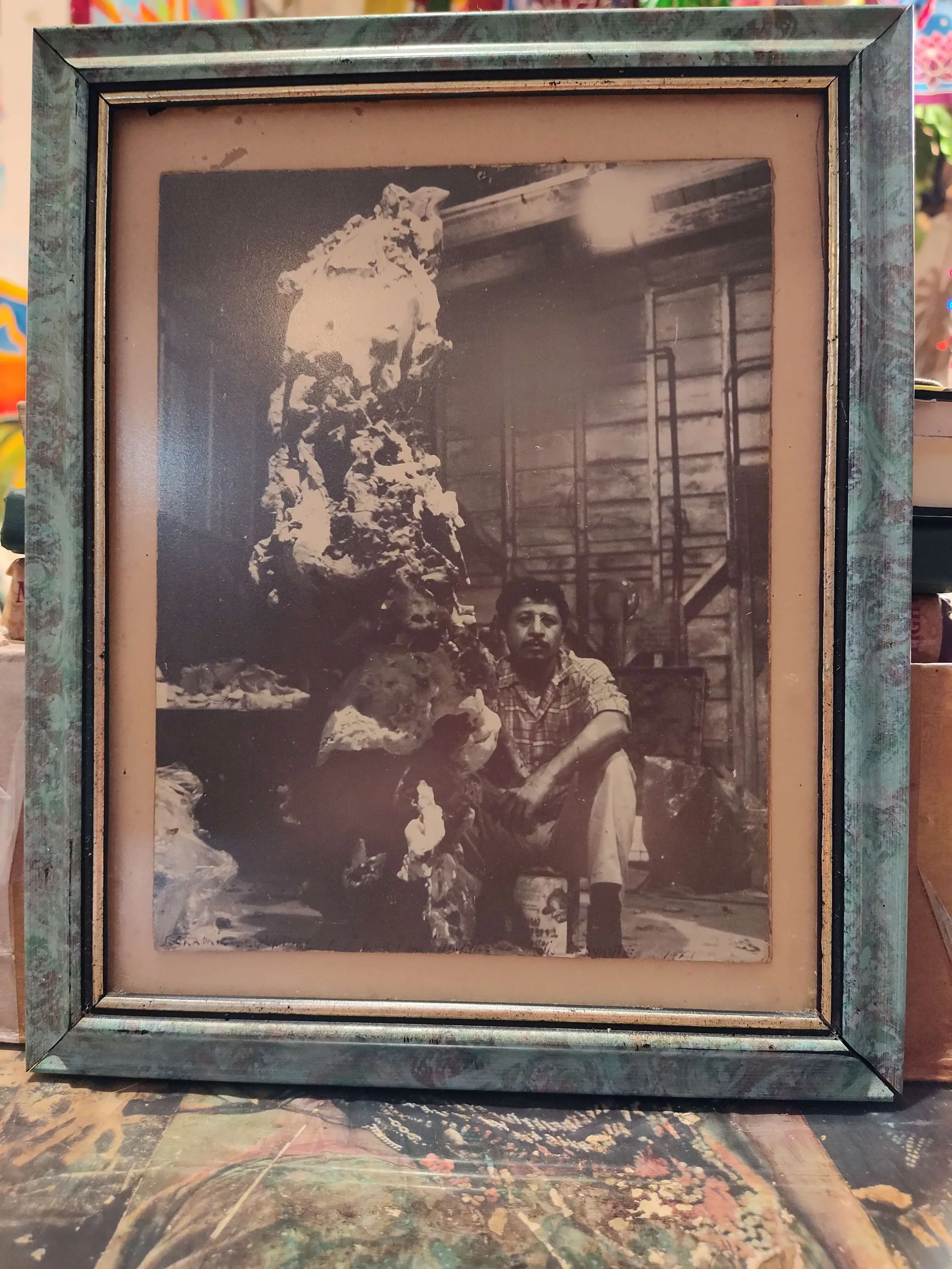
In that first year, around 1970, with a young child, I started looking around at what existed for children. There was a dilapidated playground in Precita Park, a community center at the end of the park with no arts programming, and an elementary school across the street. Since there wasn't any art for children anywhere, I decided to volunteer my time at the Precita Valley Community Center — preschool art classes and after-school classes for kids, and adult painting classes in the evening. Meanwhile, Luis worked as a custom mattress maker at the McRoskey Mattress Company for over forty years. He was also an artist — a painter and sculptor. When I first met him he was a ceramic sculptor, but we didn't have a kiln, so he started working in other materials.
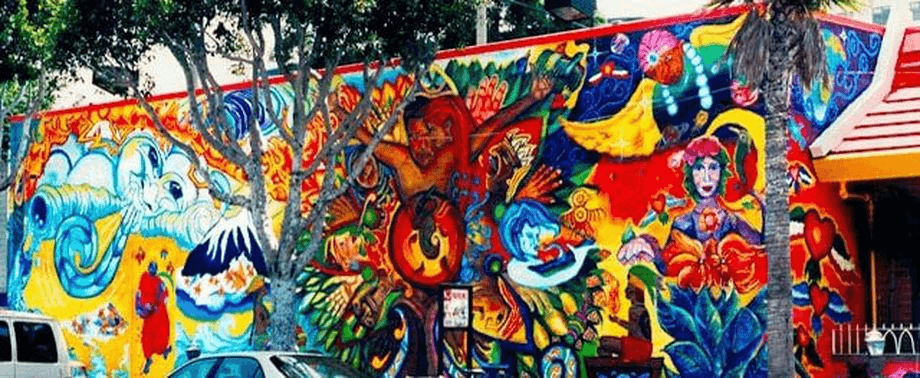
We were very familiar with the other Latino artists making work in the Mission District, and got involved with Galería de la Raza, another cultural cornerstone of the neighborhood. I knew a lot of the Latinas who were making art. One day I saw them painting a mural on Mission Street, on the old Mission Hiring Hall, a two-story building. It was fantastic to see women up on the scaffolding, getting paid to make a painting about the culture. So I'd visit them every day, bring them refreshments, and document their process. They invited me to work with them on their next mural, at Paco's Tacos. Graciela Carrillo invited me — she was one of the original Mujeres Muralistas, "the women muralists." There was Patricia Rodríguez, Consuelo Méndez, Ester Hernández, and Irene Pérez. Consuelo and Graciela were commissioned to do the new mural at Paco's Tacos, and that's when I started painting with them. I got very excited about how they worked — so well together, collaborating, respecting each other's ideas, creating a unified concept out of all of them. That's really how I got involved with the mural movement.
Sharing a Life and a Studio
Hugh Leeman: I want to go back to Luis — your late husband, with whom you shared an incredible life, a family, and a studio for more than forty years. Beyond the works you made together, how did living with another artist affect the way you understood yourself, as a person and as an artist?
Susan Cervantes: It was wonderful. Our old home on Precita Park was one gigantic room, with fourteen-foot ceilings. When we got there it was just an old, rat-infested grocery store with no amenities at all — no bathroom, no kitchen, nothing. We had to build all of that out. But we wanted it to be an open space, no walls. We built a little loft to sleep in, and our first child slept underneath. It was all wide open, so Luis took one side of the space and my studio was over by the kitchen; his was by the open area that was more of a family room. We were face to face with each other, watching each other work — him on his sculpture, me on my painting.
It was wonderful to share that space and our creative energy, to share our processes and our stories. And the children grew up in that creative environment. We never had any challenges with it; we were always very compatible. I was really more into color and light, and I think that influenced his palette, while his wisdom, his nature, and his stories influenced my thinking and the way I perceived things. We shared so much, we were always together, we went everywhere together — we were never separated. It was just the very best you could possibly ask for.
Eviction, and a Circle Back to the Sears Building
Hugh Leeman: You mentioned being evicted. I'd read that a nursery you grew up around as a child, before moving to San Francisco, was later taken from your family when highway construction cut off access to the property. And then decades later you experienced displacement yourself here. How have those experiences shaped the way you think about home and land — and about the human consequences when development changes a community?
Susan Cervantes: It was very, very sad and disheartening to be evicted from my home of more than thirty-five years — particularly two months after Luis passed away. Very difficult. I didn't really have any income. We'd lived off the grid; our rent was super low, a totally different reality from everything outside our space. Once he passed and that support was gone, everything changed. But it seemed like things fell into place for me — little miracles kept happening.
I had two sons still living at home when we were evicted. My youngest, Monty, decided to move out on his own, and my middle son, Suaro, was still with me. It took me more than six months — I tried to fight the eviction, but I saw it was impossible, so I let that go and had to figure out how I was going to live, support myself, and find a new place I could afford. I had very little savings, basically just set aside for our health. Luis had a very small pension I didn't even know about. He'd been working on something at the table before he passed away — he died before he could finish it. Through a very close friend of mine who did a ceremony around him, she said he'd told her there was something on the table I needed to finish. I'd covered everything on the table with a big cloth, because people were coming by with food and flowers, and it wasn't until everything settled that I uncovered it and saw what it was. It was about his pension. It was very small, but a lot of money for me — enough, if I finished it, to put toward a first month's rent.
It took me more than six months to find a new place, and it was a kind of miracle. I found a place in the old Sears building — which was striking, because when I came here in 1961, that was the first place I worked to support myself, in women's apparel, back when it was still Sears. Sears closed around 1972 and it became artist lofts. I'd known people who lived there, including some of our closest friends, whose children grew up with my sons, but I'd never really gone there myself. Someone had breached their lease, and when I first went to inquire I couldn't rent anything. I was about to give up on finding anything possible. Then they called to say someone else had breached their lease — was I still interested? I went to look, and it was perfect. Luis's sculptures weigh tons and are taller than I am, so whatever space I took had to hold them. I opened the door and thought, this is it. I put down first and last month with the pension funds I'd finished — without that, I couldn't have done it.
I'm the founding director and co-founder of Precita Eyes, and I was still managing the organization, but I'd never really paid myself a salary — I was always looking after everyone else. I had to ask the board to establish an income for me, which they did, and that let me pay the rent and continue. That's what I still do today; I supplement it with Social Security. If I weren't still doing my work here, I wouldn't be able to pay the rent.
Saving the Space: A McDonald's Mural
Susan Cervantes: I learned something from that eviction, because later we also faced one at Precita Eyes, which was on Precita Park. We were renting two storefronts, and the landlord closed off the passageway between them, because they were going to put the other building on the market. I could tell it was an eventual eviction, so I had to think, how am I going to save this space? My heart was around Precita Park, but there was nothing available there. I went down Balmy Alley, the mural environment we take visitors through, from Precita Park over to see the murals.
Back in the early '70s, while I was volunteering at the community center, I was also volunteering as a tutor at the 24th Street Place, a little storefront at the end of Balmy Alley that Mia González directed. I'd bring children to my studio to learn to read recipes — you read the recipe, make the food, and then you have food to eat, or an art project to do. Going through Balmy Alley, I saw that the old 24th Street Place tutorial center had been boarded up for years, and I wondered about the space. A friend gave me the name of a broker, and I asked what was going on with it. They said it had just gone on the market.
We only had about $11,000 in our capital campaign — this was around 1996. I knew we were going to be evicted, so I had the insight to look for an alternative. But I didn't know how to do five-year cash flow projections, or get a bank loan, or any of that. I wasn't able to get a loan, and I raised some money but not enough for a down payment. The owner said, "We don't know what to do about you — nonprofits, how do you make your money?" I was completely disheartened.
I calmed down, and about two or three months later, another building on 24th Street became available — the one we have now. It must have been meant to be, because I was able to get a bank loan, I had a little more cushion in savings, and lots of people started giving me loans to make it happen. But we were still about $15,000 or $16,000 short of the down payment. Then the man opening the new McDonald's contacted us to do a mural. I said, that's great, we'd love to — but I've never even eaten a McDonald's hamburger. He said he thought it was part of the culture and important to support. I said, so we should be able to do whatever we want on your building? He said okay. We designed it with all of our children, youth, and artists, everybody donating their time, and the money from that McDonald's commission is what paid the down payment for the building that is our home today.
Hugh Leeman: For someone who'd never eaten a McDonald's hamburger, it was McDonald's that put the final touches on making this possible. I want to hear more about Precita Eyes, because it's been such an incredible part of your life. It developed from a neighborhood workshop into an organization whose methods have traveled internationally. What has it been like to see it become not just murals, but an artistic methodology?
The Precita Eyes Way
Susan Cervantes: What's been really important is our process. I can see it now in perspective, after doing this for almost fifty years — next year will be our fiftieth anniversary. Every mural Precita Eyes has ever done has been by request, because people want to experience something together: building community and creating something special of their own that tells their story. That's what I learned from the Mujeres Muralistas — how they shared each other's ideas and integrated them into one unified concept. Every workshop we do follows that same process.
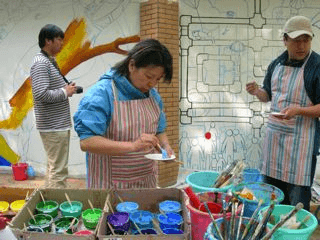
We hold a community mural design workshop with whoever we're serving — a school, a university, a health center, a hospital, a homeless shelter, a senior center. Many of these people have never drawn or painted before; they just want to be part of something and create something beautiful for their space. The community decides the theme. We make a list of themes, and they choose the one that most resonates with them. After they do their drawings, everyone discusses what's important in their drawing, what it means to them, and why it should be in the mural.
Then we make a list of all the images — it goes from the verbal to the image — and we start seeing how they relate to each other. Even though everyone's coming from a different place, their ideas are all interconnected, and we keep the integrity of everyone's ideas together. No one is excluded; everybody's ideas are in the story the whole collective makes. A kind of magical moment happens when we make the composite together, decide where things go, and all of a sudden it all makes sense — it tells its own story, with all these other stories inside it, and it's unified. They get so excited participating in it. From there, the lead artists develop and research the ideas and share the full-scale drawing, with the community's own voices and narratives behind it. Once we have the approvals, we prepare the wall, and we often schedule community painting days so people can come out and help paint. Done that way, it's a true community mural process — we call it the Precita Eyes way. That's what we practice, and that's what people keep asking us for.
Carrying the Process Abroad: Russia and China
Hugh Leeman: You've taught community mural methods in places from Russia and China to Sweden and Canada. What have you learned from communities elsewhere that has affected the way you work with communities here in San Francisco?
Susan Cervantes: It's really interesting when you go outside your own world and begin to share this with other people. I went to Russia because I was invited, and to China because I was invited, to share the process with people who had no idea what it meant but really embraced it. Working with Russian artists in a collaborative, community way — they'd never worked on anything collaboratively before, so it was all new; everyone had to wrap their heads around it and embrace it. We had a great time, bringing people in and making them feel part of it. I went three times; the last was in 2004, doing a mural with twenty Russian children at a children's art school. It was amazing.
In China it was the same, and they're even more individualistic — though the Russians are too, and I think their social situation makes it very hard to sustain anything communal. In China they had never seen people come together to create something collectively. Everyone's very individualistic — "this is mine, that's yours," no one touches your work. The first time I went, I had about 150 students doing two murals, in groups of about thirty. What struck me was that they had never even touched each other's drawings. Here, we're always sharing them — holding them, putting them up on the wall next to each other. They felt intimidated by that, until I showed them how to put things together after drawing out their ideas — setting your drawing aside, looking at it alongside everyone else's. It was the first time they started touching each other's work. And when they began composing together, a big light bulb went off. They got so excited, there was this buzz, this energy — everybody really got it.
Because of that, I was invited back to work with twenty art teachers from all over Beijing, at the same site, a huge national children's garden and pavilion. The teachers embraced the whole idea completely. They'd show me, "There's a new wall at the Chinese National Museum — we're going to work with the community and put a mural there." They were ready to start practicing it in their own communities, which was the whole point of working with the teachers: so they could share the process all over northern China. I'm so glad they embraced it. Those Russian artists and children are probably all grown now; I think it was a very meaningful experience. But with the world situation the way it is now — it's a mess. They say, don't even think about coming here, it's a mess, and that's unfortunate. You'd hope for more communication, more inclusiveness in our processes — not just as artists, but as people, as human beings. I think that's the whole point of our being here: respect, and loving each other just the way we are.
Water Is Life, and a Mural for Now
Hugh Leeman: I want to talk about that. There's one mural in particular, the Water Is Life mural, that emerged from an American-Soviet collaboration concerned with peace and the environment. Decades later, residents fought to preserve it long after you were gone from the scene. Today, given climate change, war, migration, and political division, what issue would make you feel compelled to paint a new international mural — and what would you want it to ask people to do?
Susan Cervantes: I imagine it would be a mural reflecting all the beautiful creativity that human beings can share with each other — through dance, poetry, music, painting, making food, all the great things that make up a human being and what we love to share. If it were international, you'd want to invite people from all over the world, from different countries, to contribute to an overall theme of peace, a global cultural theme. We'd put all their ideas into one big composite and then invite everybody to come and paint it — if we had a big enough wall. I've always thought the wall behind the Orpheum Theater, at UN Plaza, would be a great place for something like that. I've had a vision of an international mural, and that's how I see all the pieces coming together: incredible artists from all over the world sharing their ideas and putting them in one place.
Should an Artist Take a Side?
Hugh Leeman: You once said, "It's not about becoming an artist, it's about becoming a better human being." In the history of muralism — and in your own work with Precita Eyes — there are elements of activism, sometimes implicit, sometimes explicit. Is there a case where an artist should remain neutral in the face of injustice, or should it be addressed in the mural? How do you and Precita Eyes think about that?
Susan Cervantes: When we have discussions about the themes and issues come up — homelessness, abuse, intolerance, any kind of issue — we talk about it. This is a great place to have dialogue, to discuss people's experiences that have been traumatic, where they feel they're different, outsiders. There needs to be a discussion so we can find solutions within it, as the designs and ideas are developed, and those solutions get incorporated into the mural. So it's not just showing the negative part, but the solution too, and everybody agrees on that.
We did a mural down on 6th Street at the Rose Hotel, a homeless hotel, and there was a lot of discussion about drug abuse, violence against women, mistreatment of each other and of yourself. But there was this hope, this real positive energy that came out of the designs and images from the homeless people participating. Even with the internal struggles they'd had, and the abuses they'd suffered from other people, it was shown side by side with a positive, hopeful, loving life. That helps uplift and reach the people who need the care.
Hugh Leeman: You've spoken of muralism as something inclusive, not exclusive. Are there moments when an artist, or a community, should take a side — where it can no longer be entirely inclusive, where you need to make a statement? How does that work in the Precita method?
Susan Cervantes: There's room for that, but we have a strong feeling for being inclusive. We're not the ones designing it — it's the people we're working with whose images are drawn, composed, and developed into the final concept. There's always been some common ground; people find themselves and each other in the process, no matter their differences. Where you see people who might never have worked together, a bond is created. That's the impactful part of the mural process: people begin to talk to each other, to see each other for who they really are and respect that, letting their true selves be seen and reflected in the work.
Because of that, it's transformative — people apply it to other parts of their lives. Twenty years later I'll get an email: "Thank you, Susan, for letting me participate in a mural, because it totally transformed my life. I'm a better person; I see things differently now." But I'm not thinking about that while we're doing it or facilitating the process — it just happens, and we're all grateful that it does. As long as people still need or want this, we're here to share it. It's really important for people to be able to see themselves, to express themselves, to have an outlet. There are so few outlets for expression. We should see art in the street every day, people making music every day, dancing in the street, community painting every day — there needs to be more of that. I think art is transformative, that it can change people's lives and make them better human beings.
What the Next Generation Should Keep
Hugh Leeman: A consistent through-line in your stories today has been collaboration and influence — the Mujeres Muralistas, and your decades with Luis. Muralism today keeps expanding; it includes graffiti and street art, social media, digital projectors, even AI-generated imagery. What do you think the next generation should preserve from the community mural tradition, and what should they be willing to reinvent?
Susan Cervantes: They're going to have a lot of new tools — technology is pretty amazing. A lot of the time I still say you have to start at the drawing board, with a pencil and paper, though most people are doing it on their tablets now. But the philosophy will be the same. I have a lot of beautiful young emerging artists working here at Precita Eyes, and they're really its future. They're grateful to have a place that cares about community, that wants to bring art to the people, because there's almost nowhere else they can turn to do that. We train people to work with communities, so they can go out into their own neighborhoods and do the same thing — I see the same practice being shared in many other regions.
They'll have new tools — social media, AI, things beyond what we can even imagine — and those can still be used in an inclusive, respectful way, with beautiful visions and solutions to the problems people face. So it's going to continue in some form. The mural movement has spread all over the world, and so has the graffiti movement, which has been fantastic. We started our urban youth arts program in the 1980s, when I started seeing little throw-ups on the walls and wondered, who's doing this? It was another new form of muralism — back when it was still considered criminal just to carry a marker. Spray paint is just another tool, like a brush; it's a preferred tool with its own style. Our youth do traditional painting too, but they do their touch-ups with spray paint, and they can use projectors to put up their images — though when we work with large groups we still use the grid method. All your concepts can go on the computer, be moved around and layered. Those tools are there for everyone.
But it's the same idea: sharing your ideas with other people, being inclusive in whatever you do, in whatever discipline — dance, music, poetry, whatever it is. I think an inclusive action is what we need to grow and go forward and see more beauty, more people coming together, living a beautiful life.
Hugh Leeman: Sharing ideas and inclusivity, working together to lead a beautiful life. Susan Cervantes, thank you so much for making time to share these ideas and the stories from your career.
Susan Cervantes: Thank you, Hugh. I really appreciate your time.
