
Joel Hernandez, At Least We’re Damned Together, Moth Belly Gallery
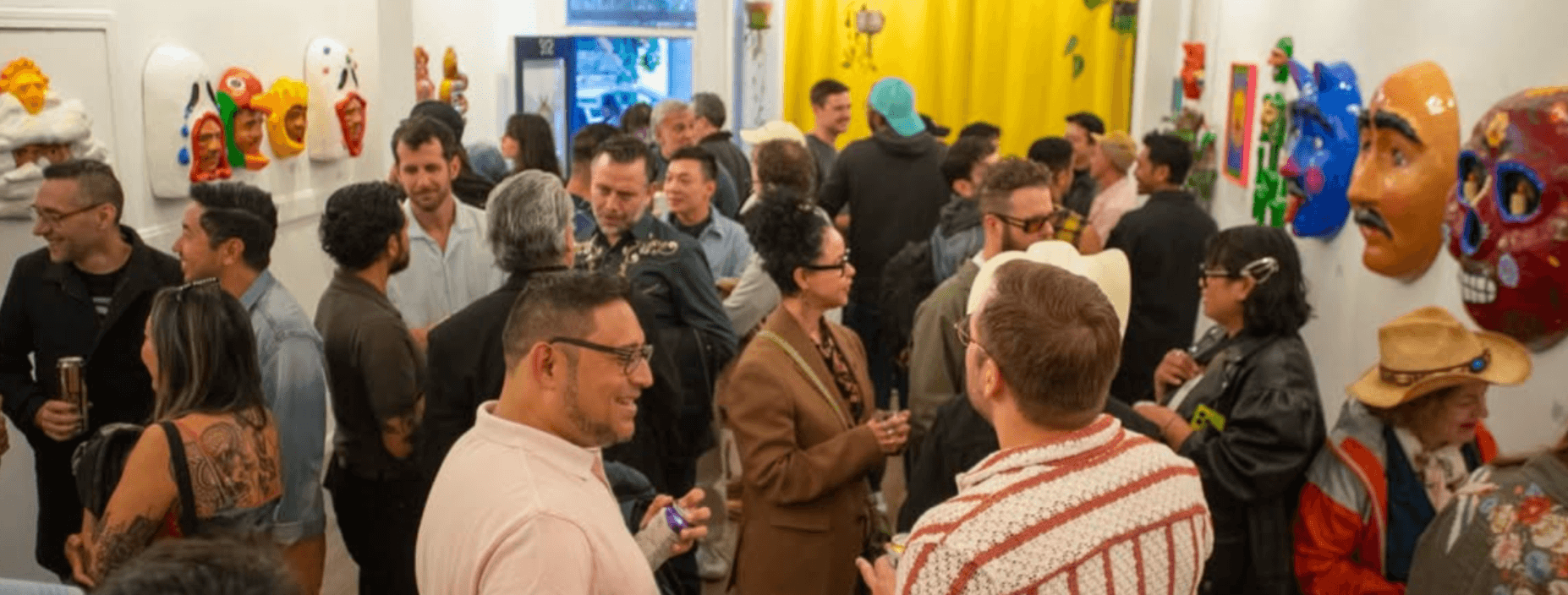
Opening Reception for At Least We’re Damned Together, at Mothbelly Gallery, 06/06/26, San Francisco, CA.
“…I try to believe in The Cross.
…But I can’t. Need is not quite belief.” -Anne Sexton, 1962
By Grey Dey
When I walked into Moth Belly Gallery for Joel Hernandez's At Least We’re Damned Together, I felt like I was walking into a really fun, sassy party. There on the walls were so many delightful and startling characters, sculpted in paper mache, looking right back at the viewer and, at times, even playing a kind of peek-a-boo. Faces emerge from masks and eyes peek through clouds and over water. So many characters and stories in exuberant colors, and faces full of lively expressions, greet you like entering an ebullient masquerade. But after my initial impression of celebratory color and charming style, I began to see the layers of interiority and critique. Childhood memory and innocence, magic and shapeshifting, and adult pleasure and demise, all intermingled throughout this playful exhibition.
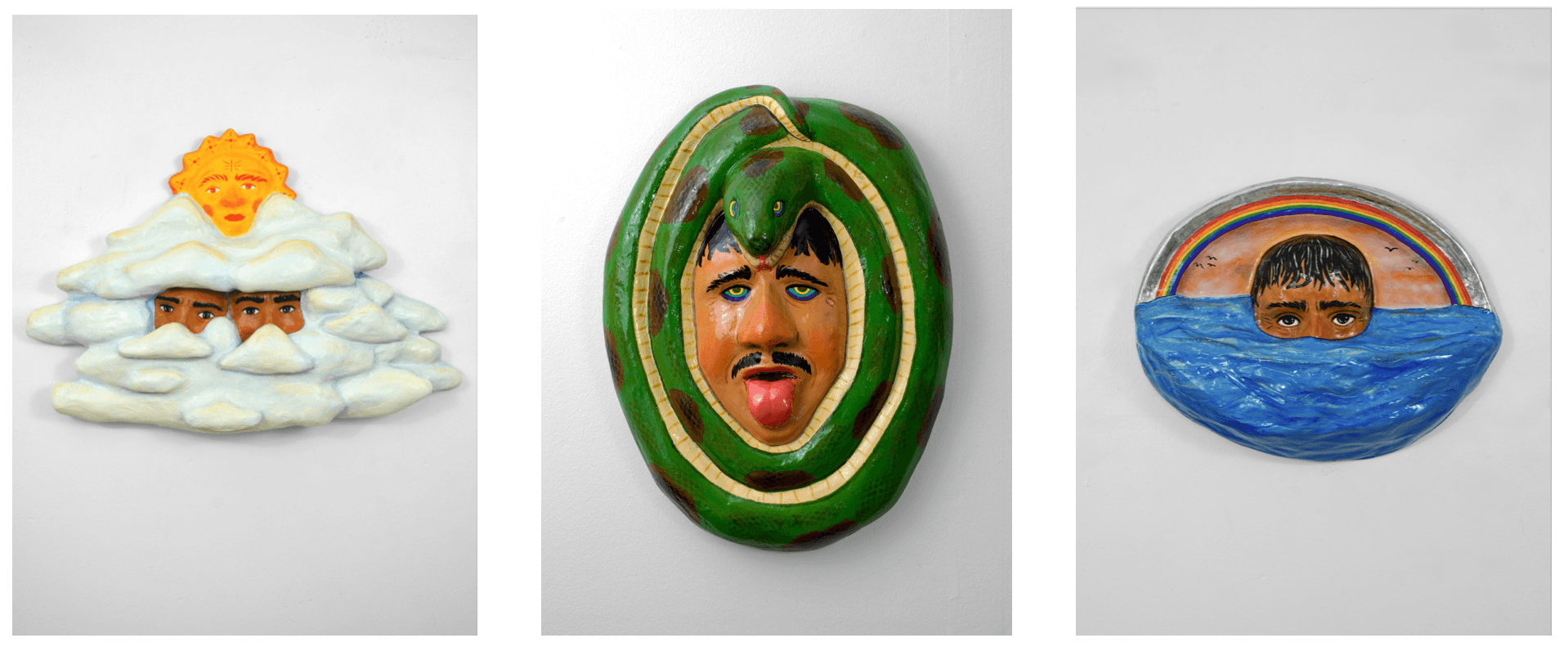
(L) Lets Buy a Little House in Heaven, 2026, Archival-grade paper-mâché, acrylic, and artist-grade resin, 28 x 20 x 7 ½ in
(M) Hypnotized, 2026, Archival-grade paper-mâché, acrylic, and artist-grade resin, 19 x 14 x 5 in.
(R) Silver Lining, 2026, Archival-grade paper-mâché, acrylic, and artist-grade resin, 21 x 16 x 5 in.
I was fortunate on a recent visit to San Francisco to catch up with Hernandez on a day when he was available for visitors to the gallery. I was able to spend a considerable amount of time with him discussing the show. Hernandez grew up in a Mexican border city, Nuevo Laredo, in the state of Tamaulipas, directly west of Lorado, in lower Texas. After some years in Indiana and Texas, he ultimately settled in San Francisco for the last 11 years, building his studio practice in the Mission District.
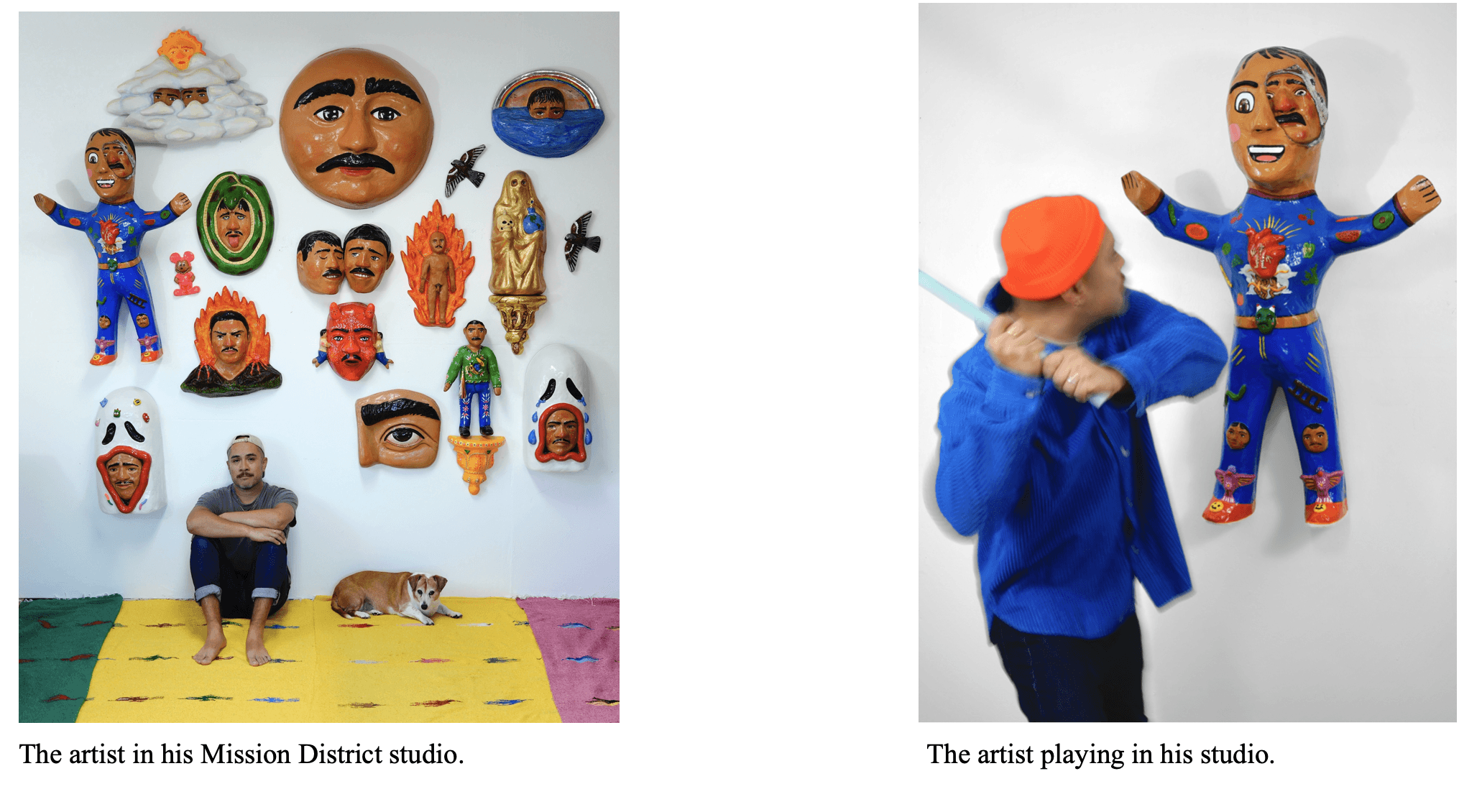
Fun video of the artist playing with the work in the studio: https://www.instagram.com/p/DZ5UFPfITE9/
He told me of the powerful impression made on him in his childhood by the local artists of Nuevo Laredo, who set up shop just as you cross the border from Texas. These artists were heroes for Hernandez and reappear in his ongoing mastery of hand-crafted paper mache and color palette. His personal takes on many of these regional, cultural themes and subjects carry these influences and artistic traditions forward into contemporary contexts, without sacrificing the value of personalized work made with care by hand. We see Hernandez honoring one of these artists in the piece, Hungry for Food. The title is echoed in his Instagram comment referring to this piece and another similarly constructed piece, Hungry for Riches.
“The golden statue was inspired by all of the AI billboards around town that try to convince you to not hire humans. I wanted to create two people at different spectrums. One that is happily creating art, culture and color. The other, encouraging you to not hire humans therefore stopping human growth, creativity and all things only humans can make… -The artists are hungry for food and the CEO is hungry for wealth.”
Hernandez told me that the faces in the pedestal represent the many individuals in today’s world who are aspiring to those riches and trying to climb to the top. The figure cloaked in gold is hiding the opportunist individuals behind this corporate AI takeover who disregard the global and societal harm in its wake. We never see the people behind the onslaught of AI content.
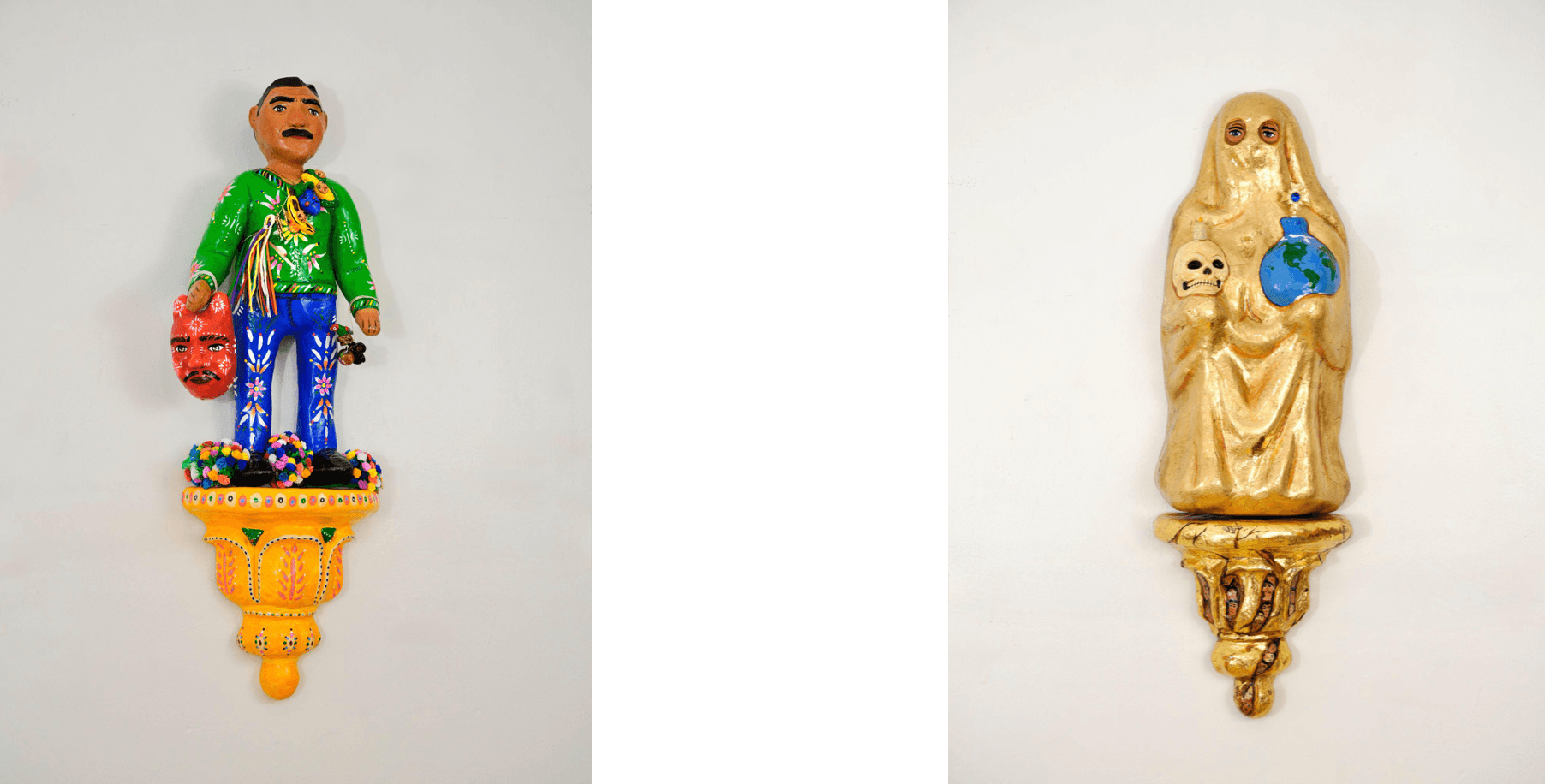
(L) Hungry For Food, 2026, Archival-grade paper-mâché, acrylic, and artist-grade resin, 34 x 11 x 6 in.
(R) Hungry For Riches, 2026, Archival-grade paper-mâché, acrylic, and artist-grade resin, 34 x 11 x 5 in.
In Hernandez’s art we see the ubiquitous influences of Catholicism infused into Indigenous and regional Mexican visual traditions. But that cultural colonization is subverted through Hernandez’s critique of religious and cultural dogmas that do not allow for his contemporary, multicultural, Queer experience. Queer liberation and self realization often facilitates additional insights around other agendas of institutionalized oppression such as racism and classism. In Two Little Homos Whispered In My Ear, Hernandez flips the metaphor of having a devil on one shoulder and an angel on the other. This time, the (Queer) subject is reclaiming society’s demonizing, rejecting the moral binary, and choosing for themself who they will choose to listen to. As Hernandez said to me, “we control the narrative!”
In the title piece, we see the empowered, flippant disregard of hegemonic threats. Like the quote above from Sexton’s poem, With Mercy for The Greedy, religious metanarratives fail to maintain their stranglehold in modern contexts. Today it is difficult to reconcile these colonial and contradictory belief systems with the atrocities witnessed everyday. We are left to create our own world views that reflect our experience today. From an interview with Brandon Joseph Baker he states:
"The title [At Least We're Damned Together] was inspired by a piece that I made a long time ago where a snake swallowed two men, but the men inside the snake were relaxed and smoking a joint. It’s about the idea that we can find silver linings in difficult moments. I think that’s the mantra that we’re all in right now, trying to find the upside and the positives in a dark moment in society."
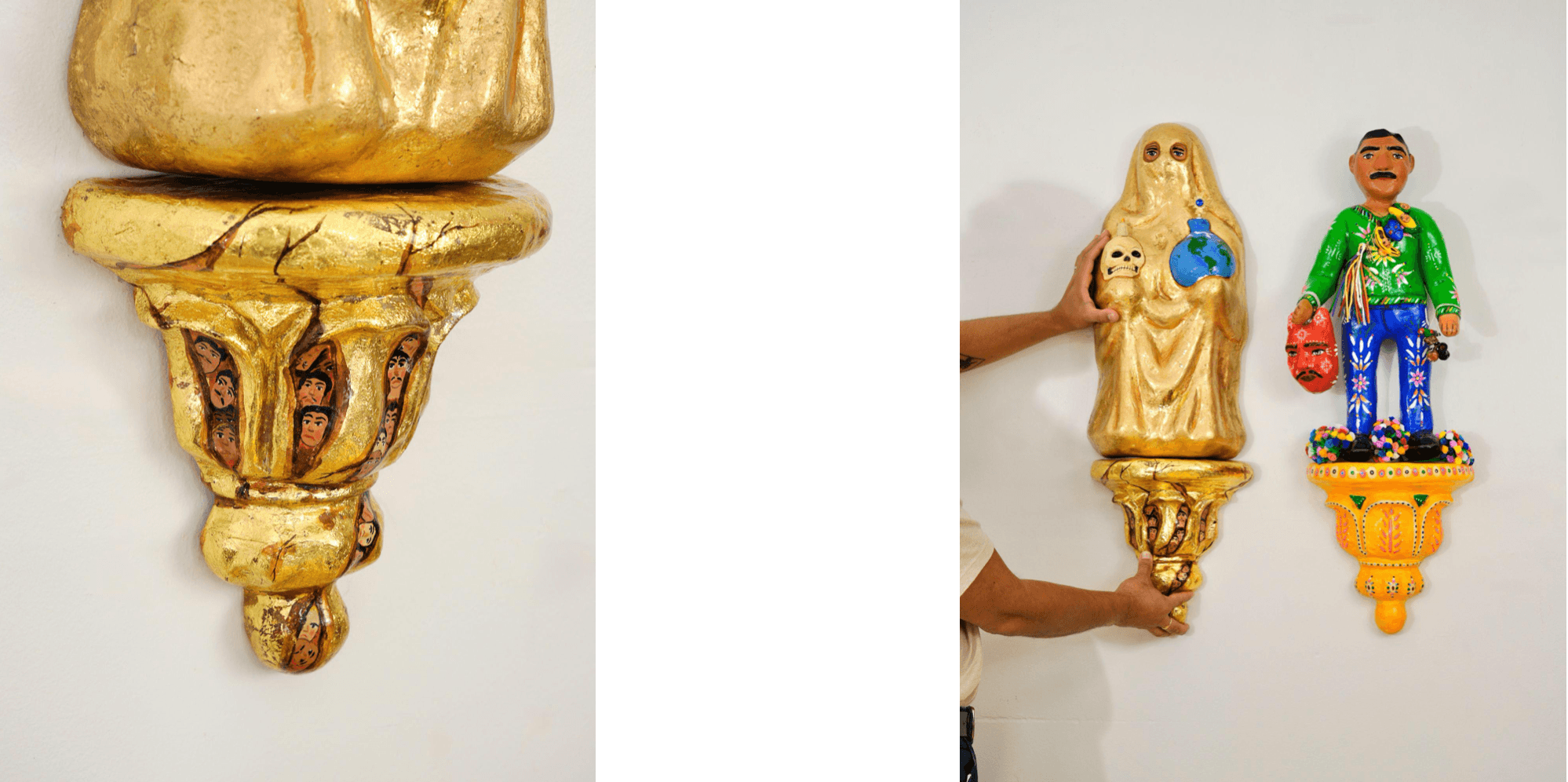
Two Little Homos Whispered in my Ear, 2026, Archival-grade paper-mâché, acrylic, and artist-grade resin, 15 x 15 x 6 in.
At Least We’re Damned Together, 2026, Archival-grade paper-mâché, acrylic, and artist-grade resin, 23 x 14 x 2.5 in.
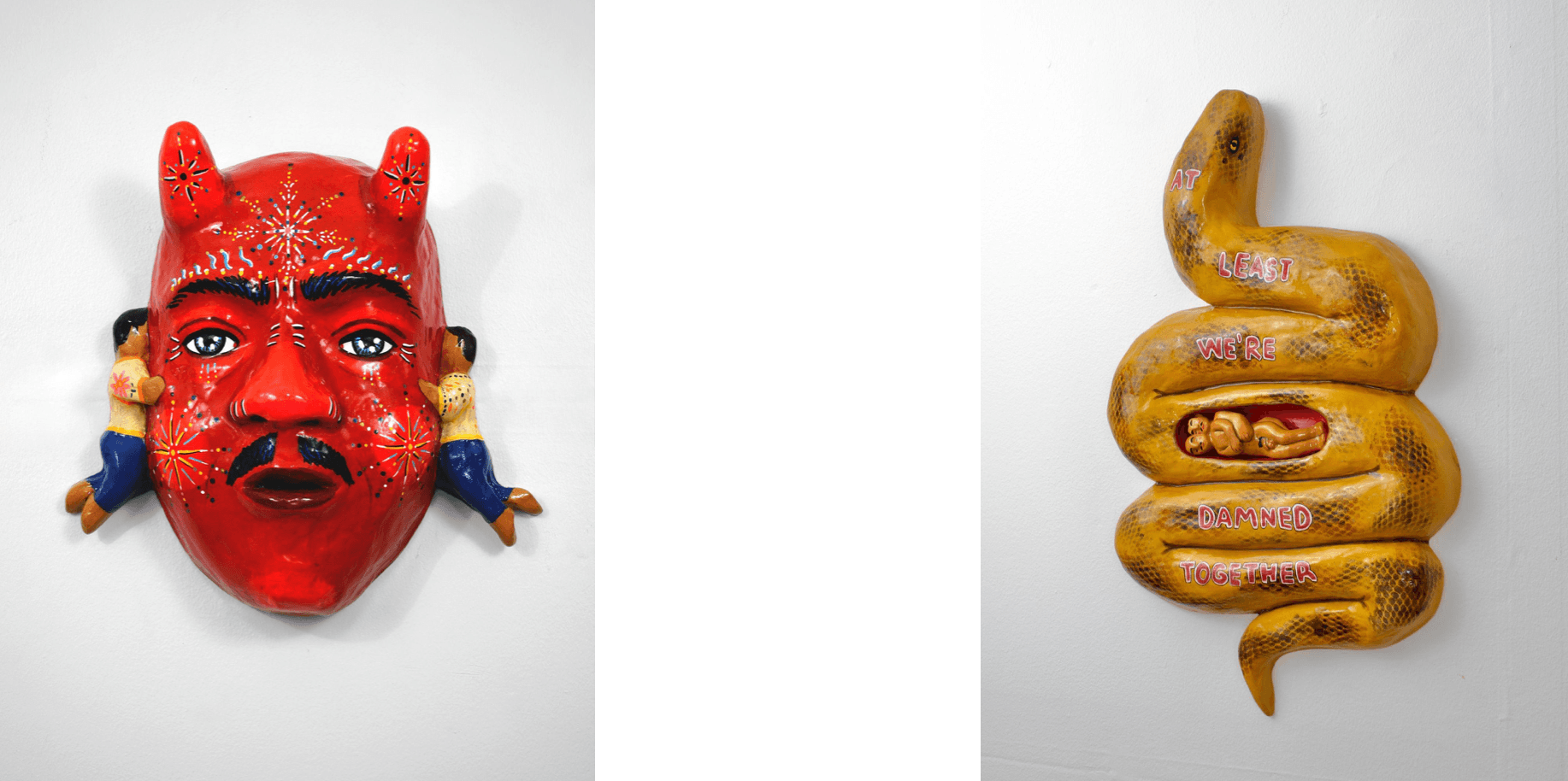
(L) Two Little Homos Whispered in my Ear, 2026, Archival-grade paper-mâché, acrylic, and artist-grade resin, 15 x 15 x 6 in.
(R) At Least We’re Damned Together, 2026, Archival-grade paper-mâché, acrylic, and artist-grade resin, 23 x 14 x 2.5 in.
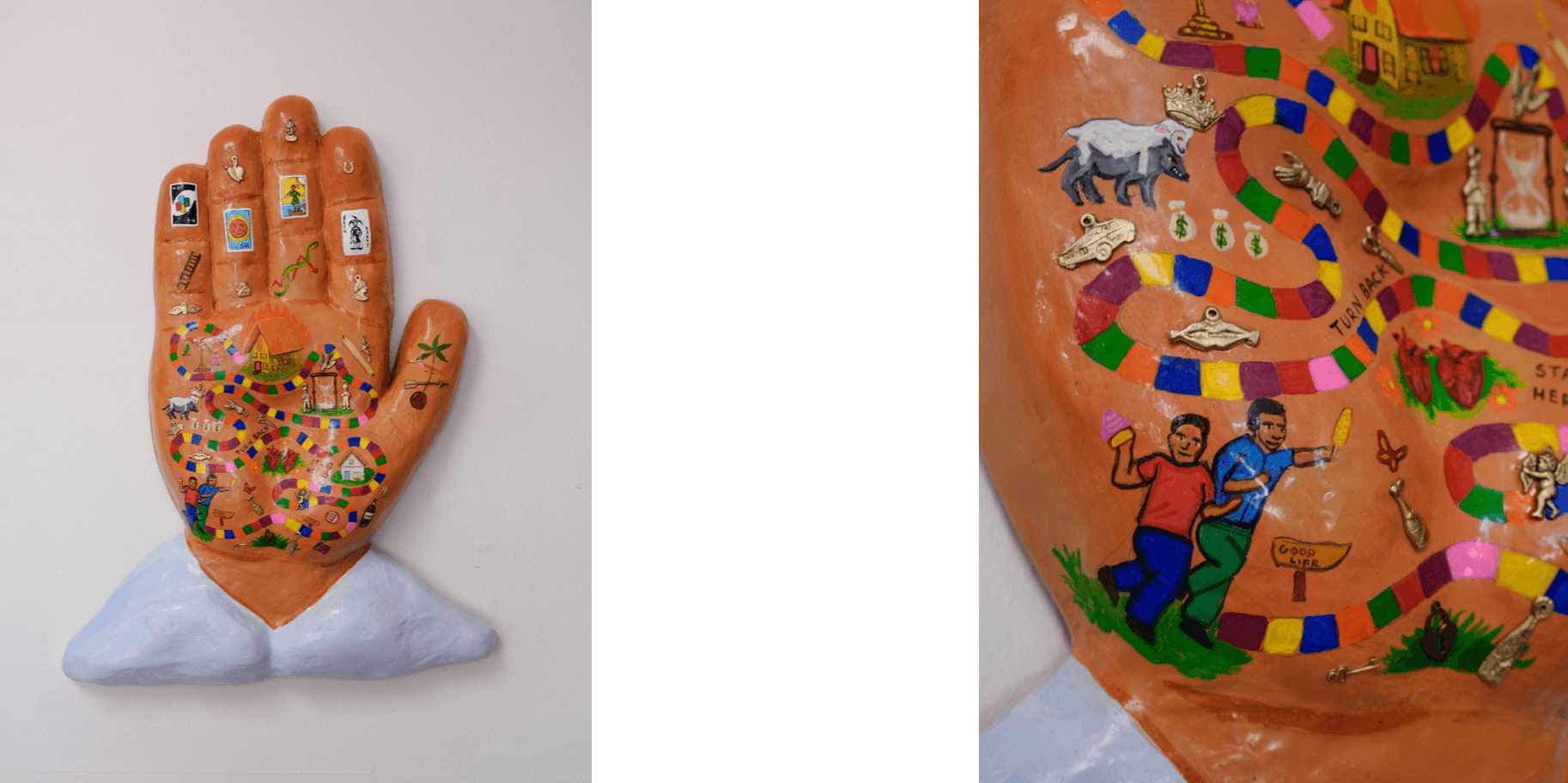
(L) Learning When to Quit, 2026, Archival-grade paper-mâché, acrylic, and artist-grade resin, 22 x 16 x 3 in. (R) Detail
We see another example of this critique in Learning When To Quit. The palmistry hand is painted with a board game template, replacing life-line wrinkles, that warns of ambitions for success turning to excess and ruin. We see a gay couple optimistically beginning their life together to create a loving home. To continue playing beyond that goal includes ignoring warnings to “stay here” and “turn back!” The journey then slides into the pathos of temptation and self destruction, sacrificing time and simple pleasures to the unquenchable desire for more. This results in ultimately losing everything. The yellow brick road need not go all the way to Oz.
The game and the hand are decorated with milagros (small, golden charms that serve as placeholders for prayers, hopes, and gratitude,) Loteria (a Mexican game similar to Bingo but sometimes used as an oracle) and Tarot cards, along with other symbols representing the mysterious forces that often complicate our life choices and confound our worldview. The sleeve cuff morphs into a collar and the hand stands in for the head, revealing the pressure and confusion of sorting all of this out.
While other works also incorporate milagros, several works reference iconography from contemporary global pop culture, layering them into historical Mexican cultural contexts. In Aye Carumba, we see a heart shaped face of a Mexican man emerging out of a stylized Bart Simpson head. The title of the piece confronts how U.S. audiences need comedic, slapstick, and often dehumanizing filters to process non-eurocentric and non-white-supremist references, in order to consume them as entertainment. In The Simpsons, a layer of innocence-as-camouflage is added in the form of a young boy co-opting the Spanish exclamation. All the while, we are reminded of the origins of the phrase through the winking Hispanic face. In Happy Gooble, we see an adult face, (probably a self portrait,) peeking through a beloved childhood TV character covered in toy replicas of Gooble’s friends on the show. The face is remarkably emotive, expressing the simultaneous feelings of nostalgia for uncomplicated youth, and gratitude for friends throughout the trials of adulthood.
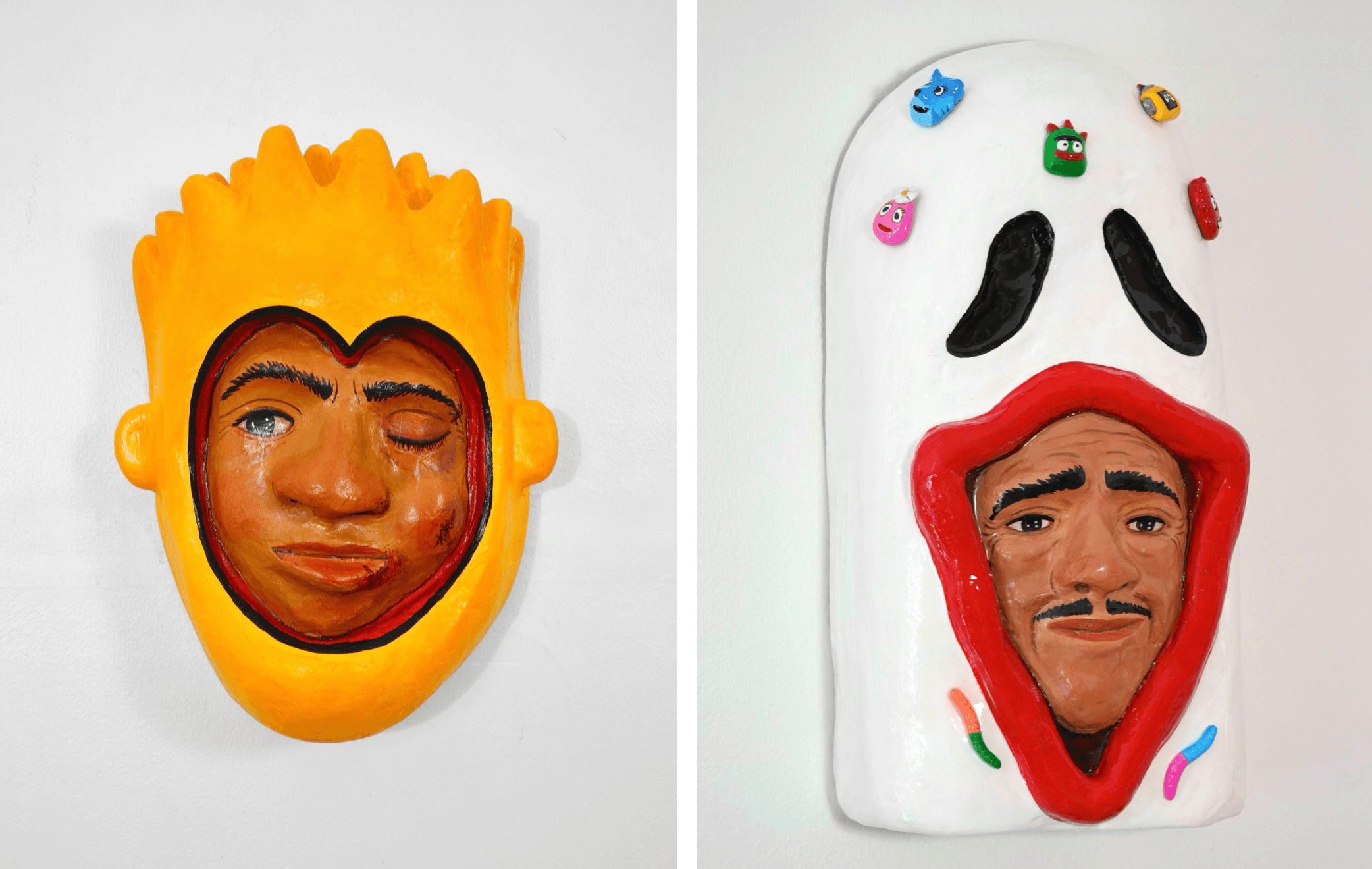
(L) Aye Caramba, 2025, Archival-grade paper-mâché, acrylic, and artist-grade resin, 14 x 9.5 x 4 in.
(R) Happy Gooble, 2025, Archival-grade paper-mâché, acrylic, and artist-grade resin, 23 x 11 x 8 in.
Inserted, now and again, are paintings, the subjects no different from the paper mache sculptural pieces that populate most of the show. Hernandez told me that they were portraits of previous sculptures he would have liked to have seen in this show of works made during the past year. He told me that he identifies as a painter and sculptor, but primarily as a storyteller. We can plainly see the narratives in some of the pieces mentioned above. But for some, it helps to see the pieces installed in relationship to one another to recognize a story. For example, in the pieces Remembrance, Quopo, and Blue Devil, Hernandez commented on Instagram that:
“With these three in particular, I wanted to make a triptych of what it felt like being stuck between nostalgia and being carefree. Living in the now and living in the past.”
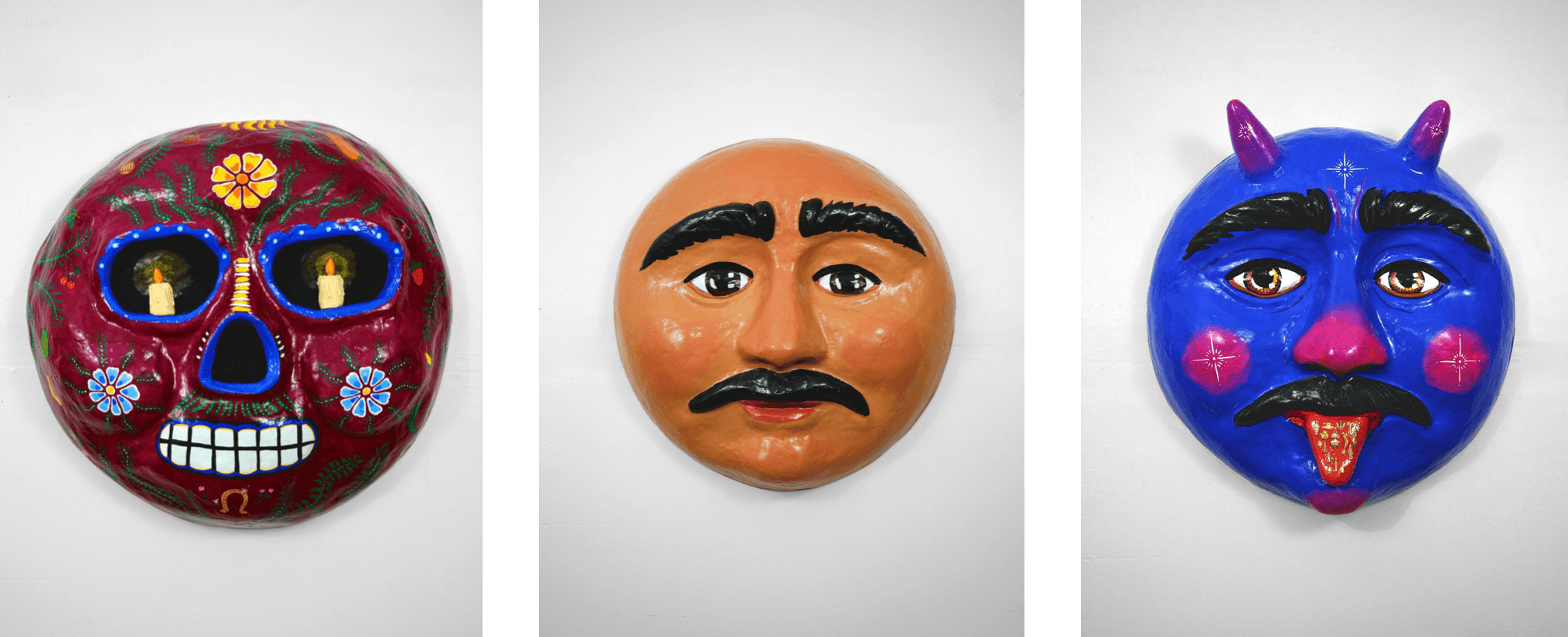
(L) Remembrance, 2026, Archival-grade paper-mâché, acrylic, and artist-grade resin, 29 x 29 x 9 in.
(M) Quopo, 2026, Archival-grade paper-mâché, acrylic, and artist-grade resin, 29 x 29 x 9 in.
(R) Blue Devil, 2026, Archival-grade paper-mâché, acrylic, and artist-grade resin, 29 x 29 x 9 in.
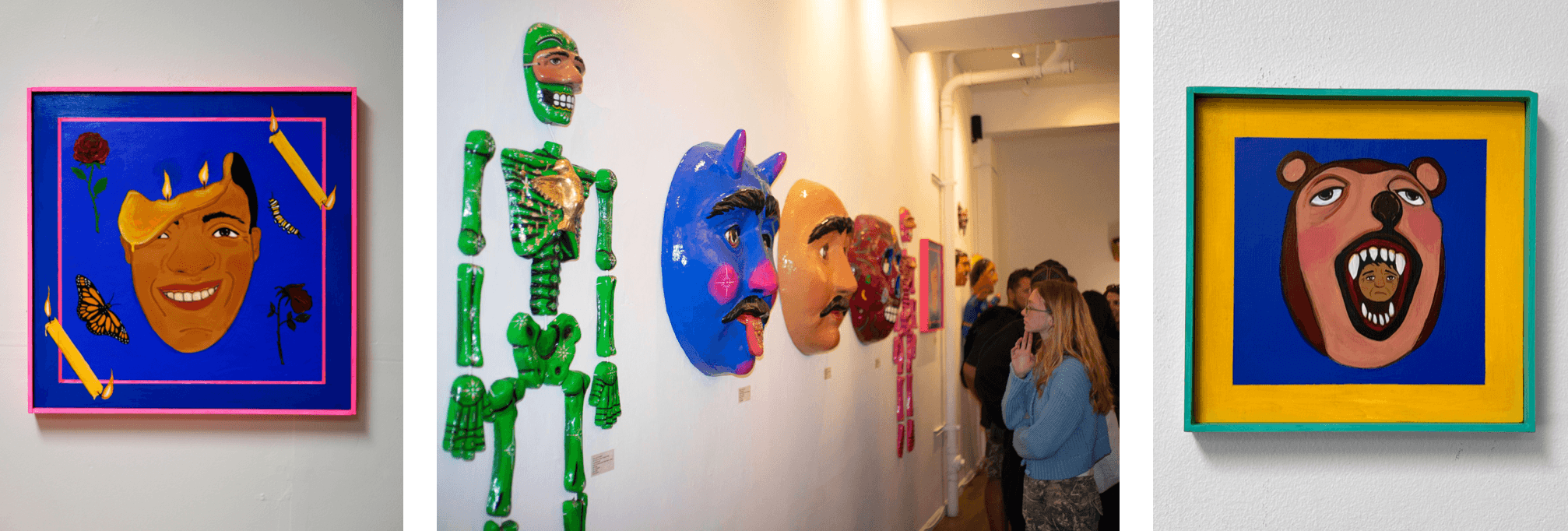
(L) As Long As You're Next To Me, 2026, Acrylic paint on wood, 24 x 19 x 2 in
(M) Gallery installation.
(R) I Was Just His Little Snack, 2026, Acrylic paint on wood, 10 x 10 x 2 in.
At Least We are Damned Together is an emotional body of work. Not in a manipulative or pedantic way, but in a more honest and generous sharing of a spectrum of feelings shared with the viewer. A holistic offering from an artist capable of acknowledging this range within himself. Again, the overall impact on me entering the space was one of delight, but ultimately bringing to mind a quote from The Drama of The Gifted Child, by Alice Miller, "The true opposite of depression is neither gaiety nor absence of pain, but vitality—the freedom to experience spontaneous feelings.” Let Hernandez’s work inspire us all to continue making art as resistance to our perilous times. As he relates in his artist statement:
“I like to think that there are better days ahead, but I’m also too aware of the difficult shared emotions we’re all going through given the chaotic times in which we live. Anger and despair can sometimes feel like waves crashing over our heads, and at the same time, joy and love can feel equally strong and important in these moments. In a time that feels like we’re facing crisis after crisis alone, I want people to know we are experiencing this together, and to hold on to loved ones. All we have is each other.”
At Least We are Damned Together is a powerful example of an artist’s ability to reclaim the language of the colonizers, and transform the violence of the oppressors. In Hernandez’s deft hands, these injustices become resistance through humor, beauty, and care that refuses to forget who we are and the communities we are a part of.
Through July 25th
All photos, @brandonjosephbaker brandonjosephbaker.com courtesy www.mothbelly.org
