

Of Gatherings: Oscillating between the social, the public and the community; Part 1
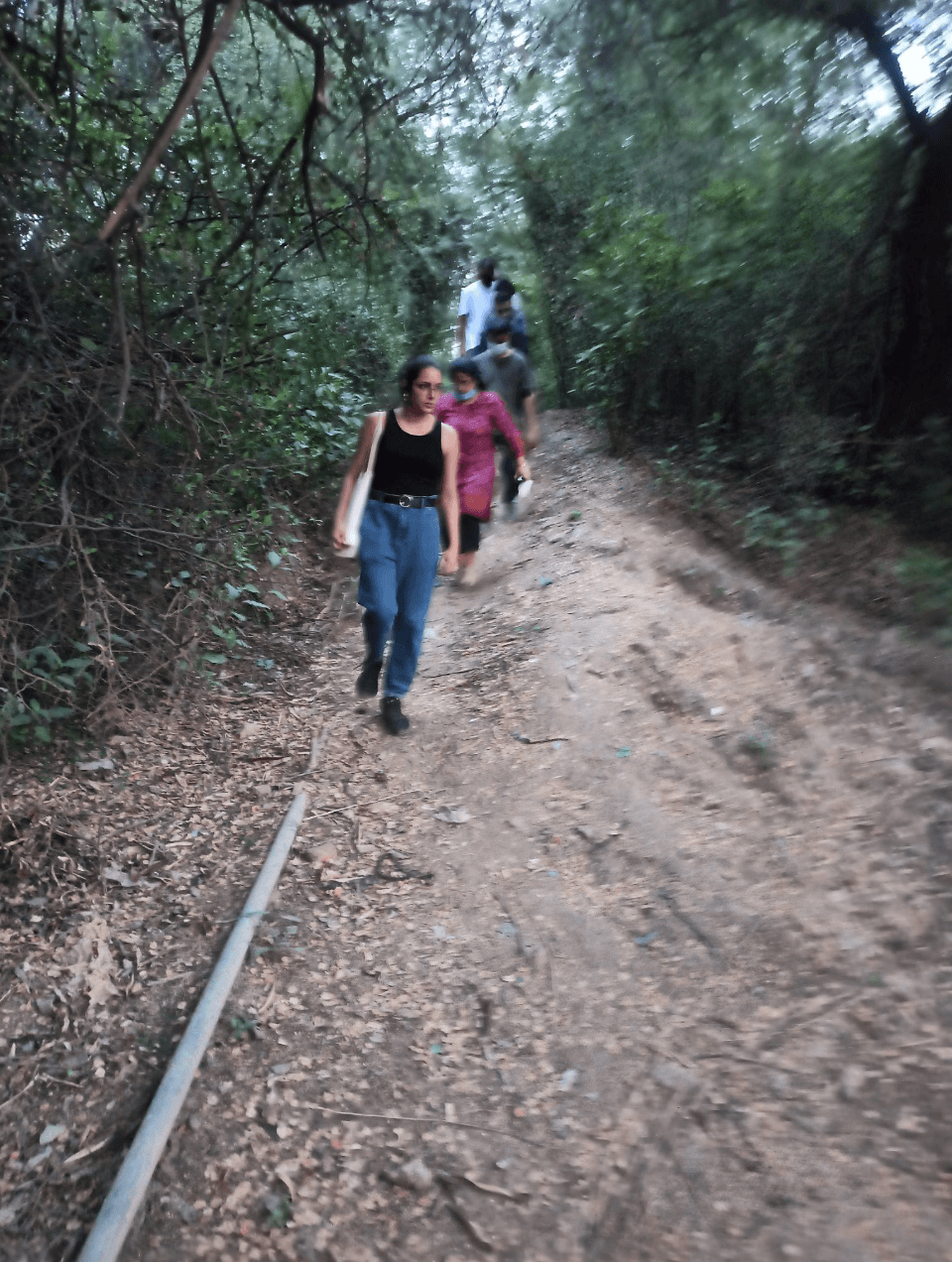
(L) On walking, wandering, Sanjay Van, Delhi, 2022 , Pc- first draft
I first met some of the artists of the first draft collective in Delhi in summer, 2024. In pursuing a research project on art collectives and urban experience, a friend recommended that I meet them and hear about their gathering practice. In this essay, the artists chronicle a series of recent gatherings that they have initiated, in Delhi and beyond, and the themes that emerged from these meetings. While the conversations among participants are the most tangible takeaway from these events, these are not presented here for needs of brevity. Gathering is a time-based media, a form of social practice, and a community-building exercise, so capturing the dynamic can be tricky in written form. This is the first of a two-part series on these gatherings. Printing this series in Roborant Review is a means of expanding the geographical scope of the journal while also inviting artists to write about practices whose results fall outside the scope of an exhibition.
- John Zarobell
By first draft collective — Sonam Chaturvedi, Priyesh Gothwal, Priyank Gothwal, Akshay Sethi, Anarya
On a summer evening, 9 June 2025, a gathering took place at a DDA apartment's barsati/terrace in Delhi, India. It was between the members of first draft artists' collective, who came together to discuss the relation between the urban city and first draft gatherings. This is a condensed residual short-form of its transcription, divided in two parts. The second part will meander further into particular gatherings and their relation with urban cultures.
A gathering is a form of coming together that the collective has borrowed from the social and cultural history of the Indian subcontinent, where people have practiced various modes of organising to sustain co-existence and community life. Since the first gathering in 2021, we have experimented with its form—often doubting, reshaping, and stretching its possibilities. The form—gathering—thereafter, became an accepted and popularly adapted method all across the creative world.
A gathering positions the social relationships, their varying intimacies and distances in the foreground of art practice. In its conceptual framework, it is placed in oscillation between the aspects of the 'social', the 'public', and the 'community', thereby having a fleeting definition and a nomadic relationship with the city—constantly changing, moving, in a liquid state.
Through a meandering flow of conversations, we route through some of the cities where the gatherings took place—Delhi, Baroda, Mumbai, Aizawl, Patan (Kathmandu), Singapore, London, Vienna, and Dubai.
A nomadic existence. Mobility. Ephemerality. Leakages.
The absence of a singular place, agenda, or context allowed us to gather in different cities around the world with a diverse group of people through simple, playful prompts that make the space porous for anyone to enter, often trespassing the disciplines, expertise, and socio-economic barriers. This form allows for an egalitarian structure where everyone has equal space, the choice—to listen, attend in silence, to speak (more)—is left with the gatherers. Since the gathering has the potential to move across spaces, groups of people, and to subvert the intentions of a given location, it provides a unique viewpoint to understand the city's cultural spirits by pushing it to come together, thereby spilling into the many co-existing, overlapping, unprecedented, and negotiated layers of life that a city allows and interfaces.
Delhi, as a city, allowed for this specific mode of gathering to emerge, a fertile ground in/formed by academic, cultural, and educational institutions, where many people migrate to study and stay back. These institutions, spread across the city and in the periphery, play a crucial role in building and circulating discourses and conversations, which enable a gathering to take root and thrive.
There are two layers of the city that we explore here, one that is given to us and another that we create through the gatherings, unearthing the creative surplus of the city. To give an example, On walking/wandering chose Sanjay Van (city-forest), also known as Delhi's green lungs, because of its function and place in the city. The gathering transgressed its purpose by using the site as the prompt, where the gatherers brought responses on walking, while walking in the forest.
In those who gather, the place gathers itself.
When we ask 'Where do we gather?' it implies a conceptual space of convergence rather than a separation between those who gather and the place where we gather. The individuals who come together give meaning to the place, and both derive force from one another. In essence, in those who gather, the place gathers itself.
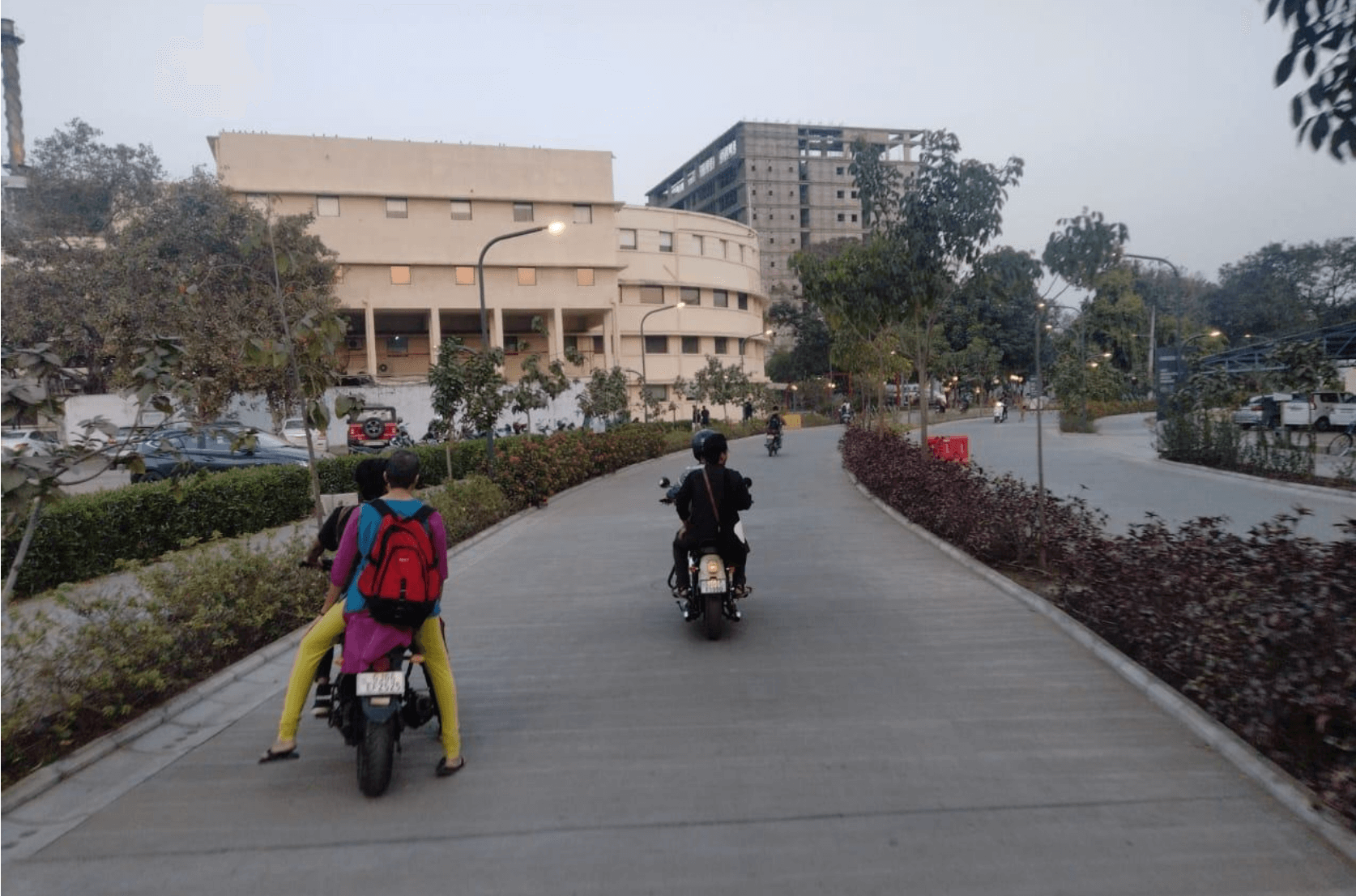
Shared Spaces, a gathering with the prompt to bring a space. Baroda, Jan 2023.
In the gathering, we roamed around Baroda city to visit the participants' responses, i.e., the spaces/locations. Since many people were residents and had two-wheelers, it was very accessible. P. brought an image of a hoarding as a response, with an advertisement of an apartment under construction. Only the foundation was laid, some construction had started, but the image was already produced and advertised with a text saying that if anyone wants to buy a floor, it is for ₹25 lakhs. With the investment money, they are also building it and making profits. So even before the place exists, people are already investing and claiming future spaces.
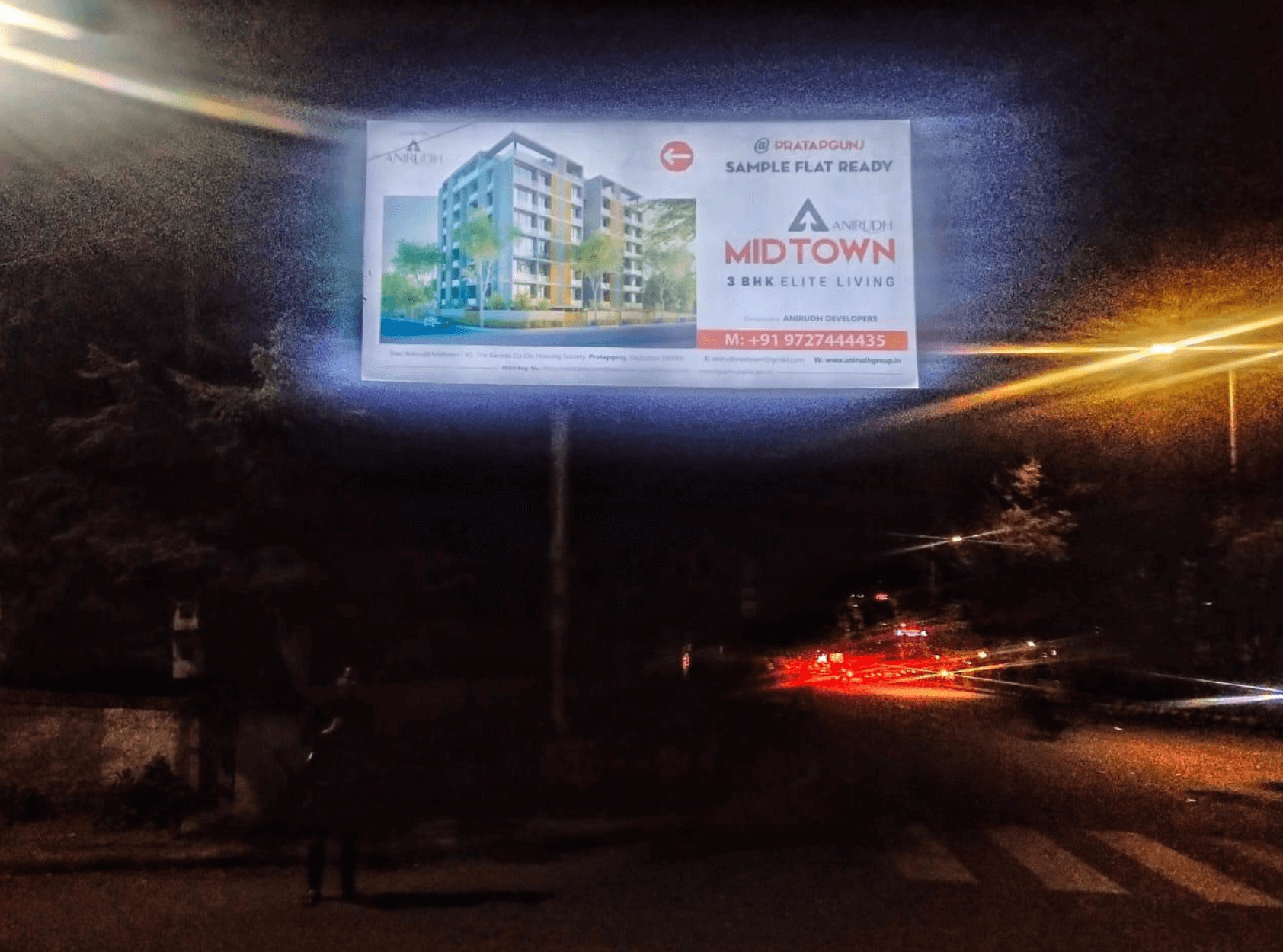
Shared Spaces, hoarding, Baroda, 2023, Pc first draft
This contradiction led to interesting conversations. M. mentioned selling land on the moon, and naming stars after someone (often in a very romantic context), like 'I will gift you a star, it will be documented in your name', hence investing in spaces that are not there. A. pointed that while with the hoarding one is investing in the future, with the stars they are investing in the past.
Likewise, p. brought the moment of the city when the shadow is the longest, either in the morning or in the evening, dusk or dawn, to discover the city in its shadows.
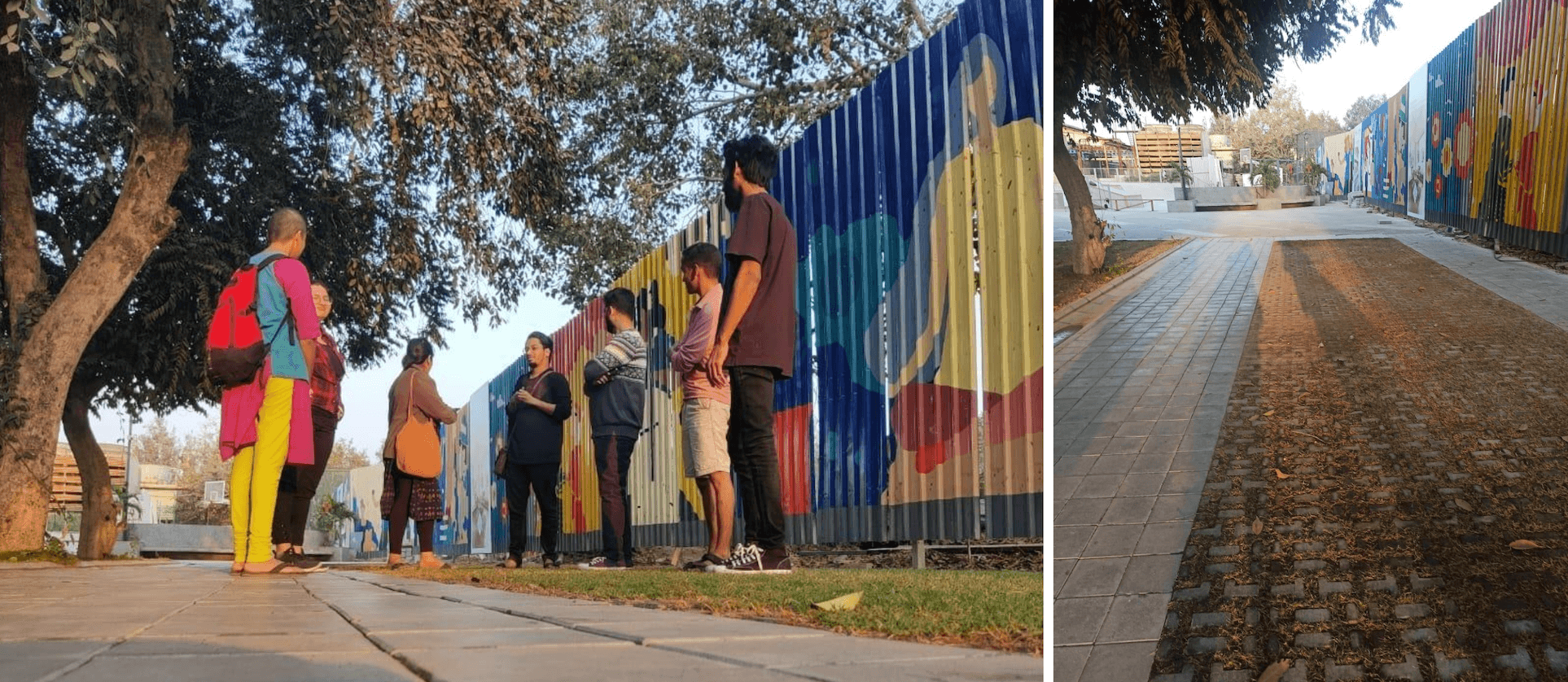
(L) Shared Spaces, shadows, Baroda, 2023, Pc- first draft
(R) Shared Spaces, shadows, Baroda, 2023, Pc- first draft
Whereas S. got nighttime as a space by taking the group to a secluded and dark place near the Vishwamitri River. During COVID, when she was staying with her parents, she only got space at night; during the day, there was too much disturbance. She brought the night as a space of privacy and intimacy, reclaiming it in a way.
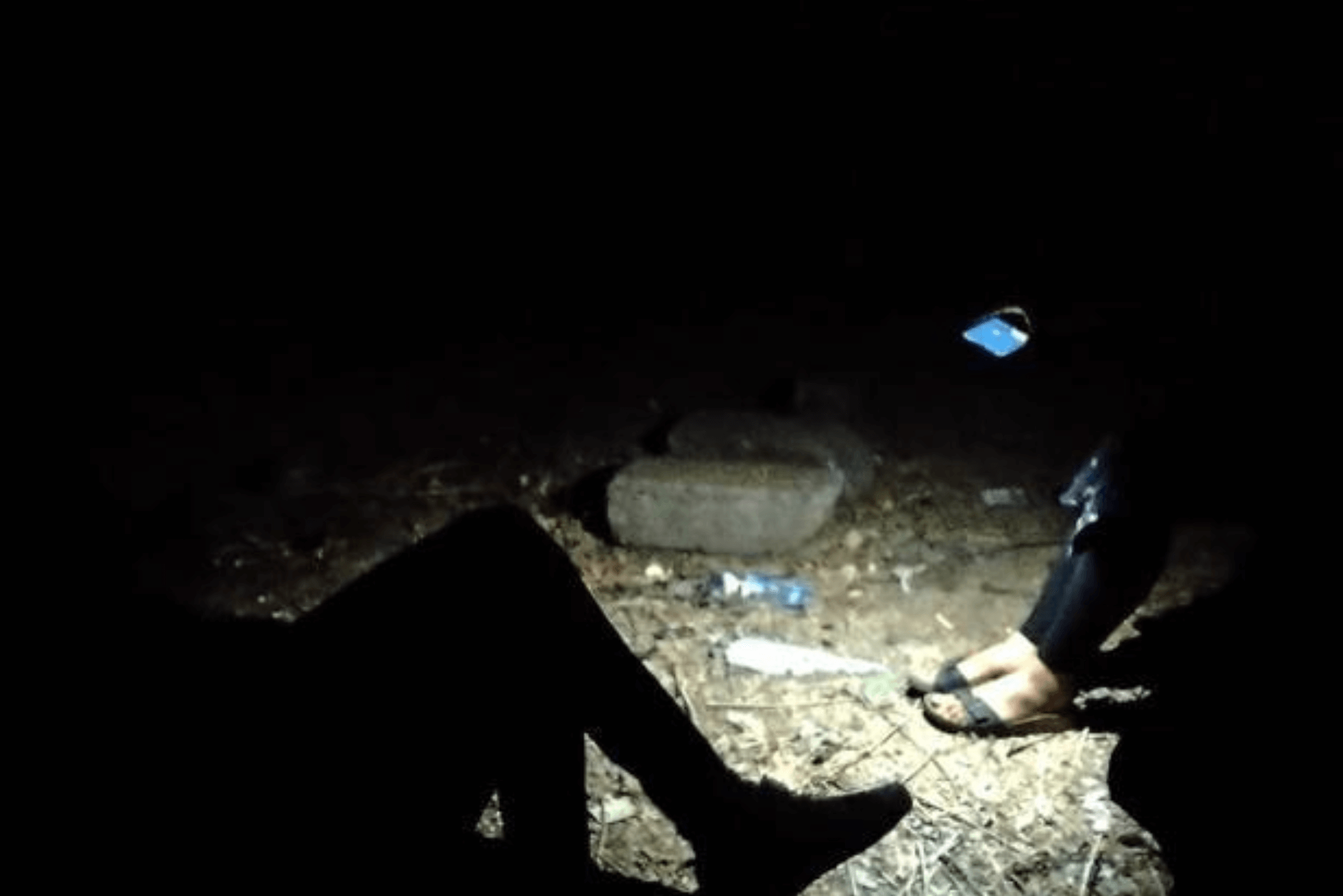
Shared Spaces, night-time, Baroda, 2023, Pc- first draft
The night, which holds a different effect on the city, remains intimate, peripheral, and mysterious as compared to the day. It is the nocturnal city that reaches out to the natural world in its silence; the buildings stand in companionship with the trees, something that has continually been eroded through 24/7 production and consumption markets.
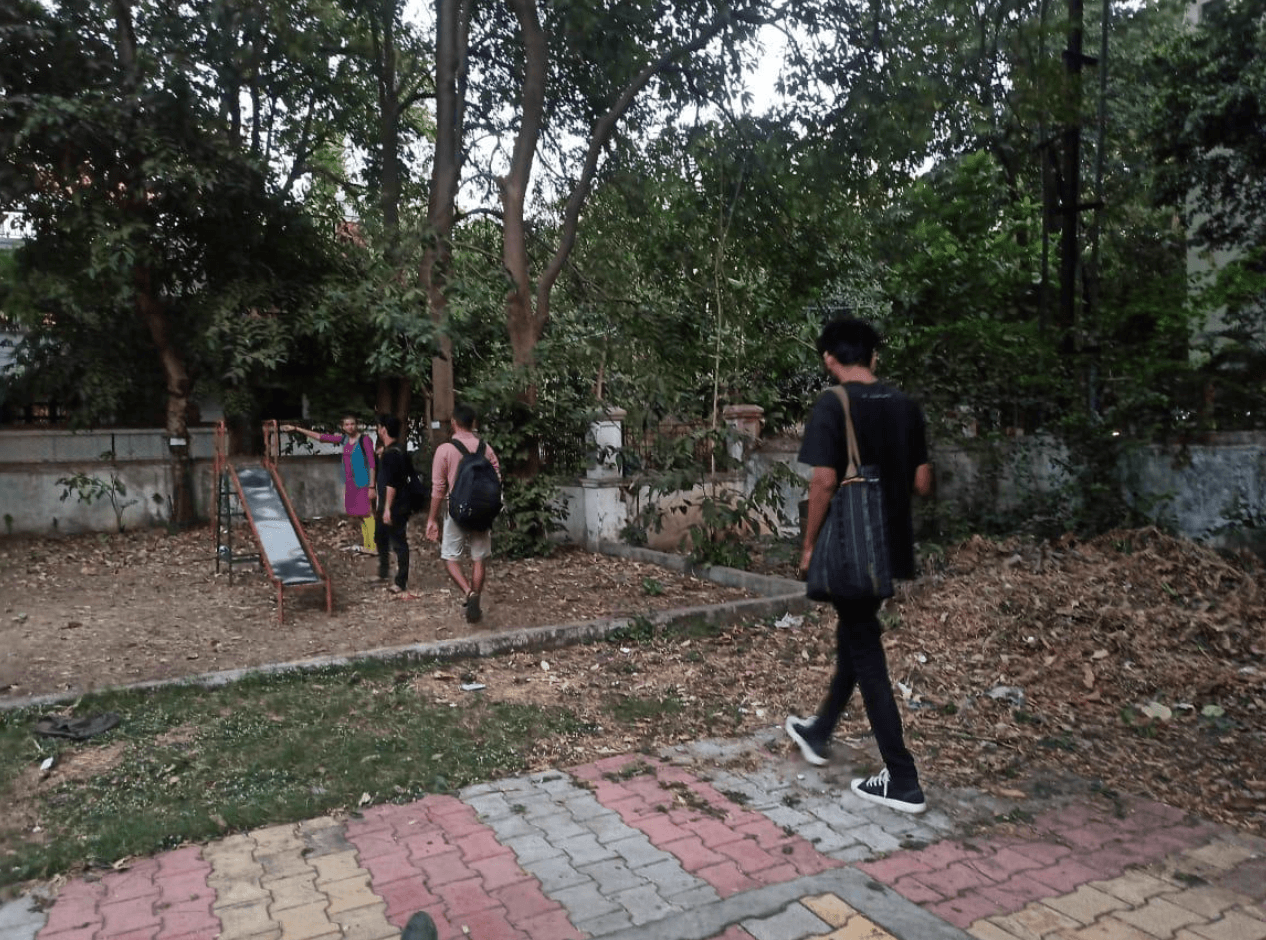
Shared Spaces, community park, Baroda, 2023, Pc- first draft
Z., a local resident, brought up the politics about a community park, which is maintained by her family and the community. She informed that the Municipality wants to erase it to build something more 'productive' in its place. Her family is fighting to retain it. She took us there and showed us the community hall as well. With this, an interesting conversation emerged, to imagine what if the same space could be re-established elsewhere.
Gathering disobedience
At times, gatherings become a strategy to trespass the city's gates, barriers, fences, walls—the divides between different communities where only certain people are allowed and others excluded, between the private and the public.
When talking about space, the city contains the divides between the public and the domestic. The private spaces are very clearly defined and much more restricted in the city than in the rural areas. There are very stark boundaries, barricades, so then the function of a space shifts from domestic to semi-public in a gathering when we do it here. Thus, a gathering has the potential of blurring these social divides and connecting them with each other. With the tactic to blur these lines of class and caste that exist in these urban spaces that we inhabit, new spaces are constantly reshaped each time we meet.
"What would it mean to gather in these organised spaces and disturb their inherent order?" A. questioned.
In the Rafooghar gathering, a few people were responding with questions like: "How do you occupy public spaces in the city?", "What's your strategy for being outside, especially for young women?". Community centers like Yellow Streets develop conditions to bypass the normative divides of the city. For instance, they were talking about how they come for Iftaar or to learn stitching, "this is how we can come out, we can come to stitch," and how they were responding to the city in relation to community building and being out in the city, out of their 'domesticity'.
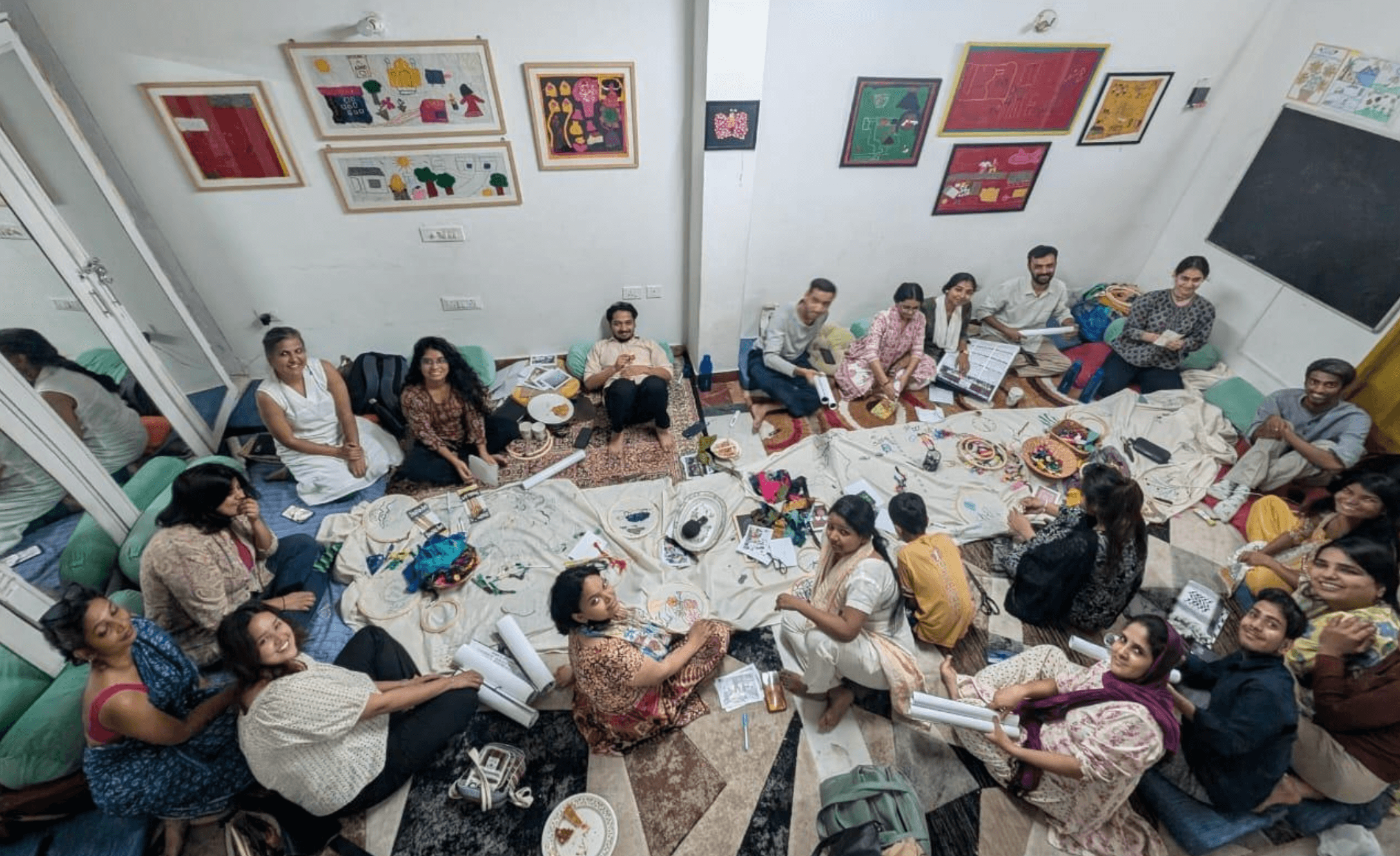
Khayali Pulav, April 2025, with Yellow Streets, Rafooghar, and Artreach India, at Yellow Streets, Delhi. Image Courtesy - Shivangi Singh.
Strategies for being in the city then become part of building new communities. One has to navigate so many things, like P* was talking about going out—she comes to the centre, hangs out, goes for tafri here and there with her friends in her neighborhood, and how, slowly, because of these spaces, she can go further, to challenge people who say, "Why do you need to go out?". These strategies, responses, and stories were brought by some of the gatherers who are building community spaces that are parallel to being in the city.
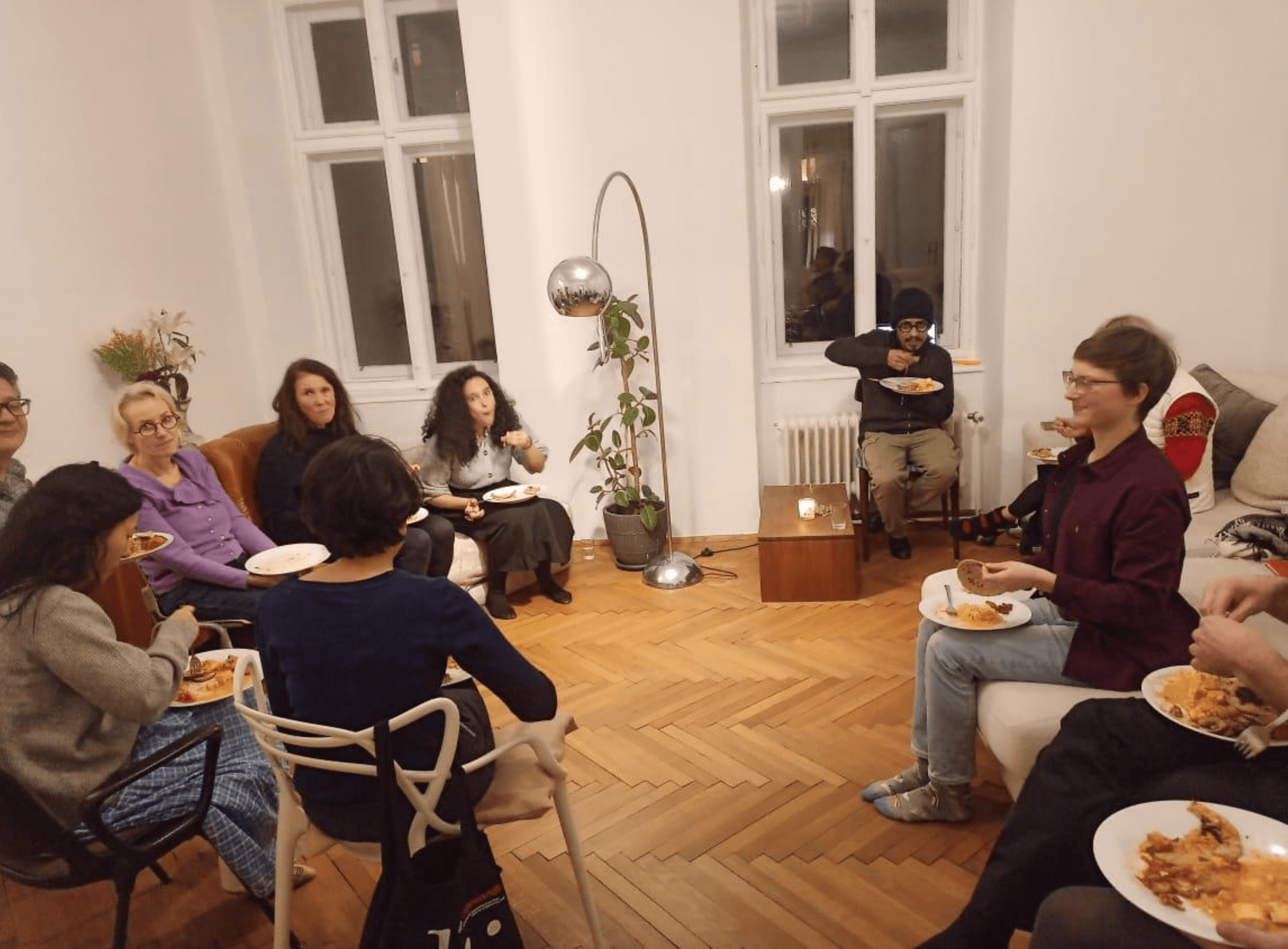
Time as an ingredient, Vienna, 2025 Pc- first draft
Urban development in the world's modern and 'smart' cities has fewer free and public spaces for assembly, which makes the inhabitants rational, impersonal, alienated, unemotional, and autonomous. The speed of work-life and survival anxieties keeps the inhabitants busy and distracted. With barely any time to take care of basic needs, the need for social, cultural, and emotional fueling takes a backseat. Having such a future of our cities in sight, gatherings become a way for communal recovery. Vienna was an eye-opener, with an extremely warm and intimate gathering that was least expected from a 'developed' and individualistic society that does not have many opportunities for accidental or public encounters. It yearns for warmth, intimacy, a conversation, a hug. Gathering, therefore, became a small act of disobeying the norms of our fragmented societies.
The tripartite anchors of the 'Social', the 'Public', and the 'community.'
These are the conceptual grounds for us to gather in the modern world. The modern state fabricates all its facets of congregation except the facet of Community, which is formed in negation to it. It is often romanticised in its conception. In contrast to the 'social' and the 'public', 'community' signifies the affective bonds and obligations that connect people. In other words, while the 'social' and 'public' serve as substitutes for the loss of congregational spaces where ideas and debates can arise, the 'community' represents something we have lost in the modern world. We gather to seek intimacy as a posteriori action oscillating within the three fabricated spaces of modernity.
Citations:
Personal Experience. Gatherings at festivals, celebrations, architectural spaces, everyday encounters, mass mobilizations: Lohri bonfire with family and friends ; Iftaar dinner at Yellow Streets centre in Kalindi Kunj, Delhi; Navratri Garba at Faculty of Fine Arts in Vadodara, Gujarat, 1950s-present; Dasain celebrations on the streets of Patan, Nepal; Shaheen Bagh and Jamia Milia Islamia Anti-CAA-NRC protests of 2019-'20; Anti-CAA-NRC protest-picnic by Vasantkunj Solidarity Group in B-9, Vasantkunj, Delhi; families gathering at Chakli circle at night, Vadodara, 1990s; Women Walk at Midnight, Delhi, 2016-present; Groups of adults playing cards at a Takhat in Mathura, UP, dates unknown; Boomna and Sharbat ki Baraat in marriages, Mathura, UP, dates unknown; Parrots (8), Squirrels (4), Babblers (7) and innumerable pigeons feasting together at Terrace/6464, Vasantkunj, Delhi. first draft artists while witnessing or participating in the above. South Asia. 1990s to present-day.
Schmidt, Theron, et al. (2022).The First Thing We Make is the Condition of our Meeting: A Gathering on Gathering. Performance Research, On Meeting, 28, 2. pp. 14-25.
Seu, Mindy. On Gathering: Collecting, sharing, and creating the Cyberfeminism Index.https://issue1.shiftspace.pub/on-gathering-mindy-seu
Woolf, Virginia. (2004). The Waves. Vintage Classics.
Kabir. (1977). "The Kabir book: forty-four of the ecstatic poems of Kabir"
Lucas, Susan M. Rocky Mountain Review of Language and Literature, vol. 55, no. 1, 2001, pp. 138–40. JSTOR, https://doi.org/10.2307/1348177. Accessed 5 Jan. 2026.
Sharpe, William, and Leonard Wallock. Visions of the Modern City. Johns Hopkins University Press, 1987.
Hobbes, Thomas. Leviathan. Printed for Andrew Crooke, 1651.
Nancy, Jean-Luc. The Inoperative Community. University of Minnesota Press, 1991.
