
Bay Area Then, Yerba Buena Center for the Arts
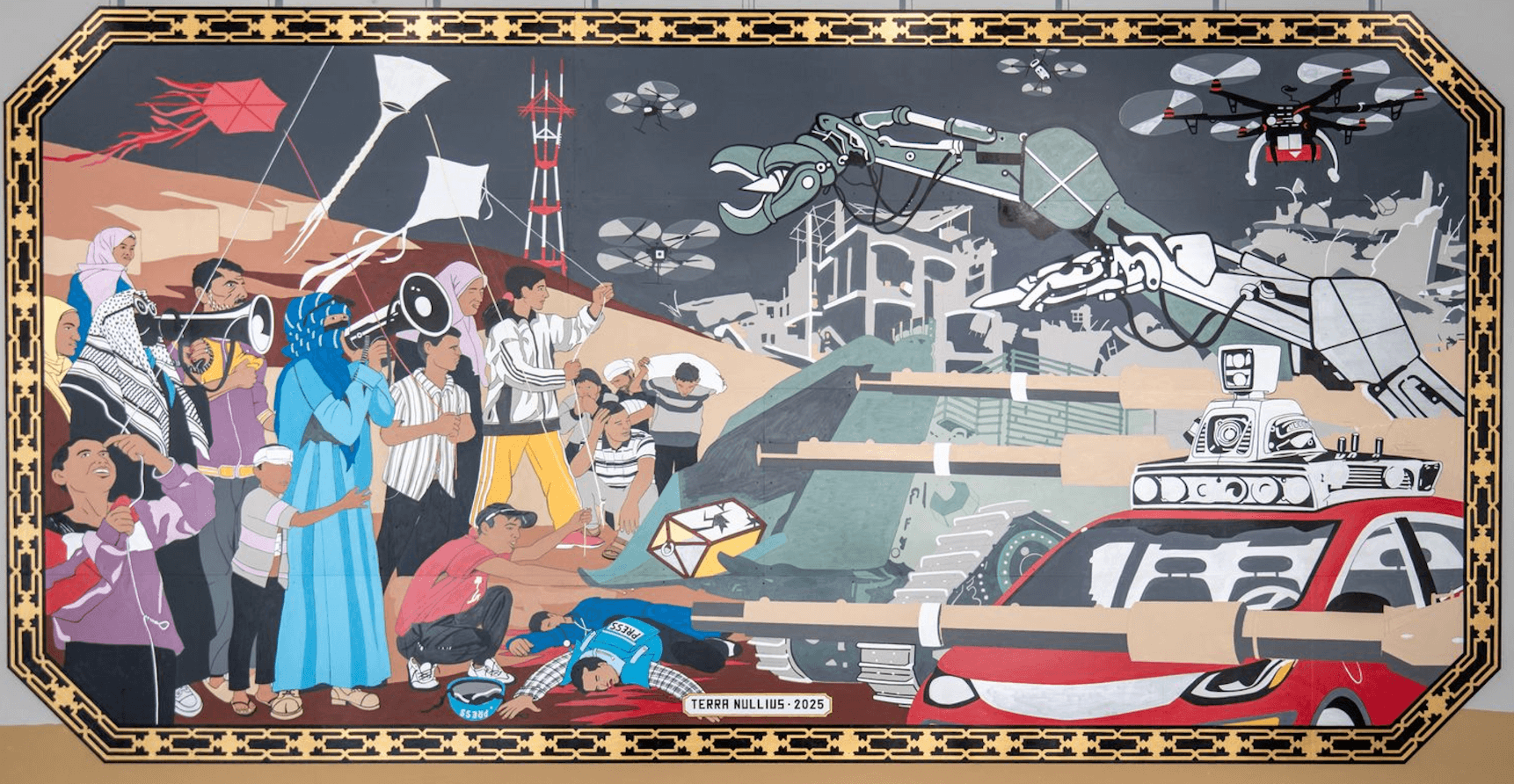
Terra Nullius, 2025 by Rigo 23 (paint and masonite)
By Patrick Dunagan
Ambitious in scope and presentation, Bay Area Then at YBCA, August 1, 2025–January 25, 2026, guest-curated by Eungie Joo, at once both delights and rankles with its broad assertions regarding Bay Area art circa the 1990s into the present.
With works by Nao Bustamante, Carolyn Castaño, Bill Daniel, Sergio De La Torre and Chris Treggiari, Beatrix Fowler, Mike “Dream” Francisco, Johanna Jackson, Chris Johanson and Ajax Oakford, Arnold Kemp, Margaret Kilgallen, Josh Lazcano, Alicia McCarthy, Barry McGee, Ruby Neri, Manuel Ocampo, Eamon Ore-Giron, Gina Osterloh, Rigo 23, Spie One, and others, the grasping after an (mis)apparent inclusivity is at once monumental yet futile. Recognized past groupings, such as the ‘Mission School’, that immediately pop to mind just as quickly fade away in the helpless blur of addition.
That “others” tagged on at the end of the listing of participating artists is worth more consideration and would have benefited from a bit of unpacking of the sort which does not occur much in the gallery spaces or accompanying online info regarding the show. There’s a tension between presenting a sort of look back upon key activities of an era as well as featuring new ongoing work by several artists. This results in a bifurcation of works and individuals that is less than cohesive, without any indication of whether it’s intended or not. It’s more like a series of small, often feeling incomplete, shows slammed together as one rather than a cohesive presentation with set clarity.
Individual works, however, do remain quite stunning and impressive. Muralist Rigo 23’s Terra Nullius, clearly staged upon Goya’s The Third of May 1808 (1804), as noted on its label and reflecting “Rigo 23’s resolute disgust with the ongoing slaughter of medical professionals, journalists, and other civilians in Gaza and the Occupied Territories,” is visually arresting. As in Goya, on one side there are a group of demonstrators clearly voicing dissent: two figures with faces covered have bullhorns aloft as others fly kites—a historical symbol of the freedom-denied Palestine. One kite flyer appears rather quizzically to scratch his head as his gaze upward grows concerned.
While on the other side are menacing oversized robotic arms above looming artillery barrels. In the middle, on the ground in a pool of fresh blood, are two slain bodies, one of which wears a vest with a “press” badge visible. There’s also what looks like a partially destroyed tent with perhaps an abandoned box of aid supplies in its opening. A young figure is seen hoisting a bag of what might be rice on his shoulders, and further back are the ghostly sights of bombed-out buildings. Several drones also hover above.
While the figures and the setting may be identifiably Middle Eastern, the landscape a desert brown, high on a hill in the background, rising up above all, is a clearly recognizable radio tower ever reminiscent of San Francisco’s own Sutro Tower.
Stepping back to take in the image at a distance allows the full mural to unveil itself. The homage to Goya is thus seen to be a huge framed painting, propped up against the even more massive concrete wall, topped with barbed wire and floodlights–imprisoning Gaza off from Israeli territory.
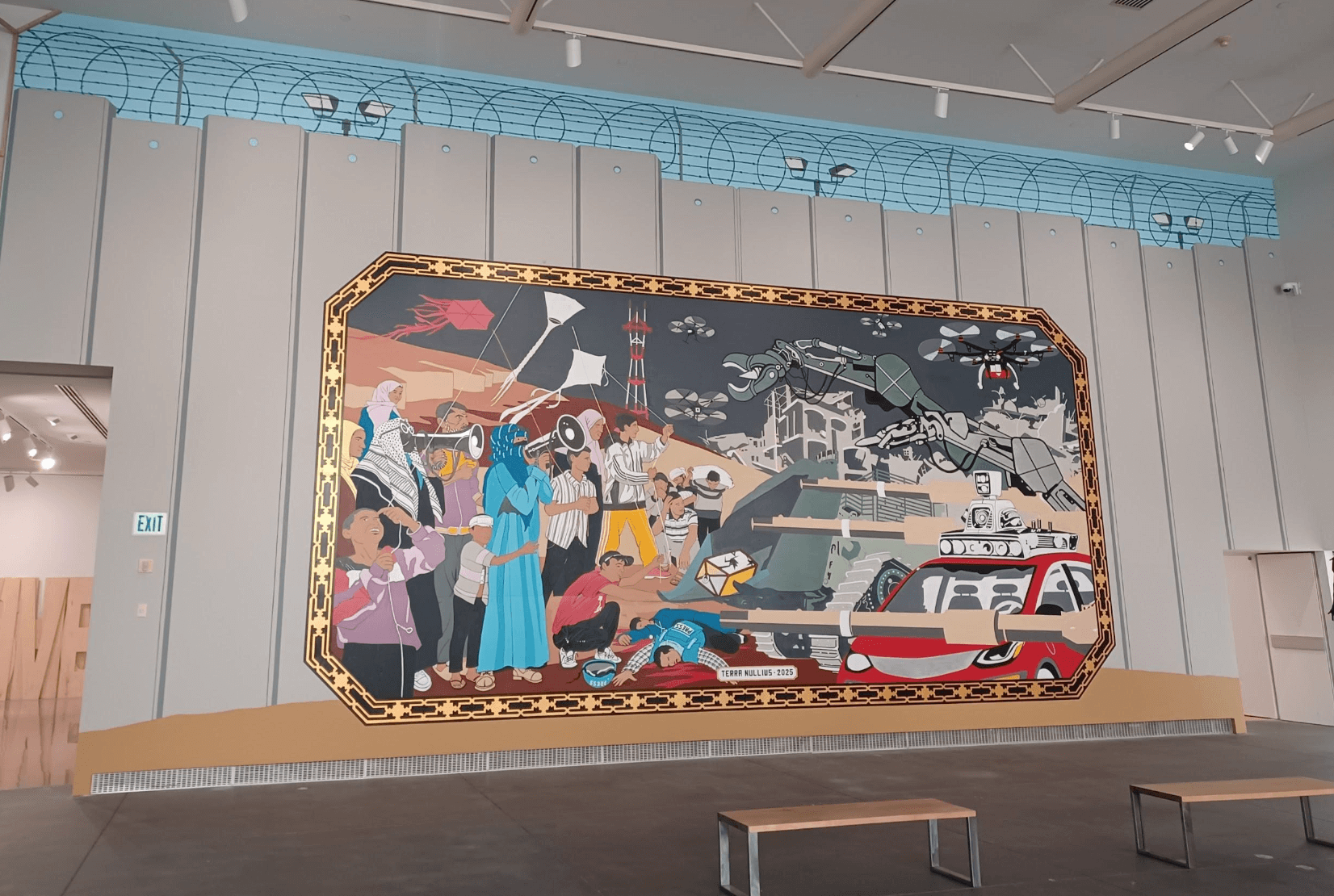
Terra Nullius, 2025 by Rigo 23 (paint and masonite)
With its upper central image of Sutro Tower, and given the current regime’s fanatical obsession with militarizing our own border along with the violent intensity of ongoing ICE operations, when quickly glanced at in passing, Rigo 23’s mural appears a saliently bitter vision of an all-too-probable future San Francisco reality.
On the far side of the same gallery space, Chris Johanson and Ajax Oakford’s 2 Love, 3 Love, 4 Love… erects an alternate future vision of a kind of idealized dystopia. Discarded bits of used lumber have been ramshackled together with bright splashes of paint here and there, forming a skeletal structural maze en plein air.
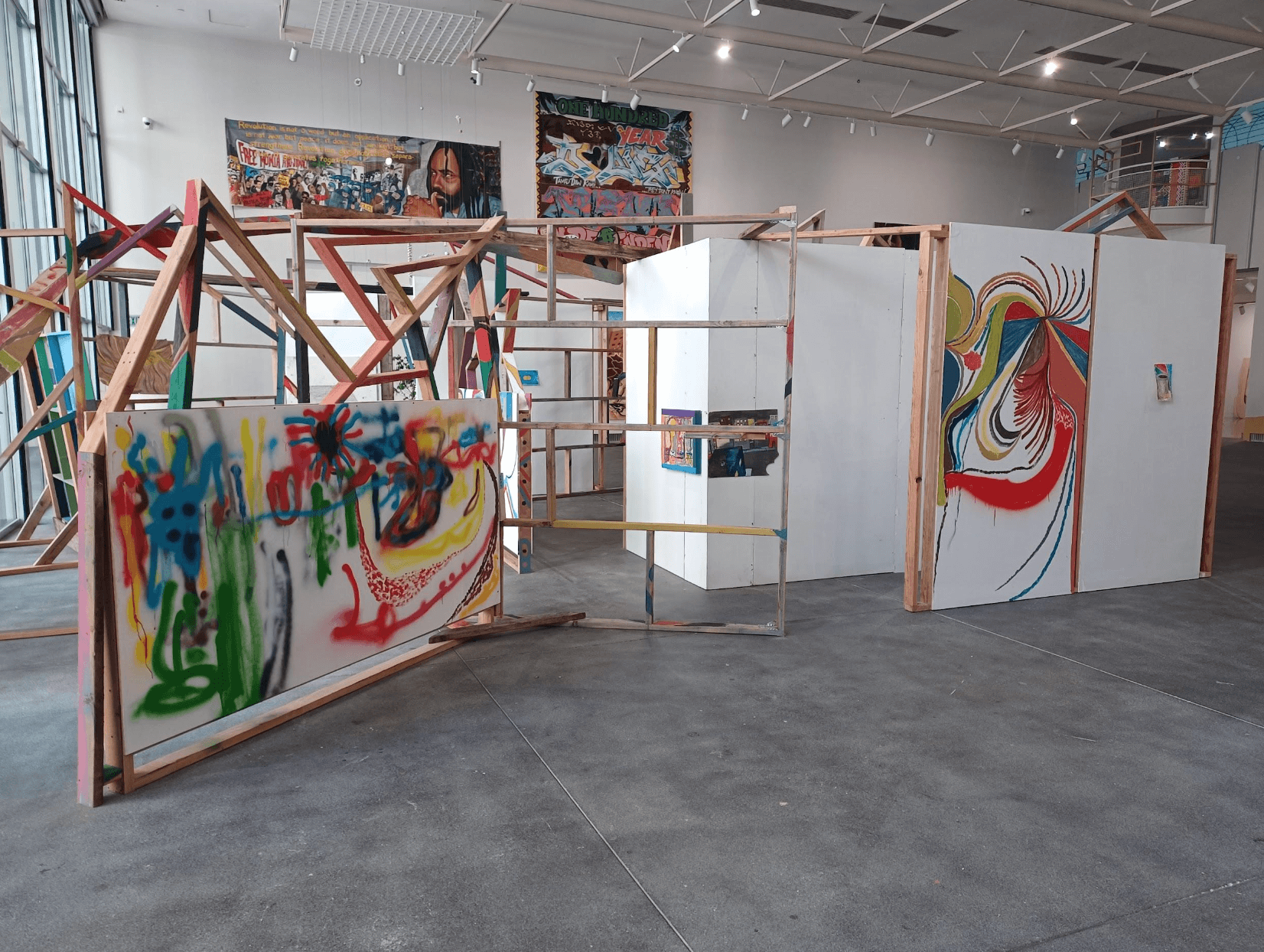
Chris Johanson and Ajax Oakford’s 2 Love, 3 Love, 4 Love…, 2025 (reclaimed wood, particle board, paint, and previous and recent works by Chris Johanson)
Where there are walls, old and new works by Johanson adorn them. A kind of adult art playhouse of impracticality, at once charming and no doubt, for some, a bit of a fright. All in all, fun.
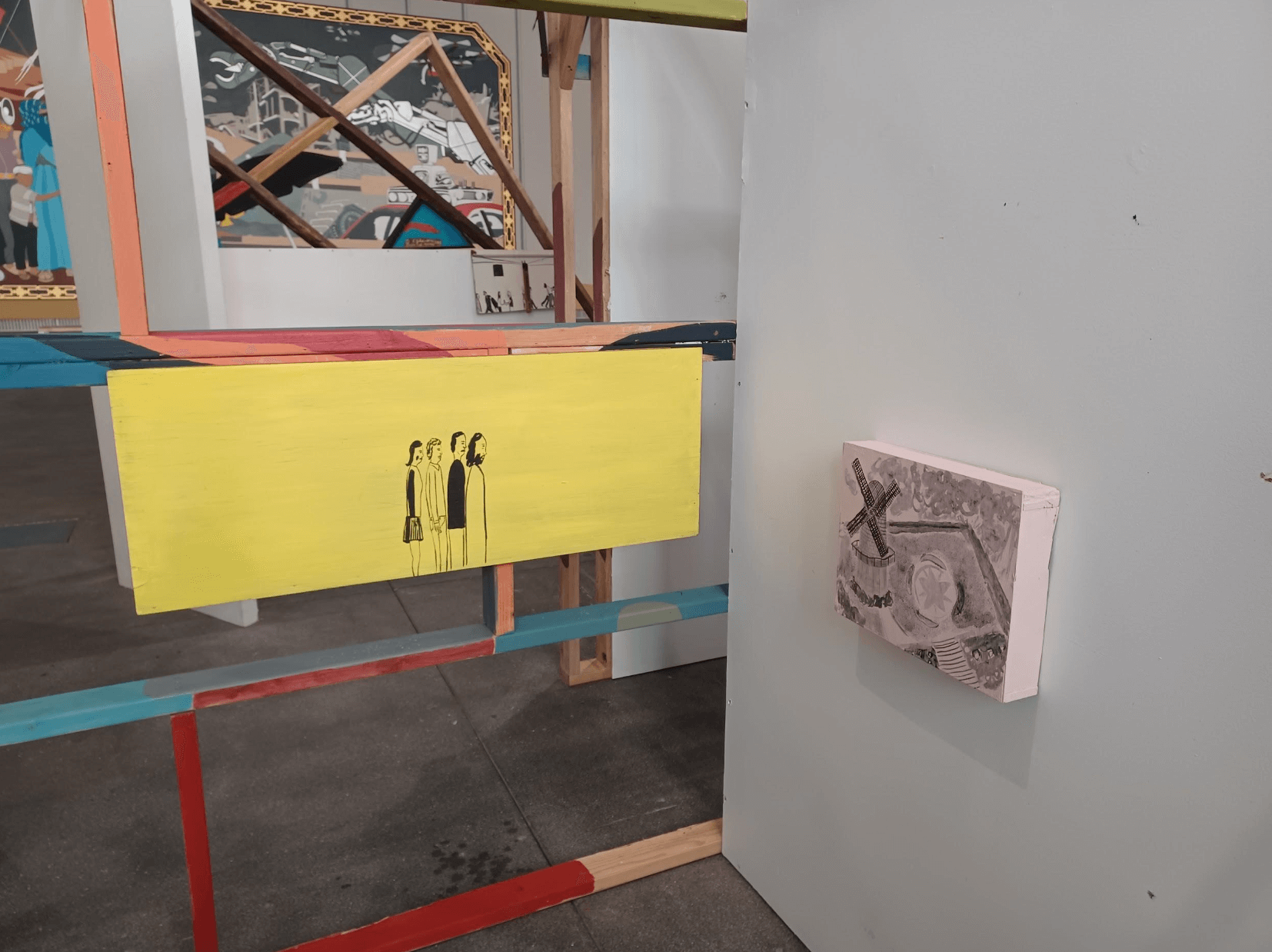
Detail, 2 Love, 3 Love, 4 Love…
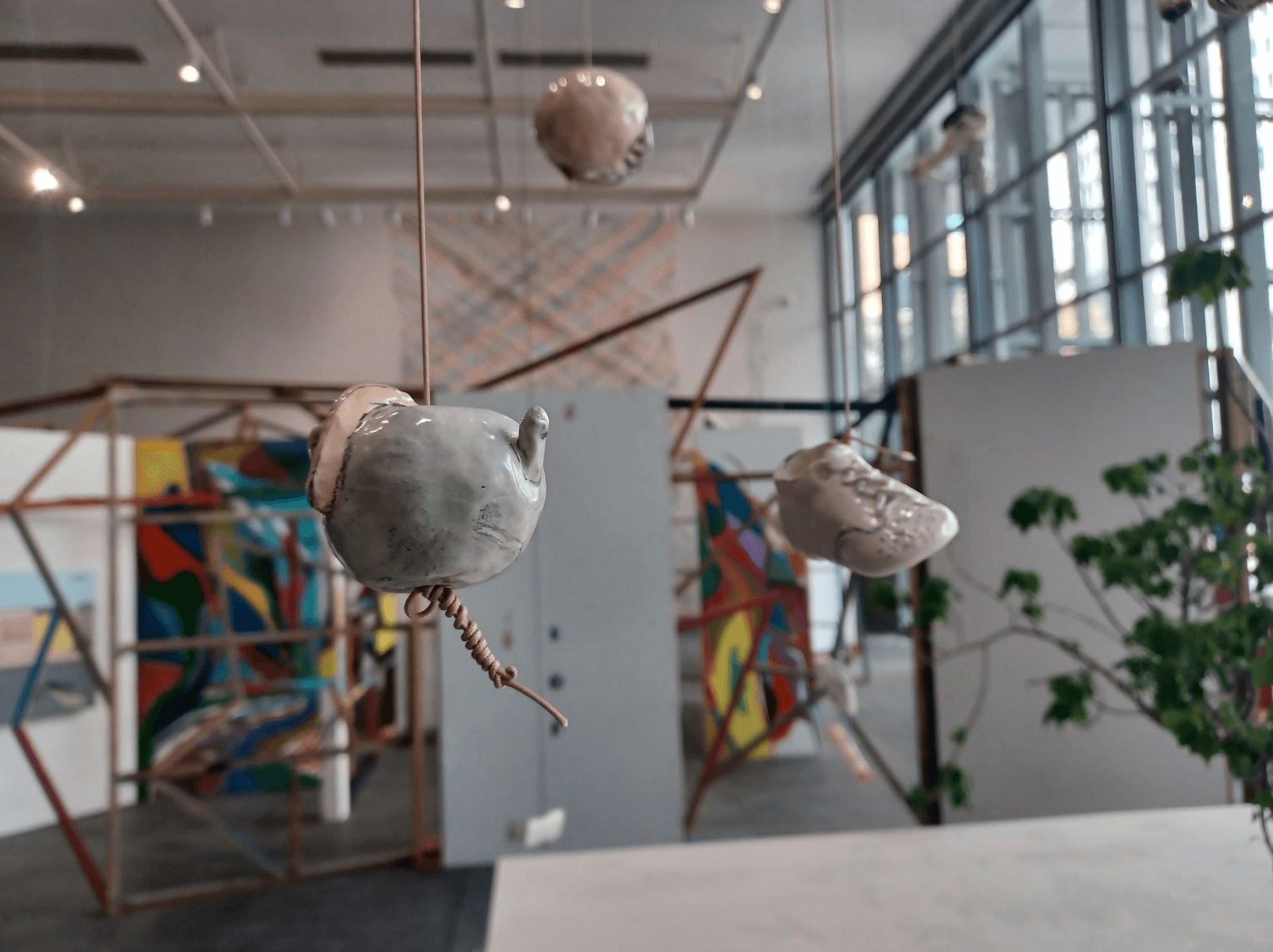
Congenially offering a similar alternate future dystopic vision of beauty, Johanna Jackson’s I Am Vertical sprouts forth directly next to 2 Love, 3 Love, 4 Love…. A plum tree sapling arises from a hole cut into the top of a raised white box to find itself surrounded by dozens of suspended small ceramics whose forms are those of sundry household items.
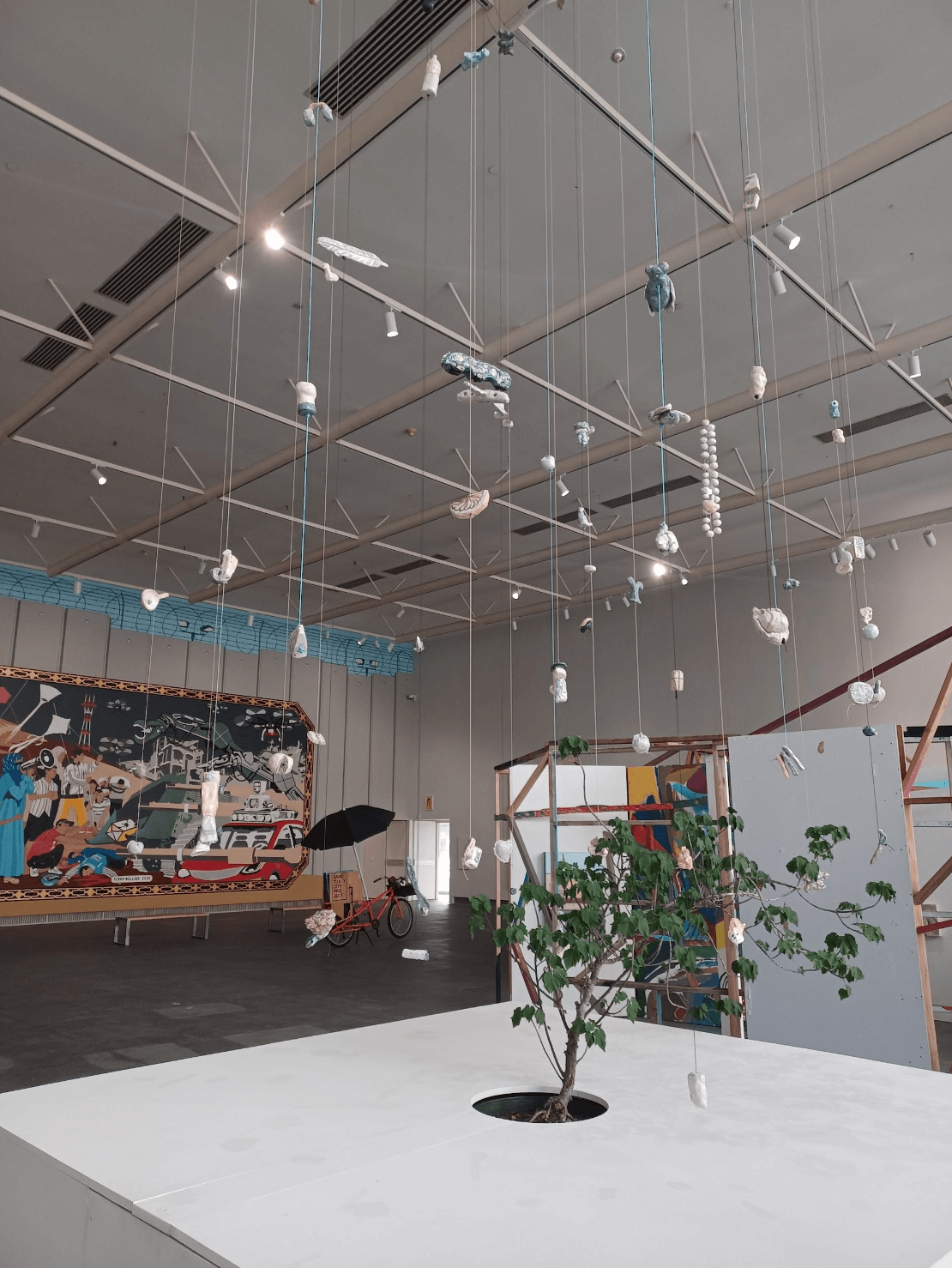
I Am Vertical, 2003–2025 (tree, glazed porcelain)
Again, we are in a playland of delight, left to peer close in order to decipher just what forms the ceramics take up. Here is a shoe, as there is a kind of mid-morphing deformity as a tea kettle merges into the shape of a turkey.
While over on the opposing wall, Alicia McCarthy’s Untitled (4 ORFN/Aaron Curry Drawings) returns us to large-scale mural work combined with a set of four small framed collage works. The multicolored wavy lines laid out in a tilted pattern with a central grid are mesmerizing in their easygoing invitation to stare awhile.
The quadrant of four collages grouped beside the mural extend that invitation with homesy, unpretentious presentation. You feel as if you were in McCarthy’s kitchen, yacking away about art, television cartoons, cars, and growing up in weird and lovely California.
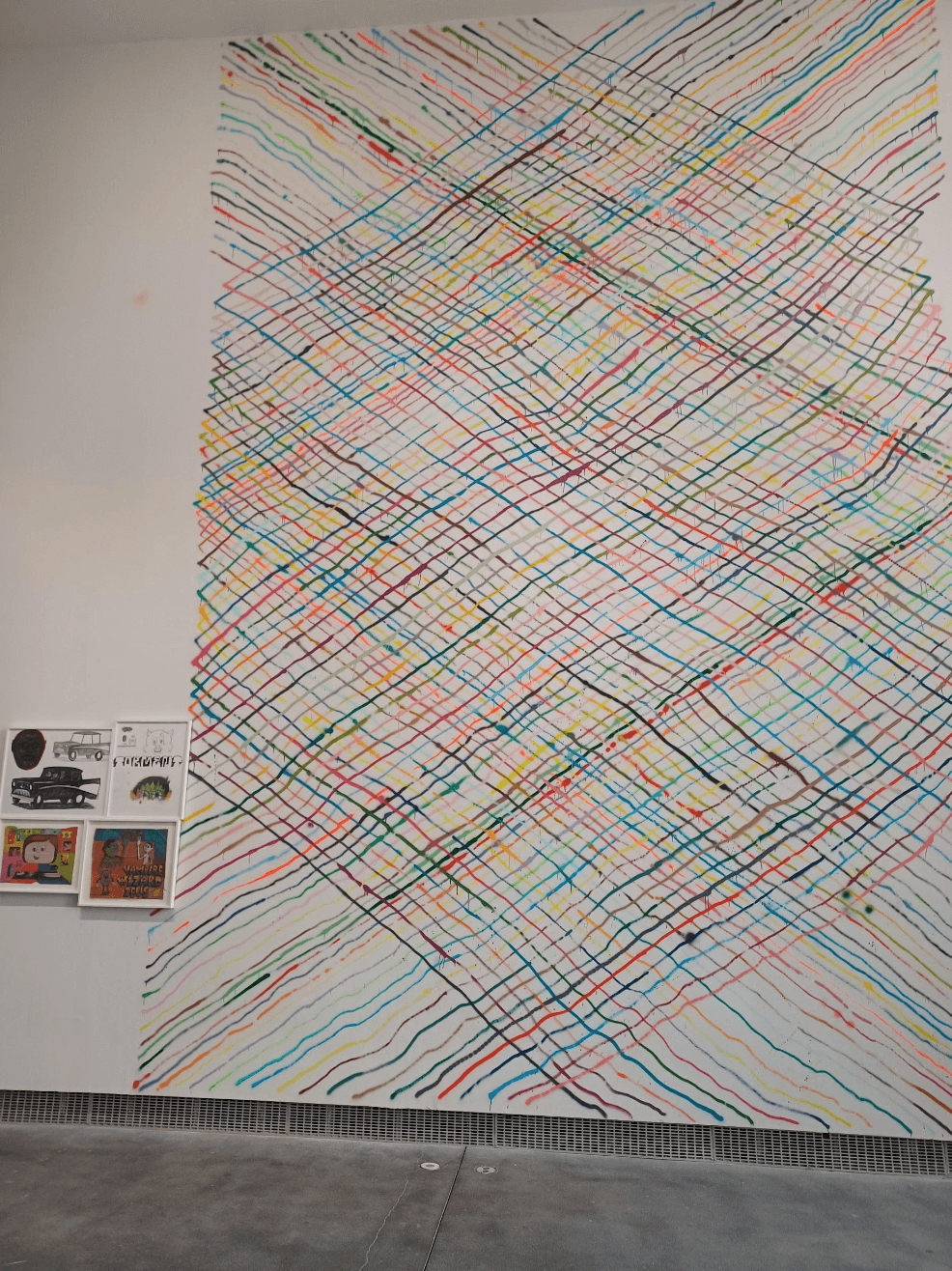
Untitled (4 ORFN/Aaron Curry Drawings), 2010–2025 (water-based spray paint on wall, four framed drawings with collage on paper)
In the next gallery space, Ruby Neri’s work keeps the vibe going, with soft warm colorings marking her work’s invitation to consider varying embodiments of womanhood. The figures in On the Wall are ashimmer in various states of activity. Some might even be said to be dancing. All appear affected, to one degree or another, by the flower in the lower left corner—an aphrodisiac perhaps, or possible narcotic.
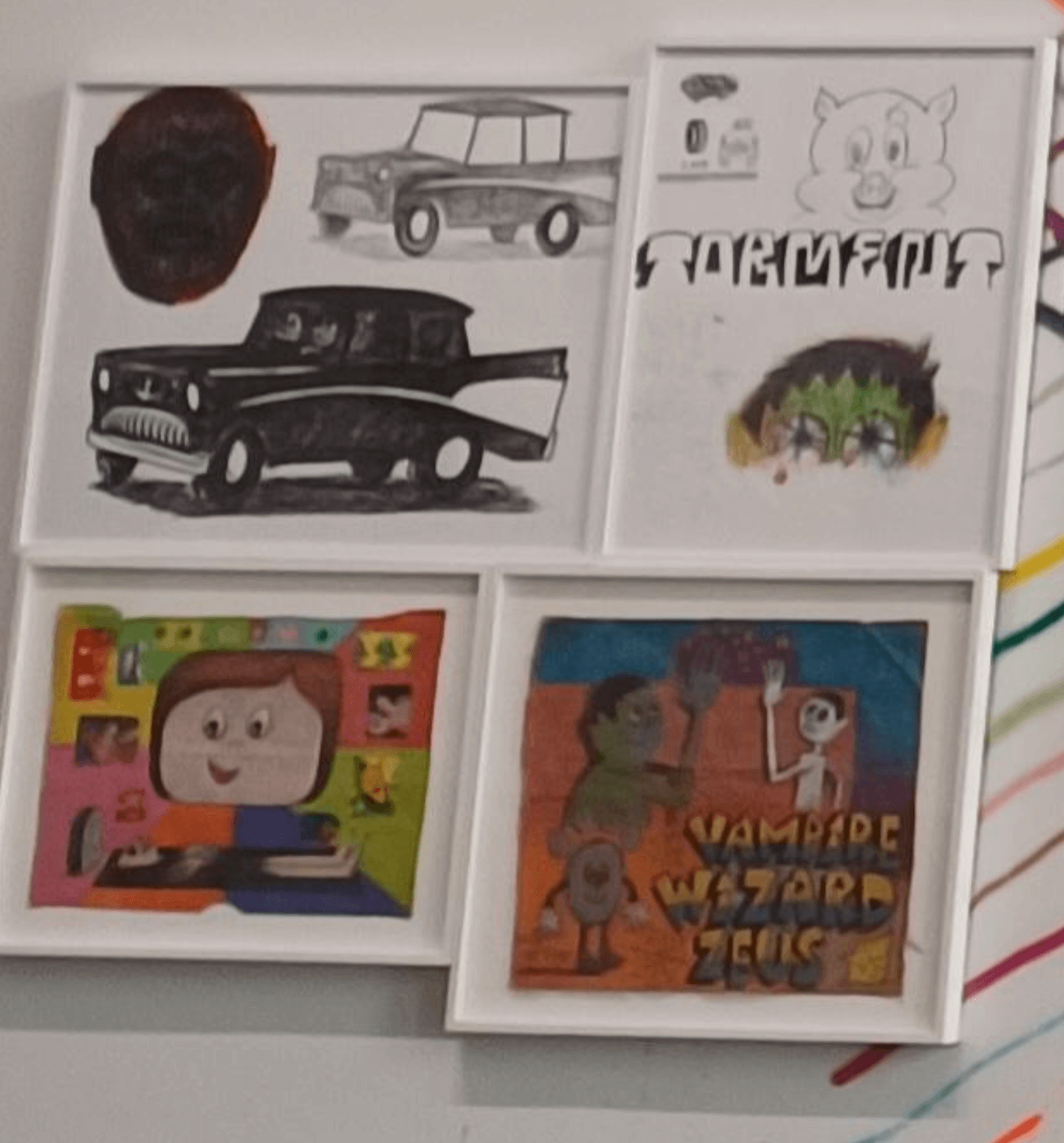
Detail, Untitled (4 ORFN/Aaron Curry Drawings)
In the far corner of the same gallery space, Margaret Kilgallen’s Main Drag mounts an inescapable presence. This was Kilgallen’s last installation commission for East Meets West at ICA Philadelphia in 2001, the year she died. It has been recreated based upon “precise documentation” by “Kilgallen’s friend, the artist Jeff Canham, and family member Mike McGee.”
Its power is such that the entire show could have been framed as a tribute to her. But that’s not what Bay Area Then is about.
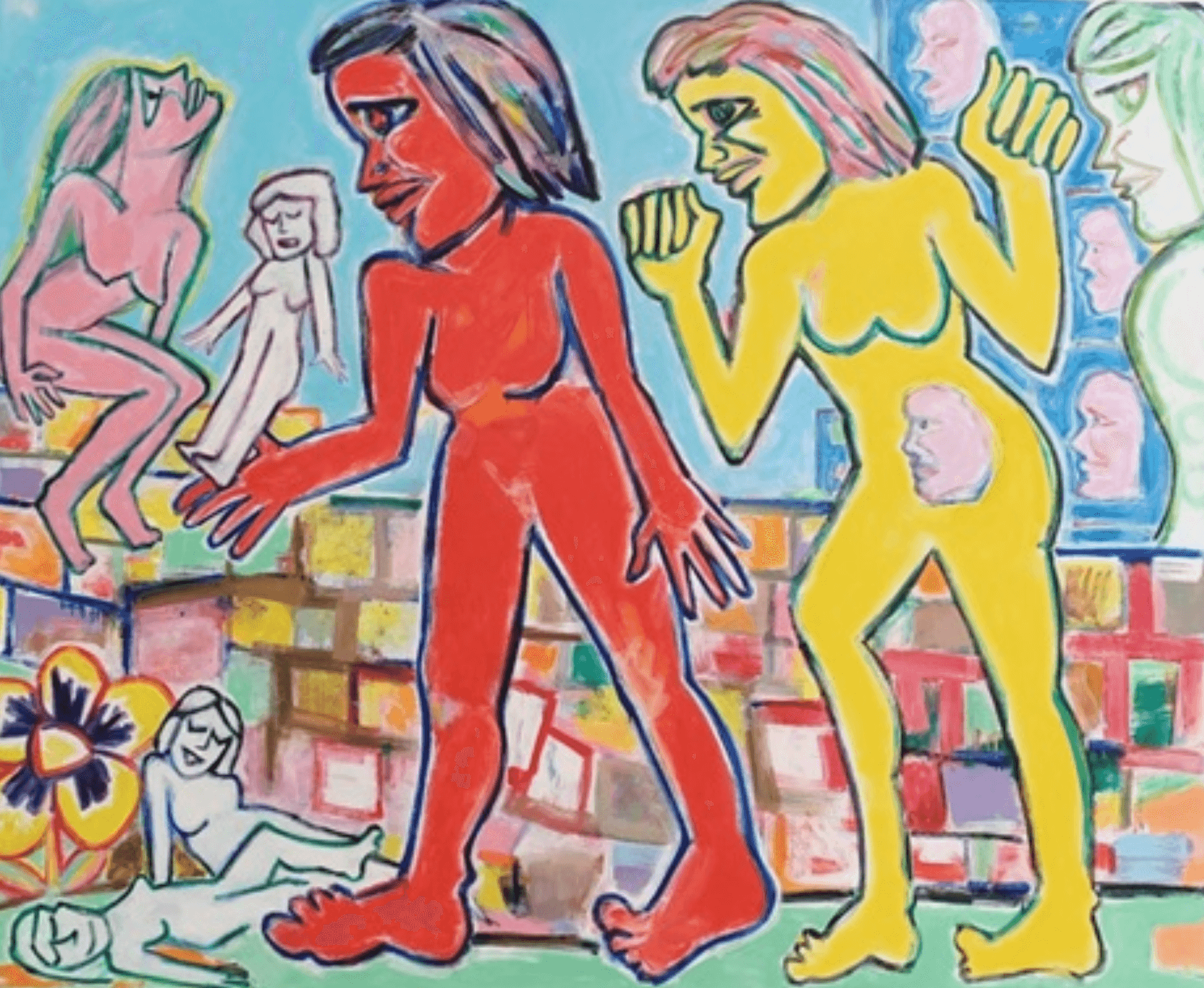
On The Wall, 2025 (acrylic on canvas)
There’s a compulsive quality to Main Drag which pulls in the viewer and asks you to get close—closer.
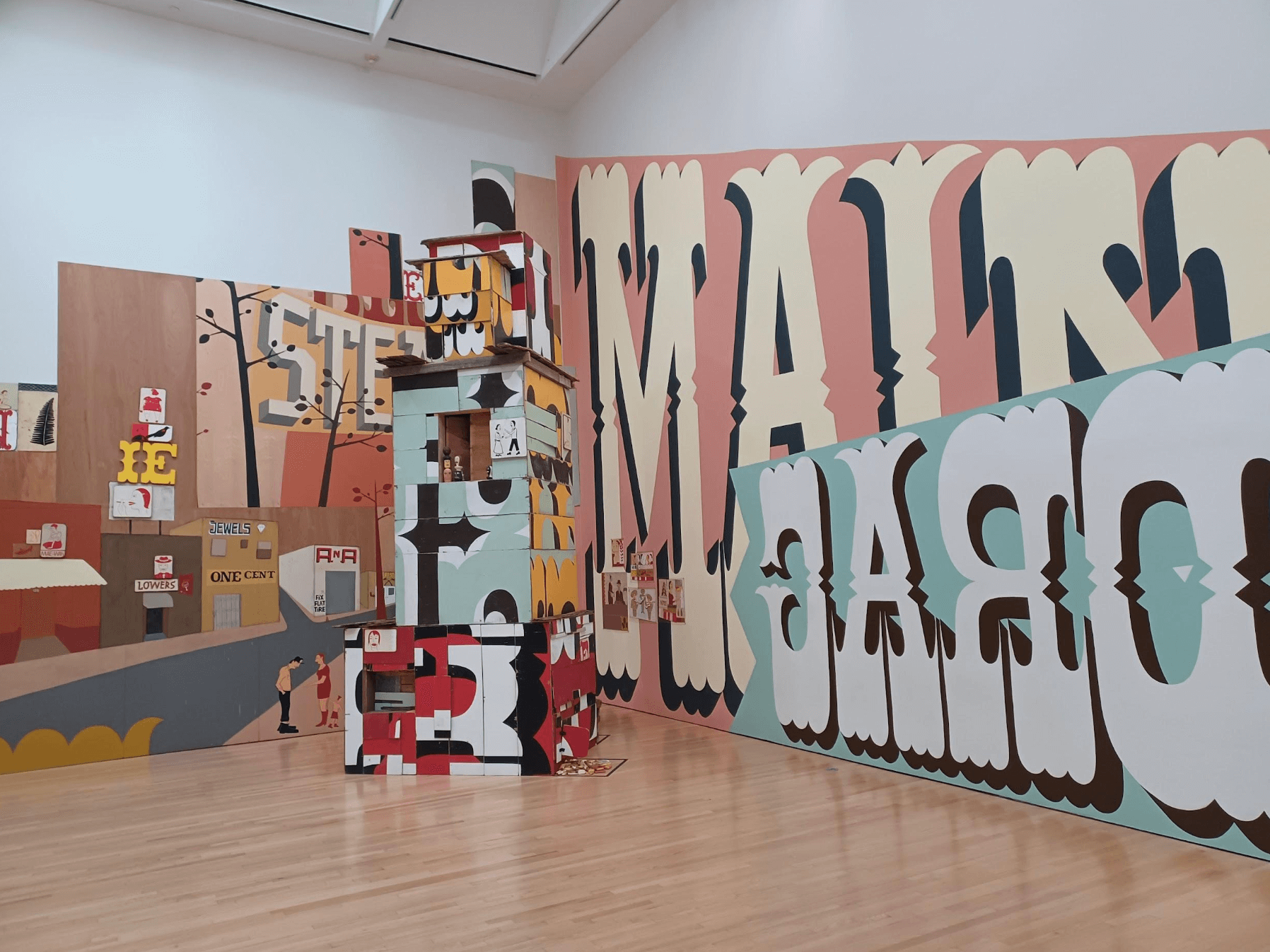
Main Drag, 2001 (paint, wood, steel, canvas, mixed media)
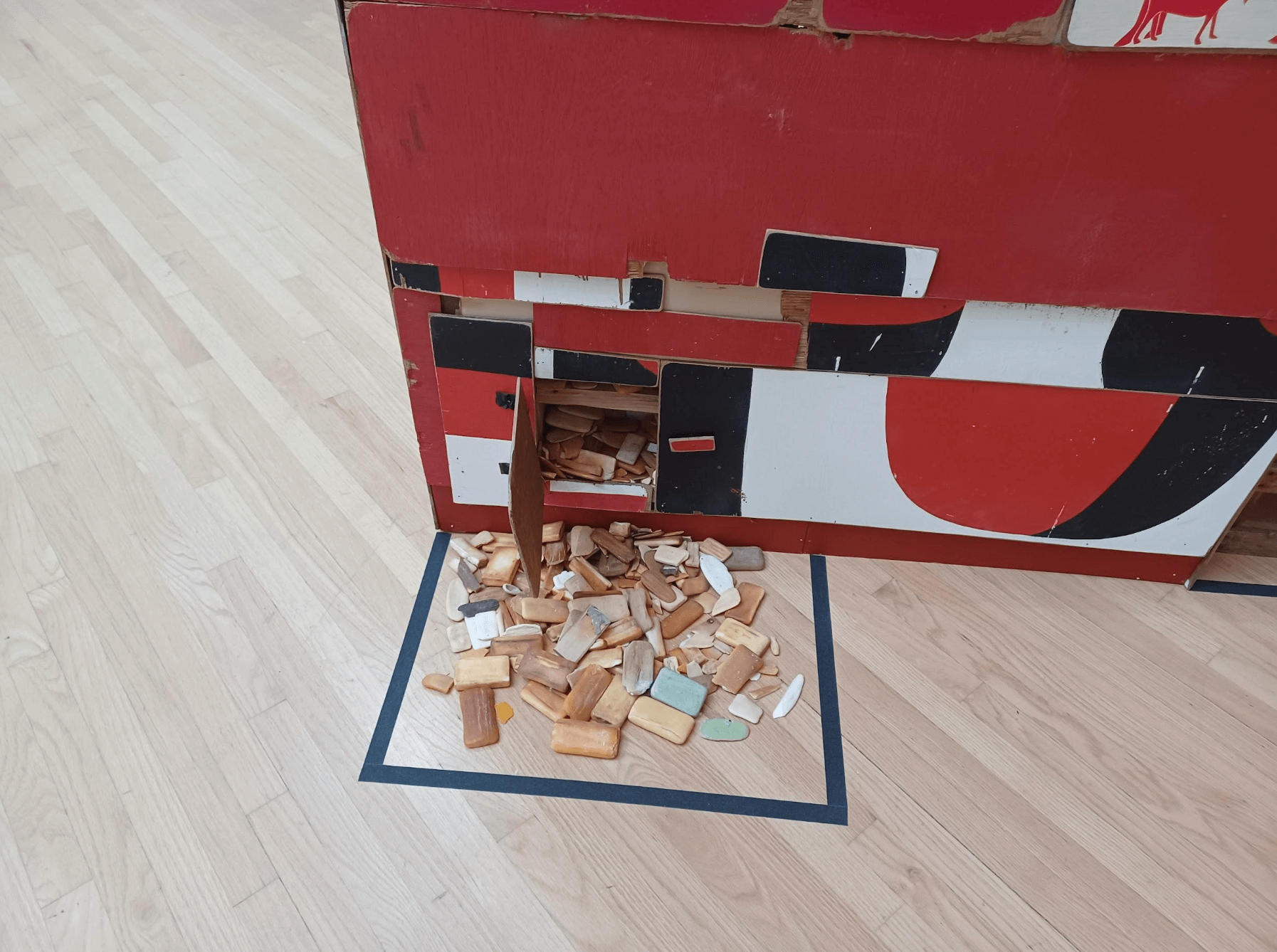
Detail Main Drag
Catty-corner from Main Drag are life-size prints of Bill Daniel’s Bicycle Messenger Portraits, framing the entry to a viewing room for his films Messenger Diary, 1989 (Super 8 film), and Trespassing Sign, 1999 (installation documentation video).
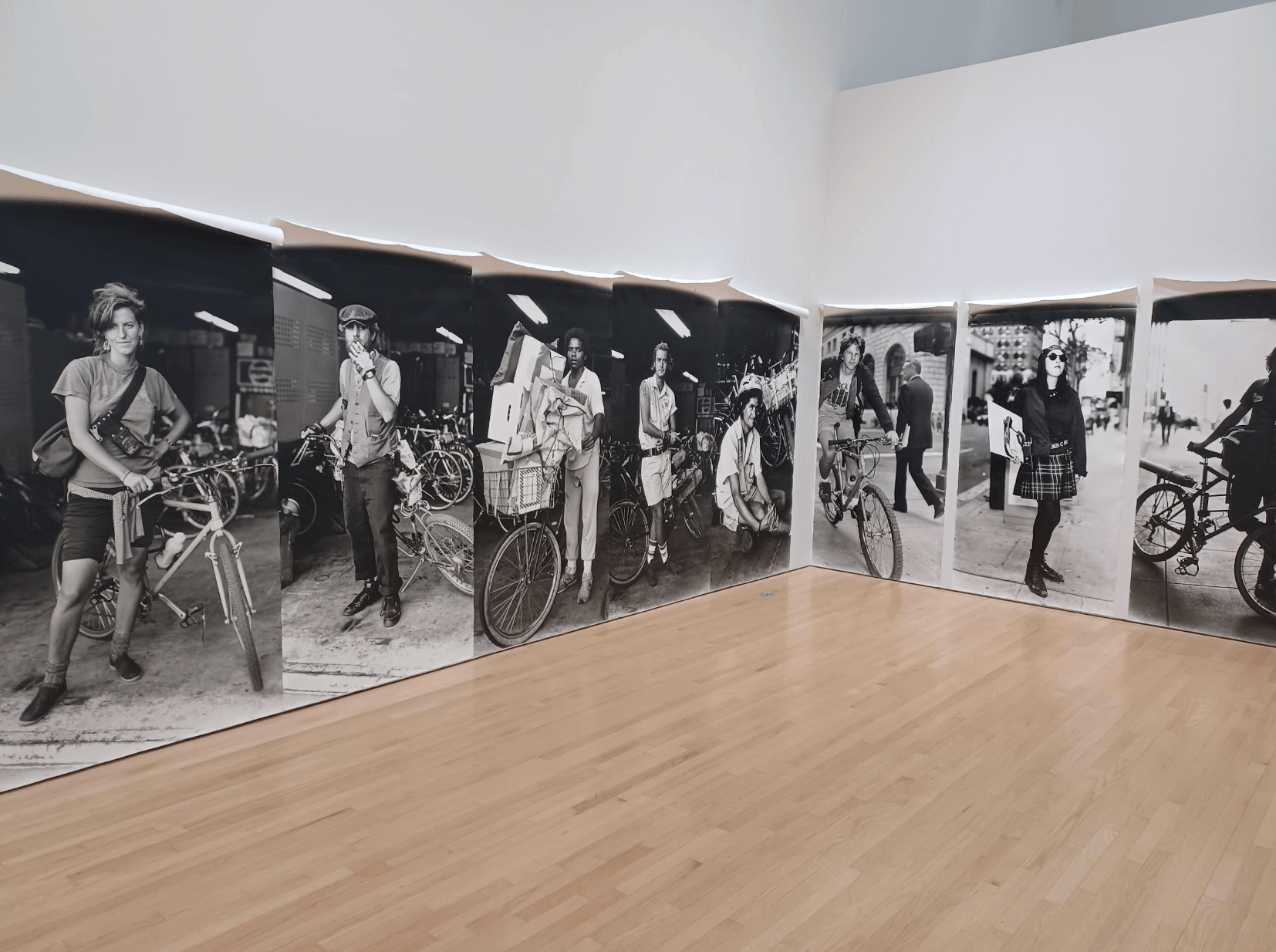
Bicycle Messenger Portraits, 1989/2025
Daniel’s Super 8 film, Messenger Diary, is one of the show’s greatest surprises. An intimate look into a once-integral community vital to San Francisco’s thriving underground culture. Bike messengers had unique individual style and flair that was as bad-ass as it gets. All of them evoke a San Francisco ethos which fed directly into the art scene blossoming in the Mission and elsewhere. They are decidedly not Kevin Bacon à la Quicksilver (1986).
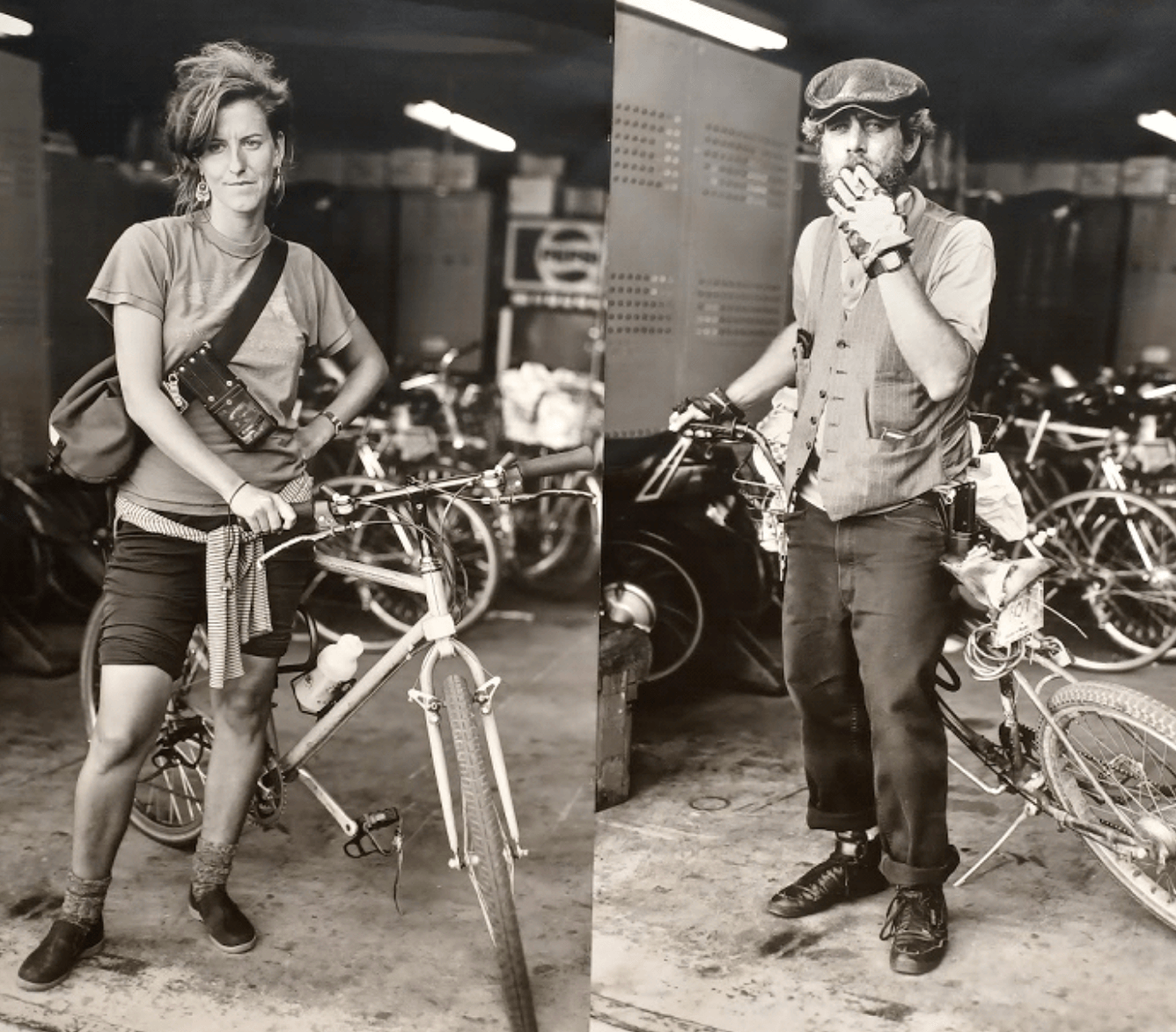
Detail, Bicycle Messenger Portraits
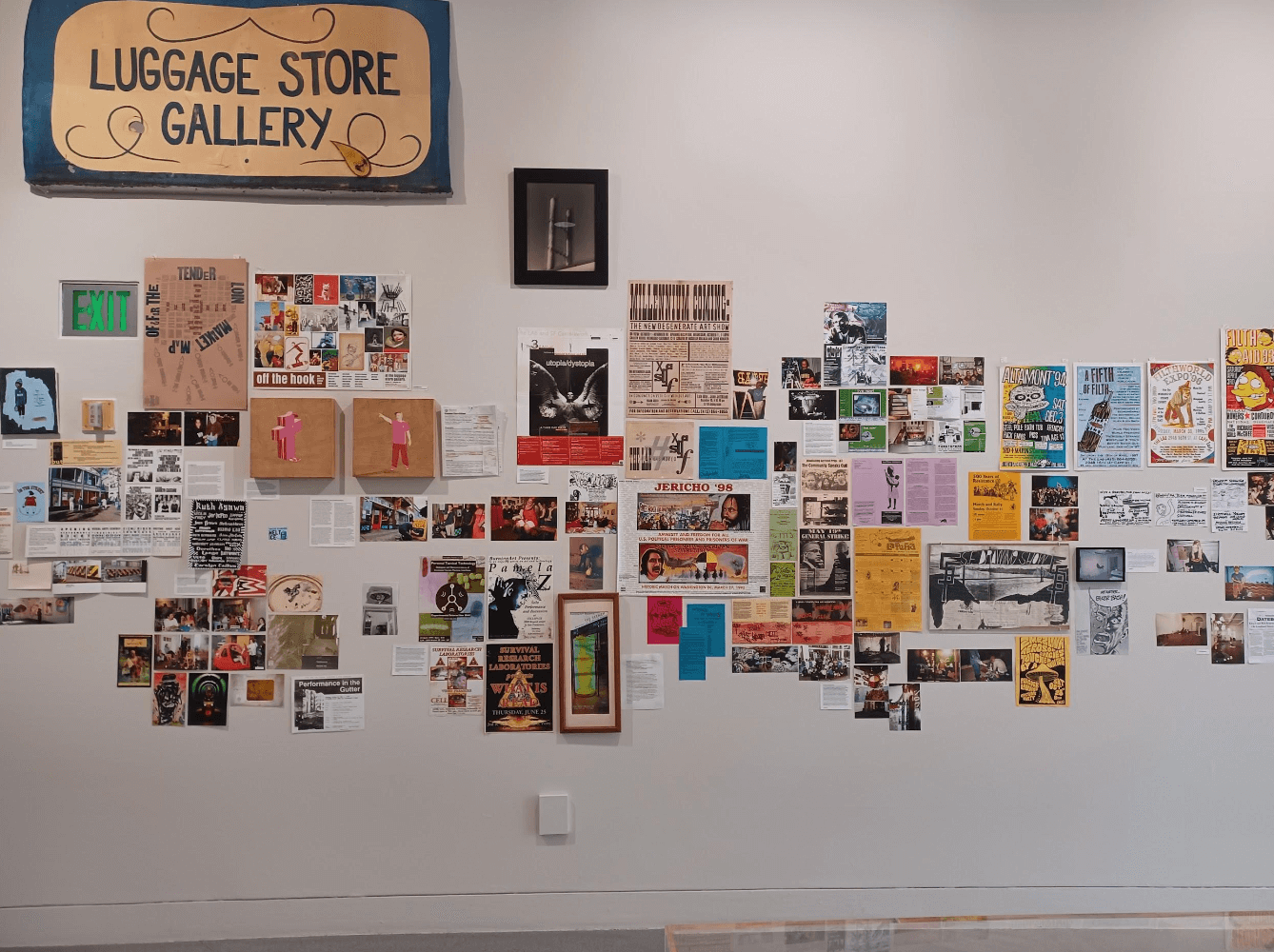
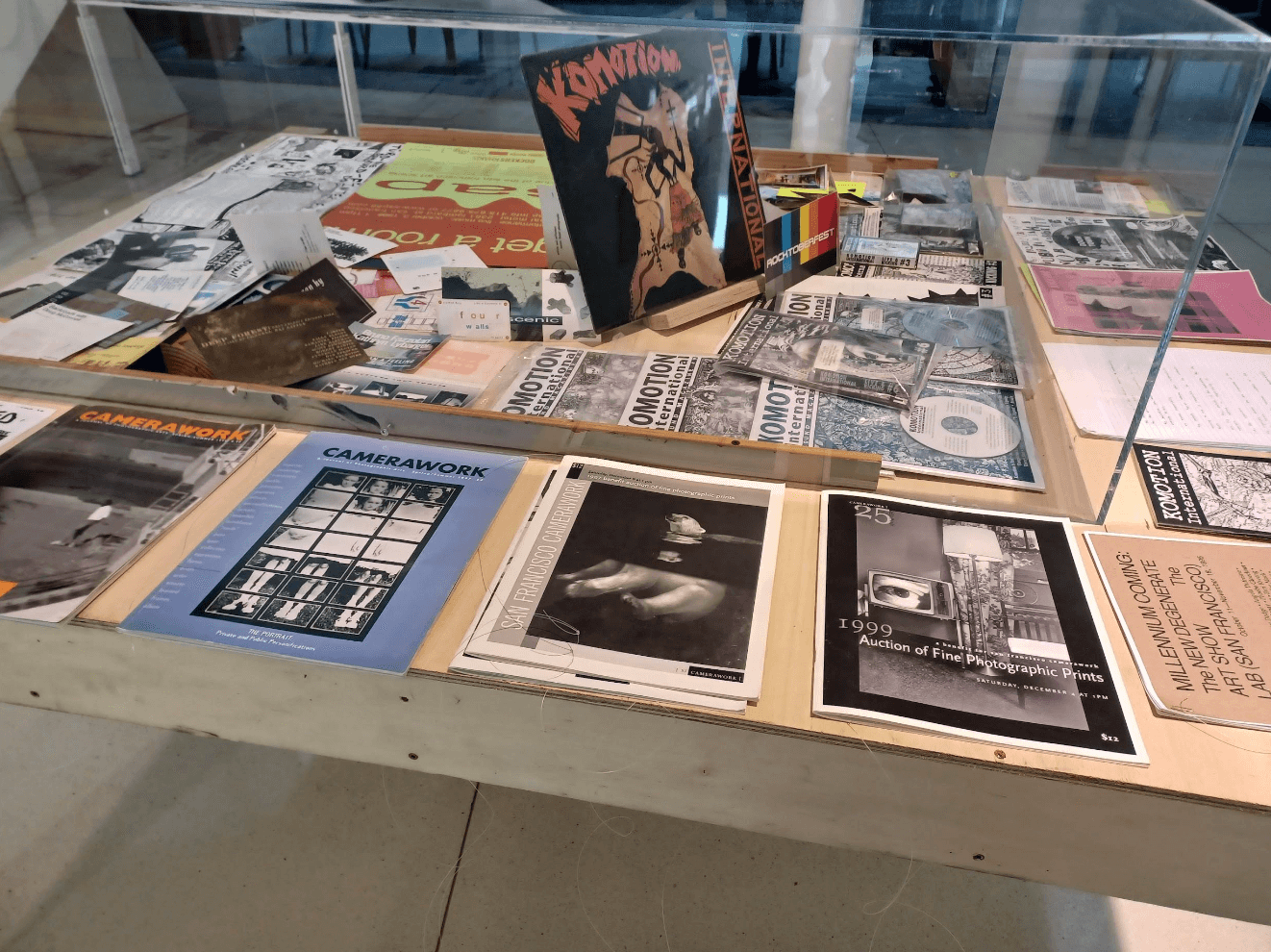
This underground art scene is on display in the entry to the gallery spaces, where one wall has been festooned with flyers for various shows along with other ephemera, all headlined above by a sign for the now-legendary Luggage Store Gallery on Market Street.
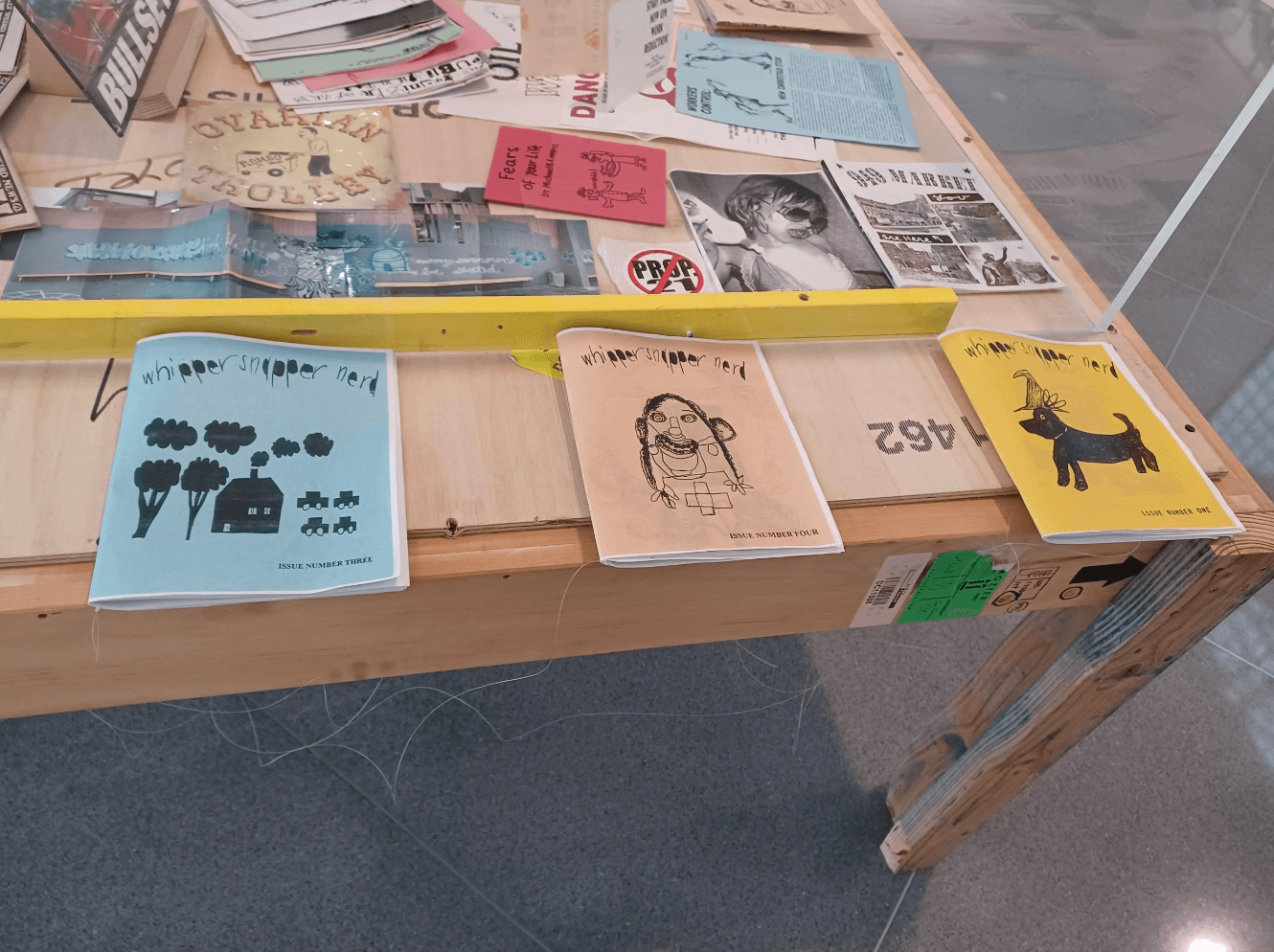
Print flyers were once a staple feature of the scene in those pre-digital days, as were zines and print mags run off down at the corner store’s photocopier. Fittingly, two tables have been set up with various samples of the art zines and mags from back then, several of which may be handled and flipped through.
Not to be missed is Barry McGee’s Untitled, 2025, tucked away (and spilling onto the outer wall) of a room directly off YBCA’s main hall just beyond the restrooms. Here McGee has assembled a vast quantity of smaller works and cast-offs by a host company of the unnamed. It’s a phenomenal display of “anonymous” art clustered hilter-kilter. Much of it is an ode to the disappeared Mission of the 1990s, when Andrew McKinley’s Adobe Books was on 16th Street (various artists and poets, such as Johanna Jackson, picking up shifts manning the desk) and Abandoned Planet Bookstore was around the corner on Valencia, with the back room covered with mural art by poet Jack Micheline.
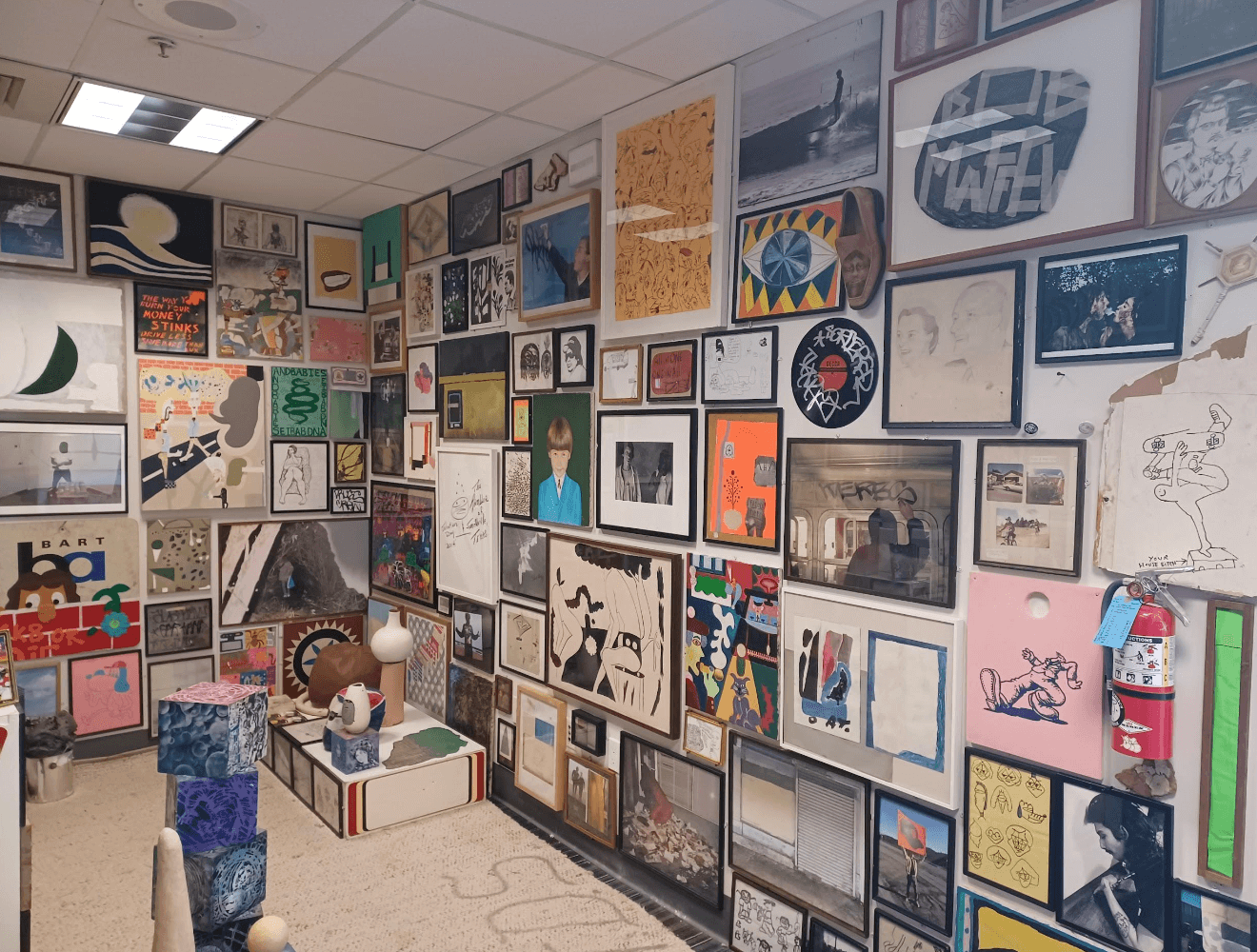
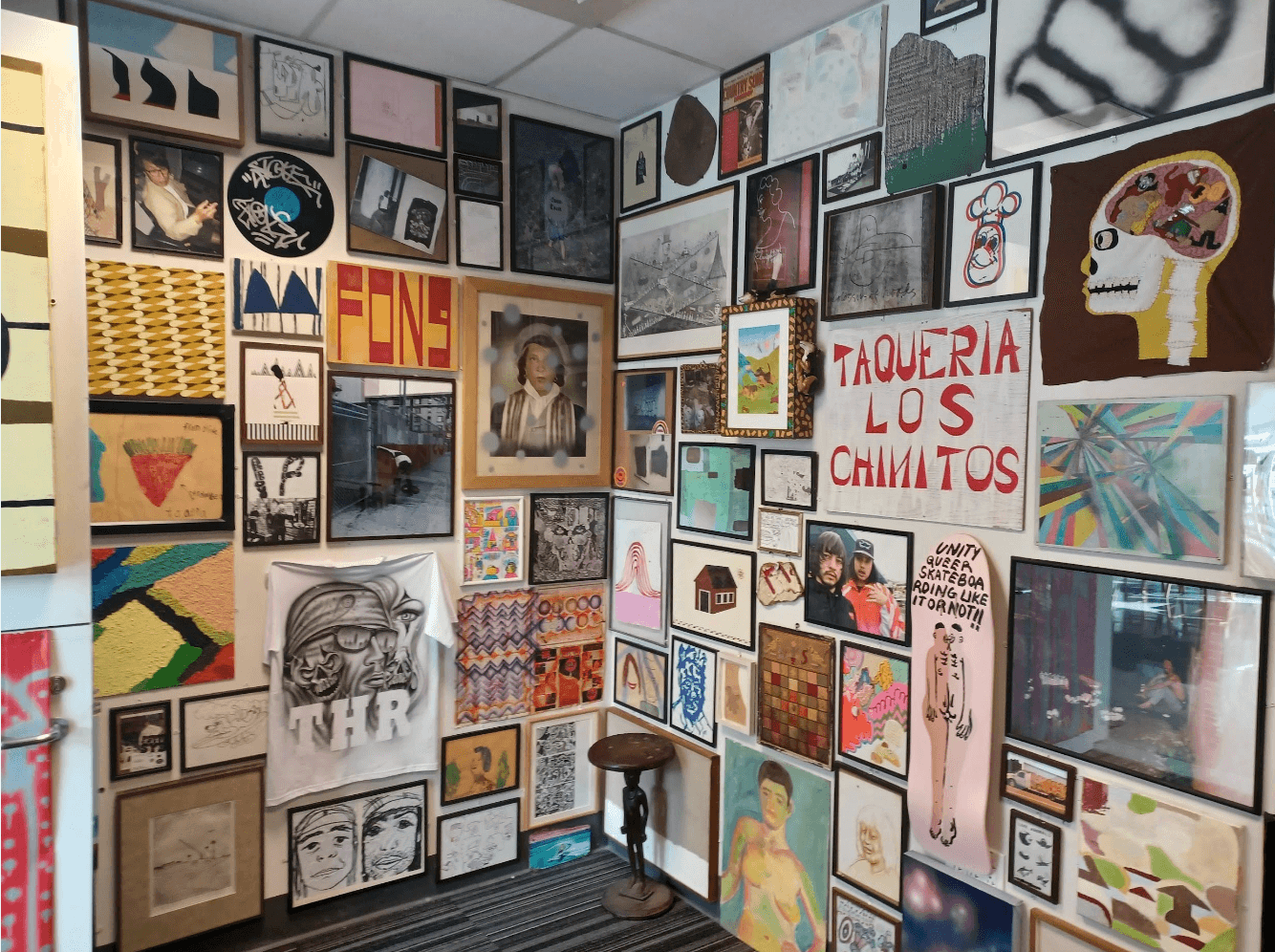
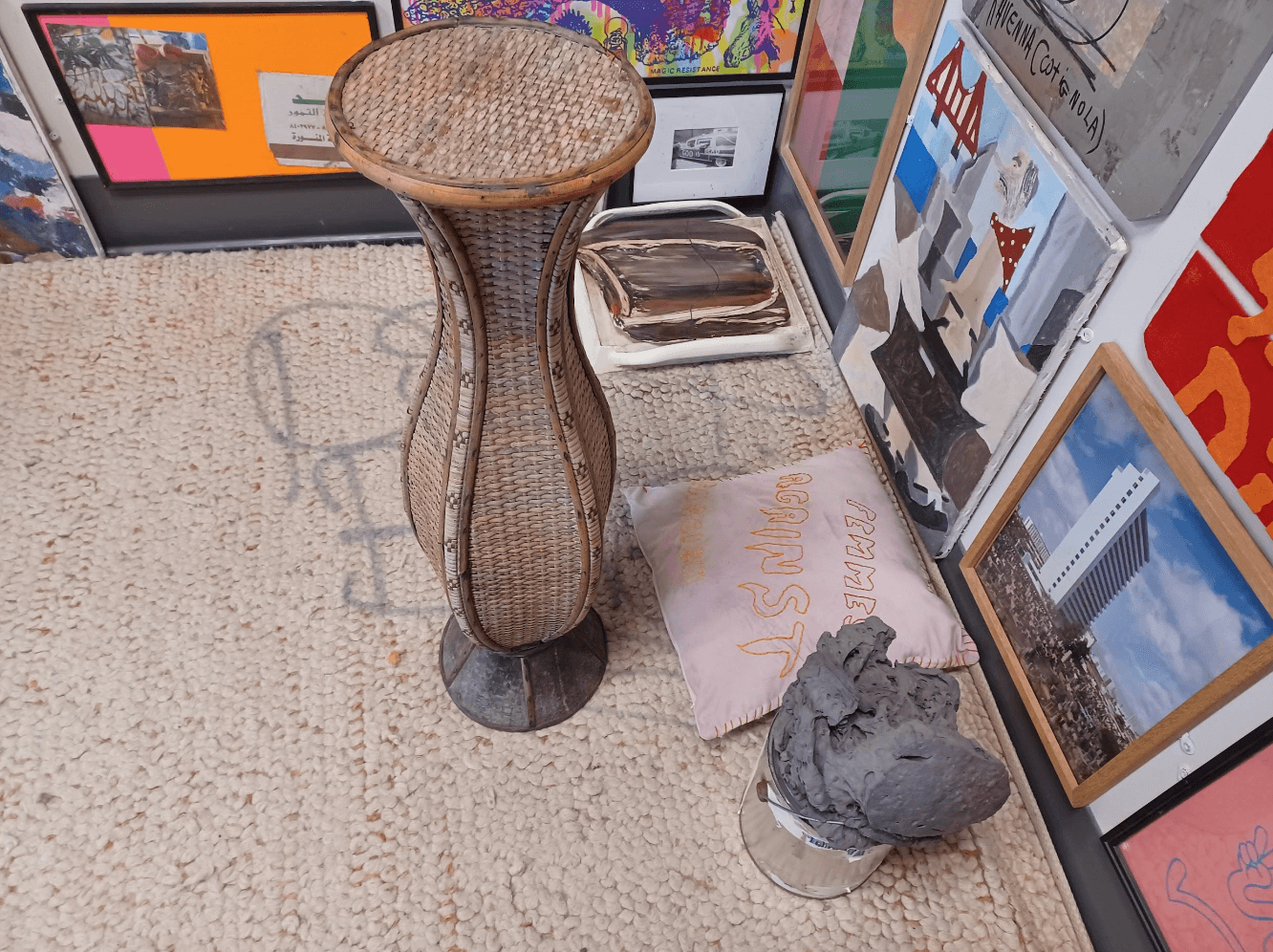
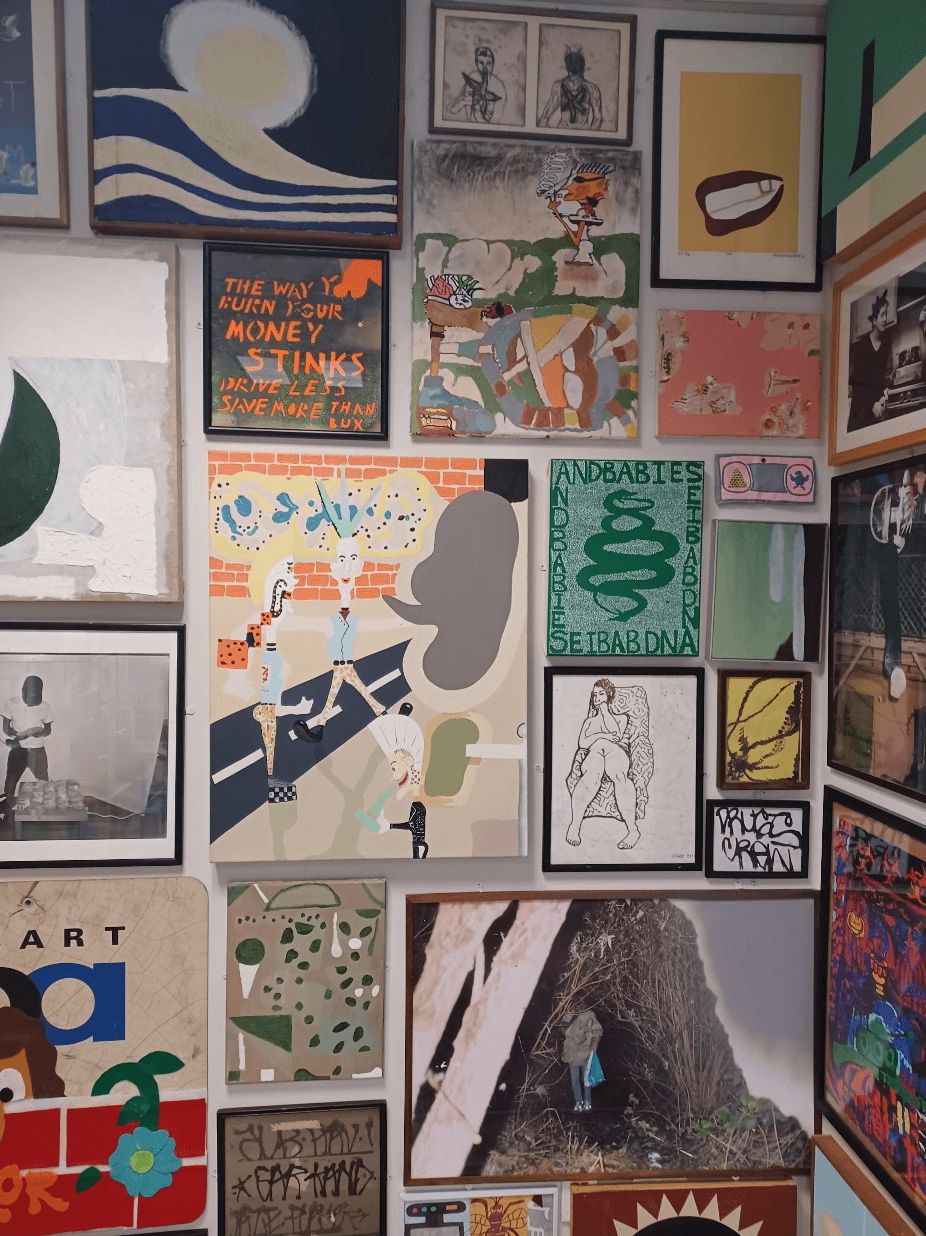
detail photos, Untitled
Those who have been around the scene will likely notice works by friends, pals, acquaintances, and numerous other folks. The skateboarder drawings of Mark Gonzales, for instance, are unmistakable for any avid reader of Thrasher magazine over the years.
Johanson and Oakford’s 2 Love, 3 Love, 4 Love… extends out of the gallery onto YBCA’s Third Street Courtyard, where it forms a small stage. In a nod to historically strong connections between the city’s poets and visual artists, Johanson recruited poets Yates Cessna and Marina Lazzara to host a monthly Saturday reading series on the site. A kind of activation amid the street sounds, with downtown’s towering buildings overhead. It is accessible to gallery visitors during normal operating hours. The final reading for the Bay Area Then and Now Poetry Series before Bay Area Then closes will be Kevin Dublin, Magick Altman, and Tongo Eisen-Martin on Saturday, January 17, 2026, 12–1 PM.
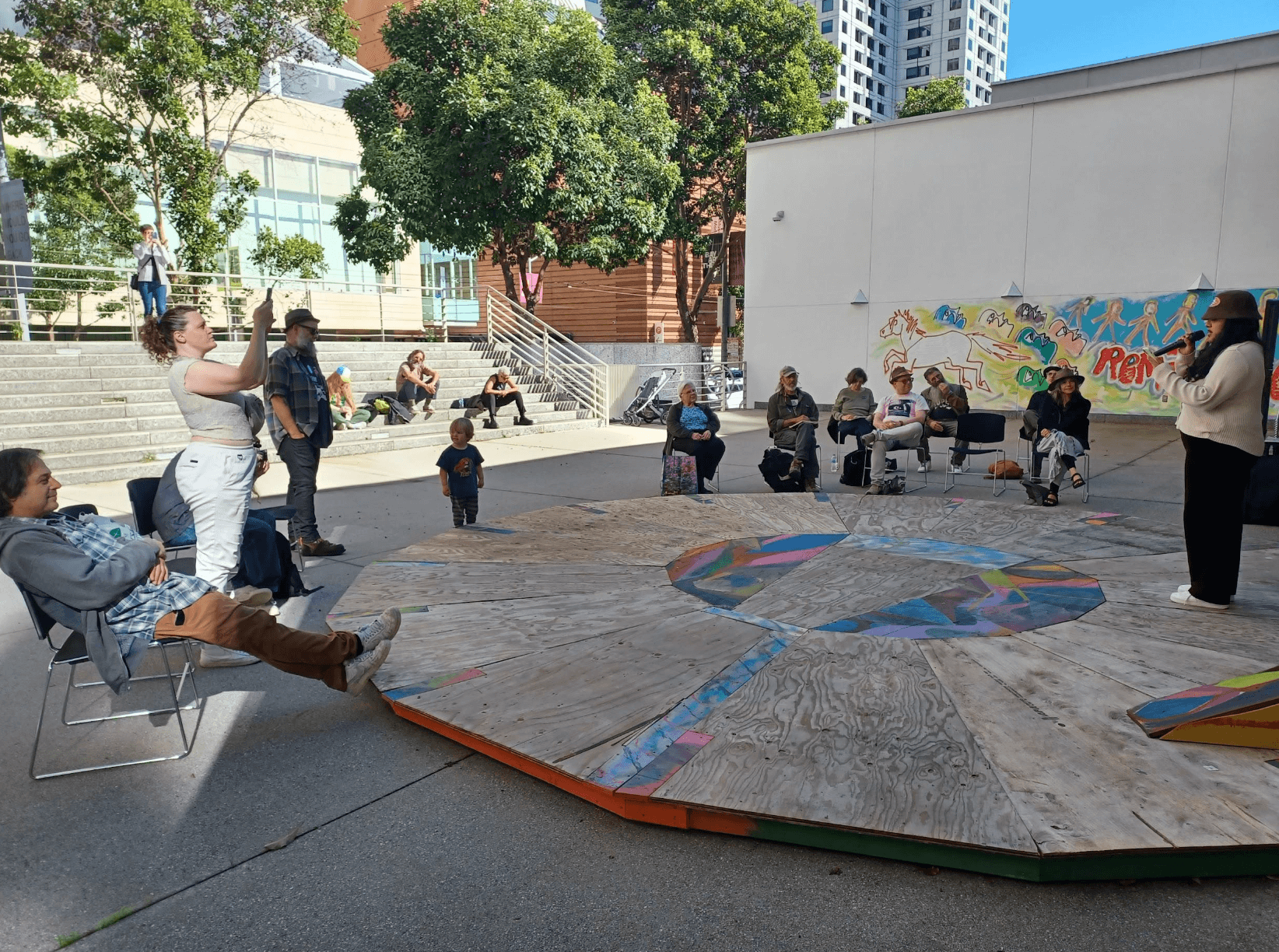
Yenia Jimenez reads her poetry on the deck of 2 Love, 3 Love, 4 Love… November 8, 2025.
Some Bay Area Art Then… & Now actually seems a more naturally fitting title for the show itself. Bay Area Then leaves too many questions unanswered (what era is “then” referring to, anyway?) or else asserts too broad a dominance, claiming ground which it fails to fully deliver. What brings together the work of these artists? A whim? How does the new contemporary work relate with the earlier pieces and the scene depicted via the ephemera displayed?
While exceptional art has been included, there’s no overlooking that individual artists and accompanying scenes have been skimmed over if not entirely elided. This is not to say “what about so-and-so or where is this and that?”. Less than bruised egos, it is a matter of ensuring as accurate representation of factual and historical record as possible. Bay Area Then simply is not that.
