

slow burn, San Francisco State University
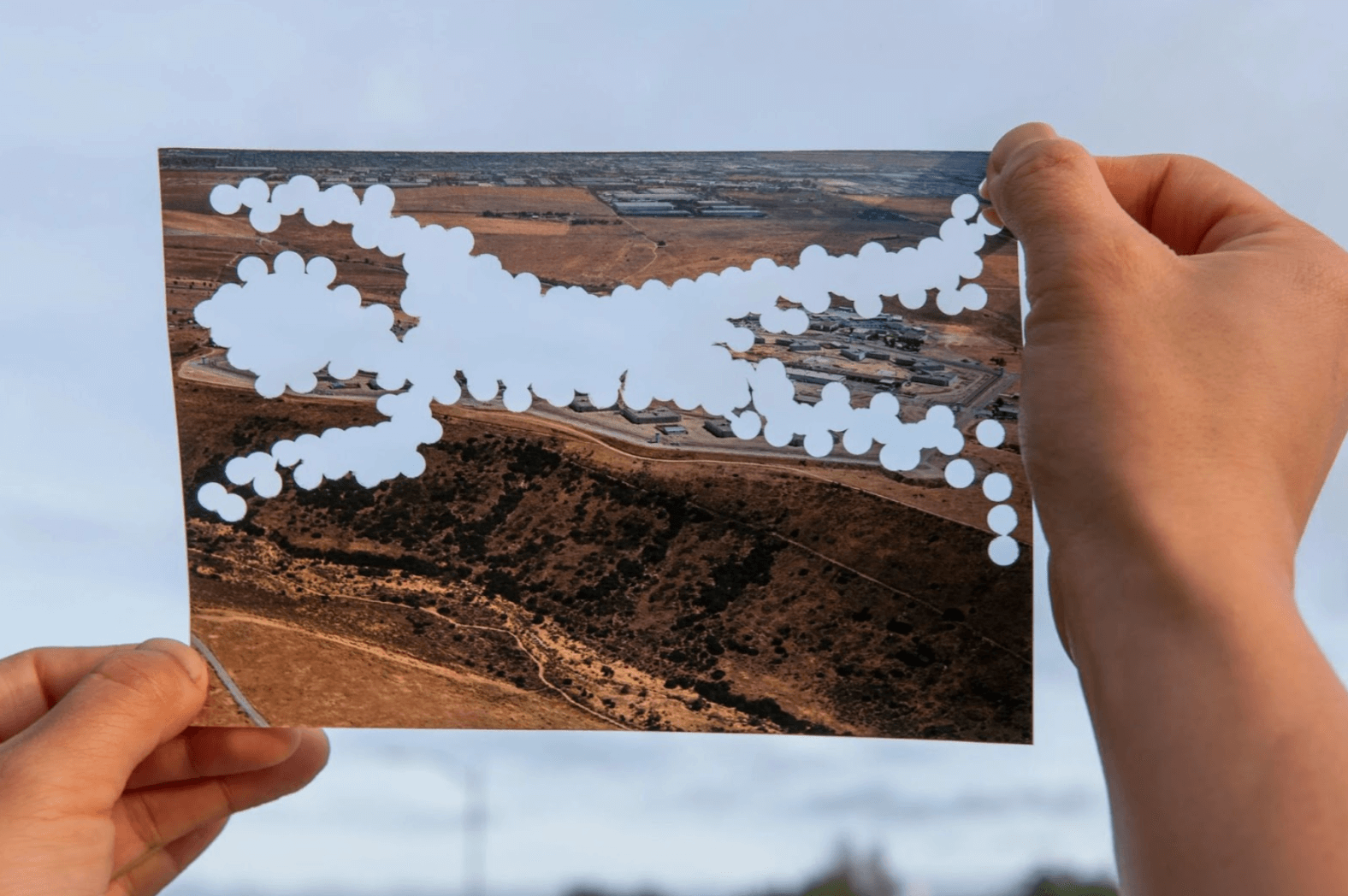
A participant holds up a hole-punched photograph after a 'Disappearance Jail' workshop facilitated by artist Maria Gaspar. (Courtesy of the artist)
Who’s There? Invisibility Equals Violence in slow burn at SF State
In a noisy, dizzyingly hyper-connected world, constant in-your-face visibility is your ticket to success. So what then becomes of the silent? slow burn at San Francisco State University's Fine Arts Gallery asks us to hit the brakes and to take life at a crawl pace to reveal the ghostly voices of the overlooked. slow burn frames slowness as political refusal, revealing how time is experienced through absence, through what systems of power remove, erase, or render invisible.
Guest curator Lorena Molina has united a fierce assembly of BIPOC artists, Mara Duvra, Tesora Garcia, Maria Gaspar, Tianzong Jiang, Ana Mendieta, Joshua Moreno, and Elaine T. Nguyen, to unmask time as a villain that can be stopped. I had an insightful one-on-one with curator, artist, and SFSU professor Lorena Molina, who enlightened me about the impetus for creating this exhibition. Molina illustrates time as not neutral but historically engineered to consolidate power. “We live in a time of manufactured urgency that keeps us overwhelmed and busy but never gives us time to process violence.” Her thinking developed over several years but crystallized during the COVID-19 pandemic, when inequalities around time became obvious. “Some people suddenly had time to be online, to make TikToks, to be seen,” Molina noted. "Meanwhile, essential workers were risking their bodies every day to keep society functioning, but their labor remained hidden from the public sphere.”
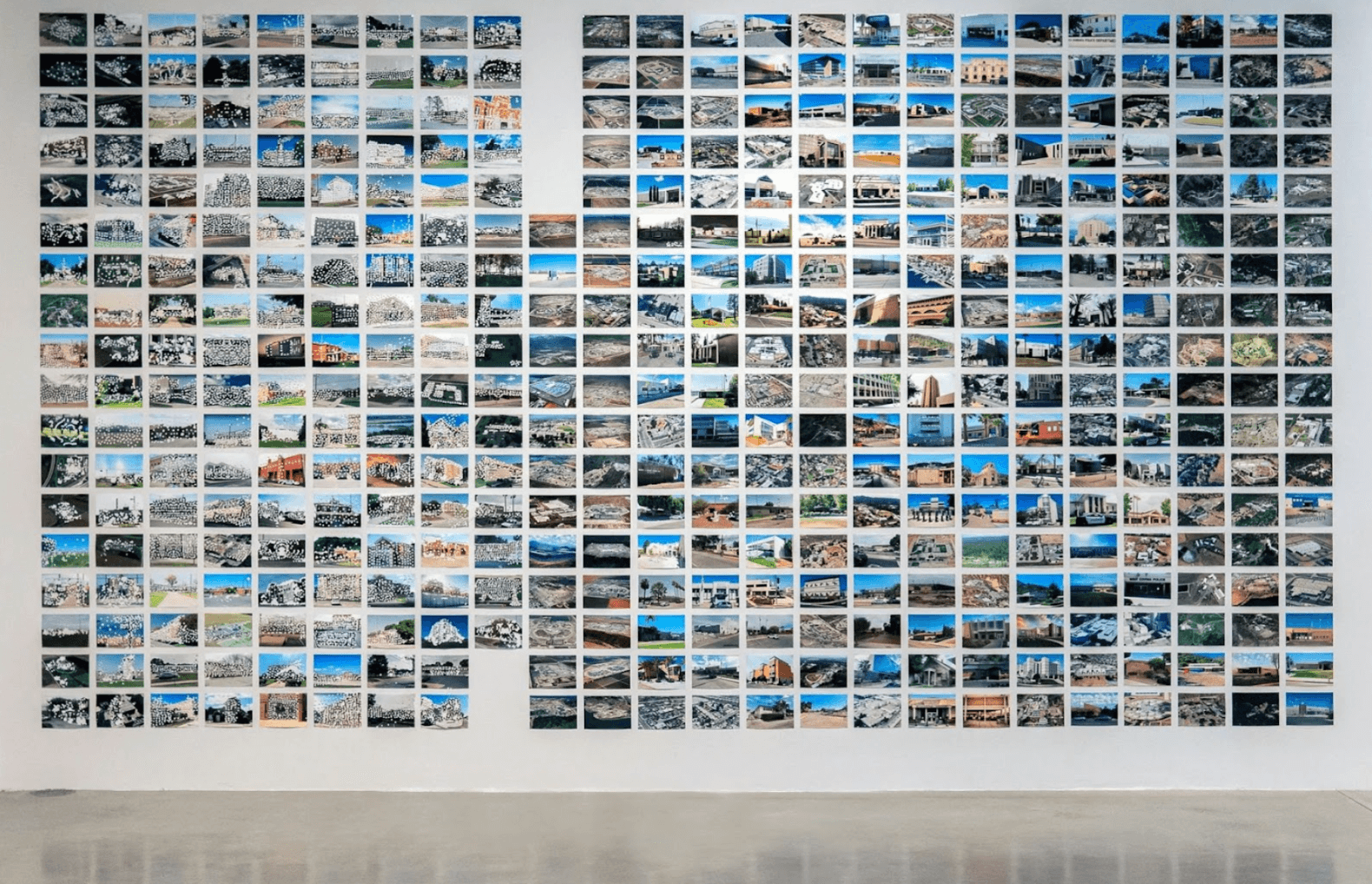
Disappearance Jail (excerpt; series), 2021-Ongoing, Hundreds of perforated Archival Inkjet prints on rice paper, courtesy San Francisco State University Fine Arts Gallery
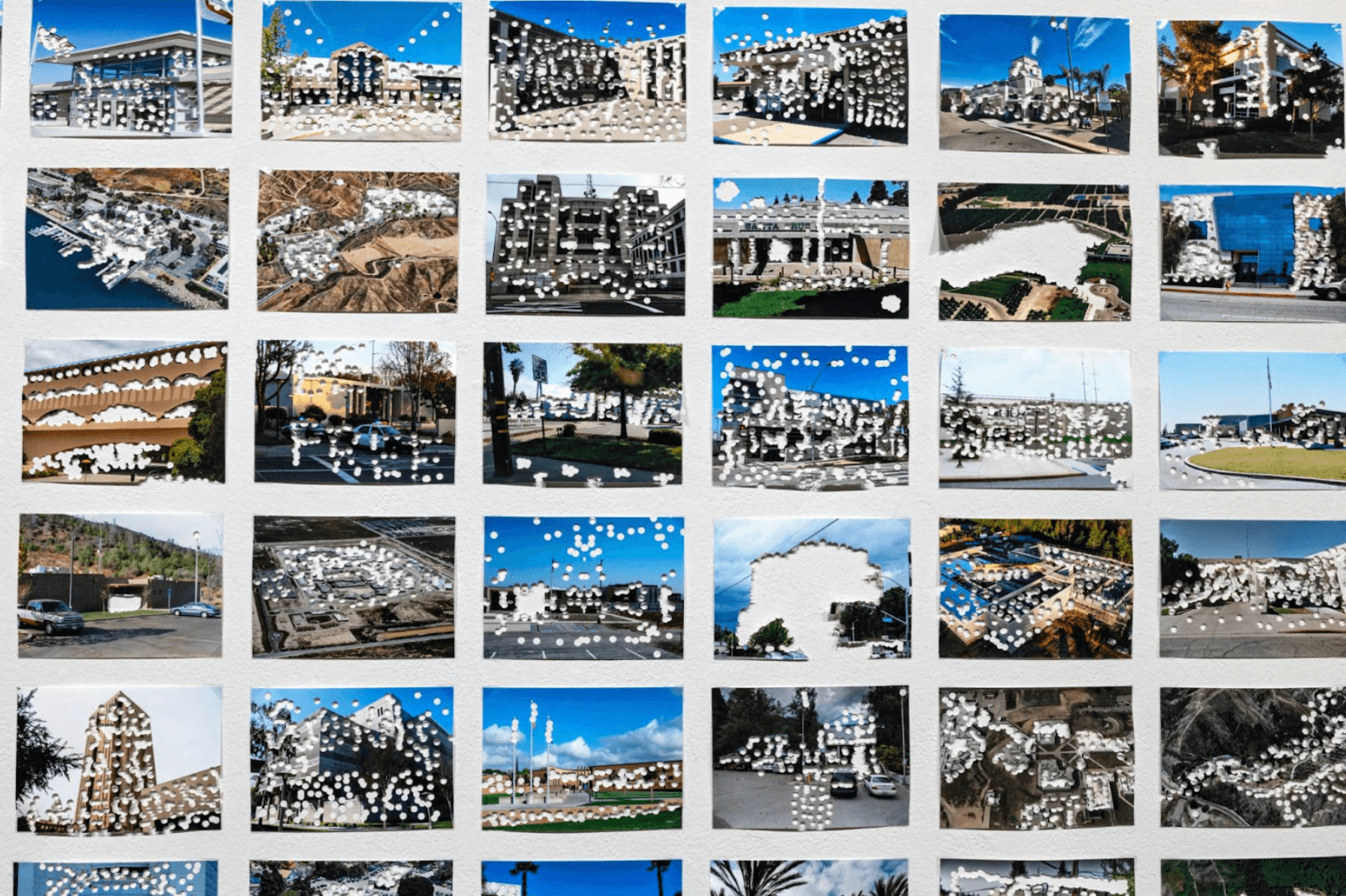
Disappearance Jail (detail)
When the chatter in our mind makes us feel like a soulless mechanism of consumerism, decelerating can read as retreat. But we are not exploring the softness and cliché therapeutic approach to slowing down that is glamorized by the slow culture movement. The work is much deeper than that. María Gaspar’s Sprawling work “Disappearance Jail” features images of more than 500 detention centers that are arranged in a grid-like wall. Through workshops with community members, including those directly impacted by the penal system, Gaspar directs participants to punch holes into photographs of detention facilities, creating portals of collective reimagining. Each hole becomes both opening and wound, a slow undoing of the facility enacted one punch at a time, but also a symbol of the toll time takes on prisoners. Growing up beside Chicago’s Cook County Jail, one of the largest single-site jails in the United States, Gaspar approaches incarceration not as an abstraction but as lived geography. In fact, this geography is uniquely American and should be familiar to all of us. Nearly two million people are incarcerated in the United States today, more than in any other country in the world, and people of color comprise the majority of those imprisoned. In the context of slow burn, this gradual dismantling exposes the prison system not as an invisible necessity but as the exhibition’s clearest fiend, a structure sustained by obscurity and undone through sustained attention.

Untitled (Blood Sign #2/Body Tracks), Super-8 film (color, silent) transferred to video, Running time: 1:20 minutes, 1974, Collection Walker Art Center, Minneapolis, T.B. Walker Acquisition Fund, 2011. © The Estate of Ana Mendieta Collection LLC. Courtesy Galerie Lelong & Co. Licensed by Artists Rights Society (ARS), New York.
Refusing spectacle, Ana Mendieta’s work positions protracted time as a strategy of radical confrontation. In the grainy and mute Super-8 video, duration unfolds through the ritual pressing of Mendieta’s limbs against the wall before her, her face withheld so that she appears simultaneously present and absent. Two bloody red traces remain, opaque in meaning, seemingly purposeful yet resisting immediate legibility. She refuses to be performative, but rather her actions are visceral and unnerving. This withdrawal echoes her earlier work, Rape Scene (1973), when viewers found Mendieta silent and motionless, bent over a table, partially naked from the waist down, her body smeared with blood. The space appeared staged to resemble the aftermath of a sexual assault. Across these works, Mendieta uses her body to expose the social conditions through which the female form is colonized by desire and marked by masculine aggression. Slowness becomes crucial to this strategy: by delaying recognition and resisting spectacle, her work compels viewers to confront the processes through which certain bodies are simultaneously made visible and erased.
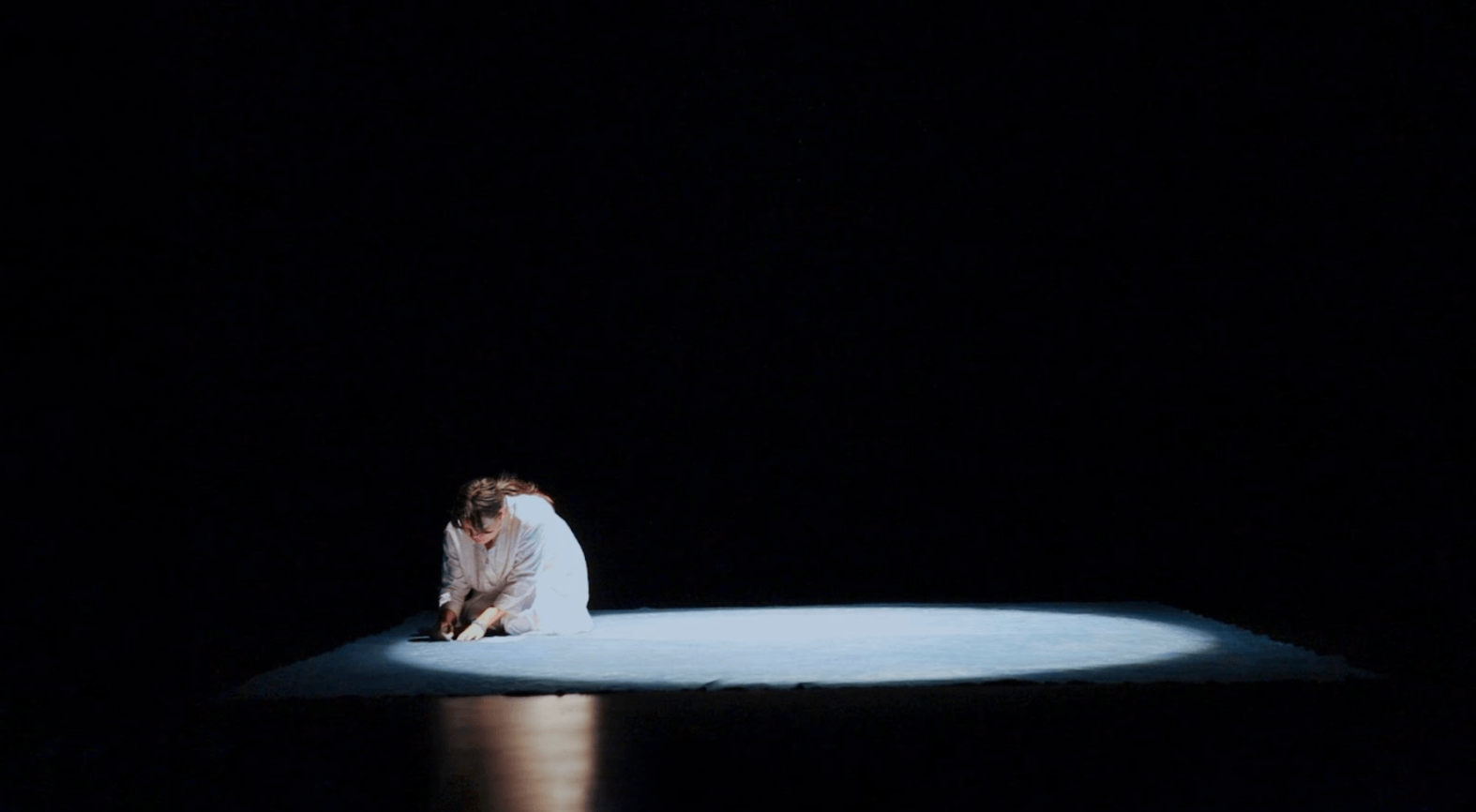
Ngoạ i ă n, Ngoạ i có sứ c khỏ e, 2024, Elaine Nguyen, Porcelain and cyanotype on canvas, 12'x12', courtesy of San Francisco University Fine Arts Gallery
The work Ngoại ăn, Ngoại có sức khỏe, emerges from a durational performance in which Nguyen repeatedly walked and wrote as an act of devotion, attempting to relearn a language partially lost to her. Vietnamese and English words form a fading rotation rendered almost illegible, smudged with porcelain chalk into a deep blue surface of cyanotype-blue canvas that ripples like water. Voidal at its center and circled by a glimmer, the work recalls an eclipse, something somewhat visible yet ultimately obscured. Such is the relationship between Elaine T. Nguyen and her grandmother. In this work, Nguyen reflects on her relationship with her grandmother. While in college, Nguyen’s grandmother's health deteriorated; she longed to say all the things she wanted to say to her grandmother, but there was a language barrier. The distance between granddaughter and grandmother registers as the aftereffect of cultural assimilation, where language erodes across generations. Sustained gesture here becomes an act of longing rather than restoration: repetition does not recover language but instead reveals its absence.
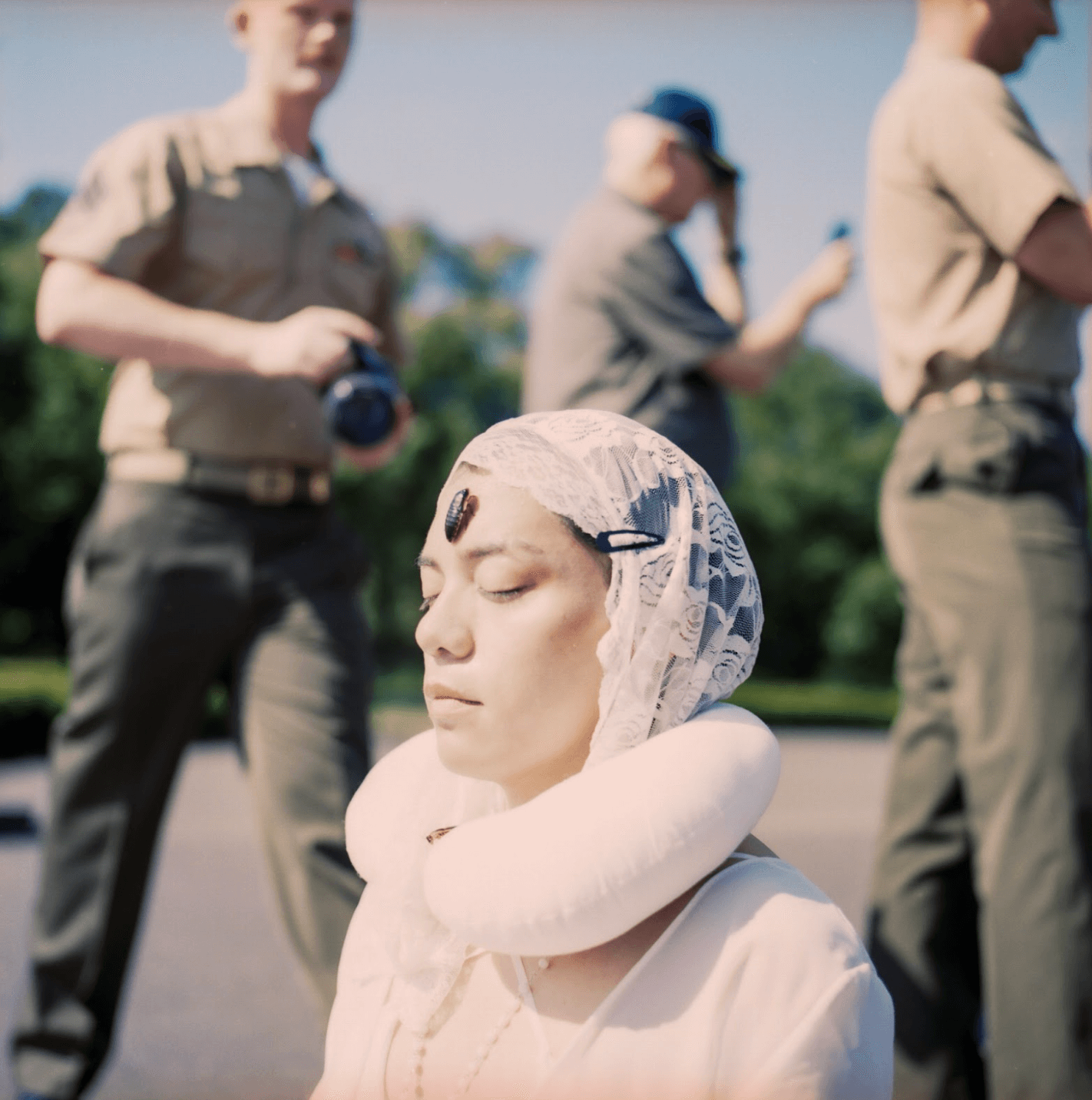
a holding place, installation, 2021, Tesora Garcia, courtesy San Francisco State University Fine Arts Gallery
In Tesora Garcia’s “Ecstatic Visions from Outer Space,” a video of a guerrilla performance, Garcia recontextualizes the National Mall, pointing out the absence of a sense of spirituality in the heart of the American capital. This intervention is situational and political in nature, all the while spiritually significant, as if to say that a soul is not present to these monuments until Tesora brings it, and even when it is there, it seems alien. Tesora is dressed with a thin veil reminiscent of a modest Latina woman at church. In contrast to her surroundings, her appearance takes on an otherworldly tone, and the audio of chanting in Spanish and English, with references to occult themes such as the sacred twins, adds to the effect of something that does not belong. The praying protagonist lays offerings at the base of monuments to Western imperialism while passersby continue uninterrupted, indifferent to her presence. Cockroaches crawl across her face, living symbols of beings that exist everywhere yet remain unseen. The protagonist moves about like a ghost, present but unrecognized, revealing how visibility is structured by collective neglect. Such measured pacing here allows viewers to witness how bodies of resistance are rendered invisible within spaces that monumentalize power.
Slowness whittles away at the facade of power structures to help us perceive differently in slow burn. We are pitted against a culture that equates visibility with value, and the viewers are asked to remain with the radically mundane: traces, erasures, and incomplete presences. What emerges is not simply a critique of speed but an exposure of the systems that decide who is allowed to appear fully within public life and who is relegated to disappearance. As for a happy ending, the exhibition does not restore what has been erased; instead, it teaches us a harsh life lesson: recognize the violence embedded in erasure and sit with its consequences. What emerges victorious in this exhibition, even beyond its stated preoccupation with slowness, is that in all the work, the voiceless erased have a second chance to speak.
