
Martin Wong, Chinatown USA, Wrightwood 659
By Wei Huang
“I was never an outsider to anything,” this proclamation by Martin Wong (1946–1999), written in all capitals in an undated notebook now part of the collection of New York University, preludes Margo Machida’s catalogue essay for the exhibition Martin Wong: Chinatown USA at Wrightwood 659, Chicago. The insider-outsider dynamic has long been a favorite approach to Martin Wong and his art, so much so that the artist himself had to address it. A gay Chinese American, Wong grew up in the San Francisco Chinatown and later moved to New York in 1978, where he involved himself with the Black and brown community in the Lower East Side. He shunned the mainstream art world of the city and instead grew into one mainstay among artists, writers, performers, and graffiti communities often excluded from the mainstream art world.
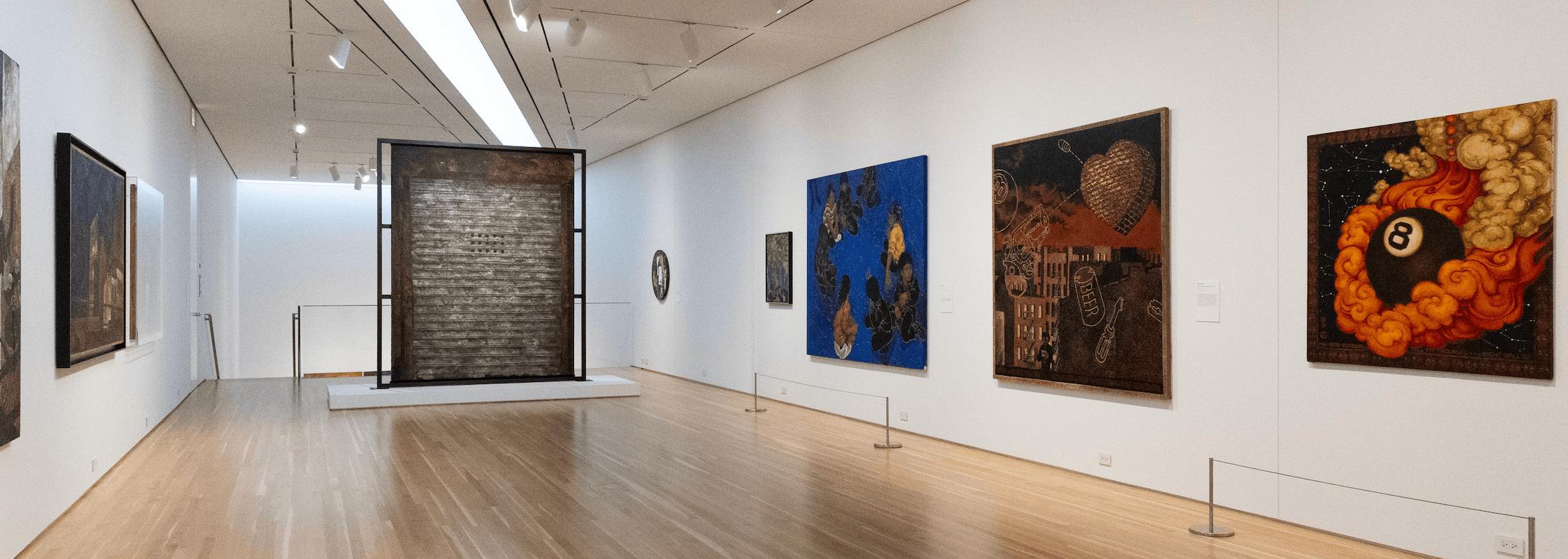
The works displayed at Wrightwood 659 are largely informed by this transitional period and the subsequent time in Wong’s life from the 70s to the 90s, most of which would not have been shown to the public until 1993 at New York’s P·P·O·W gallery. The appeal of these paintings is evident. Occupying the third floor of the museum are his most extravagant paintings of the San Francisco Chinatown, defined by indigo hues and golden contours, while his most celebrated works, composed with the brick walls and the Black and brown dwellers of New York, populate the fourth floor.
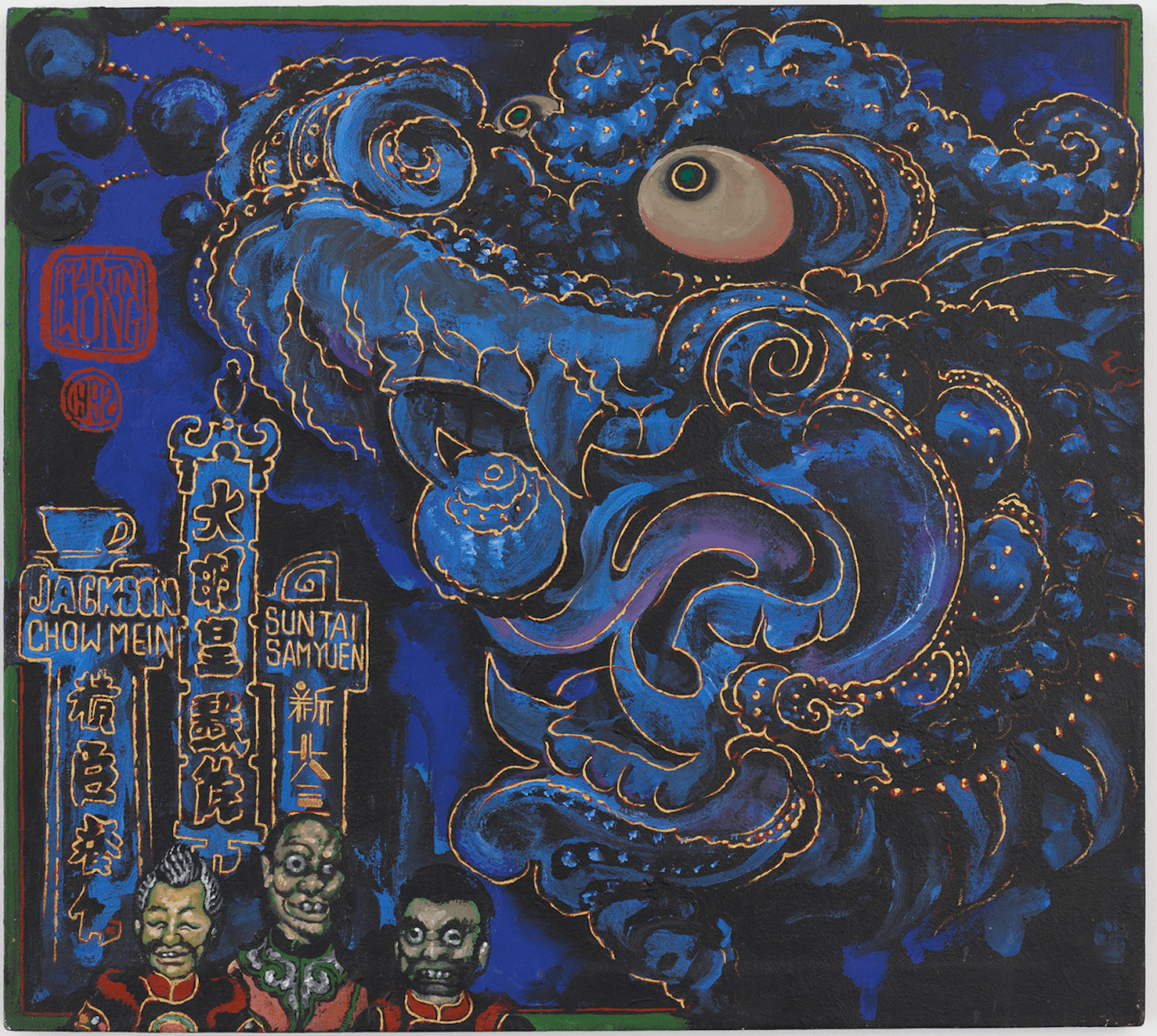
Martin Wong, Jackson Chow Mein, acrylic on canvas, 26 x 29 in., 1992.
Here one could easily characterize Wong’s perspective as an outsider’s lens. In his Chinatown paintings, Wong boldly employs some of the most stereotypical iconographies. In Jackson Chow Mein (1992), from the title, the dragon that takes up the majority of the canvas, to the neon restaurant billboards with Chinese and English written over, and the three Chinese caricatures in the foreground, this painting epitomizes the part of Wong’s artistry that critics and scholars such as Lydia Yee like to label as “self-orientalism,” a form of resistance against the Western gaze through the reappropriation of racial stereotypes. This interpretation, which charges Wong’s art with social and political consciousness, has been gradually challenged by scholars like Marci Kwon, who argues that the characterization itself is still flattening Wong’s œuvres that are so hard to be contained, as corroborated by the immense capacity of Wong’s artistry showcased in this exhibition. In Portrait of Mickey Piñero Tattooing (1988), Wong depicts his collaborator and romantic partner Miguel Piñero in a prison setting.
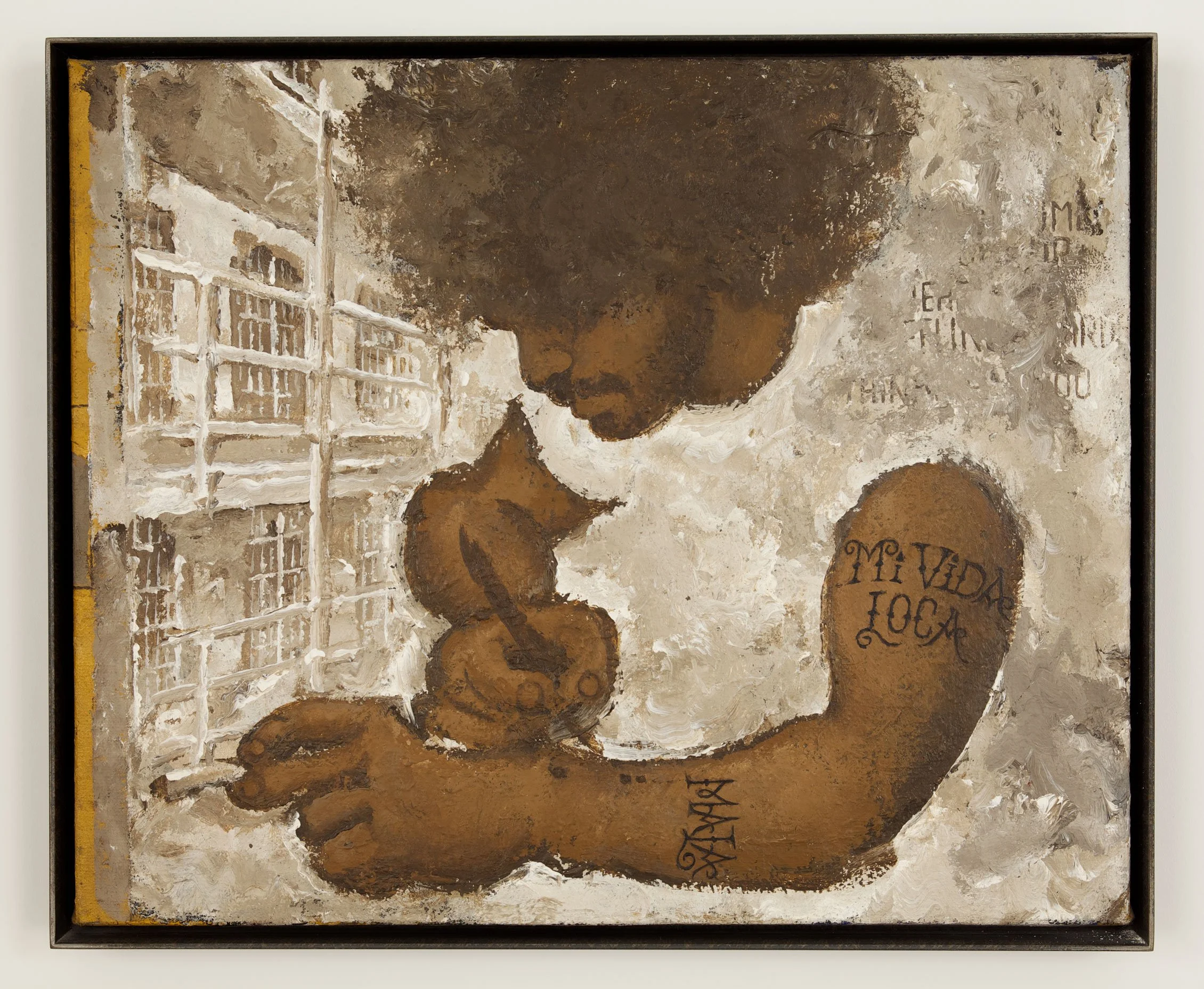
Martin Wong, Portrait of Mickey Piñero Tattooing, acrylic on canvas, 17 3/4 x 21 5/8 in., ca. 1988.
The two first met at a performance on the Lower East Side, where Piñero was cast in a crime-themed exhibit for his incarceration history. As active as Wong was in the Loisaida (a Spanish-English hybrid alias of the Lower East Side), coming from a middle-class background and having never been incarcerated, Wong straddled the threshold of the Nuyorican (New York Puerto Rican) community he loved so deeply, half in yet half out.
Despite his vehement rejection of the outsider status, Wong was at times ambivalent about his position in the world in which he indulged himself. In an interview with Machida in 1989, just a decade before his premature death from AIDS-related illness, Wong admitted that he investigated Chinatown from “an outsider’s view,” while his gaze at New York’s East Village was his own. The Chinatown paintings on display, though mostly created after he moved to New York, predominantly thematize the San Francisco Chinatown after dark, except for Canal Street (1992), featuring two pagodas erect against the New York City night sky.
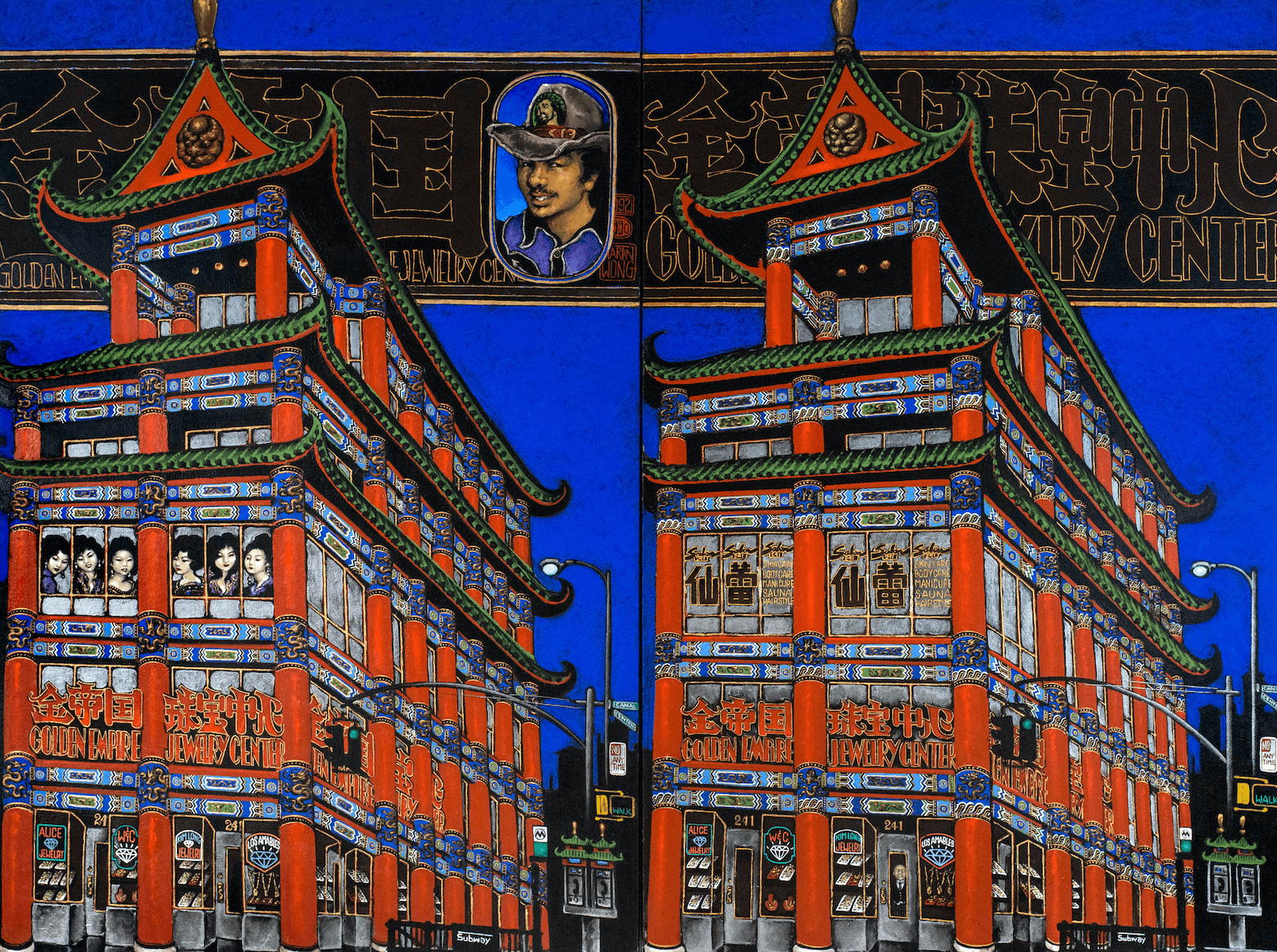
Martin Wong, Canal Street, acrylic on canvas, 72 x 96 in., 1992.
Wong certainly felt affinity to the aesthetic of Chinatown, but the dearth of New York Chinatown in his œuvres paints a more complex picture of his attachment to the “Chinese Heritage.” The Manhattan Chinatown, just adjacent to the Lower East Side, never seemed to become integral to Wong’s vision. His depiction of the San Francisco Chinatown, on the other hand, is concocted with memories of the physical place and archives, as he acknowledged that the Chinatown on his canvas might resemble the one in 1938.
The exhibition also presents Wong’s personal collection, ranging from work created by graffiti artists to Chinese antique artworks. Wong specifically drew inspiration from the Chinese scroll paintings, which culminated in his venture into the vertical format and the text-based form of painting, exemplified by A Meating of the Bored of Education (1971). In a widely circulated quote from a 1984 interview with Yasmin Ramirez, who curated Wong’s seminal retrospective that ignited the contemporary interest in Wong at the Bronx Museum in 2015, Wong articulated being a “Chinese landscape painter……If you look at Chinese landscapes in the museum, they have writing in the sky. They write a poem in the sky and so do I.” The popularity of this quote, also featured on the label of this exhibition, is hardly surprising, as it serves as the perfect pretext to tie Wong back into the genealogy of Chinese art history and highlight his sense of Chinese identity.

Enticed by this art historical narrative still, curator of the show Yasufumi Nakamori treads lightly on the identitarian issue, acknowledging that Wong “occupied a complex position in regard to his identity.” For one who so assiduously traced the strokes and structures of the Chinese characters on the Chinatown billboards, Wong did not seem to concern himself too much about the language. He never learned Chinese, nor did he ever set foot in China. His interpretation of the inscribed poems on Chinese paintings as writing in the sky betrays a sense of exoticization. The auto-romanticization creates the illusion of “self-orientalism,” but this sense of political militantness proves incongruous with Wong’s unabashed use of racialized and eroticized imagery of Black and brown subjects in his art and his fetishization of them that has since been problematized by by art historians such as Shanté Paradigm Smalls and Ramona Ngin, whose critical engagement with Wong’s role in the New York Hip Hop scene and his obsession with the incarcerated supplements our understanding of Wong's complex life and art.
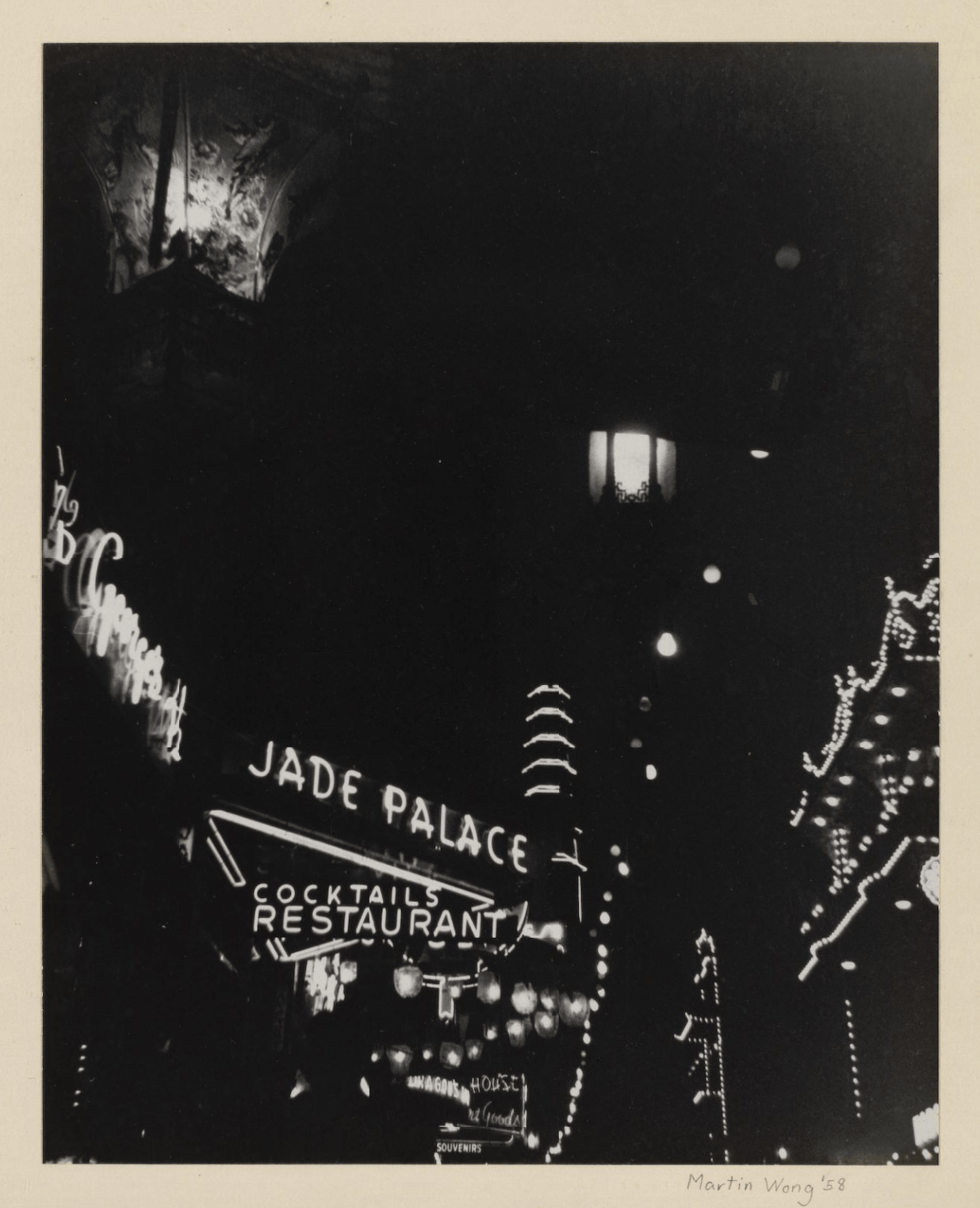
Martin Wong, Jade Palace Cocktails Restaurant, photograph, 14 3/4 x 11 ½ in., 1958.
Ever so rebellious, how do we grapple with this character of a man? Circling back to Wong’s interest in the Chinese characters, it inhabits only the most formalistic level. He attends their strokes with the same meticulous manner as he assembles the constellation of the stars and the American Sign Language (ASL) that so often ornate the backdrop of his pictures. Fantastical are his painted worlds, Wong cited social realism as his influence and characterized his Chinatown paintings as “straight documentation” with the help of photographs and memories. Displayed in the archive vitrine, a monochrome snapshot of the San Francisco Chinatown from 1958 stands out salient in this regard, as it captures the familiar nighttime when neon billboards, pagoda-like architecture, and streetlights in the form of lanterns are the most glamorous. He was never simply retrieving Chinatown as a concept, but a Chinatown from his childhood, the real life.
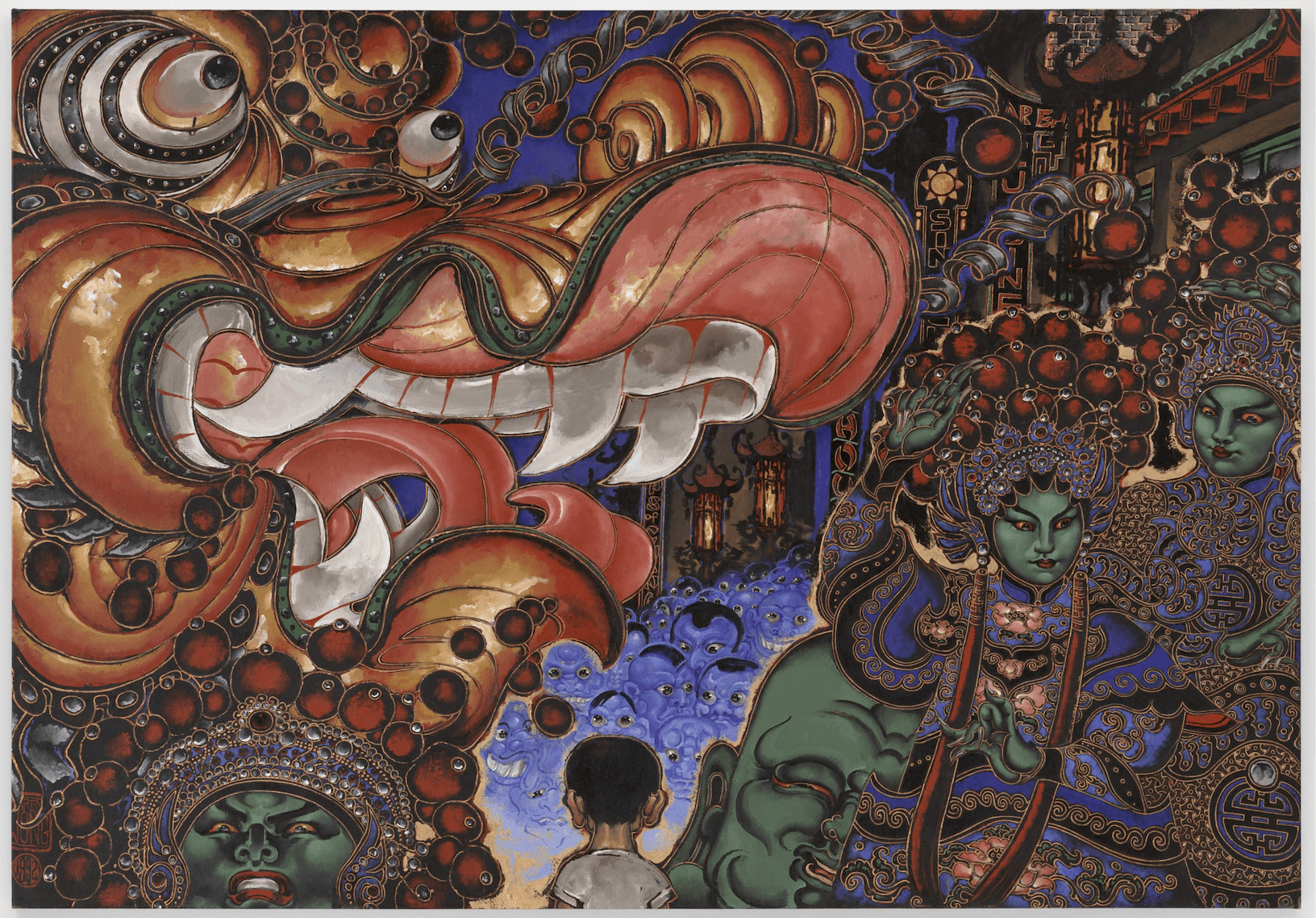
Martin Wong, Chinese New Year’s Parade, acrylic on canvas, 84 x 120 ½ in., 1992.
Operating on this rationale, Wong reinserted his child-self back on his canvas. In Clones of Bruce Lee (1992), a cheeky self-insert can be detected on the terrace on the proper left of the painting, where a small child peeks outside the window, unmistakably meeting the viewer’s gaze. Likewise, in Chinese New Year’s Parade (1992-94), Wong’s childhood persona takes up the central foreground of the work in Rückenfigur, facing a kaleidoscope of Chinese iconographies of a dragon (which is an exact recreation of a dragon prop in a photo of Richard Nixon at a San Francisco Chinatown parade) and Peking opera performers. When an avatar is absent, Wong’s body remains latent. Heaven (1988), a tondo consisting of nothing but a circular brick wall, is punctuated by the dark hole at the center of the canvas. An anus, a window for illicit transactions, a glory hole, one night of cruising, the plain brick wall assumes a surrealistic façade but constructs the very real world Wong lives in.
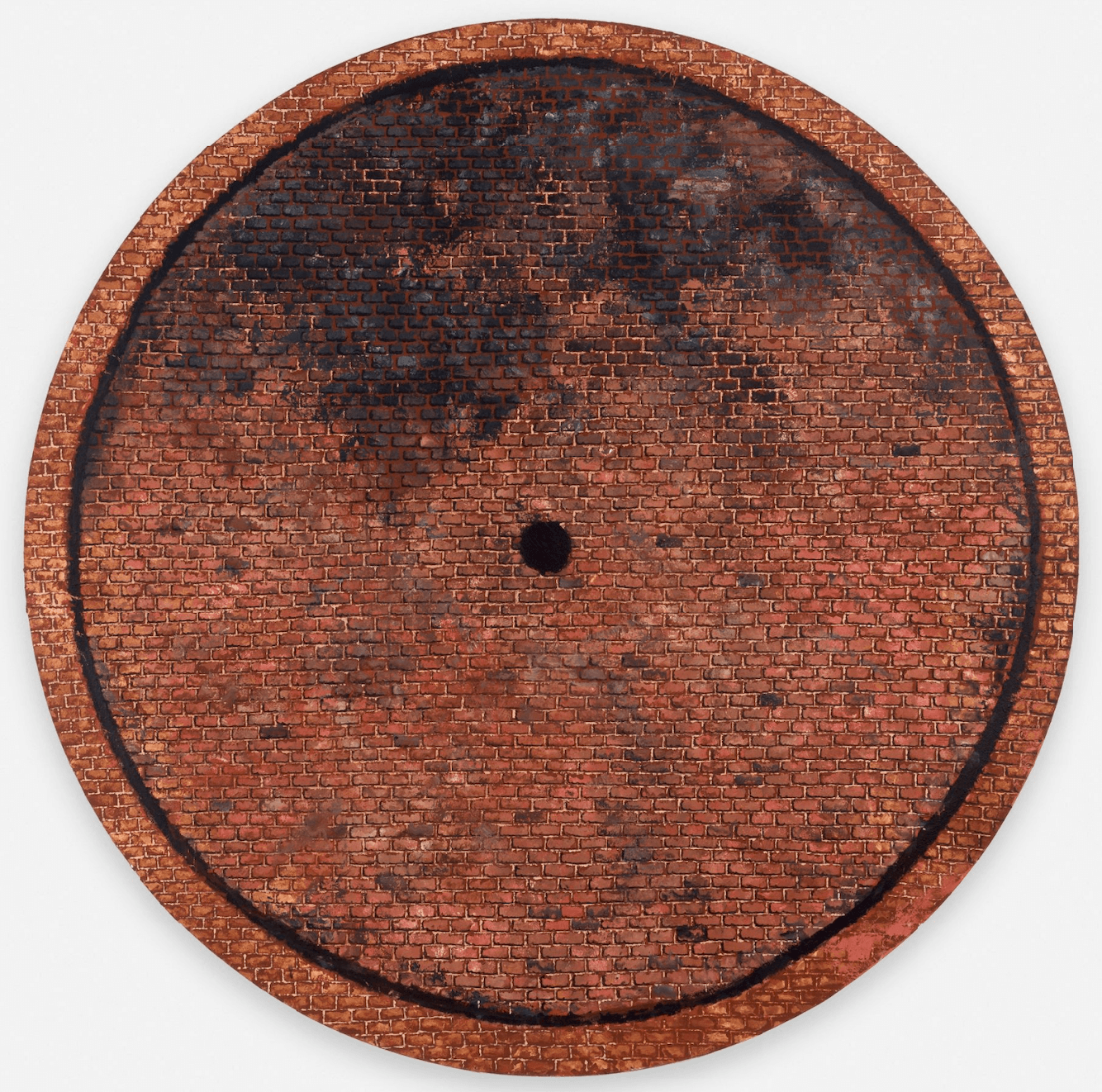
Martin Wong, Heaven, acrylic on canvas, 72 x 72 in., 1988.
Martin Wong’s painted world is his manifested psyche, a self-mythologizing realm that keeps on expanding. A disciple of the world he lives in, his art occupies a certain liminal space between political and apolitical, where his faithful rendition of his lived environment is politicized much more than the artist’s intention: the Black and brown individuals, the carcerality, the Chinatown, the queer life. His art contains his entire world, and maybe that is why he was never an outsider to anything.
