
Listening With the Body: Christian Marclay, Fraenkel Gallery
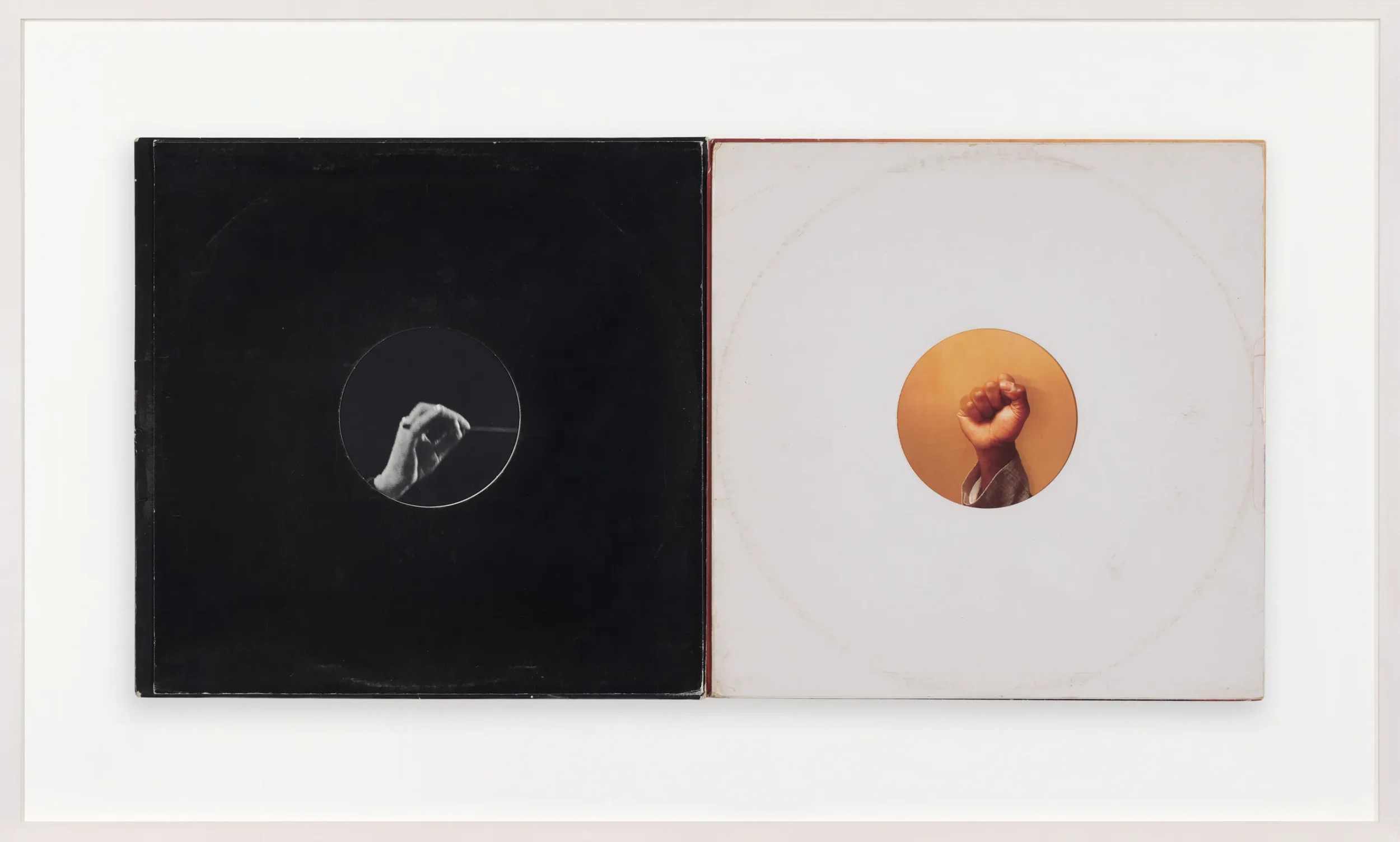
Oculi (Hand Signals), 2025
two record covers and sleeves, 18 x 30-1/4 inches (framed)
By Ani Yurman
There is a certain type of quiet in the Fraenkel Gallery at the moment. Not an empty kind of quiet, one with weight, the kind that allows you to be hyperaware of the sounds around you; the faint hum of the elevator ride up, the soft drag of shoes on the polished gallery floor, and the dry stillness of paper and frames against stark, white walls. It is not sterile or reverential in nature. It has an anticipatory feel, like that one suspended second after a needle drops onto vinyl, just before the first crackle declares itself, because it is not quite there yet.
This is Christian Marclay, and even when you are silent, you have an expectation that sound is somewhere, that it is incoming.
The greeting occurs instantly, stepping off of the 49 Geary Street elevator, the metal doors sliding shut behind you, you're welcomed in by Oculi (Looking), nine record covers and sleeves, each acting as a monocle of the artist's, and the work they hold within. The edges are layered and worn, large circular impressions indicating the record they home. The result is somewhat unsettling. The eyes don’t just look, they return your gaze, not in stasis, but actively searching, identifying, and observing the observer.
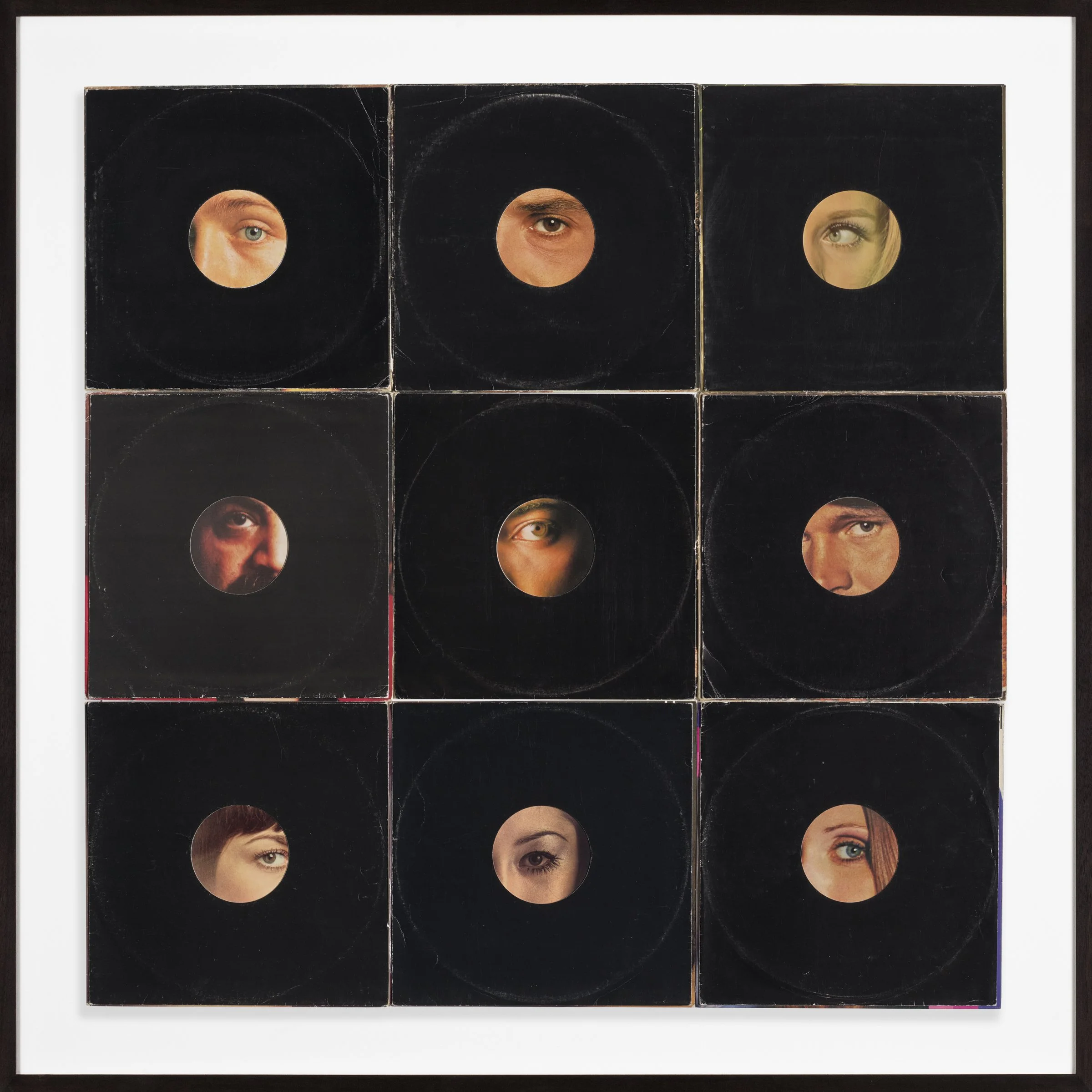
Oculi (looking) 2025
Christian Whitworth, the director of the gallery, told me they're very conscious and carefully think about this choreography. "We often 'greet' the viewer as they step off the elevator with one of the more visually striking works…This sets the tone of the show, and the visual variety through the first and second galleries is intended to invite visitors to move through the space." (C. Whitworth, personal communication, February 20, 2026)
That feeling of intention is physically experienced. The eyes in Oculi don't establish tone, but establish relation. The record sleeves, previously containers for sound, are transformed into apertures, absence becomes a frame, and the circular cutouts, which used to hold vinyl, now hold gaze, the welcoming gaze. The hole where the record once sat feels less like something missing and more like something opened.
It’s a subtle reversal. Instead of us activating the record, the record activates us.
Beyond that first encounter, the walls are covered with collage-like framed record covers and sleeves, as well as monotypes: impressions onto the surface of a smooth Somerset paper. Unlike traditional prints, these are irreproducible. You can see the textural elements of the pieces, where pressure shifted, where the ink pooled, and where the transfer process didn’t perfectly mirror onto the surface. They don’t present as images produced, but images pressed through something.
The main source material for this exhibition, vinyl record covers, were originally created and designed, in part, to boost sales, drawing audiences in with eye-catching images of what ‘listening’ lied ahead, but they also served as protective measures, shielding fragile records and allowing them to be used and abused by the wear everyday life, like being stacked in crates and flipped through casually. The original brown paper covers were repetitive, and this repetition collapsed into singularity. The surfaces of these covers hold onto abrasion, fold, and wear, impressions of a life well lived. A living history of its users, listeners, and their contribution to the space.
Standing in front of them, I found myself leaning forward closer than usual. Not to decipher them but to feel them. The faded typography registered as pressure instead of language. Creases have the appearance of fault lines. Fragments of a history, almost like an artifact, left unfinished, or hidden to the observer, incomplete just enough that your body tries to complete it.
That completion is not intellectual. It is perceptual.
In the Phenomenology of Perception, Maurice Merleau-Ponty argues that perception isn’t a collection of sensations that are isolated, but rather, a lived relation that the body has in conversation and reaction to the world around it. We don't stand outside of the object we see, but orient ourselves in reference to it. The body is not an object in space; it's our opening into space. "To be a body, is to be tied to a certain world, as we have seen; our body is not primarily in space: it is of it." he writes. That inhabitation has a literal sense here.
Looking becomes an adjustment; inching forward or backward in any direction alters the perception and understanding of the pieces. Too close, and the image turns into the separate parts that created the whole, ink and paper. Too far and it trends back down into graphic legibility, something more easily perceived in the mind. My posture was constantly shifting in the rooms, small bends at the waist, slight tilts of the head. The works are not overpowering; they are, in a sense, calibrated.
I believe there’s a kind of intimacy in this calibration. Not sentimental intimacy, but spatial intimacy. Proximity. The distance between where my body is and the paper was charged, almost negotiated.
Marclay's long association with Fluxus silently hovers over. Fluxus broke down the distinction between art and life, taking ordinary materials without making them into something presumptuous and necessarily anticipated. Record sleeves were never intended for hanging on white walls. They were made to be used, worn down, and heard.
Here, they are not sanctified. They are re-seen. Their wear is visible in terms of time rather than damage.
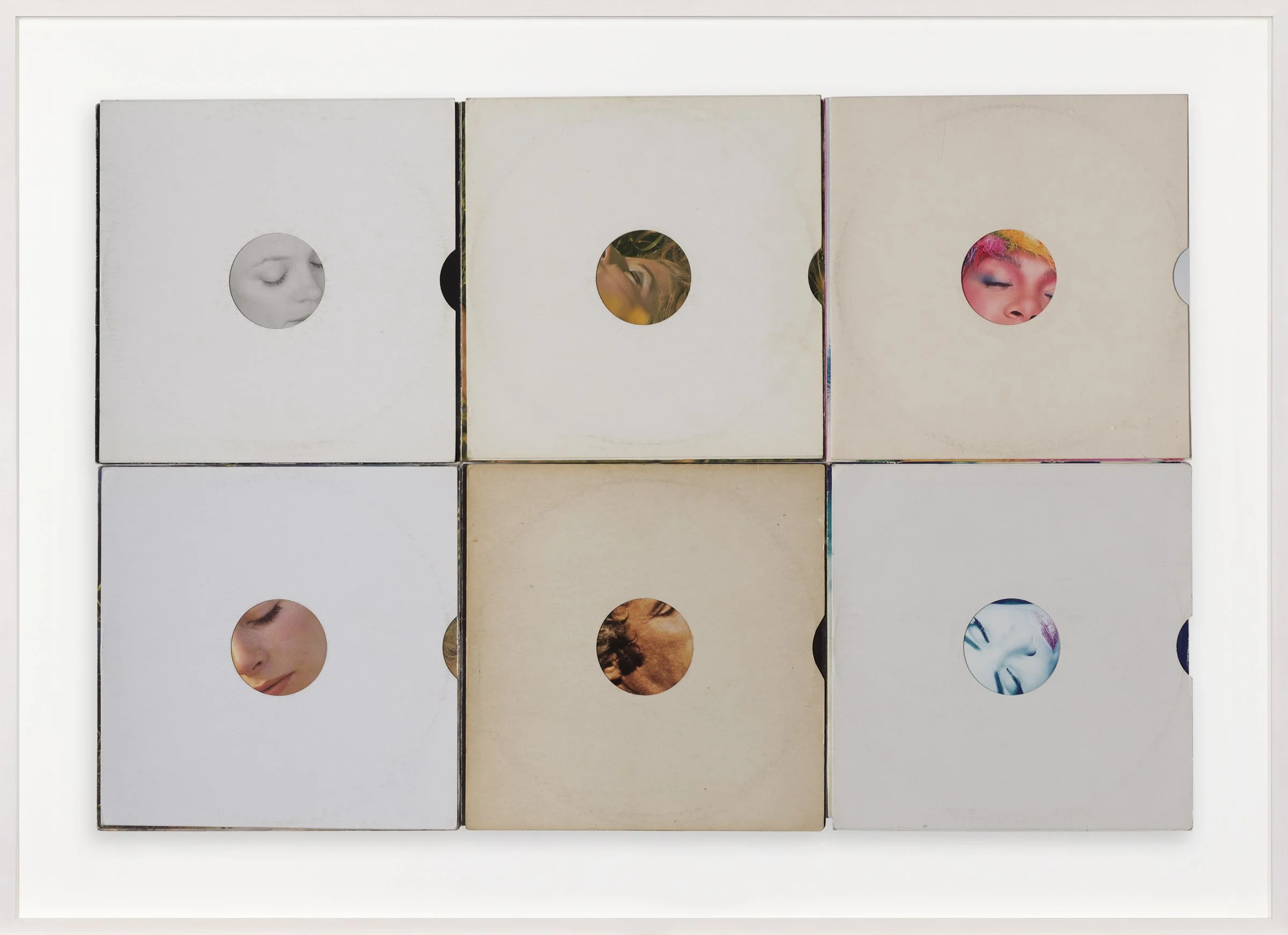
Oculi (Listening), 2025
six record covers and sleeves, 30-3/4 x 42-3/4 inches (framed)
Whitworth said that there is "[A]n element of playfulness to the work…given the fragments of visual information, many have been guessing who is pictured within.” (C. Whitworth, personal communication, February 20, 2026) That playfulness is unmistakable. Viewers, like myself and the other gallery spectators visiting the exhibition, hovered over the pieces, quietly speculating. My friend and I began playing something of a guessing game of which artist’s hand, or mouth, or eyes we were viewing. A partial face elicited recognition. She’d let out a whisper of a name, not sure. I would agree, or posit my own impression. The gallery gets light conversation, not loud, but conversational in the sort of way that we all become critics and detectives.
What I find most interesting is how this ‘play’ coexists and ‘plays’ with the intimacy of the exhibit. The guessing isn’t breaking the spell of looking, but makes it more intense. Because we, as viewers, are dealing with an incomplete kind of information, our perception becomes active, working harder than we expected it to in the respective setting. Your eyes search. Your memory provides you with possibilities. It invites a different kind of orientation because of the lack of explicit clarity.
In the second room that the exhibit spans to, something happens. At first, it is almost indistinct. A faint echo leaks into the otherwise quiet space. It isn’t loud enough to command attention from the space or to dominate, but indicative enough to be noticed, even for a second. And as such, the body’s perception and intimacy with the work, the silence of space, acquires a certain texture.
You hear the video before actually seeing it.
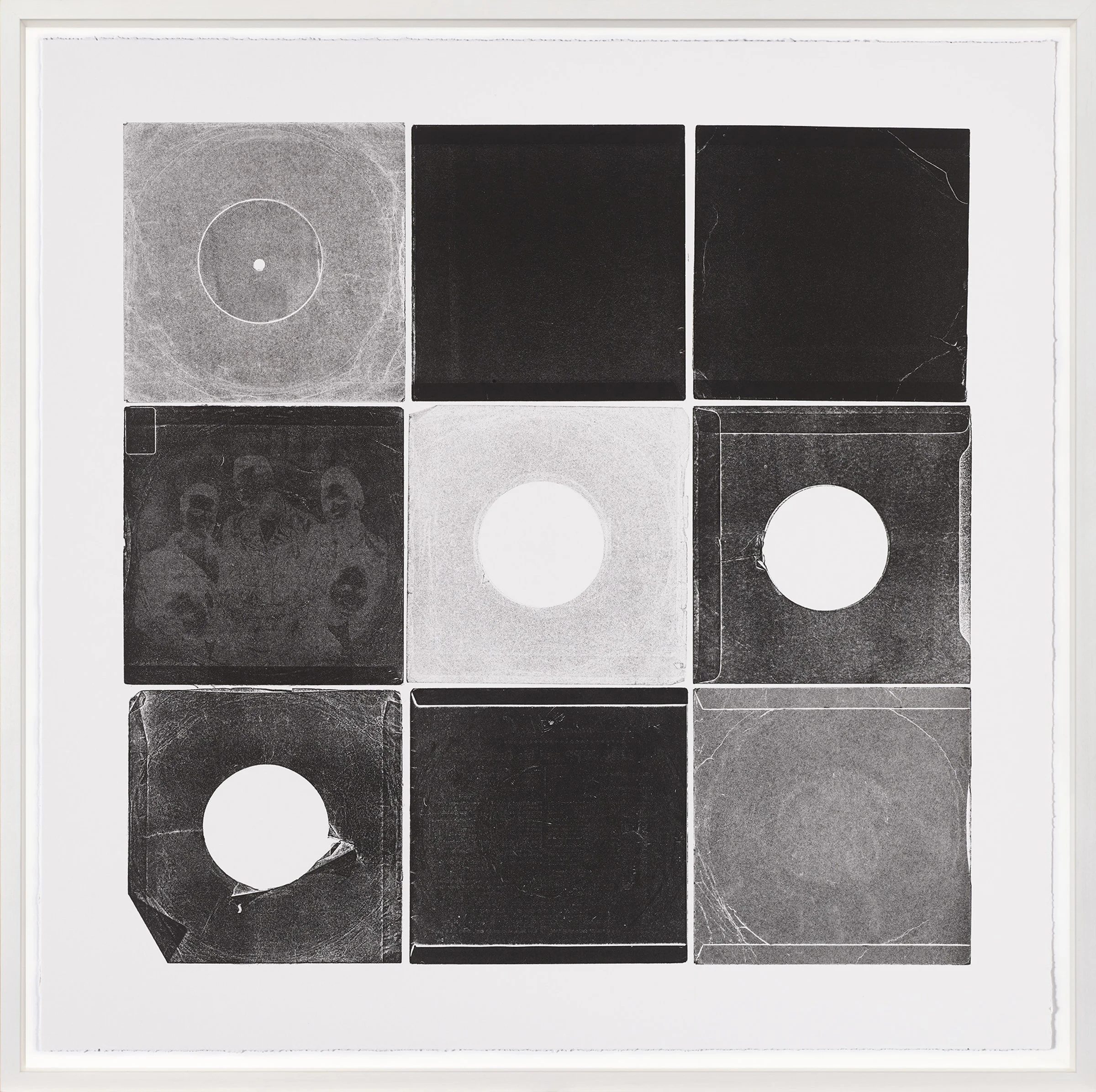
Sleeves and Covers (Nine 7"/No7) 2025
unique monoprint on Somerset paper, 37-1/8 x 37-1/8 inches (framed)
The sound gently pulls almost subconsciously. And as you get closer to it, the light fades away, entrance into the final room of the exhibition, the theater. The transition into this space is just as physical as it is mental, almost clearing the mind in preparation for what it is about to witness. White walls give way to a shadow, and the hum grows clearer. Upon entrance into the darkened room, your perception tightens. The glow of the screen isolates movement. Suddenly, the sound is no longer compressed, but fills the room, flooding your body as you instinctively move toward the center seating, ready to observe and sit with whatever is being presented to you. The space is almost like a sensory deprivation chamber, not because everything is taken away, but because everything that remains is distilled.
Light. Echo. Rhythm.
After the previous physical proximity, the darkness reshapes the body differently. Your eyes adjust. Your ears sharpen. You become aware of the weight of your feet on the floor, the slightest shifting of the person sharing the bench next to you. It’s all heightened, and you become intimately acquainted with the darkness and the projection.
Merleau-Ponty is insistent on the fact that perception is not a separation of channels, but that they’re intertwined; that sight, sound, and touch form a unified field, absolute in their composition and thought formation. It is in this room that the intertwining is palpable. The echo heard in the gallery remains in the mind. The darkness makes the sound sound closer, making even the darkness feel textured.
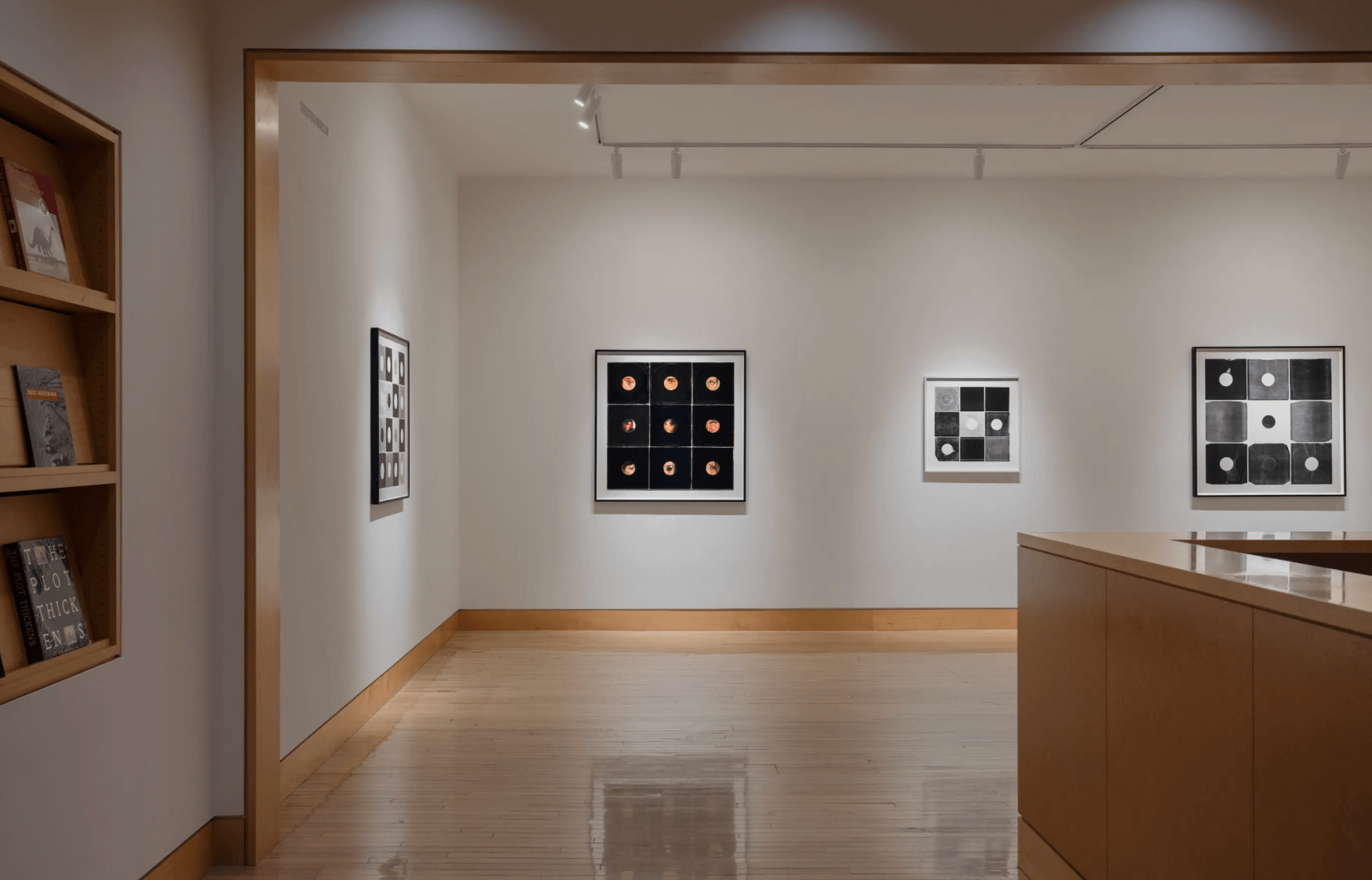
Fraenkel Gallery, San Francisco, CA
Emerging out of the theater, and upon return into the greater light of the monotypes, the silence is changed. It is no longer neutral. It is charged with the residue of sound.
What you have is an exhibition that, quietly, reorganizes the way that you inhabit a space. It slows the tempo of looking. It brings in the knowledge of a known distance. It foregrounds orientation.
At a time when much of the world, particularly music, exists in an invisible ‘cloud’ and is trapped within algorithms, where the craftsmanship of vinyl records and album art is reduced to a cover image on whichever listening platform you subscribe to, these works insist on weight. Not nostalgia, but gravity. They insist that perception is most of all physical, but also intimate and influenced by our history.
Outside, on Geary Street, the city picks up again to its speed. Traffic hums. Someone passes by with music oozing out faintly from their earbuds. A bus pulverizes the pavement beneath it.
But something has shifted.
The sound of footsteps is more clearly registered. The low mechanical rumble of traffic has more of a layered feel than it does a 'flat' one. Sound appears as if it is purposefully taking up space, rather than filling up an otherwise crowded world. And the world itself feels dimensional.
Marclay doesn’t bring analog media back as some relic. He presses it back through the body, into the body, in a way, we become a monograph, pressed into a newly sensitive and heightened world. He reminds us that perception is not passive reception but an active inhabitation.
The quiet inside the Fraenkel Gallery turns out not to be absence, but density; dense with trace, with abrasion, with the subtle labor of looking. And when you're gone, the world is a little closer.
Not louder. Just more textured.
