
Laina Terpstra, Solutio, Incline Gallery
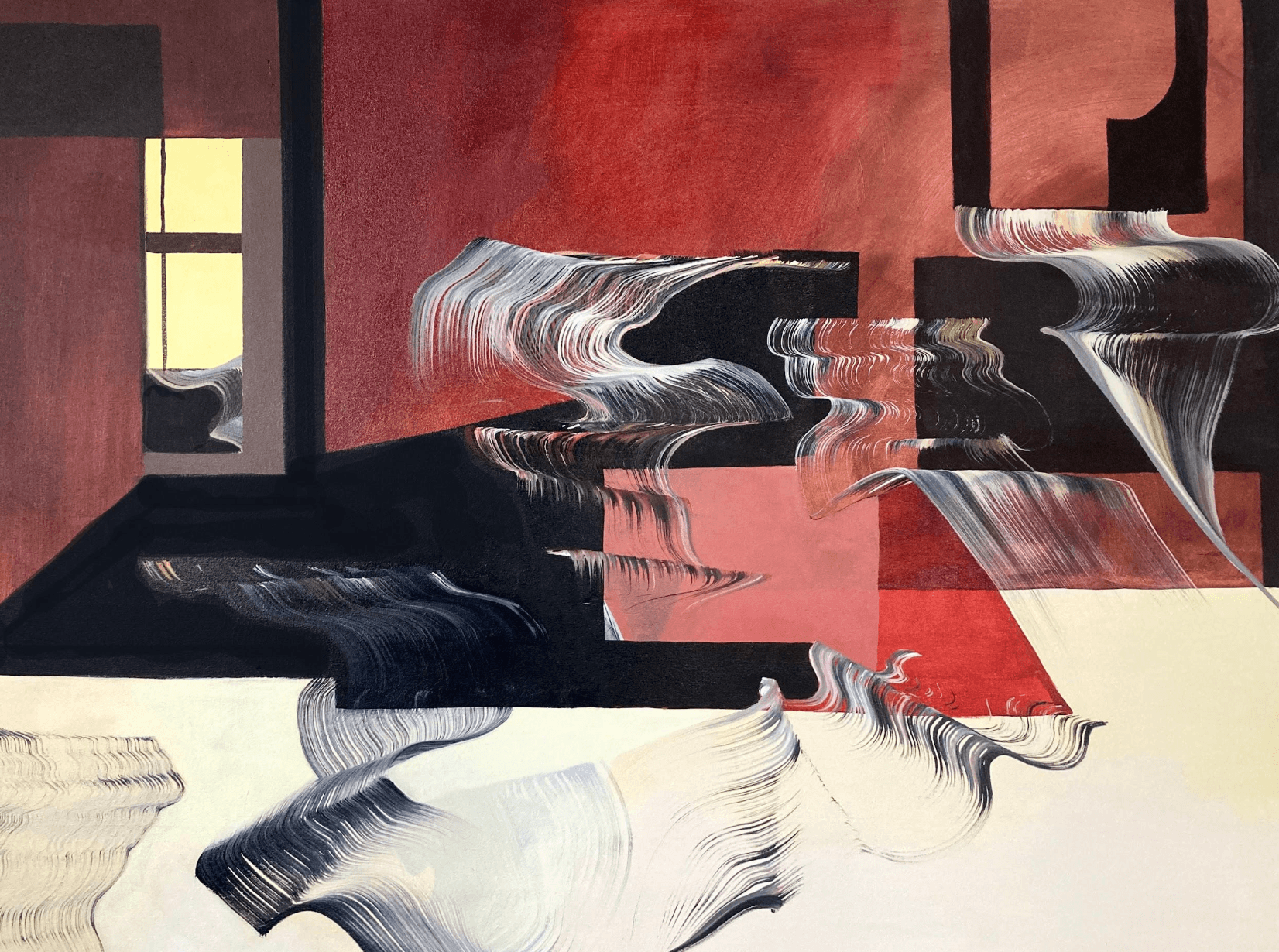
Laina Terpstra, Solutio, acrylic on canvas, 36 x 48 inches, 2025.
Laina Terpstra, Solutio, Incline Gallery, San Francisco, March 20 - April 20 2026
In Solutio at Incline Gallery, Laina Terpstra presents paintings spanning more than a decade. Built from architectural interiors and unsettled gestures, the works feel both stable and quietly shifting, as if returning to the same place under different circumstances. Set against the gallery’s stark white walls and sloping walkways, the paintings unfold in a way that feels almost continuous, carrying the viewer through the space like a slow river current, where movement gathers and passes, and the world seems to sway gently around you, as though in a perpetual dance.
A San Francisco native, Terpstra lives and works in the city, and studied at Sarah Lawrence College, where her focus extended beyond painting to include modern dance and philosophy, disciplines that clearly continue to inform the physical and perceptual qualities of her work. In the years since, she has presented a number of solo exhibitions across the Bay Area, gradually developing her distinctive visual language. Solutio, however, marks a shift in how that language is held. It brings together works made over more than a decade, where the emphasis is less on progression and more on returning, allowing different emotional and perceptual states to surface within a consistent framework.
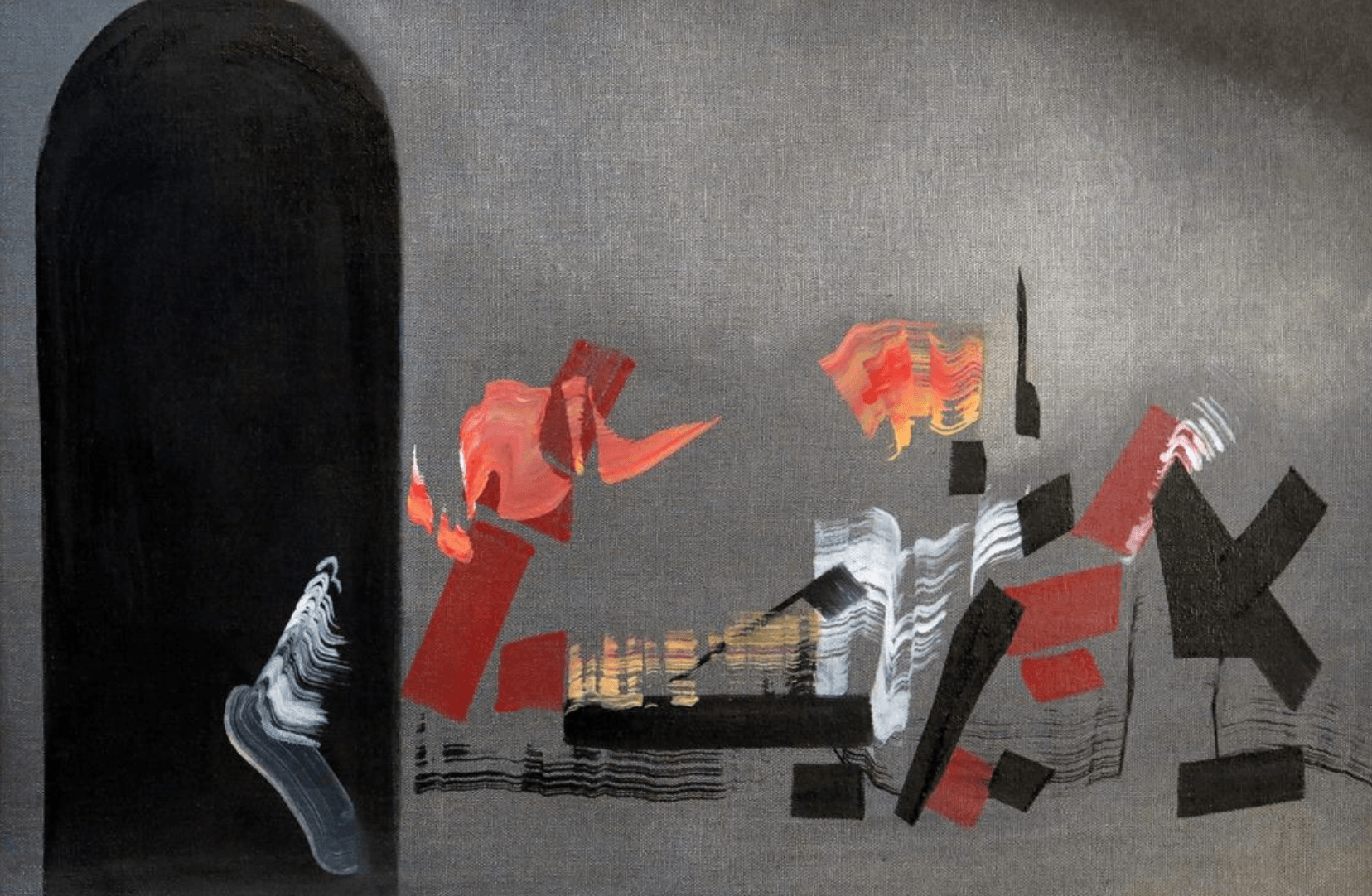
Laina Terpstra, Variation #2 from Jacques Louis David’s ‘The Death of Socrates,’ oil on canvas, 13.5 x 20 inches, 2016.
Terpstra builds her compositions around a steady sense of interior space. Walls, openings, and planes suggest a room which is then disrupted with gestures that feel dragged across the surface rather than carefully placed. These movements carry a physical weight, moving through space and time as though a moment has been frozen while the gesture continues to trail, leaving behind a sense of energy still in motion.
These interior spaces are often built from Terpstra’s interpretations of Old Master paintings, where architecture is used to establish order, balance, and a sense of containment. Here, that structure remains, but its role shifts. Rather than holding a clear narrative or figure, the space becomes a kind of framework; something to move through, to press against, or to unsettle.
Against this structure, the gestures take on a more intuitive looseness, moving with a sense of rhythm that feels both physical and deeply personal. They carry an immediacy, as if worked through by feeling rather than planned, shifting in tone from lighter, almost atmospheric passages to denser, darker and more insistent movements. There is something alive in them; a force moving through the space with a kind of quiet intensity that suggests an internal process unfolding on the surface.
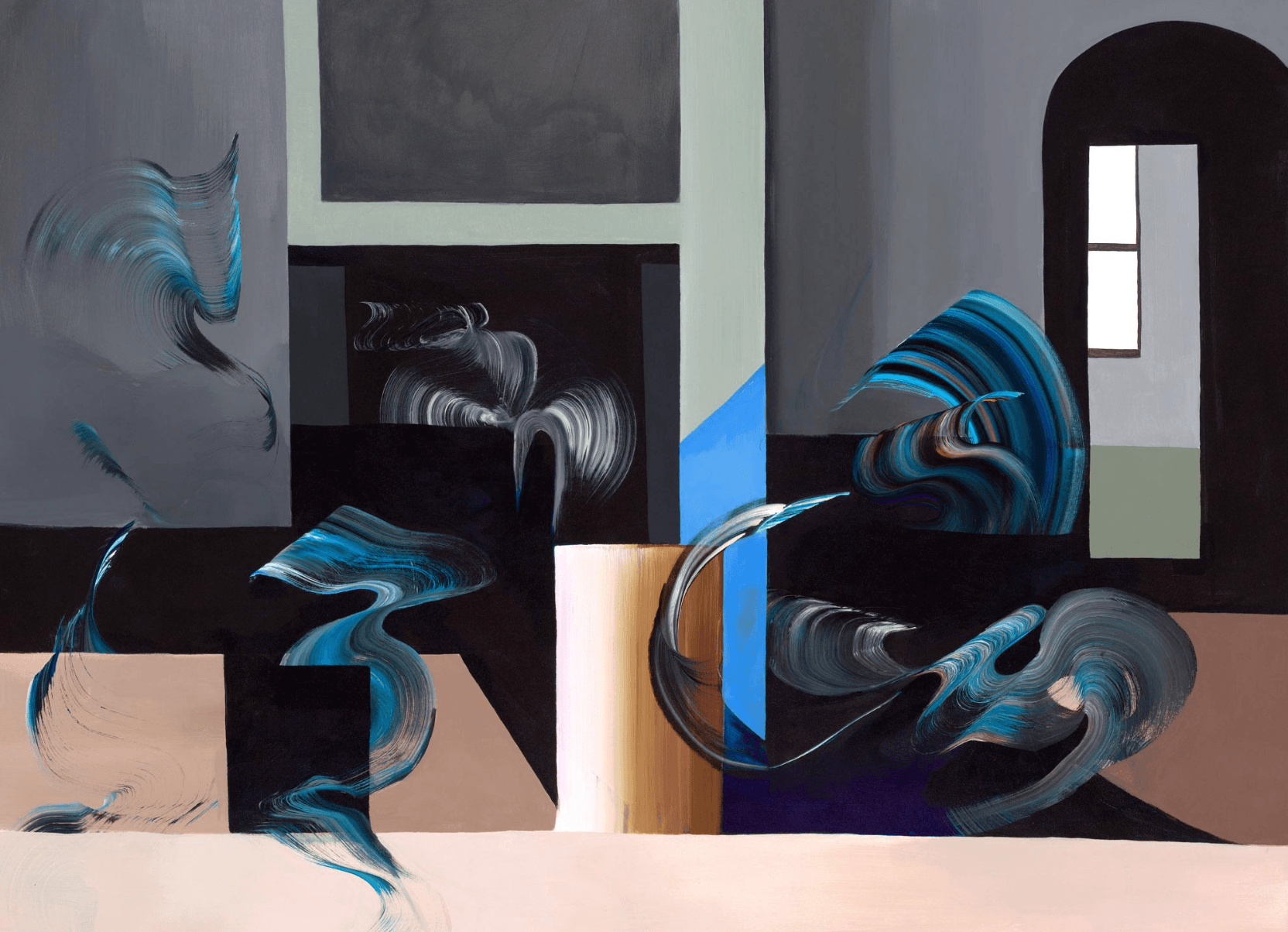
Laina Terpstra, Variation #2 from Jan Steen’s ‘The Card Players in an Interior’, acrylic on canvas, 48 x 60 inches, 2025.
In one painting (Variation #2 from Jan Steen’s ‘The Card Players in an Interior)’, a cool, blue-toned interior is built from solid architectural divisions; a doorway, a window, and darkened planes that hold the space in place. Within it, gestures move with a quieter, more fluid rhythm, slipping through the structure rather than pressing against it. They gather and disperse with a lightness that feels almost atmospheric, as if carried by air rather than force, creating a sense of movement that is continuous but not urgent, present without demanding resolution.
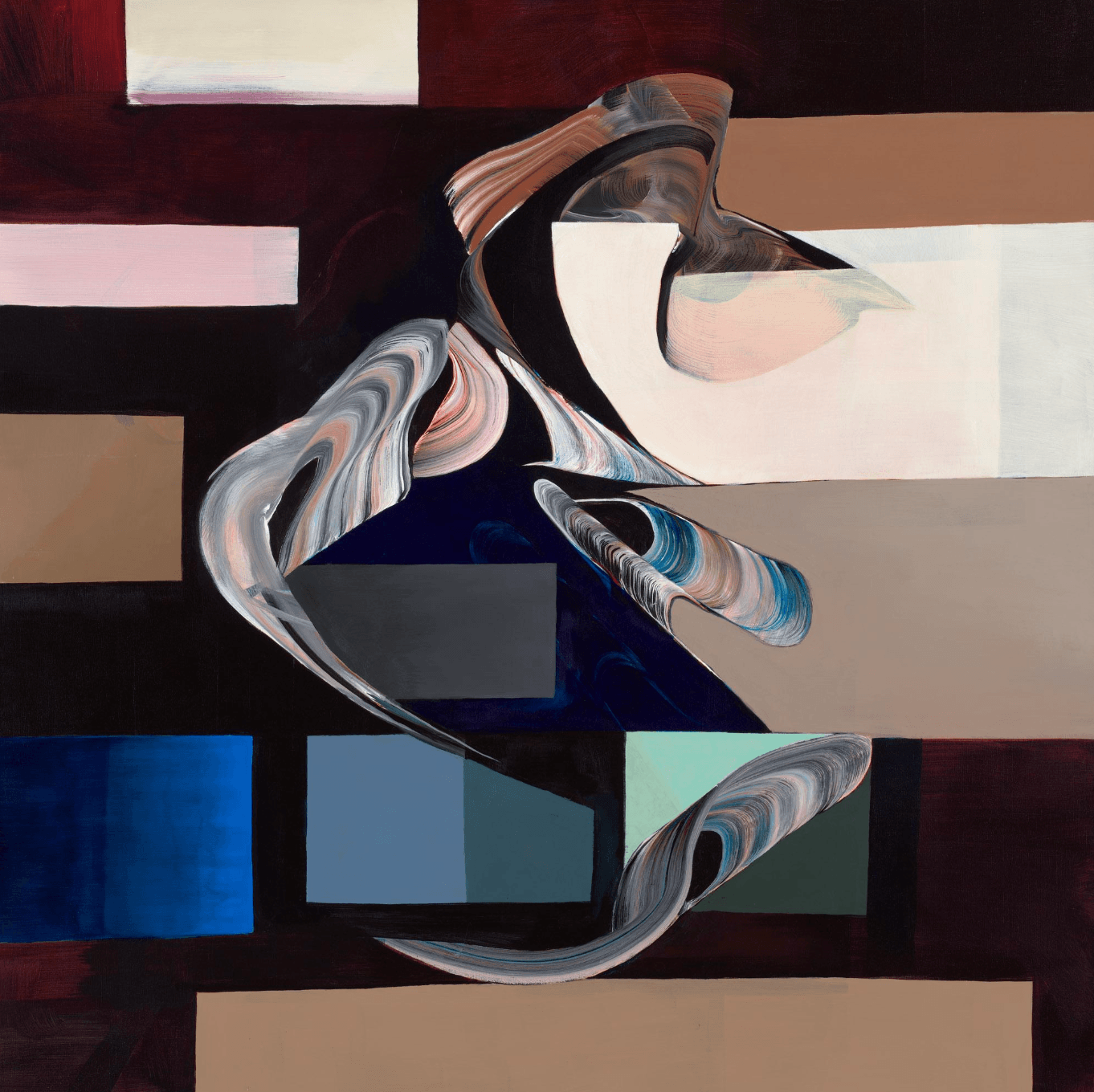
Laina Terpstra, Untitled, acrylic on canvas, 48 x 48 inches, 2025.
In another (Untitled, 2025), the movement becomes more concentrated, gathering into a central, twisting form that pulls the surrounding space inward. Here, the gesture feels heavier and more insistent. Its weight is shifting the balance of the composition as it folds and turns through the structure. The surrounding planes hold their ground, but the energy at the center feels active and unresolved, as though something is still working its way through, caught between forming and slipping back into motion. It conveys the lingering feeling one gets when they wake from a bad dream, it was never real but your body still holds onto that energy.
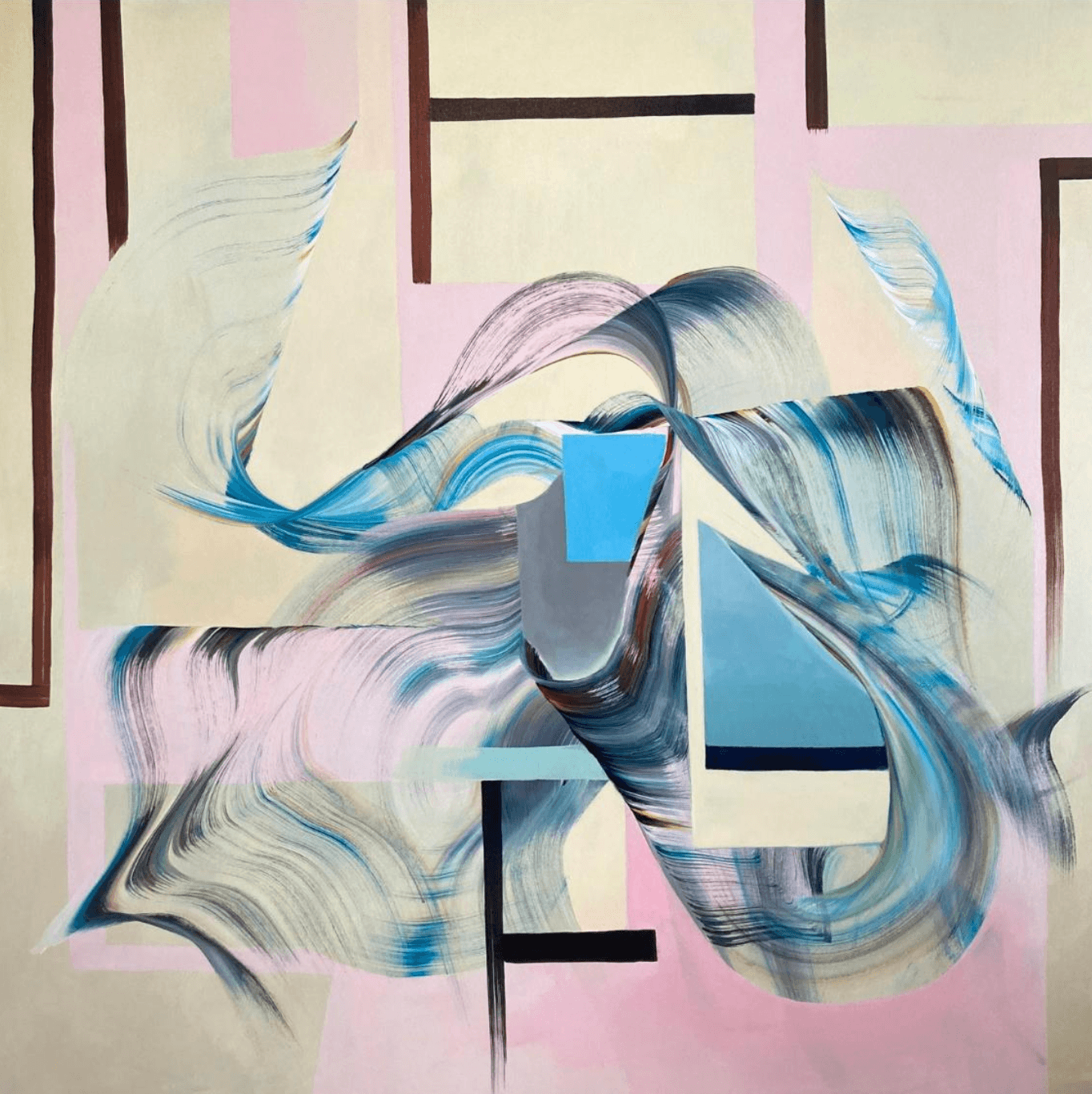
Laina Terpstra, Untitled, acrylic on canvas, 48 x 48 inches, 2023.
In Untitled, 2023, the palette shifts noticeably. Soft pinks, pale creams, and light blues open the space up, giving it a more buoyant, almost airy quality. The gestures move more freely here, looping and folding through the structure with a lighter touch, as if less constrained by the architecture that holds them. There is still a framework in place, but it recedes slightly, allowing the movement to take on a more expansive, rhythmic flow. In this way, the work loosely connects to a Bay Area sensibility where space, light, and structure often sit in quiet balance, but Terpstra’s approach unsettles that balance, replacing calm observation with something more internal, where the movement feels experienced rather than simply seen.
Self Portrait, an earlier black and white work from 2013, feels more immediate, almost abrupt in its construction. The surface is worked heavily with paint scraped, pushed, and built up in a way that holds onto the physical act of making. The architecture is already there, but much less resolved, more fractured, as if still being assembled. There is a directness to it, a kind of urgency, where the gestures don’t trail so much as collide and stack against each other. It feels closer to the body and less about movement through space. It is about contact, pressure, and resistance.
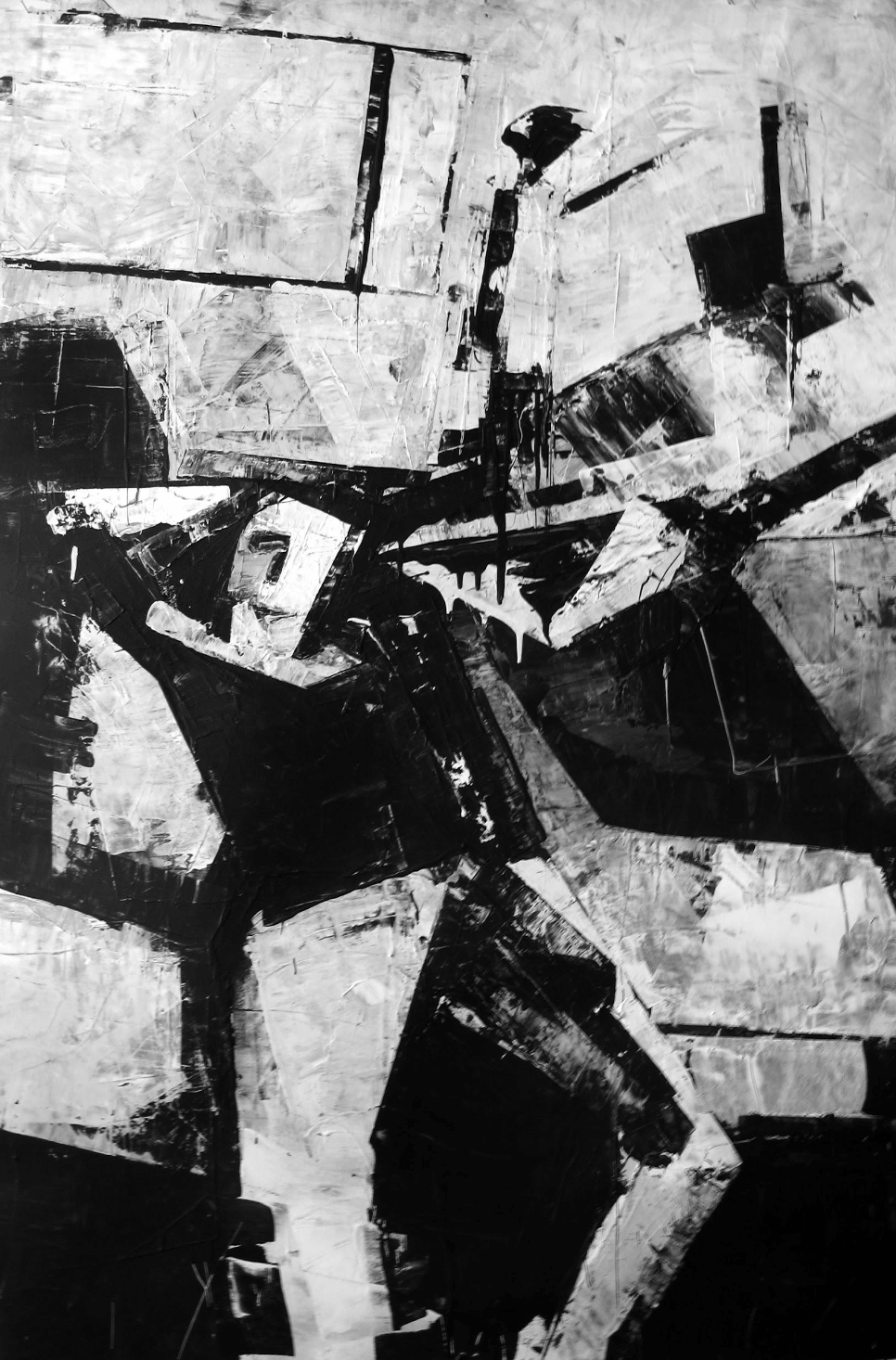
Laina Terpstra, Self Portrait, Black and white housepaint on paper, 56 x 38 inches, 2013.
By 2016, something begins to shift. In the darker, black and orange-toned work of Untitled (Vibrations no. 1), the surface opens up and the gestures start to elongate, pulling vertically through the space in a way that feels more sustained. The image softens at the edges, as if caught mid-motion, and the architecture blurs, becoming less rigid and more implied. There is still weight here, but it’s carried differently, it is more intuitive and drawn out. It begins to hint at the distinct language that will come later, where movement becomes continuous rather than momentary.
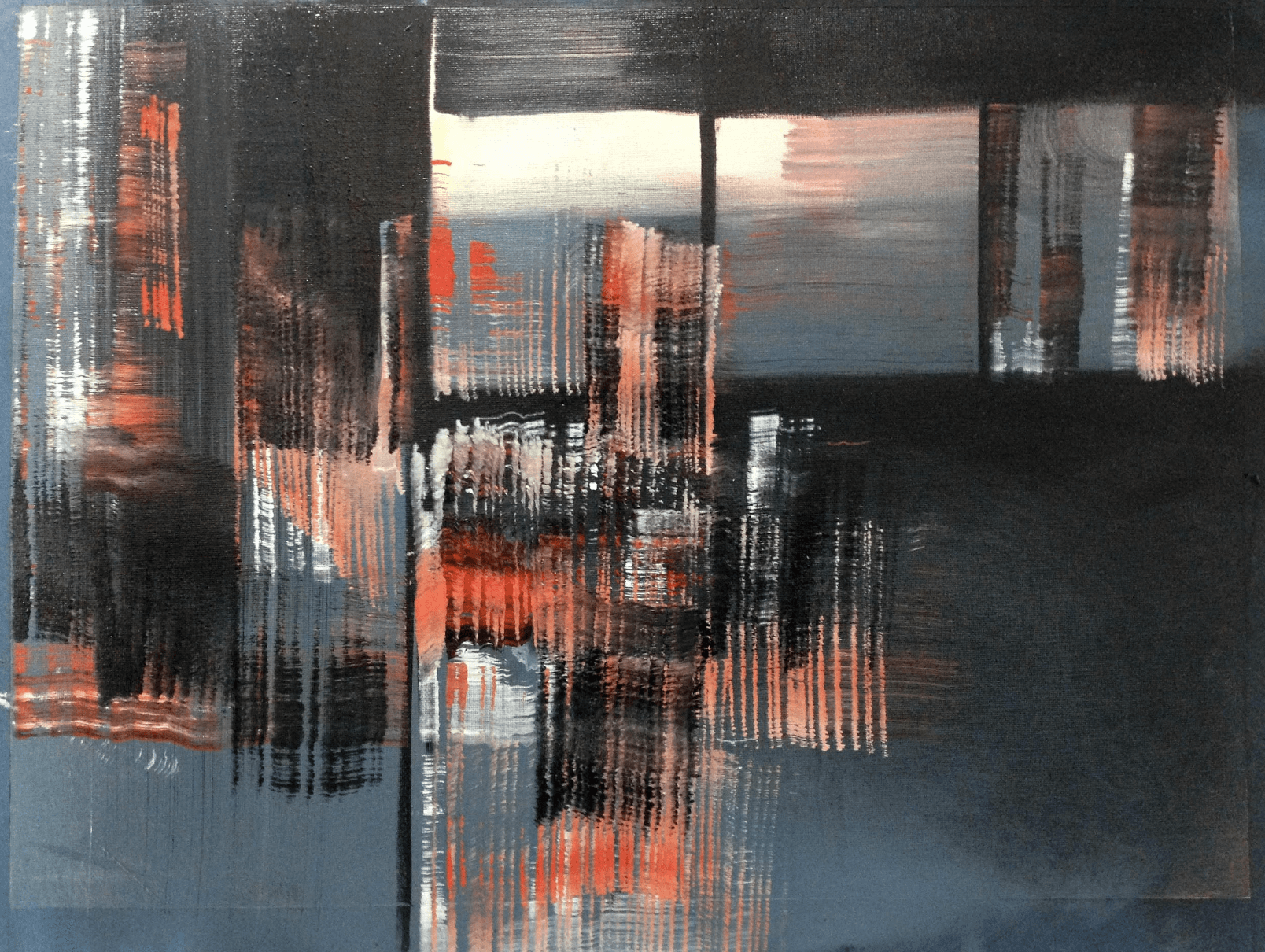
Laina Terpstra, Untitled (Vibrations no. 1), oil on canvas, 16.5 x 22 inches, 2016.
Technically, the difference between the two is just as telling. The earlier work leans into a heavier, more physical handling of paint. The thick application, the scraping and push-and-pull feel closer to construction than image-making. By 2016, that weight begins to shift into something more controlled, where the paint is dragged rather than built up, leaving behind those vertical striations that carry a sense of movement within the mark itself. There are echoes here of both European expressionist painting and a more process-driven, material approach; however, even at this stage, it feels less about influence and more about the artist working toward a language that would eventually become her own.
Taken together, these works begin to show the range of expression Terpstra is able to hold within a language that remains distinctly her own. The same underlying structure persists yet the emotional tone shifts from one painting to the next, moving between something quieter and more atmospheric to moments that feel denser, more concentrated, and insistent. This range does not come from a change in style, but from how that style is inhabited. Terpstra seems to hold influences loosely, allowing them to surface and recede as needed, while maintaining a consistent visual voice that feels both grounded and open.
What makes Solutio linger is not just the work itself, but the feeling of proximity it creates. There is an intimacy to these paintings that doesn’t announce itself, but settles in quietly, the sense of witnessing something mid-thought, as if the gestures are carrying fragments of an internal dialogue not meant to be fully shared. They move like a kind of visual stream of consciousness, revealing and withholding at the same time, so that the viewer is briefly let in, only to feel it slip away again. It’s a fleeting access, a moment of closeness that never fully resolves, but stays with you after you leave.
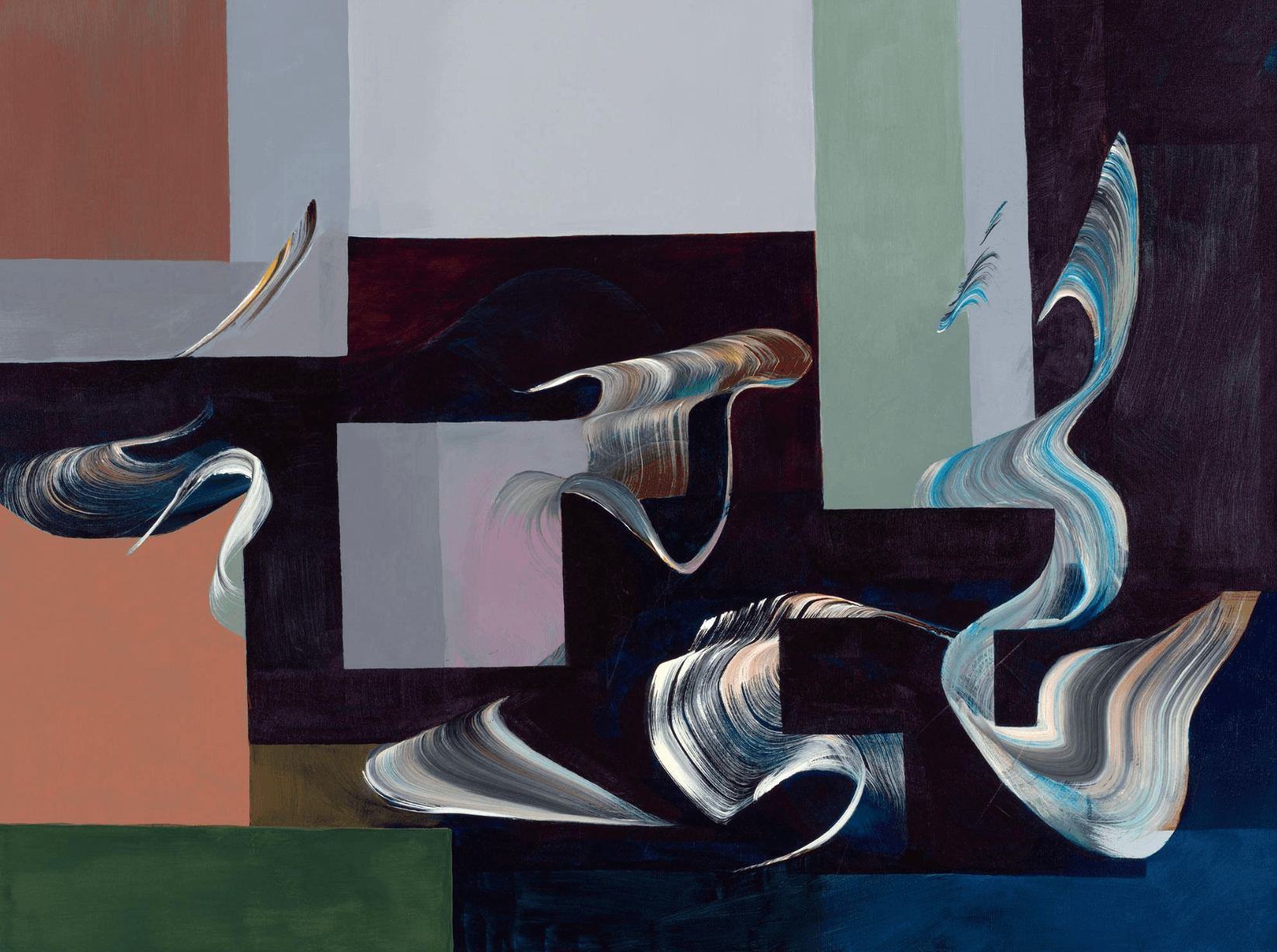
Laina Terpstra, Unfurling, acrylic on canvas, 36 x 48 inches, 2025.
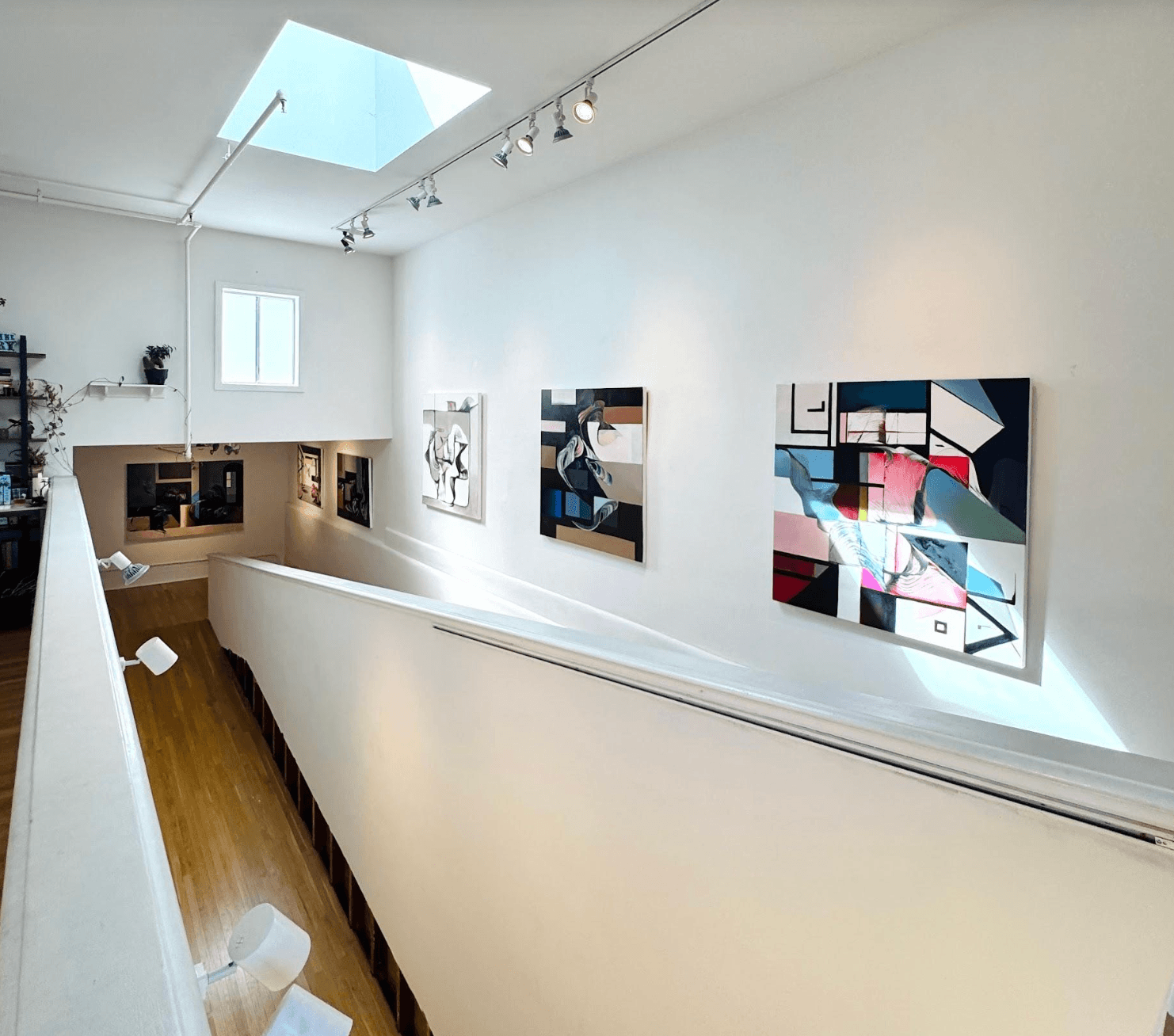
Laina Terpstra, installation at Incline Gallery, March 2026.
On view at Incline Gallery from March 20 through April 20, Solutio the word by definition speaks to loosening, dissolving, and breaking apart. Across paintings made over more than a decade, there is a quiet sense of things being taken apart and re-formed, where structure holds just long enough to shift, and meaning remains open rather than fixed. The word is an apt title for the show. Spending time with the work subtly broadens your own visual and emotional language, offering a way of seeing that is both grounded and unsettled. At this point in her practice, Terpstra’s voice feels fully her own. The work stands as something both resolved and still shifting, like a ballerina in solo; the mind is quiet while the body is moving as though it is thinking.
