
Amy Sherald, American Sublime, Baltimore Museum of Art
By Liz Goldner
During my recent tour of “American Sublime” at the Baltimore Museum of Art, the many visitors there (mostly women of all ages and races) were so enchanted by the 40-plus portraits that they began to spontaneously converse with each other, to share stories from their own lives. Indeed Amy Sherald’s (born 1973) subjects appear to look out directly from their canvases, to reveal their true natures to viewers, while inviting us to dialogue.
As the catalog accompanying the exhibition, containing paintings from 2007 to the present, explains, “Their personhood emanates from the intangible mix of body language, facial expression, clothing choices, color, and, most importantly, gaze.” The catalog adds that her portraits prompt reflections on how Black Americans have been misrepresented, and invite new understandings about race in our country.
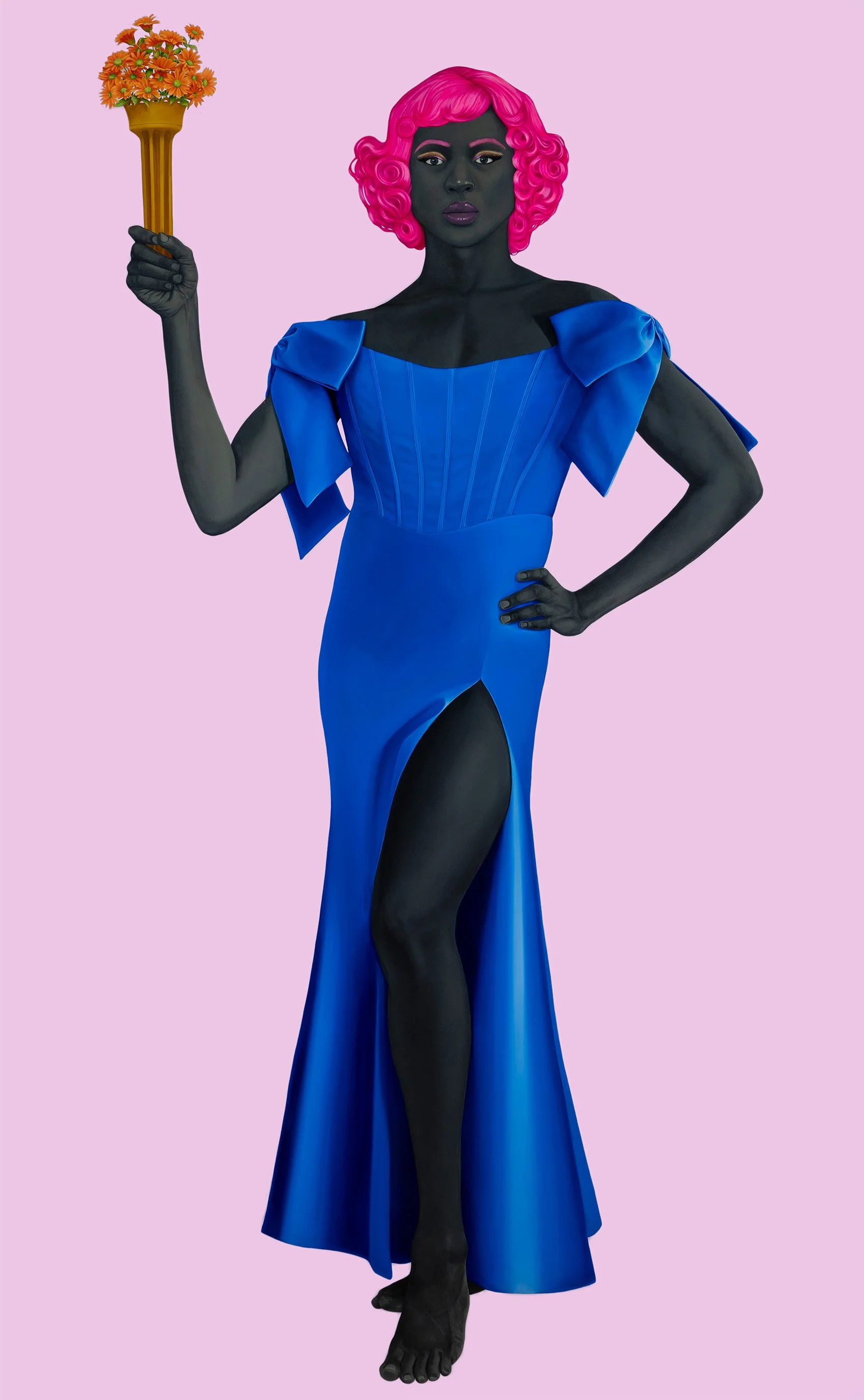
Amy Sherald, Trans Forming Liberty, 2024, Oil on linen, 123 × 76 1/2 × 2 1/2 in.
“Sherald’s portrait, “Trans Forming Liberty,” 2024, is of a beautiful trans woman wearing an elegant blue gown and luxurious red wig, while posing as the Statue of Liberty. With her bold, stately expression, she conveys the artist’s and the model’s (a trans woman) desires that the freedoms described in our Constitution be applied to all people, regardless of race or sexual orientation.
“Trans Forming” is so controversial that the artist cancelled her scheduled 2025-2026 showing of “American Sublime” at the Smithsonian Institution’s National Portrait Gallery, as the museum suggested withdrawing it from the exhibition. In the “New York Times,” Sherald, who brought her show to the Baltimore Museum, stated, “It’s clear that institutional fear shaped by a broader climate of political hostility toward trans lives played a role … When I understood a video would replace the painting, I decided to cancel.” While admiring “Trans Forming Liberty,” a woman near me began talking about her neighbors whose child recently became a trans woman.
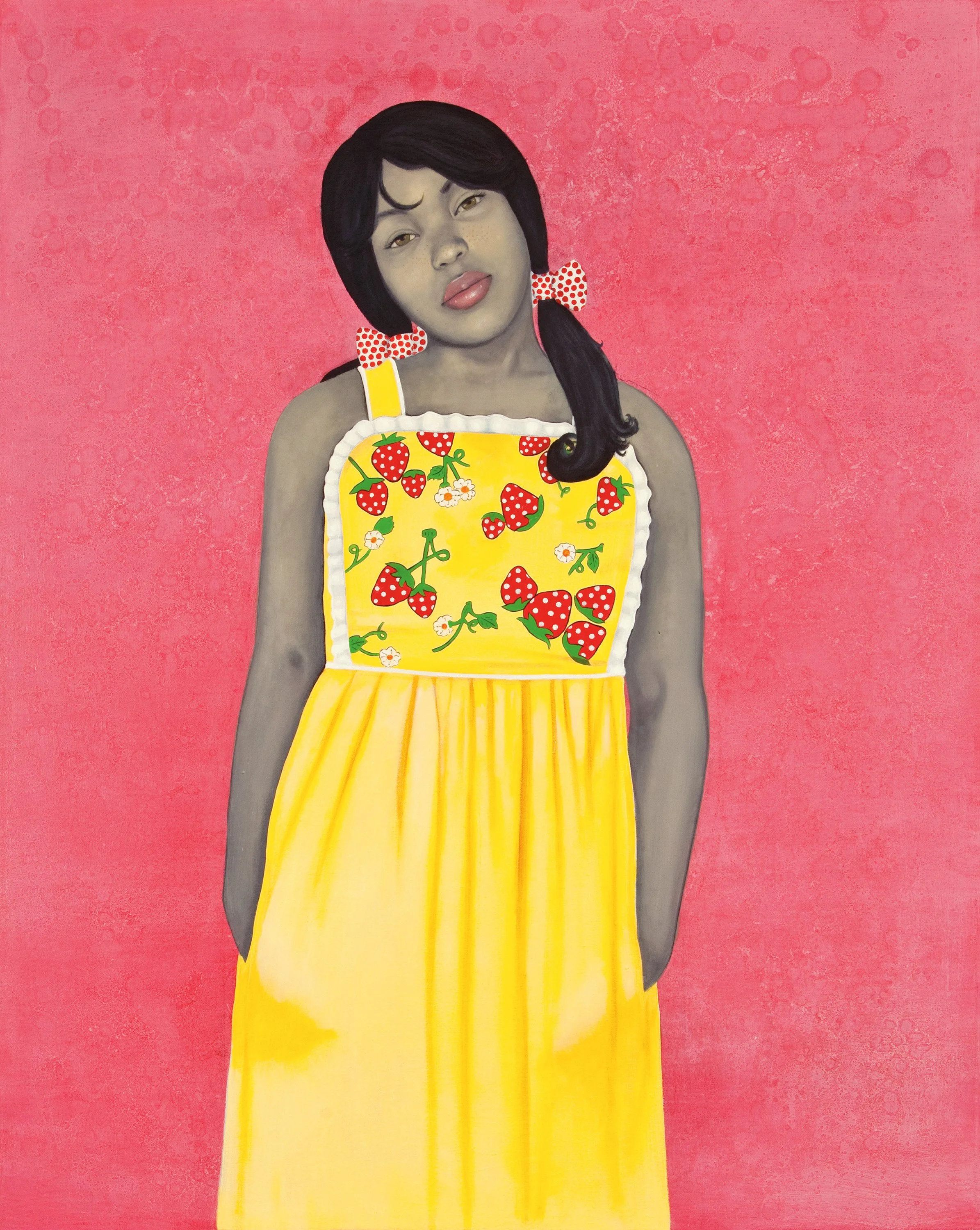
Amy Sherald, They Call Me Redbone, 2009, Oil on linen.
“They Call Me Redbone, but I’d Rather Be Strawberry Shortcake,” 2009, another compelling portrait, features a charming young woman, dressed in a strawberry patterned pinafore with pigtails fashioned with red polka dotted ties. Sherald’s use of “redbone” is derived from the 18th and 19th century term, used to describe individuals of mixed African, Indigenous, and European descent, and later for light-skinned black people with red or warm undertones. Exhibition labels explain that Sherald, who was often called redbone in her youth, is transforming the disparaging moniker by portraying the self-possessed young woman. The model, with her head tilted to the side and glossy pink lips, manifests the radiant charm of a teenage model in “Seventeen” magazine.
It is significant that Sherald’s Black subjects' skin tones are painted in grayscale to challenge the concept of color as race. She also positions most subjects against monochromatic backgrounds, providing few if any clues about their locations. Her intention is to create direct encounters between the viewers and her subjects, while focusing on their inner lives—which she skillfully accomplishes.
Sherald composes her completed scenes with great care. After selecting her models, she decides on their outfits and settings, and then photographs them. Working from these photos, referred to as “studies,” she presents versions of Black Americana that transcend racialized tropes. Her subjects are, “simply living lives of richness, rightness, and greatness in their ordinariness,” according to the catalog. Sherald identifies with and has been compared to portrait painter Alice Neel (1900-1984), an artist who manifested passion and dignity in her portrayals of people, and was identified with the social and political movements of her time. In addition, Sherald directs her paintings to hang slightly lower than the usual museum height, so that viewers can connect directly with the subjects.
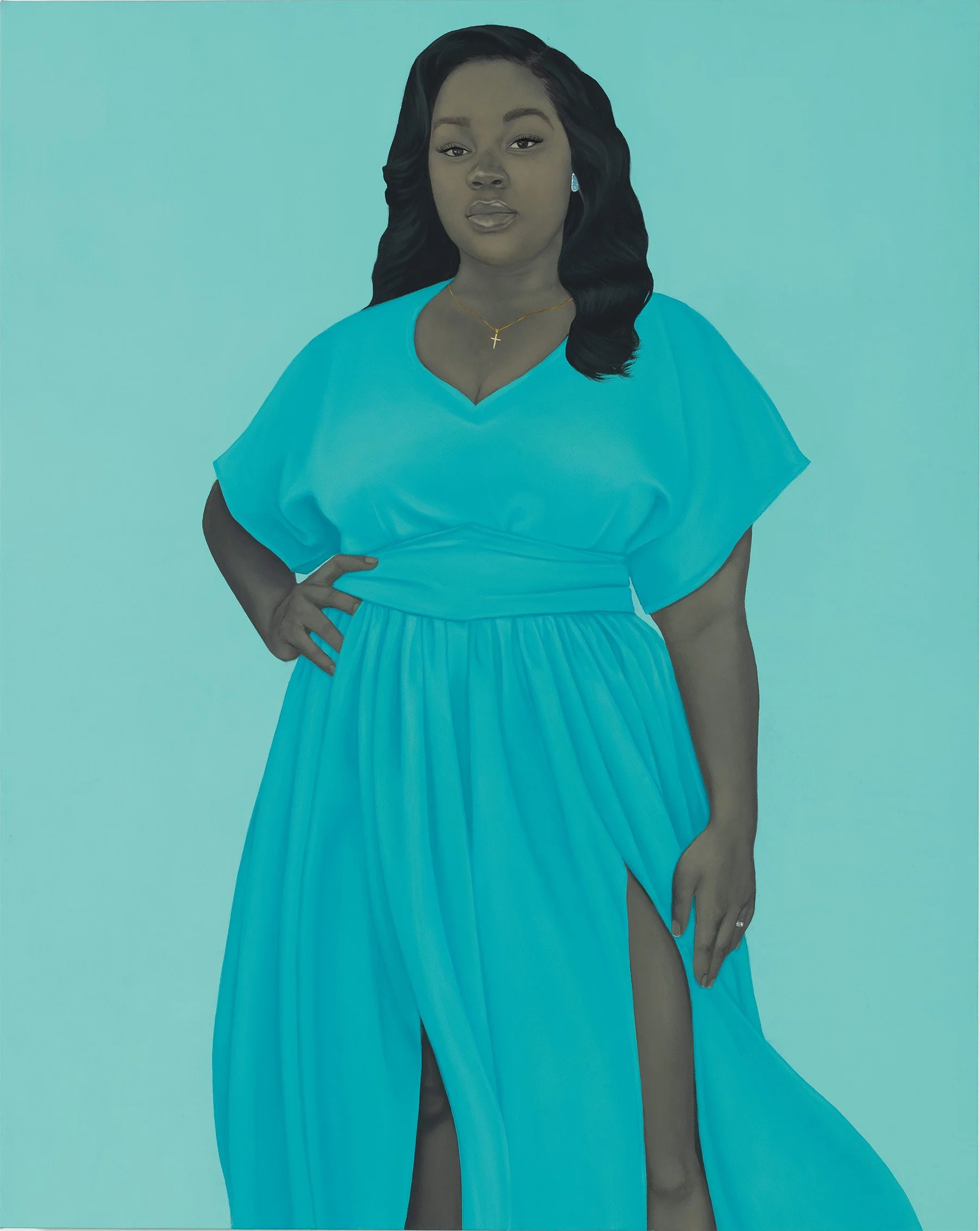
Amy Sherald, Breonna Taylor, 2020, Oil on linen, 54 × 43 × 2 1/2 in.
One of Sherald’s most important portraits is “Breonna Taylor,” 2020, created soon after the 26-year-old woman was killed by police in her home in Louisville, Kentucky. After the young woman became an almost instant symbol of gun violence, the artist was invited to paint her portrait to appear on the cover of September 2020 “Vanity Fair” magazine.
Planning every detail of the portrait, Sherald met her family and boyfriend, studied her postings on social media, used a Facebook photo for her face, and asked a friend to model for her body. The resulting portrayal conveys the compassionate, forthright woman that Taylor’s friends and co-workers knew and loved. The finishing touch to the painting is the inclusion of an engagement ring, which had not yet been given to her by her boyfriend. Sherald is quoted about the painting: “I knew I had to do it. I knew it was a way to focus not on her death but…on her aliveness and what her life meant.”
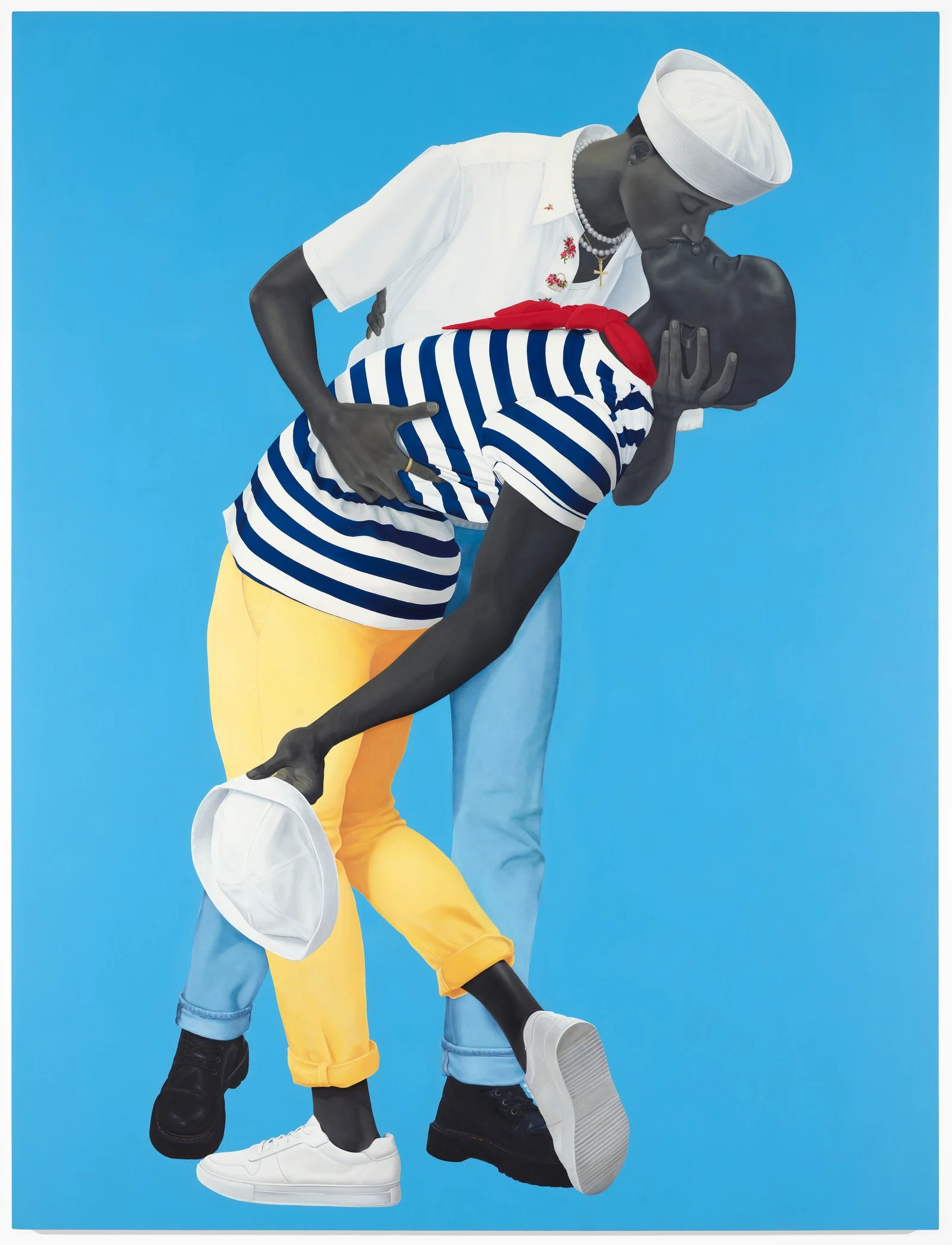
Amy Sherald, For Love, and for Country, 2022, Oil on linen, 3 1/4 × 93 1/8 × 2 1/2 in
“For Love and For Country” (2022) is an unabashed reinterpretation of the renowned Alfred Eisenstaedt 1945 photograph, “V-J Day in Times Square,” of a sailor kissing a woman during the celebration marking the end of World War II. As some criticisms of the photo have addressed the whiteness of the two people, their heterosexuality, and masculine conquest, Sherald appropriates the image to include two Black men in military uniform. The painting also honors the numerous Black soldiers who fought in the war, whose service was unacknowledged, and who experienced prejudice upon returning home.
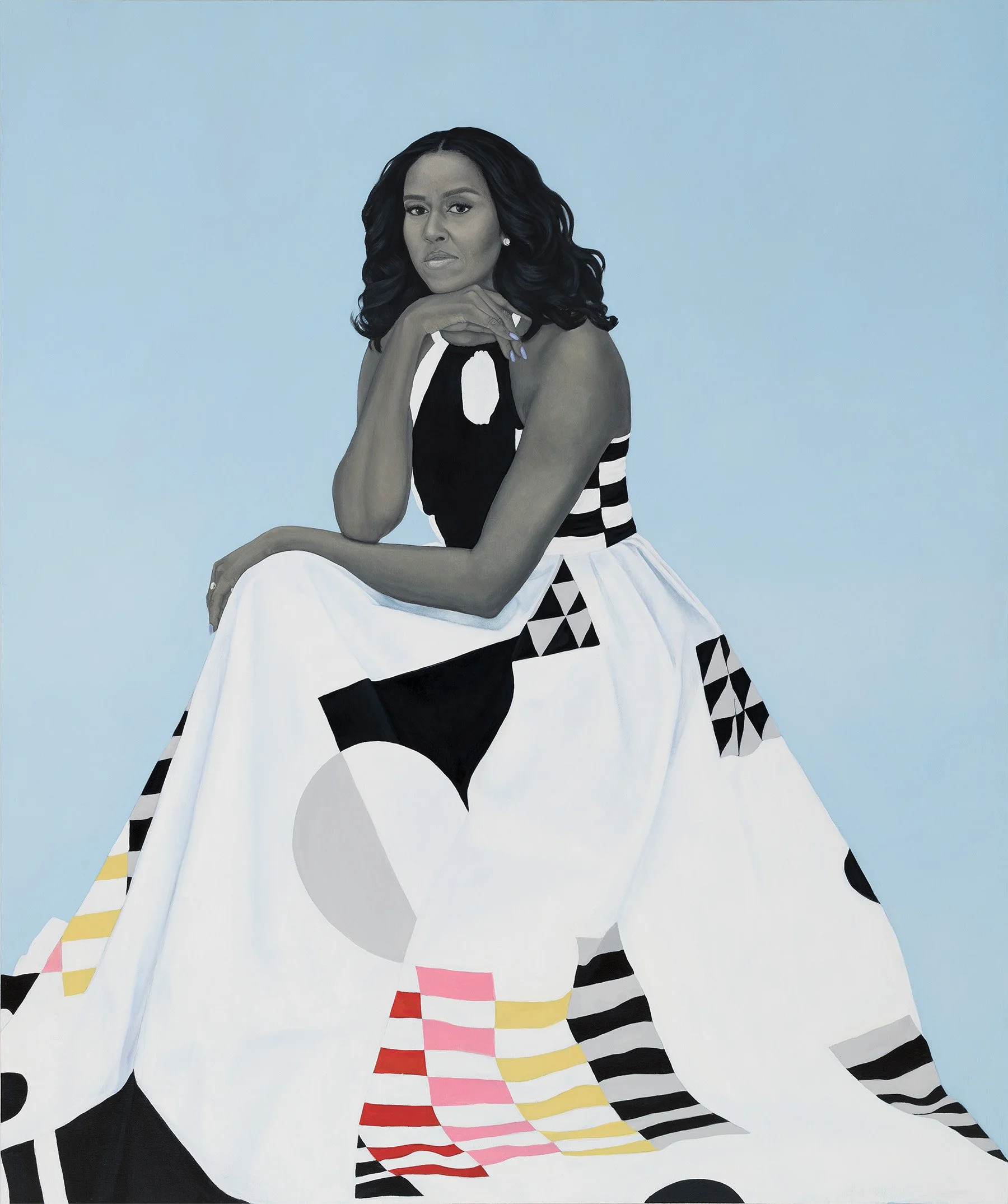
Amy Sherald, Michelle LaVaughn Robinson Obama, 2018, Oil on linen, 72 1/8 × 60 1/8 × 2 3/4 in.
The pièce de résistance of this remarkable exhibition is “Michelle LaVaughn Robinson Obama,” 2018, the official portrait of First Lady Michelle Obama. As her first official commission, Sherald stated, “I wanted to produce something that…alluded to the nuances of who [Obama] really is versus who she has to be.” The artist chose for the portrait a dress by Milly designer Michelle Smith, with its geometric patterns used by the Gee’s Bend quilters in Alabama. She also photographed Obama in an open, unguarded pose. Eschewing the formality that typifies most official portraits, the First Lady is posed in a characteristically thoughtful and gracious state, while revealing her authentic forthright nature.
Amy Sherald describes herself as a “conceptual portraitist,” indicating that her completed figurative paintings delve deeply into the nature of her subjects, while avoiding the more formal aspects of most conventional portraits. The exhibition, which closes on April 5, 2026, is the Baltimore Museum of Art’s most attended exhibition in 25 years. Attendance is expected to reach 75,000 by the time it closes.
“Amy Sherald: American Sublime” premiered at the San Francisco Museum of Modern Art on November 16, 2024. It then traveled to the Whitney Museum of American Art, and to the Baltimore Museum of Art. The exhibition was organized by SFMOMA and curated by Sarah Roberts, the museum’s Curator and Head of Painting and Sculpture.
