
Jeana Zhenyu Zhang, Arising and Passing, VillageOneArt, New York
By Wei Huang
The visual commonality between classical Chinese ink wash paintings and abstract art has long been noted by artists, scholars, and art viewers alike. Some of the bolder, inkblot-filled compositions from the Chinese genre have drawn comparison with Abstract Expressionism and analysis of modernity, as seen in the scholarly works of Jonathan Hay and Wu Guanzhong. In parallel with this speculative dialogue, Jeana Zhenyu Zhang’s paintings navigate style, medium, and culture in her solo exhibition, Arising and Passing, at VillageOneArt, New York.
Based in New York, Zhang’s works might strike the impression of invoking the longstanding tradition of American abstract paintings. Her Rockery series (2025) arrived at the middle ground between the spontaneous drips of Jackson Pollock and extravagant wash of James Whistler. Strips and blots of black paint dominate the canvas, but far from a pastiche of the predecessors, Zhang builds her own visual lexicon by opting for acrylic paint as her main medium. Taking advantage of the liquidity of acrylic, Zhang applies a thin layer of paint and floods the canvas with gradients of paint wash. Shades of black overlap each other to create a composition reminiscent of tumbling clouds or surging waves. As if attesting to the fluidity of the material, the acrylic paint under Zhang’s paint brush flows almost like ink.
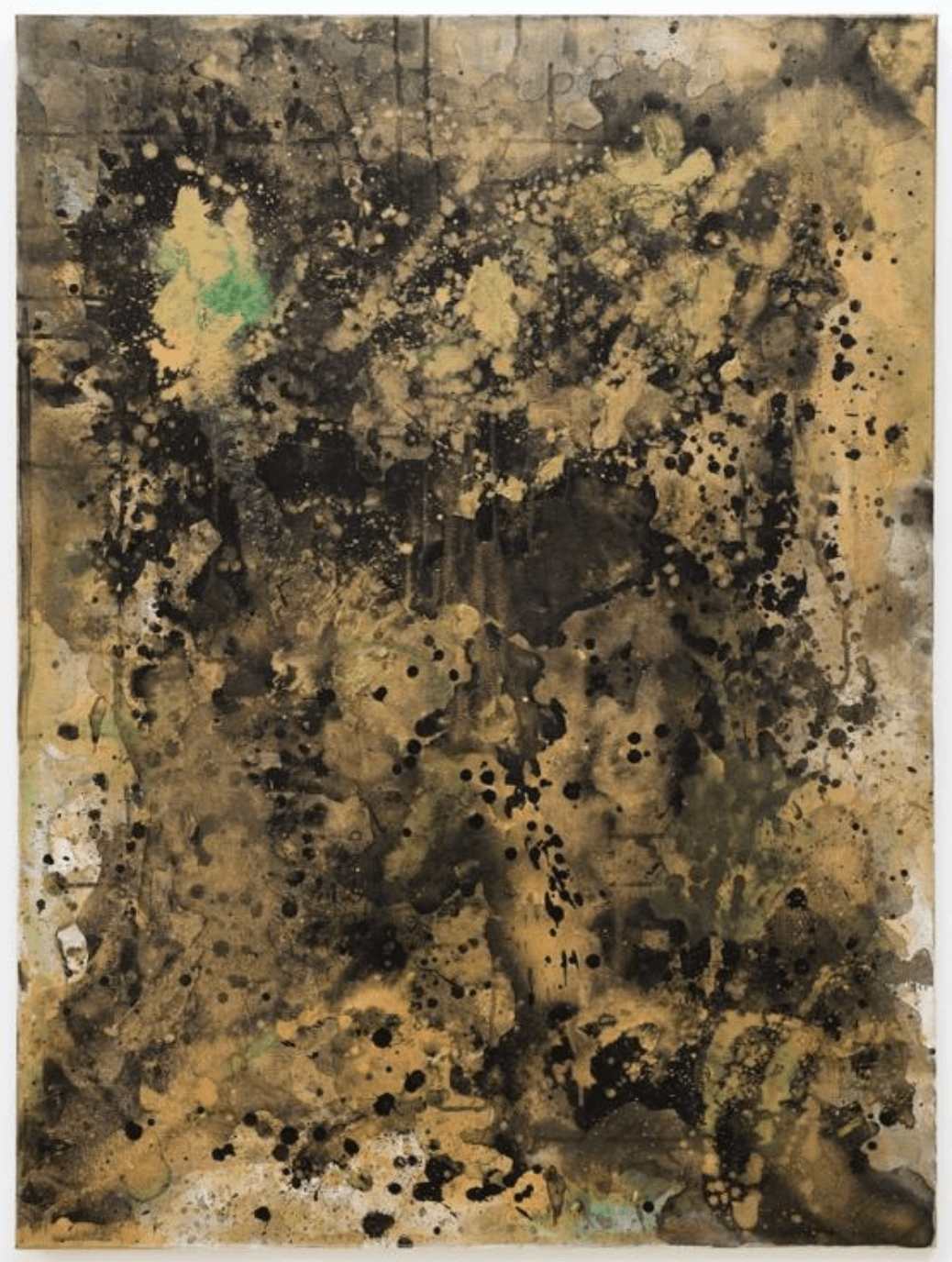
Jeana Zhenyu Zhang, Rockery 4, 2026. Acrylic on canvas, 40 x 30 in.
The verisimilitude is Zhang’s intended orchestration. Born in Dalian, China, Zhang was classically trained in Chinese paintings, proficient in both ink painting and calligraphy. Though the formation honed her techniques, the academic orthodoxy later became a constraint on her artistic individuality. Her pursuit of idiosyncrasy eventually brought her to the US, first to study oil painting at the California College of the Arts, then mixed media at the Parsons School of Design. Still, classical Chinese elements concern her. In addition to the abstract, her venture into figurative paintings likewise harbors an evocation of ink. The paintings series Drifting and Flowing (2026) and Leaves to Dust (2026), along with the standalone work As Reflection (2026), all thematize lotus realized with baimiao, a classical Chinese painting technique that draws only the outline of figures and objects without filling in colors. The two Drifting and Flowing paintings, in particular, take the vertical form of Chinese scroll paintings.
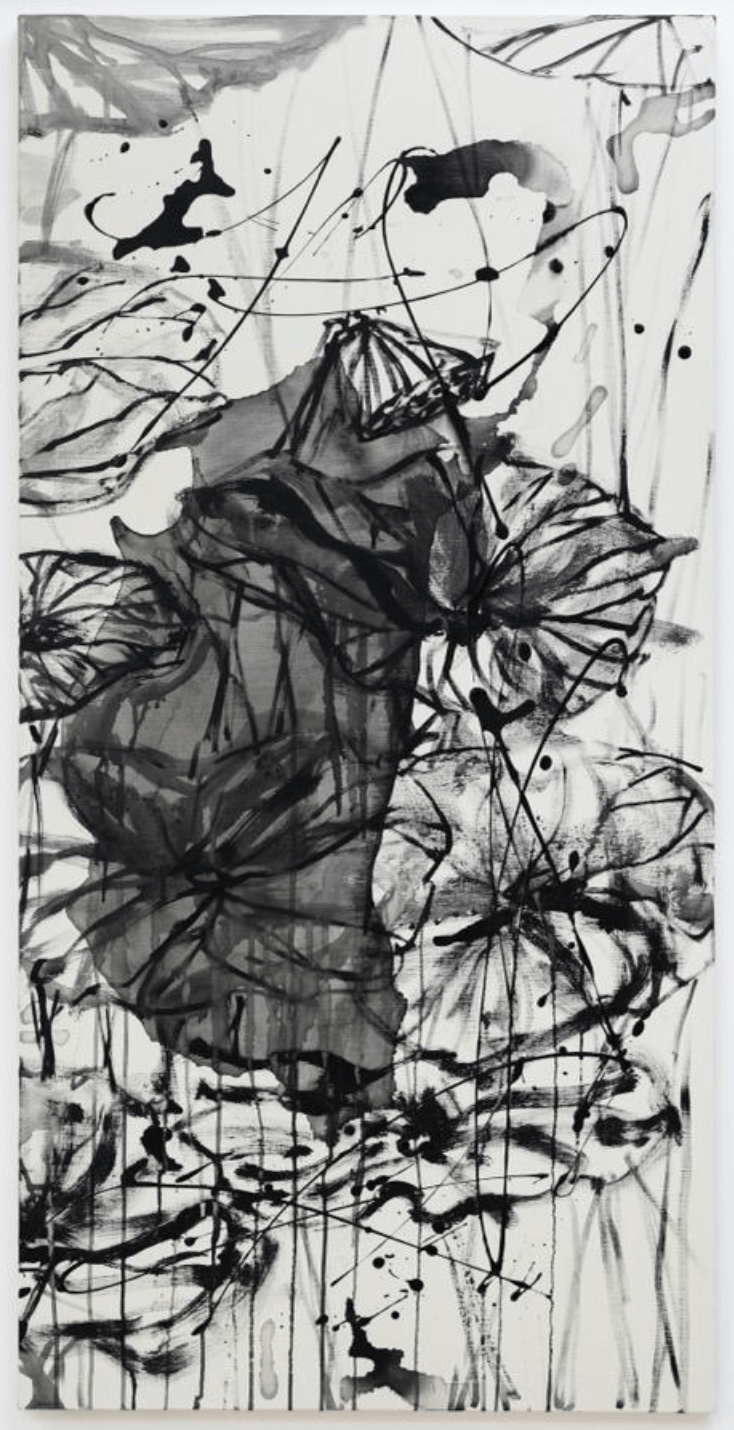
Jeana Zhenyu Zhang, Drifting and Flowing 1, 2026. Acrylic on canvas, 24 x 48 in.
The approach to classical Chinese art through Western media, however, is only the starting point for Zhang’s artistic development. In See Through (2025), the same lotus pond motif is here depicted in gold paint against a background of black abstraction, of which the sheer volume and intensity strike the impression of pomo, the ink-splashing technique prevalent in classical Chinese paintings that scholars like Alexandra Munroe deems a source of inspiration for the abstract expressionists. Instead of flowers, Zhang foregrounds withering lotus leaves and roots in See Through with intense color contrast and brushworks, rendering them almost apparitional.
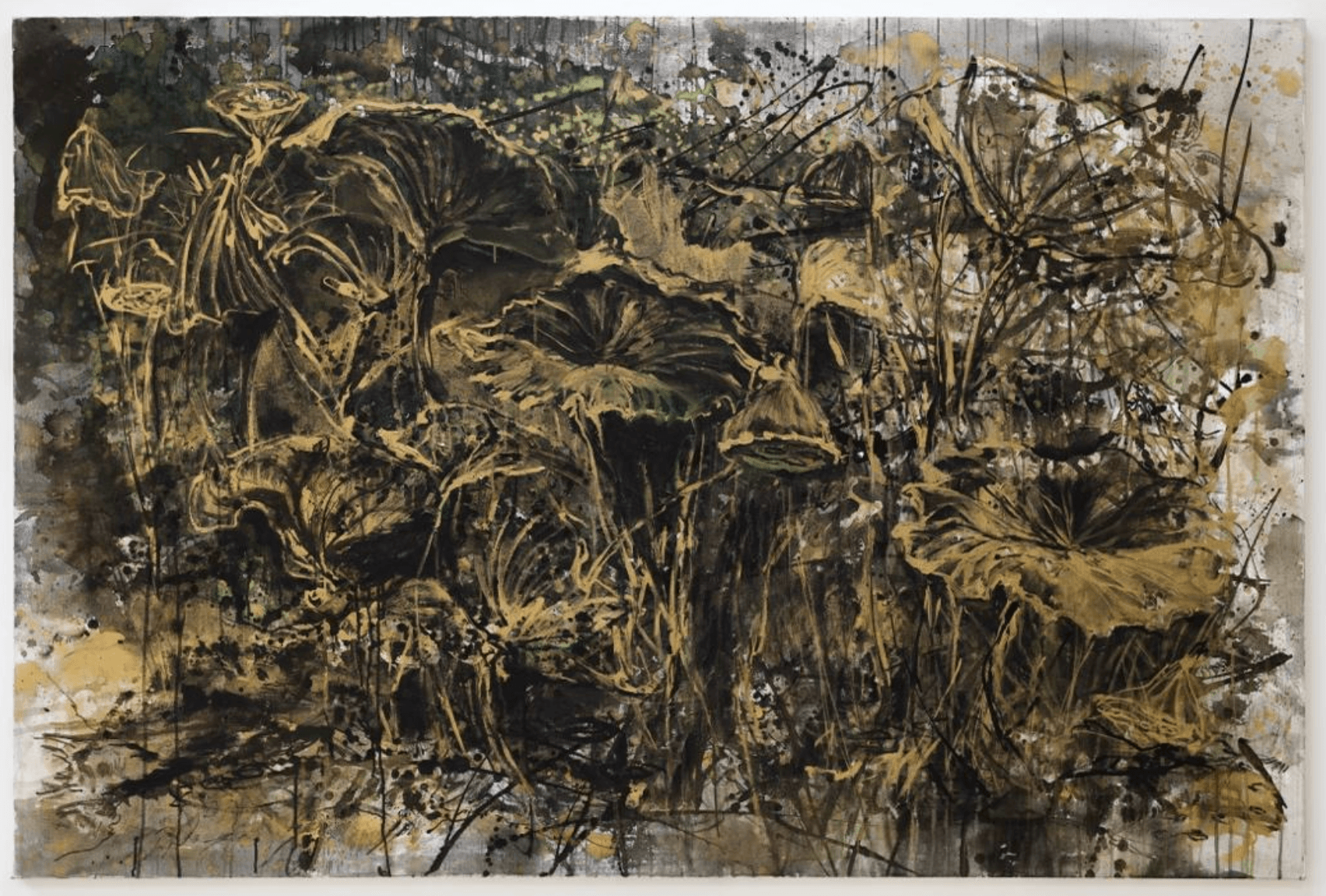
Jeana Zhenyu Zhang, Seeing Through, 2026. Acrylic on canvas, 48 x 72 in.
The bold and creative use of material is where Zhang’s long-pursued individuality shines most. In Savoring, a small-scale series of lotus paintings, Zhang applies gold leaves on the background, adding metallic shimmers to the optical effects. Her interest in mineral materials leads her to concoct her own medium by adding metallic substances to acrylic paint, which turns the paint heat sensitive. The paint changes color in accordance with the degree of oxidization and temperature. Green boasts the strongest presence in her works, while violet and red-brown are more discreet, interspersed among the more prominent colors. Zhang sometimes would even use hot water to catalyze the chemical reaction for the sake of variety, but how it turns out remains out of her control. The embrace of unpredictability is reflected in another small-scale series of studies with a Buddhism-inspired title, Karmic Encounter (2026). Contingency dictates the color scheme of these nine wood paintings: green and yellow once again wrestle each other for the spotlight, but a closer look will reveal the subtle brown and mauve hue in the mix. The overall tone is further meddled by Zhang’s signature drips of black paint, but instead of acrylic, it is ink that makes up the abstraction of the series. The series is a callback to Zhang’ artistic roots and an unexpected point of reference to the beginning of Zhang’s journey.
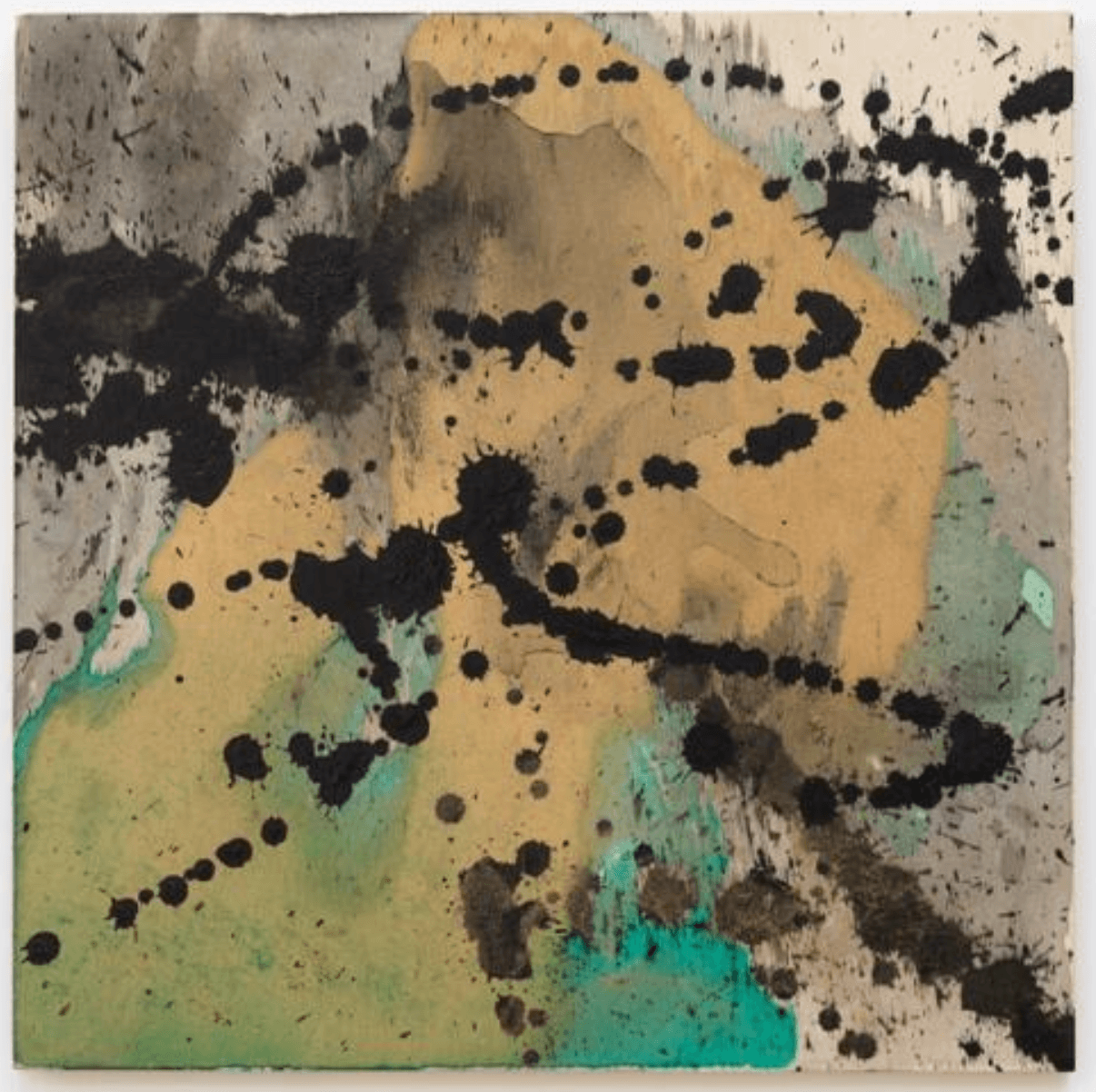
Karmic Encounter 1, 2026 Ink on wood, 12 × 12″
The desire to break free from a rigid system does not equate to forgoing the past. Zhang is always conscious of her roots in Chinese artistic training. It appears that she views the evolution of her art as a constant loop of the old and the new feeding into each other and eventually morphing into something that is distinctly hers. The exhibition title, Arising and Passing, speaks to this notion. More context is provided by the alternative Chinese title of the exhibition, 葉脈, which stands for “leaf vein.” In an interview with IMPULSE magazine, Zhang mentions that the veins become more conspicuous when the leaves wither. Decay and then reborn, Zhang shapes her art through the progression of the cycles of life.
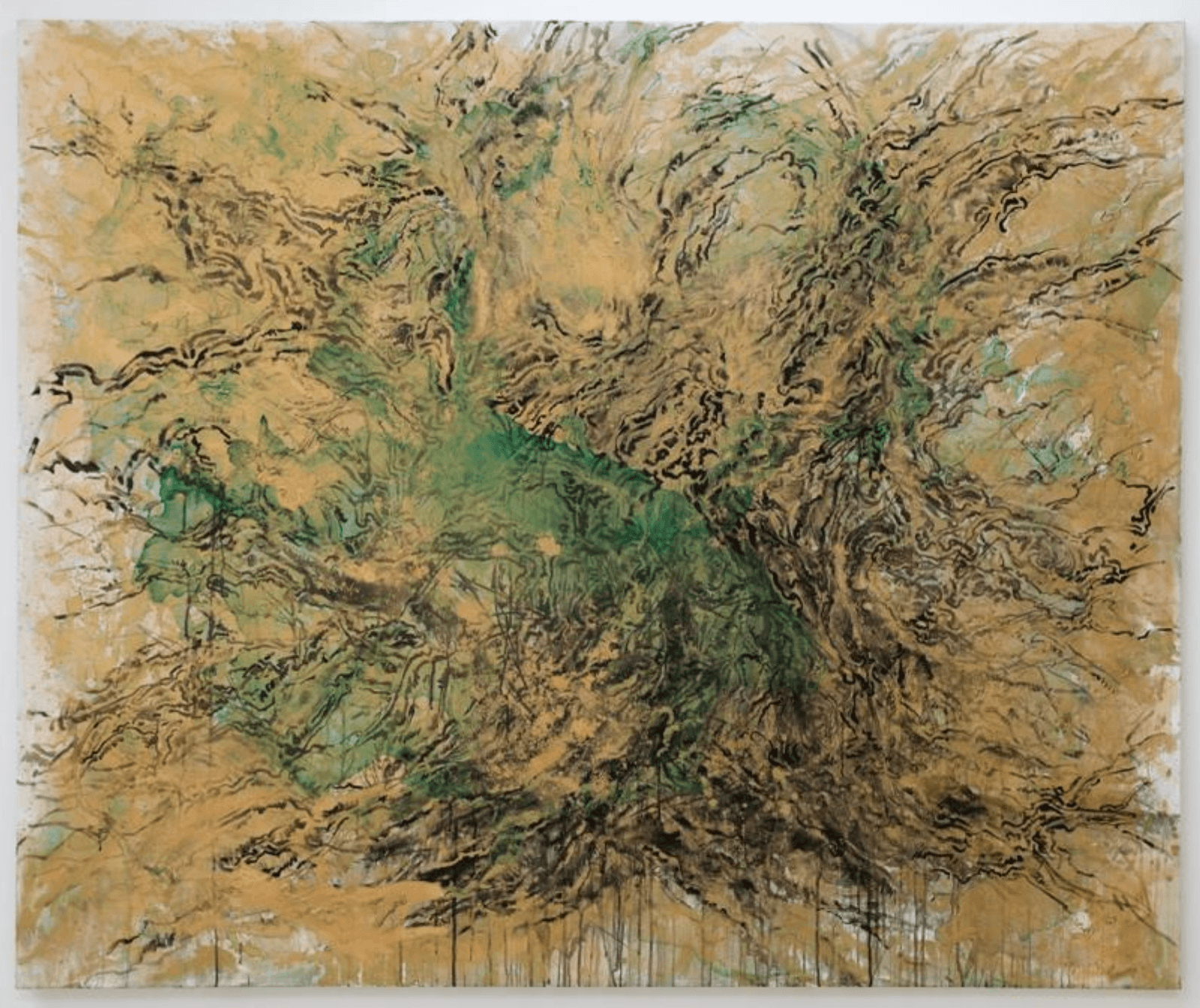
Jeana Zhenyu Zhang, Knot of Circumstances, 2026. Acrylic on canvas, 60 x 72 in.
Extending her longstanding interest in vegetation, trees take the spot of Zhang’s latest interest, as seen in the nascent arboreal delineation Knot of Circumstances (2026). Trails of dripping paint resulting from gravitational pull run over the familiar golden background of green wash and black contour. Taking over the composition, a burl-covered tree trunk of what appears to be a noble tree is unlike other works in the exhibition. The central message remains faithful to Zhang’s core: Much like the burls, which are plant callus induced by wounds or diseases, her art is constantly growing anew by conviction and by chance.
