
STRYBING, William Bondy / Linocuts, Birdhouse Gallery
I admit it: I’m the one who missed the Ruth Asawa retrospective at SFMOMA. Having read “Everything She Touched: The Life of Ruth Asawa” recently, there’s no show I’d rather see, so I’m kicking myself. My consolation is that a whole new layer of San Francisco art history has come in to focus for me, from the mosaic she worked on with kids at Alvarado, (where I now have a 1st Grader), to the inspired vision and years of advocacy she provided to the public arts High School, the Ruth Asawa School of the Arts (where my daughter is now a freshman). What a life! And what a realization I’ve had, how much this city, and my own personal experience of it, has been touched by the force of Ruth Asawa.
So it’s no surprise, I suppose, that the artist behind “STRYBING”, a recent show of Linocut prints at the Birdhouse Gallery is acclaimed architect William Bondy, a longtime colleague of Ruth Asawa’s husband, fellow architect Albert Lanier.
Are you hip to “Strybing”? I was not. But I'll bet you know the Botanical Garden in Golden Gate Park. It was originally named Strybing Arboretum after Helene Strybing donated the funds to build and plant it, the San Francisco voters of the early 1900’s having rejected the public financing measure. Thank you Helene - there is no more magical place in the city than San Francisco Botanical Garden at Strybing Arboretum.
How about the art of the Linocut? Can you describe how a Linocut is made without watching a YouTube video? I could not - or at least couldn’t without fumbling through vague ideas about image transfers and confusing the Linocut with the lithograph, which of course means confusing the relief print with the planographic, chiseling into linoleum with drawing on a stone.
My first impression of the 18 Linocut prints William Bondy is showing at the Birdhouse was how dark and sinewy they are, like spiderwebs glimpsed in moonlight. Scanning the wall, the labyrinthine lines flutter, swimming in a sea of black ink. It’s disorienting at first, seeing scenes of lushness rendered so stark, and it takes a minute to adjust to the extreme desaturation.
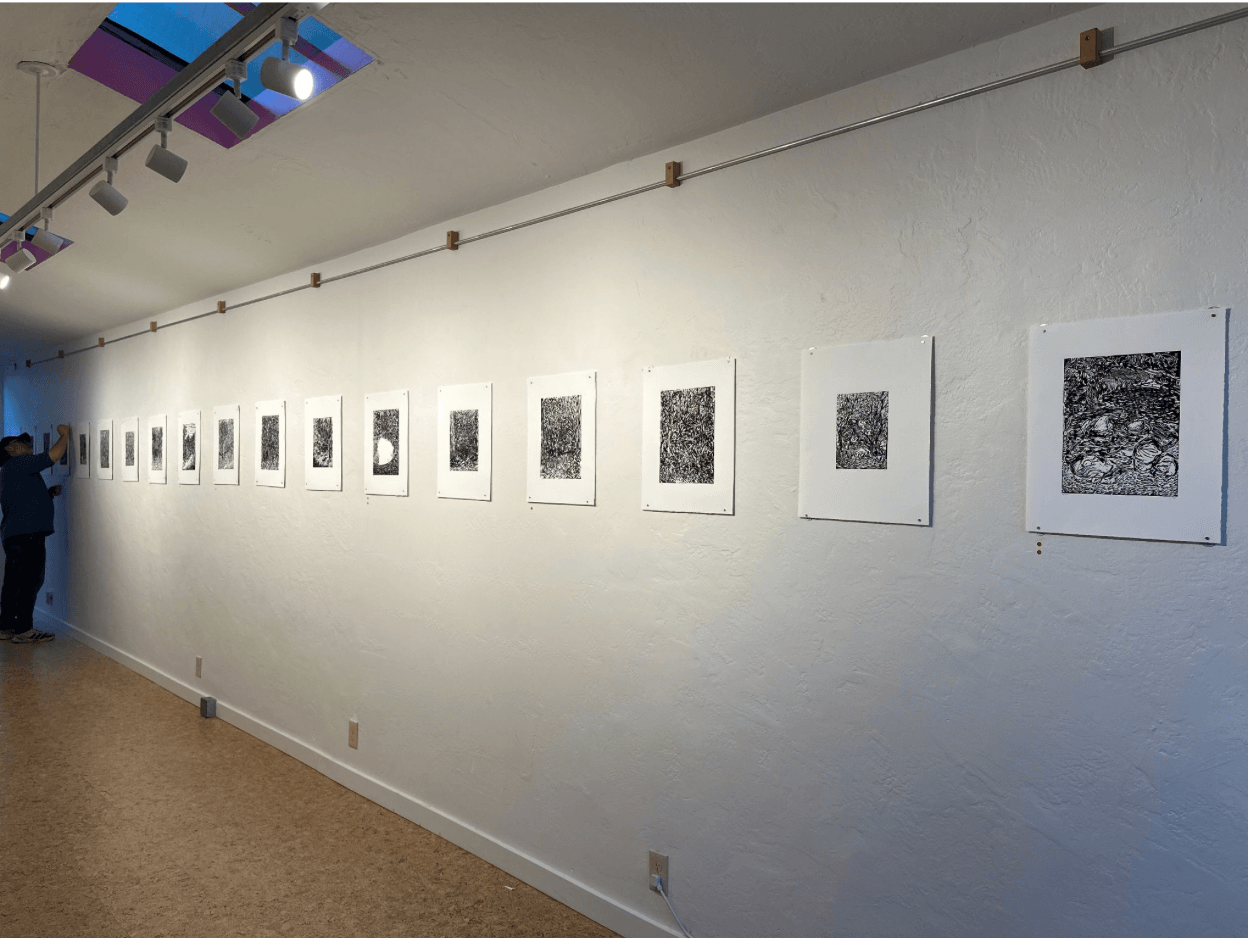
William Bondy, Installation Shot, Birdhouse Gallery .
And so I reoriented. These prints are based on plein-air sketches from the Botanical Garden, after all, and like the Botanical Garden, which indulges our temperate climate by cultivating nearly 9000 different kinds of flora from all over the world, William Bondy’s Linocuts depict an extraordinary variety. It’s clear why he’s drawn to drawing there: if your art is inspired by nature, the Botanical Garden is a gift that keeps on giving.
Among the many things I have no proclivity for, but wish I did, is the identifying and naming of plant-life. In these linocuts, I recognize the bamboo, at least - but thankfully for this viewer, the real art here is not the academic rendering of nature, but rather orchestrating the symphonic complexities of naturally occurring shapes and forms. And what’s so striking about these Linocuts is how by abstracting these scenes into black and white negatives we can see the foundations beneath the form, like an x-ray of natural beauty.
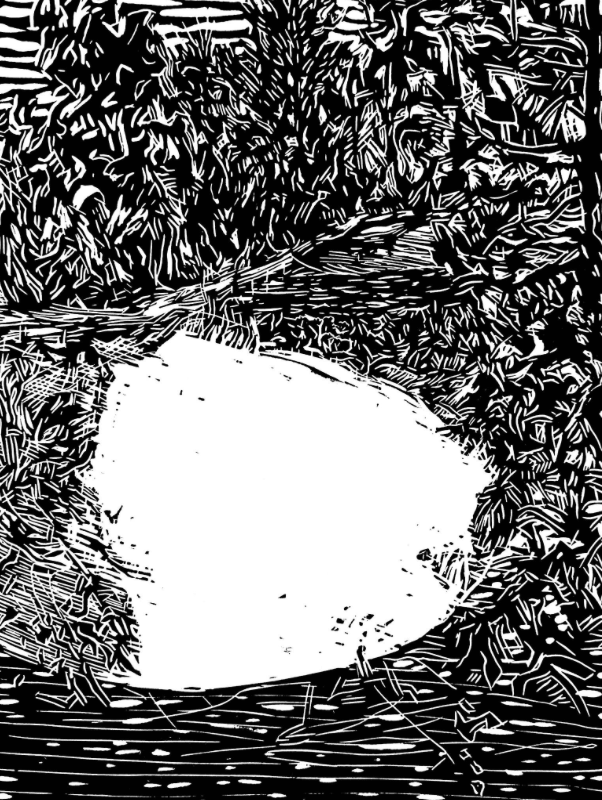
William Bondy, Linocut print.
It’s hard not to think of the influence of Van Gogh when viewing the works in STRYBING. They are created in the same spirit of depicting, while freely interpreting, nature. They are alive with surface tension, the mad marks of the busy brush working around vigorous, circuitous bends and flows. A breeze rustles the leaves; a school of fish changes directions. I’m not certain, but perhaps there’s even some of the same flora Van Gogh painted present here, clippings from Provence growing wild in our arboretum.
And Van Gogh - like Bill Bondy - was a draftsman first - a dedicated, disciplined true believer in the power of our perception to manifest in the steady-handed drawing of line. He’d probably have made a decent architect! It is certainly compelling that an architect like William Bondy, someone who has spent their life considering the mathematical aspects of space and material requirements of structure, would find both solace and release in depicting the comparatively berserk density of a garden in bloom.
Perhaps he’d identify with my friend who used to say, as we drove out of the city to go weekend hiking in Muir Woods, “We need a break from all these 90 degree angles, man!”.
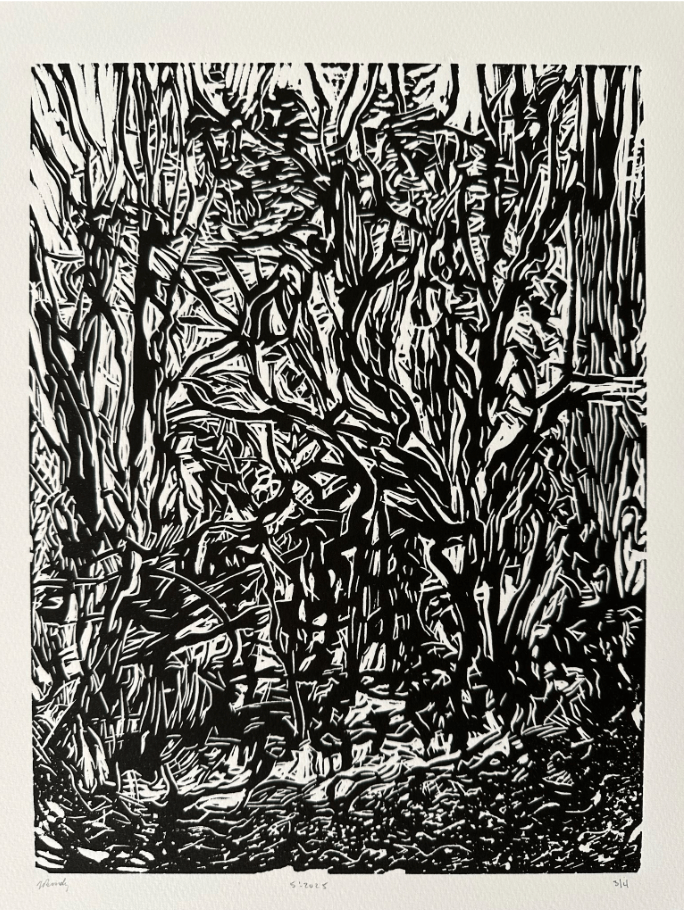
William Bondy, Linocut print.
The more time I spent looking at these prints, the more I realized the degree to which my physical proximity to the work changed the perceived compositions. I found there’s a sweet spot, two steps back from the wall, where the nature being depicted appears most present and raw. Another step or two back and the complexity condenses into tangles. And examining too close-up, the linocut gouge-marks take on a rounded artificiality, like a photoshop tool, distinct from the organically responsive vicissitudes of pen or brush.
Adjusting to stay in that sweet spot where the elements appear most alive is a small price to pay for the enchantment of Bondy’s teeming, enveloping, shadow-work pastorals. Ruth Asawa would, no doubt, approve.