
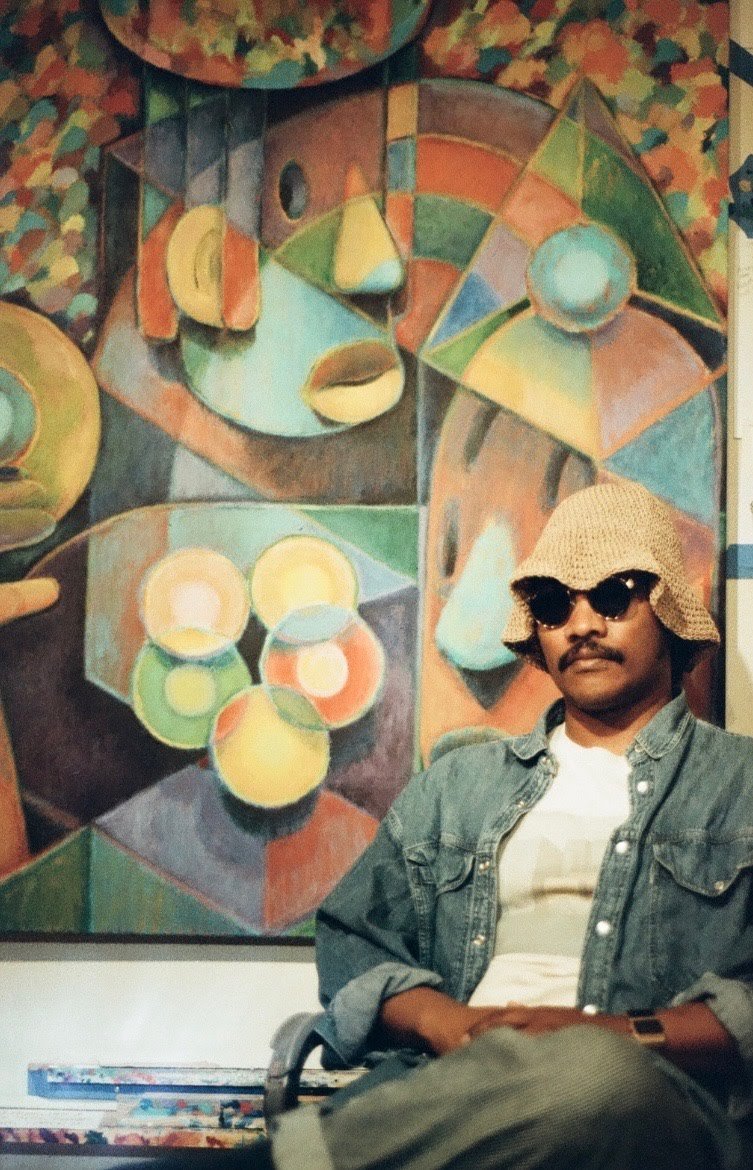
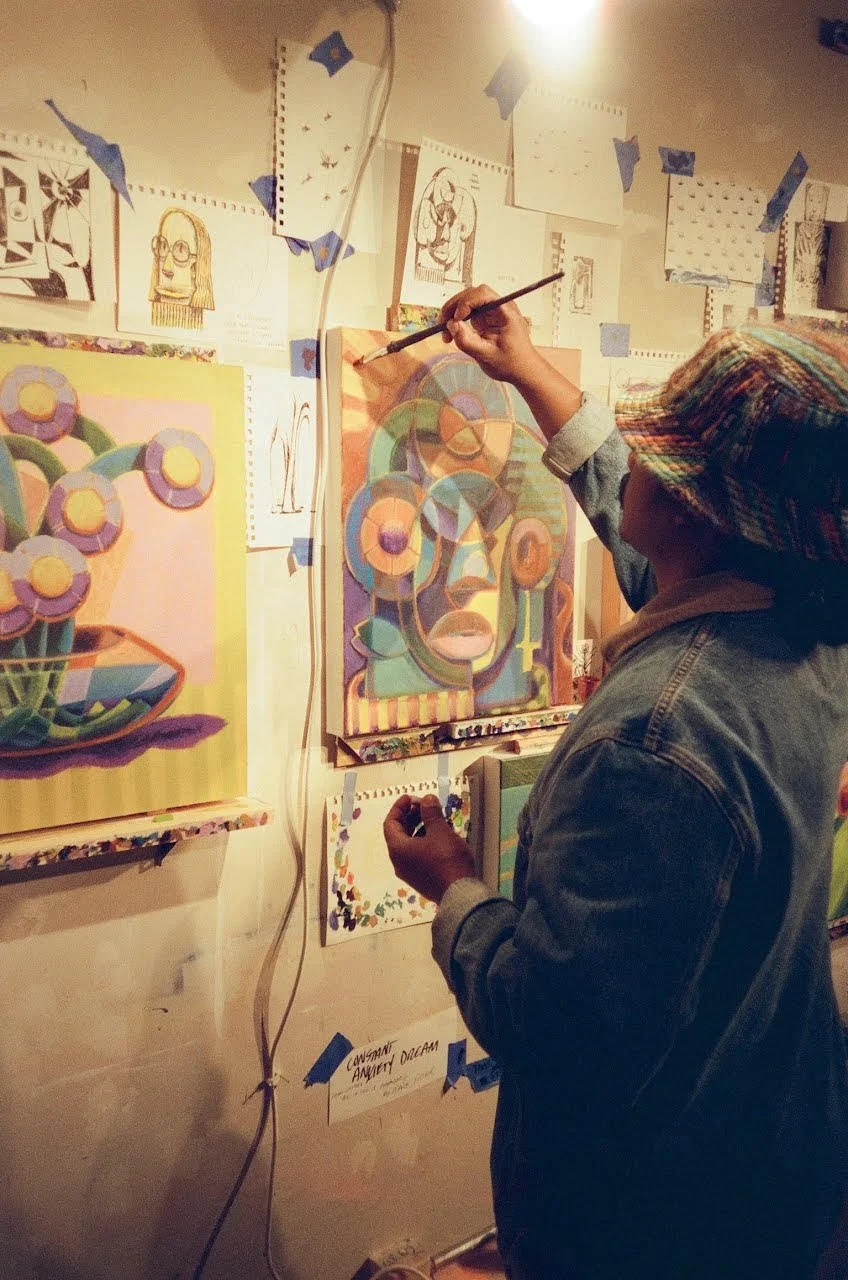
Portrait of Wardell McNeal by Zachary Hart Baker.
Wardell McNeal is an Oakland-based painter whose vibrant figurative works blend abstraction with surrealism. Drawing on memory and personal experience, his paintings explore human emotion, spirituality, and the complexities of everyday life.
Thanks for agreeing to this interview. We’re delighted to learn more about your practice. Can you start by describing your work and specifically what you’re working on now? Do you have a preferred medium? Subject matter?
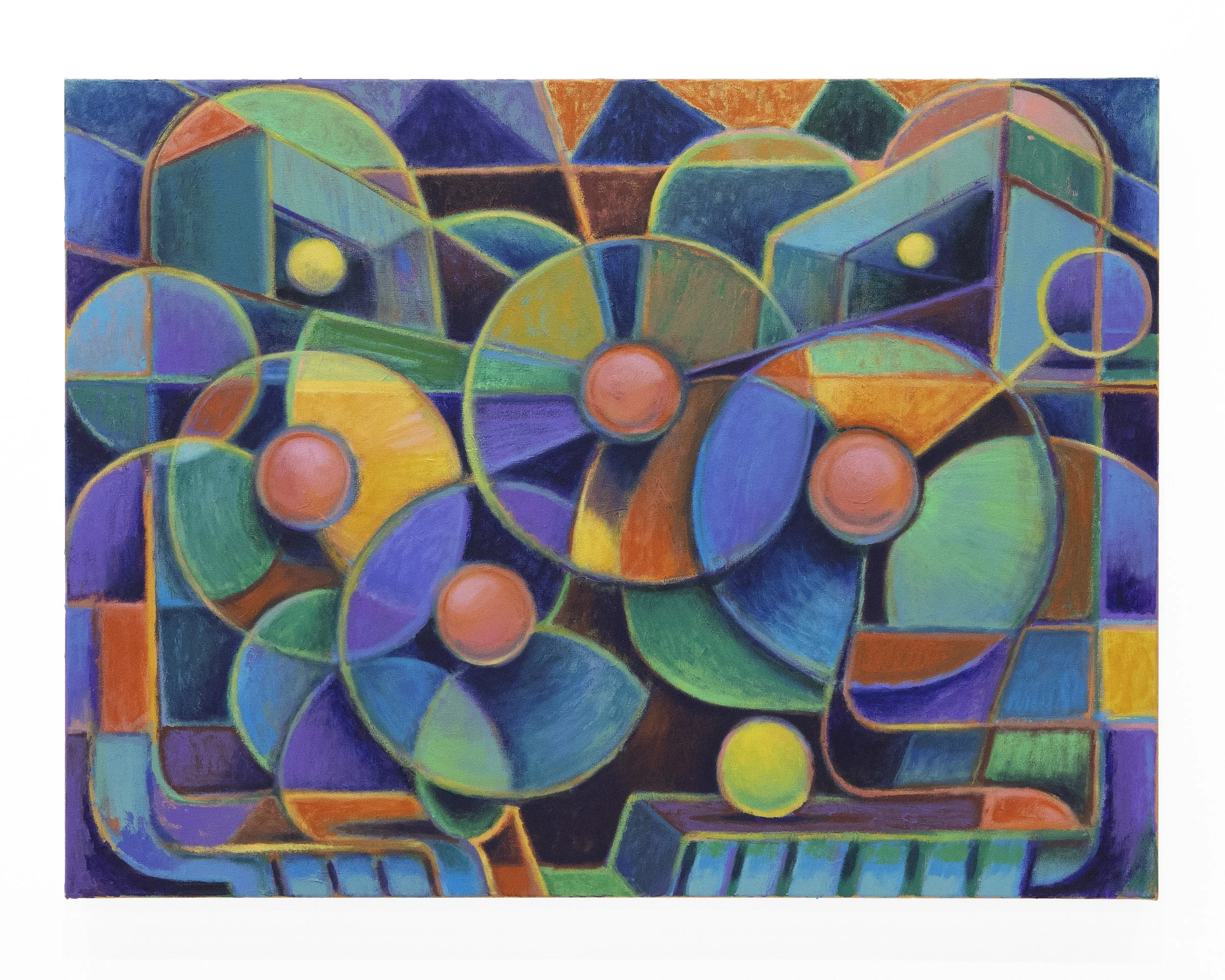
Thank you for keeping the spirit of dialogue around art and thought alive. My practice is centered around painting (primarily in acrylic), but also includes a lot of ink and sometimes pastel drawings. I work out a lot on paper before taking ideas around light, shadow, and form to the canvas. I’ve never really been firm on categorizing my style / direction, but I do feel that I lean towards the direction of speculative fiction. I play a lot with abstracting and reimagining familiar forms, developing space, and exploring depth in a sometimes loose, sometimes intentional way.
Where can people see your work? Are you in any exhibitions right now or have anything scheduled? Do you welcome studio visits?
I show a lot at Pt.2 Gallery in Oakland, CA. I have a solo exhibition scheduled there next year around September / October. Currently though, I have no work on view, but am always open to studio visits. Pt.2 hosts Open Studio days periodically, and those are always pretty fun.
Can you share how you became an artist? Did you have an epiphany that compelled you in this direction? Did you have formal training? Did you grow up in a family that valued art and left the door open for you to become an artist?
I started making art after graduating from studying Design in San Francisco, but I have no formal studio training outside of foundational art courses. I have been self-taught, and compelled to make art since 2013 or 14, driven by a combination of post-graduation anxiety and fresh creative energy. I had so many art supplies and material from projects, I would just use that up in my journey.
I found out later in life that both of my parents were creative souls, though I only knew that my dad was from photo albums of him playing instruments back in his youth, my mom has revealed her artistic depth to me over time. The first that I can remember is a time when she walked into the living room of our childhood home where I was doing something or other, with music playing in the background, and she picks up my guitar and starts playing along with the song on the CD, and more recently she has proven to be a improvisational wizard with a crotchet needle. The best part is that she always takes the time to really look at and interpret my work, and talks to me about it, and she has really good insight, it surprises me when she picks up on my intentions or techniques. She has alway been encouraging about my art while I was growing up, supplies and books, she has hung up all my college art assignments, encourages me to go to the studio, and knows that it is beneficial for my health and happiness.
Do you think art should make political or social commentary? Does your art do that? Is there a role for the artist to play in challenging political climates?
One of my favorite art quotes is by Ai Wei Wei: “Everything is art. Everything is Politics”
When I was in school, I was really tapped into the socio-political energy around San Francisco, and when I started making art myself, I think it organically incorporated my consternation around the nation’s political responses to tragedies and loss happening while I was still in school like Trayvon Martin and the children of Sandy Hook Elementary. I also moved from SF to Oakland around that time and the protests and community response to the continued loss of black and brown lives was much more palpable. I was viscerally compelled to make art during those times, drawing and painting, imagining and dreaming. So I feel politics in some way helped me understand how art can be empowering and effective on a human level as a way to emote, as a method of comprehension, or simply as pressure relief. I'll often inject my thoughts on politics, usually as some sort of emotion or object, sometimes buried and subtle amidst layers of complexity, and sometimes explicit and representative of pain. Is it even possible to for an explosion to be subtle?
Do you believe art reflects an artist’s diversity such as gender identity, sexual orientation, ethnicity, or race? Are these (or any other diversity consideration) present in the art you make? Why or why not?
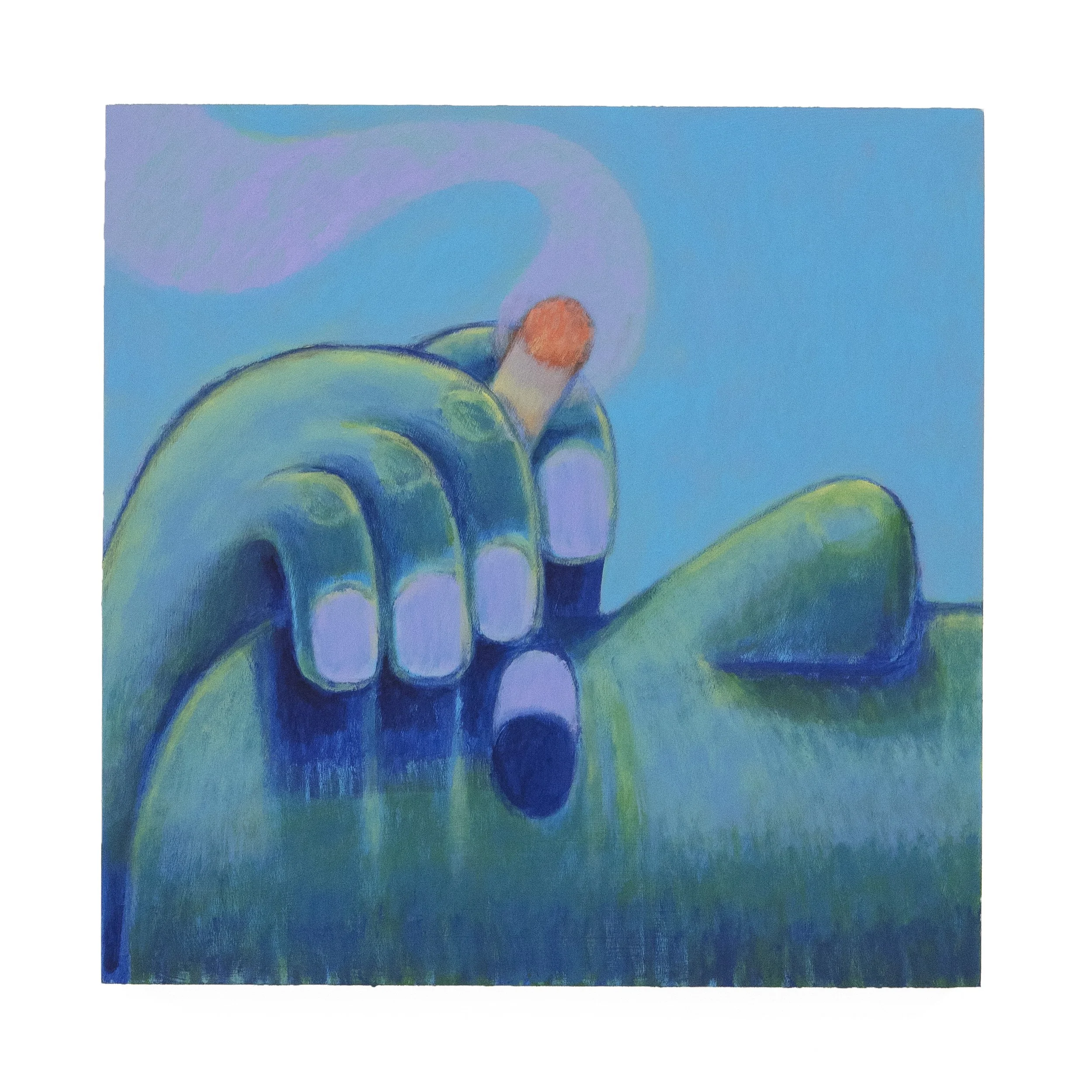
I seem to see the self in an artists work, so I think it is inherently tied to their identity or being in some way or another. The people that appear in my own work, while purely imagined, contain marginalized features, more representative of my own cultures and communities. Partly because of reference / familiarity, and partly for sake of representation and expanding the concept of beauty and objectivity.
What do you think artists should be talking about right now?
Artists should be talking about whatever is compelling them to create, or think, or curse, or laugh, or cry.
Outside of art making are there any cultural projects you’re interested in or currently engaged with? Any art adjacent hobbies you enjoy?
I love philosophy, metaphysics, phenomenology, and the quantum sciences. Anything really heady and complex that challenges me to think, dream, and imagine in new ways.
Are there any contemporary artists you draw inspiration from? Can you name the artists and say how or why they inspire you? Same thing for historical artists. Are there any who speak to you despite their living in a different era?
I really love Salman Toor for the same reasons everyone loves Salmon Toor, just gorgeous imagery and storytelling. Toor has such efficient and expressive mark-making, and is a genius at interpreting light and form. Daniel Richter is another Contemporary Artist that I am fascinated with conceptually and compositionally. Richter has a much different, but equally effective approach to the use of color in his paintings, and I love the diversity of his palette. It just works; pops where it needs to. I admire the way both of these painters talk about their process, decision making, and the philosophies of their approach. That type of stuff fascinates me, and they both are so articulate in the pursuit of image making. From the perspective of Historical artists, I think back to when I was in design school I was really into all things Bauhaus. And from there came my attraction to Kandinsky and Klee, standouts in art history from an academic perspective, and ground breaking in the work they produced. I draw a lot of inspiration from their work and concepts on pattern, repetition, rhythm, and harmony. Harkening back to these fundamentals can help develop (and even rescue) a painting in my own practice.
Do you have a favorite public art piece? What is it and why?
Muzae Sesay has an amazing, mile long, sculptural piece crowning the Yerba Buena Tunnel on Treasure Island. It has yet to be completed, but the photos are quite the site to behold. Muzae’s style compliments the surrounding landscape and infrastructure so seamlessly, it's very impressive and beautifully integrated.
Can you say something about the art you live with? Whether you bought, found, were gifted, or traded for the piece, what artworks do you live with? How has the experience of having these pieces influenced your own art making?
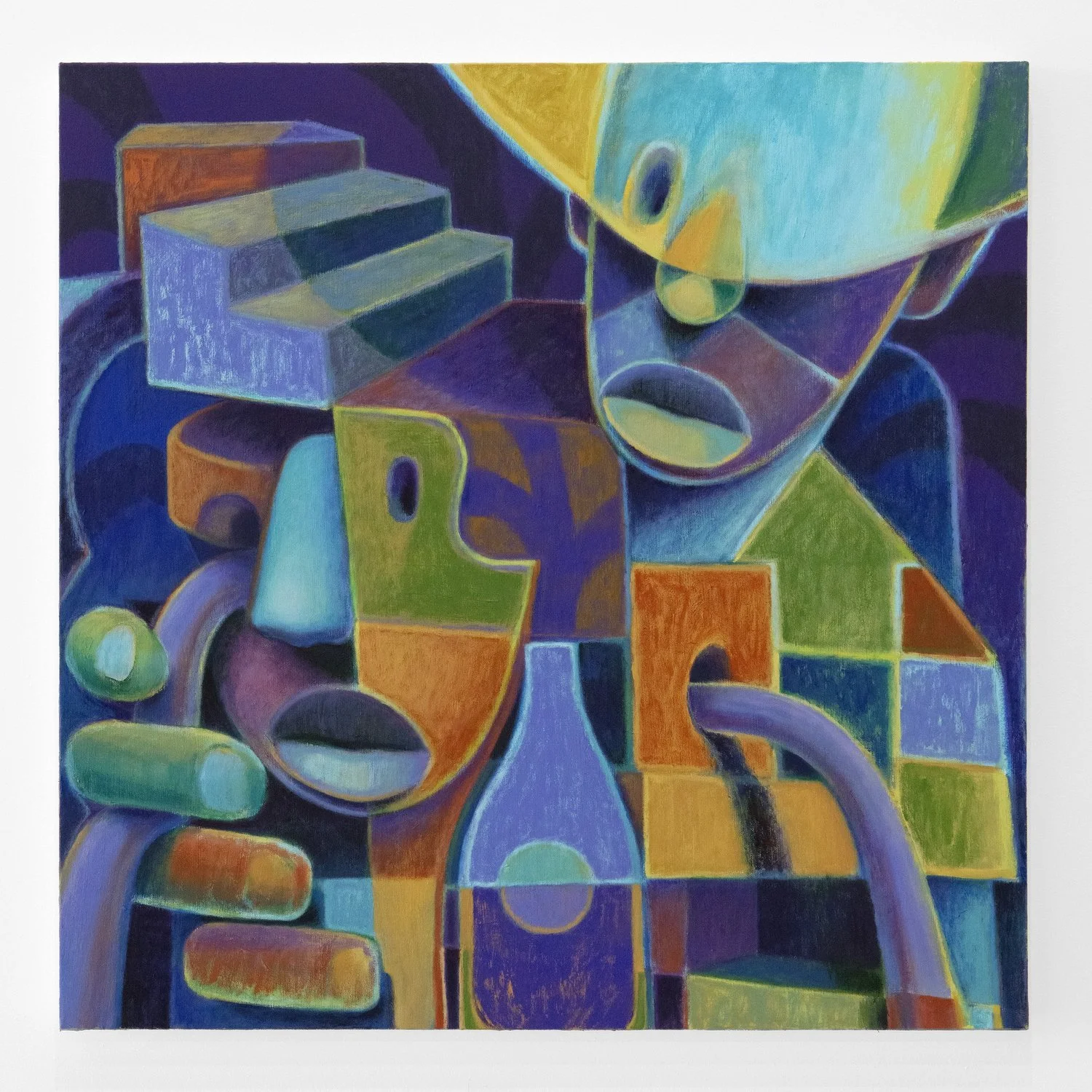
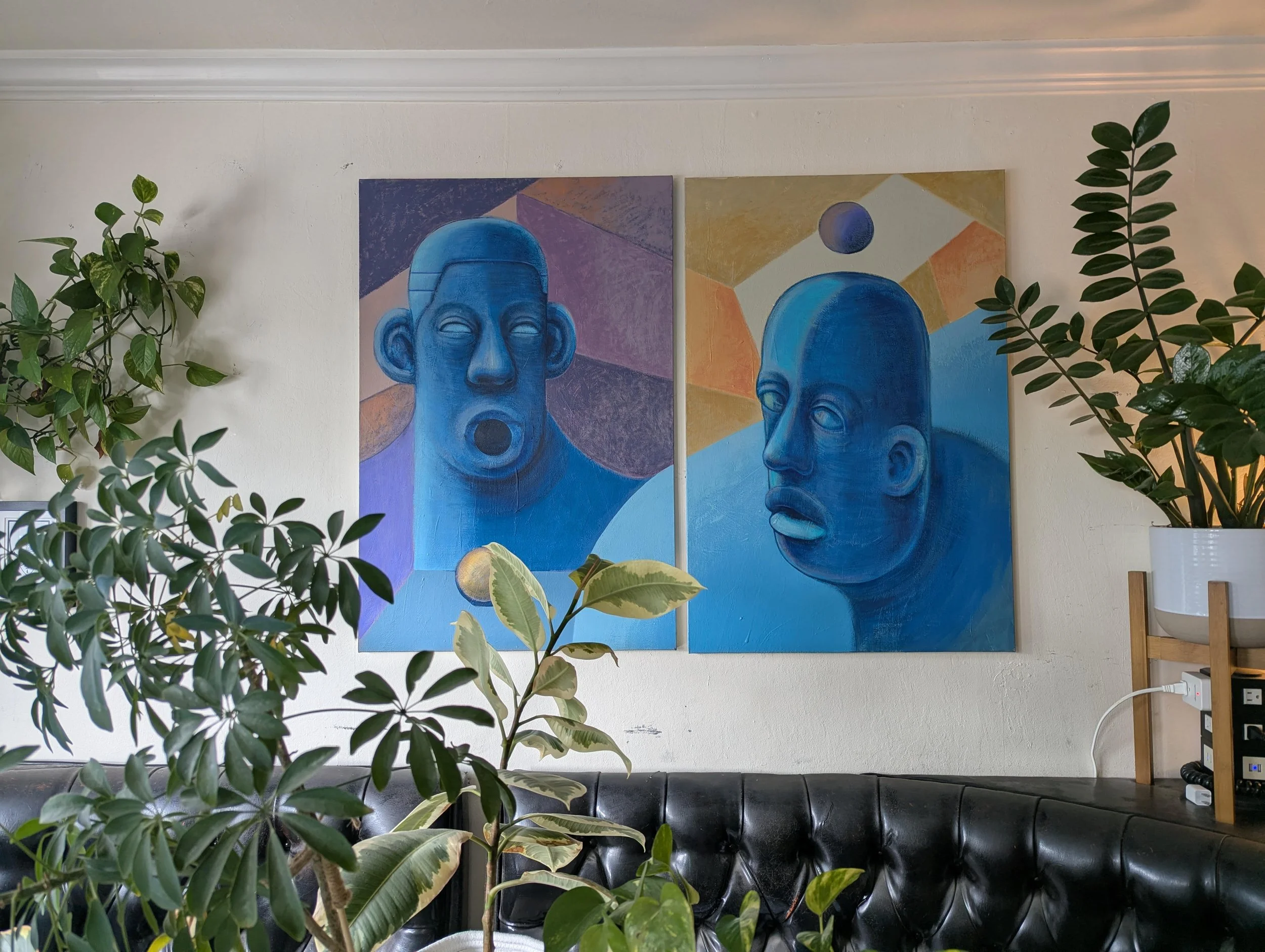
I’ve got a lot of art around the home, the actual canvases are my own, but I have a good number of prints and show opening posters and flyers from artists whom I know and whose work I love. It’s a blessing to be greeted with beauty and magic on a daily basis, so that art is integrated in the idiosyncrasies of being. A couple of examples is a framed flyer of a tooth brushing portrait by Emilio Villalba that lives in my bathroom, or another framed flyer of plated mackerel by Martha Shaw above my cat’s food bowls. The real benefit is my second home, my studio located in the BOH of Pt.2 Gallery. The entrance for the artists in the studio spaces is the same as for regular visitors so I am exposed to amazing artists and shows and am allowed to spend all the time and get intimate with the work without worrying that I'm hogging the view from others. I draw so much inspiration from that access.
Artists are increasingly expected to have an online presence and, in some cases, become their own publicist. How do you feel about social media? Has it helped your career, or does it sometimes feel like another job entirely? Any social media rules or tricks you abide by?
The social media thing has become more and more difficult for me. I really only used Instragram, but it has become less centered around the user’s preferences / curation, and transformed into this algorithmic, force-fed, attention apparatus. It seems like the primary conduit for self promoting projects, so it’s hard to not participate, but it’s not as exciting or fun to use unless you are messaging people directly. I only have it on my tablet at home, because it can be such a distraction during the day, and use it sparingly, since there are always so many more productive things I could be doing when I get home.
It’s difficult to talk about being an artist without talking about money. What does making a sustainable life as an artist look like to you? Do you think the art world is honest enough about the financial realities of being an artist?
Money and art right now has been tough, I think people are more fiscally conservative during war times and uncertainty. Living in the Bay Area is pricey, and I have only able to sustain my art practice with the help of a full time job. While it does take away a lot of time from my studio, it also affords me the freedom to purchase materials, space, and take care of logistics without stressing over costs.
What are you unwilling to compromise on in your work, even if doing so might make the work easier to sell?
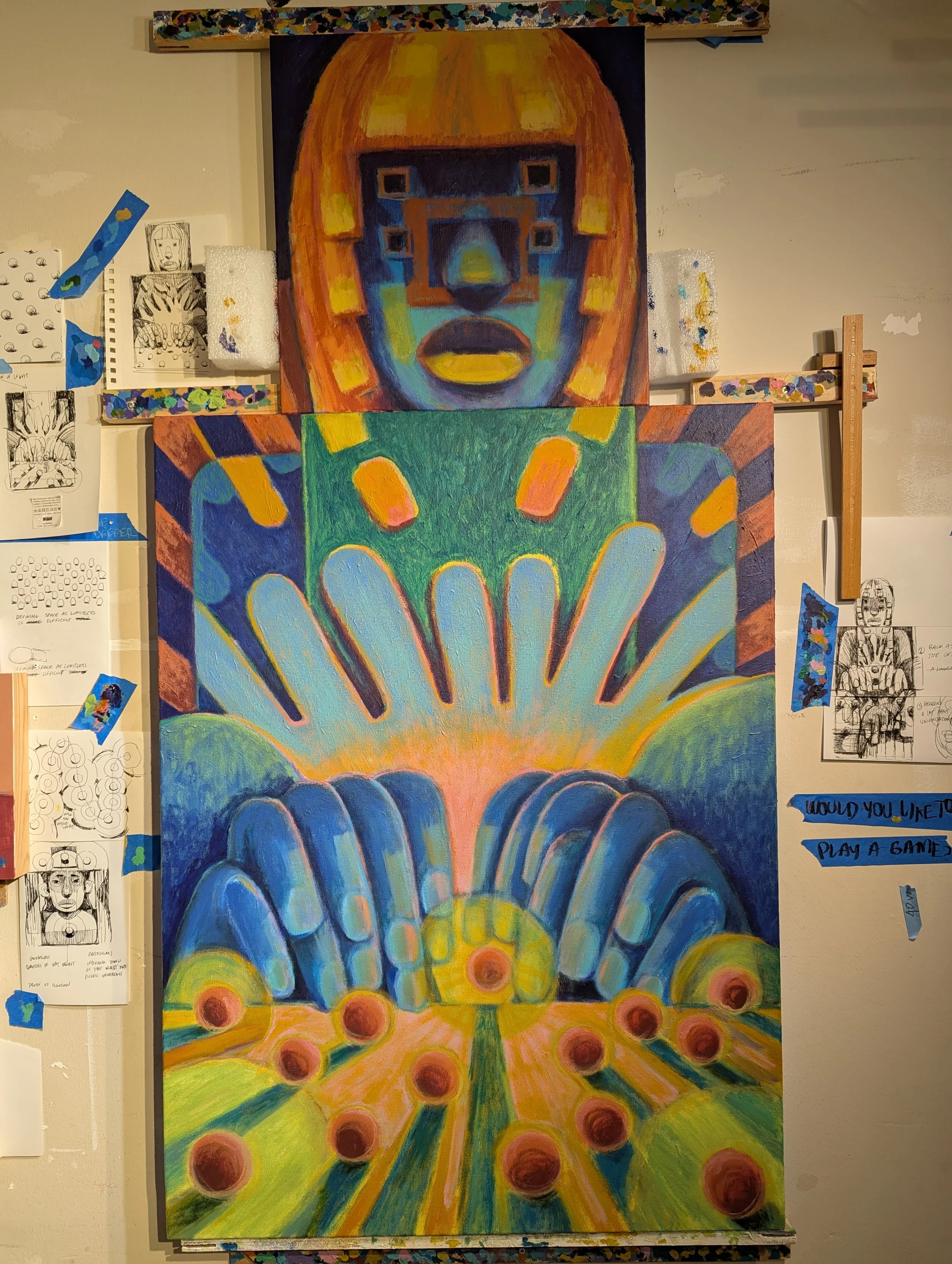
The way I paint is improvisational and intuitive, so I couldn't really paint with any formula. Since I work a lot from ink on paper sketches, there are rarely any color references, and rarely does the final image look anything like the beginning. There is so much editing going on in real time, the pressure of any outside approval or financial influence looming over any part of the decision making process makes me ill.
If you suddenly had unlimited money, space, and time to make one work or project, what would you make?
If I were somehow blessed with the time and opportunity / freedom to focus on a single specific work, I think I would opt for a large scale public sculpture. Something that would be unignorable by the community, similar to the effect of a monument or bridge. I think of people who miss out on the impact of the art due to the complexity of individual lives, and how useful it would be to fill that gap, if our lived environments were more united with public art and sculpture. In this fantasy, I imagine also being given the time and grace to learn from subject matter experts, theory, history, craft, and materiality.
What current art trend have you noticed and do you support it? Are there any fads or trends in the art world you believe will be fleeting?
I’ve only seen trends on social media, and not in real life so I dont really trust if I am seeing a real trend, or if they are the results of some misguided algorithm. Maybe I don't go to enough shows / group shows, but I feel like a lot of the work I am seeing appears subjective, genuine and unique.