
By Terri Cohn
“When the principles of perspective are reversed and solidified into sculpted paintings something extraordinary happens: the mind is deceived into believing the impossible, that a static painting can move of its own accord.”
—Patrick Hughes, Quotes About Art
Stepping into a gallery filled with Patrick Hughes’s work evokes the odd sensation of tumbling down Lewis Carroll’s rabbit hole. While I couldn’t initially figure out why, I began to feel genuinely dizzy as I walked through Scott Richards Gallery, experiencing Hughes’s starkly realist still lifes and landscapes. This experience seemed to mimic sequences in Alice in Wonderland where Alice drinks a magic potion and eats a piece of cake, causing her physical environment to expand, contract, and twist in direct defiance of natural logic.
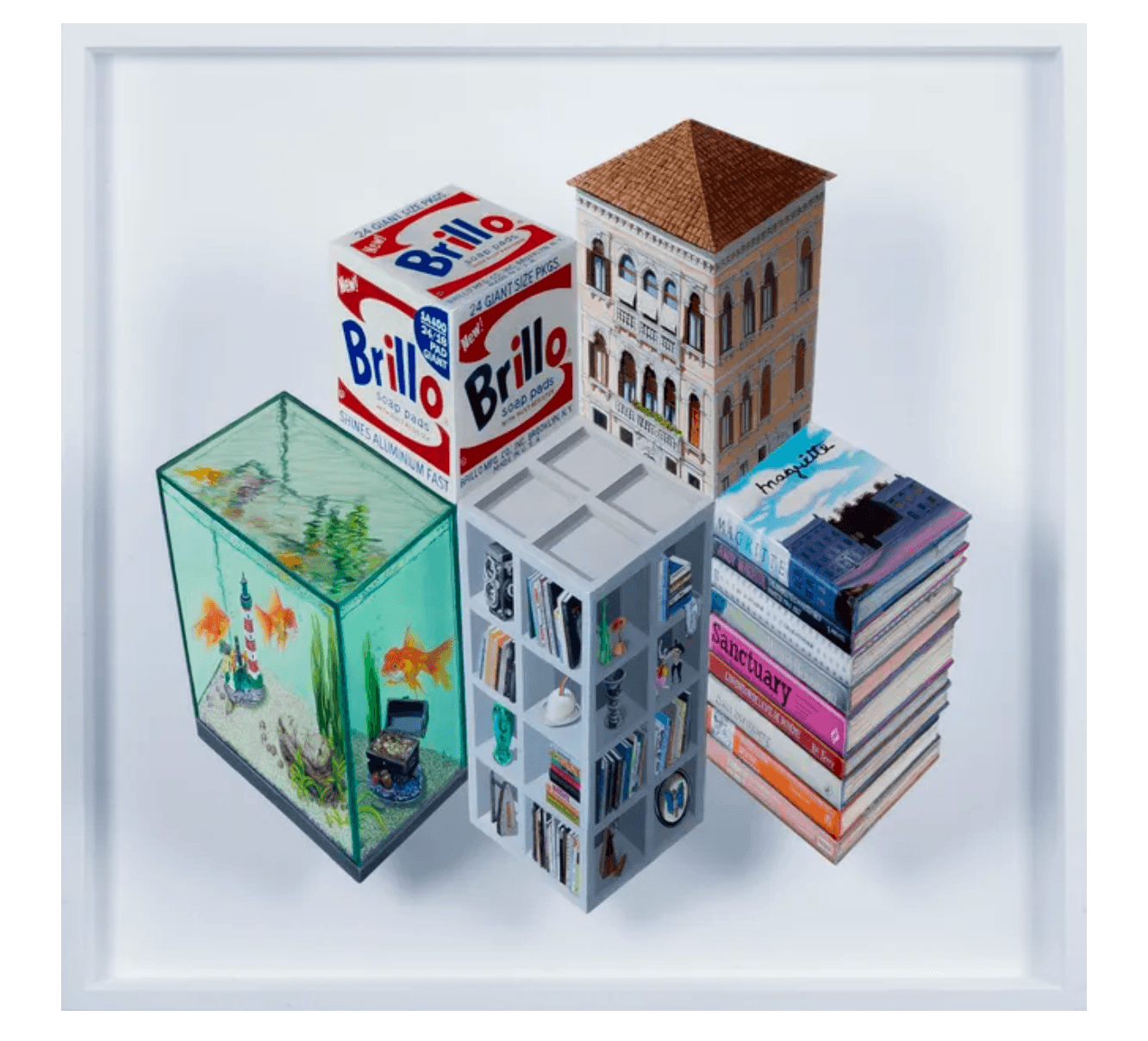
Patrick Hughes, The Rule of Five, 2026, oil on board construction, 32-1/2 x 31-1/2 x 11”
This optical disorientation has profound and poignant roots. Born in England in 1939, Hughes spent part of his childhood sheltering from World War II air raids beneath his grandparents’ staircase. Looking up at the underside of the stairs, he became fascinated by its inverted architecture—a configuration he later described as “stairs that only a spider could walk up.” In another room, two opposing mirrors produced an endless sequence of reflections, offering an early experience of infinite space. These childhood encounters with spatial reversal and optical illusion were formative for Hughes’s artistic imagination.
Hughes’ early experiences also fostered his lifelong passion for books, which offered another kind of escape, and left him looking at the world “the wrong way round.” These experiences also situate Hughes within a lineage of visual paradox, bringing to mind the surreal perspectives of Giorgio de Chirico and the subversive wit of René Magritte. He was also drawn to M.C. Escher’s impossible geometries, which helped shape his signature technique of “reverspective.” Hughes paints on wooden panels that project outward, reversing the conventions of linear perspective: what appears distant in the painting is closest to the viewer.As viewers move around the work, its apparent depth and perspective shift, unsettling their sense of space and distance. More than a visual trick, the effect can be physically disorienting, even inducing nausea.
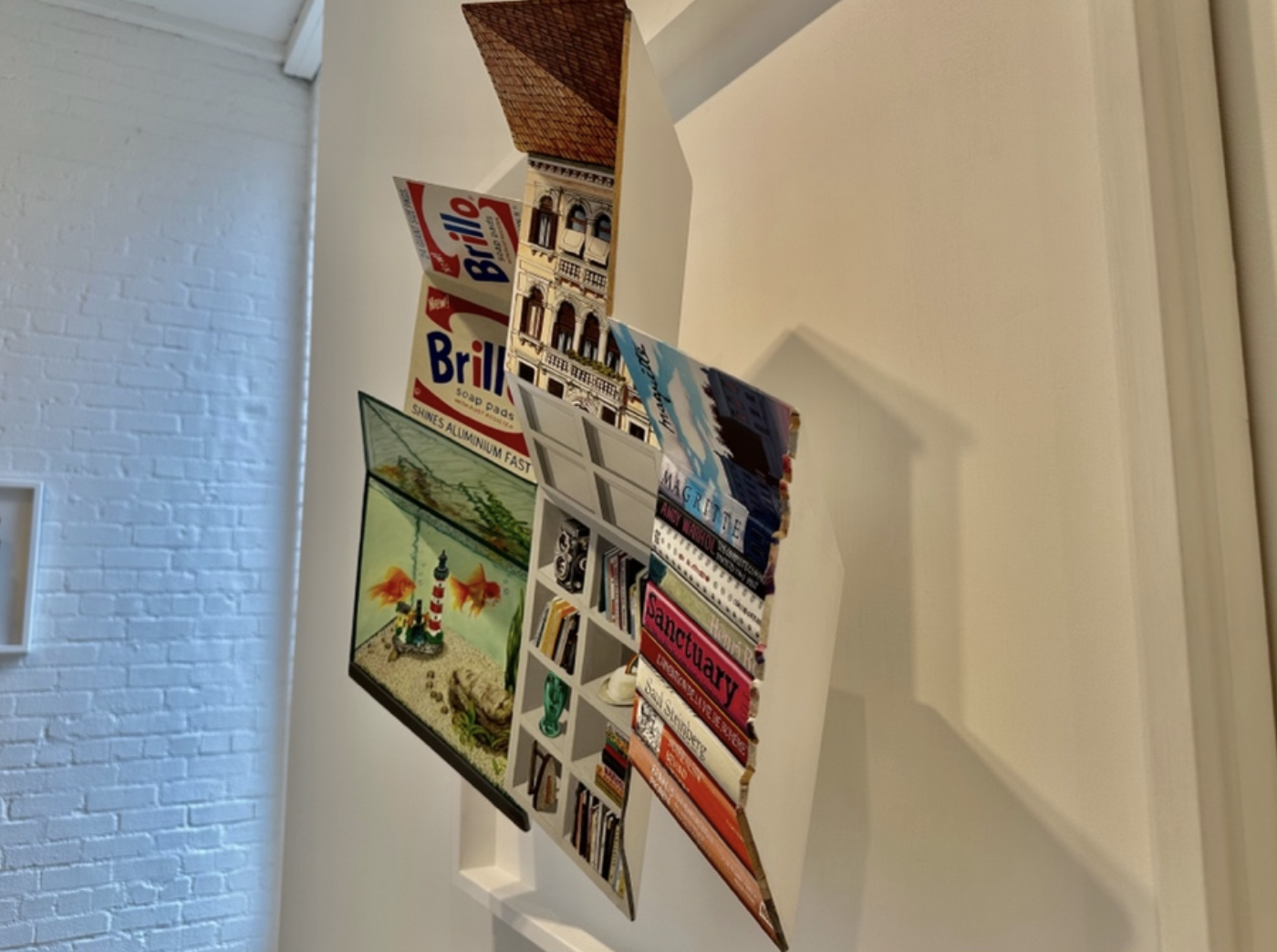
Patrick Hughes, The Rule of 5, 2026, oil on board construction, 32-1/2 x 31-1/2 x 11”, Photo by Terri Cohn
Once you stabilize your footing in the gallery’s “wonderland,” you encounter Hughes’s conceptual wit. In works like Box Fresh and Love Books (both 2026), he creates dialogues between physical objects and cultural memory. By juxtaposing a trompe l’oeil Warhol Brillo box and a Robert Indiana LOVE sculpture with art history monographs dedicated to those same artists, he constructs interactive archives. As you look at the iconic object, read the adjacent book spines, and move around the piece, you find yourself caught in a continuous loop: the physical artwork points to the history book, which in turn validates the artwork.
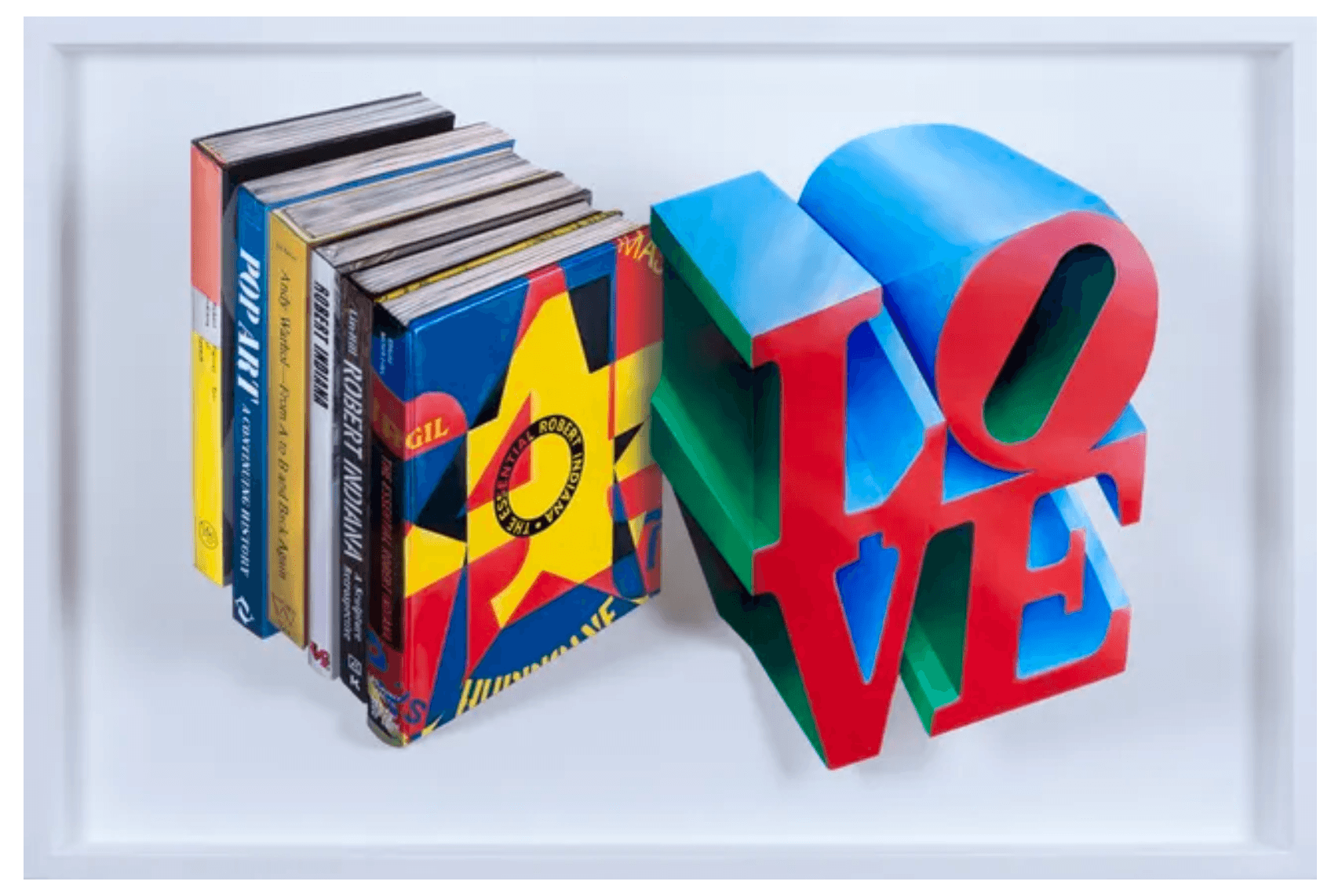
Patrick Hughes, Love Books, 2026, oil on board construction, 24 x 36 x 13”
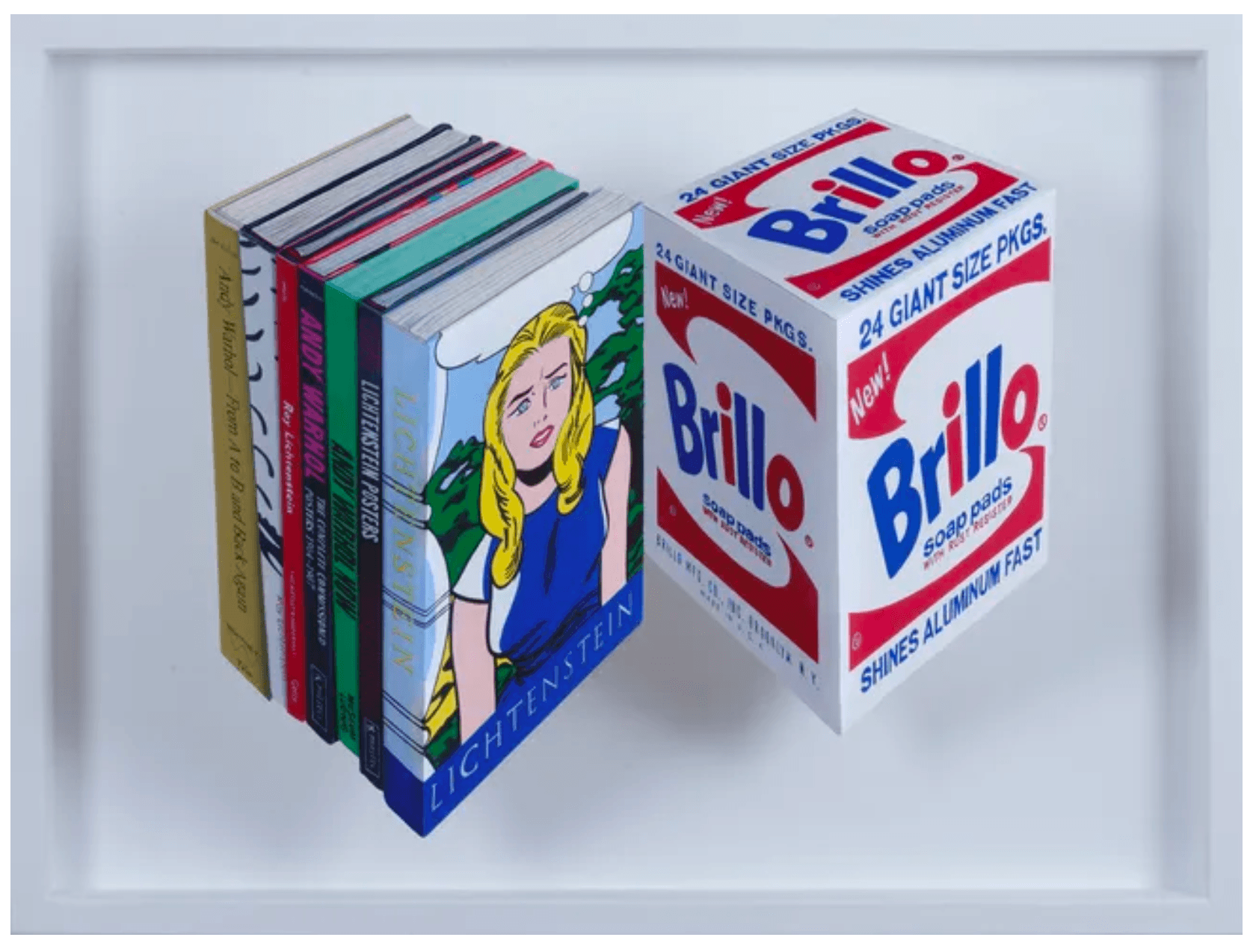
Patrick Hughes, Box Fresh, Oil on board construction 19 1/2 x 26 x 10 inches
In Books of Babel, this impulse becomes a celebration of Hughes’s pleasure in literary association. The titles on the stacked books read like a conceptual playlist, chaining together into a living linguistic landscape. For me, Books of Babel serves as the centerpiece of the exhibition. Its pyramidal form rises from evocative titles such as Paradox, Pun, Perspective, and Contradiction near the base, to Surrealism and Infinity near the top, with Poetry, Geometry, and Imagination among the ascending titles. The work is both playful and profound, and evokes the Tower of Babel as a metaphor not only for the confusion of language, but for the physical instability of perception itself. As you walk past, the books appear to shift, warp, and move on their own, evoking the biblical builders who suddenly could not understand each other or their reality. Viewers experience the inability to fully trust their perceptions and what they are seeing.
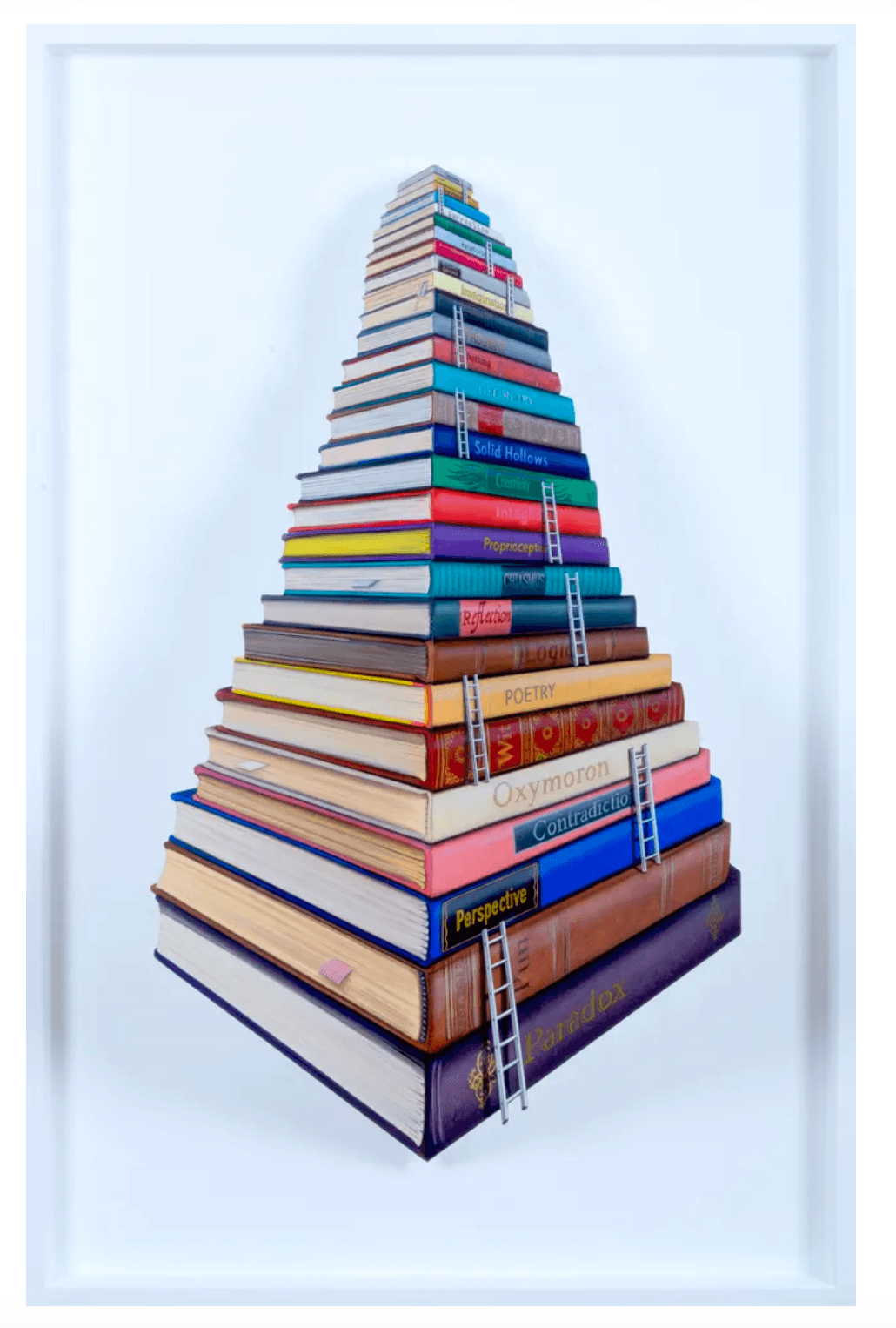
Books of Babel, 2026 Oil on board construction, 41 3/8 x 29 1/2 x 9 7/8 inches
In his Vuittons series (2025), the boundaries of reality stretch even further. Here, Hughes targets the heavy, grounded luxury of classic travel trunks. Hundreds of hand-painted monogram details and weathered vintage travel stickers wrap around strategically stacked luggage. Yet his three-dimensional construction unmoors their physical weight. Because of how the perspectives fold in the relief, the heavy leather and brass trunks seem to break free from gravity and float effortlessly in mid-air, a striking visual metaphor for the transportive, weightless spirit of travel itself, suspended in empty space.
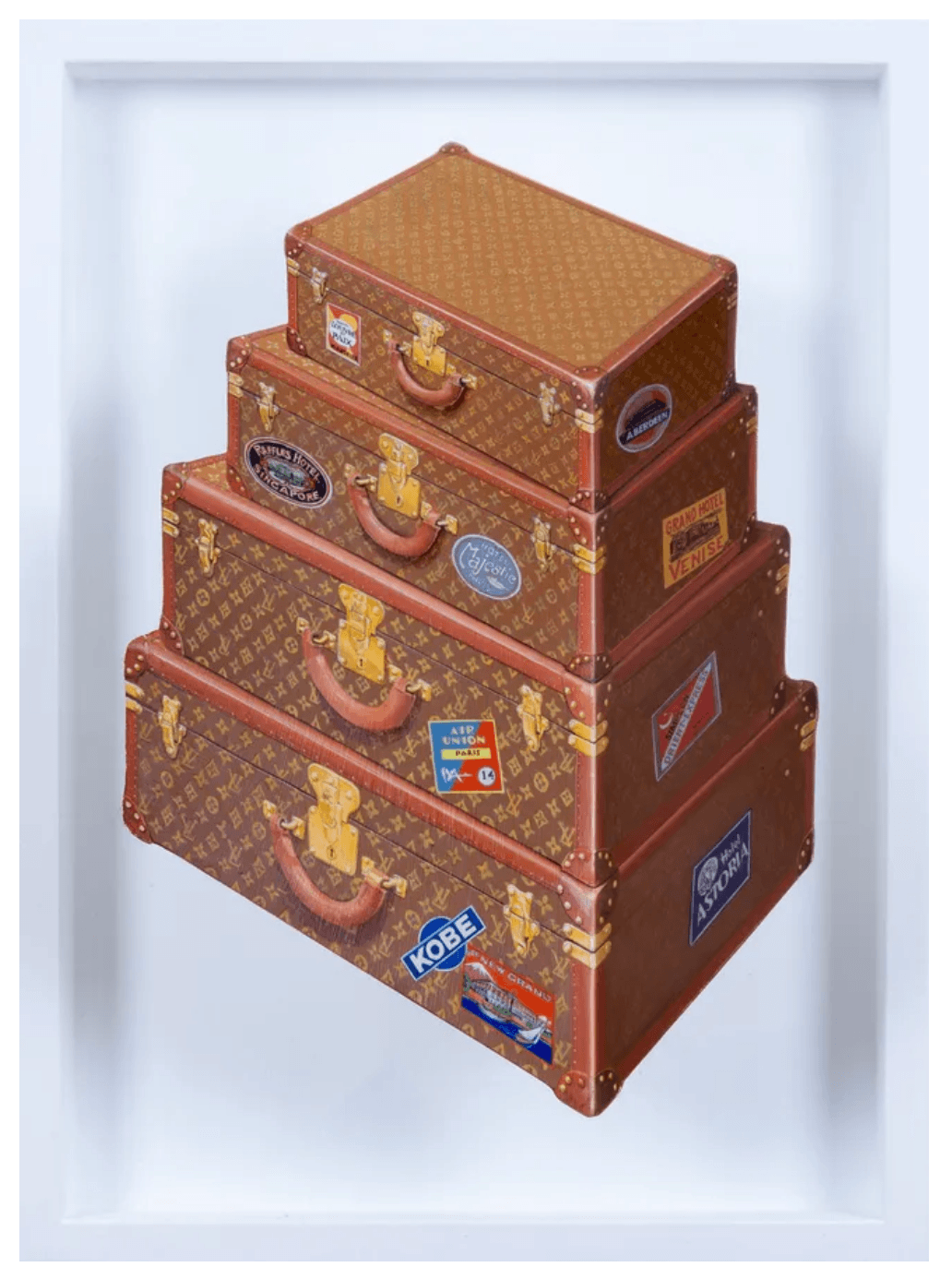
Vuittons, 2025, oil on board construction, 22-3/8 x 16 3/8 x 11 1/4 in
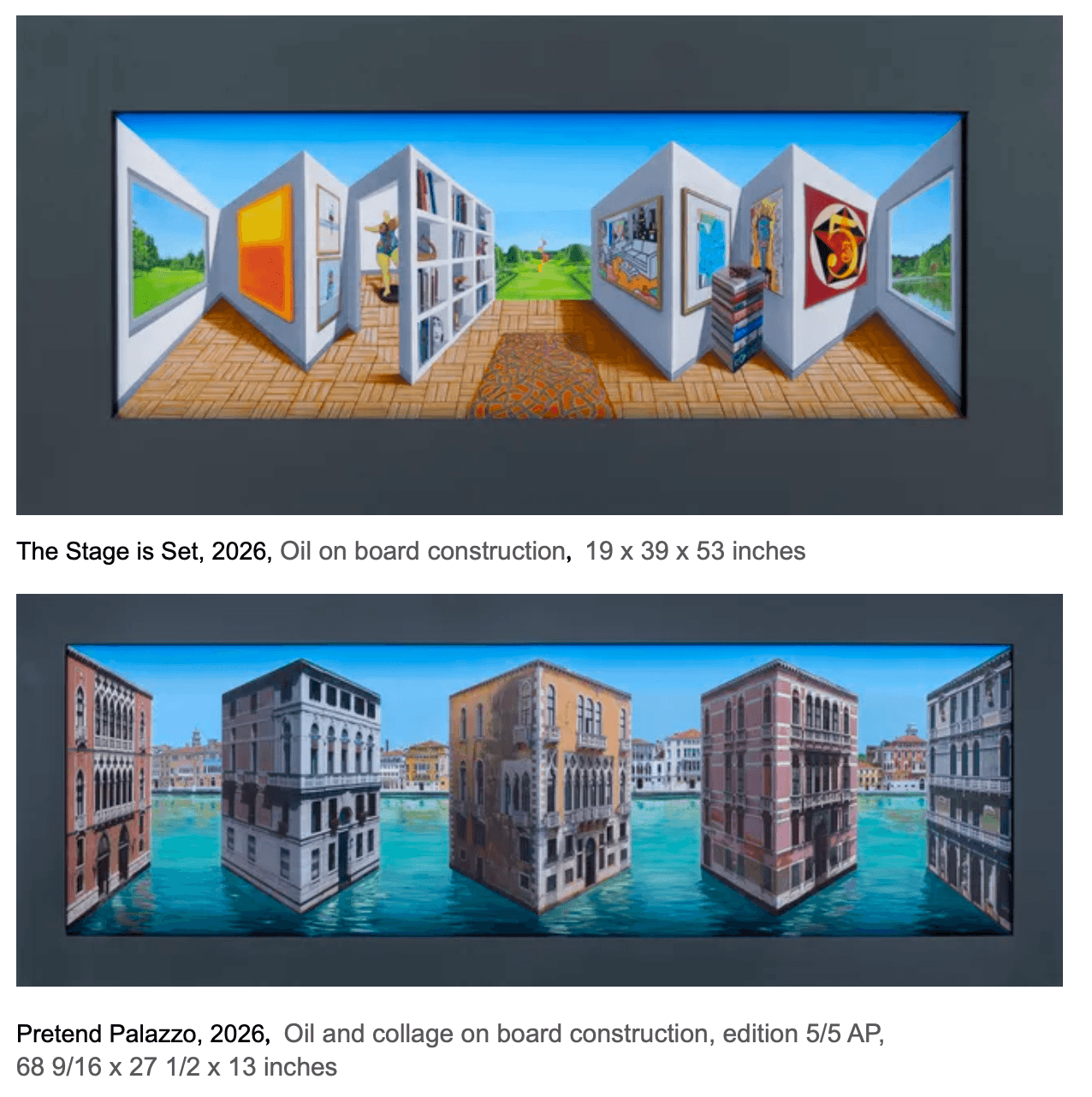
This cerebral wordplay and floating imagery shift from a conceptual puzzle to a deeply visceral challenge when you face Hughes’s grand architectural pieces, such as The Stage is Set and Pretend Palazzo. Here, his signature reverspective technique moves beyond visual playfulness and again triggers a genuine sensation of vertigo. I spent a significant amount of time studying Pretend Palazzo, walking back and forth to analyze why I felt so physically challenged, even videotaping myself to understand how the architecture seemed to shift. It recalls the “Mona Lisa effect,” in which a subject’s eyes seem to follow you as you move through a gallery. Except with Hughes, it isn’t just a pair of painted eyes tracking you—it is an entire palace. The walls pivot, the colonnades rotate, and the whole structure turns its head to watch you move, upending logic, balance, and scale.
While Hughes has long focused on European art and optical traditions, this exhibition also includes works specific to American artists and institutions. NYC MOMA and SF MOMA (both 2026) reimagine those museums as reverspective structures, folding iconic artworks and architectural spaces into single, shifting images. By bringing these institutions into his play with perspective, Hughes invites us to reconsider not only how we see art, but also how art history itself is constructed, layered, refracted, and always subject to changes in viewpoint.
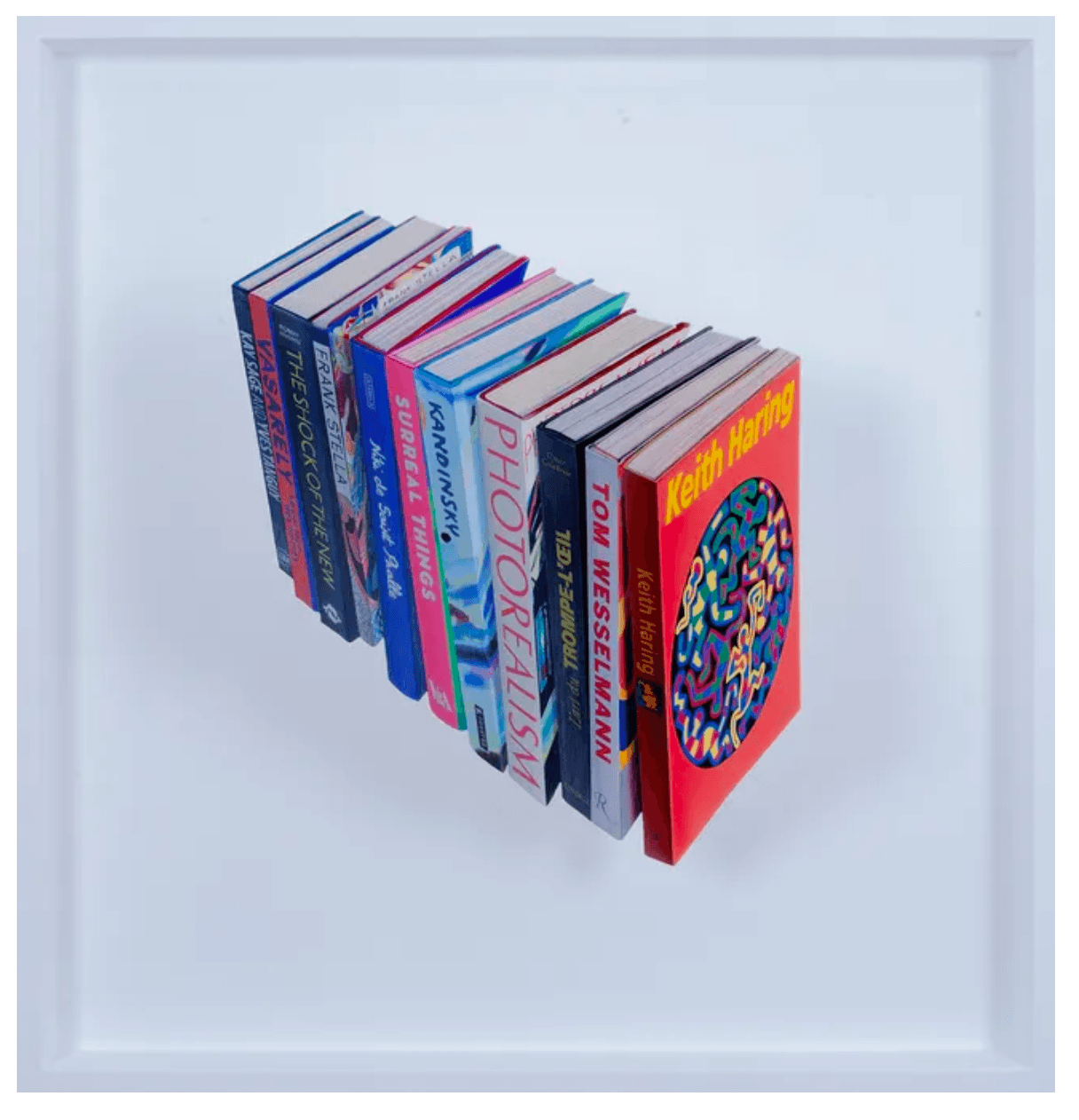
NYC MOMA, 2026, Oil on board construction 32 9/16 x 31 7/16 x 12 inches
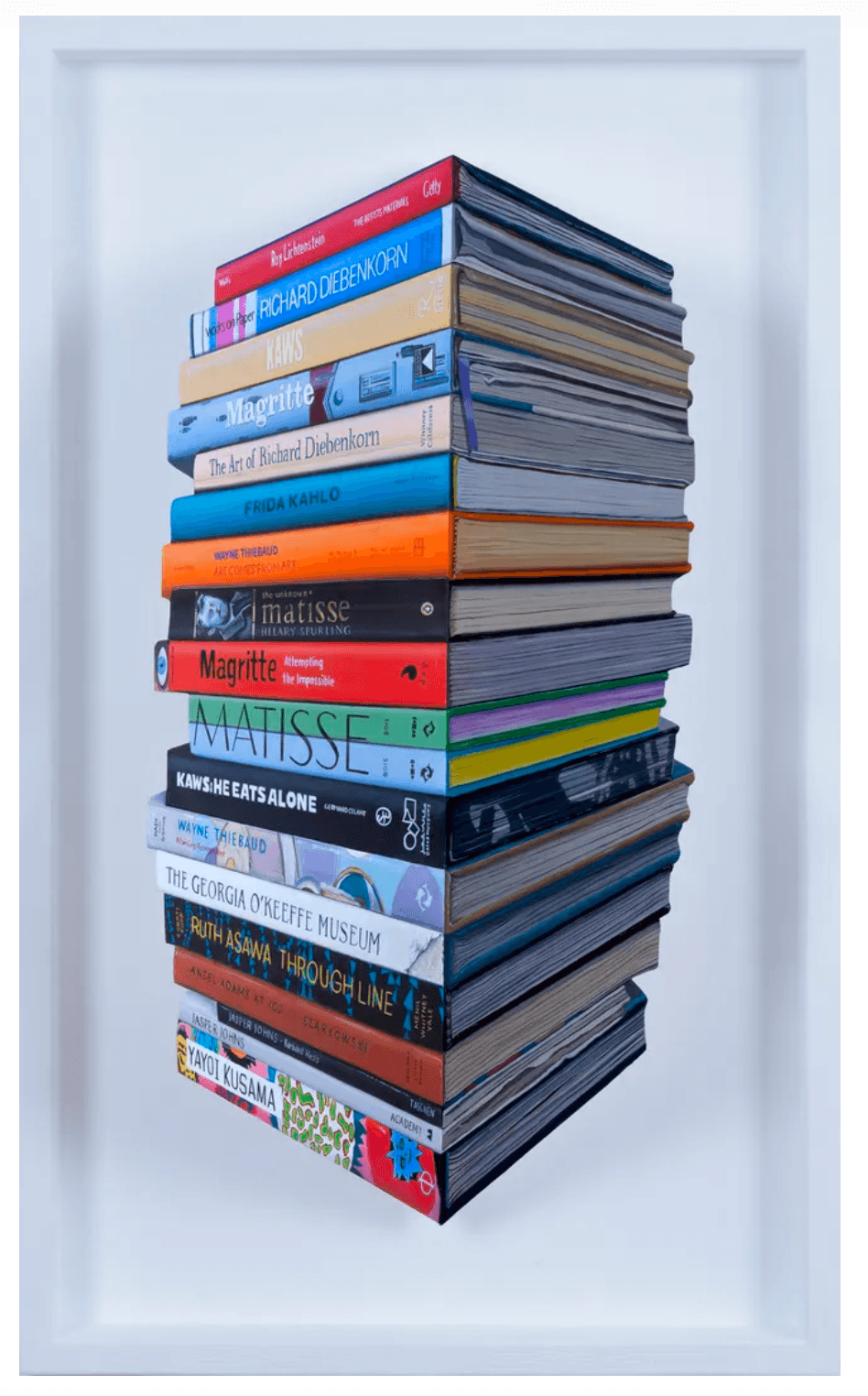
SF MOMA,2026, Oil on board construction, 30 1/16 x 18 3/8 x 10 inches
