
Hilda Robinson: Retrospective, Beth Van Hoesen: Felt Through Line, and Walking the Quiet: A Collaborative Commission by Zach Clark, St. Mary’s College Museum of Art
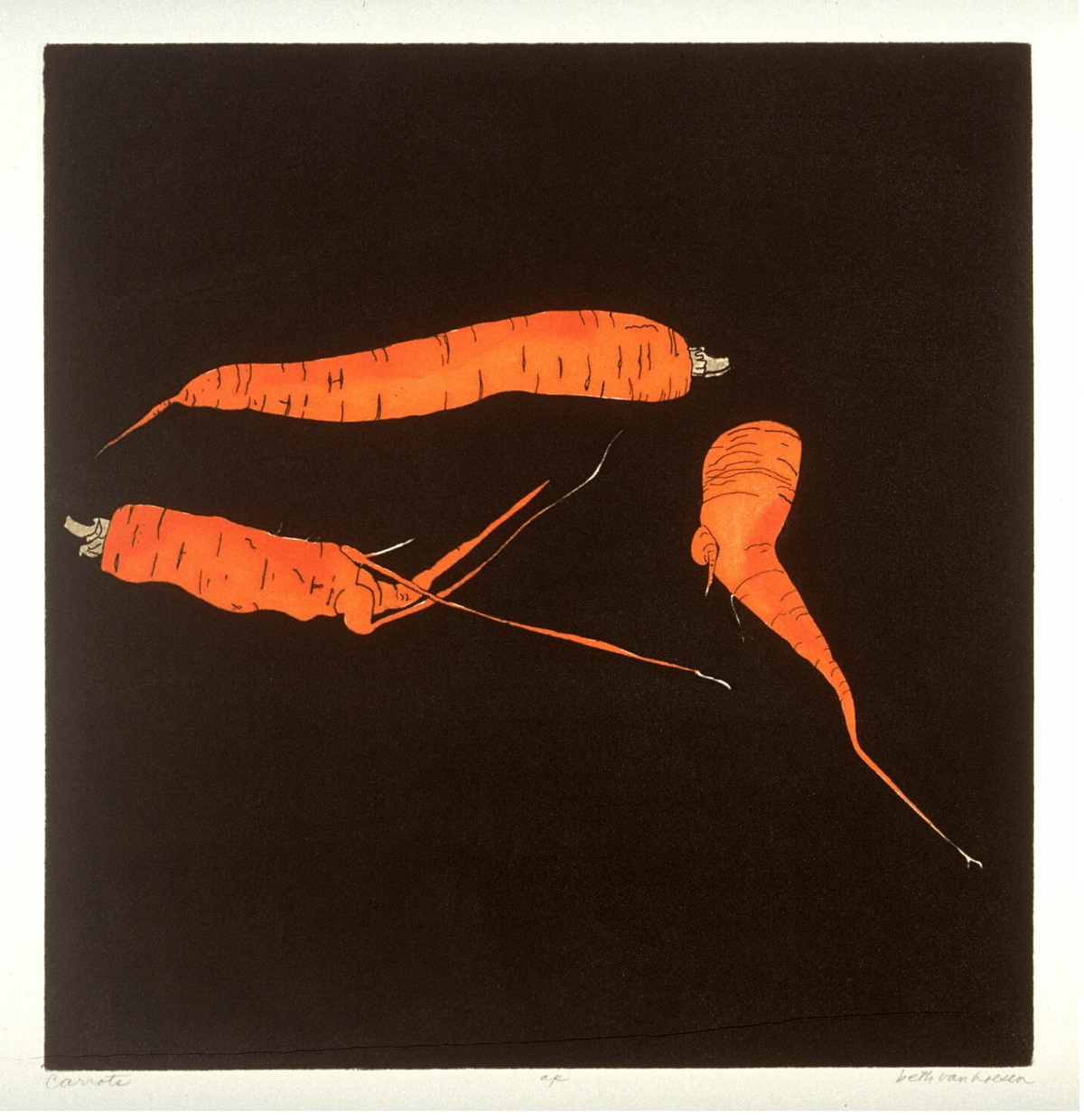
Beth Van Hoesen, Carrots, etching, 1971
By Robert Brokl
Intentional or not, pairings can have surprising results. Case in point, St. Mary’s College Museum of Art, in Moraga, featuring, the first retrospective of Hilda Robinson (1928-2023), Black American and Oakland-based artist, and Felt by Line, work by printmaker Beth Van Hoesen (1926-2010), through June 21, 2026. The contrasts are stark over careers, attitudes, audience and style.
The Van Hoesen selection is the result of the gift to the museum of over 100 artworks from the Mark Adams and Beth Van Hoesen Adams Trust, part of a distribution to museums and other institutions nationally. The Hilda Robinson retrospective arrives three years after her death in 2023, age 95. Most of the narrative drawings on display are loaned by her immediate family or friends.
The Robinson exhibit is in collaboration with the St. Mary’s College Office of Inclusion and Belonging, and Robinson is an ideal candidate for more exposure. She took art classes at Tyler Art College in Philadelphia, her birthplace, worked as a professional dancer New York City, then moved to the Bay Area. In her 50s, she attended UC-Berkeley where she received her B.A. in 1978 and M.A. in 1980. Her formative influence at the school was figurative painter Joan Brown, who encouraged her use of oil pastels, pastels mixed with non-drying oil and wax binder. Like Brown, she reveled in color, her palette is bold and bright—gray was not in her vocabulary. She also chose personal subject matter: “My work is about community, I am present in this community.”
Beth Van Hoesen

Beth Van Hoesen (1926-2010) From Mt. Angel [From Mount Angel, Oregon], 1973, Aquatint, etching: Printer’s ink on paper, Press/Printer: Gwen Gugell, 7 ⅞ x 15 ⅞ inches, Gift of the E. Mark Adams and Beth Van Hoesen Adams Trust, Saint Mary’s College Museum of Art Permanent Collection, 2025.2.35
Van Hoesen’s history was of different sort—born in Boise, Idaho, she first studied at Stanford. Married to artist Mark Adam in 1952, and in 1955 they both moved to France where he studied with a famous textile designer, Jean Lurçat, in Saint Céré. She assisted, and both were influenced by the textile design process to simplify their imagery. Upon their return to San Francisco, she enrolled at the California School for the Arts, studying under Clyfford Still and David Park. She began to focus exclusively upon printmaking in 1956, specifically etching, relying upon the best fine art printmaking presses to produce her work. The printers and presses are credited on the wall labels.
Felt though Line benefits from the numerous prints from early in her career, before the better known tour-de-forces to follow, well-known now from reproductions and exhibits—Sally the rabbit, the roosters, and amusing dogs, etc. Earlier on, etchings such as Collector (!963) share Edward Gorey’s enthusiasm for overstuffed interiors, but without his undercurrents. Her wit is on display in her Fleischhacker Pool (the open air saltwater pool in San Francisco, closed in 1971) with minuscule figures in the exaggeratedly vast body of water, produced in 1966 at Kathan Brown’s soon to be renowned Crown Point Press, From Mt. Angel (1973), and Field Games (1958-59), even a Pop Art candy box. Racoon (sic) Straits (1965) revisits the Tiburon landscape explored earlier by Society of Six artists.
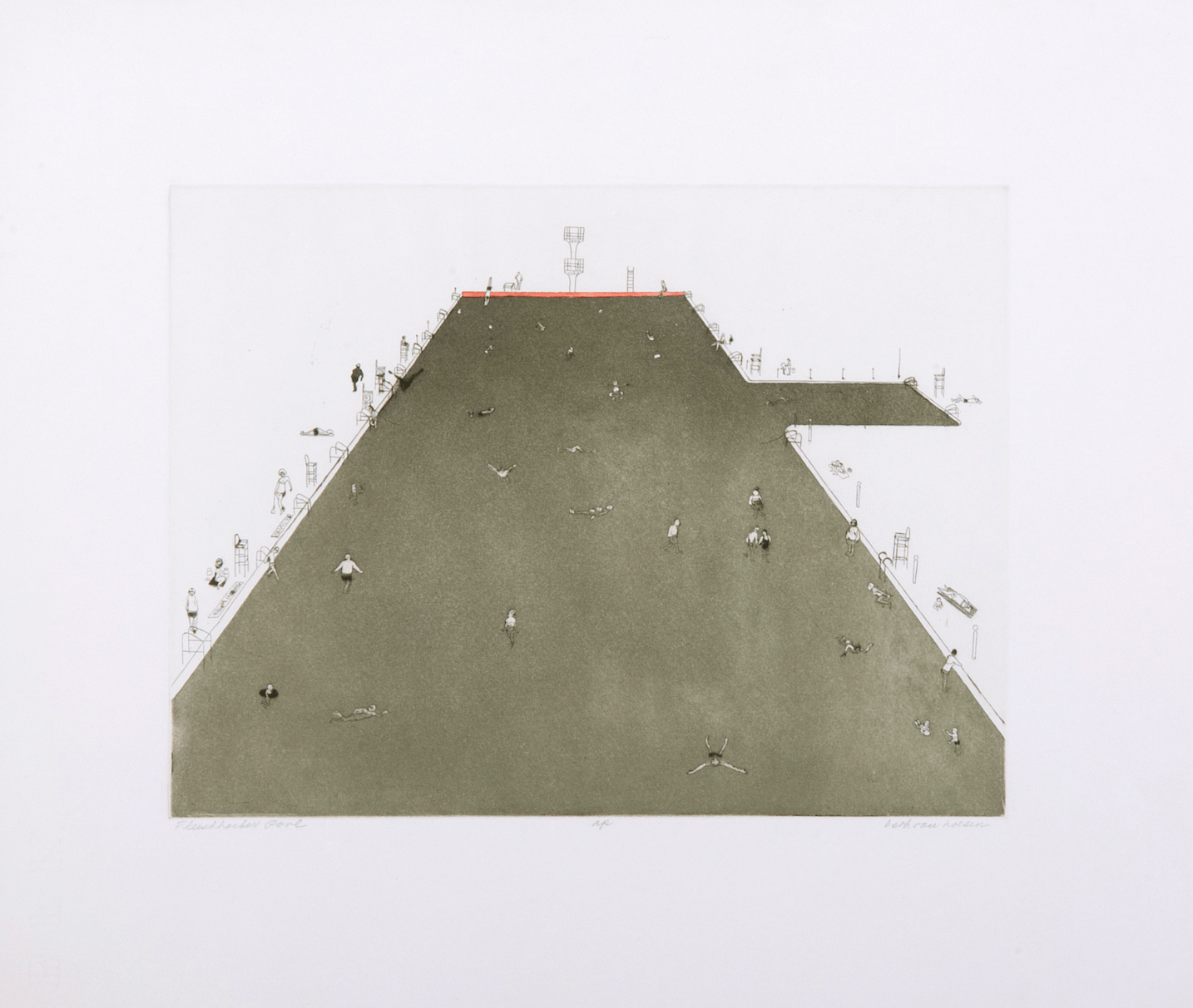
Beth Van Hoesen (1926-2010), Fleishhacker Pool, 1966, Etching and aquatint, printed with retroussage: Printer’s ink on paper, handcolored with watercolor, 11 ¼ x 15 inches, Press/Printer: Crown Point Press, Gift of the E. Mark Adams and Beth Van Hoesen Adams Trust, Saint Mary’s College Museum of Art Permanent Collection,2025.2.31
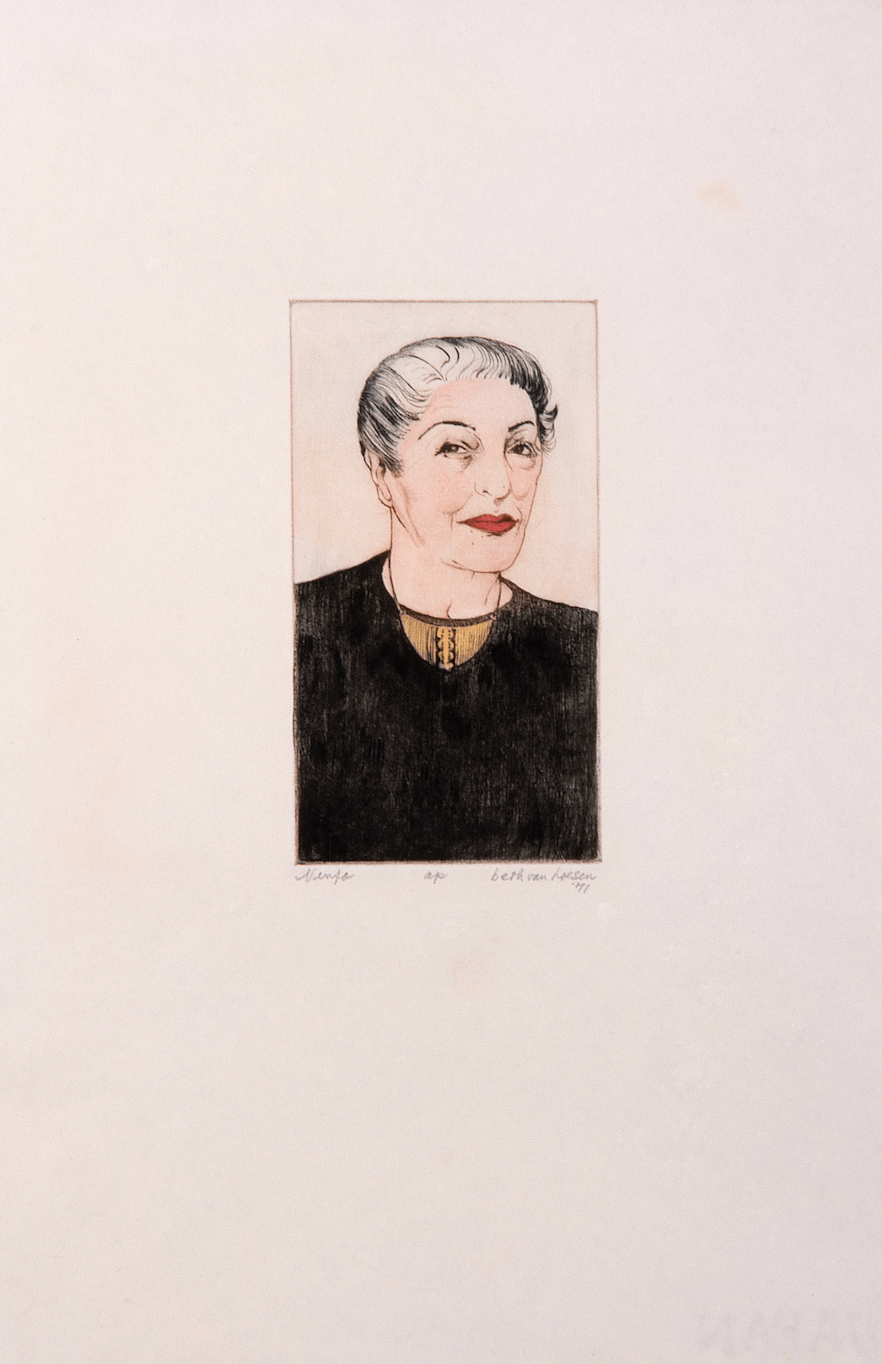
Beth Van Hoesen (1926-2010), Ninfa,1971, Drypoint with roulette: Printer's ink on paper, hand colored with watercolor, Press/Printer: Artist, 6 ⅞ x 3 7/16 inches, Gift of the E. Mark Adams and Beth Van Hoesen Adams Trust, Saint Mary’s College Museum of Art Permanent Collection, 2025.2.52
In 1959, Adams and Van Hoesen paid $7500 at auction for a 1910 firehouse at 22nd and Castro Street in San Francisco—affordable, she maintained, because no one wanted it, renovated for living and work space. They were a formidable San Francisco artworld power couple, and exhibited regularly at blue-chip galleries like John Berggruen Gallery. Van Hoesen’s work was collected by institutions from the Metropolitan Museum of Art to the Bone Creek Museum of Agrarian Art, in David City, Nebraska (an image of sow and piglets). Their drawing sessions with live models or themselves as subjects included the likes of Wayne Thiebaud, William Theophilus Brown, Ruth Asawa, and Gordon Cook. Indeed, the large flower drawings showcased at the recent Asawa SFMOMA retrospective keep company with Cook’s spidery plants and Van Hoesen’s Cornflowers (1959). Friendship infuses the affectionate Imogene Cunningham portrait (1971-84), Ruth’s Faces (clay masks, 1966), and Ninfa (1971), a Fine Arts Museum curator, nearly a caricature of chic sophistication. A forerunner of the more imposing in scale and ambition productions she’s best known for—subtle washes of aquatint backgrounds and sure line—occurs with Carrot (1971), suggesting an elegant Chinese famille noire porcelain, with quirky, oddly shaped carrots on a rich black background, and vivid Halloween colors.
Hilda Robinson
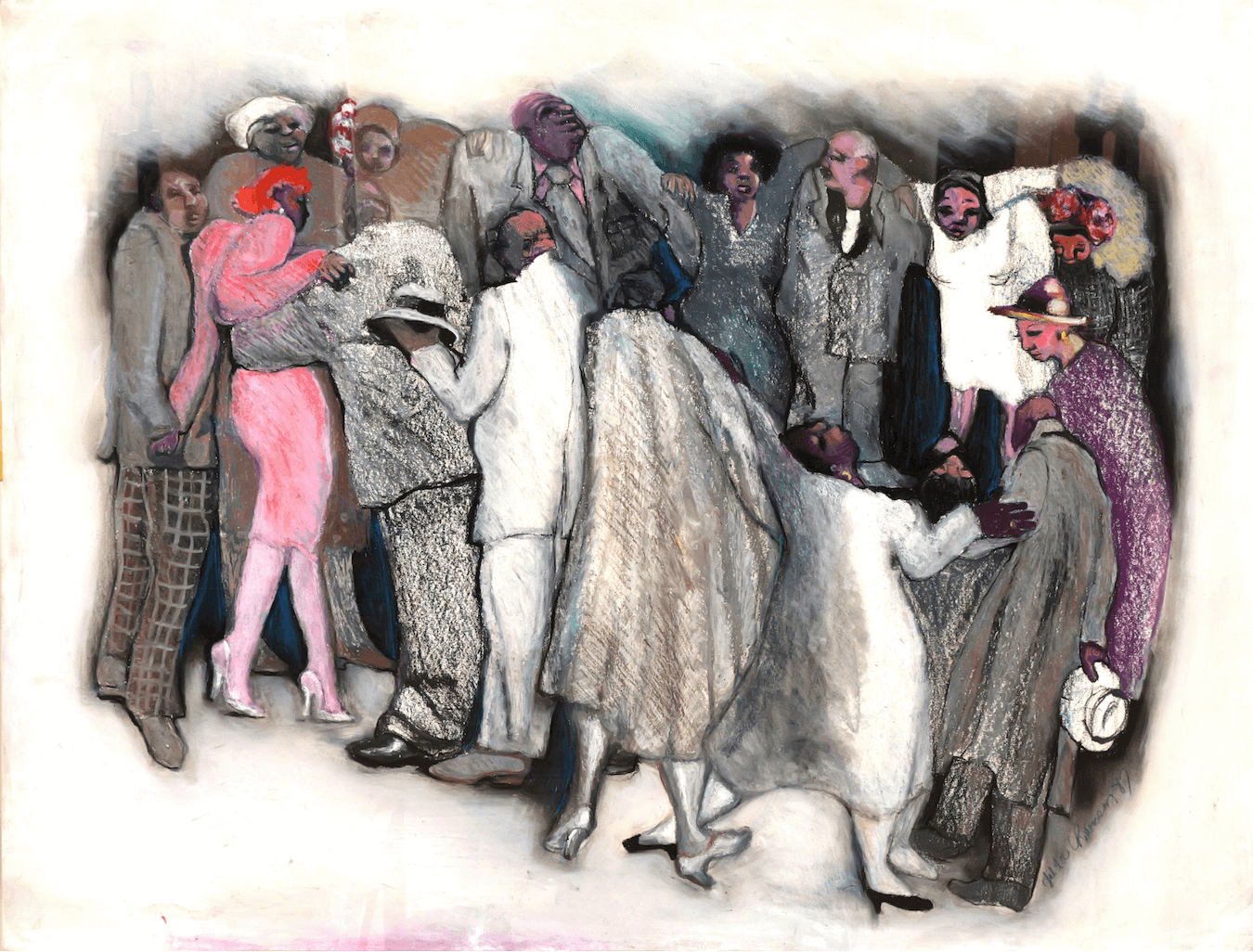
Hilda Robinson (1928-2023), Benediction, 1987, oil pastel on paper, 40 3/4 x 52 ¾ inches, Courtesy of the Bishop Family
Robinson’s focus is upon Black Americans, with few exceptions out and about, at play and in celebration. Her compositions are crowded but don’t feel cramped, with figures placed top to bottom, no foreground/background, like Chinese landscape painting, stacked and flat. Farmers’ Market (2017), collection of the Alameda County Art Commission, is a fine example of a community gathering, dense with detail and close observation. In the 2022 YouTube video, An Emerging Artist, Robinson declared, “Being a black person in the world is easy for an artist because the subject matter is there—it’s active, it’s colorful, and I work with that color, with that activity, and the movement of my people.”
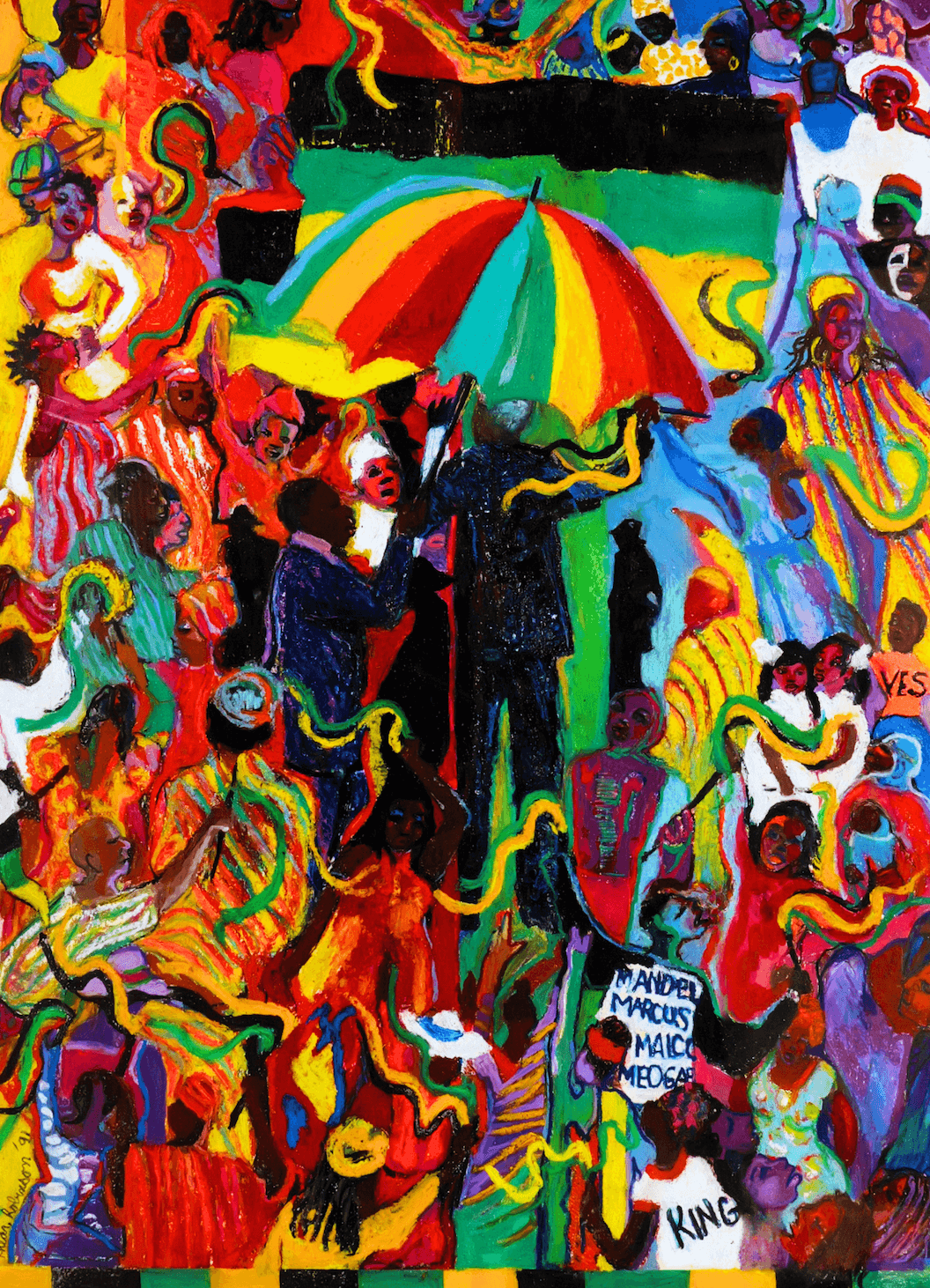
Hilda Robinson (1928-2023), Mandela, 1991, oil pastel on paper, 54 x 42 inches, Courtesy of the Bishop Family.
Robinson mentions the colorful clothing of fellow public transit riders as sources, and her dance background is apparent in several pieces, notably (Untitled) Diner (1986) and Benediction (1987)—figures swaying and jumping, alive and exuberant, resembling Ernie Barnes’ The Sugar Shack, 1976. An oft-cited influence is also Harlem Renaissance painter Archibald Motley, also noted for figures in motion. Joan Brown’s criteria for evaluating students’ work often boiled down to “energy,” the more of it the better. No wonder she sponsored Robinson! And the energy didn’t diminish—Porch was completed in 2023, her last year of life.
The curators suggest Robinson is illustrating the “Third Places” concept of sociologist Ray Oldenberg, portraying environments, outside home and work, where people can gather like “churches, cafes, hair salons, and libraries across generations and economic boundaries.” Columbia professor/author George Chauncey’s 1994 Gay New York: Gender, Urban Culture, and the Making of the Gay Male World 1890-1940 documents the practice, similar and different, of claiming public spaces by another minority: “…privacy could only be had in public…in the streets…”, restaurants and cafeterias, parks, and beaches, away from the prying or hostile eyes of family and neighbors.
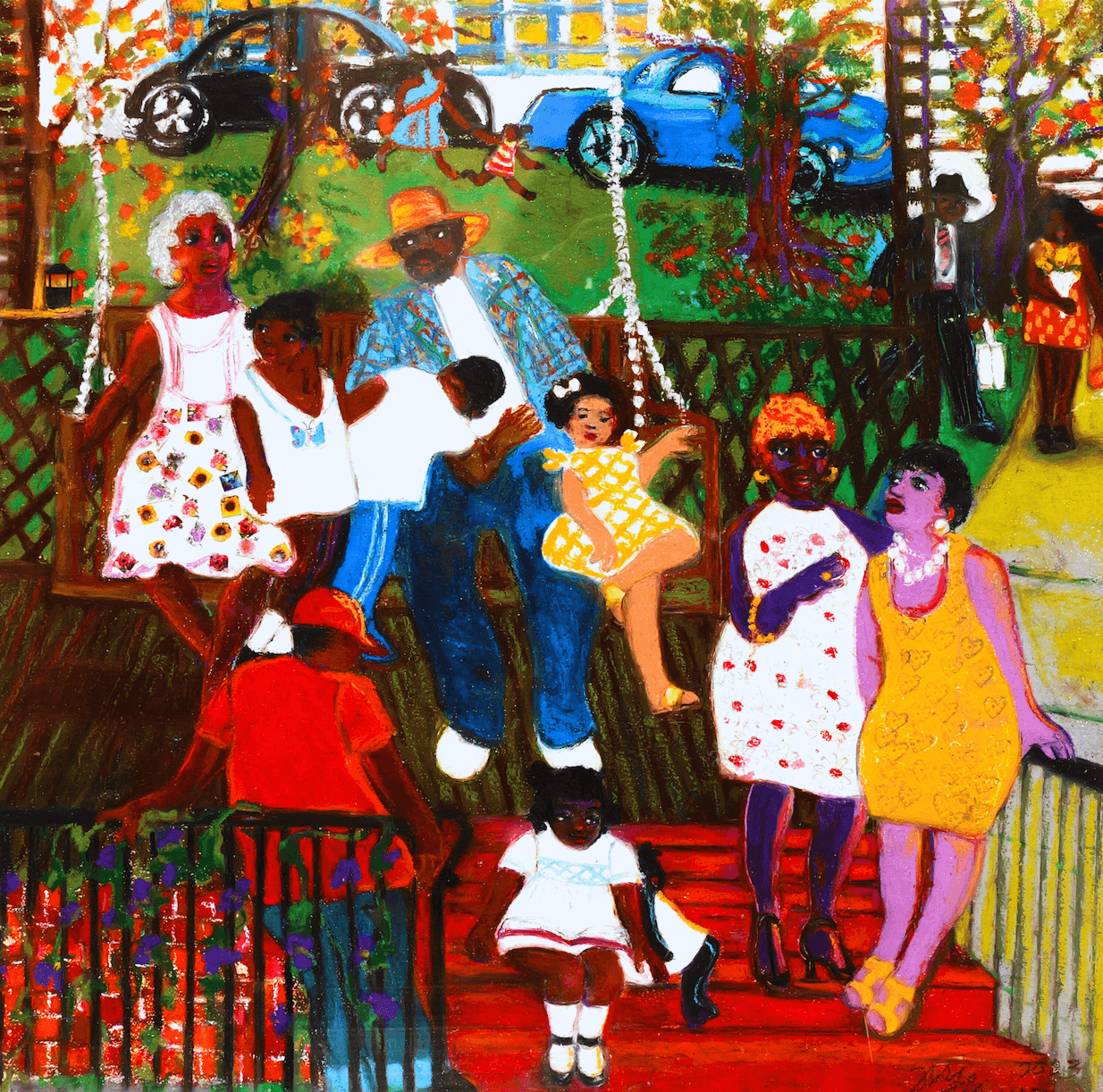
Hilda Robinson (1928-2023), Porch, 2023, oil pastel on paper, 39 1/2 x 38 ½ inches, Courtesy of the Bishop Family
Robinson’s work is inherently political (“I am”), overtly in Mandela (1991). She also illustrated the children’s book, Didn’t We Have Fun!, a collaboration with Oakland-based Methodist minister Jeff Kunkel in 2012, showed in the annual The Art of Living Black at the Richmond Art Center and at AbramsClaghorn Gallery, Albany, in 2022. But Robinson, unlike Van Hoesen, had a different audience and venues in mind than the commercial gallery artworld, one of family and friends.
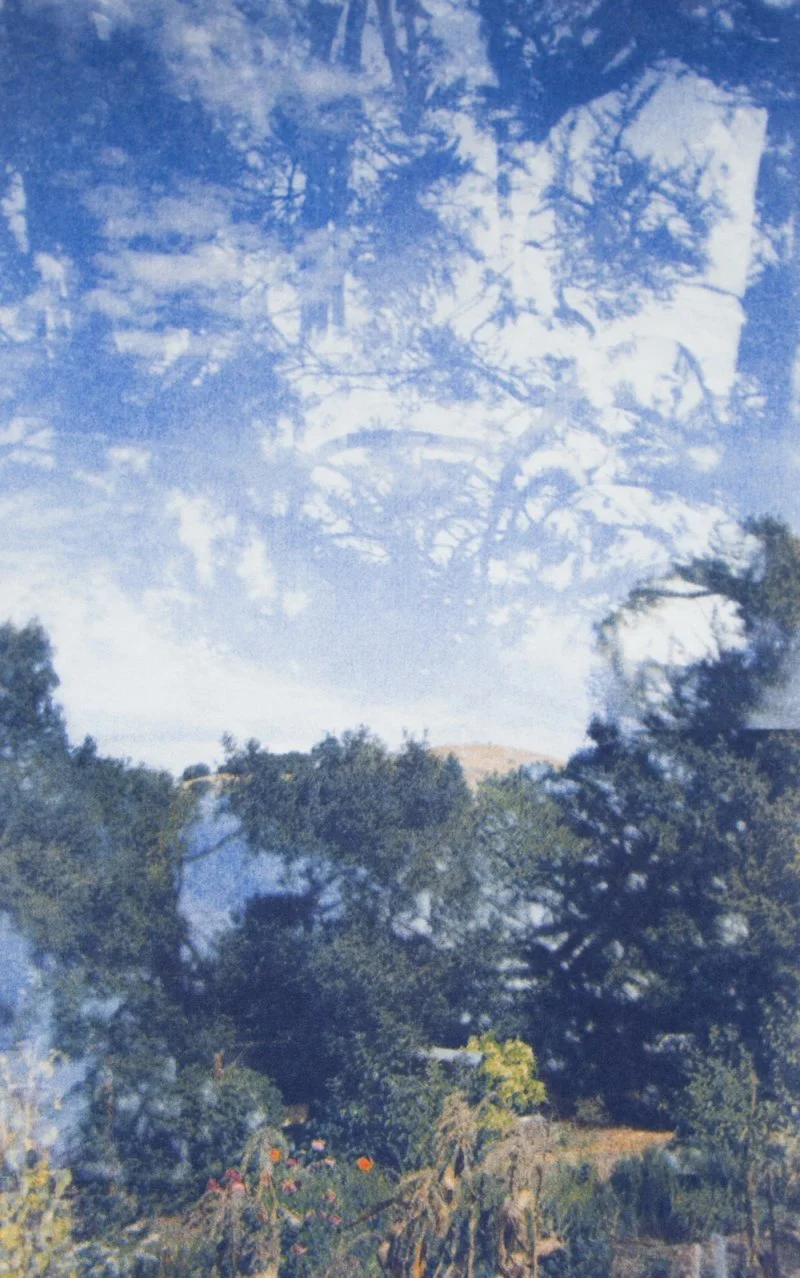
Zach Clark (b. 1983) Walking the Quiet, riso ink on paper, Saint Mary’s College Museum of Art, Acquisition fund for Core 370: Acquiring Art.
Zach Clark
Walking the Cloud: A Collaborative Commission by Zach Clark (b. 1983) features another generation of artists altogether. Clark used modern technologies and methods of reproduction, like risographs, in conjunction with St. Mary’s students, to depict the bucolic landscape of the campus.
