
Olin Marcus Johanssen, Guy Diehl: A Retrospective - Works from 1957-2025, Cañada College
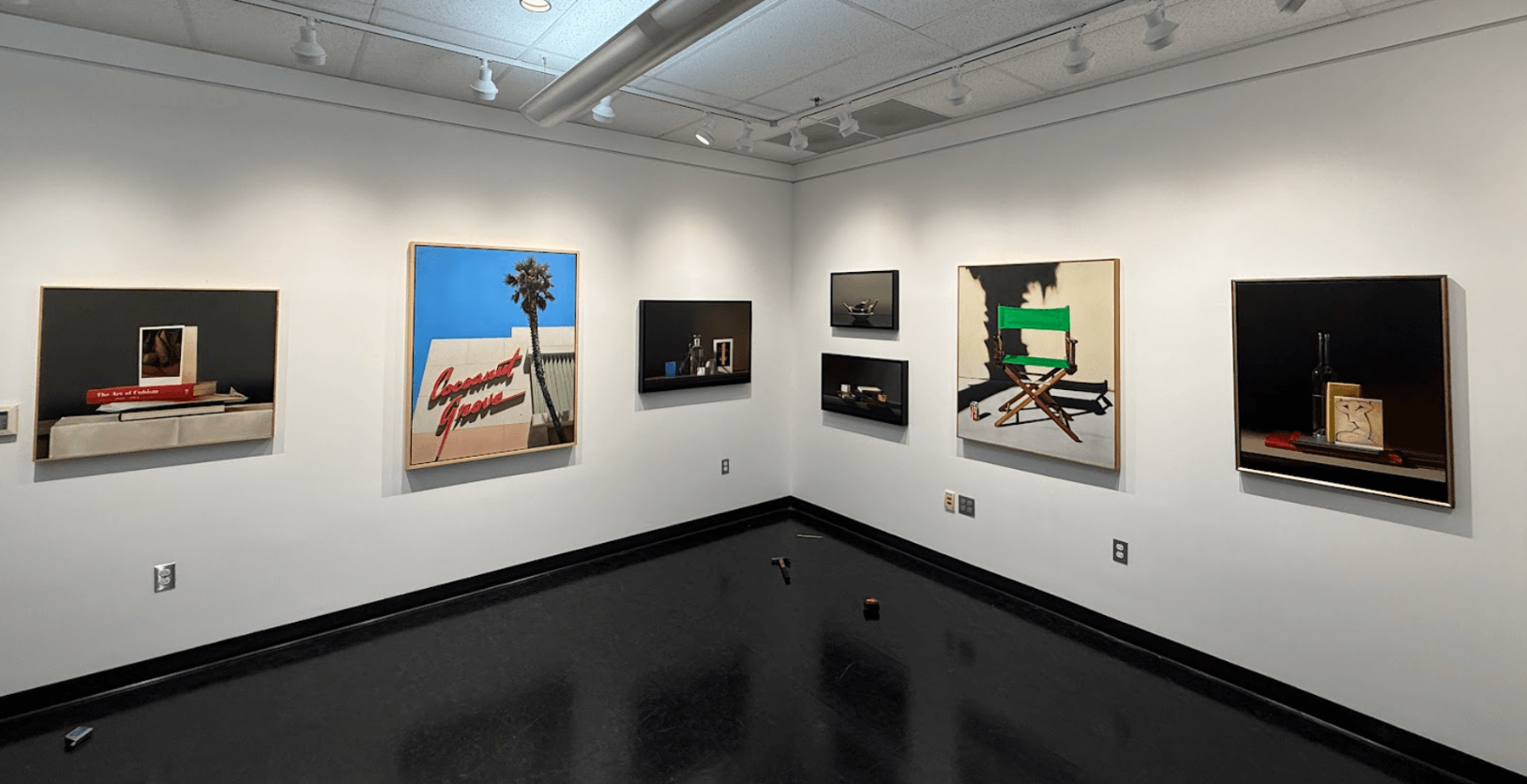
Installation photograph, courtesy of Emilio Villalba.
This review is part of our “Artist on Artist” series.
On February 21st, I had the pleasure of attending a conversation between the artist Guy Diehl and art critic Kelly Jean Egan at Cañada College. The public event, which was preceded by a slide presentation by Diehl, corresponded with a retrospective exhibition of the artist's work currently on view at the campus through March 19, 2026. As with every Diehl exhibition, it was a tour de force in realism, leaving the viewer in thought and awe at what he is able to render on the canvas.
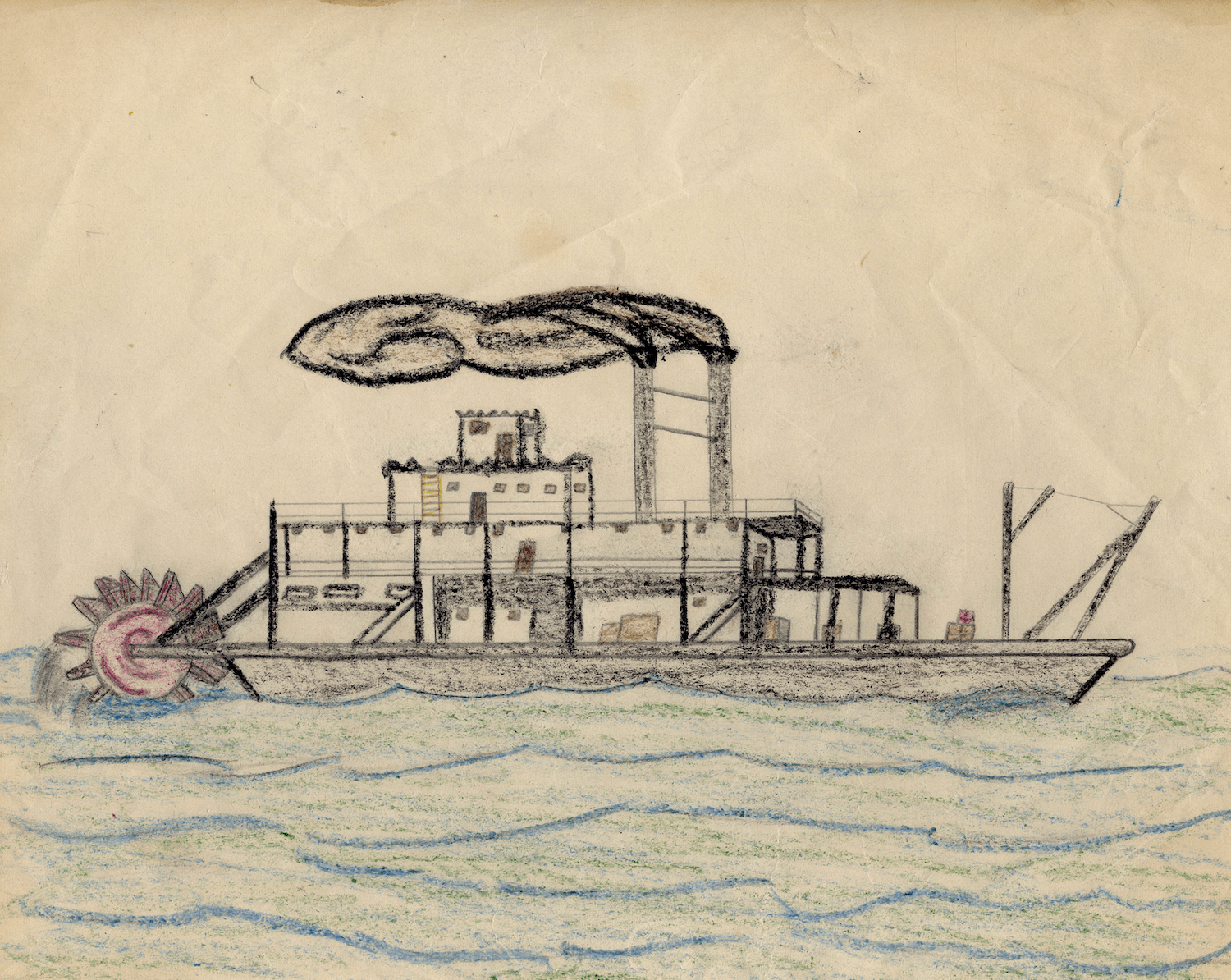
Guy Diehl, Riverboat, graphite and crayon on paper, 8.5 × 11 inches, 1957.
Diehl’s journey begins with an epiphany. A drawing by an 8-year-old Diehl of a riverboat executed in crayon and pencil with a ruler on paper. Diehl had set out to make a copy of a photograph from a National Geographic magazine that caught his attention. What he didn’t know is that the drawing would unveil a secret which would forever change the young artist; how to render perspective. Included in this exhibition, one can see clearly how the eye was opened and how the drawing metamorphosed mid process. There is a weighted darkening in the lines that follow the discovery as if there was a very conscious desire to impress it upon the mind. This concept will create an arch across Diehl’s work and career. Through the razor execution of this technique coupled with a very discerning eye, he will create hundreds of complex paintings made to look easy by his technical skill and ability to strip out all that is unnecessary.
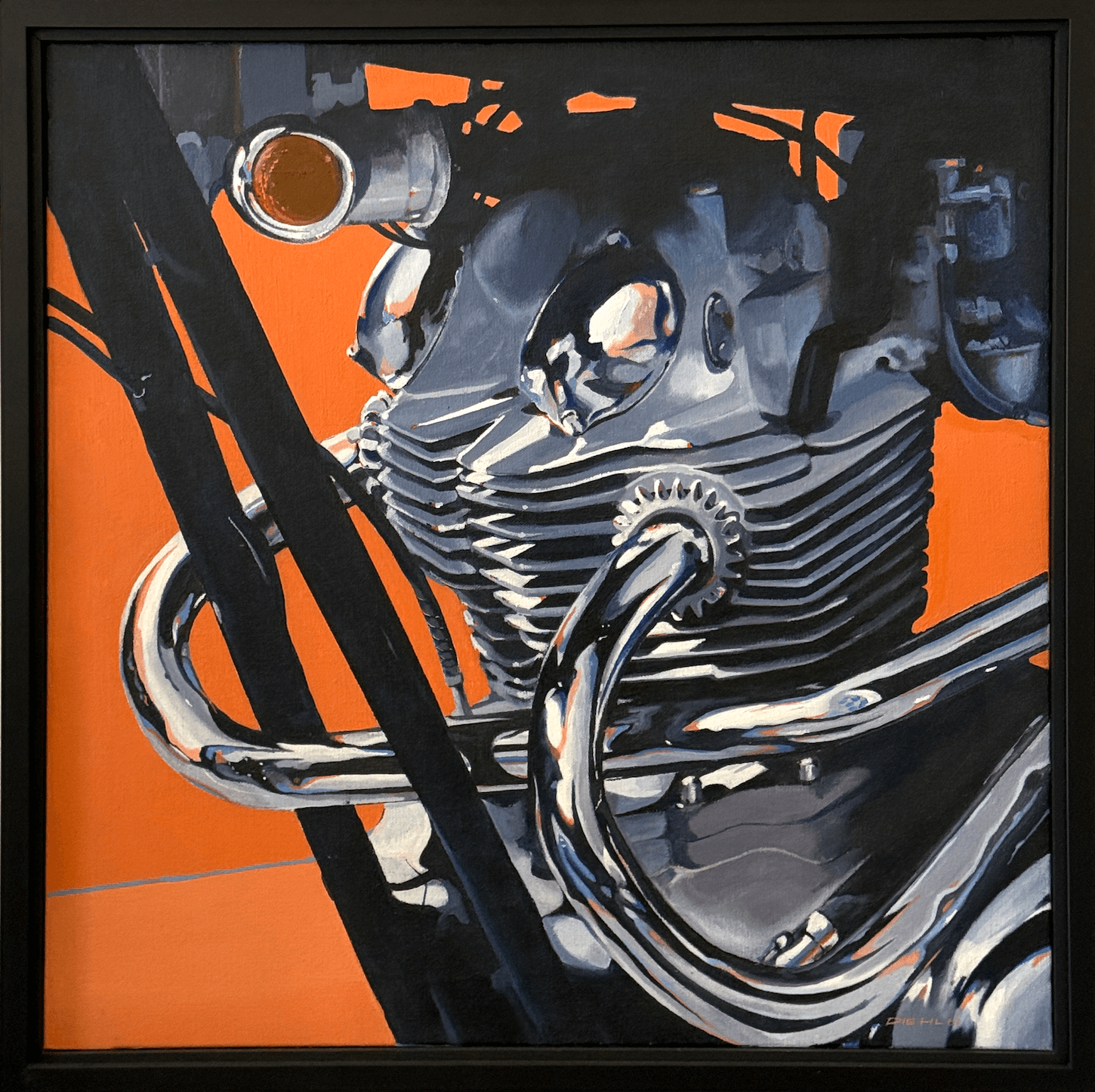
Guy Diehl, Norton Commando 750, acrylic on canvas, 24 × 24 inches, 1969.
Moving into his late teenage years, Diehl has his next breakthrough in a painting from 1969 titled “Norton Commando 750” which he completed while a student at Diablo Valley College. A dichromatic piece in orange and blue, it is a beautifully rendered composition of a motorcycle engine and frame. What stands out to me about this piece is how it appears to both stand still and move simultaneously. By taking a liberty with the right exhaust pipe, threading it through the frame of the bike to follow the left, Diehl breaks up the foreboding black frame at the foreground and puts the motorcycle in flight. Throughout the exhibition Diehl gives a masterclass in the use of the horizon line, an element central to his work, and here is one on an upward trajectory, blue on a plane of orange further exacerbating the movement the viewer feels in his work.
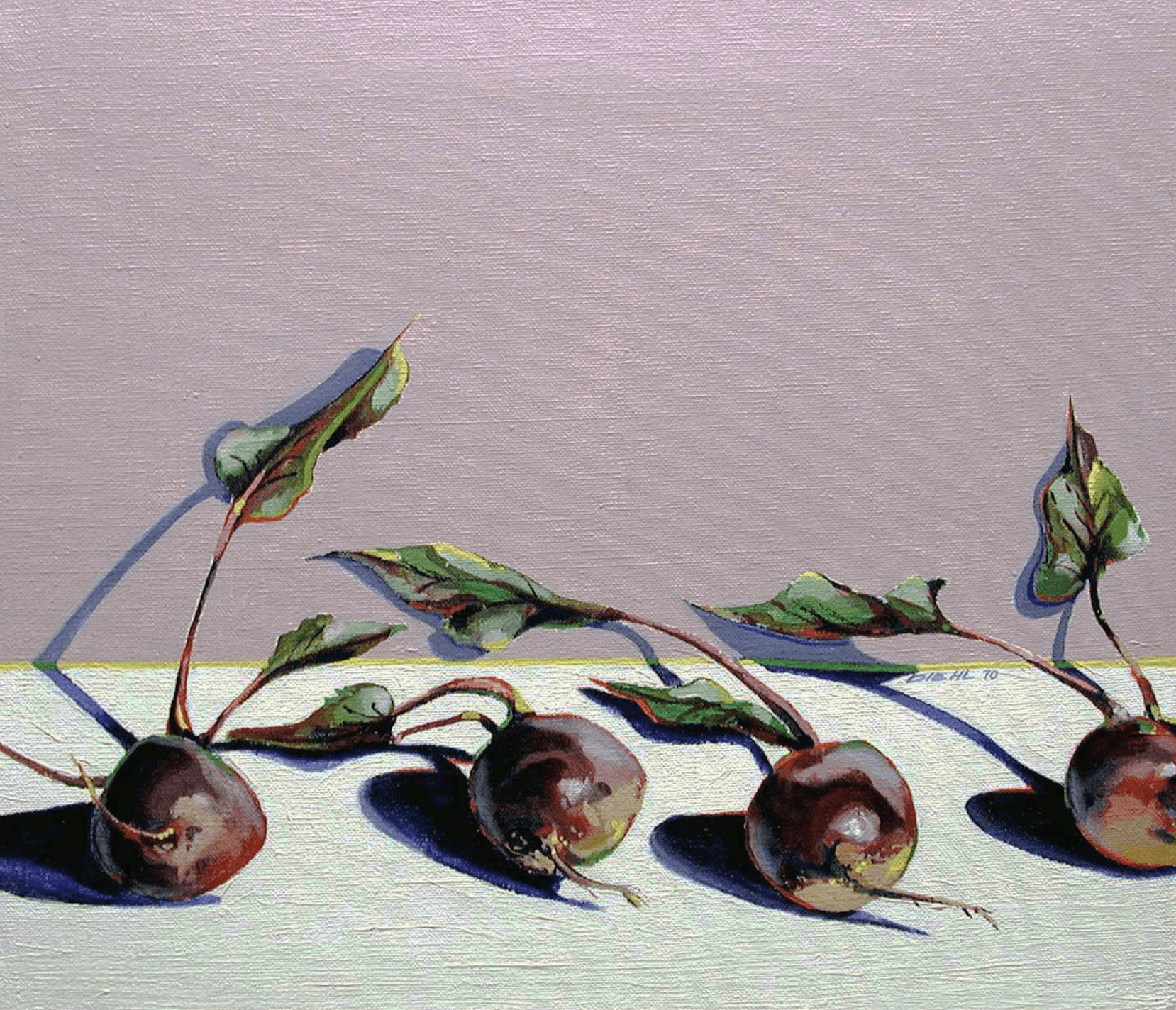
Guy Diehl, Four Beets, acrylic on canvas, 14 × 16 inches, 1970.
In 1970 as part of a school assignment, Diehl completed a painting after the work of a personal influence of his, artist Wayne Thiebaud. As he will continue to converse with influences of his over the course of his career, looking closely at this painting is a fitting place to dissect his process. The piece titled, “Four Beets,” is a wonderful homage, it could pass as Thiebaud if it weren’t signed by the artist. The deep blue shadows, subtle red outlining of the foliage, and technical aspects are a well-executed mimicking of Thiebaud’s style. But it is the subject matter that makes this piece a favorite of mine. The playful conversation happening between Diehl and Thiebaud in choosing “Four Beets,” a root vegetable that is often processed into the sugar and food coloring used to create the sweet treats we so commonly associate with Thiebaud’s work. These beets, by the looks of their firm stems, appear to be freshly pulled similar to the way cakes, pies, and ice creams are always freshly presented. The leaves are just starting to wilt from being set in the stark high-noon light, which provides the viewer with a sense of temperature and time, other themes common of Thiebaud. Finally, it feels possible to identify that both are in California by the specific use and color of light. I leave this painting in reverie of the hot summer days of my youth, an acute sensory recollection that feels more real than a photograph, as if it were etched on my soul. Diehl continues this mastery throughout his career, giving us only what we need for a painting to be realistic.
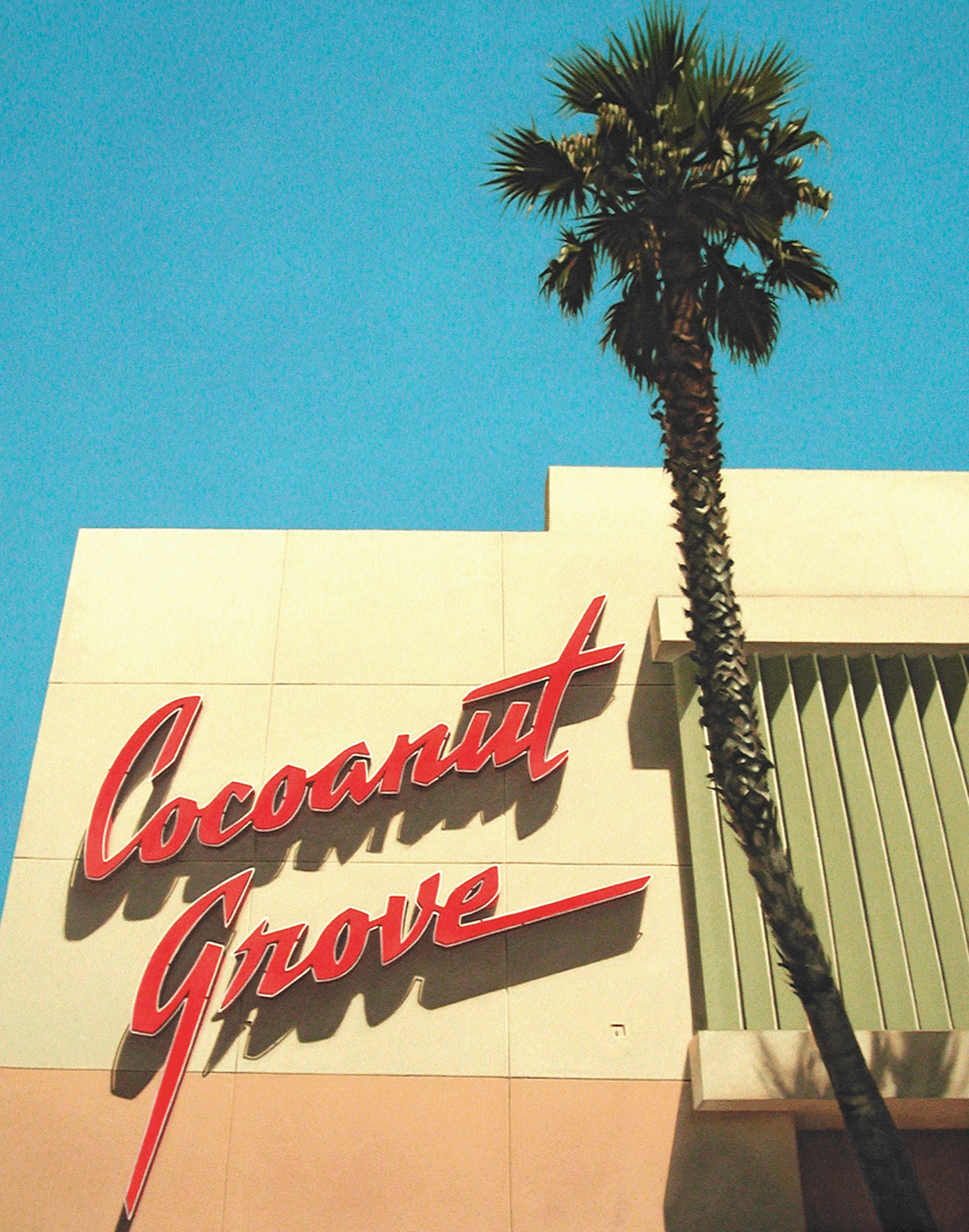
Guy Diehl, Cocoanut Grove, (Santa Cruz, CA), acrylic on canvas, 48 × 36 inches, 1984.
‘Cocoanut Grove” (1984) is a stunning large piece depicting the, unknown to me, location in Santa Cruz, CA. A lone palm tree over the backdrop of a brilliant cobalt blue sky sways in the breeze as if it is a flag signaling to those on their journey that they have arrived at their destination. The building itself appears to us a windowless, nondescript box with ornamental shutters, the name “Cocoanut Grove” emblazoned in fluorescent lights across it in a script that feels like it is made out of the leaves of the palm, their deep red color feel illuminated even in the stark afternoon light. I get a kind of dopamine rush like I feel when I am about to go into a place where everything is happening, good times being had by all. But as I look deeper something causes me pause, and I ask myself is this a mirage? Is the Cocoanut Grove a place not of respite from the world around it, but a siren leading one away from the beauty surrounding them, the sun, its heat, and the salty ocean breeze? I want to go in but I can’t find a way, and I realize the gift being given to me, presence over potential.
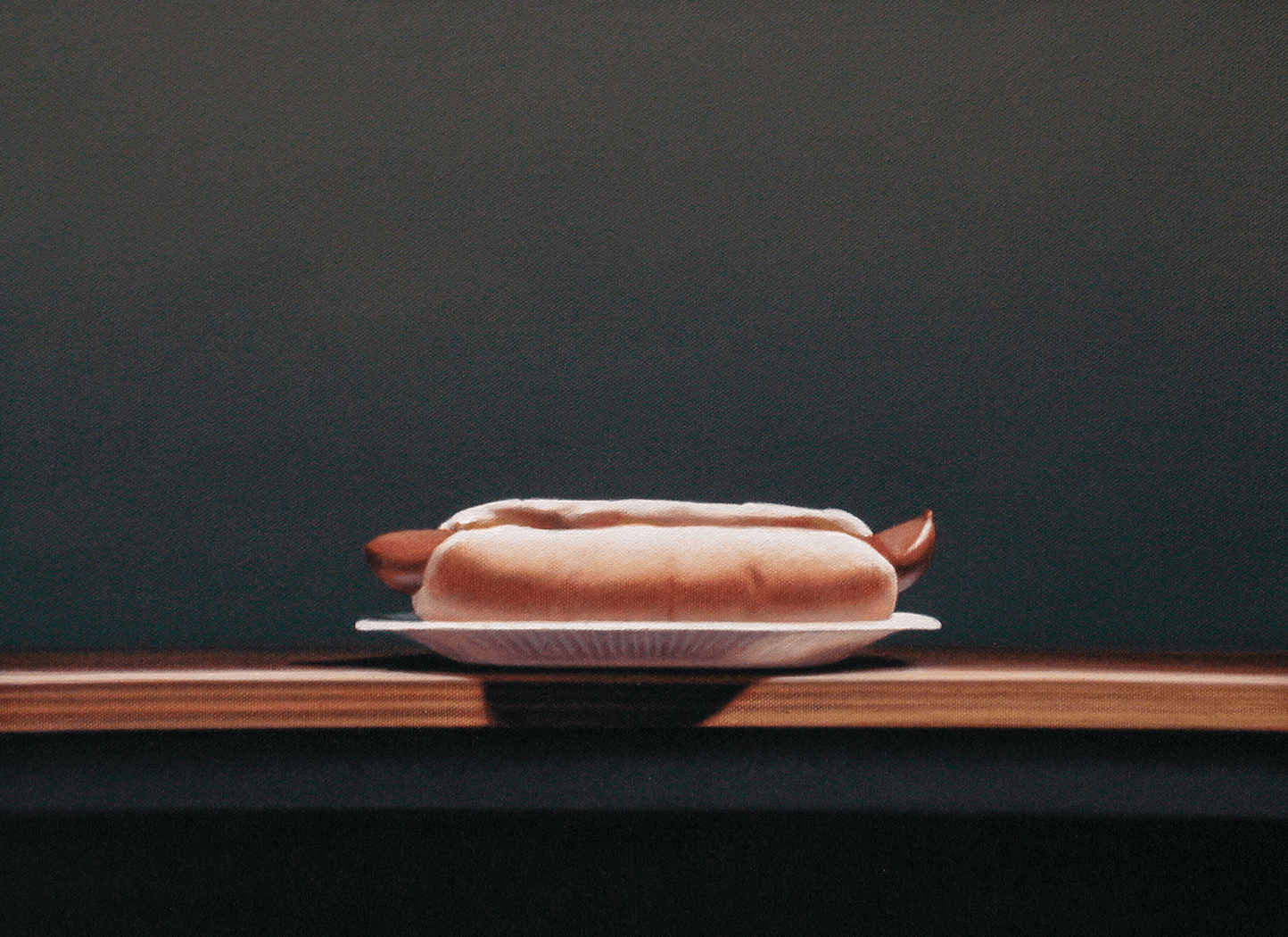
Guy Diehl, Hot Dog & Plate, acrylic on canvas, 12 × 16 inches, 1987.
In “Hot Dog & Plate” (1987), we can see the transition to the dark background work common throughout Diehl’s career; subject matter becomes king. This simple object, the quintessential backyard BBQ, summer day baseball fare, becomes much more under the interrogation of overhead studio light. Sitting on a white styrofoam plate on top of a slab of plywood, we see additional elements one could associate with the 1980’s American exceptionalism era. However, as I look further, I am presented with contradictions to that narrative. The plate sits perched dangerously upon the edge reminiscent of still life paintings of the 17th century Dutch Golden Era, signaling a precariousness that all that is well, may not end well. The shadow cast by the plate creates a funnel pulling the eye down in the deep black bottom of the painting, asking us what sits below this image or what is holding it and us up? Finally, the horizon line is shallow, and as the light quickly recedes into its darkness, we are forced to ask ourselves, is the light running out on us?
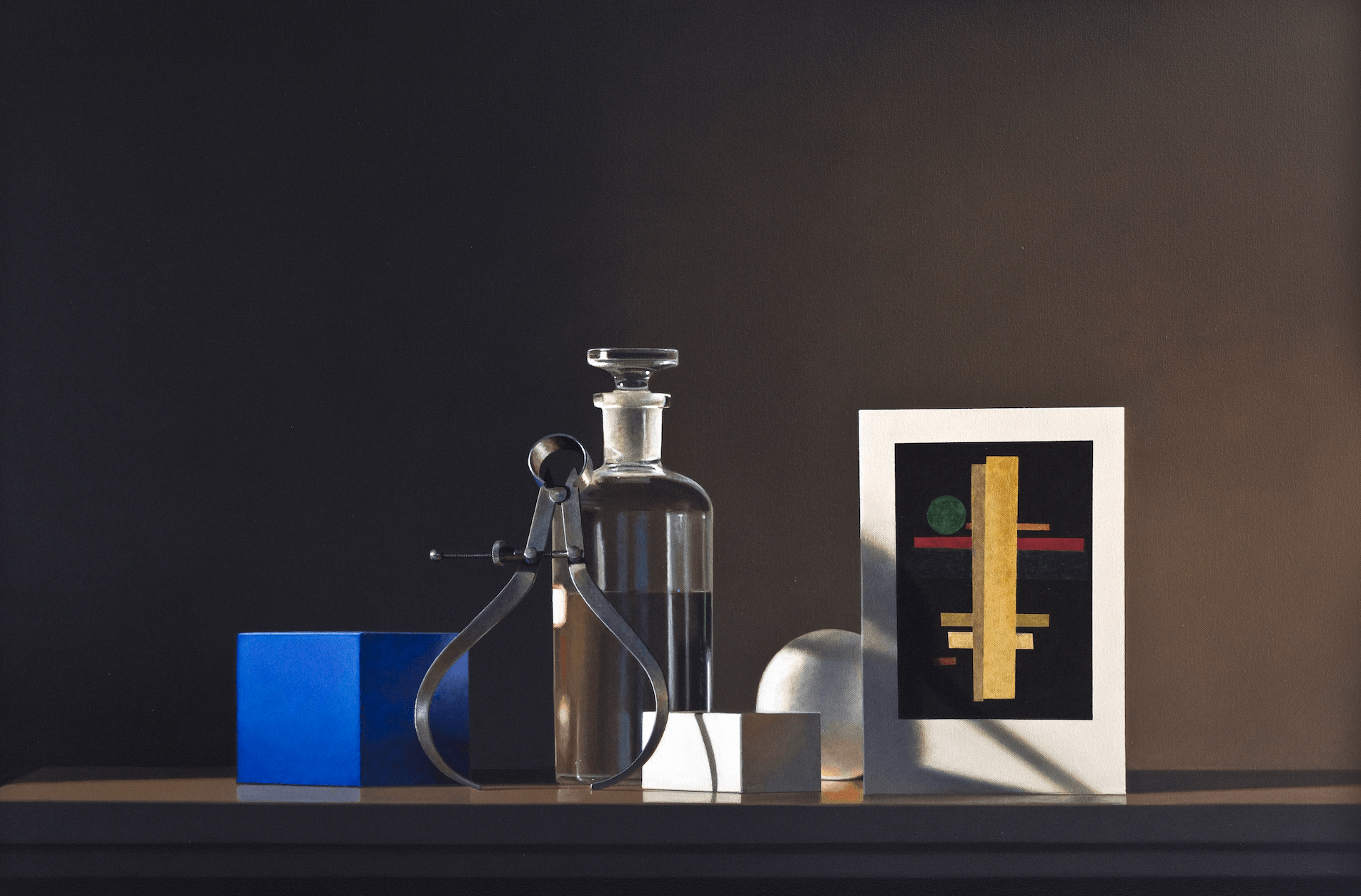
Guy Diehl, Still Life with Ilya Chashnik, acrylic on canvas, 24 × 36 inches, 2013.
In the 2013 rather large work, “Still Life with Ilya Chashnik” we see the transition to natural light we are familiar with in Diehl’s contemporary work. Shadows fall softer, light is subtly refracted on the back wall and cubes in ways that make it appear to have come out of a Vermeer painting. The beauty of light coupled with the simplicity of the decorative objects: cubes, spheres, calipers, a bottle of clear unknown liquid, and a postcard of a painting by Chashnik in the Suprematism style, create a tableau of the piece being referenced. Placed upon the table they sit; it feels like a bookmatching of the Chashnik composition. If we think back fifty-five years to the epiphany of perspective discovered by the young Diehl, we now see this technique rendered expertly. With the near center vanishing point, nothing feels flat, the depth on display seems obvious. I am struck personally by how many attempts it would take me to execute this, the difficulty appears simple to our eye, but that is the effect of mastery.
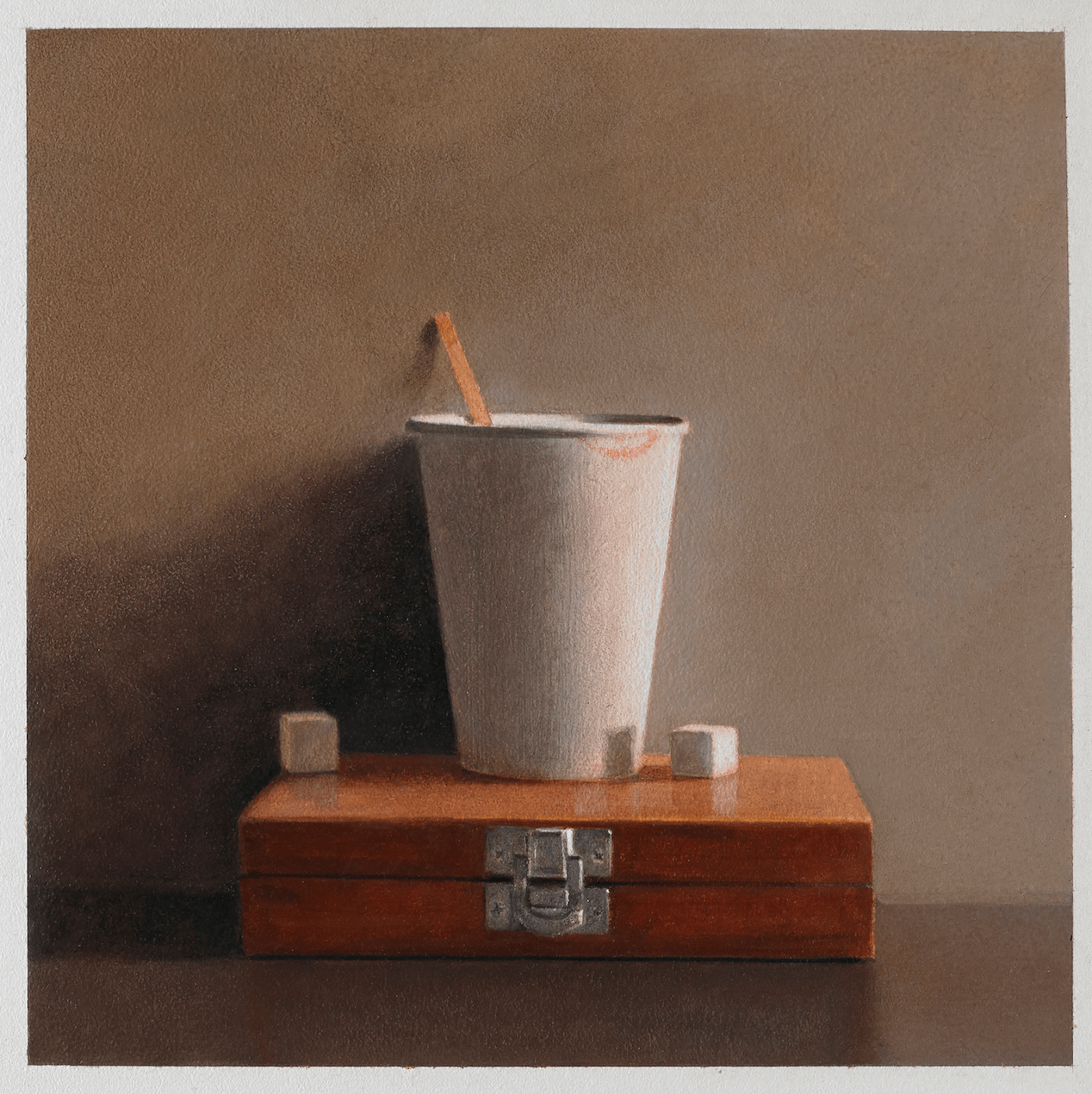
Guy Diehl, Kelly's Coffee, acrylic on linen paper, 10.9 × 10.9 inches, 2022.
The final piece that knocked me to my core was a smaller acrylic on paper painting titled “Kelly’s Coffee” (2022). An innocuous paper cup with a wooden stirrer and two unused sugar cubes sits atop a wooden box that appears to be for holding keepsakes as designated by its utilitarian clasp. This box feels heavy, and I ask myself, is it keeping us out or holding something in? Again, we can see the manner in which these paintings offer the viewer competing meanings. The outline of lipstick on the upper right illuminated edge of the cup lingers like the scent of another that has yet to leave, allowing the viewer to get lost in its redolence. I am transfixed even further by the lighting, an opus of yin and yang. The outside edge of the cup, bright where the inside is dark and its opposite dark and bright, the stirrer is stationary, and I think of two souls that were mixing and are no longer. Then there are the cubes of sugar, one in the bright light of day, its face shining in the sun, while the other in the shadow, its body illuminated by the reflection of the light beyond it. These are two people that knew each other well, two bodies intertwined and now only their souls remain entangled. Guy offers us a simple subject matter for a story so complex and deep. I feel sadness but not despair: there is hope, hope that two lips will meet again, and truth, truth that life is sweet when we are mixed together but it doesn’t sour when we are apart. The sweetness lingers and we lock it in a box to carry with us forever. A secret in plain sight.
In Diehl’s presentation and conversation, he mentioned being told around the age of 28 that it was “ok to be an artist”, and how reinforcing and liberating that was. It seems that this simple bit of wisdom was as important as any artistic lesson he ever learned. If not for it, would we even have this exhibition? I have seen countless examples that support the greater truth of this message, and I have lived on both sides of it. It is completely acceptable to be what you are meant to be, in fact we should be nothing else. Disadvantages are not the cause for lack of success, not knowing and following your calling is. When we align ourselves with our purpose, our needs will be met and our souls liberated by a life lived not earned. A paycheck buys us back a fraction of the time we sacrifice for it. The rich man who gives up his time, earns a pittance compared to the man who purposefully uses his.
Earlier this week, I went back to see the exhibition again. Having a chance to digest and be around the paintings without an audience was a worthwhile choice. I could have written a glowing review of each piece. The “Take Out Only Series” is deserving of its own review, the “Pool Series” too, and there are also countless intriguing conversations with great artists happening in the paintings, although Diehl's quintessential qualities are ever present and dominant. As Diehl nears completion of his 500th still life painting I look forward to his next exhibition, which is scheduled at Dolby Chadwick Gallery in June, to see the continued evolution of his work. Before leaving, I was reading some material that was out for viewers looking for anything I may have missed to write about, and I saw his exhibition dedication, an eloquent and deeply personal message to a lost love:
In Memory Of
This exhibition is dedicated to the memory of Kelly Beede, the love of my life.
From 2007 until her passing in 2020, our life together shaped my work in so many important ways—and in ways she wouldn't let me get away with.
As you view these works, know that her discerning eye, creative insight, and occasional eye-roll were always deeply valued, and that she will remain my enduring muse.
And above all, I got to be her Guy.
I hope you all can attend the exhibition and have a cup of coffee with someone you love.
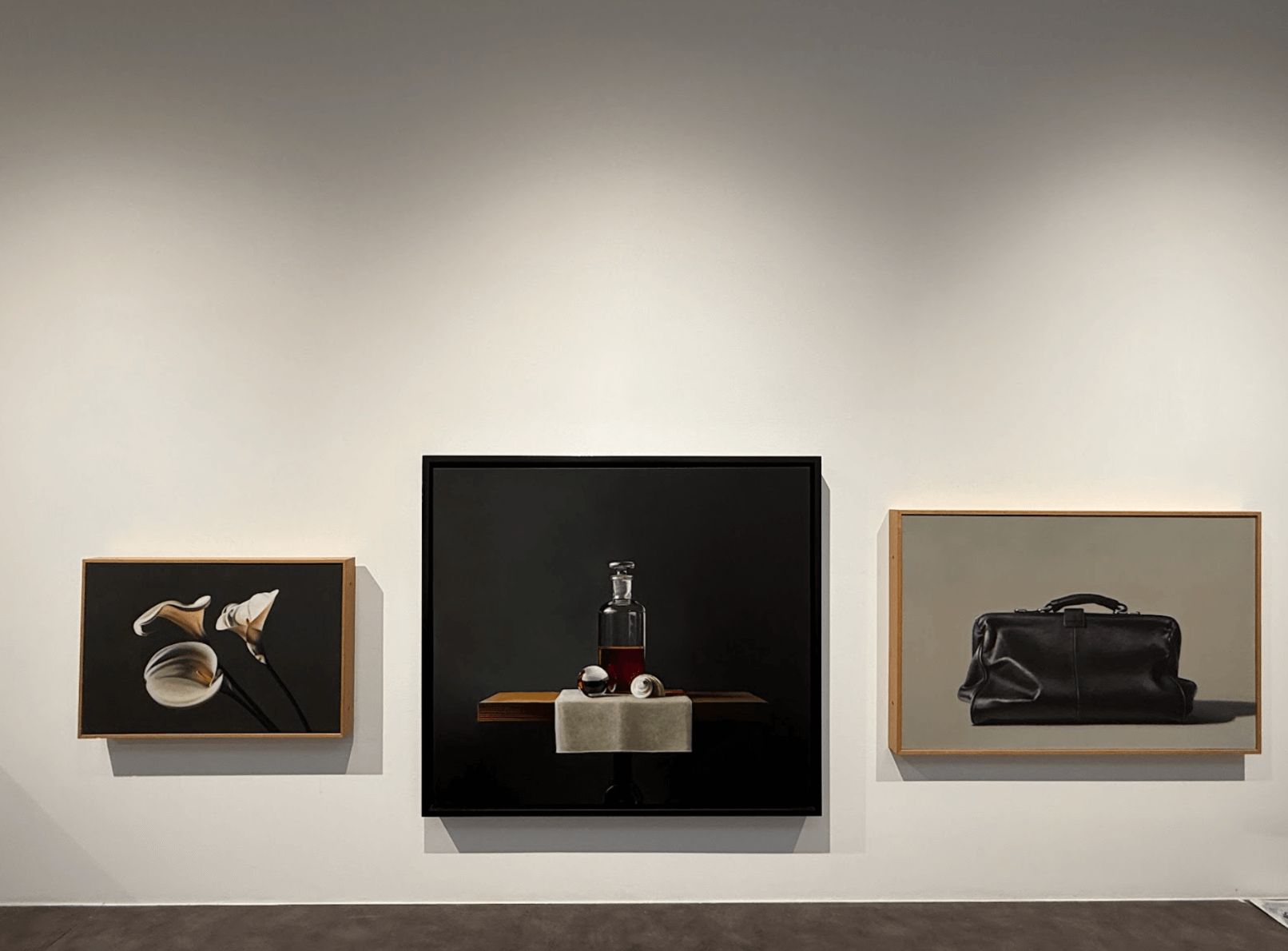
Installation photograph, courtesy of Emilio Villalba.
Guy Diehl: A Retrospective exhibition is curated by Emilio Villalba, an Assistant Professor of Studio Arts at Cañada College. The next exhibition in the art gallery will present works by Wardell McNeal and is scheduled to open in April.
