
Guy Diehl, The Quiet Eye, Dolby Chadwick Gallery
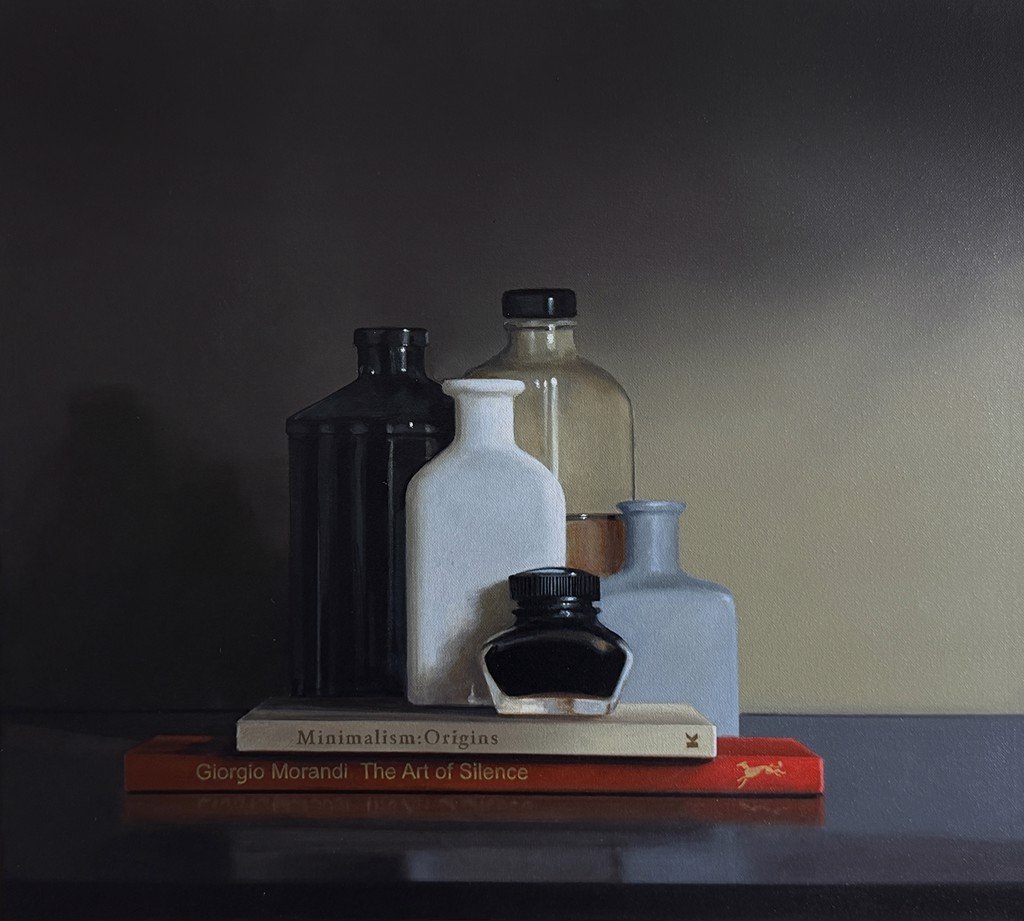
Guy Diehl Conversation with Morandi #2, 2026 Acrylic on canvas 18 x 20 in (Framed 19.5 x 21.5 in)
The Quiet Eye: Guy Diehl’s Patient Light
Guy Diehl has spent fifty years and five hundred canvases convincing himself, and us, that nothing in a room is more or less worth looking at than anything else: a tangerine, a take-out box, a postcard of Giorgione’s Sleeping Venus. But spend twenty minutes in The Quiet Eye, his seventh solo show at Dolby Chadwick Gallery, and a different claim emerges underneath the first one. This is not, finally, a show about objects. It is a show about what happens to time when someone insists on looking at something for long enough.
“When I’m painting, everything stops for me,” Diehl has said. “It takes me out of the moment.” That sentence could serve as the show’s true subtitle. Diehl’s still lifes are often described, accurately but incompletely, as photorealist. Up close, though, the realism reveals itself as a negotiation rather than a transcription: there is exactly enough information to convince the eye an object exists, and not a brushstroke more. The effect isn’t documentary. It’s meditative. Diehl isn’t recording what a tangerine looks like; he’s recording how long it takes to really see one.
That distinction matters because it relocates the show’s real subject. Diehl arranges his objects (bottles, shells, books, the occasional reproduction of a Malevich or a Morandi) the way a director blocks a scene, but what he’s actually chasing is the light that falls across them. He sets up a composition and photographs it once an hour, tracking how daylight moves across the same surfaces over the course of a day before he ever touches a brush. “Mostly it’s about light,” he has said, comparing his own practice to Monet’s Haystacks. The shell, the box: he’s drawn to them as much for their shape as anything else, vessels for catching incandescence, throwing shadow, gathering the soft, bleeding halo that bright light leaves on an object’s edge, a phenomenon photographers call halation. The objects are simply where the light happens to land that day.
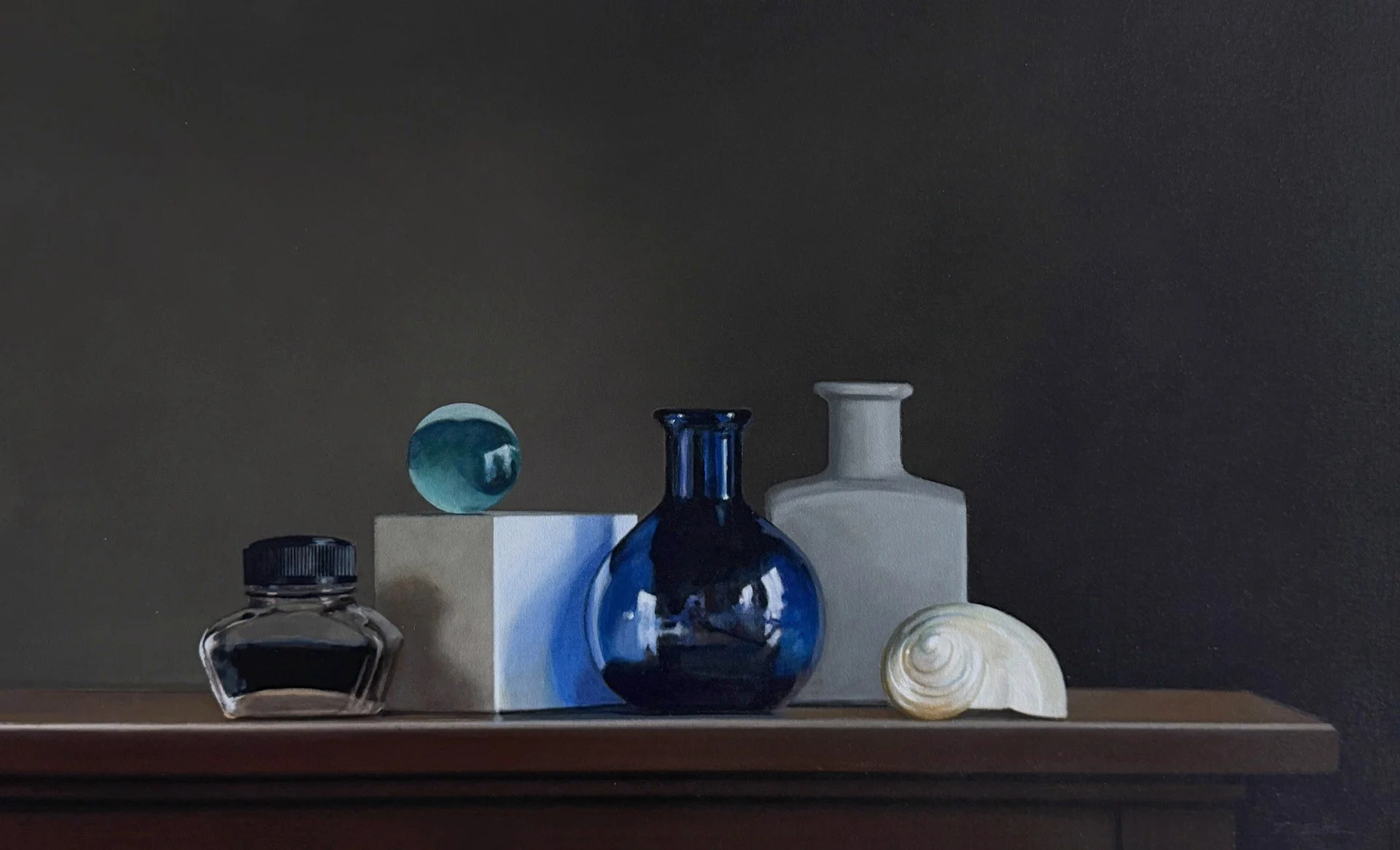
Guy Diehl Still Life with Ink Bottle, 2026 Acrylic on canvas 16 x 26 in (Framed 17.5 x 27.5 in)
This is also where Diehl’s relationship to his own medium becomes legible as a kind of argument. He paints in acrylic, a medium that dries fast and forgives little revision, and he has spoken about that speed as a productive restriction rather than a limitation, a constraint that forces distillation instead of accumulation. He marks up his canvases against a color wheel, working out red against blue with something closer to a physicist’s notation than a romantic’s intuition. The result is paintings that feel underbuilt in the best sense: spare arrangements where linear perspective does the work that incident usually does in painting.
Diehl likes to recall something Wayne Thiebaud once said in a talk, that an artist really only has three subjects, person, place, or thing, and the real craft is in how you combine them. Diehl seems to have taken this almost literally. By pressing "thing" and "place" into the same image, arranging objects until their recession along a single plane starts to read as geography, he collapses the very distinction Thiebaud was drawing, so that still life and landscape become two names for the same picture. His clusters of bottles and books resolve, at a certain distance, into something that reads less like a tabletop than a horizon: a still life that quietly behaves like a landscape, miniature and self-contained.
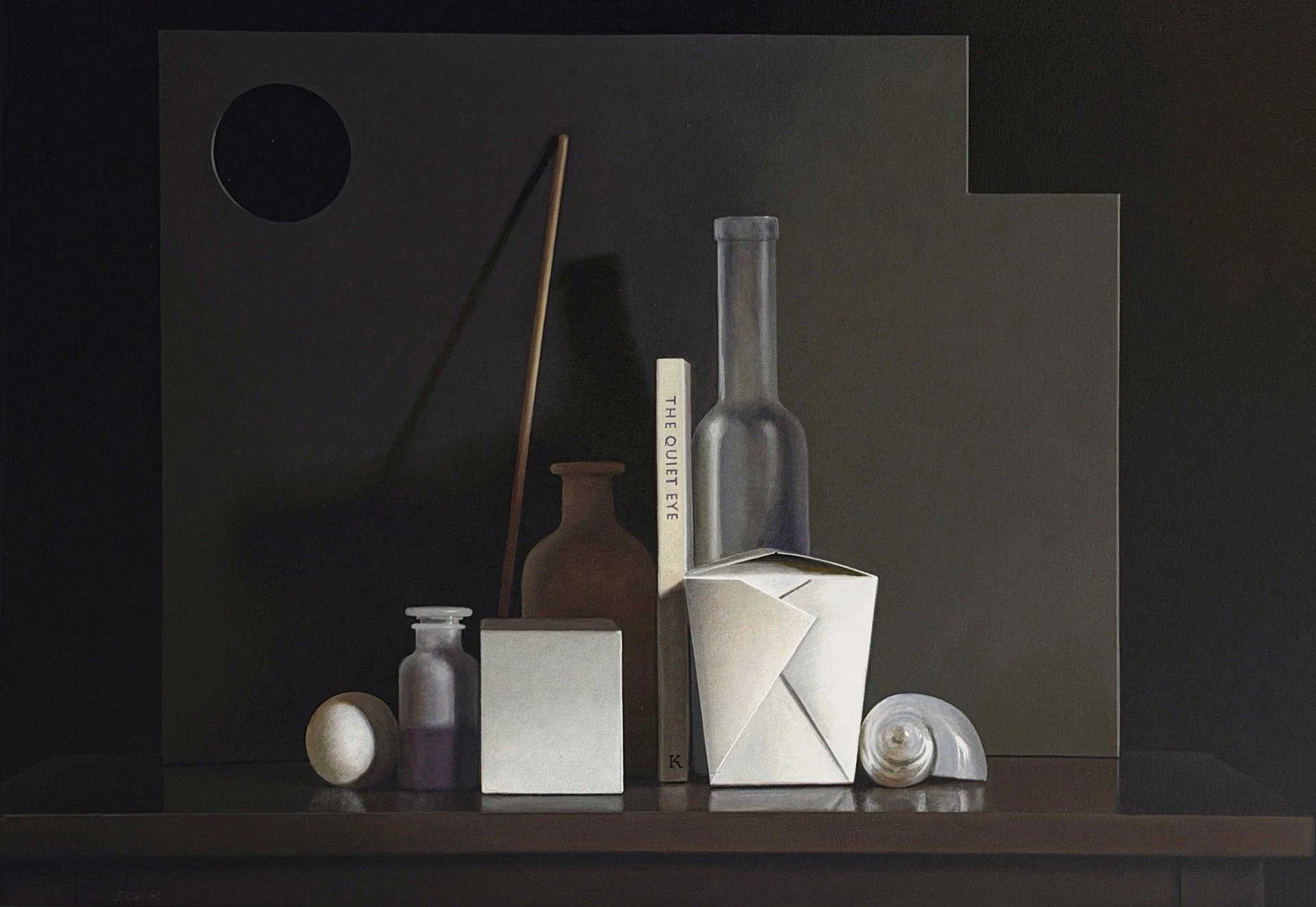
Guy Diehl The Quiet Eye, 2026 Acrylic on canvas 23 x 32 in (Framed 24.5 x 33.5 in)
The show’s title work and Diehl’s five-hundredth signed canvas, The Quiet Eye (2026), plays this distillation as a kind of summation. Diehl’s signature bottles and shells meet the take-out containers from his more recent vocabulary, proof that no hierarchy survives long enough to matter in the artist’s eye. The background dissolves into geometry, handled like a painter’s palette, fields of muted lilac and deep violet into which Diehl has slotted an actual copy of the exhibition’s namesake book. It’s the closest thing in the show to a signature gesture: five hundred paintings arriving, deliberately, at an image of nothing more than a room holding its breath.
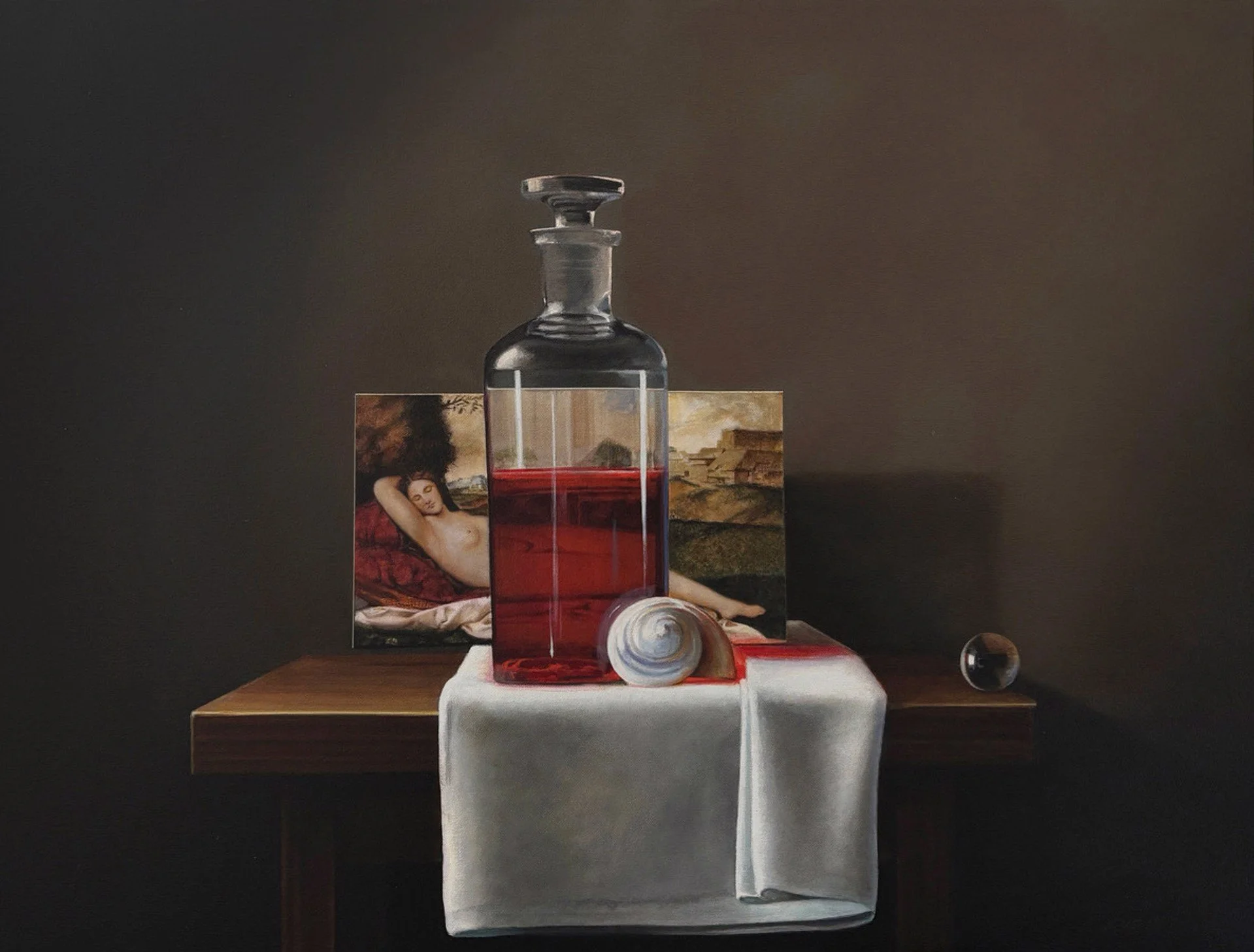
Guy Diehl Allegory of Love: Conversation with Giorgione, 2024 Acrylic on canvas22 x 28 in (Framed 23 x 29 in)
Allegory of Love: Conversation with Giorgione (2024) makes the show's argument about hierarchy almost confrontational. Giorgione's Sleeping Venus appears only as a postcard, flattened into the same plane as everything else on the table, her reclining body distorted once by reproduction and a second time by the bottle of red liquid set in front of her, its glass bending and reddening her image until she barely reads as a figure at all. That double distortion is what sets up the painting's real tension. At the composition's edge sits a glass marble, caught in the same wash of red. The marble does what the Venus, reduced first to a souvenir and then to a smear of color, no longer can: it holds its shape. It holds tension. It looks, in that instant, like it might roll off the table entirely, and the whole painting quietly becomes a memento mori built from nothing more than reflected light and a millimeter of glass.
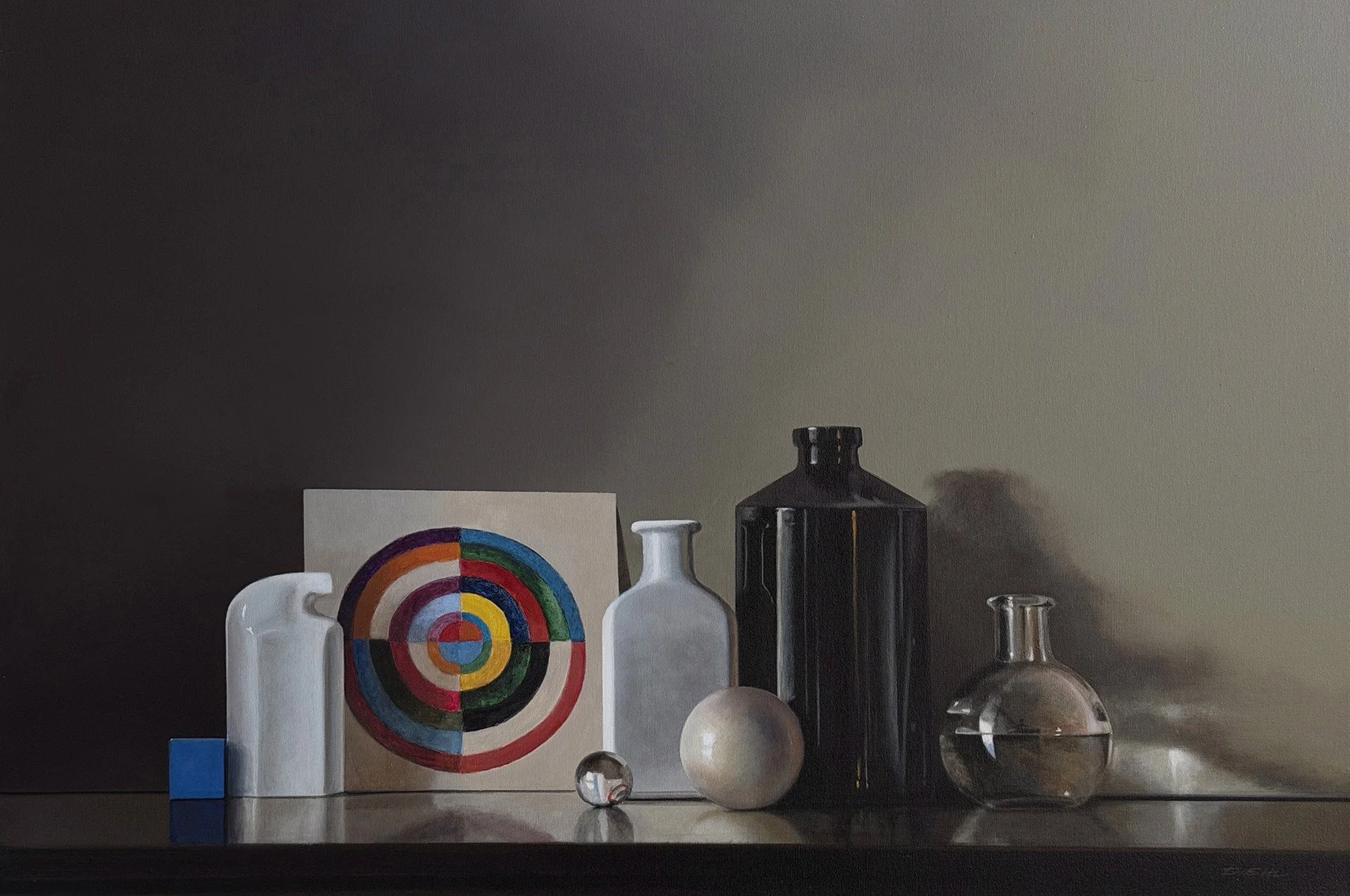
Guy DiehlConversation with Robert Delaunay #5, 2026 Acrylic on canvas 22 x 32 in (Framed 23.5 x 33.5 in)
Conversation with Robert Delaunay #5 (2026) takes the same device, the marble as a small optical universe, and turns it inward rather than outward. Delaunay’s concentric color rings appear twice in this canvas: once as a flattened reproduction among the other objects, and once again, inverted and miniaturized, caught inside the marble’s curved surface. It’s the most literal staging in the show of what Diehl means by “conversation”: not homage, but a kind of optical argument, where the original loses its claim to singularity the moment it’s reflected back at itself, distorted, in glass. Look closely enough into one of these spheres across the show and, occasionally, you’ll find Diehl’s own small reflection looking back, a self-portrait small enough to miss, embedded in the very mechanism that lets the paintings see themselves thinking.
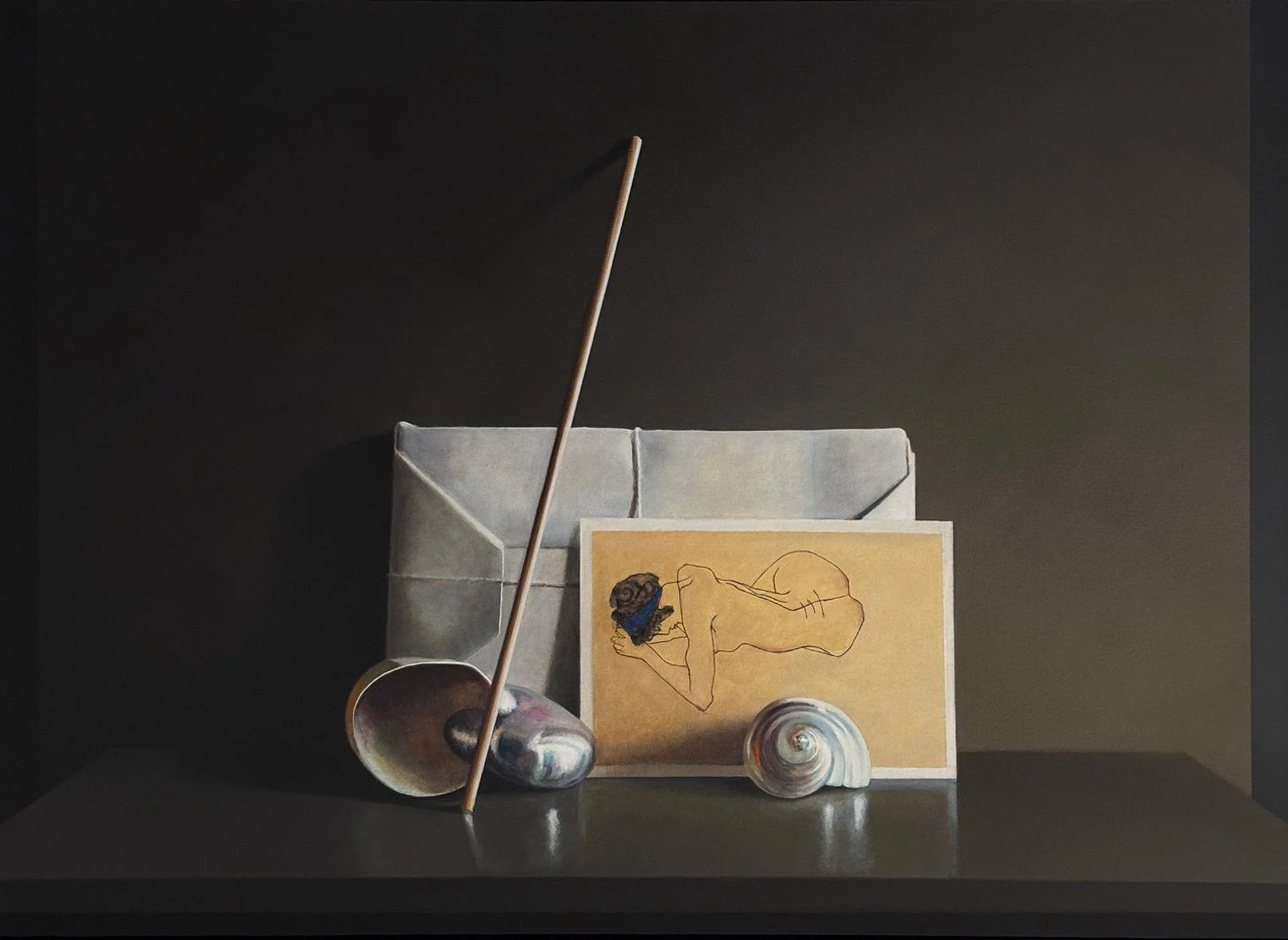
Guy Diehl Still Life with Egon Schiele Nude, 2025 Acrylic on canvas 23 x 32 in (Framed 24 x 33.25 in)
The show’s most pointed staging of that tension between control and feeling is Still Life with Egon Schiele Nude (2025). Schiele built his reputation on raw, nervy line and bodies pushed to the edge of distortion, the kind of expressionism that announces itself. Diehl borrows none of that heat directly. He renders the reproduction small and flat, boxed into the same disciplined geometry as the paper-wrapped package beside it, so the painting becomes a quiet argument between two opposed instincts: the expressionist charge of the source image and the almost minimalist restraint of Diehl’s own hand. The wrapped parcel keeps its secret. The borrowed nude keeps its silence. Even here, the arrangement resolves into something closer to a horizon than a tabletop, blocks of paper and color receding like the geography of a small, contained landscape. Diehl isn’t quoting Schiele so much as cooling him down, proving that even a charged image can be absorbed into the same patient, even light that governs everything else on his table.
That patience, the willingness to let an object, a sealed package, simply remain unresolved, is the connective tissue running underneath every painting in this show. Diehl has said that by selecting and arranging objects, he can introduce a narrative into his paintings, but the narratives here are unusually quiet ones: not stories about the things themselves, but about the duration required to actually see them. By relying on a steady set of recurring props (marbles, paper bags, books, shells) across hundreds of canvases, Diehl turns repetition into a register fine enough to carry real variation; the nuance lives in the light, not the object.
Five hundred paintings in, The Quiet Eye doesn’t announce a culmination so much as confirm a method: slow the eye down enough, and even a take-out box starts to look like it’s been waiting its whole life to be seen.
