
A Certain Slant of Sunlight, Will Yackulic, pt.2 Gallery
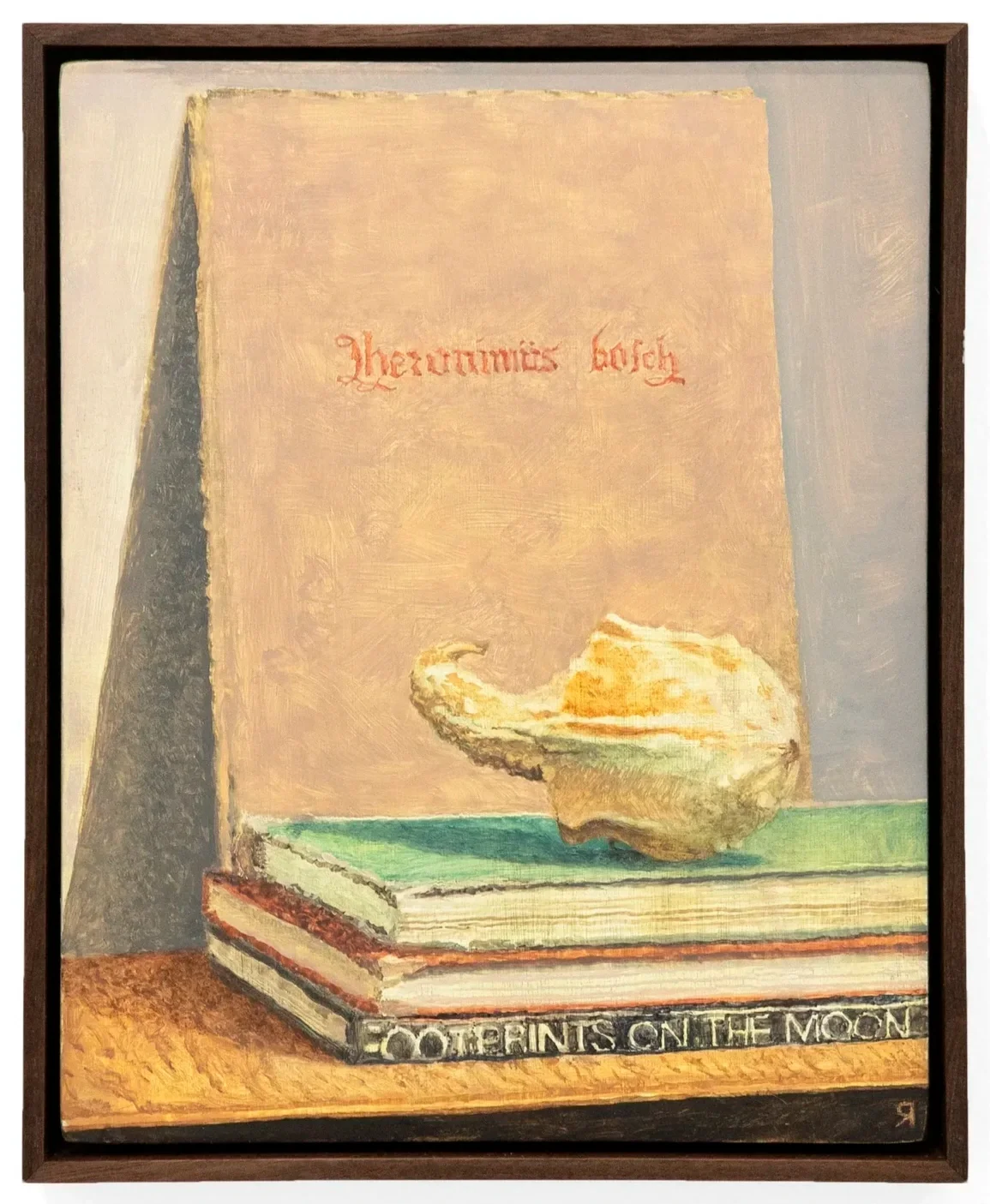
Bosch
Oil on wood panel
9 x 7.25 inches framed
2026
Will Yackulic is an artist I encountered first through the Bay Area poetry scene, rather than the art world as such. This is not suggest that he hasn’t had art world success—to the contrary, his work can be found in the collections of SFMOMA, LACMA, and the Berkeley Art Museum—but rather that he’s one of those artists, like a Brainard or a Jess, whom you frequently find in the company of poets, resulting in numerous book and magazine covers over the years. In a superficial sense, you could explain this away by noting his family connections to the New York School of poets: his aunt and uncle were Alice Notley and Ted Berrigan, the title of whose posthumous final book of poems A Certain Slant of Sunlight (1988) he has borrowed for this exhibition of small scale paintings, all of which are oil on wood panel and most of which measure 9” x 7.25”. As with this book—comprised entirely of poems written on 4.5” x 7” postcards—the restricted format becomes the form. The paintings could indeed make splendid book covers without any adjustment to their dimensions, though naturally they don’t require any purpose other than themselves. Intimate, intricate, often inscrutable as is the way with the contemporary lyric, Yackulic’s paintings are fundamentally poetic in sensibility, irrespective of any biographical lineage.
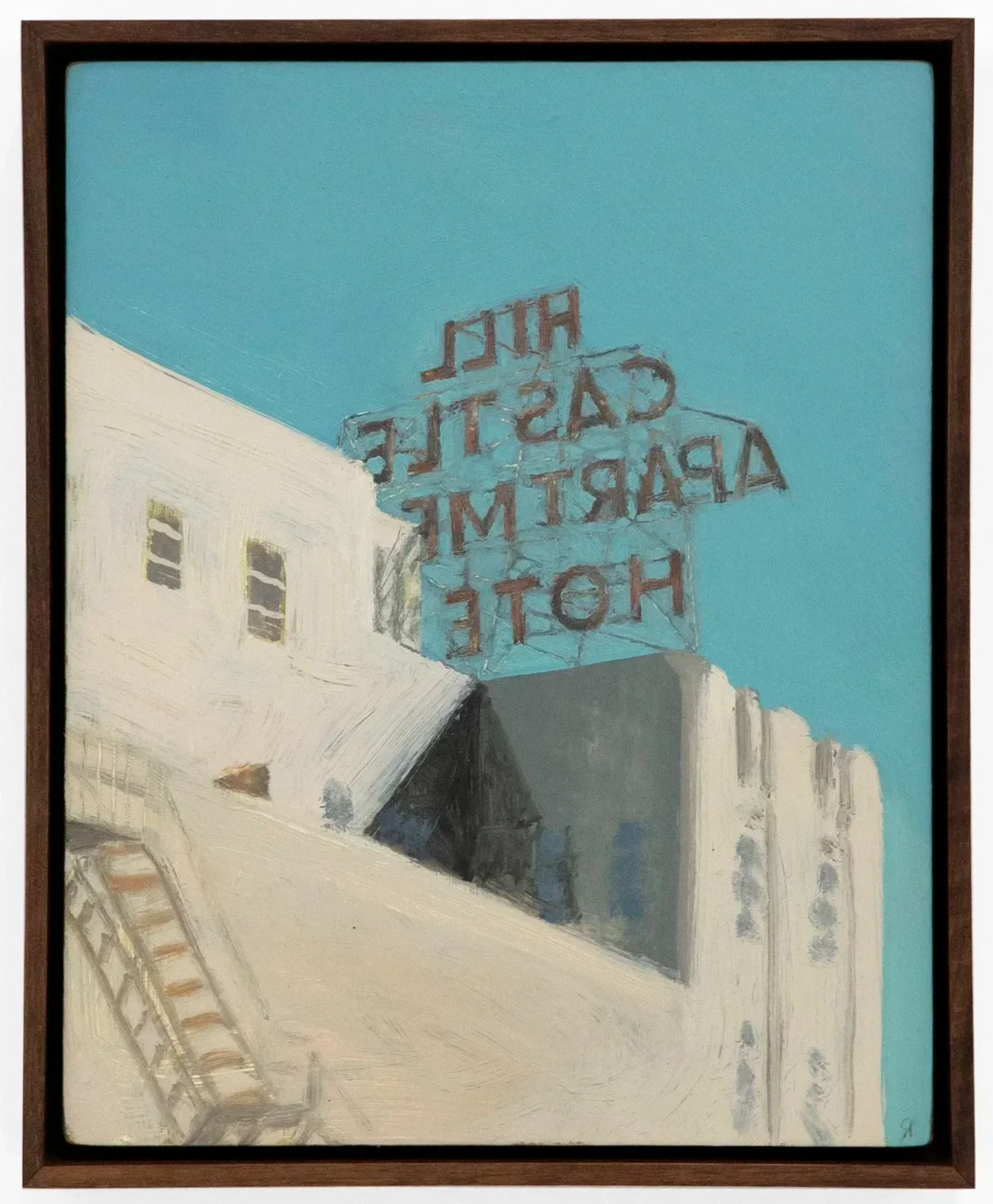
Hill Castle Apartment Hotel IV
Oil on wood panel
9 x 7.25 inches framed
2025
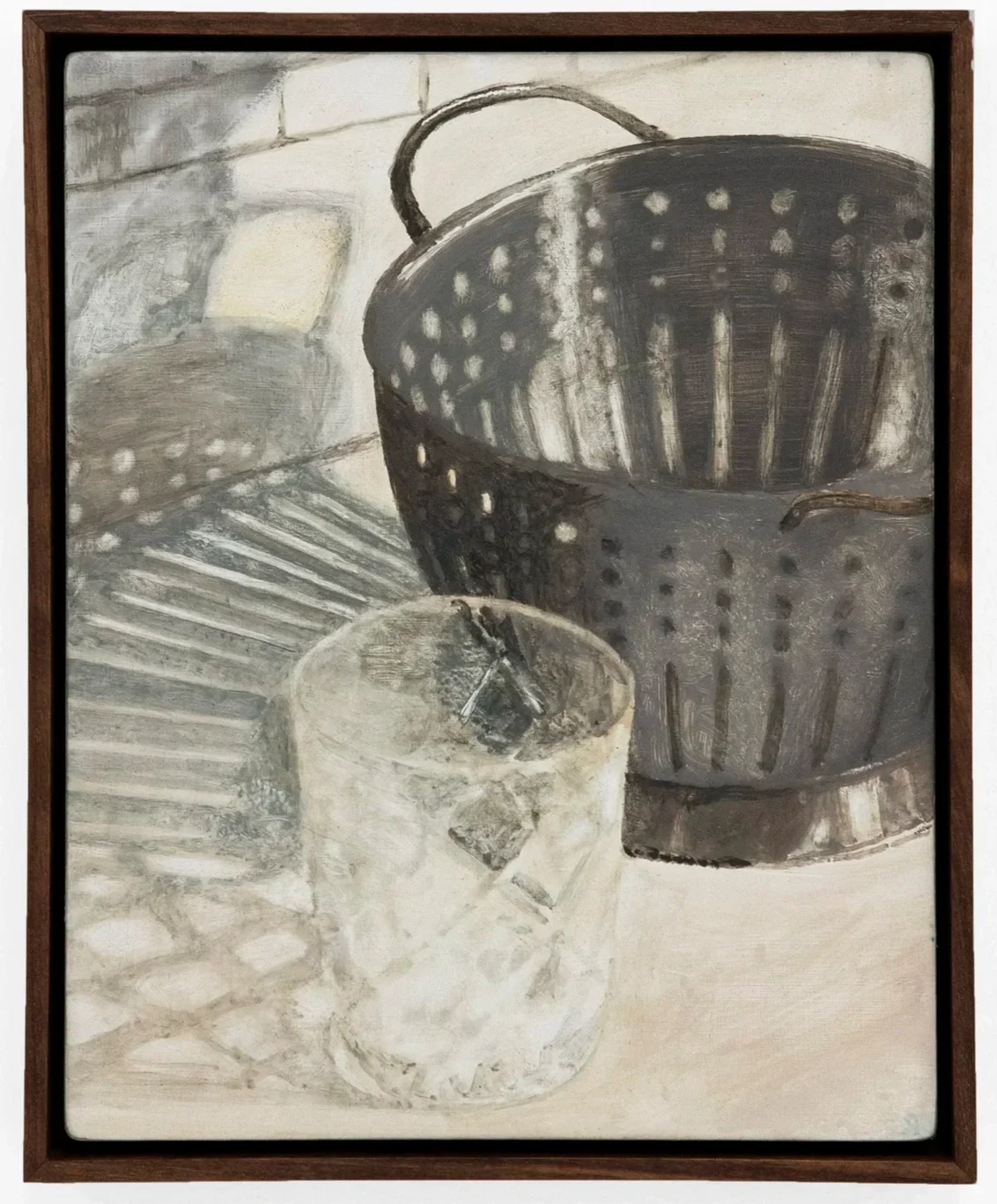
In a more thematic sense, A Certain Slant of Sunlight lends itself to this exhibition because light is a major preoccupation of these paintings, though in truth nothing seems to delight him more than a slant of shadow, as we see in Bosch, behind a book leaning against a wall, or in Crystal Clear Tape, from sunlight bisected by a window frame, or in Kitchen, from light traveling through a colander and etched glass tumbler. That said, Yackulic quite clearly responds to the light in the East Bay, the monumental quality it gives certain buildings, like the imposing bulk of Hill Castle Apartment Hotel IV, seen from behind on a sunny day, or the skinny Gothic revival skyscraper Cathedral Building, poking up behind a treetop on an overcast day. Deceptively simple, many of the paintings are as complicated as vision itself, such as Tree (Spring), where we look through lower branches that are backlit by the sun directly lighting the higher branches behind them. Such details don’t draw attention to themselves, lending the paintings an air of mystery; you know what you’re seeing but you don’t immediately know why you are seeing it. Why this image, isolated from the general welter of what we see? Yackulic’s paintings might be described as acts of attention that in turn only emerge through a viewer’s sustained attention.
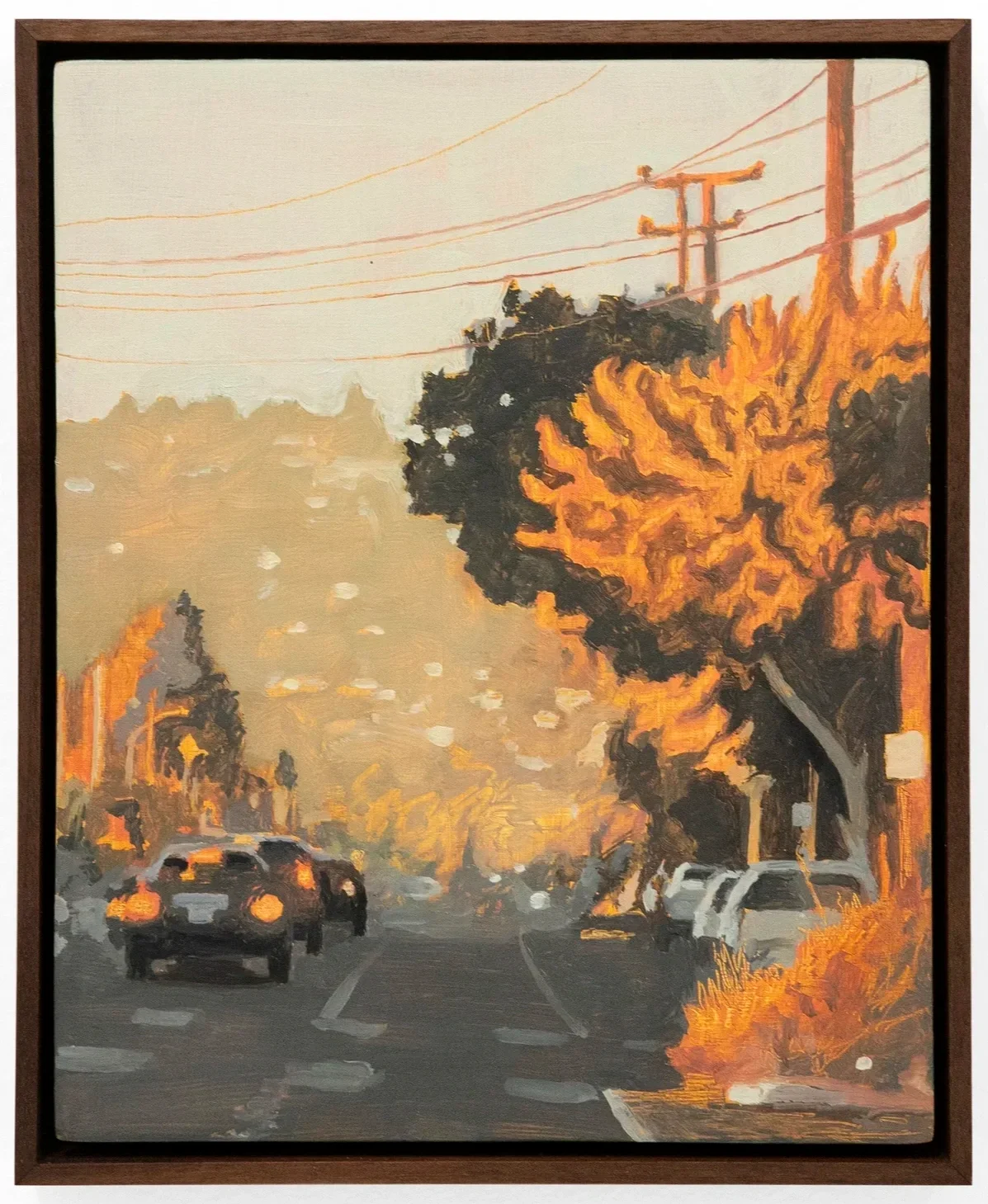
On Adeline
Oil on wood panel
9 x 7.25 inches framed
2026
The exploration of light quite naturally evokes the imperatives of impressionist painting; sometimes one of his paintings will seem almost photographic when viewed at a certain distance, but on close inspection will look almost comically unrealistic, thick with brushwork that defies disappearance into illusion. This is particularly the case here in paintings like Theater II or the two On Adeline, with the perspective of the street extending into the distance. The first On Adeline is especially impressive, the Berkeley hills faint but looming like a tidal wave, the just-before-sunset light changing in successive layers the closer the objects get. In the foreground, Yackulic adds an extra layer with the artificial red brake lights on the cars driving away from the viewer, at a time of day when it’s too bright to switch on the headlights, but dark enough for the electric light to begin to glow.
Net II
Oil on wood panel
9 x 7.25 inches framed
2026
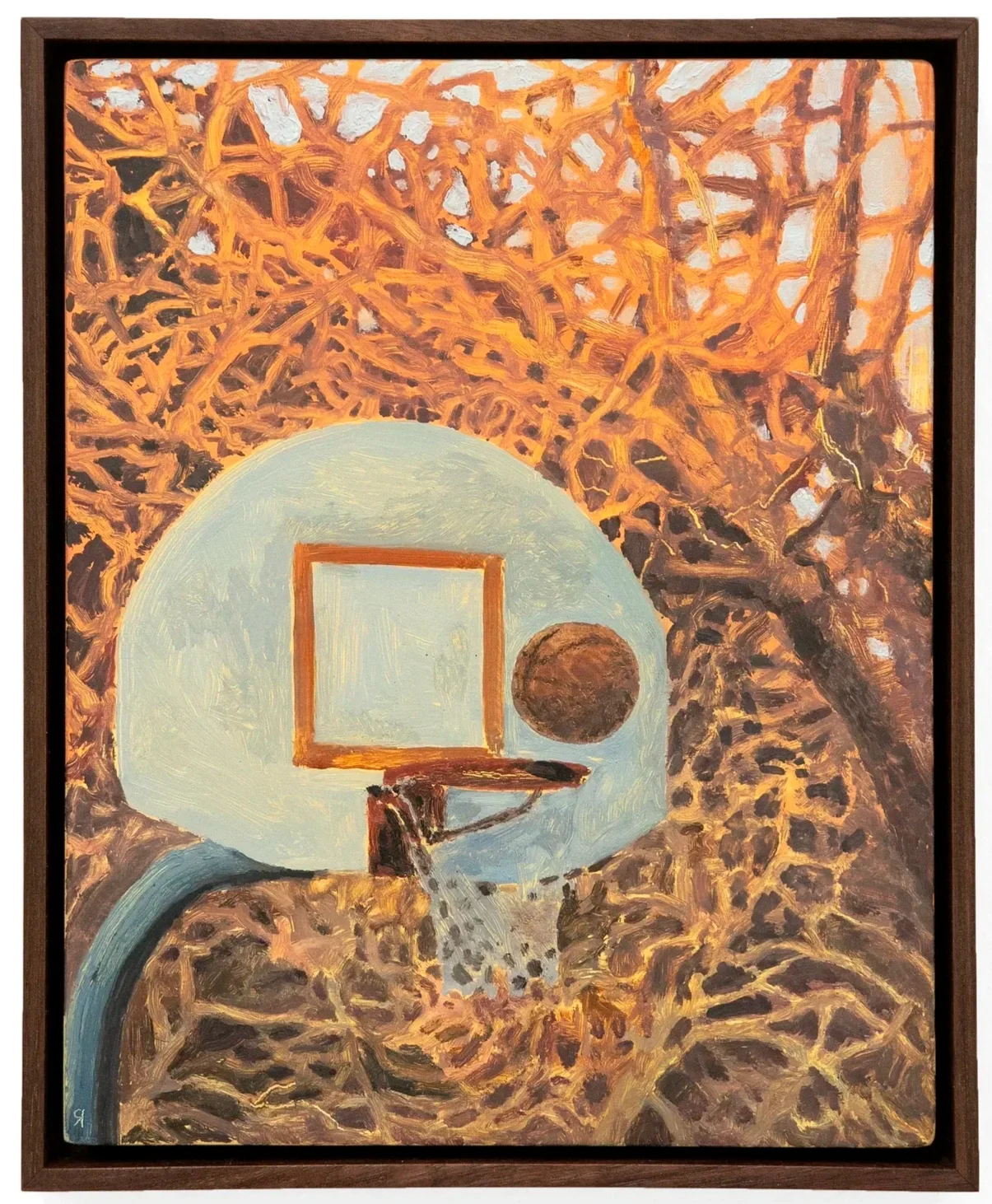
Yackulic’s earlier success as an artist had a remarkably different character, akin to op art, so this recent work can be seen as a rebellion, in some sense, from the work that made his reputation, the Poésies to its Maldoror. And yet, these two modes seem to me intimately related. His op art work—generally building up structures from small geometric increments—required a minute precision that, at a glance, he would seem to have abandoned in favor of impressionistic illusion. But to me, the current oil paintings suggest that he hasn’t so much abandoned this precision as exceeded it. The casual subject matter under attention conceals the highly composed nature of the image, as in Net II, where the natural elements of the landscape and the artificial ones of the basketball backboard, net, rim, and pole mirror one another in Yackulic’s attentive gaze. This compositional excellence combined with a technical effortlessness suggests he’s gone beyond virtuosity. All that technique remains, but unconscious, or rather he is no longer directly engaged with it in favor of what he sees. It’s almost like he’s deliberately degrading his precision as a challenge. Take the “D,” say,” in “OAKLAND” as displayed on the Theater II sign; it barely looks like the letter in question. But this doesn’t deform the impression of the word, or of the scene as whole, in the least.
Kitchen
Oil on wood panel
9 x 7.25 inches framed
2025
It will be interesting to see where Yackulic’s art goes from here. In a sense, this post-technique era of his work could sustain an artist indefinitely, in the manner of a high-end photographer, endlessly able to frame and capture images with a camera. In both cases, the ability to see outstrips the accouterments of the media used to capture the vision. But I suspect a certain restlessness that has already characterized his artistic development will set in and lead to the next evolution of his work, in a way no less unpredictable than his turn from op art success to these poetically expressive oils.
