
GaHee Park, Behind the Curtain, Yerba Buena Center for the Arts
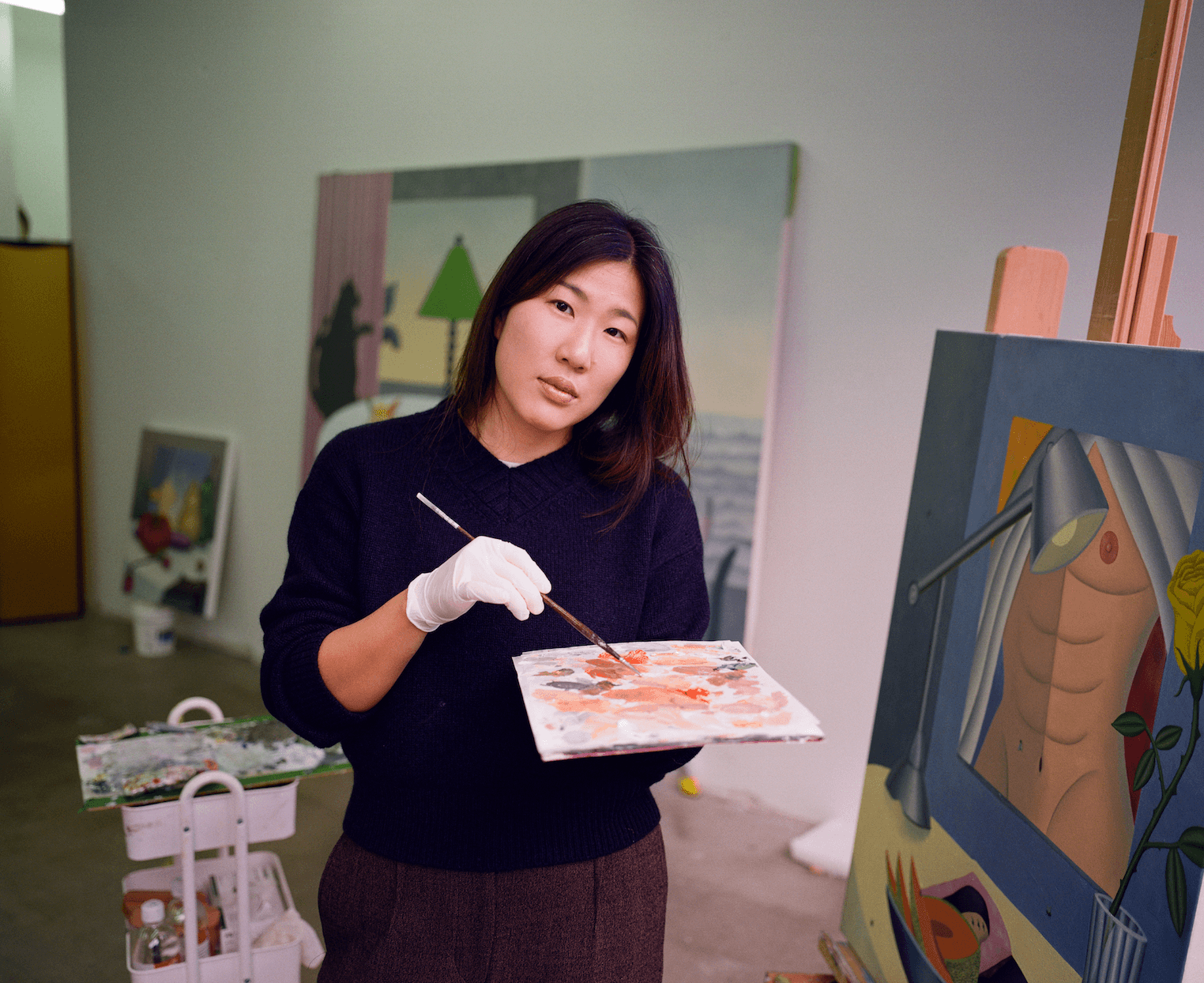
GaHee Park working in her studio. Photo by Michael Vass.
There is something seductive and faintly disquieting about GaHee Park's paintings. Their colors are muted but rich—dusty pinks, grays, greens, and yellows—and their surfaces have an almost decorous calm. Flowers sit in vases, fish lie on tables, women recline, cats watch, insects crawl. Then you begin to notice what else is happening. A body doubles. A shadow develops a presence of its own. An eye appears where it shouldn't. What initially resembles a still life or portrait slips into something erotic, uncanny, and increasingly strange. The longer you look, the less stable the picture becomes.
GaHee Park: Behind the Curtain, curated by Dorothy Dávila at Yerba Buena Center for the Arts, is the Seoul-born, Montreal-based painter's first solo institutional exhibition in the United States and brings together work from the past five years. Park has created a pictorial world entirely her own, populated by women, animals, insects, flowers, food, landscapes, shadows, and disembodied parts. Still life, portraiture, landscape, eroticism, and psychological theater trade places with one another until the categories stop holding.
The exhibition's title provides a useful way into these paintings. Curtains appear repeatedly in Park's work, revealing and concealing at the same time. They are theatrical: something is always about to appear or disappear. A curtain is a flat surface that implies depth behind it—a plane that promises a room, a body, a scene it doesn't actually show. Park's paintings operate in much the same way. They offer themselves to the eye and then resist being completely understood. Again and again, Park sets up the expectation that looking will reveal something, only to make looking itself unreliable.
That tension has roots in Park's childhood. Raised by strict Catholic parents in Seoul, Park has described filling her sketchbooks with drawings of nude figures and genitalia, then gluing the pages shut so her mother wouldn't find them. When her mother did discover a set, she burned them. That impulse to hide has never entirely left her work. Desire is rarely announced directly. It hides in fish, fruit, fingers, shadows, and folds. Even when the subject is plainly sexual, violent, or strange, the painting remains strangely composed. Nothing in Park's muted palette or controlled surfaces signals alarm. Concealment, in other words, isn't only something she depicts; it's built into the way she paints.1
In Still Life with Tired Moth (2025), the seemingly innocent tradition of flower painting carries this history of concealment. The bouquet can be both subject and decoy. Park borrows from the vanitas tradition of seventeenth-century Dutch still-life painting, in which flowers, food, insects, and luxury objects reminded viewers of decay and mortality. In Park's hands, the old memento mori into new territory. The familiar symbols are there, but Park makes them slippery. Mortality is folded into sexuality, secrecy, appetite, and humor.
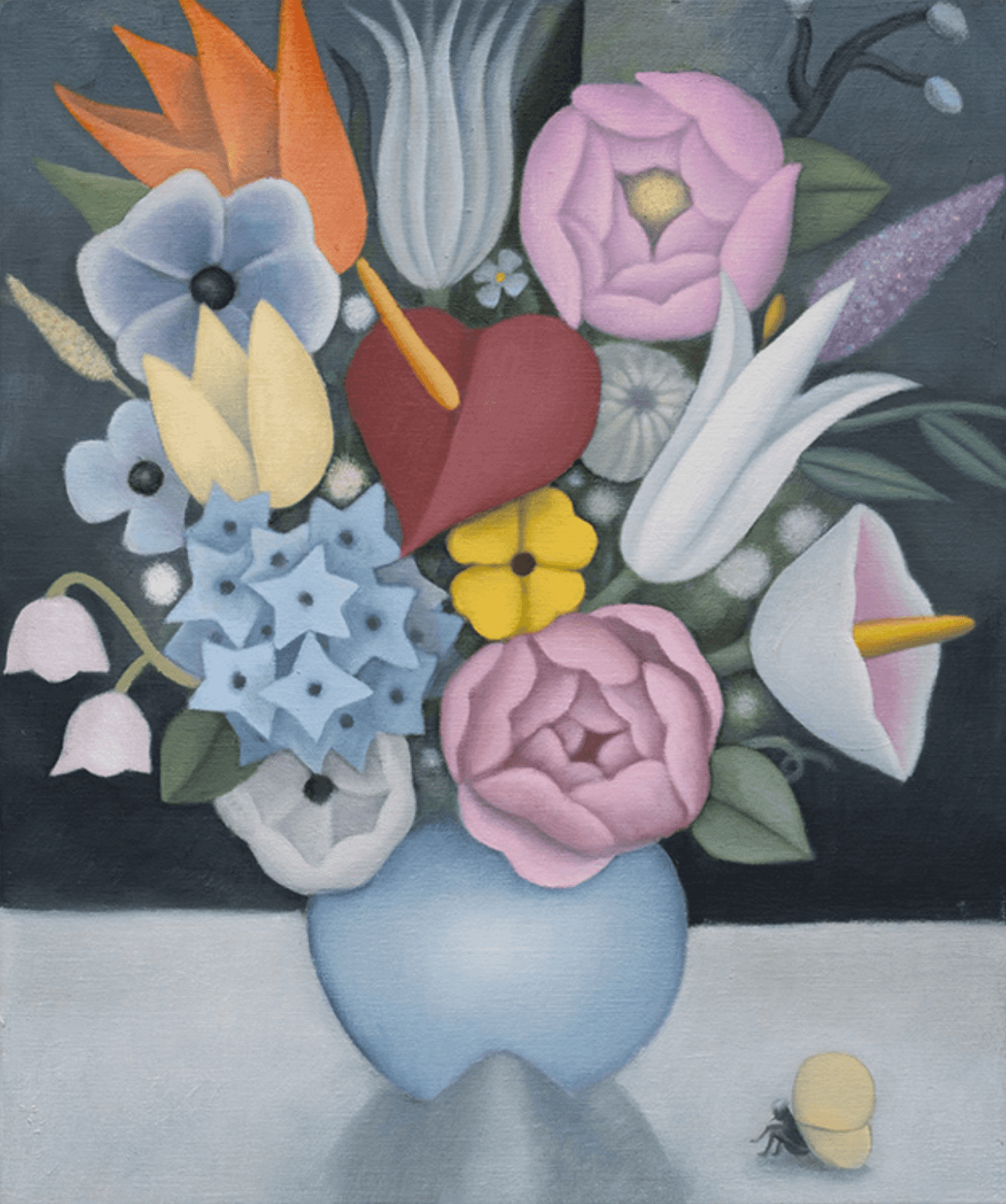
Still Life With Tired Moth, 2025 Oil on linen 18 x 15 inches
Photographer: Paul Litherland Courtesy of the artist and Perrotin.
Dream with Still Life (2022) makes that connection especially clear. The composition retains the compressed space of traditional still life, but a sleeping woman has entered it. Beside her lies the carcass of a fish, while a snail makes its slow passage and a cat watches the scene. The woman is at once sleeper, dreamer, body, and one more object in the arrangement.
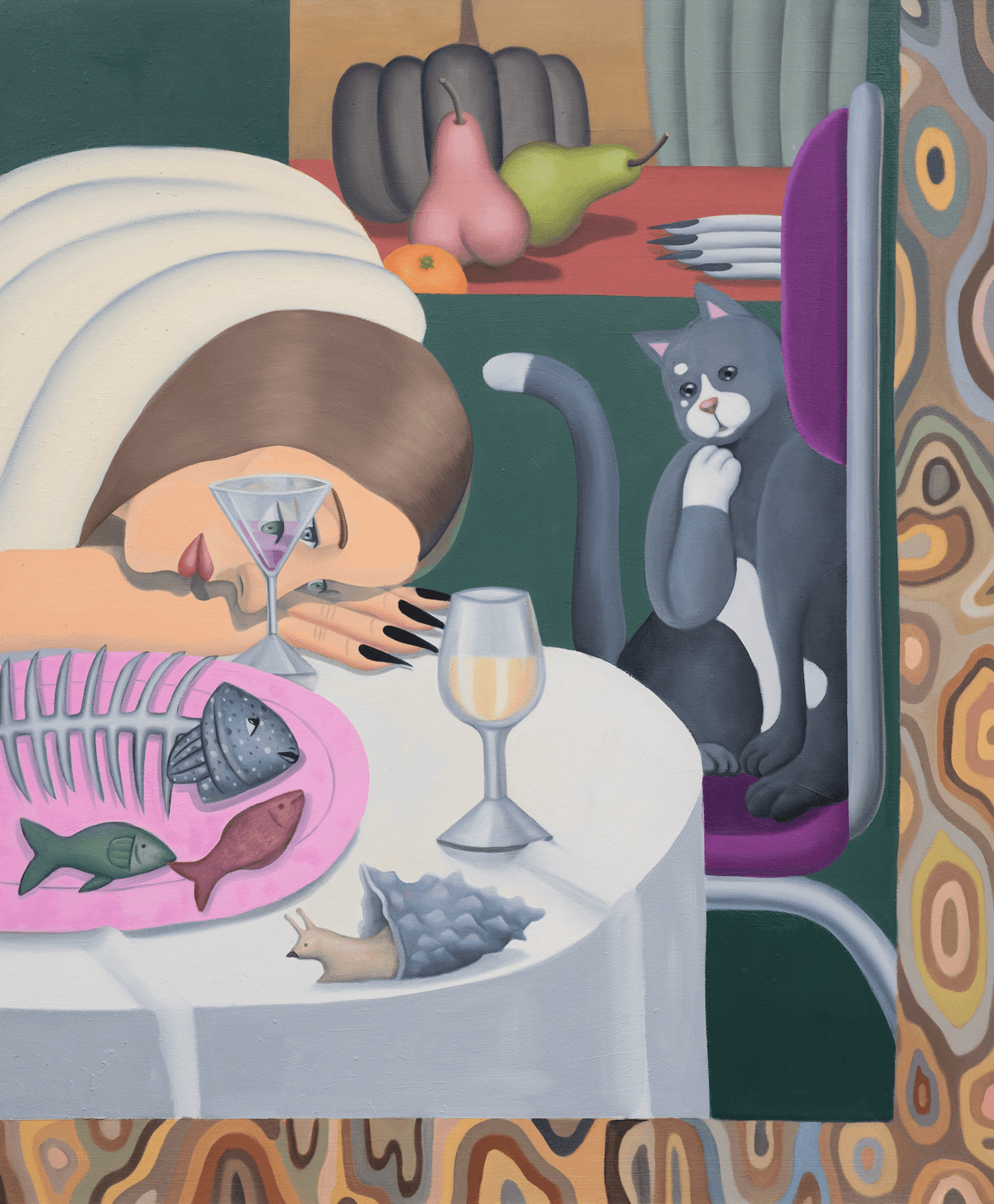
Dream with Still Life, 2022. Oil on canvas, 41 x 34 in.
Collection of Scott and Cissy Wolfe.
Courtesy of Jessica Silverman. Photo by Eric Ruby
Animals in Park's paintings often function as voyeurs. Cats stare. Insects creep through scenes. Creatures occupy the edges of human encounters as if they know something we do not. But Park never allows the position of voyeur to remain stable. We watch the woman; the cat watches her too; the woman may be looking back at us; somewhere else an eye appears without a body attached to it. Looking circulates through these paintings without ever belonging securely to anyone.
Park's women may be exposed, fragmented, reclining, doubled, or partially hidden, yet they rarely seem passive. Eyes wander, detach, and appear in unexpected places. A face can seem to look in two directions at once; a reflection does not necessarily confirm the person standing before it. The morePark gives us to see, the less certain our position as viewers becomes.
Park's unstable reflections bring to mind Jacques Lacan's theory of the mirror stage, when an infant recognizes itself in a mirror and begins to form a sense of a separate self. But that supposedly unified self is first encountered as an image—a flat representation.
Park's mirrors refuse to provide that reassuring correspondence. Her doubled eyes, disembodied faces, shadows, and reflections fragment rather than complete the figure. The reflection becomes a kind of visual short circuit: instead of extending the illusion of pictorial space, it calls attention to the fiction of the painting itself. Like the curtain, the mirror appears to offer access to another space while remaining stubbornly flat.
The martini glass is another recurring motif, a small emblem that signals the onset of an altered state—the hour when composure loosens and the subconscious starts to surface. Dusk similarly becomes a threshold, a moment between day and night when perception becomes less reliable. In Table at Dusk (2025), the domestic table becomes a stage. Food suggests appetite, and appetite tips easily into desire.
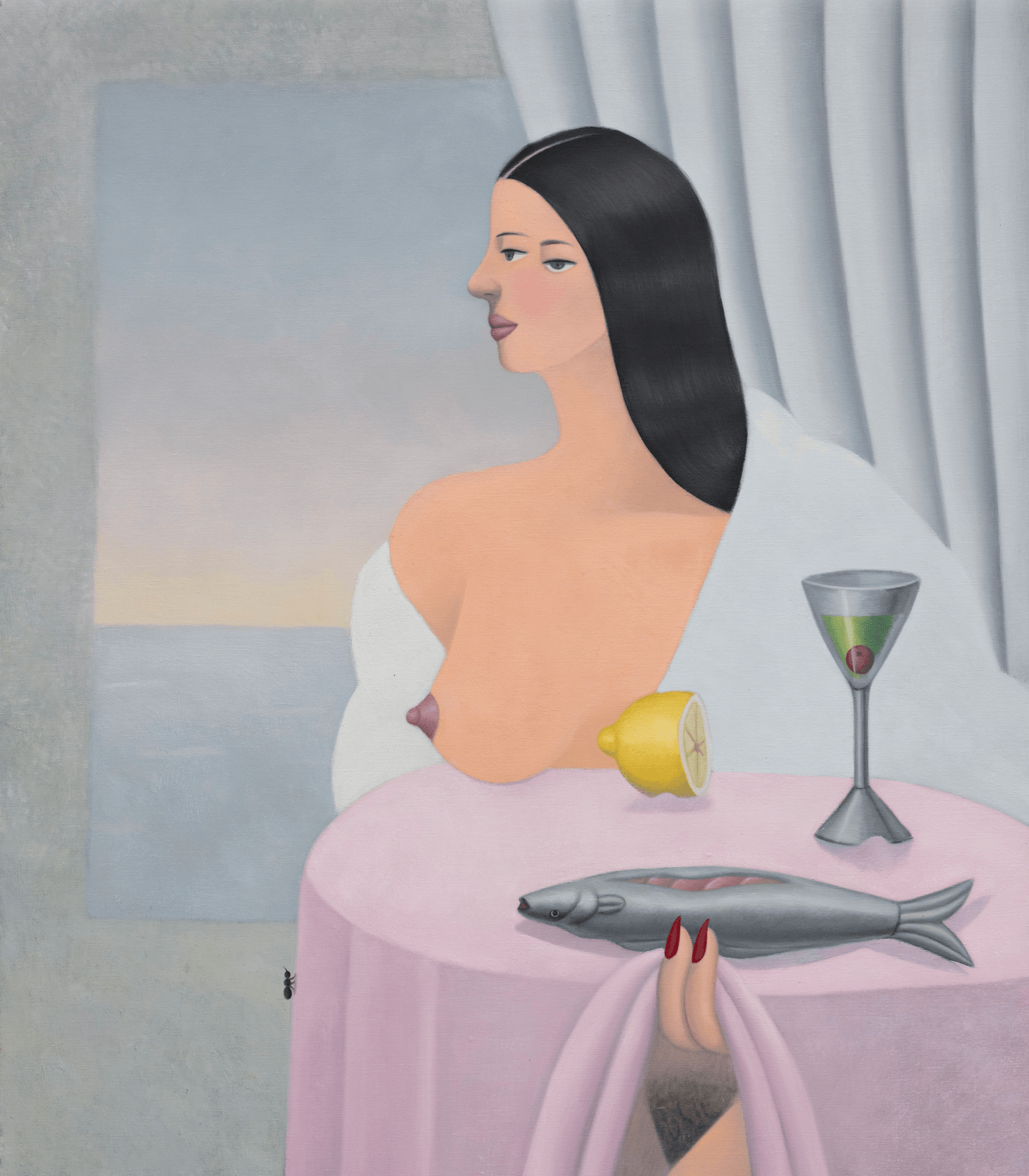
Table at Dusk, 2025. Oil on linen. 101.6 x 88.9 cm, 40 x 35 in.
Collection of Ariel Kliegerman and Remi Janier.
Photo by Paul Litherland. Courtesy the artist and Yerba Buena Center for the Arts.
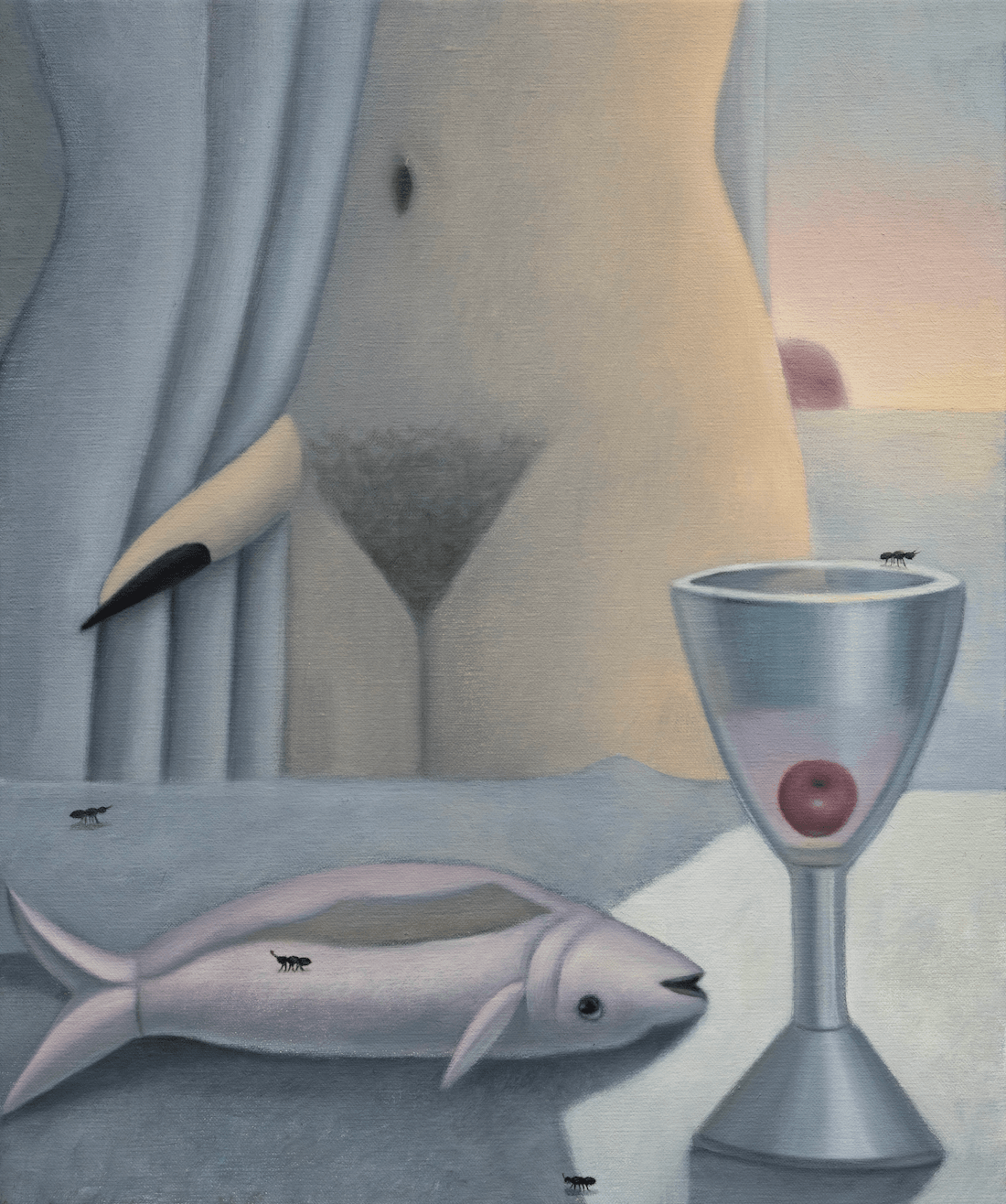
In Woman with Shadow and Ants (2024), even the shadow seems to acquire an identity of its own. Ants introduce another scale of existence, seemingly indifferent to the woman beside them. Likewise, in Fish and Ants on a Table (2024), human, animal, insect, and food occupy the same visual ecosystem.
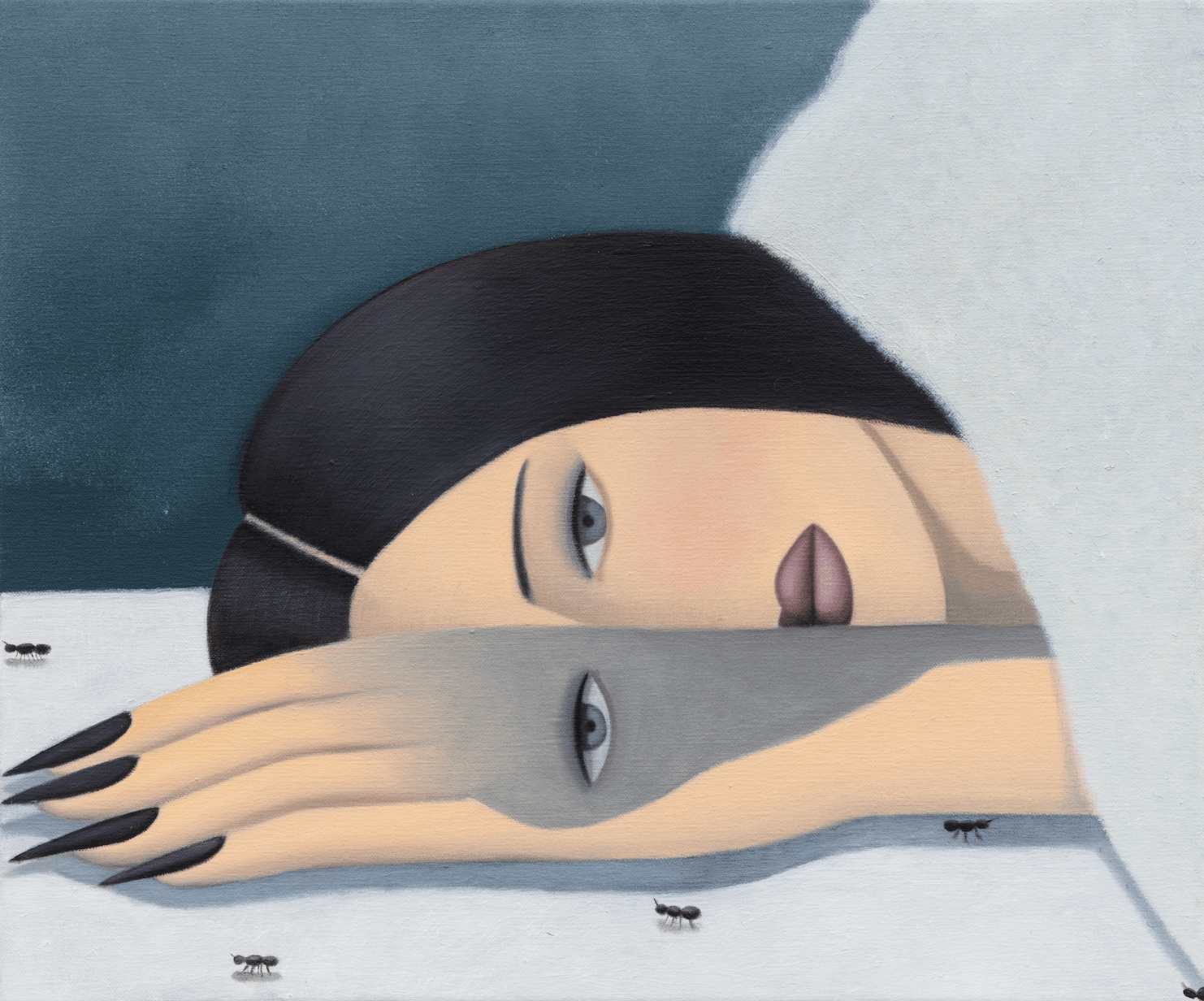
(L) Woman with Shadow and Ants, 2024. Oil on linen. 38.1 x 45.7 cm, 15 x 18 in. Courtesy the artist and Yerba Buena Center for the Arts.
(R) Fish and Ants on a Table, 2024. Oil on linen. 45.7 x 38.1 cm, 18 x 15 in. Colm John Lannigan. Photo by Paul Litherland. Courtesy of Jack Cohen and Perrotin. Colm John Lannigan. Photo by Paul Litherland. Courtesy of Jack Cohen and Perrotin.
What Park has built is a private grammar out of sex, food, death, beauty, sleep, appetite, the act of looking, for which she won't supply a key. The same flower that conceals a body in one canvas can simply be a flower in the next; a fish is sometimes a corpse, sometimes a stand-in for flesh, sometimes just dinner. Nothing in her vocabulary carries a fixed meaning. Its sense depends entirely on what surrounds it, which is another way of saying these paintings aren't meant to be decoded so much as entered.
Park gives us enough information to make us curious. And curiosity, in these paintings, is its own kind of desire. We don't want to solve the mystery behind the curtain so much as remain transfixed.
1. Numéro (Éric Troncy, "Who is GaHee Park, painter of ambiguity and eroticism," published Nov 2024, updated July 2026): https://numero.com/en/art-design/art-en/ambiguous-eroticism-and-spectator-voyeur-the-enigmatic-canvases-of-gahee-park/ and It's Nice That (Ayla Angelos, "Exaggerated figures and oddly placed genitals: meet artist Gahee Park," Sept 2019): https://www.itsnicethat.com/articles/gahee-park-art-300919
