
Caledonia Curry (Swoon) on Art, Trauma, and Healing
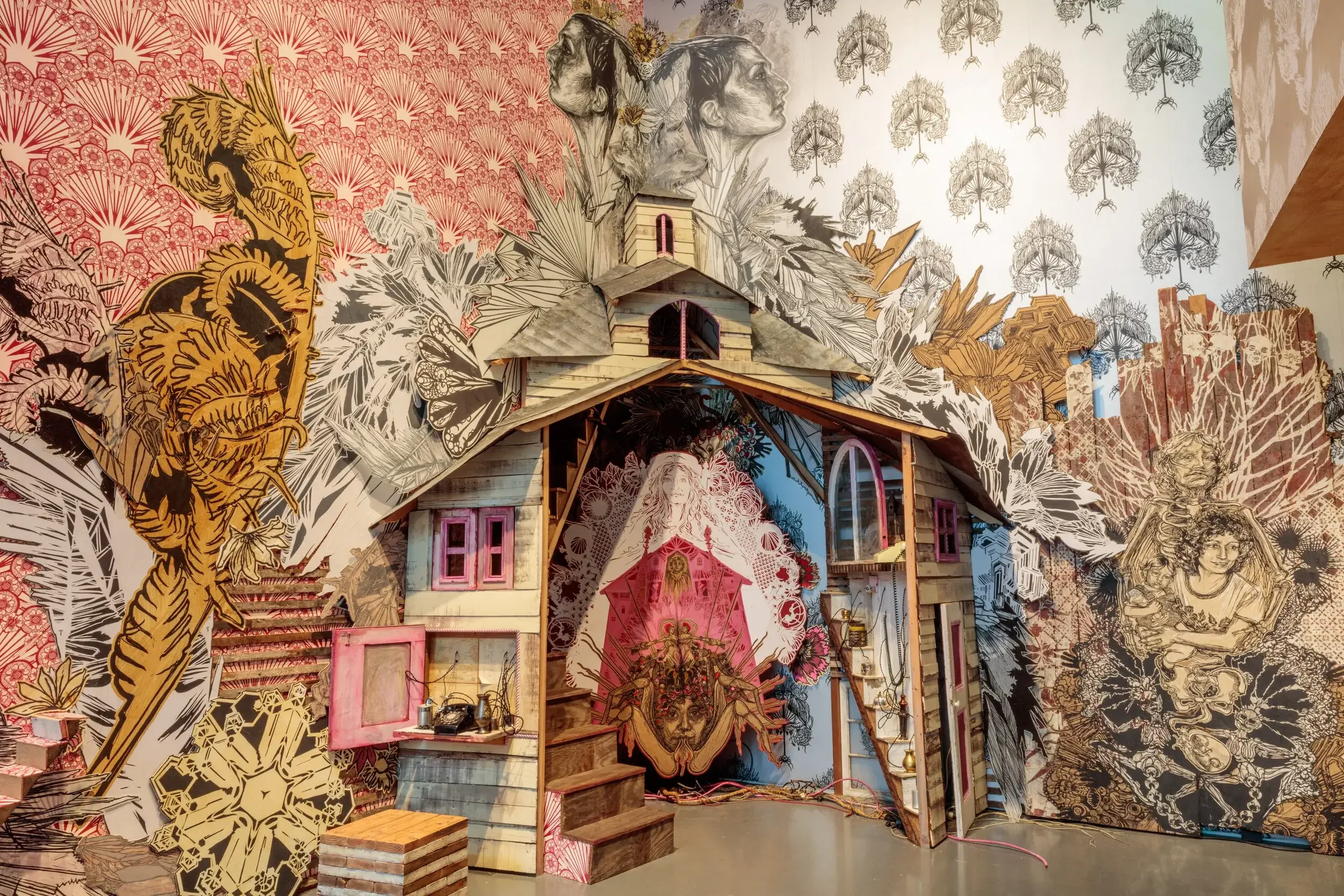
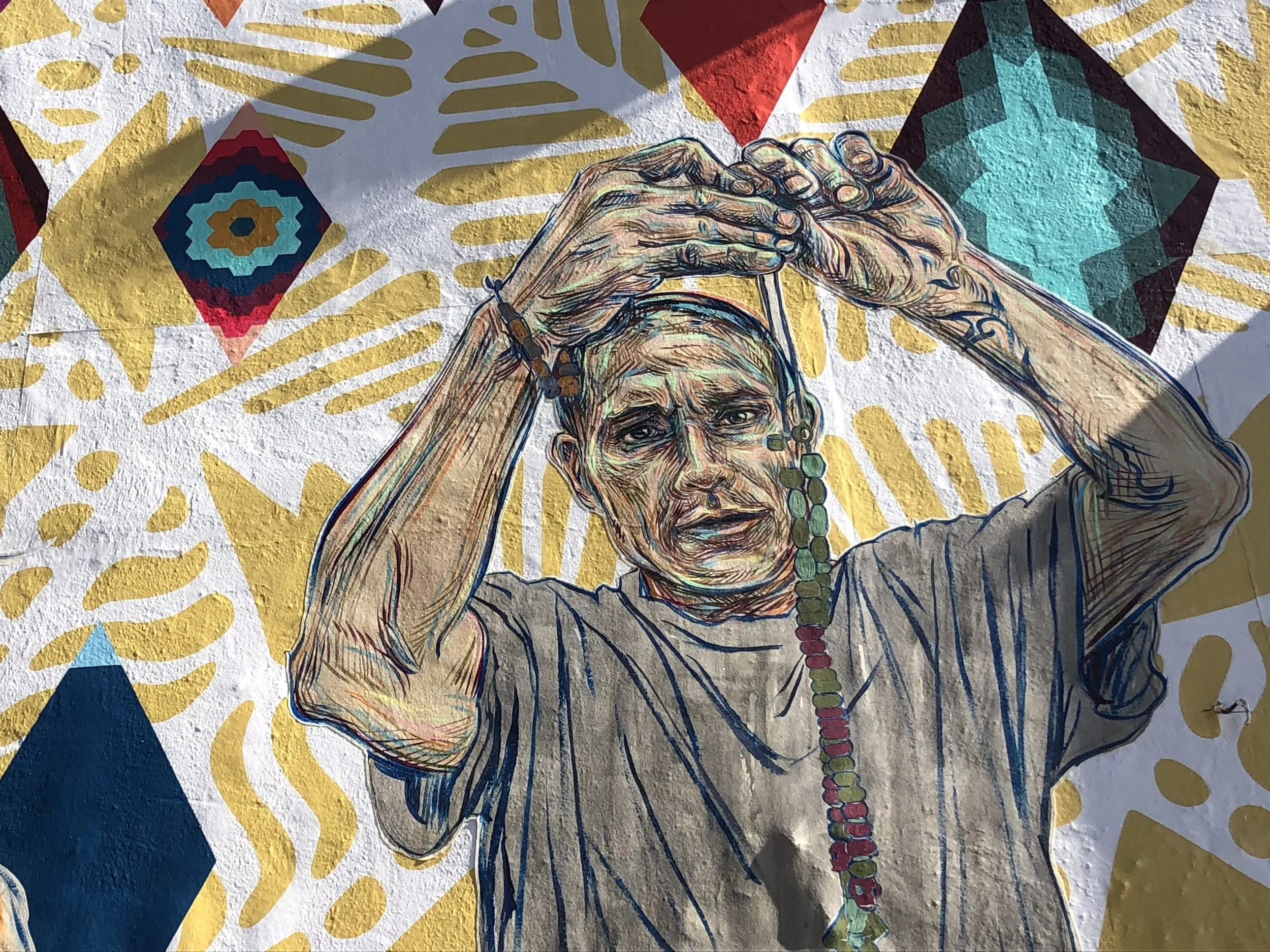
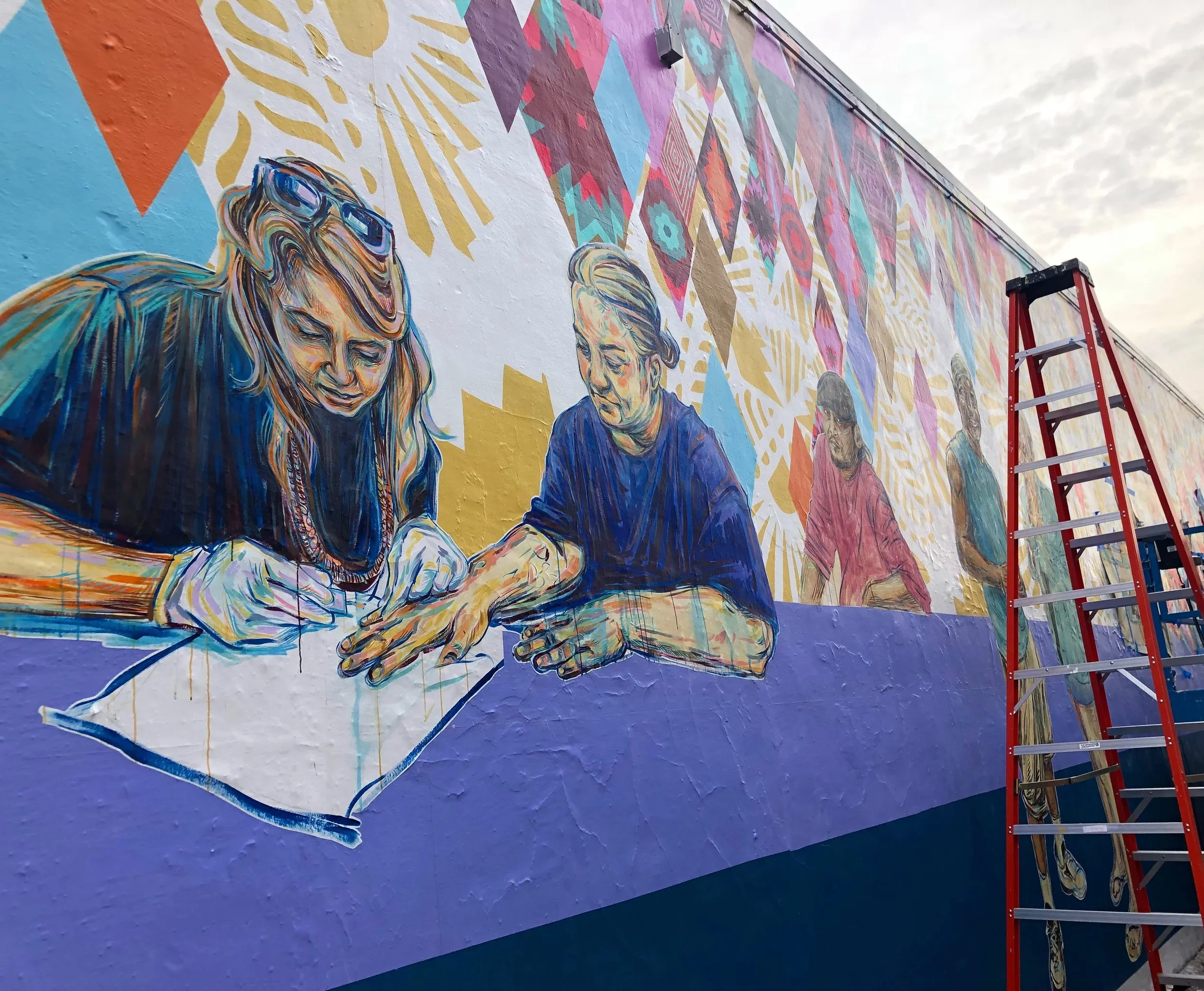
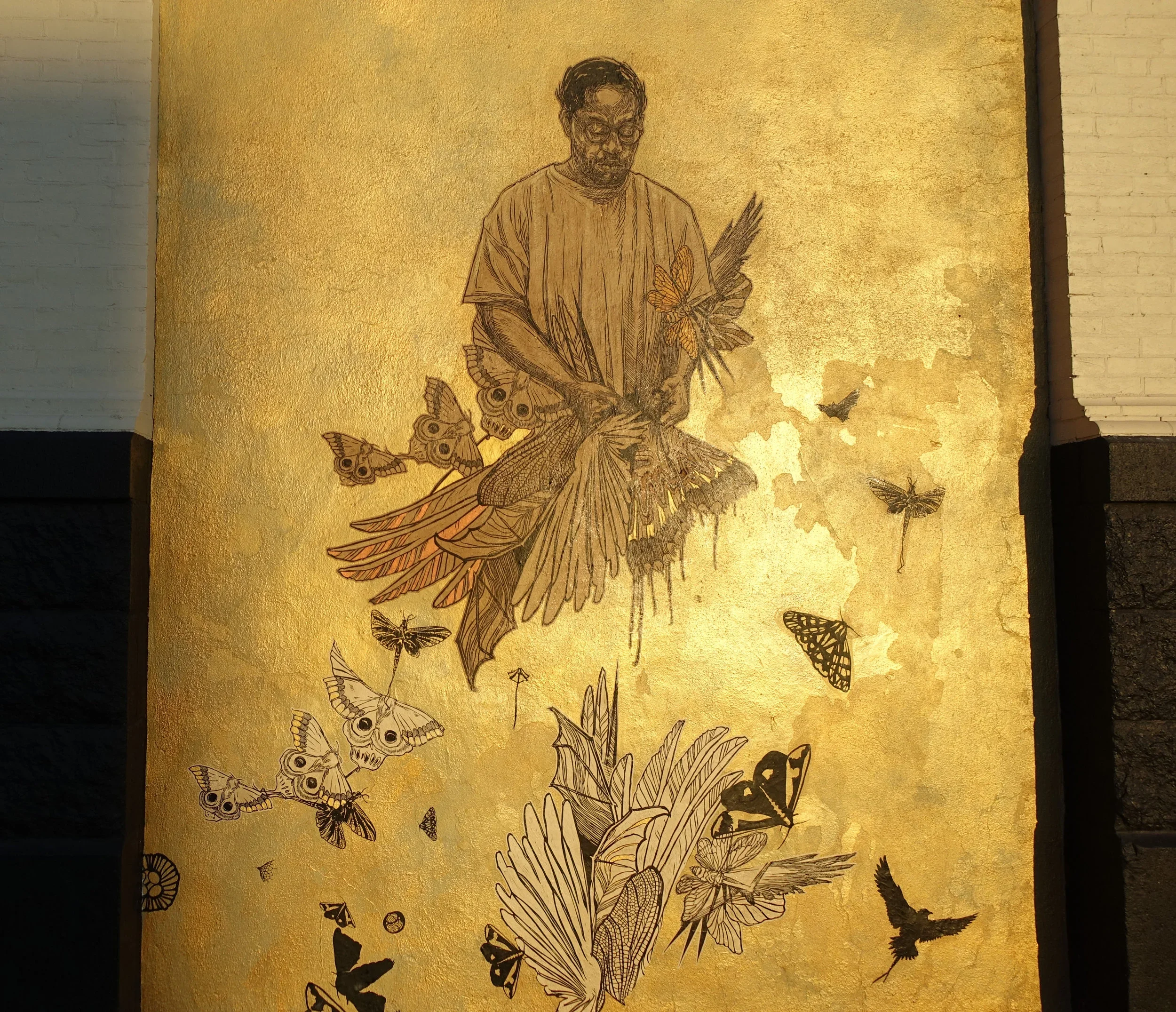
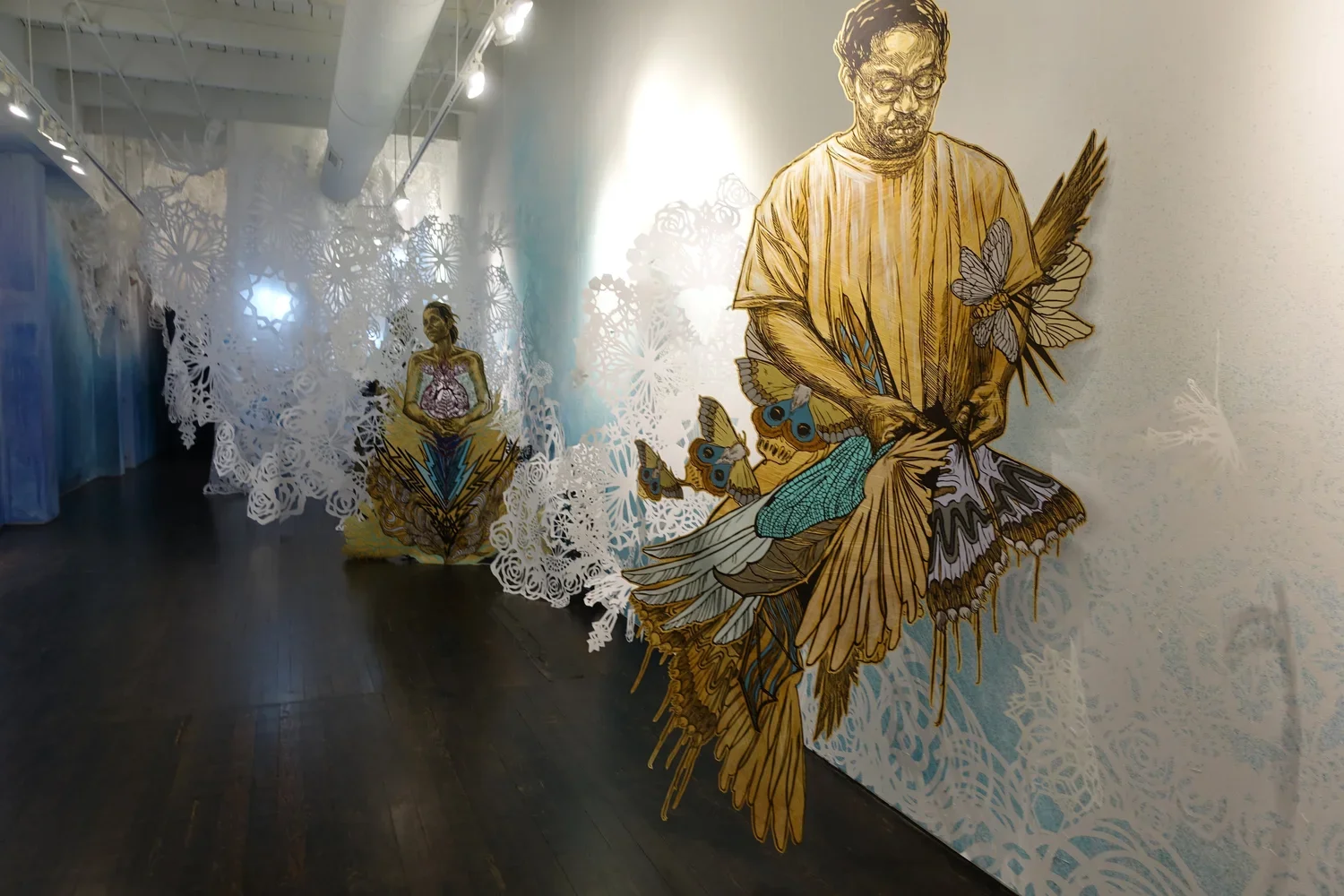
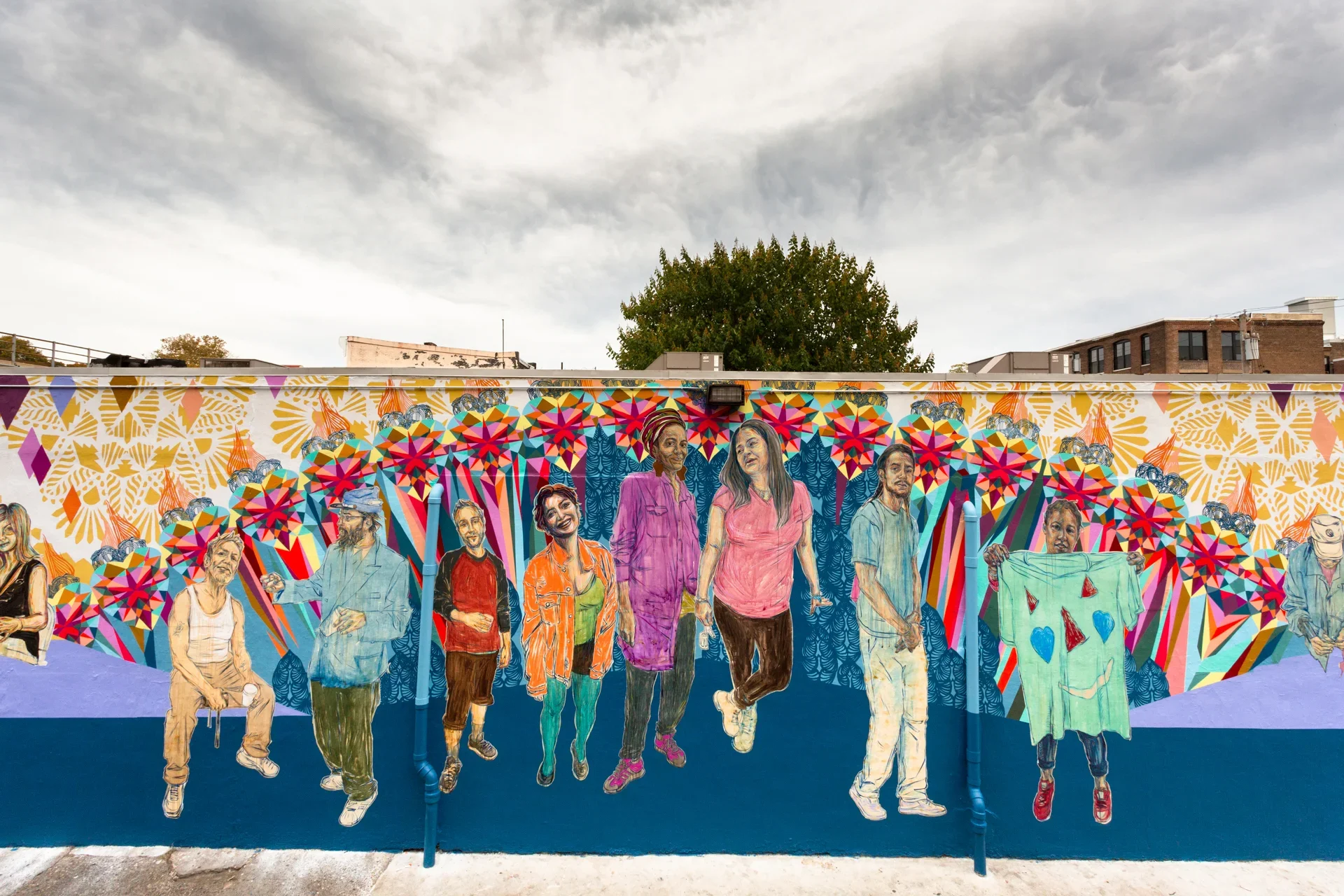
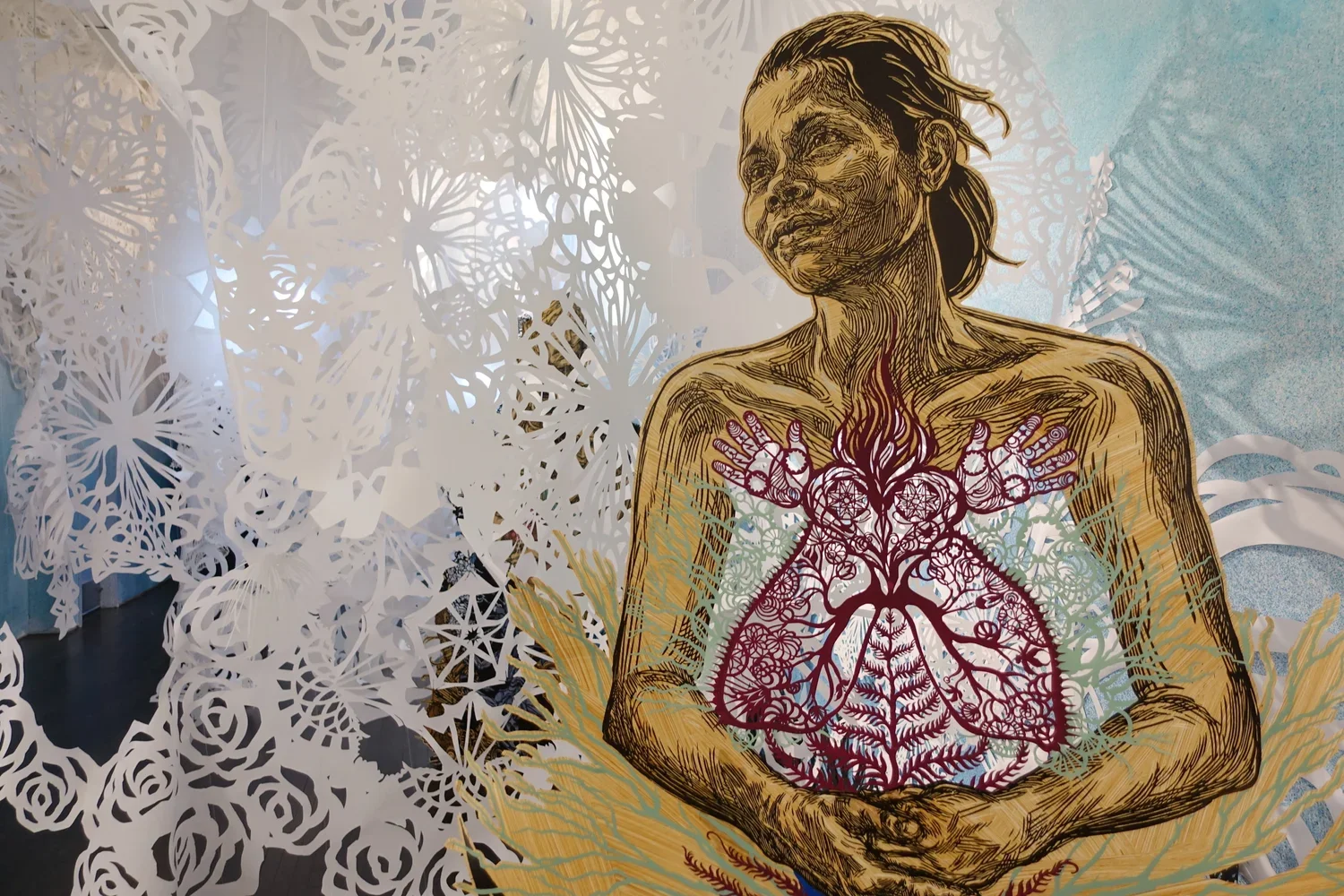
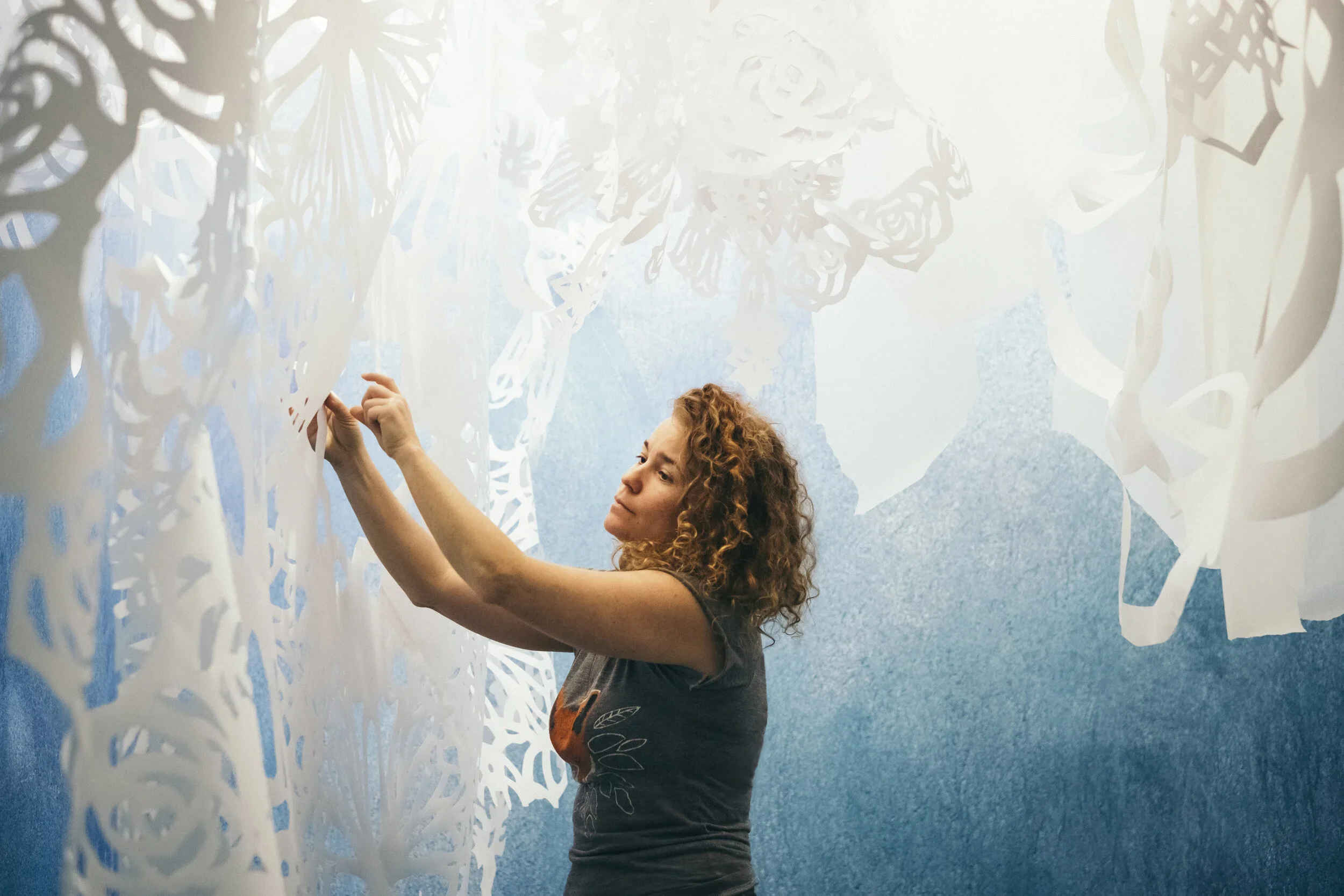
Caledonia Curry, known as Swoon, is a contemporary artist and filmmaker recognized around the world for her pioneering vision of public artwork. Through intimate portraits, immersive installations, and multi-year community based projects, she has spent over 20 years exploring the depths of human complexity, and asking how art can fundamentally re-envision the communities we live in towards a more just and equitable world.
She is best known as one of the first women Street Artists to gain international recognition in a male-dominated field, pushing its conceptual limits and paving the way for a generation of women Street Artists. Her critical engagement with issues of social and environmental justice have positioned her at the forefront of the emergent discourse around socially-engaged art practices.
Curry has participated in numerous solo and group exhibitions in major museums and galleries around the world, including the Museum of Modern Art and MoMA PS1, New York; the Brooklyn Museum; the Mori Art Museum, Tokyo, Japan; the Institute of Contemporary Art, Boston; the Skissernas Museum, Lund, Sweden; MIMA Contemporary Art Museum, Brussels, Belgium; and Museo de Arte Contemporáneo, Oaxaca, Mexico. Her first museum retrospective was The Canyon: 1999–2017 at the CAC Cincinnati. Her work is held in public and private collections including the Museum of Modern Art, Tate Modern, the Detroit Institute of Arts, and MASS MoCA.
In 2021, Curry premiered The House Our Families Built, a major public art commission in collaboration with PBS American Portrait. She is currently developing a full length narrative movie which will bring together drawing, immersive installation, stop motion animation and her collaborative work, with the traditions of storytelling through film.
Artist Caledonia Curry (Swoon) | Interview by Hugh Leeman
The Beauty of Decay
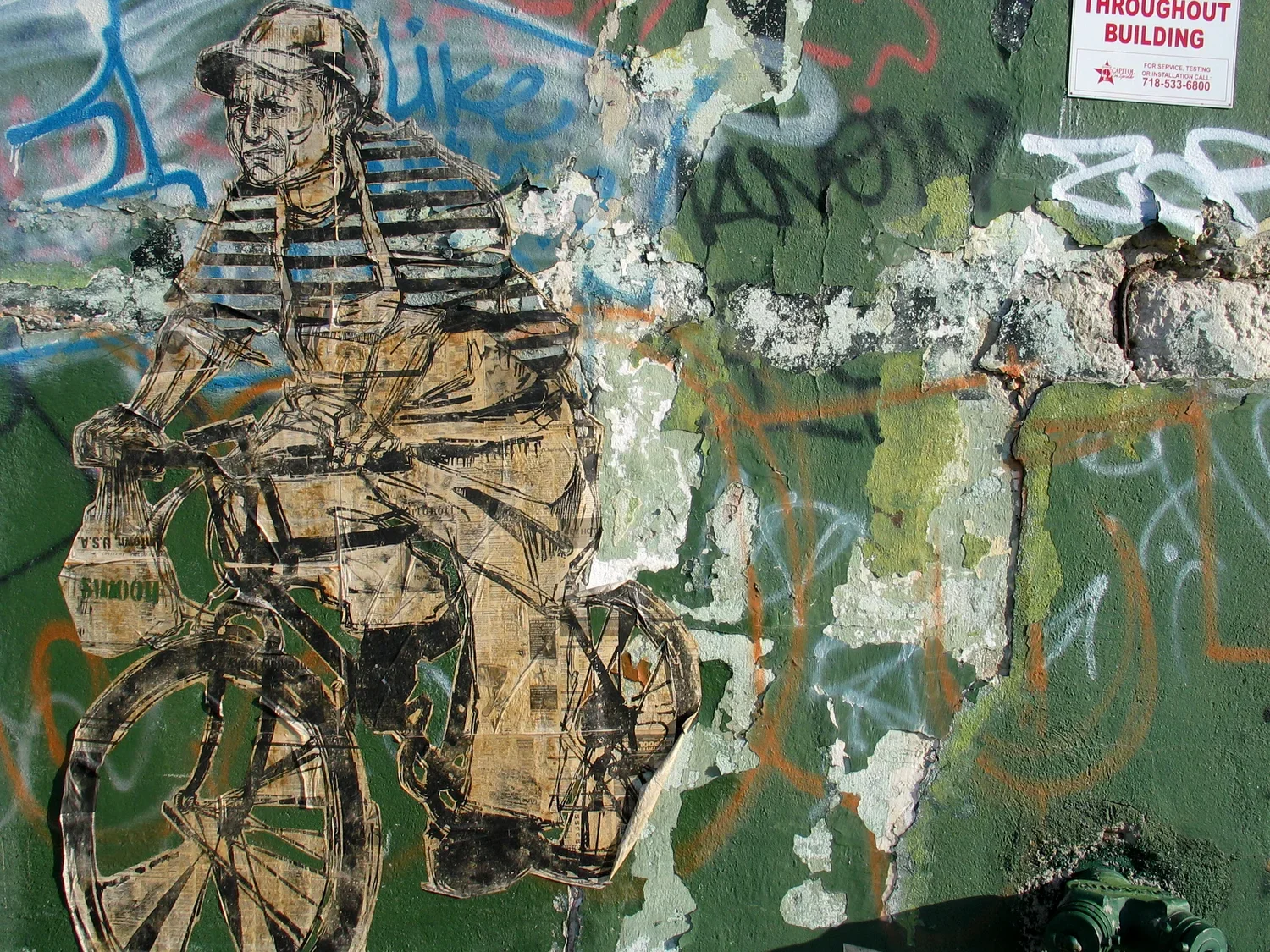
Hugh Leeman: Caledonia, your early street portraits were printed on fragile newsprint and then intentionally left exposed to the elements. How did watching those figures deteriorate and disappear affect your understanding of art, authorship, and control?
Caledonia Curry: I intentionally made those pieces that way, and I loved the process of decay, because there was always something really fun and unexpected happening — the way the paper would curl and tear and yellow. It just seemed to be alive.
At the time I was really excited by Gordon Matta-Clark, who was one of my heroes — he would take these abandoned buildings and cut them into shapes, knowing the building was going to be destroyed. Or Tibetan sand mandalas. I was looking at a lot of temporary art pieces and thinking about the way there was something precious about that fleeting moment.
A Truck Full of American Stories
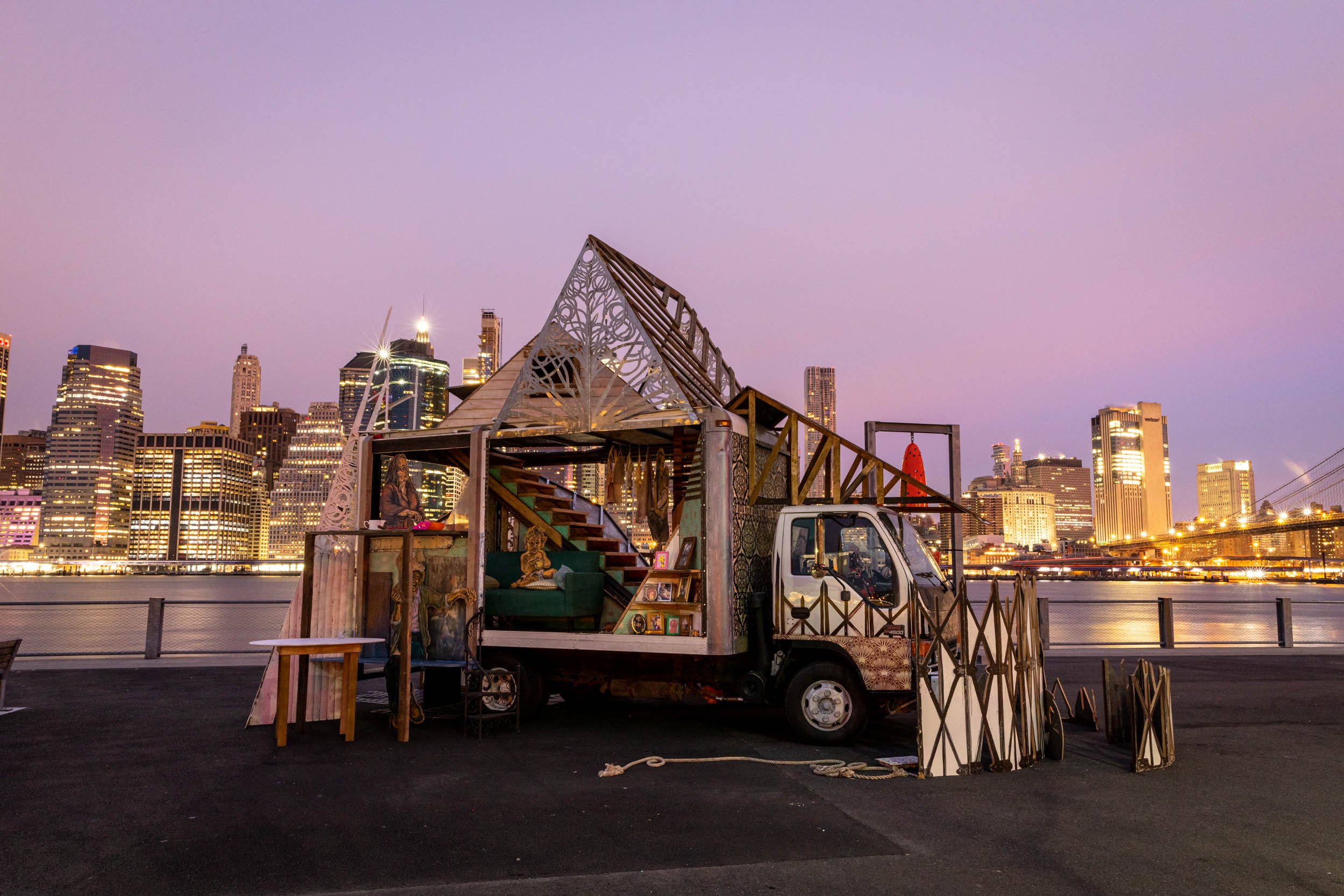
Hugh Leeman: The first time I ever bumped into your work was walking down the streets in Manhattan, and later I saw a piece here in San Francisco, and also in the West Bank in Palestine. There's a project I'd love to hear your thoughts on — The House Our Families Built. It transformed the back of a truck into a mobile domestic diorama, populated by painted figures and everyday objects, with actors performing stories about American identity and family legacies. What did mobility and live performance contribute to the work's exploration of inheritance and belonging?
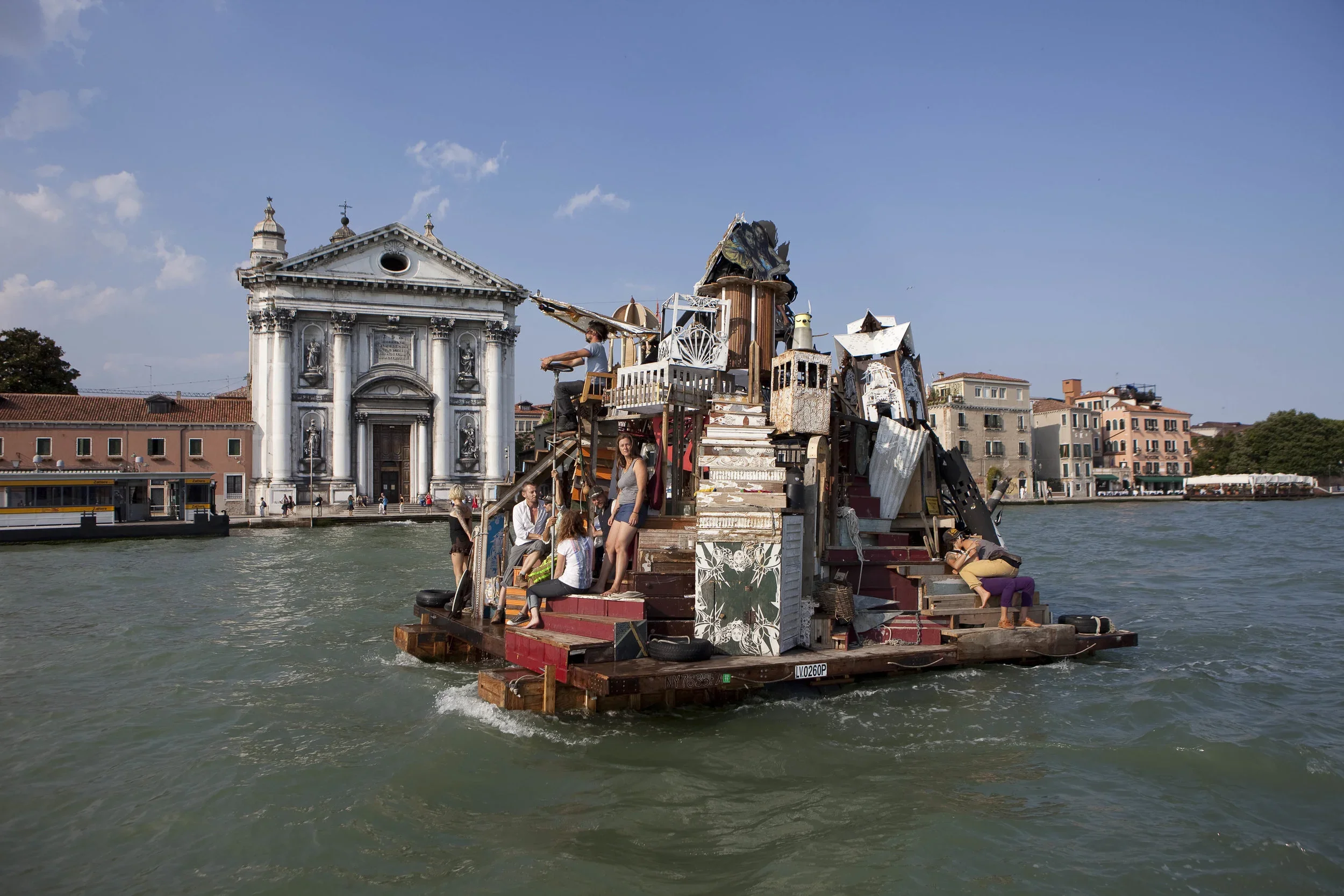
Caledonia Curry: I've always been drawn to mobility. The rafts were also mobile. Even the street pieces in their way, because they were prints — there was this way they could travel and appear in places. But with The House Our Families Built, I was working with PBS American Portrait.
As Americans, there are a lot of really big questions these days about what it means to be American, who we are, and what we want our values to be. Working with PBS American Portrait, there were thousands of people sending in these stories about their lives, and it was this idea that you can find out who we are — not through the horrible, divisive rhetoric that's going around, but through people's everyday tales about what's important to them. That was how the project started. I collaborated with them by working through a sound bank they'd created of thousands of stories. And because all these stories came from all over the country, the truck could travel and drive and move. It felt like a sort of lock-and-key kind of logic — that they made sense together.
The Third Thing: Art as a Precursor to Healing
Hugh Leeman: There's a project you did, Five Stories with Swoon. It brought together people who were incarcerated, formerly incarcerated, or receiving addiction treatment, through portraiture, art therapy, and storytelling. How did the participants' ability to author and share their own stories impact you and your role as an artist?
Caledonia Curry: To take a step back — that project began because I started collaborating with somebody who helped me tell my own story. I felt so empowered by their encouragement. They live in the Bay, a couple called the Million Person Project, and the way they brought me through this storytelling process helped me believe that telling my own story wasn't just some indulgent exercise, but something that could actually help me and help other people in the process.
I started doing it, and I started seeing that happen, and I realized there's a real power in this. I wanted to share that experience with people who were going through some of the similar things my family had gone through my whole life — addiction, coming out of addiction treatment, incarceration, various ways of getting stuck in negative cycles. I felt so transformed by that experience that I wanted to share it, so I ended up working with Philly Mural Arts and inviting the Million Person Project, all together in a way that could share this art of finding your voice.
Hugh Leeman: You've dedicated so much to incredible projects. One of them is in Kensington Avenue — for anyone who may not know, it's an area of Philadelphia that's long been home to the unhoused and those majorly impacted by the fentanyl crisis. You drew directly out of your own history and your family. How did that personal proximity change the way you entered the neighborhood and interacted with the people living there?
Caledonia Curry: The way people were describing Kensington at the time, it was the largest open-air drug market on the Eastern Seaboard. It was really a difficult place, and the level of suffering was beyond anything I had ever seen — and I moved to New York in the 90s. So it was a very extreme and intense place.
There was a tendency, when arriving in a neighborhood like that, to see people as a mass, and not as individuals. But I knew, because my parents had been those people, and yet they were my parents, and I loved them, and I knew their individuality deeply. So I had enough of a foothold to know from experience that every single person in that situation is just a person, like anyone you know and love, who just happens to have gotten so far down the ladder of addiction and crippling choices.
The thing I was learning — that somehow I didn't learn when I was a teenager — is that nobody ends up in that situation without usually having had a pretty serious history of trauma. If people are moving from a deep well of pain and then being exploited by the Sacklers and other corporations, punishment is not really a viable option. If we're working from suffering, the answer is not more suffering. My whole life, I didn't fully understand that until I was in my 30s. And then it became important to find ways to talk about that, to work with people who embrace that philosophy.
Philly Mural Arts had something called the Kensington Storefront, which I thought was one of the most brilliant and humane things I'd seen. In that area, next to the church and the needle exchange and the rehab and all the other actionable things, they found that not everyone is really ready to make such a big step — and that a thing that's deeply useful in a space like that is just a room where people can make art together. You can wash your hands, sit down, have a cup of tea, pick up a paintbrush, and talk to somebody casually while you paint a bird. There's something about making art together that soothes and grounds in such a way that it becomes a precursor to other forms of healing.
Hugh Leeman: Say more about that — this idea of it being a precursor to other forms of healing. It seems like one of the greatest returns on investment art poses for society is not in the art markets, but something like what you're describing. What's so special about sitting down and drawing a bird together that it leads to other forms of healing?
Caledonia Curry: It's such a great question. I don't know the answer, but I'll talk around it. The first thing is that we're sitting together, and we're not focusing on ourselves or each other — we're focusing on this third thing. And somehow that third thing touches into something very young, but it's low-pressure. There are certain kinds of conversations that can't happen if they're too high-pressure, but when we have this third, constructive, lovely thing we're doing together, it opens up a space for a different kind of connection and sharing. One of those famous quotes around addiction research is that the opposite of addiction is actually connection. So art-making gives us structures to connect with each other.
The other thing — I grew up in a family with severe narcotics addiction until I was about 5, and then alcoholism and psychosis and all kinds of other things after that, with intermittent stability. When I was about 10, things leveled out, and my mom took me to an art class. It was this first moment in my life where things were chill, we could breathe — and all of a sudden I'm being given this way to center, to calm, to ground, and to gain self-esteem, which I direly needed. There's something still unstudied in what the focus of making art does for the nervous system. I think of it like it gets my ducks in a line. When all this chaos is happening, if I sit down and draw a portrait, I need every single part of me to make it happen, so it has a way of calling me into one place. The mental health value of being united with yourself can't be understated.
Hugh Leeman: I love this idea of the third thing. It seems connected to the idea that it's not instantaneous — it starts to shut off part of that prefrontal cortex, where you're not going to that monkey mind of thinking, am I doing this or that, do people view me this way or that. And once that starts to turn off, you see someone go to a deeper layer of themselves and want to connect.
Caledonia Curry: I remember one woman in one of the programs loved to paint circles, and for her it was about this connection of mind and body together, the tactile relationship with the materials. But thinking of the third thing in a different way — some of the exercises we'd do were mask-making or myth-telling, and those function as a third thing differently. I was drawing on my own therapeutic experiences. I remember a therapy session where I became able to say some things through the character of Strawberry Shortcake that I was not able to say as Callie. It was like Strawberry could have seen this thing that I didn't see, because I wasn't allowed to see it. We don't really understand the brain science behind what happens when we tap into a myth, but something happens at those deeper levels of consciousness — where we start to describe things in terms of Jungian archetypes, where we don't even have the language at a neurological level, but we know something profound is happening.
I Went to the Dark Place and Found This Pearl
Hugh Leeman: In preparation for our conversation, I came across one of the most deeply personal and touchingly vulnerable talks I've ever heard. At the start, you get up and say something like, "Oh my god, guys, I'm so nervous," and I thought, oh, this is just another person saying they're nervous to speak in front of people. But it was profound. This was 2019 — you're on stage sharing all the dark challenges of your family's history, and their influence on your artwork. You talk about psychedelics and healing in a conversation with the renowned psychologist Gabor Maté and an underground therapist. How did you prepare for this talk, and summon the courage to share so vulnerably?
Caledonia Curry: I needed help, actually. How it began is I was in Istanbul on the day my mom passed away. I woke up from this incredible dream where I knew she had passed away. I'd known she was sick, I'd already said goodbye, but I was still planning on going back home — and then I woke up and I knew. I thought, I'll just wait for my sister to call, and I'll do my day, because there's nothing really to be done.
In that time period, I met these people — we were giving a presentation at a place in Istanbul — and they said, our work is that we help people tell their stories within the context of their work. Something about just losing my mom, being so raw and disoriented — I saw this woman say this and I was like, I need this. I need to tell this story. So I went and grabbed her and said, I think I have a story that needs to come out, and I don't know how to do it. And I started working with them.
I truly don't think I could have done it by myself. There are talks where I got on stage and said, I feel like I'm going to throw up. And I don't even mind public speaking — I like public speaking. But I was having full-blown panic attacks before giving these talks, because the family taboo, the social taboo, everything you go through in those experiences weighs on you to not talk about them. I needed structure. I needed someone to coach me through the idea that to do something like this was actually an act of leadership, not some humiliating exercise.
One of the things they were so good at is they said, you're not just up there for yourself. You've learned something from this experience, and you're going to get to what you've learned, and then you're going to get to what you hope. So I'd get up and say, this is the family I came from, and I've never been able to talk about it, but the fact is, I'm an artist, and I now believe this thing about human resilience and human nature as a result of having been through these things. My belief in human dignity is not some fluffy shit that came out of nowhere — I went through the trenches and I still think this. Here's where I got this. I went to the dark place, I found this pearl of wisdom, and I'm bringing it back to you because I still believe in humanity.
Being taught that you can share your most vulnerable experiences in the context of what they have taught you and what you now hope for humanity is a very different thing than just standing up and sharing for no reason. Trauma throws you out of rhythms, out of patterns, out of networks, out of the sense of the world. Standing up on a stage and saying, I've been through this, and here's the sense I made of it, and here's the sense I hope we can make of it together — that's like saying, I want to restitch myself back into the sense of the world, in a new way. It's not just exposing vulnerable things, it's asking to be refolded back into a different kind of world.
Hugh Leeman: During the talk, you say — and I may be paraphrasing — "unconscious and buried pain is the only path to great art."
Caledonia Curry: Sorry — I don't think I did say that. Unconscious and buried pain is the only path to great art? No. I would never say that.
Hugh Leeman: Okay — tell me more, then, because part of my curiosity was thinking, my goodness, it seems like there might be other paths.
Caledonia Curry: Maybe I said it isn't the only path?
Hugh Leeman: It could be. What spoke to me about my interpretation of that quote is that unconscious and buried pain seems like a lot of what you had been doing before — before Strawberry Shortcake, before asking for help. There's a point where you talk about going back after therapy sessions and looking at your art and saying, oh my god, that was me dealing with this situation with my mother.
Caledonia Curry: I definitely don't think it's the only path to great art at all. But if we're talking about how it connects to great art, which it does — I almost think of unconscious and buried pain like a coiled spring. A jack-in-the-box. It's this tremendous energy shoved into a very tight space. Most of the time, all that stuff does is ruin your life. I'm not out here advertising for unconscious and buried pain at all. But it is true that every once in a while, under the right conditions, with enough resources and care, and enough of that pain directed in the right way through and into certain materials, you can get a situation where that coiled-up, high-impact energy actually becomes able to move through a medium and create great art. In my case, a lot of what I was doing was powered by the force of what I was running from. The urgency contained within it was the urgency of somebody who couldn't stand to sit still or be inside their own skin. There's a silver lining there sometimes.
From "Why the Addiction" to "Why the Pain"
Hugh Leeman: There are mentions of the renowned therapist Gabor Maté. For myself, he was the first person I ever heard give a talk on trauma and addiction, and that idea that the opposite of addiction is connection really resonated. You mentioned transforming a question that had long been in your life — from "why the addiction" into "why the pain" — and that it helped you reconsider your mother's life and reconnect with her before her death. How did that movement from judgment toward compassion transform the artworks you made of her?
Caledonia Curry: If we're speaking specifically to the artworks I made of her — the only time I ever made an artwork of her before this was one time in my teenage years, and I thought I was making a surrealist painting. When my mom looked at it, she said, why did you put me in jail? And we both had this uncomfortable feeling, like some unconscious memory or desire or anger was coming out. I really shied away from making work about her after that.
It wasn't until she was sick with cancer, and I was working through all this stuff, that I really needed to lean into making work in that way that saves you — especially for me, because I already had this well-worn path of holding onto the world via the artistic process. When she was sick, I started to make art featuring her, and since then she's showed up in a lot of my work. Unpacking her life, unpacking our relationship, trying to find a compassionate way to see this heavily traumatized and addicted person has been a big part of the core of my work.
One of the projects that's occupied my last many years is a narrative world called The Sibylline Sisters — it's a novella, exhibitions, an oracle deck, an in-progress film. It's essentially a fairytale fictionalization created around a moment when my mom had a psychotic episode when I was 7, and I needed to make sense of it as an adult. Since my mom's death, and since that ability to see her really compassionately, that desire to show who we are at our core — often through sharing stories of my relationship with my mom — has really been the core of my work.
What to Share, What to Hold: The Light After
Hugh Leeman: Your experience at your mother's death eventually led you to research shared-death and near-death accounts, and to create a project called The Light After. When you translate such an intimate experience into the public realm, how do you decide what to share, what should remain private, and what should remain unresolved?
Caledonia Curry: A lot of it is instinct. But when I'm really going to share something in public — and maybe this is just me, I don't think every artist has to do this — I tend to share things that are a little bit processed through. Making the work helps me process them emotionally. As a matter of personal preference, I like people to land in a space where they're being held a little bit. Even if I'm sharing something really difficult, I like the current that runs through the work — the beauty of the images, the dignity of the portraits, the colors, the sense of safety within the piece — to be like a basket that holds you, so you can experience this otherwise difficult thing within a felt sense of safety.
With The Light After — that one was such an unusual experience that only a handful of people truly knew what I was talking about, and those people would come up to me at the show and tell me very personal stories. There was a woman who'd been hit by a bus and almost passed away, and she had a near-death experience. She came into the room and shared what it was like, and how connected she felt to what was happening in the room. There are so many ways people can receive an artwork, but when you have those moments where people receive it so fully, it's always really special.
Slowly, Slowly, Then All at Once: Healing Chronic Pain
Hugh Leeman: A through-line here pulls me back to something from one of the talks — you were speaking about chronic pain, and overcoming it. How did that happen for you? It's obviously not some simple recipe.
Caledonia Curry: I'd had chronic pain for years, and it got much worse after my mom's death. I put out a post — please, can anyone recommend me something? I was going through physical therapy and doctors. A friend clocked the connection: Callie's pain just got much worse, and her mom just died. She sent me a message: my friend was scheduled to get back surgery, then read this book, healed herself through it, and now she's a runner and never got the surgery. And I was like, give me this book.
It was the work of Dr. John Sarno. As soon as I read it, I was like, I really think this could be me. I was still skeptical, so I read all his books, did a visit with NYU at the pain hospital where the person who took over his practice was. I was really thorough, because I didn't want a fluffy answer — I wanted a medical opinion. He called it Tension Myoneural Syndrome, but he said, the name could change, our understanding can change. My contribution is just pointing it out and helping people heal. And he helped thousands of people heal from it.
What he pointed out is that he'd been a back-pain doctor at NYU for years, and he kept noticing his patients all had the same personality — they'd come in so nice, focused, perfectionists, caring about everyone, working really hard, trying to do good. He started to put together that there's something about this high-perfectionist, high-driving personality where the pain ends up in the body through the brain. Then he realized buried trauma can be another layer.
It took me three months of doing the workbooks, making doctor visits, doing all the things — and keep in mind, I hadn't started therapy at this point. I was doing the work for three months and seeing no results, but I kept going because I knew this was me. And then one morning I was meant to go on a trip, and I woke up from this horrible nightmare about two men fighting, dragging each other across the concrete, covered in blood. I missed my train, couldn't take the trip, was a total mess. And then by that afternoon my pain had started to go away. Within a couple of days I was 90% pain-free. So it was almost like — slowly, slowly, slowly, and then all at once — via this emotional breakthrough of what was essentially a resurfaced memory about some kind of violence from when I was a kid.
It can happen all different ways for people. Another friend read one paragraph and started to feel better. Mine was really deeply buried, and I needed some work. But it's such a hopeful thing. I'm 48, and I'm going to go surfing when we get off this call — which I couldn't have done in my early 30s because I felt so crippled by pain. I'm healthier now than I was then, via just an emotional process.
Hugh Leeman: Was there a pathology — a bulging disc, a torn disc, a ligament cyst — that went along with the pain?
Caledonia Curry: It was all the usual suspects — sciatica, carpal tunnel, all those things. Here's what's wild about Dr. Sarno's work: he says those don't cause you a lifetime of pain. Bulging discs are just gray hairs of the spine. You see them, they show up, but if a nerve is actually being pressed on for months at a time, it'll just die. That pain is actually created by the brain and kept alive via the nervous system. The fact that they seem connected is one of those processes of the body, but often it's random. They'll x-ray somebody for the liver and be like, did you know you have three slipped discs? And the person's like, no, I don't feel it at all. We've connected something that isn't actually connected, and that fixation becomes a pathway for the pain.
Hugh Leeman: You mentioned John Sarno as the author. What was the name of the book and the workbooks?
Caledonia Curry: He wrote three books. I started with The Mindbody Prescription, but I did the others too — Healing Back Pain and The Divided Mind. And the workbooks — there's a guy named David Schechter who did the mind-body workbook. A lot of other doctors have taken on his practice since John Sarno passed away — Nicole Sachs, maybe, and David Schechter — doctors who were patients of his and now practice the same style of medicine.
Cleaning the Attic of the Mind: Medea and the Switchboard
Hugh Leeman: I want to come back to a project you did — Medea. It centers on a house splitting apart, with portraits of women across generations of your family, and an audio switchboard representing dissociation. How did the combination of the architecture, the portraiture, and the sound allow the installation to hold conflicting histories that couldn't be contained in imagery alone?
Caledonia Curry: That installation started because I had a vision when I was 15. It was one of those blips of wisdom from my unconscious that I had to put on a shelf for 20 years before I could even understand it. It was this image of myself as a switchboard with all the wires scrambled — and I even knew at the time, these wires are scrambled to connect cause from effect and emotion from cause, so that I could hide how much I feared and hated the people that I also loved and depended on, which was my family. I wrote it in a journal and set it aside for many years.
Later, when I was finally ready to confront my family's history — and it wasn't just the addiction, it was also pretty serious mental illness, dissociative identity disorder among close members of my family, schizophrenia, suicidal depression. It was a very scary thing. My family were people full of love who wanted to do right, but really struggled. Growing up as a child of those people, my whole teenagehood I was just waiting — it's going to hit me, I'm going to get mine. And somehow, through art, through care, through luck, I was in good health, I left for New York, I became an artist. But those thoughts were plaguing me. I remember crossing my late 20s and being like, whew, okay, I made it — there's always this sense of having made it into another decade.
When I became ready to work with that stuff, I thought, okay, switchboard, what were you trying to tell me? There are sounds in a switchboard, so I put different sounds in it — a journal entry, this, that. Working with the idea that there are multiple channels. My own sense of dissociation happened like a fracturing or splitting, where you split off different parts of yourself and hide them and forget about them. The memory of my mom's psychosis, I buried it for many years, and it returned as a teenager. This idea that you can fracture and split off and hide — this multiplicity to the brain that's a function of dissociation. To go from something where the channels are split apart, and try to bring it back toward one single coherent story, felt like cleaning the attic of my mind.
The Last Stop on the Train: Museums as Container
Hugh Leeman: I want to bring things full circle. You initially felt apprehensive about entering museums after building so much of your practice outside institutions, but you later concluded that institutions can be a container for creativity — as long as they're not the only one. What possibilities and limitations do you see in museums, and what would they need to change to become more meaningfully civic?
Caledonia Curry: I love that idea, meaningfully civic. I was just in Virginia at the Taubman Museum in Roanoke, and it seemed like every day they'd bring me down and say, here's this class where we work with this group — and there were so many community groups they were working with, people with different sets of needs, different sets of skills. They had teachers, they'd give classes, they'd take people through the exhibitions and build a lesson out of that. The museum became not just a public resource but a teaching institution. On the opening, they had street performers, face painting for kids, happening outside on the street and inside. There are definitely some really great institutions around the world trying to answer that question.
My gold standard for how art can interact with community — I guess it's not an institution — is Philly Mural Arts. It's always art, always focusing on something, creating something together, but the way they work in all different communities all over the city, addressing all different sets of needs. My project with them was at the Kensington Arts Center, but at the same time they'd have a project in the next neighborhood over planting gardens — because maternal nutrition was low, pregnant mothers weren't getting high enough nutrition, so they'd work with families to plant sweet potatoes in abandoned lots. The variety of ways of addressing needs, and doing it creatively, was unlimited.
Don't get me wrong — I love the hallowed halls, the textbook nature of an institution. I've actually learned to love that now that I understand what it is. When I was a teenager, I was like, wait, this is all art can be? No way. And now I see they do this really invaluable thing of protecting things that would otherwise not be protected. When I view them that way, I can celebrate the quiet, spare, weatherproof interior they've got going on, while keeping in mind that that's almost like the last stop on the train.
Do One Thing Badly
Hugh Leeman: I love that — the last stop on the train — because it implies the destination is not nearly as important as the process and the journey. And I think that's testament to your life. Listening to you, and thinking about your talks, there's something that recalls Joseph Campbell and the hero's journey — that you've been pulled on this epic, crushing journey, and that you're an alchemist who's turned that lead into gold. If you had a magic button, and anyone who reads or listens to this could push it and do the thing you think would be most enriching — what should people do?
Caledonia Curry: That's such a good question. For some reason, the thing coming to my mind is a little more individual, maybe because I've been thinking about this a lot this week — asking myself, what does it take to go from idea to action, and why is it so often blocked for people? A lot of people feel a distance between the dreams they have and the ability to bring them into the world.
So, weirdly, what I'm going to say is that people should do one thing badly. Allow yourself to think of a thing you want to do, for no reason — it doesn't even make sense, you just want to do it. Maybe you just invoked Joseph Campbell, so what I'm saying is: follow your bliss.
I imagine there's a kinked hose — the free flow of love and creative expression that can come from all people — and then there are the ways our hoses are kinked. One of the ways we unkink that hose, that we begin to let the free expression of whatever is inside us flow — because a world in which each person is following their bliss, allowing that free expression of their best self, is naturally a better world.
I'm somebody who's always pursuing excellence, always trying really hard, wanting everything to be perfect — back to John Sarno. But one of my little magic secrets of early life was that I did this book, The Artist's Way, when I came out of college. She talks about just following that one first impulse. You want glitter, but you're not making anything with glitter? Just pick up the glitter, it doesn't matter. You feel like you want to make a pile of leaves? Go collect the leaves. You don't need an excuse. Stop overriding yourself — like what you were saying about the prefrontal cortex stopping you. Do one thing where it's just a pure desire, and you don't override yourself, and you just let yourself do it. And that's enough. And just see where it goes from there.
Hugh Leeman: Caledonia Curry, thank you for being the alchemist who proves to us that lead can transform to gold. It's incredible and inspiring. Thank you.
Caledonia Curry: Thank you so much. I really appreciate that.
