
Ben Peterson, Tropic of Cancer, reading room, Et al. Gallery
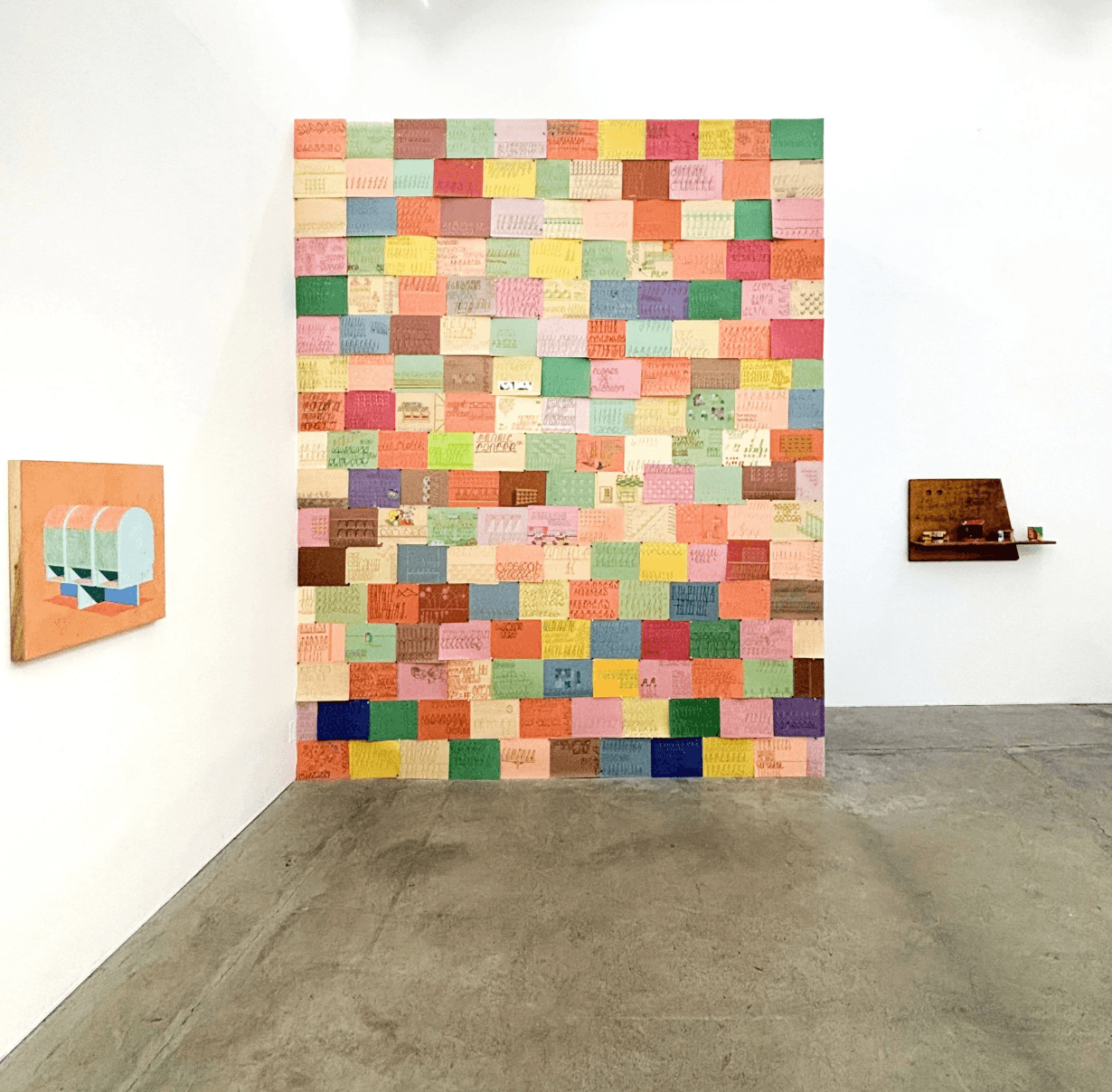
Installation view
At around eleven years old, I dreamed–briefly–of being an archeologist. I imagined I would dig up mysterious, well-formed artifacts, then ponder their former function and the long-lost world from which they came. The outcome of my work would look a bit like “Tropic of Cancer reading room,” Ben Peterson’s current Colpa Press-curated show at Et al. Gallery (through August 30).
What a thrill digging up any of the three wall-mounted pieces with simple, repetitive geometric patterns would have been. Made of romantically peeling plaster on porcelain plates, the works’ muted, mostly pink, blue, and gold color scheme appears to have been adopted from Wes Anderson. The pieces have irregular edges and interrupted patterns, both of which make them feel like fragments. Because of their weight, the works are mounted using visible, L-shaped brackets.
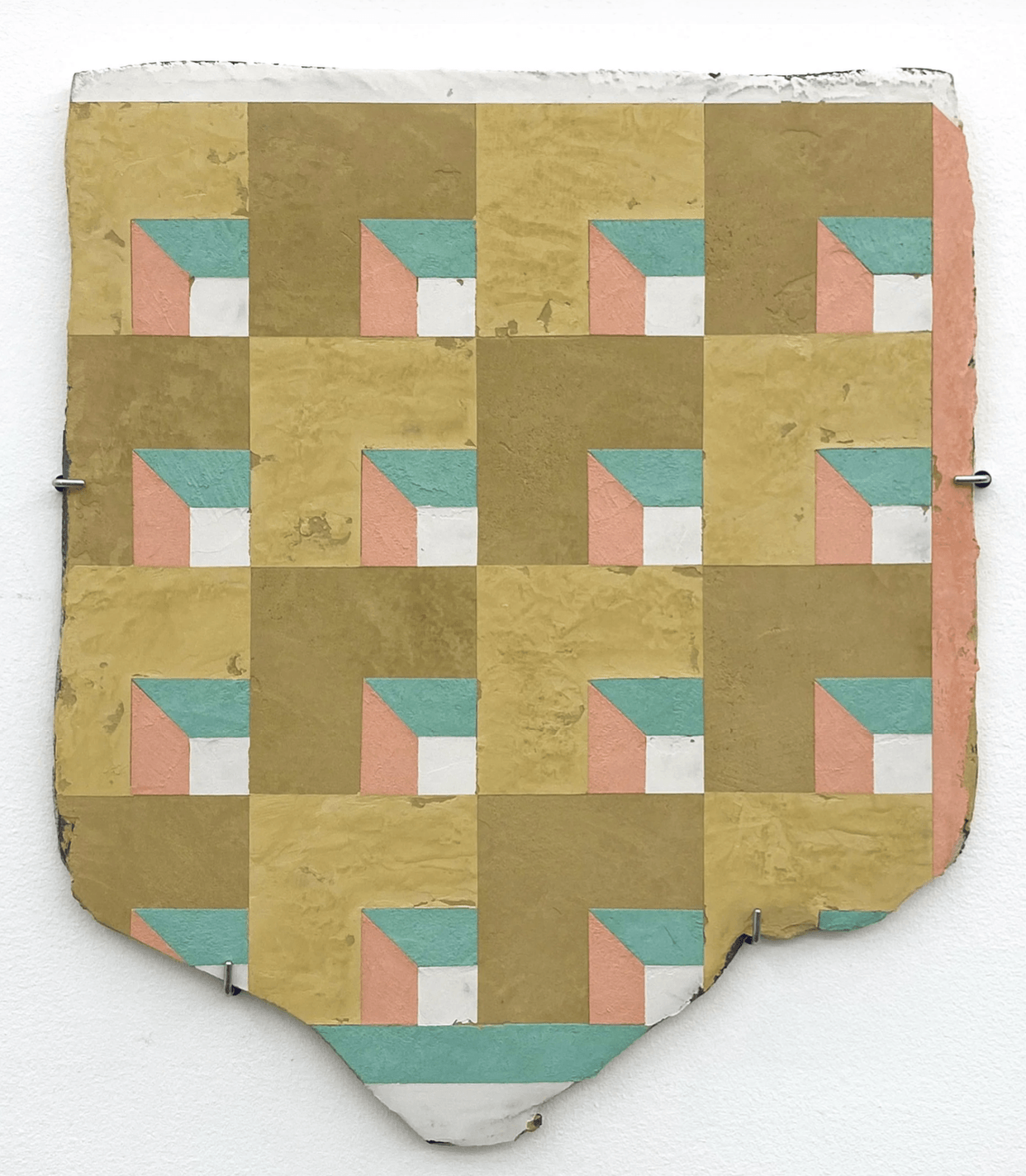
Untitled Plate I, 2023. Plaster on ceramic plate.
Three wall-mounted works with conventional, rectangular forms are also included in the show. These pieces are plaster on wood panel and feature a color palette extending that of the previous works to green, orange, and light brown. Rather than resembling bits of floor or wall, these pieces are portraits. The inanimate objects that are portrayed have rounded sections and straight parts and sometimes they look a bit like US mail collection boxes. But the objects have no real counterparts in everyday modern life.
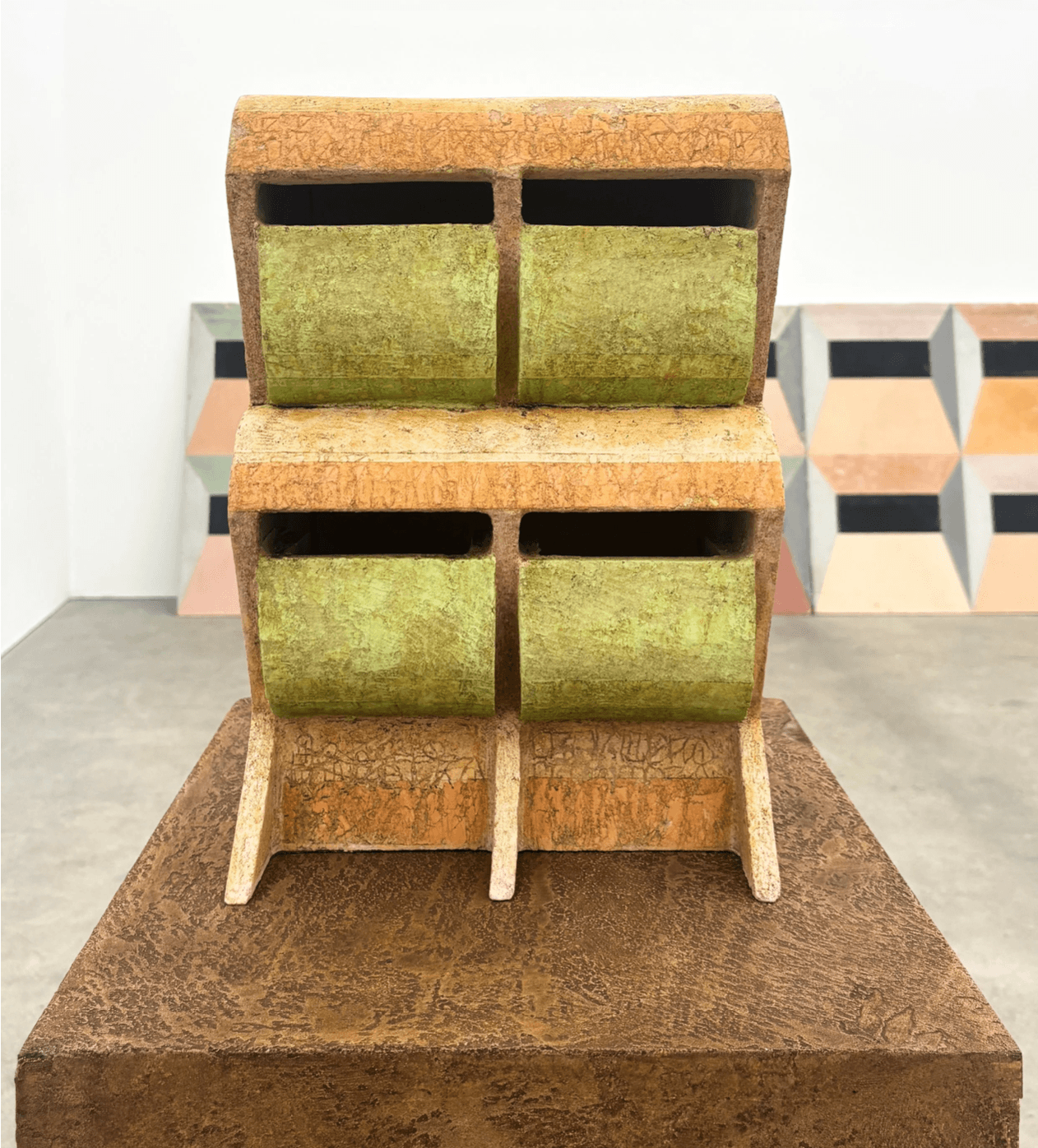
Two sculptures mounted on pedestals in the center of the room appear to come from the same object family as the portraits. One mostly clay-colored sculpture has squiggly, decorative markings that may be text on its borders and four pale green panels, each with a slot above it, on its front. The second, speckled sculpture consists, on one side, mostly of space: two large, empty bays. The forms of both of these sculptures suggest a storage-related function.
A large fresco on two pieces of drywall leans against the gallery’s back wall. The work’s repeating geometric pattern has black panels that echo the slots of one of the central sculptures. There is a slightly irregular color arrangement amongst the work’s recurring shapes. As a result of the fresco technique, the piece has a smudged, glowy surface unlike that of the other repeating pattern works in the room.
Frontera, 2024. Ceramics and Italian plaster.
Rectangles of colored construction paper, each bearing a text message in a strange font and, sometimes, a companion drawing, have taken over another wall, pushpinned into a quilt-like grid. The bizarre fonts used for the text make it mostly indecipherable. The drawings include repeating decorative motifs and cartoon characters.
A vintage wooden shelf near the gallery entrance holds tiny structures made from cereal boxes and other packaging material. There is also an art book “Tropic of Cancer” published by Colpa Press (for sale copies are stored at the front desk). “Tropic of Cancer” sports a corrugated cardboard cover and pages filled with eccentrically arranged photos and drawings, all depicting contraptions similar to the sculptures at the center of the gallery.
The show’s magic lies in the synthesis, made by the viewer, of these artifacts into a new world. A world that is located–I’m guessing–somewhere in the Tropic of Cancer. The multiple media used and the way that themes–plaster, modularity, containerization, hieroglyphics–recurr across media facilitates the viewer’s synthesis. The world has a framework, governing rules.
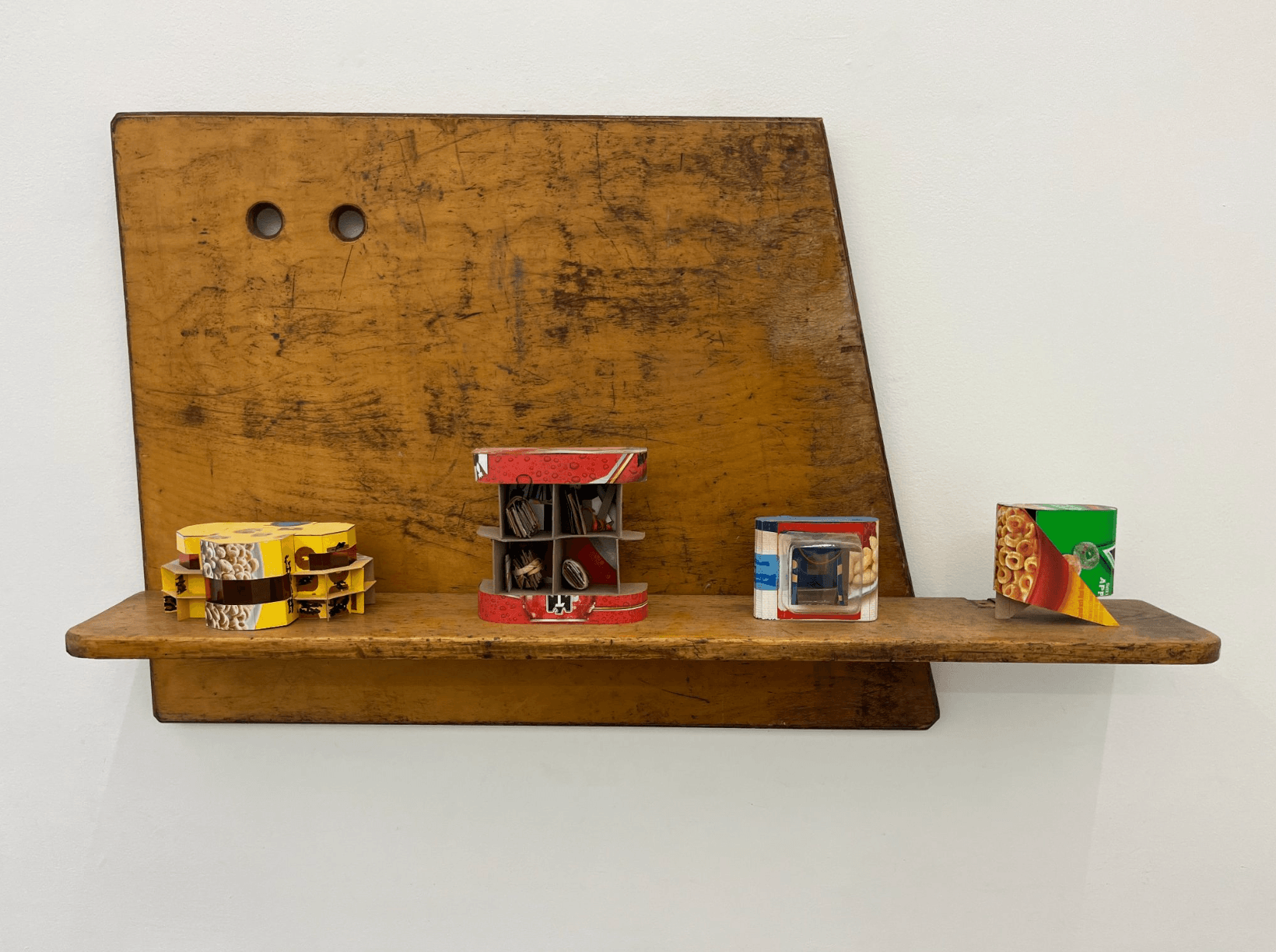
Cheerios cereal box, glue; Tecate bookshelf; Crispy Window; Naples Yellow. Cardboard.
Modesty is a feature of the show’s world that, because it is becoming rare in our contemporary existence, increases the world’s appeal. The artist’s hand is almost never seen in the exhibition’s works. Instead, the pieces appear to have arrived fully-formed, perhaps from the head of Zeus. The materials used are simple and, often, old-fashioned. The inclusion of repeating patterns aligns the works with craft rather than fine art.
A second alluring quality of the show’s world is mystery. The internet seems to know it all, and robots may soon be able to do everything. But google all you want: the meaning and any function of the strange sculptures at the center of the gallery will remain opaque. These works induce the imagination, and if you allow that facility to run a little wild, it might feel a bit like being an archeologist.
