

Dear America, The National Gallery of Art
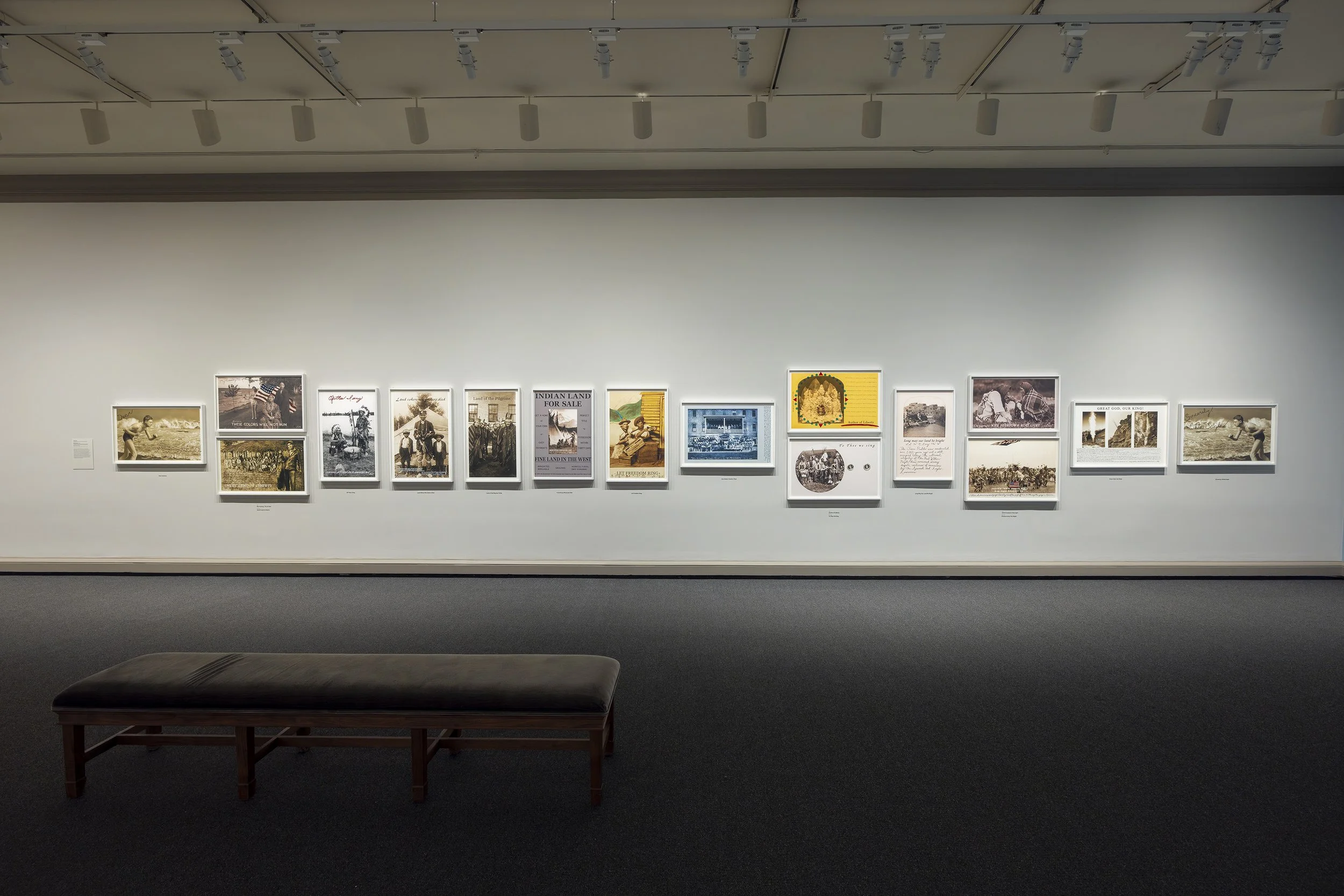
Installation view of Dear America (2002) by Tom Jones (Ho-Chunk Nation) in Dear America: Artists Explore the American Experience at the National Gallery of Art (April 11–September 20, 2026). Image courtesy of the National Gallery of Art.
By Liz Goldner
A dramatic series in this expansive exhibition is “Dear America” (2002), (the inspiration for the show’s title) by Tom Jones, Ho-Chunk Nation. The series contains enlarged postcard scans featuring white Americans, along with Indigenous people. Each panel displays handwritten lyrics from the song, “My Country ‘Tis of Thee,” (1832).
By combining the images with the well-known lyrics, the artist explores his perspective on patriotic imagery, land ownership and representation. As a significant artwork in this semiquincentennial exhibition, it is one of 100-plus items. Included also are prints, photos and drawings, exploring our country’s landscape, its people and concepts of freedom, most from the National Gallery’s extensive collection of American art.
The exhibition is divided into sections. The “Community” section includes the Tom Jones’ series. Looking at the images, reading the song lyrics written on them, then reading the artist’s handwritten inscriptions reveal conditions that Indigenous people have endured over centuries. These include settler colonization, land seizure, forced removal from their homes, federal policies and broken treaties, all undermining tribal sovereignty.
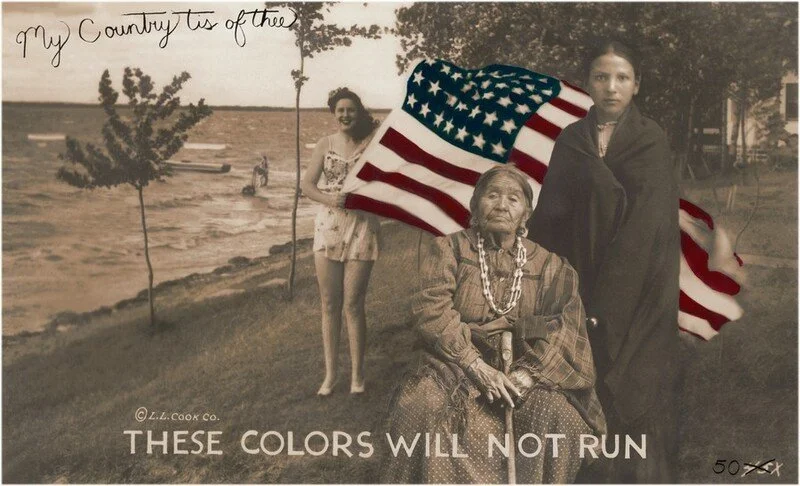
Tom Jones
My Country, 'Tis of Thee 2002
inkjet print, black ink and colored acrylic paint
image/sheet: 59.69 × 95.25 cm (23 1/2 × 37 1/2 in.)
The first panel with the lyrics, “My country 'tis of thee,” portrays a depressed elderly Native woman, while a smiling angelic white woman stands behind her, overwhelming her, and holding a large American flag. The message is clearly that our country is owned by white settlers and their ancestors.
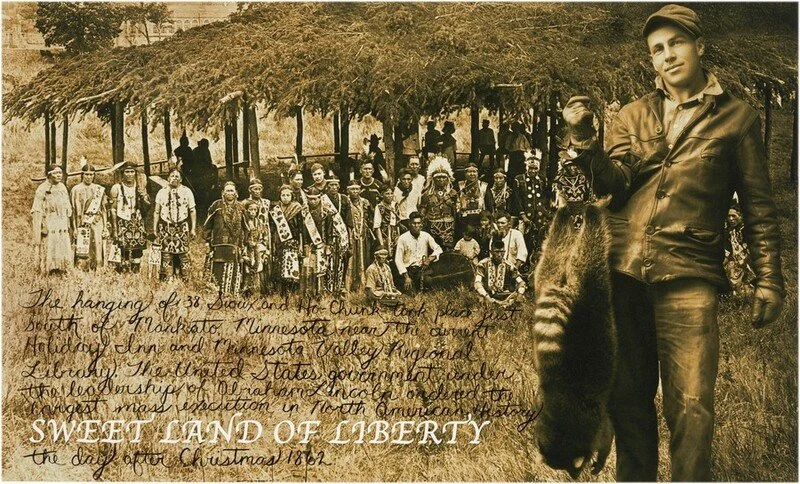
Tom Jones
Sweet Land of Liberty 2002
inkjet print and black ink
image/sheet: 61.28 × 97.47 cm (24 1/8 × 38 3/8 in.)
The second panel, “Sweet Land of Liberty,” is a collage of a 19th Century group portrait of Sioux Indians, with a victorious white hunter in the foreground. By displaying a large raccoon that he has captured, he symbolically indicates the white man’s ownership of the land. Jones wrote onto the image, “The hanging of 38 Sioux and Ho-Chunk took place just south of Mankato, Minnesota Valley Regional Library…[it was] the largest mass execution in North American history the day after Christmas, 1862.“
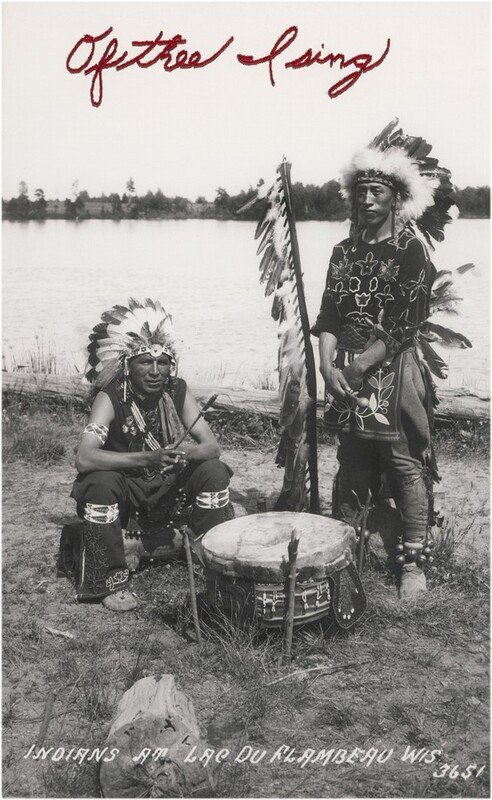
Tom Jones
Of Thee I Sing 2002
inkjet print and glass beads
image/sheet: 97.47 × 62.55 cm (38 3/8 × 24 5/8 in.)
The third panel, “Of thee I sing,” a more positive version of the Native condition, pictures two proud members of the Lac du Flambeau Band from the Lake Superior Chippewa tribe, relaxing by a lake. The words “Indians at Lac Du Flambeau, Wisconsin,” written by Jones on the panel, refer to the Natives’ centuries-old practice of catching fish at night by torchlight.
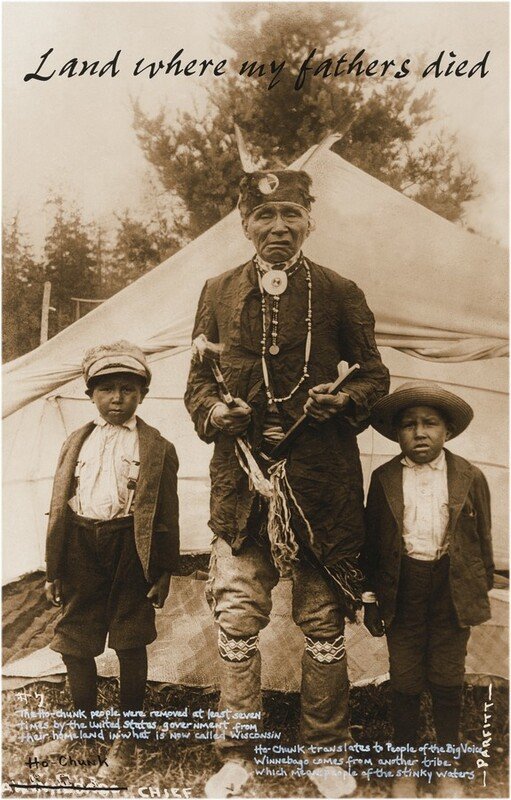
Tom Jones
Land Where My Fathers Died 2002
inkjet print and black ink
image/sheet: 98.11 × 65.09 cm (38 5/8 × 25 5/8 in.)
“Land where my fathers died” depicts a distraught-looking elderly Indian man with two young boys, all wearing Native clothing. The desperation of the trio is echoed by the artist’s written words on the image: “The Ho-Chunk people were removed at least seven times by the United States government from their homeland in what is now called Wisconsin.”
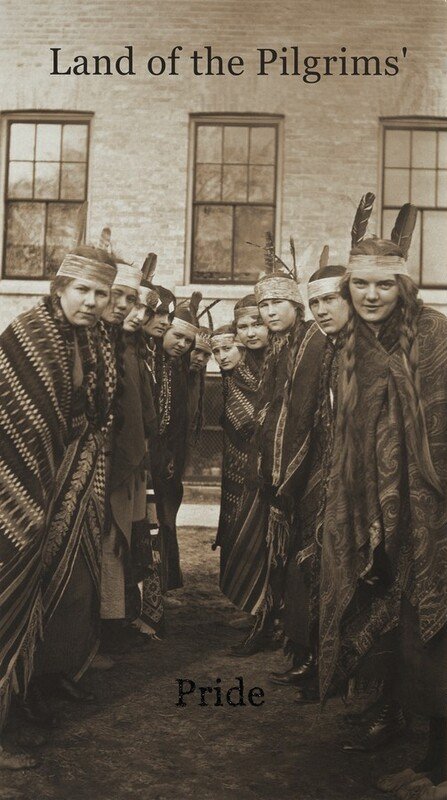
Tom Jones
Land of the Pilgrims' Pride 2002
image/sheet: 98.43 × 50.8 cm (38 3/4 × 20 in.)
inkjet print and glitter
“Land of the Pilgrims Pride” is a photo of a dozen young women dressed in traditional clothing with head-dresses and feathers, and their hair in braids. Viewers can decide if the women are Native Americans from decades ago, or contemporary white women dressed for a costume party. The verse, referencing proud pilgrims, invokes settler-colonial origin stories that marginalized Indigenous presence, as Native people have lived here for millennia. Regarding the image, 100 years ago, photos of Native people, real or manufactured, were offered as souvenirs to tourists.

Tom Jones
From Every Mountain Side 2002
inkjet print
image/sheet: 94.3 × 63.5 cm (37 1/8 × 25 in.)
The panel, “From Every Mountain Side,” with the words, “A council of the blackfeet Indians at Glacier National Park,” describing an image of Indians meeting harmoniously, is the most dramatic piece in the series. The image is collaged onto a 1910 flyer that says, “Indian Land For Sale, Fine Land in the West.” The artist has created an in-your-face example of white settlers embracing a bureaucratic ideology, transferring Indigenous land to white people. The doctrine is based on the belief that settlers had the God-given right to seize land that Indians had lived on for millennia.
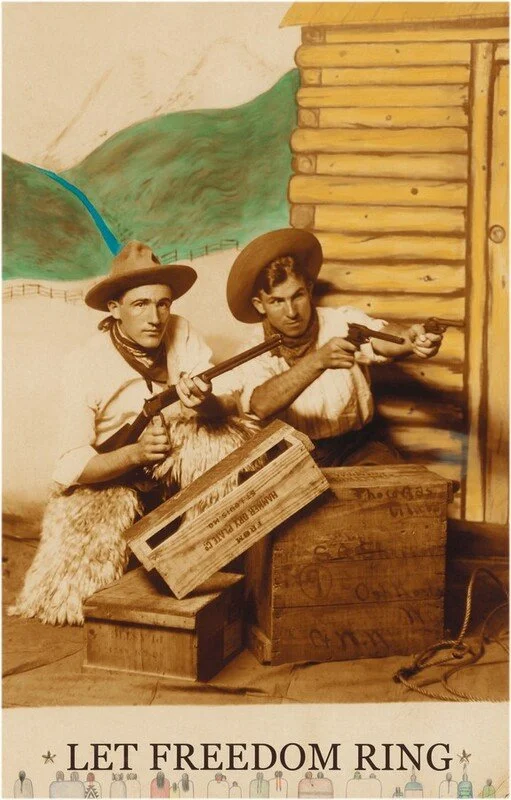
Tom Jones
Let Freedom Ring 2002
inkjet print, black ink, acrylic paint, metal stars and colored pencil
image/sheet: 97.79 × 58.42 cm (38 1/2 × 23 in.)
"Let Freedom Ring" illustrates two young cowboys, posing as if to shoot someone in front of a hand-painted scene that captures the mythologizing of westward expansion. The panel exposes how settler ideas of freedom and property were often built through Indigenous dispossession and anti-Indigenous violence. It also references the entitled sense of freedom and ownership of the land that white people have possessed for centuries.
While there are more illustrative panels with subsequent “My Country ‘Tis of Thee” lyrics, these seven panels convey a powerful message about Native Americans’ centuries-long struggles; specifically about their ongoing efforts to assert sovereignty, cultural survival, and self-representation.
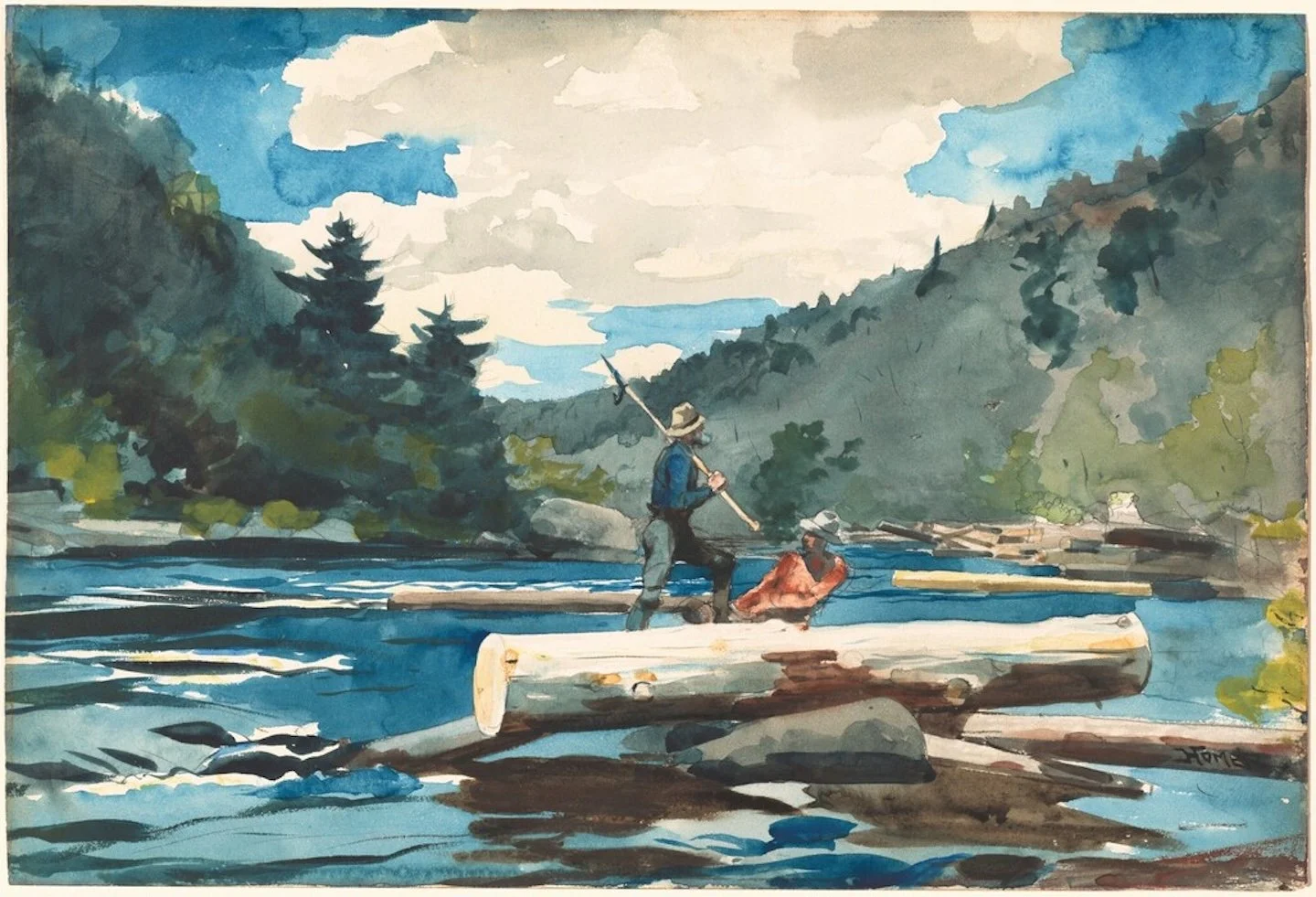
Winslow Homer, Hudson River, Logging, 1891-1892, watercolor over graphite on wove paper, Corcoran Collection (Museum Purchase), 2014.136.171
Additional sections in “Dear America” include “Land,” honoring the grandeur of the American landscape. Here are paintings of the mist-shrouded “Tower at Tower Falls, Yellowstone” (1872) by Thomas Moran; Winslow Homer’s “Hudson River, Logging” (1891-1892), with two loggers admiring the magnificent scenery; the vibrantly colored “Grand Canyon” (1977), by Clare Romano; and “The Niagara Cascades” (2024), by Kay WalkingStick (Cherokee Nation of Oklahoma). The gelatin silver print, “Mount McKinley and Wonder Lake, Denali National Park, Alaska” (1947), photographed by Ansel Adams was made to advance Alaska’s wilderness as the “most important campaign in which I have participated.”
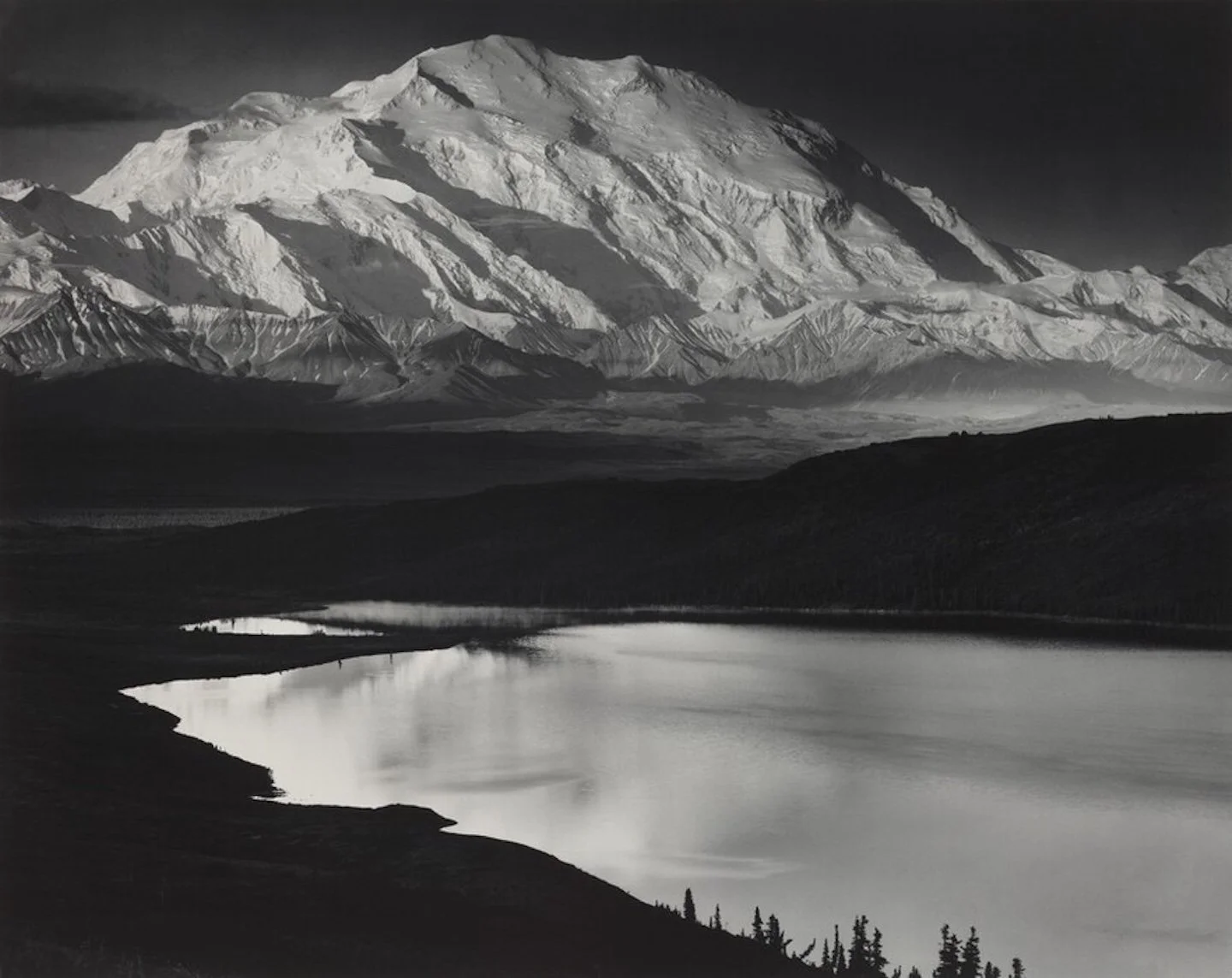
Ansel Adams, Mount McKinley and Wonder Lake, Denali National Park, Alaska, 1947, printed 1981, gelatin silver print, Gift of Virginia B. Adams, 1986.3.36
Mitch Epstein’s “Mount Rushmore National Memorial, Six Grandfathers, South Dakota” (2018) was shot with clouds partially obscuring the carved portraits. It references the controversial history of the monument as a symbol of broken treaties, as the Memorial was built on Native land. Mount Rushmore is in the Black Hills/Pahá Sápa land, guaranteed to the Lakota under the 1868 Fort Laramie Treaty, but later seized by the United States; “Six Grandfathers” is the Lakota name associated with the mountain before the carving.
Also in the “Community” section, several intense portraits by Sedrick E. Huckaby reveal a unique manner of depicting Black Americans in the 21st century. His textured paint captures the emotions of people historically marginalized, aspiring to achieve entry into the middle class.
Embracing modernism, Robert Indiana’s pop art styled “Liberty ’76” (1974–1975) was created to celebrate the Bicentennial 50 years ago, with the message that genuine freedom is fundamental to our democracy.
The final section in “Dear America” addresses the concept of “Freedom,” with depictions of the American Revolution and the Civil War. These are followed by photos by Lewis Hine, “Climbing into America” (1905), a close-up of Italian immigrants arriving at Ellis Island, and Alfred Stieglitz's, “The Steerage” (1907), an overview of immigrants arriving as part of the mass movement of people fleeing oppression.
“Artists have long helped us see America not just as a place, but as a living idea shaped by many voices,” said Kaywin Feldman, director of the National Gallery of Art. “Through these remarkable works from the National Gallery’s collection, visitors to the nation’s art museum can witness the power of art to illuminate our shared past, illustrate the experiences of our lives, and inspire our collective future.”
“Dear America” runs through September 20, 2026 at the National Gallery of Art, Washington, D,C.
