
Ward Schumaker, Paintings 2007-2026, Modernism
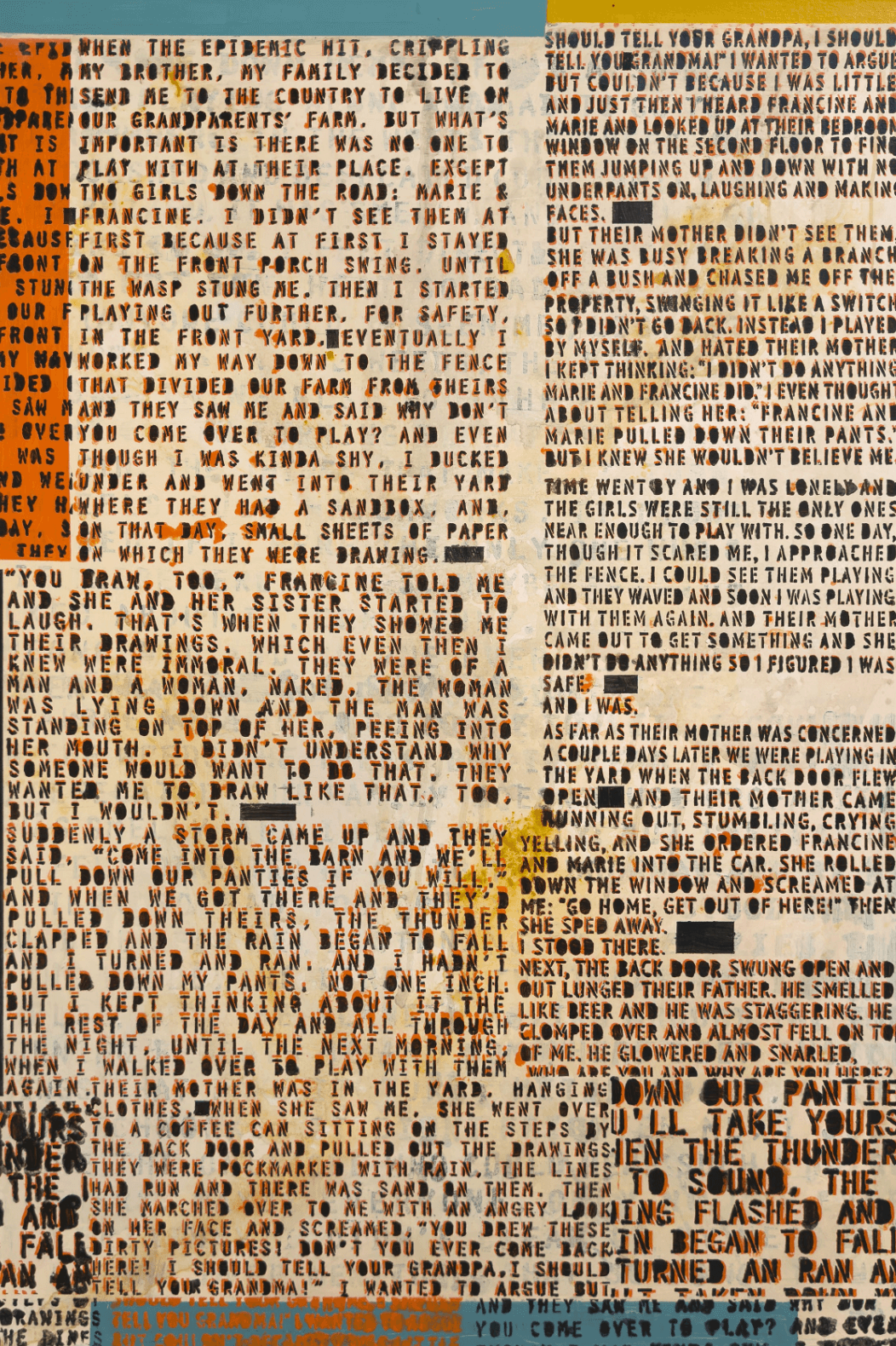
Drawing Dirty
2020
acrylic on canvas 62 x 42 inches
By Lani Asher
Ward Schumaker enjoys banks of letters, readable or not, and the accidents that happen while stenciling and painting them. He has a trickster sensibility and has a curious magpie intelligence. A lot of Schumaker’s artwork is based on chance, and on fragments of poetry, dreams, songs, music, memories, and nonsense. He still owns a battered copy of Edna St. Vincent Millay’s Collected Lyrics from his youth, 65 years later, held together with a rubber band. He is not sure why he paints the way he does, but it feels meaningful. Walking through Schumakers’ show at Modernism’s venerable gallery in San Francisco's gritty Tenderloin neighborhood is deeply satisfying, the work of a witty, mature, supremely confident artist.
Schumaker is greatly influenced by Samuel Beckett, the Irish playwright and poet, and his absurdist views of the human condition.
The artist says, I think of Beckett's Not I, in which the stage is bare except for a hole in the curtain exposing the actress's mouth—in sections, he commands her to speak faster than the audience can understand— abstracting the words. Sometimes I use words to be read, sometimes I like them abstracted, layers upon layers of type, revealing here and there a few comprehensible words. Some artists paint nudes; I paint words.
On one of his neighborhood walks, he found used rolls of printing paper from a local business, which were regularly thrown away. According to Schumaker, that paper has just the right thickness for his word stencils, which are all hand-cut. The paper often breaks down while he is stenciling, which results in blobs or imperfections that he enjoys in his paintings and handmade books.

Roots and Leaves , 2026 , acrylic on canvas, 66 x 47 inches
In the front room of the gallery, as you walk in, there is a painting titled Roots and Leaves (2025), which is based on a childhood memory of listening to music at school in Omaha, Nebraska. The words come from a collection of poems, Leaves of Grass, by Walt Whitman. He began stenciling the words that he remembered, and eventually the painting was similar in color and texture to the dead leaves, cattails, decaying carcasses, snakes, spiders, sticks, and mud that he encountered as a youth hiking with his dog along the banks of the Missouri River.
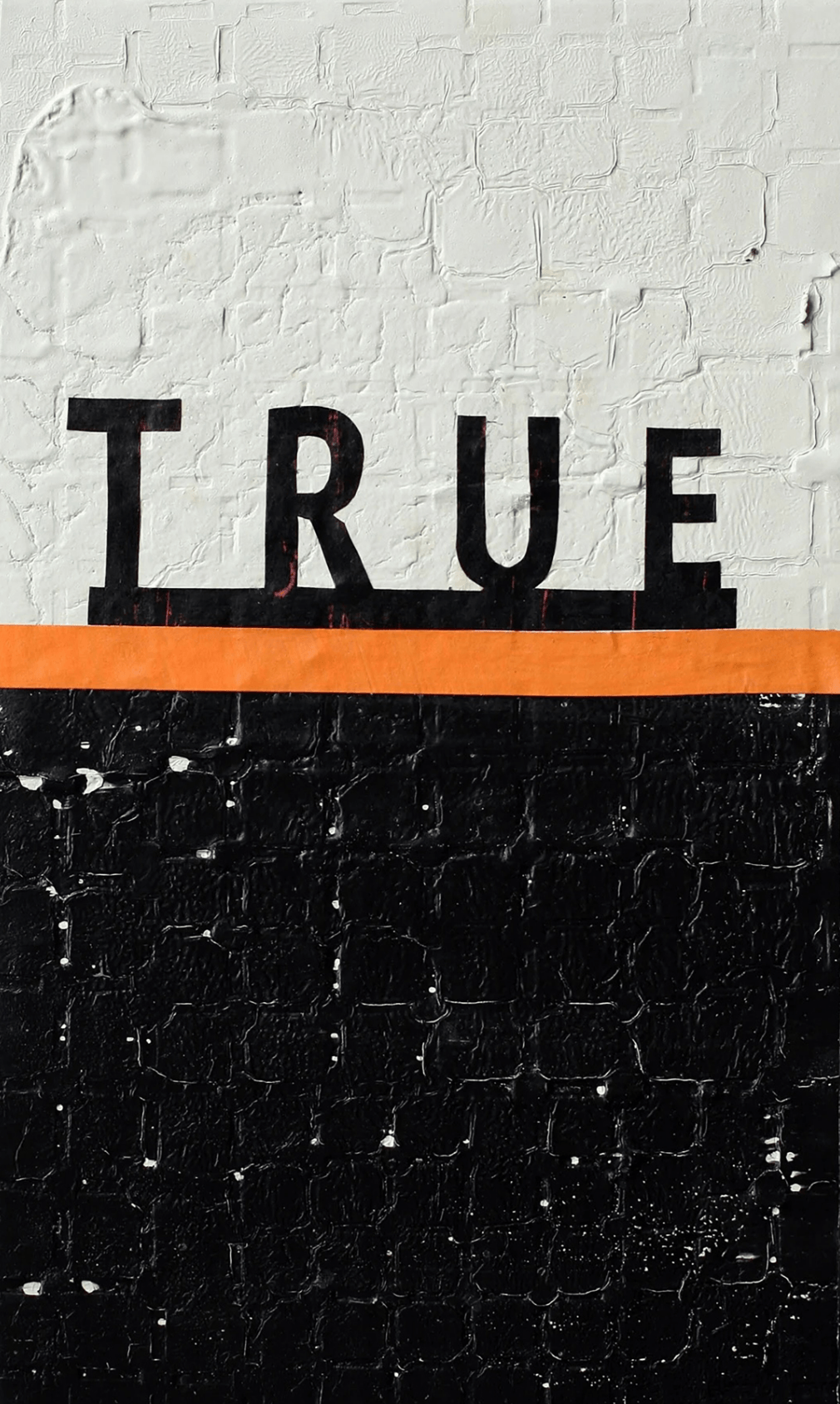
True (Descending) 2018 collage on cardboard 10 x 6 inches.png
On an adjacent wall are nine framed 6” x 10” works based on Schumaker’s long-running mail art exchange with artist Ray Johnson. Johnson, known as New York's most famous unknown artist, was a collagist and correspondence artist. Johnson studied at the experimental Black Mountain College and was part of the Neo Dadaist school in New York that inspired the Fluxus and Pop art movements. He used the post office as an alternative conceptual gallery, a democratic space outside the gallery system. Correspondence art relied on chance while creating a wide network of artist connections. Johnson ran the playfully dubbed New York Correspondence School, a large artist mail network that lasted well into the 1960s. Schumaker discovered The New York Correspondence School by chance in Time Magazine. Over the years, Johnson sent him a number of his xeroxes and postcards that inspired Schumaker's nine small studies.
The atmospheric quality in many of his paintings is the result of both thick and thin acrylic washes over stenciled words and nonsense calligraphy mixed with methyl cellulose, traditionally a glue used for book binding and for conservation. He learned to use methyl cellulose mixed with acrylics in a paste paper class at San Francisco’s Center for the Book. He likes the dreamy effects it can create, and its hard matte surface. Often, he uses a whisk to create bubbles, creating the kind of mess that he finds appealing. Making one-of-a-kind, hand-painted books used everything he wanted: non-objective brush work, stenciled type, the turn of the page, the larger format, and often a bit of narrative.
Schumaker left Nebraska when he was a young man, threatened with arrest, after one of his paintings was judged obscene. He worked as a paper company salesman, quit that job, and at 35 years old started doing graphic design and illustration. Illustration led him to Yolla Bolly Press, and Yolla Bolly Press led him to handmade books. He illustrated two limited-edition letterpress books for The Yolla Bolly Press: Two Kitchens in Provence by MFK Fisher and Paris, France by Gertrude Stein. Later, when Yolla Bolly closed upon the early death of the publisher, he got a letterpress of his own. But lacking the necessary disposition for exacting letterpress work, he soon began covering his less-than-perfect letterpress prints with paint. Eventually, he got rid of the press and simply painted the pages.
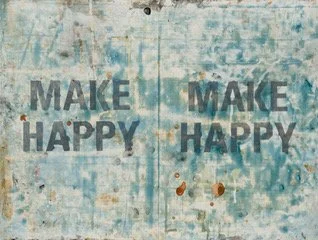
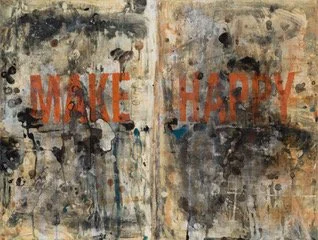
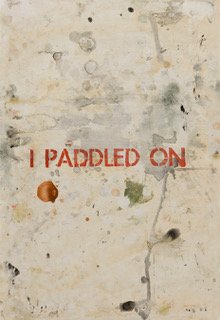
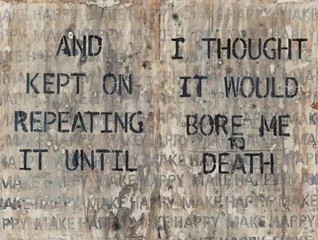
Several of his hand-painted books are in display cases in an interior room. When we met, Schumaker brought one of his books to look at in person. Elixir Refused is loosely based on the Bhagavad Gita, the classic Hindu text. It is a mix of brushwork, stenciled words, and a palette of reds and browns, layered with washes. The pages feel durable and smooth to the touch because of the methyl cellulose. The title, Elixir Refused, is a bit of a joke on the idea of enlightenment, as are the last pages of the book-MAKE HAPPY -MAKE HAPPY-AND KEEP ON REPEATING IT UNTIL -I THOUGHT IT WOULD BORE ME TO DEATH-I PADDLED ON. In the Bhagavad Gita, Krishna guides Arjuna through duty, action, and devotion to wisdom and knowledge, but in Schumaker's version, he refuses this path because he finds a life of perfection to be boring. Schumaker believes most people, including himself, don’t look for perfection or enlightenment but prefer to foolishly travel on.
Surrounding the glass display cases are a collection of eclectic paintings. There are several paintings based on modern composers he likes, like Phillip Glass and Louis Andriessen. He uses large, complicated, hand-cut stencils for paintings of the Tower of Babel, and paintings that use the circular shapes of snowmen or the Venus of Willendorf, and stenciled dots based on Dogon art and architecture from a trip he took to Mali.
A number of his most recent small works line a small hallway, incorporating the use of Morse code. His friend and former gallerist, Jack Fischer, sent him an online tool one could use to turn words into Morse Code. Finding it strangely beautiful, he printed out the code and used it as a matrix for cutting stencils.
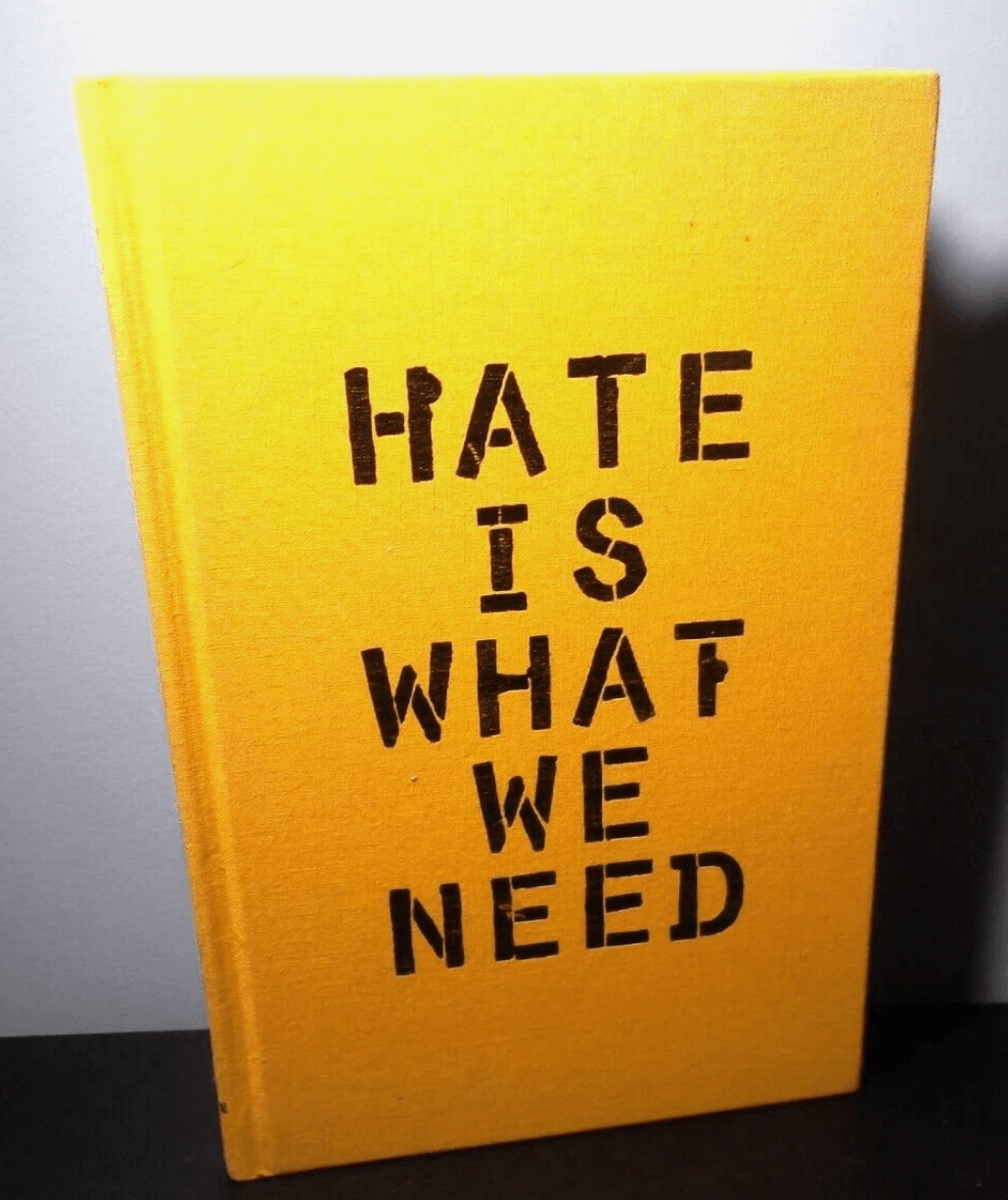
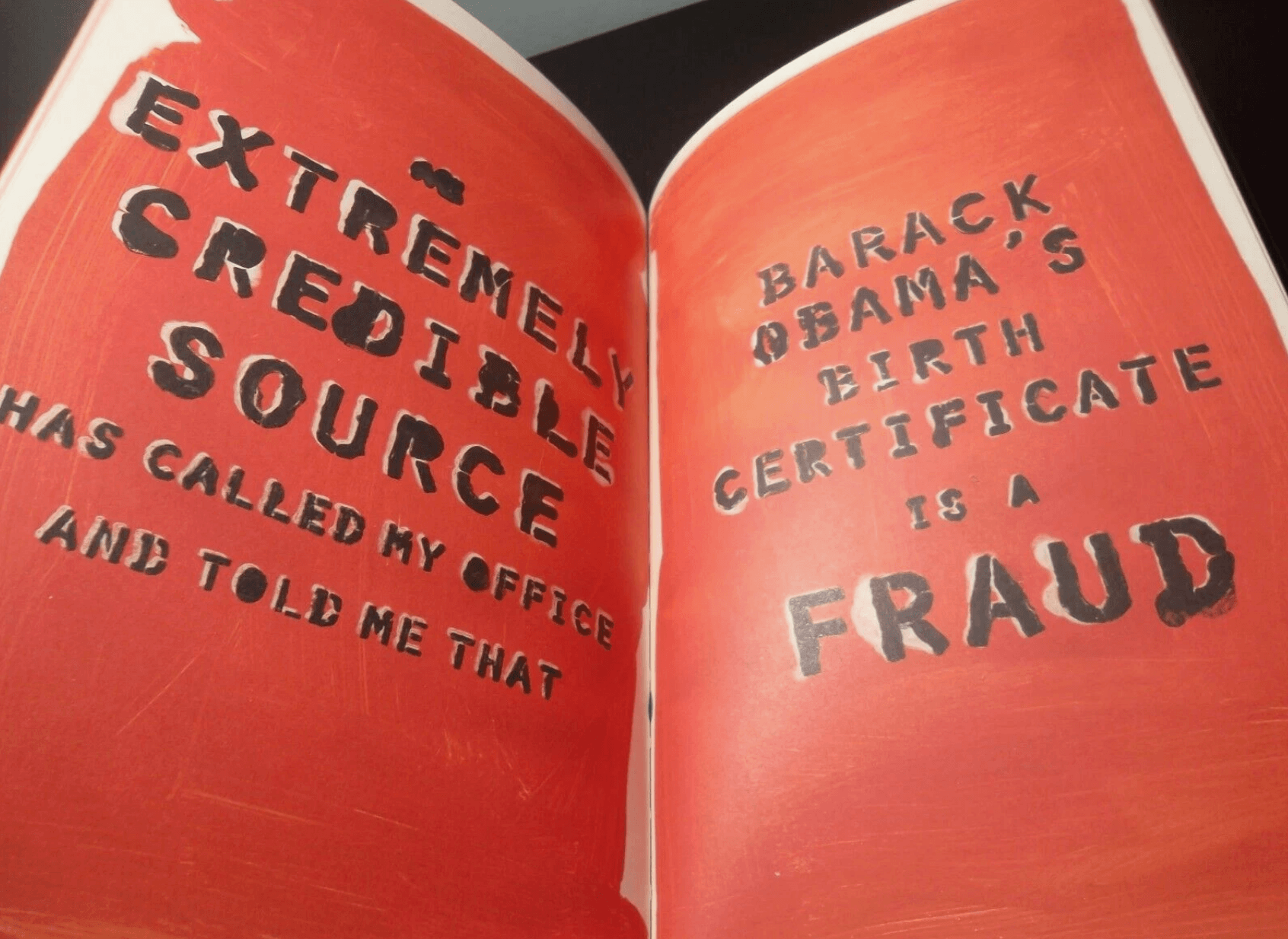
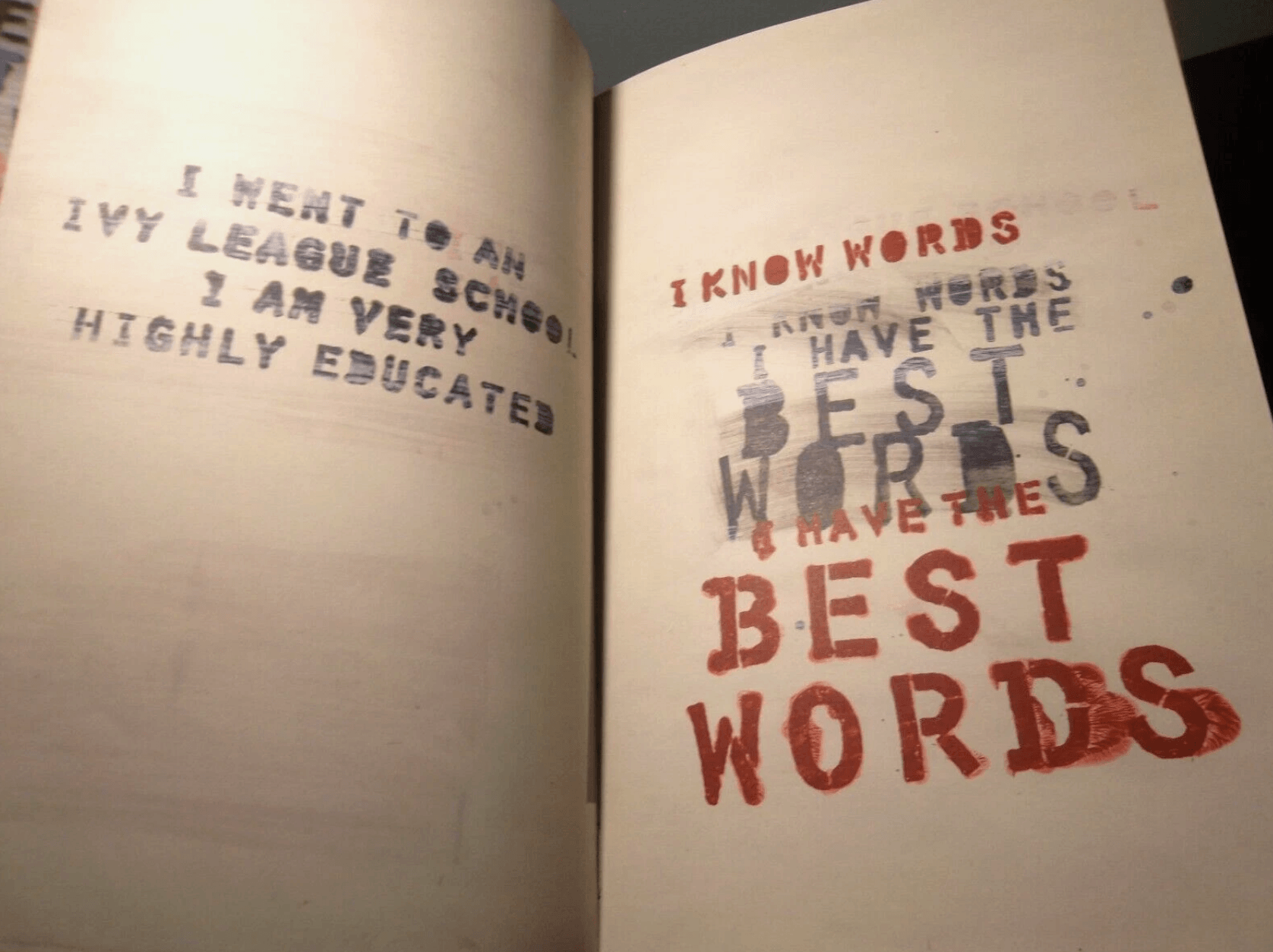
Schumacher's interest in words and absurdity took an unexpected turn with the first presidency of Donald Trump. Trump's seemingly endless stream of invective made Schumaker indignant and sparked his imagination. At the gallery’s front desk, there are free copies of small folded prints based on his earlier 1992 project featuring quotes from Donald Trump. After a conversation with his small grandson about bullies, Donald Trump: Hate Is What We Need was born and was later published by Chronicle Books (2018). Schumacher did another unique book of Trump quotes, now in the Achenbach collection. But realizing that few people ever see his one-of-a-kind books, he started making large hand-painted posters and started posting on social media. He thought he might create ten, but he couldn’t stop, and during Trump’s first administration, he created 350. And sometimes he can’t help himself from cutting just one more deplorable quote
Schumaker is a good storyteller, and his work has a spirit of the magician or the alchemist in search of the philosopher’s stone. His prolific output can be nostalgic, and his work hovers between the sublime, the beautiful, the ugly, and the awkward. He takes delight in the unknown and the accidental, a proverbial traveler through the liminal spaces between his art, life, and the material world. The exhibit showcases his work from the last 20 years. With the closing of his former gallery, Jack Fischer, this year, the show at Modernism functions both as a bookend and the start of a new chapter for this effervescent artist.
