
Cannupa Hanska Luger, A Field Manual for the Future
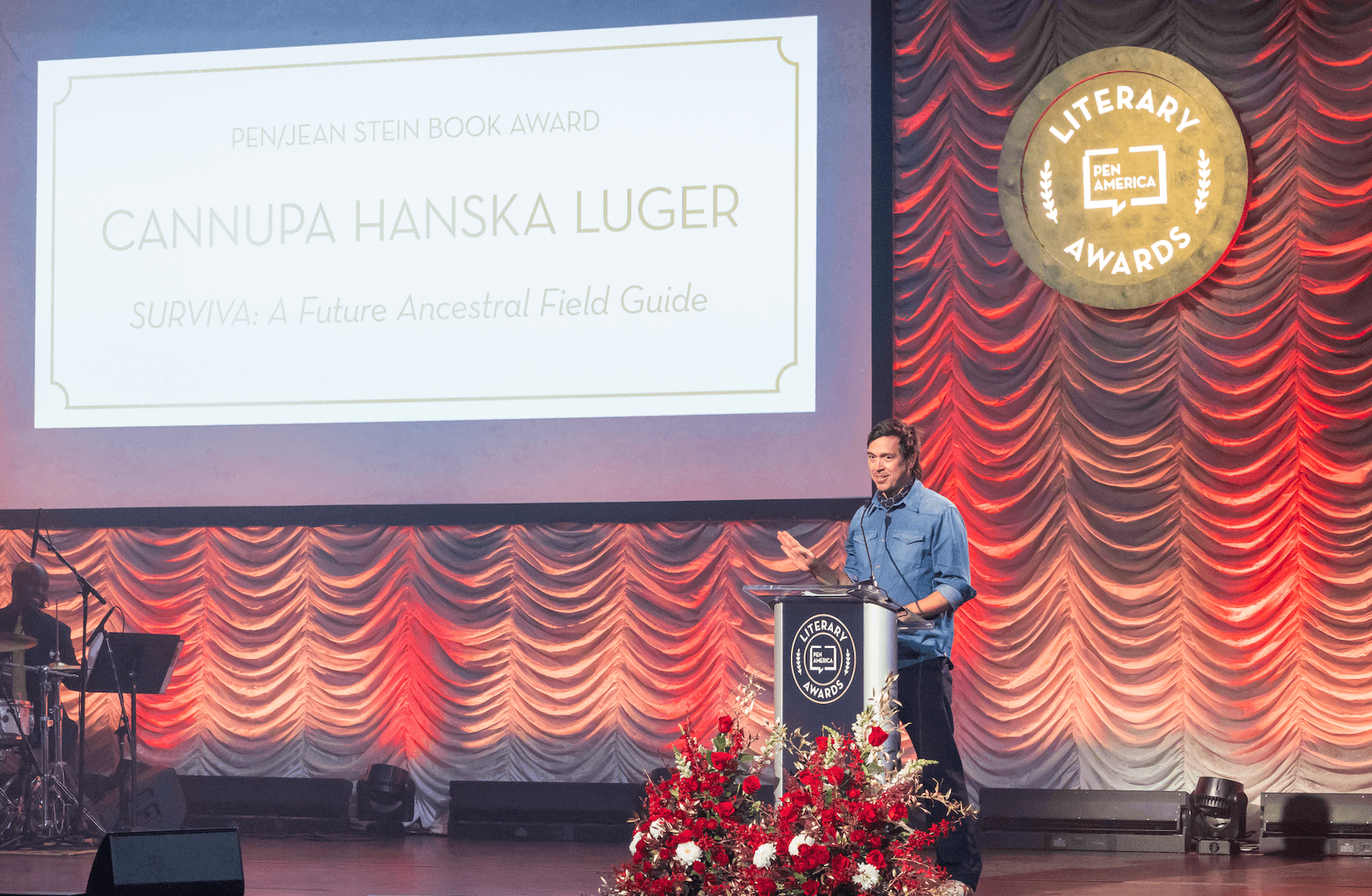
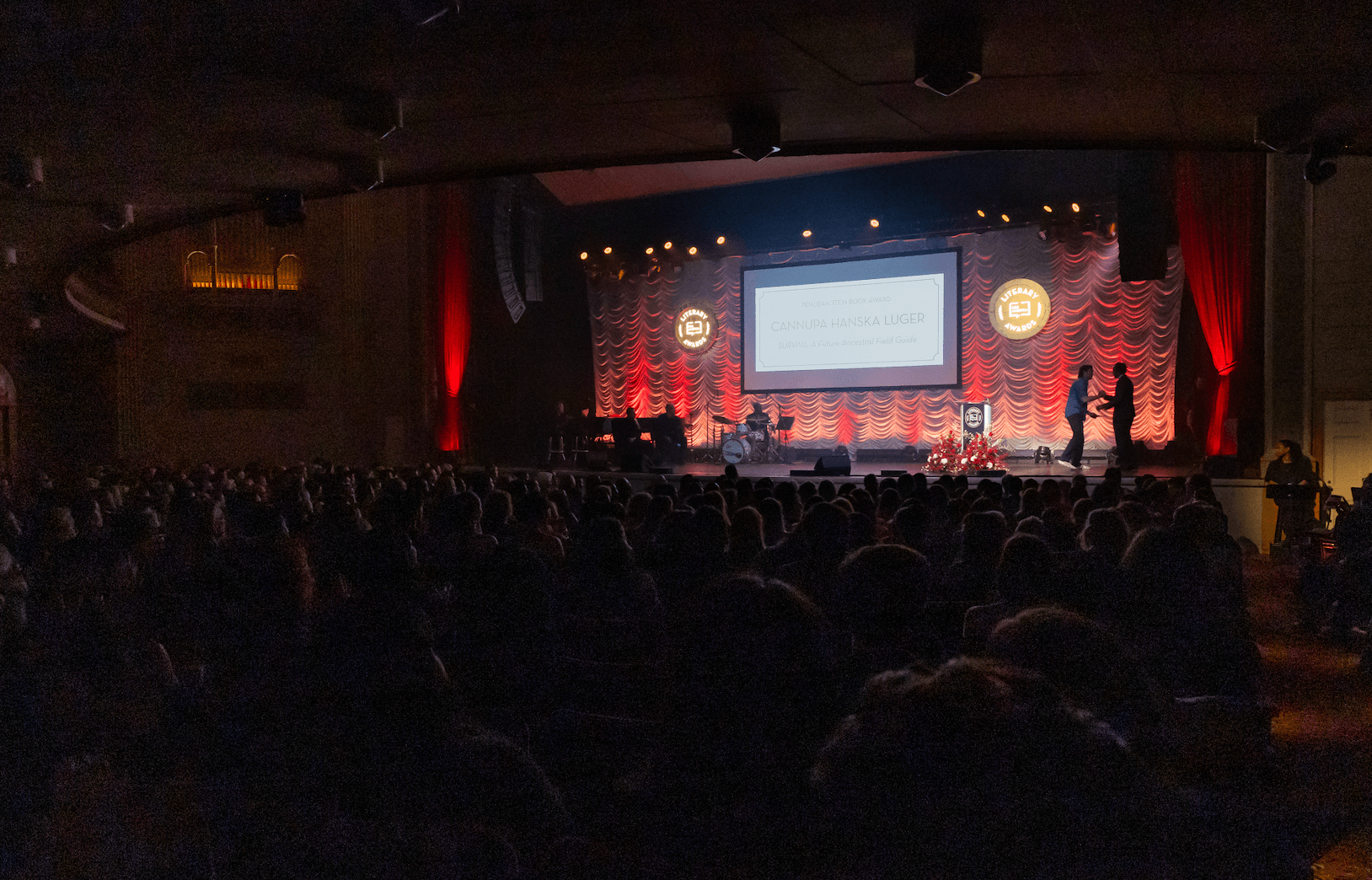
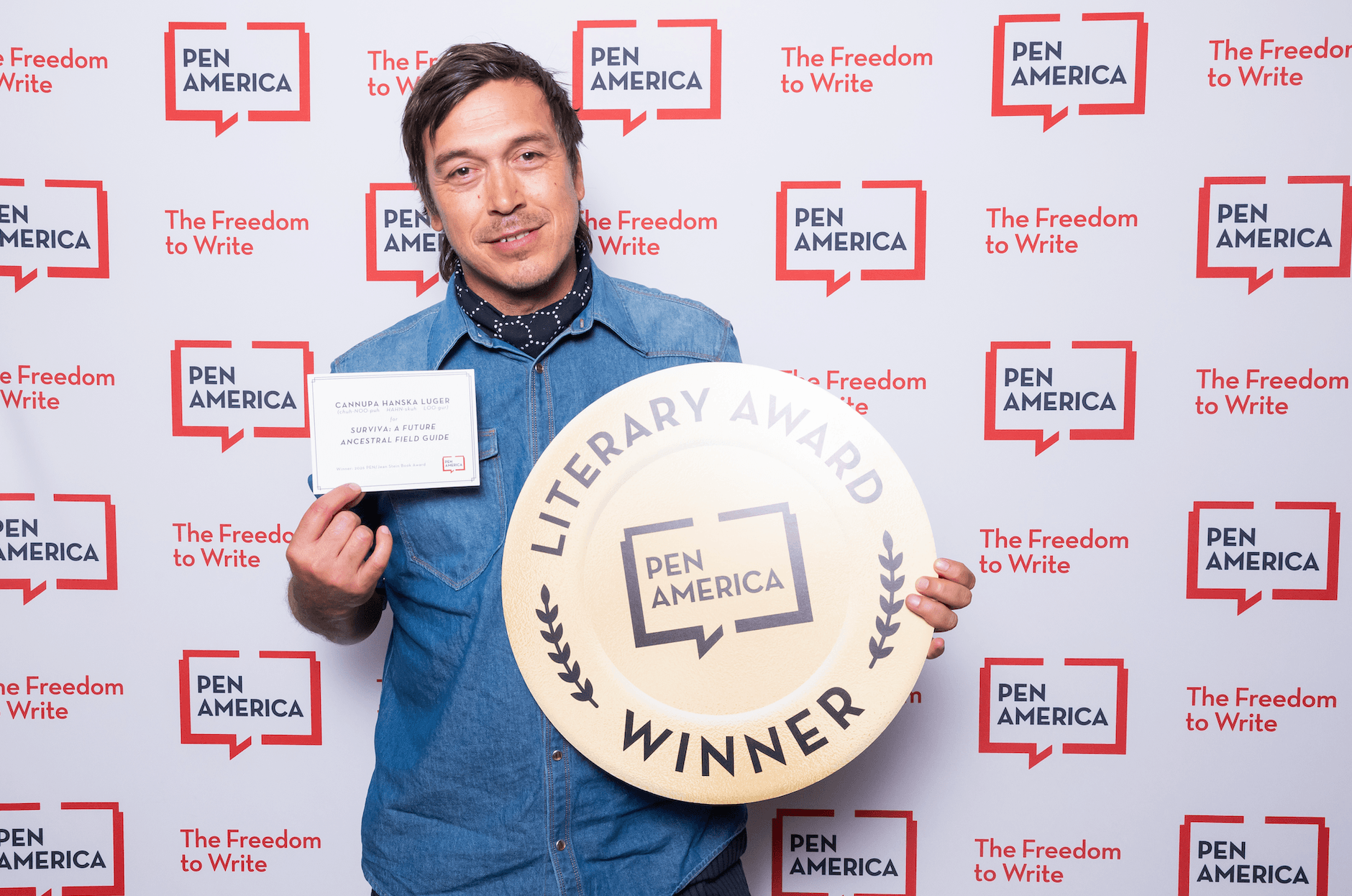
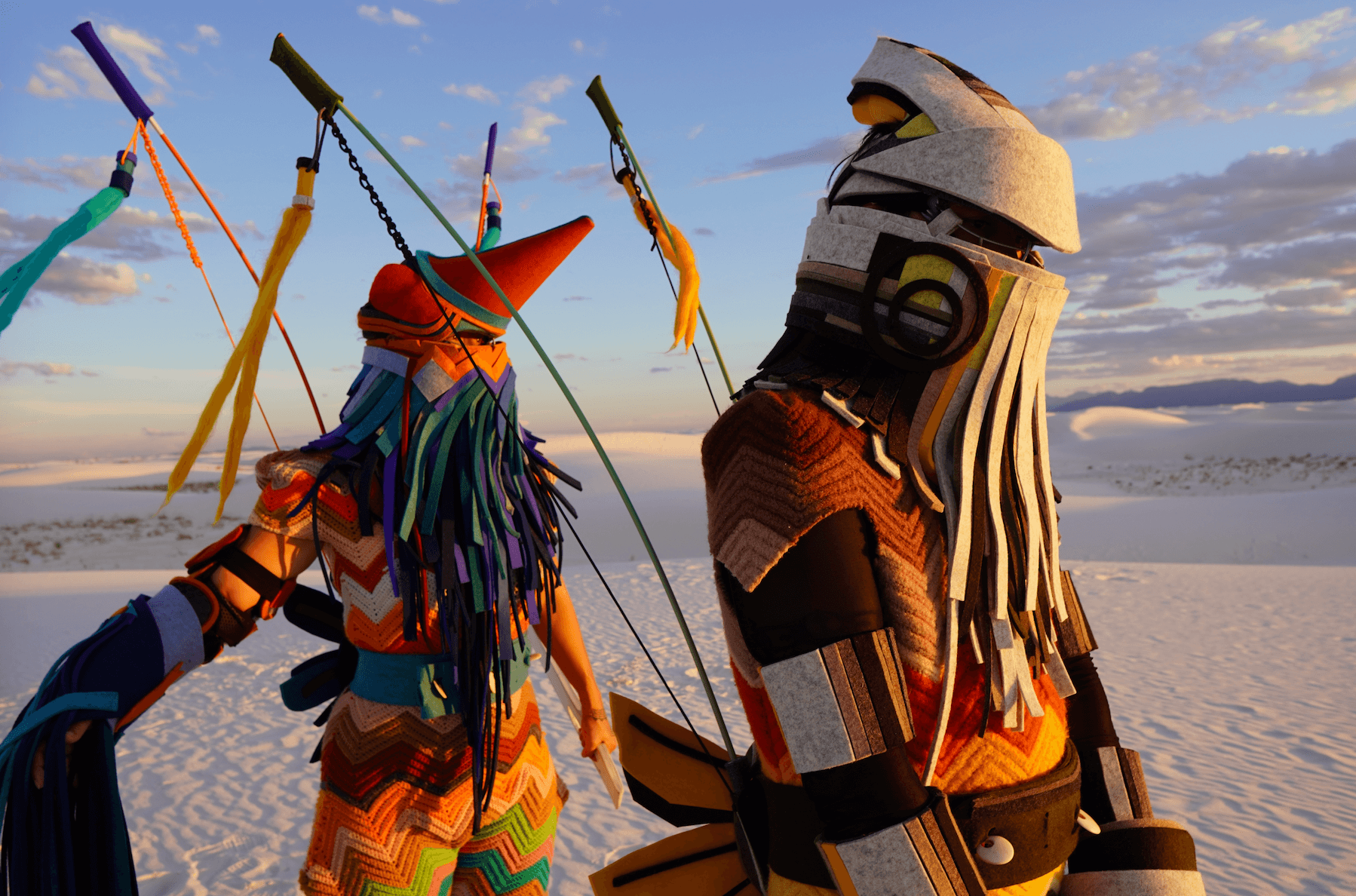
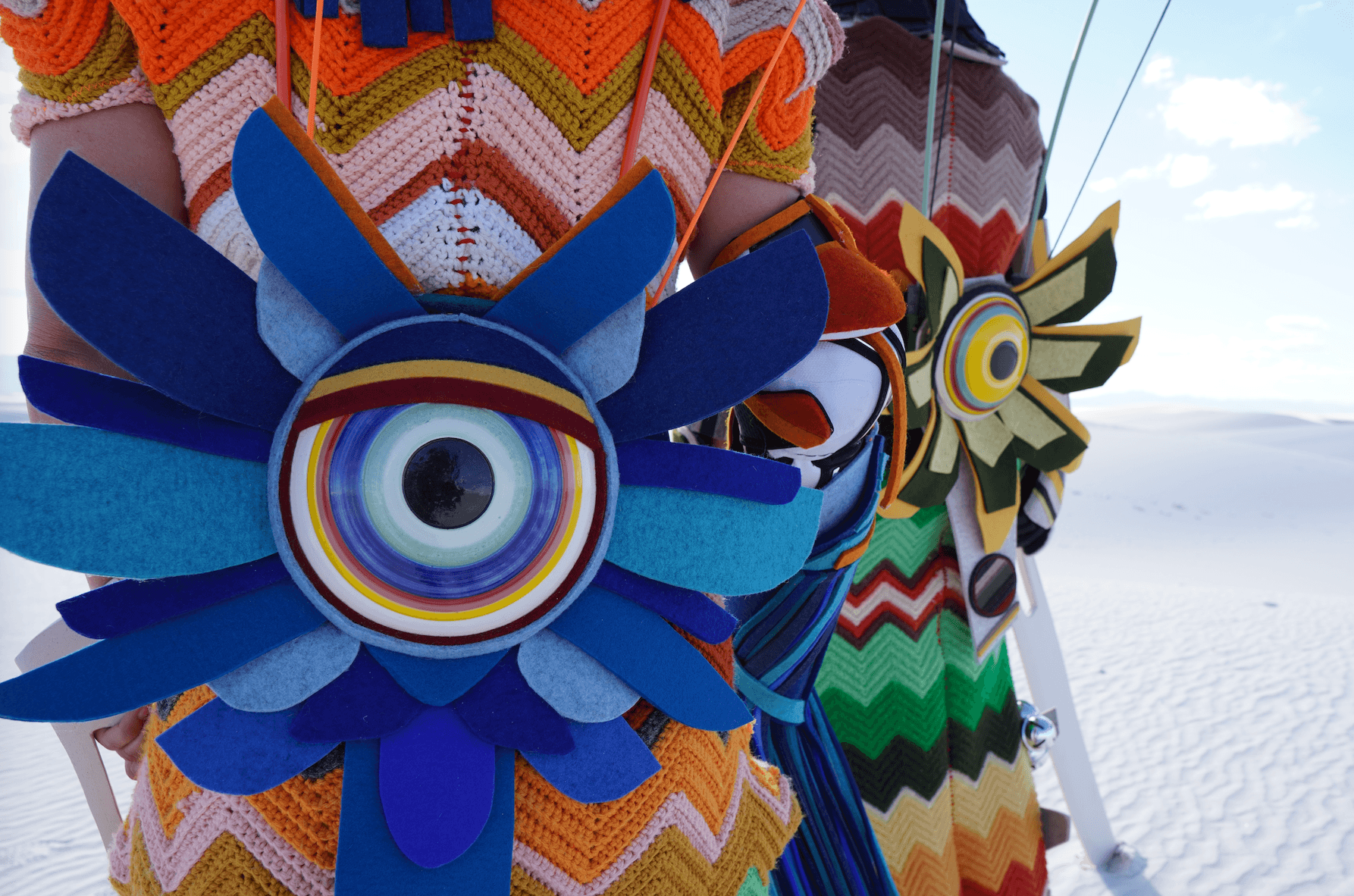
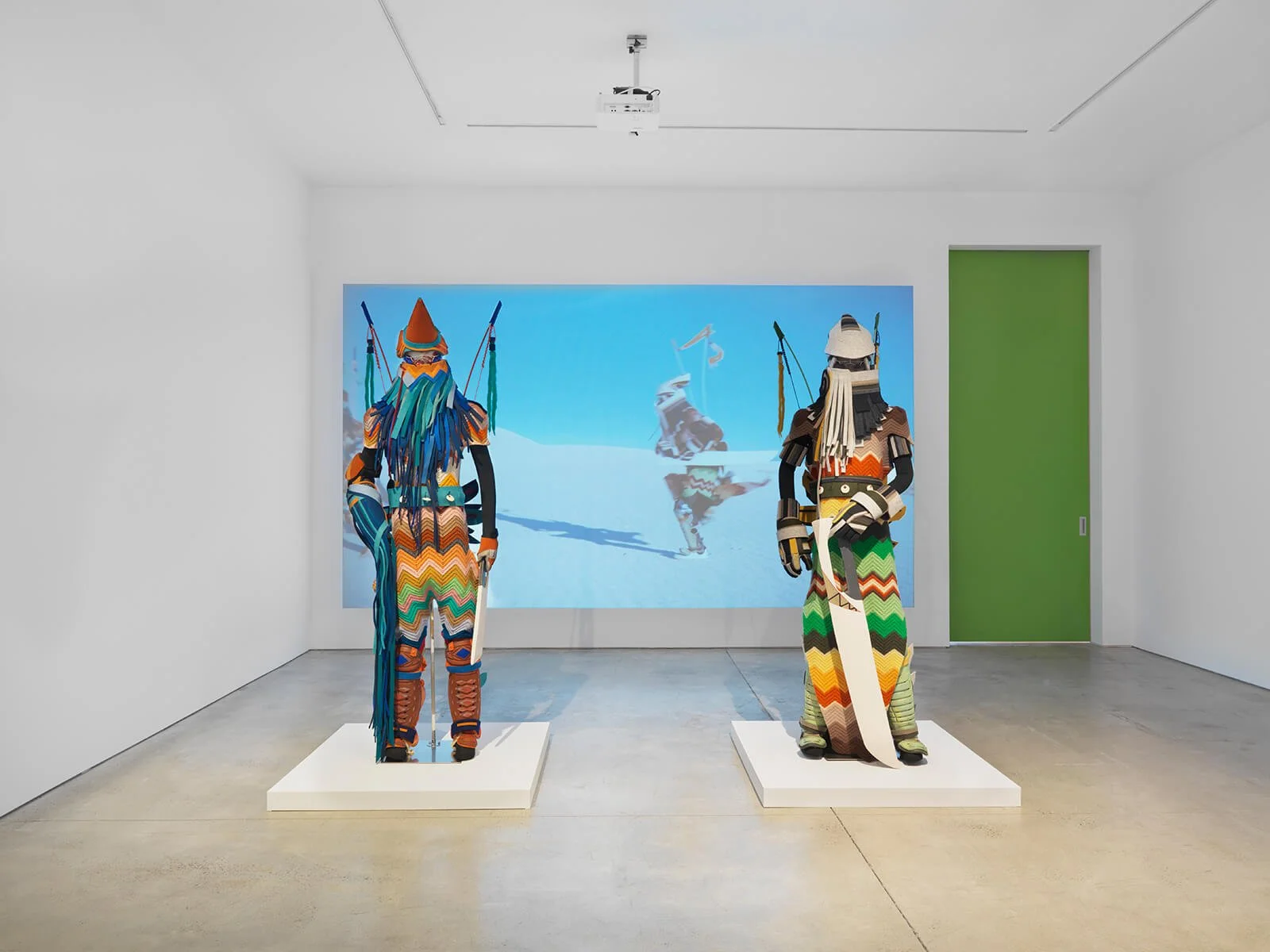
Cannupa Hanska Luger is an award-winning artist and cultural innovator whose expansive creative and philosophical practice introduces new methodologies, ideas, and speculative technologies that reflect Indigenous innovation and shift collective thinking.
Born on the Standing Rock Indian Reservation in North Dakota, Luger is an enrolled member of the Three Affiliated Tribes of Fort Berthold (Mandan, Hidatsa, Arikara) and Lakota. His bold visual storytelling offers new ways of seeing our shared humanity while centering an Indigenous worldview.
With a socially engaged, interdisciplinary practice spanning public art, large-scale installation, ceramic sculpture, performance, time-based media, writing, and land-based actions of repair, Luger’s work blends critical cultural analysis with Indigenous advocacy and deep respect for the diverse materials, landscapes, and communities he engages.
Luger’s work has been exhibited nationally and internationally, including Times Square Arts Midnight Moment (New York, NY), the Sharjah Biennial 16 (Sharjah, United Arab Emirates), the 81st Whitney Biennial at the Whitney Museum of American Art (New York, NY), the 14th Shanghai Biennale at the Power Station of Art (Shanghai, China), the Metropolitan Museum of Art (New York, NY), the Gardiner Museum (Toronto, Canada), Kunsthal KAdE (Amersfoort, Netherlands), the Art Gallery of Alberta (Edmonton, Canada), Crystal Bridges Museum of American Art (Bentonville, AR), and the National Center for Civil and Human Rights (Atlanta, GA), among others.
Luger’s work is held in numerous public collections, including the National Gallery of Art (Washington, DC); the Detroit Institute of Arts (Detroit, MI); the Nordamerika Native Museum (Zürich, Switzerland); the San Francisco Museum of Modern Art (San Francisco, CA); and the Los Angeles County Museum of Art (Los Angeles, CA).
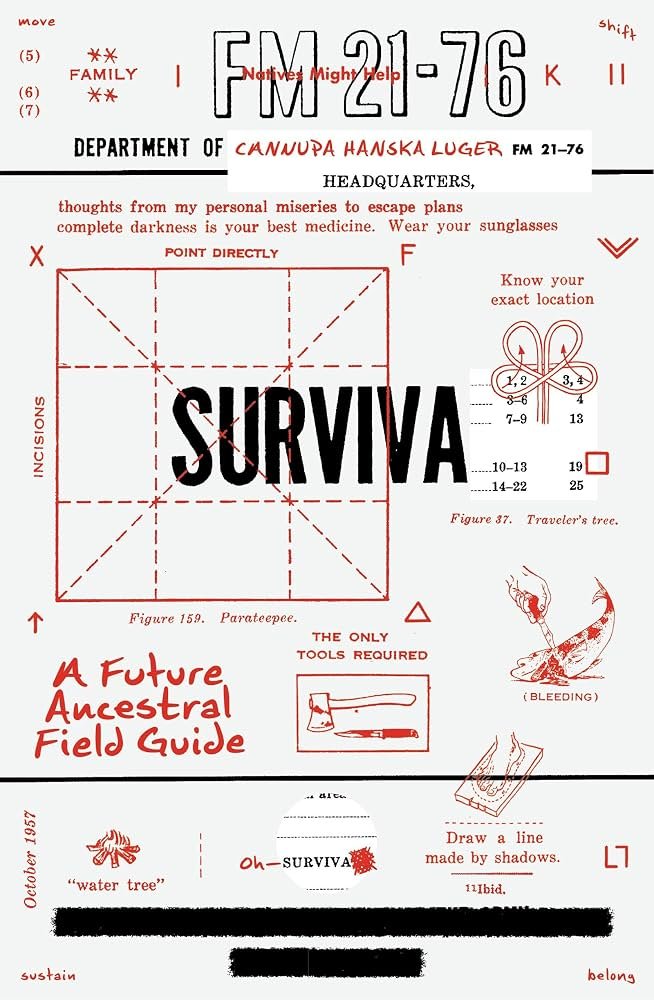
His award-winning book SURVIVA: A Future Ancestral Field Guide is published by Aora Books, an imprint of Ayin Press. Eden Pearlstein is the cofounder of Ayin Press (Cannupa's childhood friend).
Cannupa Hanska Luger: Artist & Storyteller | Interview by Hugh Leeman
A Field Manual, a Father, and a War Lived in Obscurity
Hugh Leeman: Cannupa, you recently published Surviva, a future ancestral field guide. Its existence is inspired by your father, credited in no small part to your partner, and a collaboration with your brother. Tell me the story of your father, and how this book came into existence.
Cannupa Hanska Luger: My dad is a veteran from the Vietnam War, and he carries certain traumas from that experience. I never really learned anything about his time there — just brief little snippets here and there. I once met up with a friend of his from that period in Washington State, and I heard more stories from him than I ever did from my old man. That part of his life lives in an obscure space.
This field manual — a survival field manual that my wife found at an Army surplus store and brought to me — was from the same period and generation as his enlistment. There was something about it. I kept seeing pieces of him somewhere in the original text, in this story of a period of his life that lives in obscurity in my memory in relationship to him. He's a cattle rancher. He lives in Fort Yates, North Dakota, which is where I was born, on the Standing Rock Reservation. Something tremendously traumatic had happened to him that silenced that whole period of his life.
For me, this was a way to engage with the fact that everything I knew about his time in Vietnam existed in the space that he survived it. Not that the survival manual was the credit to his survivance of that experience — but exploring the text, I started from the place of: look, this is everything I know about my dad and Vietnam. He survived it. That was the anchor for engaging with Surviva.
Hugh Leeman: As I understand it, the actual field manual — issued to soldiers during the Vietnam War by the Department of War — was effectively a survival guide cataloging Indigenous knowledge: plants, medicine, how to build shelter behind enemy lines. Then one day your partner Ginger gives you this book as a gift, and instead of writing, you start omitting parts of it so the book tells a new story. Is that a fair contextualization?
Cannupa Hanska Luger: Yeah. The generic, government-issue version of these field manuals — sans serif, Helvetica text, bold black on white paper — I have an affinity for that aesthetic. All the flourish removed, and it just being the book. My wife was in Portland, Oregon — I think it was a Christmas gift — and she went to an Army surplus store and found these field manuals from the 1950s through the 1970s. She found one that said Survival, and the baseness of the aesthetic against the depth of what it was presenting was just ironic. Bold, plain text: this is survival. The other book she got at the same time was titled Booby Traps — that's what it said on the cover. The combination of those two very serious, very direct books, titled Survival and Booby Traps, tickled everything in me that I like about aesthetic and juxtaposition. Ginger nailed it with that gift. I'm not an easy person to buy for.
I opened the survival manual just because I thought it was hilarious, and as I went through it, they don't really credit Native people or Indigenous knowledge at all — except that they suggest you act like the natives in whatever environment you find yourself marooned in, or behind enemy lines. There were so many bits and pieces of traditional ecological knowledge embedded in the plain aesthetic of this book without any acknowledgment of where the source material came from.
That was the point where I thought, I need to mess with this book. It already exists in a place of omission, so the technique I used to peel my story out of the existing text was one of redaction. The classic 1980s "I learned it from watching you, Dad" model of repair — maintaining a story out of the source material.
Indigenous Speculative Fiction and a Community That Can't Afford Your Work
Hugh Leeman: So you had this book for years, sitting with it, wanting to transform it. How did that finally happen?
Cannupa Hanska Luger: I had this book for about ten years, thinking, I want to mess with this book — but I didn't understand how I wanted to transform it, except that I wanted to. This is where my brother from another culture comes into play. He's the editor of the book, the founder of the press we put it out through. Within that ten years he started this publishing company, and he asked me, if you ever want to write a book, let me know. And I thought, oh shit — I have a book I've been sitting on.
Within that same ten years, I developed a part of my practice that's a kind of Indigenous speculative fiction. It's called Future Ancestral Technologies, and it looks at traditional ecological knowledge, cultural maintenance — all these components of the survivance of Indigenous people under the weight of a world radically changing around them. The Indigenous experience presently is one of sci-fi, of literary efforts toward apocalypse. How do you survive apocalypse? We have. So I thought this survival manual could be a great way to address what survival could actually look like.
The manual itself is interested in the survival of the individual. I was interested in the survival of culture. The organism alone is not a complete person — it's the relationships that they have. Culture has always been that part: maintaining the taboos and protocols of place.
When my brother Eden reached out — I've known him since seventh grade, we're family at this point — I realized I could use this book to address another problem I was experiencing. With success, my audience grows, but my community remains the same. The people I'm most bound to, the people I want to speak for and with — that remained the same. But my audience was growing, and the value of my work was increasing, and suddenly my community couldn't afford the work I was creating. They don't get pieces of Future Ancestral Technologies.
So what I decided to do with Surviva was imagine that I'm a person in a future place who happened to find this survival guide. I removed everything obsolete from the narrative by reduction — blocking out entire pages of text — and then wrote over the top of those blacked-out pages, or illustrated on top of them. Where the sci-fi comes in is that the author is pretending to be in a future space, so that the object of Surviva becomes the ethos in which Future Ancestral Technologies is developed: how to maintain culture into the future, and retain what's valuable from the past — the plant medicines, the traditional ecological knowledge, building shelter, all these basic things — entangled with the importance of maintaining a relationship to place, people, and environment. That relationship is equally as important for survival as food, water, and shelter.
The book became a book-shaped art object, part of Future Ancestral Technologies, that was accessible. How do I use the systems of today to mass-produce something accessible to my community? It has illustrations from various regalia pieces I've built and films I've worked on. So it becomes an artifact from the future. Within that ten years my career expanded, and this became the catalog of that imagined future space.
Sending the Book to a Cowboy
Hugh Leeman: You've said your father remains largely outside the art world, and the book is connected to experiences and traumas he rarely discusses. What did your first conversation with your dad about the completed book reveal?
Cannupa Hanska Luger: I had it just this summer. I literally just sent him the book — I don't even know if he's got it yet. One of my sisters had told him I'd written this book and that it got an award. But he's a cowboy. None of the art world stuff has any significance in his life. Knowing what's happening in New York or LA or San Francisco — feed the cows. That's his basic necessity. What do I gotta do today? Cut hay, feed cows, fix fence.
So our first conversation about it happened this summer, and it was brief. Mostly it was, can I see the book? And I thought, shoot, I should have brought one. So I sent him one. I don't know what his experience will be looking through it. It would have been great to be there, but I actually think allowing him to move through it without anybody watching is probably the most genuine way he'll experience it. So we'll see what he thinks.
Make-Believe Older Than His Teeth
Hugh Leeman: You've spoken about experiencing imposter syndrome when your first book received recognition at the PEN Awards, while your brother reminded you that you'd invested as much labor as any other writer there. How has that changed the way you understand yourself in relation to the identities of artist, writer, editor, storyteller?
Cannupa Hanska Luger: I've always had a hard time categorizing what I do. I know I work in the world of art and art-making, but honestly — I make believe. I make-believe as a career. I've been doing that since before I could walk. Me making believe is older than my teeth.
So on one hand, the imposter syndrome kicks in, because what I've been doing, I've been doing innately since I was an infant. Simultaneously, that's 45 years of practice. There was a period where I didn't want to be called artist — I thought of myself as a social engineer. There are also components of my practice embedded in cultural maintenance, which is a primary part of Indigenous art-making. The aesthetics were developed through applied practice over generations. That's true for any artist, any craftsperson — we're all part of a continuum, building off previous ideas and pushing them to the edge.
Maybe that's where craft and art delineate. Art allows the craft to fall apart by pushing the boundaries of what's possible. I have a lot of craft in my practice — knowing what works and doing it over and over hones the muscle memory, the ability to communicate it, to teach it to the next generation. But art-making takes all those lessons from craft and asks: this is how everybody does it — how can I push it to the edge in a way nobody else has? Failure is 70% of the outcome of that effort. But the 30% success is what sparks awe and inquiry in the audience.
His Mother's Career as a Field Manual
Hugh Leeman: You spent school years moving with your mother as she pursued her own artistic career, and summers on the Standing Rock ranch with your father. How did moving between those two worlds shape your ideas about artistic labor, economic risk, and what it means to be home?
Cannupa Hanska Luger: In all honesty, while there's a recognition that my father went to Vietnam with this same field manual, Surviva is probably inspired more by how I grew up with my mom. My mom, as an artist, moved the possibility of choosing an artistic career into the realm of the possible. Without that influence, I don't think there's a chance I would have chosen this career.
We traveled and moved around, ended up in the Southwest, where there was an art market for Native artists — my mother being a Native artist. Then we ended up in Phoenix, Arizona. She was raising five kids alone. We actually didn't get as much support from my dad as I'd have wanted — later in life I'm like, you could have done better — thinking about the difficulty of a single mother raising five kids on an art career. But she did it.
In the world of me writing a book about survival — that was more proof than anything my old man taught me. A mother feeding, clothing, and sheltering her kids with an art career. By the time I chose art as a profession, I thought, I've got a lot of things going for me that my mom didn't. Number one, I'm a man. Number two, I don't have five children. Number three, I'm in a stable, healthy relationship with my partner. If my mom could do it, it's not possible for me not to be able to.
Some of the lessons of watching her career move — there were instances where, because of her effort, I could choose the opposite. It gave me a guideline. If you want to talk about a field manual, my mom's career coming up in this world was a field manual for me to survive the art world, to navigate spaces — because I knew what was down certain paths. So oftentimes I chose the unknown. What happens if I zag instead of zig here?
Hugh Leeman: Tell me about your mom's art. What was she making?
Cannupa Hanska Luger: My mom was just creative. She had a background in painting — she still paints to this day — but what gave her a leg up and made her name was stone sculpture. Because there were few female stone sculptors, she had a niche, even with the difficulty of a masculine art practice. She still painted, but she's pretty agnostic when it comes to materials, and I definitely learned that versatility from her.
Her career as a field manual for me was really around versatility — being able to work in a number of mediums. She picked up jewelry because it was a bread-and-butter practice; she could put food on the table with some jewelry sales. She got into fashion for a minute. She got into using recycled materials — collecting aluminum cans, processing them, building sculptures out of pieces of aluminum cans.
It's funny, I never really thought about her career as a field manual for my life until we started talking about it right now. Her influence on my practice, even though our aesthetics are vastly different, falls in the capacity to do what it takes to survive. Even a lot of Future Ancestral Technologies as an ethos is about building a society and maintaining culture using the byproducts of our present. Thinking about those aluminum can sculptures she made, I can see the direct influence — just because somebody calls it waste doesn't mean it's garbage. If you can imagine an application outside of the material itself, then what's actually being presented is craft, practice, imagination — as the primary value, rather than the material.
A Relationship Isn't a Thing — It's a Process
Hugh Leeman: How does your relationship with your mother differ, in the way she experienced Surviva?
Cannupa Hanska Luger: I have five siblings, and I'm the only one who went the direction of art. My mom is proud, pays attention, reaches out. We have a relationship where we regularly check in. So she was there and present through the whole process, because she was checking in — how you doing, what are you up to? She's also in the world I'm in, in the same way I'm in it: as a generator of ideas, forms, images, shapes in space. She relates to the ironies and absurdities of the art world firsthand, rather than stepping out of her normal space. So talking with her about it didn't feel like anything but Tuesday. Just us talking about what I'm up to, because she's interested, because she's my mom.
That relationship with my dad, even though we spent summers with him, is primarily an employee-employer relationship on the ranch. He's dad, but he's also boss. As a kid, my desire for his approval wasn't about what I did in my life, but how I finished the job at hand — chasing cows, fixing fence, baling hay. The approval reward I've grown to expect from him is just: how'd today go? I don't seek approval from him outside of that. He'd probably be more involved if I were more involved, sharing what I'm up to, searching for that paternal validation. But I've learned not to expect that, and to just appreciate him in the moments I hang out with him, rather than live in a place of expectation for him to do something I don't think he ever would.
Hugh Leeman: You're a father now. You've described the boundaries among family, studio, and public practice as extremely porous — Ginger helping direct the studio, your children participating in performances and wearing regalia you design. How has parenthood changed the way you approach collaboration, validation, and the long-term connection of making art?
Cannupa Hanska Luger: Me and Ginger — my wife, mother of my children, studio director — she was raised by her dad, and I was raised by my mom. So even the gender-role responsibilities in the household are blurry. She sits stronger in the position of disciplinarian, but I do not get to be mom. I've got that dad energy.
What I've learned in the years up until today — and it can change — is that a relationship isn't a thing. It's a process. That's also true with kids. Right now my kids are 12 and 14, going through biological changes affecting their psychology. Puberty is powerful. Navigating that, being nimble enough to adapt to those changes, is the valuable understanding: a relationship isn't a thing. It's constantly in flux. And because my art practice involves all of us, it's like that too.
I'm making sculptures right now that look completely different from the last body of work. I wrote a book, worked on theatrical productions, played music. The variables go back to this idea of versatility — the capacity to adapt to radical change without falling apart. As a father, I'm applying that to raising a couple of boys: sit in this place of adapting to change. They'll have their own therapist to talk to in the future, I'm sure, but right now it feels like I'm doing a good job.
Hugh Leeman: They're going to make their own survival book one day.
Cannupa Hanska Luger: Yeah, exactly.
The Countdown That Started in 1975
Hugh Leeman: You mentioned a Future Ancestral Technologies entry log documented on the Mandan, Hidatsa, and Arikara Nation — your ancestral homeland. In the video, I hear your grandfather's voice as narrator, saying: "The countdown has already started to a crisis that will occur in the very near future, and that will affect your very survival. By knowing about it, you can do something about it." What is the crisis that is coming, and what should we do about it?
Cannupa Hanska Luger: What's amazing is that transcript comes from a recording made in the 1970s. That's when he orated that statement. My grandfather was an orator — a brilliant, brilliant, self-taught guy across all these disciplines. We just brought home a big chunk of his library. Ginger and I are trying to stabilize the family archive. His books are so funny — they range from 23 Boats You Can Build at Home to 99 Things You Can Do With an Oscilloscope. The first radio I ever had, he built — leather and plywood with circuit boards.
He was on Tribal Council, part of the governing bodies of the three affiliated tribes — Mandan, Hidatsa, and Arikara. He went on trips to Washington, D.C. to lobby for our tribe. Our tribe was flooded back in the late '40s, early '50s, to build a dam on the Missouri River. It flooded about 42% of our reservation. Entire towns had to be moved. The house I'm salvaging and trying to stabilize the library from was put on trucks around 1947, '48, and hauled out of a town called Elbowoods to where it presently is.
He tried to lobby to protect our community and our lands, and it didn't work. Eminent domain was too powerful. The government making our tribe reliant on it was too powerful. He'd gone to Washington — pomaded hair, a suit — to the places of governance to lobby. None of it worked. And what he found was that the most important thing he could do was go back to the land and try to rebuild our cultural practices after the dam tore our community apart.
Elbowoods was the town that was flooded, and it was the cultural center for the three affiliated tribes. All our systems of self-governance held place there. After it flooded, families got dispersed on either side of the river, or put into the Relocation Act, which relocated Native families to urban centers. That broke up our clan systems, so many things we'd held onto. So my grandfather went back to the land and tried to reestablish those culturally significant models of self-governance.
In the process, he became an orator, always asked to talk at events, at these different doings. That recording comes from a powwow around 1975. You have to consider — at this time, the American Indian Movement is happening, civil rights movements are happening. The change he was talking about was self-determination of tribal communities — recognizing that the traumas we were inflicting on each other were imposed by an external government, and that we needed to be self-determined. He also worked in the education system: we might not be able to teach the parents or grandparents, because they may be stuck in their ways, but if we can seed these ideas into the youth, something else can change.
My use of his story was — it's 2026, and I'm having the same conversation in different ways that he was presenting before I was born. It was a way to acknowledge the blurriness of time, time being non-linear. Transcribing that recording was a way to present the permeability of time. It also comes from this family practice of maintaining the archive — we've been digitizing cassette tapes. We recorded everything on cassette: talks with his friends around the kitchen table, powwows, events, little interviews, philosophical stuff. This one felt significant because of its relationship to Future Ancestral Technologies and the idea of change being constant.
New Myth: Who Are the Monsters?
Hugh Leeman: There's a project you did, New Myth, that parallels your grandfather's oration. You write: "Monster slayers found in every culture set out and sacrificed their life for the continuation of existence. Today, we are once again plagued by monsters. It's time to be the human beings. Each of us must be aware of what we can do, and the place that we stand, so that a far future that remembers this era of monsters can sing the songs and dance the stories of our ability to come together and become monster slayers." Who are the monsters that plague us today, and how do we become monster slayers?
Cannupa Hanska Luger: What's funny is that New Myth is actually a really old myth I was just re-presenting. Mandan stories have twin monster slayers. Down here in the Southwest, the Diné also have twin monster slayers. I have a Kiowa buddy, and they have a story of a singular monster slayer split in two who became two. This reoccurring archetype of pluralistic or dualistic effort was interesting to me.
In our stories, the monsters had a certain aesthetic and certain powers, but those felt archetypal. There was one called the Devourer. One called Flame Around His Ankles, or fire moccasins. One that was a giant beaver that wiped out entire forests with the swing of its tail. There was an ogre-ish woman with a basket that, if you looked into it, would draw you in.
I told these creation stories to my kids, and I started seeing the parallels between what we described back then and what's relevant today. Generating that story anew is an opportunity for people to consider: who's your monster? What does it look like? The beaver is extractive industries. The ogre with the basket — that's media. Come look at the basket, get drawn in. The Devourer is corporate greed, consumerism — us as participants. Flame Around His Ankles would run around communities creating fires, not to burn people but to generate panic — and that feels like our current policing models, driving uncertainty and concern.
I see these monsters in our present society, and I see that it's us giving them power. So slaying monsters isn't like the myths, with Perseus and a mirrored shield going against Medusa. It's simpler than that. It's: what do you choose in your life? How do the choices you make feed the monstrous? And can we, as a society, imagine or choose alternatives?
My concern is that we don't pay attention to myth and storytelling the way we used to, where it was a guide to learn from — a field manual on what can be done or what should be avoided. We've deemed myths as simply pretend. And in being just a pretend story, they lose the power of what's actually true embedded in them. The truth embedded in a myth is a far better place to store important knowledge than any server farm we could build today. A good story holds information for generations. We don't have a storage unit like that, other than our biology. So presenting New Myth was a way to acknowledge the importance of old myths, and to put in motion a way to value that as source knowledge rather than just a story.
Hugh Leeman: Cannupa, thank you so much for sharing these ideas — about myth, family, and your projects. It's beautiful to hear and learn from you.
Cannupa Hanska Luger: Thank you. I enjoyed it.
