

Philip Guston Estate, Life With P., Philip Guston: Paintings and Drawings 1964 – 1978, Hauser & Wirth
Life with P. continues Hauser & Wirth’s significant collaboration with the Philip Guston Estate and the artist’s daughter, Musa Mayer, on archival publishing projects relating to her and her parents, connected with fresh exhibitions of her father’s work. Walking through the New York show on 18th Street, Guston’s Two Hearts (1978) was hands down the standout work. I couldn’t ever recall previously seeing even an image of it (neither had John Yau in his Hyperallergic review).
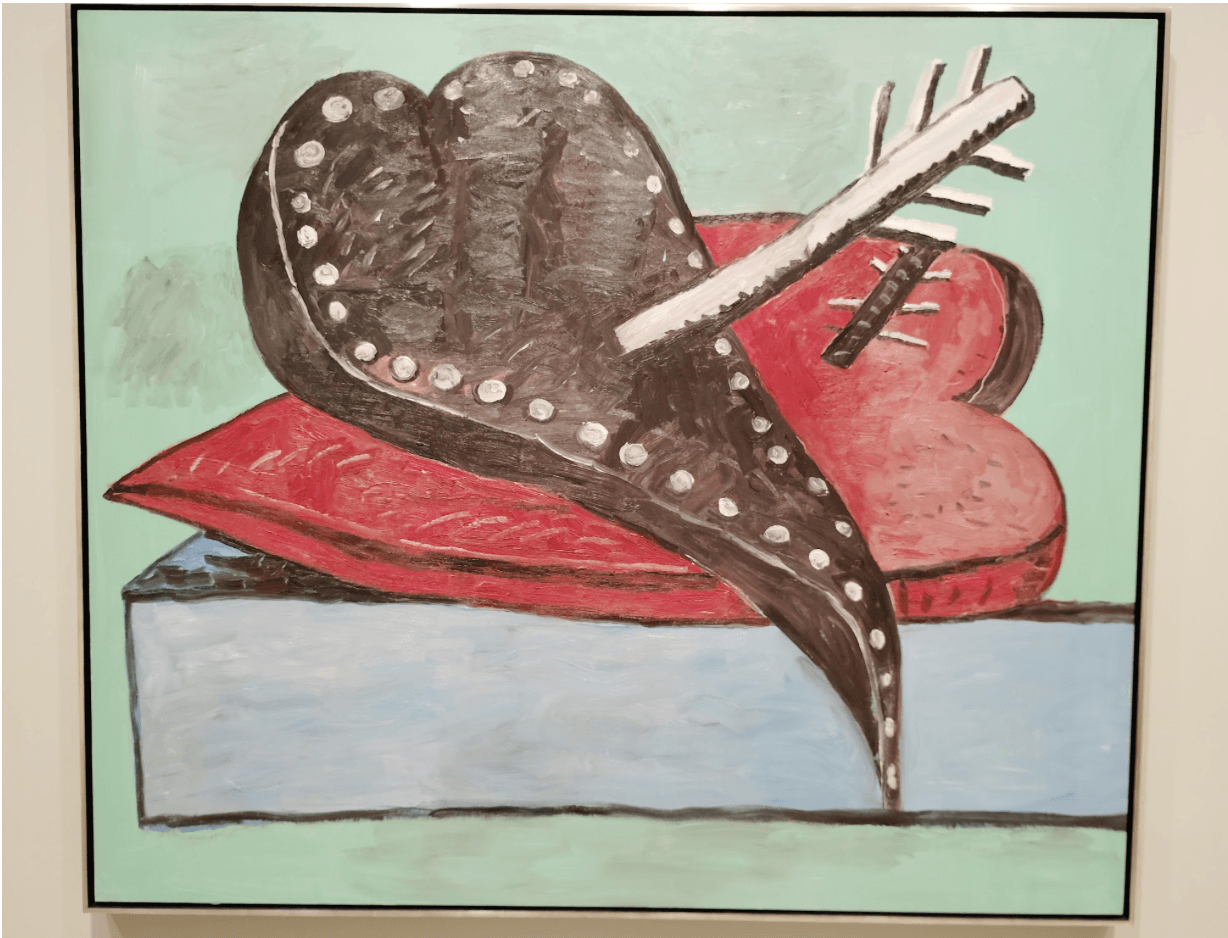
Philip Guston, Two Hearts, 1978
On an unusual (for Guston) colored light, greyed out teal background, a large red heart has a smaller black shriven heart slumped atop it with crudely drawn Guston arrow(s) piercing through them. There are nails(?) or studs , nearly rhinestone rivets in appearance, all round the top edges of the black heart, almost as if it is a beat up case, like an old gypsy guitar player might use, banging round from town to town. Which is apropos for the accompanying publication, a gathering of Guston’s wife Musa née McKim’s personal journals from 1966 to 1976, a great majority of which cover periods of travel including Mexico and Italy/Greece as artist in residence at the American Academy in Rome, time spent at artist residencies and visiting artist lectures, all alongside semi-isolation with their self-removal from the city to their rural Woodstock home, marked with intense periods of nonstop work, Guston in his newly built art studio and Musa in her own writing room.
These years were pivotal in the Gustons’ personal relationship. Musa’s journals open amidst the singular occasion when Philip separated from her for a brief period after falling in love with a younger photographer he had met, and close as Musa begins to slide into ill health due to atrial fibrillation followed by a stroke in 1977. These years also cover Guston’s final shift in his work; moving back towards the figurative from the Abstract Expressionist period in which he had firmly solidified his place in the New York painters’ hierarchy. This artistic move caused no small controversy, his show of new work at the Marlborough Gallery in October 1970 was met with broad derision from friends and critics alike.
Guston shifted back to the figurative by paring down to the barest of essentials: the singular line, or mark, in black crudely yet implicitly put down on white. From there he extended out to adding further marks towards possible identifiable forms. A set of four works in the show demonstrate his process: a pair of clouds or eyebrows perhaps; an extended arch ending with what might be a foot firmly placed; a half circle of what might be a sunrise or sunset; a partial box or floorplan divided by a line with another partial mark extending down into one section.
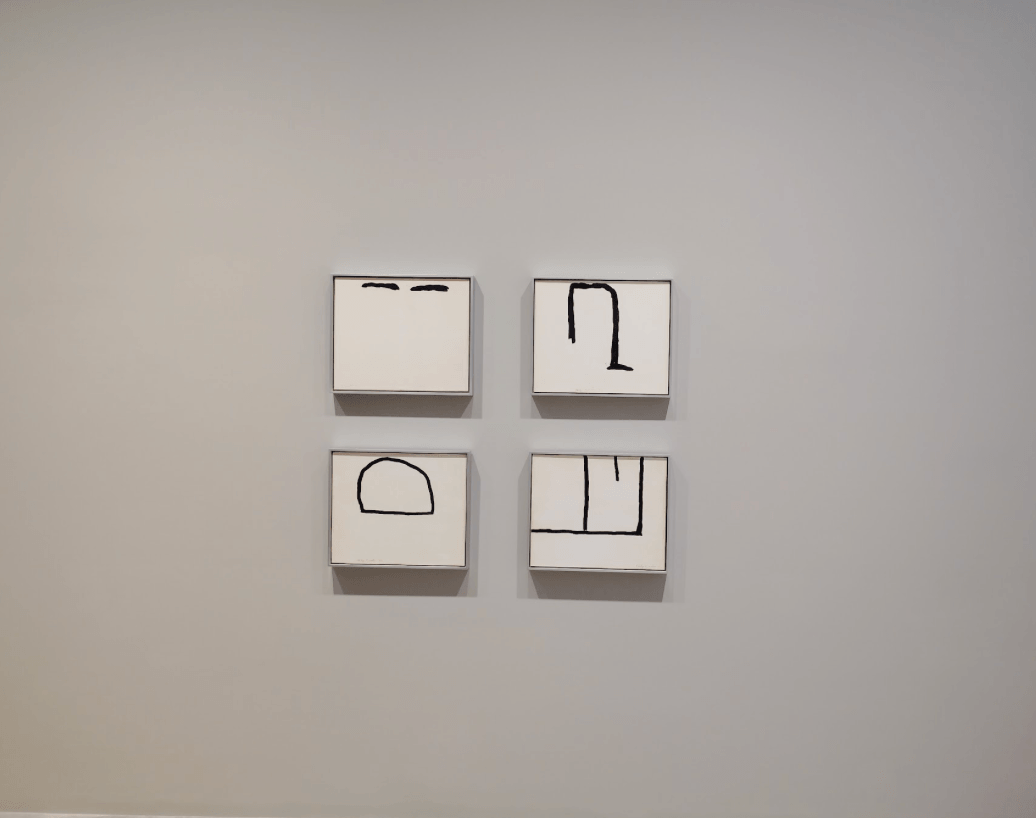
From these minimal, stripped-down-to-basics, gestural forms, Guston began painting the world of larger forms. Buildings, cars, various bric-a-brac of a life lived began making regular appearances.
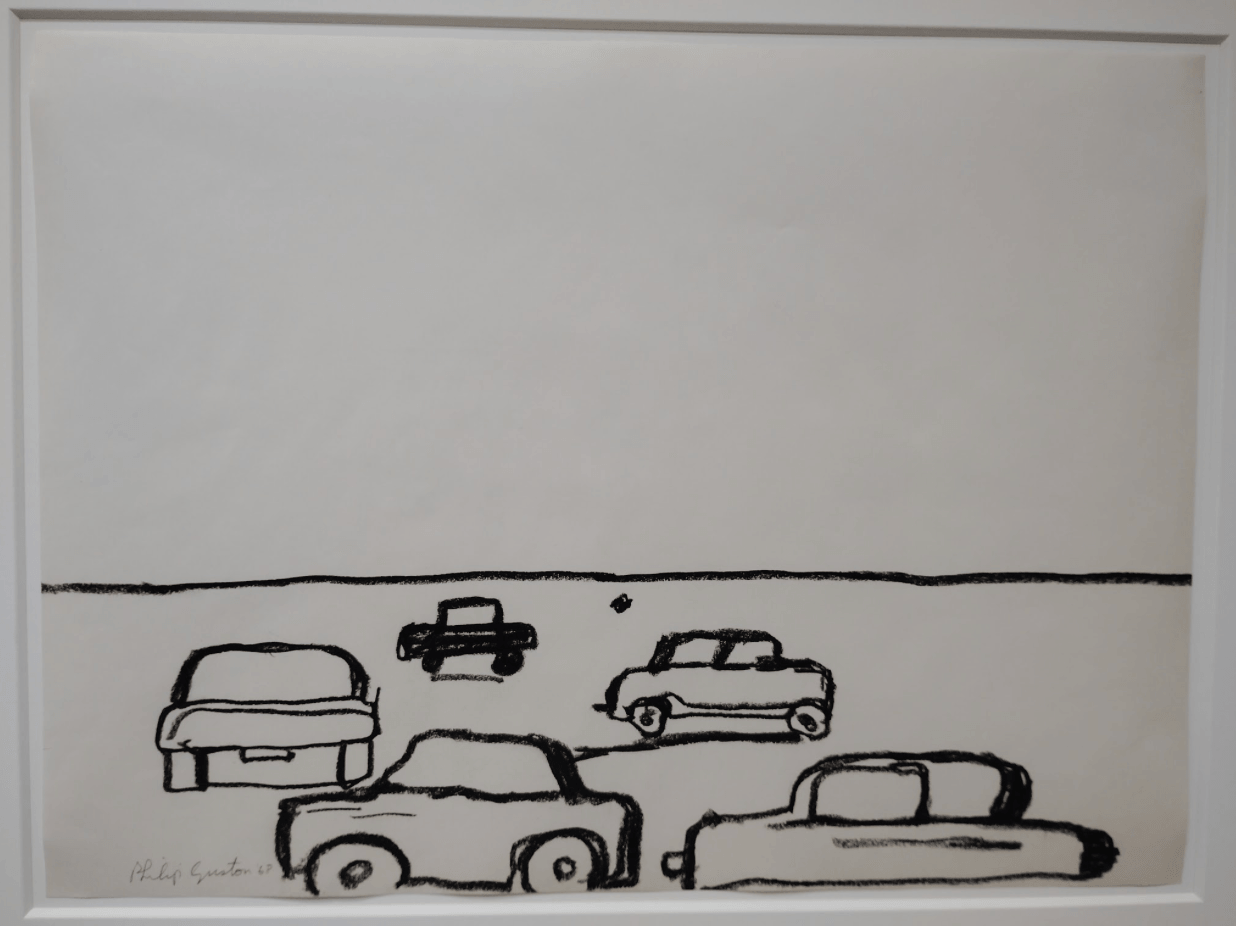
Philip Guston, Untitled, 1968
Within a short time, the now infamous “hoods” appeared, easily, (perhaps too easily, reminiscent of the Klu Klux Klan, which during the most recent Guston retrospective led to much, far too much, controversy. Not surprisingly, the Hauser & Wirth show had no paintings of hoods up. They do, however, receive mention by Musa: “a most strange denouement, where the cone people—the little bastards, as P. calls them—turn out to be the painter. There he is, in a hood, painting one of the little bastards.” (June 1, 1969). Alluding to one of the works where the painter himself appears under the hood painting a “self-portrait” of himself at work. Guston explained that placing himself under the hood was his way of acknowledging nobody’s free of responsibility for the horrors of the world. We’re all “little bastards” running about our business.
Reading Musa’s journals the hoods are rather clearly minor characters in Guston’s overall endeavor during this final shift in his work. What I’ve always found far more compelling are the onslaught of abundant everyday forms in endless accumulation. Things literally just pile up: bricks, blocks of wood, legs, shoe soles (sometimes attached to legs), nails, pipes, buildings, etc.
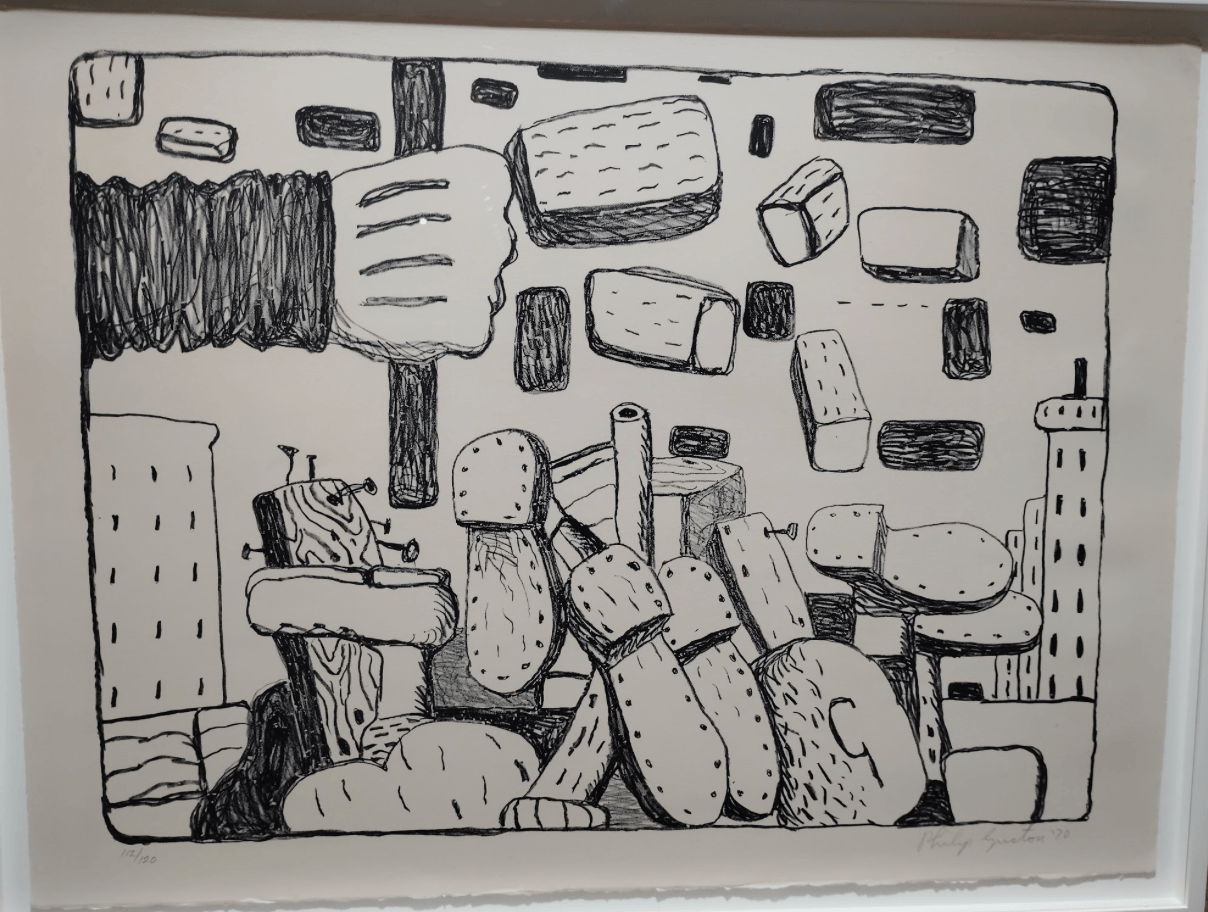
Philip Guston, The Street, 1970
Reading Musa’s entries on plants with her ponderous observations, provides some inkling of how she and Guston jointly encountered things in the world. “The first tiger lily. What a gorgeous display. Here’s when you wish you knew the names of the parts that curl back, that stick out, that are hinged.” (Tuesday, July 29, 1969). She may be writing about a plant yet how frequently in Guston’s painting appear a preponderance of things which "curl back, stick out, that are hinged.” It’s as if she’s writing a catalog essay for one of his shows. Musa herself was an artist as well. Reproductions of her artworks are scattered throughout Life with P., including the dual WPA murals the couple completed at the United States Forest Service (Forestry Building) in Laconia, New Hampshire in 1941—her accounting of a visit they took to view them some thirty years later also appears here.
With the foundations of their relationship grounded in art, the Gustons clearly shared in keen-eyed observation of their surroundings. In February 1971, traveling by bus on the western coast of Sicily, Musa records:
“Blond rows, potato fields, going right down to the sea. Ocean close, wall of cactus, sun in the middle of a cloud—P, says like a fuzzy egg. Stopping half an hour or more in Gela. We buy formaggio e panini. The sea at the end of every street. We find a patch of sun to stand in. […] Great fruit stands, fish, chunks of marble, cactus, two centuries to build such hedges, going everywhere. Nothing could equal this—farms on top of the world, cattle, industry, but beautiful structures.”
A record of visual stimulus that aligns with the frequently-produced jumbled cityscapes that Guston would create, makes for a decorative framing for a poem written by Musa during the same trip to Italy. This is seen in one of Guston’s poem-pictures (as they have been called); a collection of works executed by Guston for a range of poet friends such as Clark Coolidge and Bill Berkson.
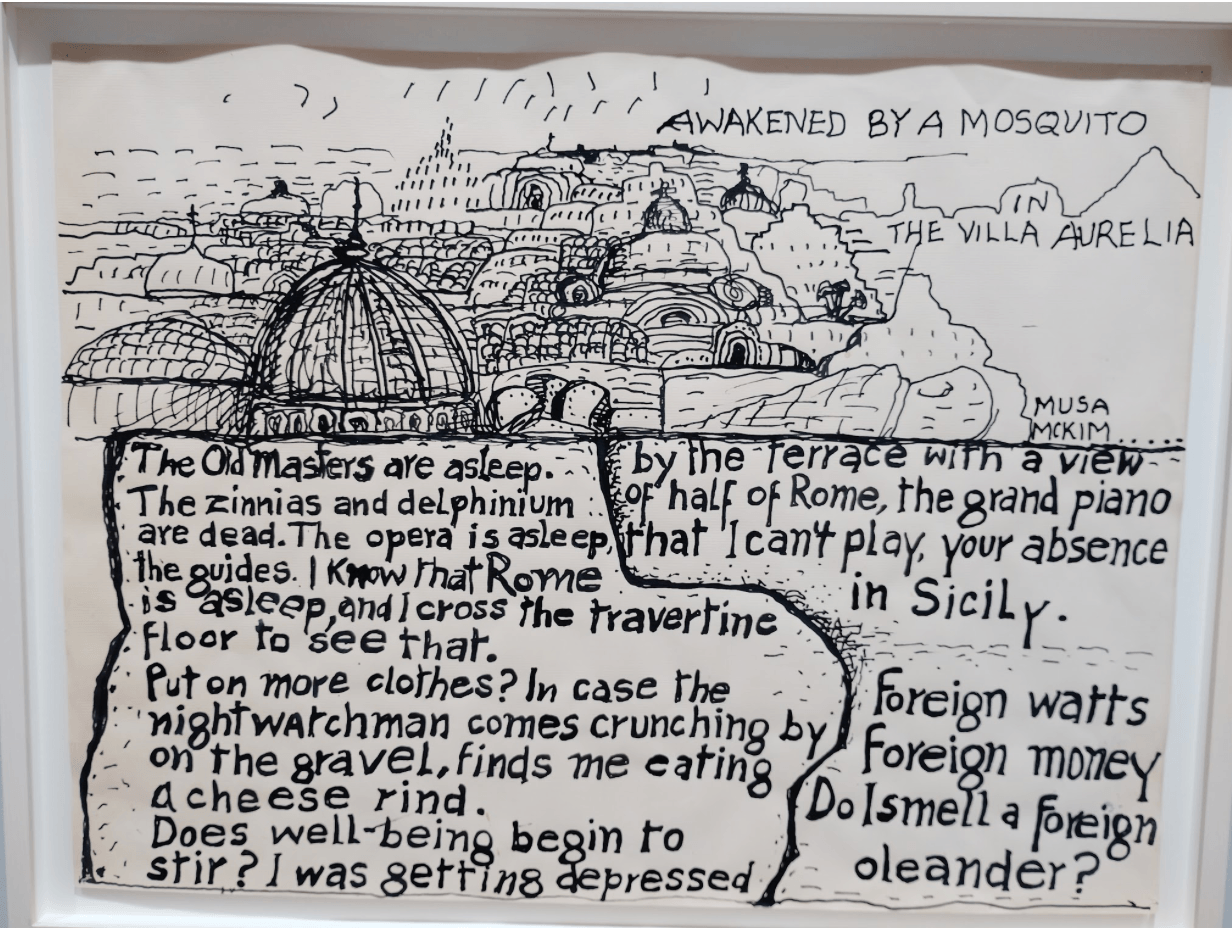
Philip Guston, illustration of Musa's poem “Awakened by a Mosquito” ca. 1972-75
Musa’s journals deliver intimate, often humorous insight into Guston’s own peculiar quirks. For instance, his definite penchant for opposing physical exercise:
“We cut the grass yesterday—at last. It took a minor crisis to get P. into shape for it, and then he flared up a few times at first—at minor-nothing-incidents—then leveled off. Afterwards—getting dripping hot and taking a shower—he felt invigorated. Said something about seeing the value of exercise. He’ll dream about being in that state but doesn’t have the heart for the routine. In fact, he distrusts it.” (Friday, September 10, 1971)
Despite any “distrust” of a regular exercise routine, Musa makes numerous mentions of how Guston was unfazed by all-night marathon painting sessions out in his freshly constructed Woodstock studio. Despite her concern for the extremes he pushed himself to, he obviously was driven by the intensity of the demands these sessions placed upon him, and was satisfied by their results.
“P. painted until I don’t know what time, going out there after dinner. Then got up about 5a.m. and went out again. He came in about 8a.m. with that sort of foolish expression he has when a painting is finished, looks at his hands as if at an accomplice, gets some coffee. I say, ‘sit down.’ He sits down. His eyes are bloodshot and red-rimmed. He starts to comment on what he has just been through or on the nature of creation in general but stops, evidently feeling no need to explain—or even comment on anything—yet needing to babble a little. He says, ‘Let’s go out on 28 for breakfast.’ I’ve had my breakfast but that isn’t it: ‘You need to go to sleep.’ I feel if I get out of the way, he will think of getting under the covers himself. If I stay here, he will only ramble and babble—very slowly, and with looks into his inward territory, with his red-rimmed eyes, he won’t move—like going to bed. So I come in here and close my door. To get the good out of the best part of the day. I hear him not going to bed but going out the door. And pretty soon I hear him starting up the car. So he’s gone off for breakfast.” (Wednesday, February 23, 1972)
After a few years of these on and off intense nonstop work sessions, Musa does report at least one period of time where they seemed to reach a state of manageable agreement, balancing their time as well as giving each other space.
“We have devised a great scheme of ‘being away’—staying right here, but with phone off, etc., and each working any hour, leaving the other alone, although generally eating dinner together. Except on the first day of P. being on a new picture. I ate first tonight about 7:30p.m. P. came in for a drink, went back. Came back for a second drink and dinner. […] It’s a great system. P. takes a break doing something; I go out and get booze, milk, eggs, etc.” (Wednesday, June 16, 1976)
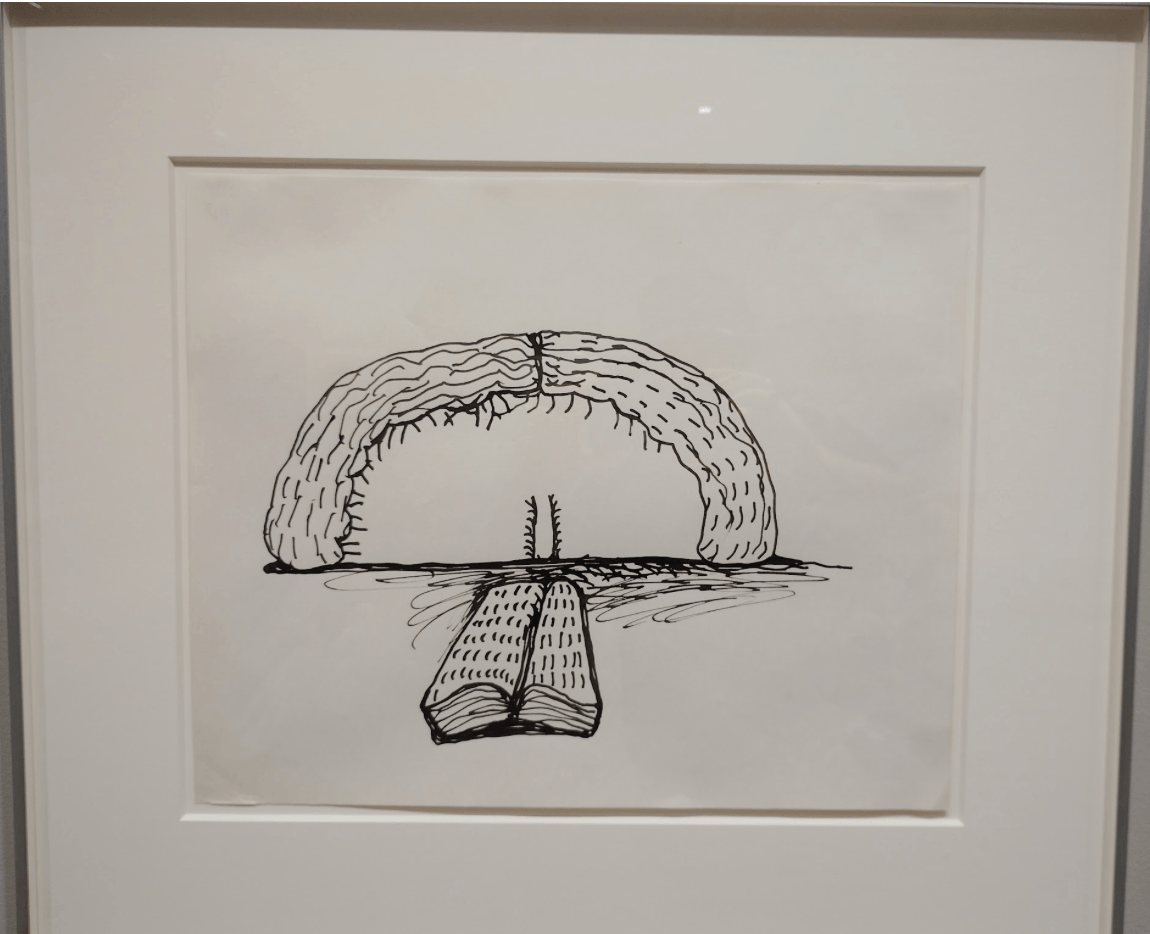
Philip Guston, Untitled, c. 1975
Musa remained constantly needed as both companion and muse for Guston. He had painted both her and their daughter (also Musa) in early works, yet she ever-increasingly appears in the later works, represented by her looming forehead with parted hair hovering over the work as both subject and onlooker. As her journals prove, they were endeared to each other throughout these closing years of their relationship.